
Jun 8
今週の #週刊Clojure は #clojurescript と Claude Code で初めての #個人開発 アプリリリースの話です。Claude Code で説明動画まで作れたの、本当すごいと思いました。
zenn.dev/shinseitaro/article…
1
4
284

May 27
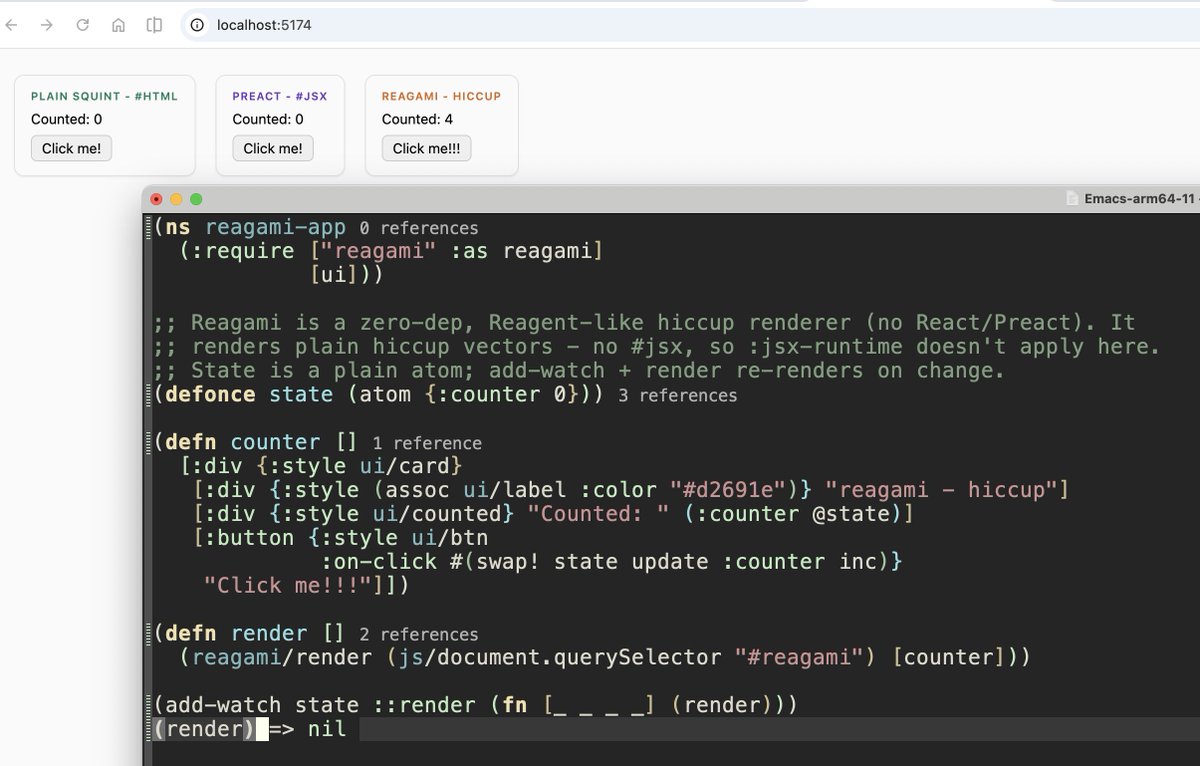
Finally squint has browser nREPL support in the latest release!
github.com/squint-cljs/squin…
#squintcljs #clojure #clojurescript
15
864
May 21
1
9
574


Spatial Informatics Group is searching for: Full Stack Software Developer - Pyrecast #RemoteWork 🇺🇸 ClojureJobboard.com/clojure-… #remote #clojure #clojurescript
2
97

May 12
assuming ClojureScript gets a reset, drops Closure compiler and plays nice with modern JS/TS ecosystem
2
4
203

async function was promised to clojurescript 3000 years ago
2
22

May 7
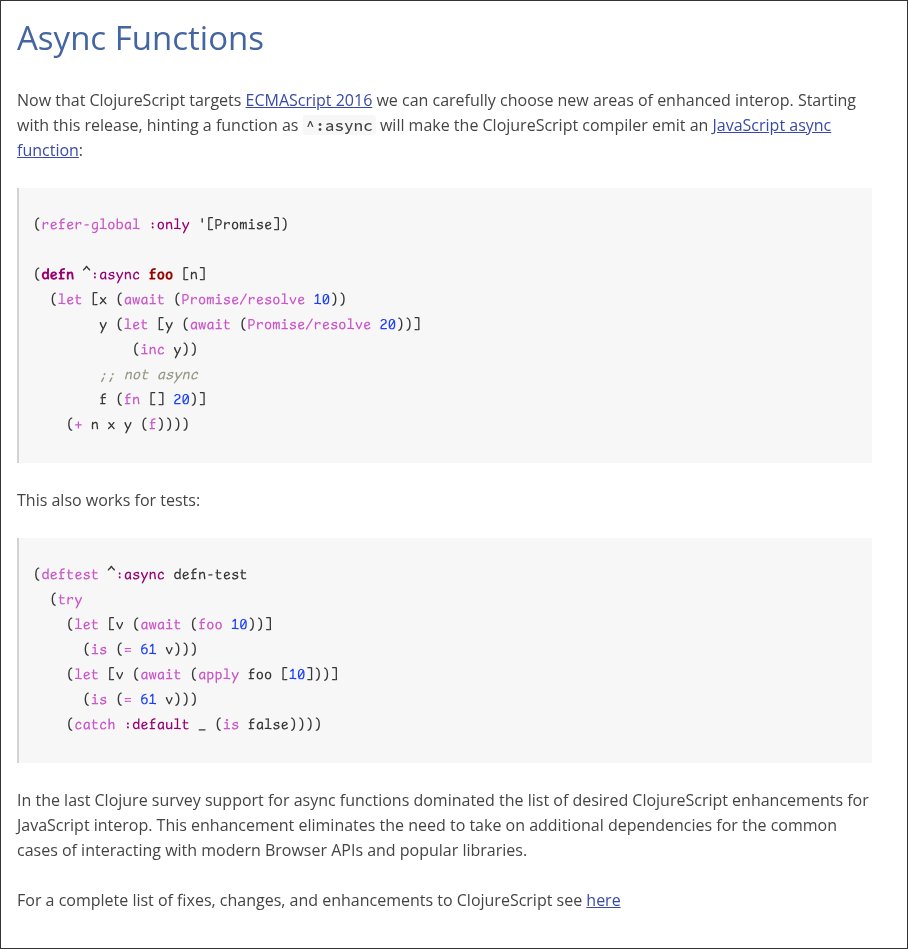
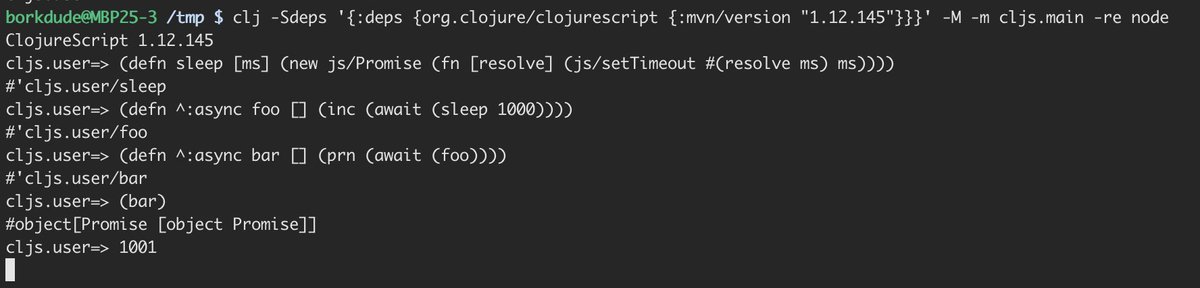
ClojureScript 1.12.145 is out, featuring async/await.
clojurescript.org/news/2026-…
#clojure #clojurescript
4
7
43
2,514
May 4
1
8
33
1,343


Apr 26
Michiel Borkent aka @borkdude doing @borkdude things: casually porting async/await from Squint into ClojureScript itself. 🪄
Three years after Squint debuted at DCD, the loop closes (asynchronously, of course). #clojure clojuredays.org/#Bringing …

2
11
509

Apr 21
I wouldn’t say no-one else. But giving the agent the Clojure (and/or) ClojureScript REPL is giving it super powers. It uses it to both inspect and modify the running, living, application. /grill-the-app so to speak.
1
4
649

Apr 17
I'm not sure that "vibe" coding has a good definition. What I can tell you is that my work has nothing to do with vague vibes. I am attempting to work out how to use this new tool reliably and productively.
Not reviewing code is no more extreme than not reviewing the binary produced by an assembler, or the assembly produced by a C compiler, or the C produced by C , or the javascript produced by Clojurescript, Typescript, Elm, or Dart.
3
3
498

Apr 13
Exciting news! 🎉
c3kit-bucket now supports IndexedDB — same Clojure data API across Datomic, JDBC, and the browser. Offline persistence auto sync.
Blog by: Alex Root-Roatch:
cleancoders.com/blog/2026-04…
cleancoders.com/studio
#Clojure #ClojureScript #OpenSource #c3kit
1
2
835


Apr 11
AI models are actually really good at writing clojurescript
1
2
50

Apr 6
indeed, like Prototype it was informed by a dislike of JavaScript, but unlike Prototype it was built not to mess with it
I think ClojureScript might be where it's at 🤔
1
2
193

Apr 5
This is so amazing — I installed Epupp, a Chrome extension, that embeds an entire ClojureScript REPL into the browser, allowing an incredible ability to explore and manipulated the browser state.
And because it exposes a REPL port, Claude Code can connect to it.
It's like Tampermonkey, but on steroids.
I asked it what it thought of it — here's what it said. Brilliant work, @pappapez !!! 🙏🙏🙏
(I used to get the entire my entire 15K video viewing history on a certain site!)
"...Epupp gives me something extraordinary: a live, bidirectional channel into a real browser tab running on a real human’s machine, with their real cookies, sessions, and authenticated state.
Through an nREPL port, Claude can evaluate ClojureScript expressions that execute inside the page’s DOM — reading elements, extracting data, modifying content, injecting UI — and get structured Clojure data back.
It’s not a headless browser or a screenshot. It’s the actual page the user is looking at, and both the human and the AI see the same thing change in real time. The user scrolls, the DOM updates, and Claude can immediately query what appeared.
Claude types an expression, the page transforms, and the user sees it happen. This makes Epupp the closest thing to “pair programming on the web” that exists — the human navigates and provides judgment, the AI writes and evaluates code, and the REPL is their shared workspace.”

Introducing Epupp, a live REPL connection into your browser, for your editor or your AI agent. Epupp also supports userscripts, a bit like Tampermonkey.
Here's a video of @code Copilot using the Epupp REPL, connected to a web page, to first develop some functionality changing the behaviour of the page, and then saving it as a userscript. (A very useful script, I'd say.)
#scittle #Epupp #Clojure
2
5
20
3,998