
I've just submitted a Call for Speakers for Clojure/Conj 2026 workshop session! sessionize.com/clojureconj-2… (About Backseat Driver)
14


🏊🚴🏃 Turning Sports Data into Insights
Follow the journey from data ingestion and time-series processing to visualization and analytics—all powered by Clojure and real-world training data.
🎟️ conference.mscc.mu
#MSCC #DevCon26 #Mauritius

12

Se eu passar em clojure será que o vampiro lestat fica orgulhoso de mim...
1
1
44

11h
O ruim de gostar de clojure é se apaixonar por homoiconicidade, uma das propriedades mais interessantes disponíveis em algumas linguagens de programação. É o que sinto mais falta quando programo em outra lang en.wikipedia.org/wiki/Homoic…
4

Lincoln Nebraska Coder </> Jerbs
Not at all! While Python is incredibly popular right now—especially for machine learning, data science, and scripting—the local engineering ecosystem in Lincoln is actually incredibly diverse. Different companies choose their stacks based on what they are building, whether it's massive enterprise infrastructure, real-time data streaming, or custom web platforms.
If you look at the major tech employers in town, the language landscape breaks down into a few distinct camps:
1. The Enterprise & Heavy-Lifting Giants: C# / .NET and Java
For large-scale, highly reliable backends—especially in fintech, logistics, and insurance—compiled, strongly-typed languages rule the roost.
Who uses it: Nelnet relies heavily on C# and the .NET framework for their massive transactional applications, paired with robust relational databases like SQL Server. Don't Panic Labs is also a major champion of disciplined software architecture using the .NET stack.
Why: They offer incredible performance, type safety, and massive enterprise support frameworks necessary for handling complex business logic and secure data processing.
2. Modern Product Engineering: TypeScript / Node.js
For building responsive, fast-iterating web applications, JavaScript’s modern evolution, TypeScript, is virtually everywhere. It allows teams to use a single ecosystem for both the frontend (what the user sees) and the backend server architecture via Node.js.
Who uses it: Hudl uses a diverse, cutting-edge stack that heavily features TypeScript and React to manage their web and mobile applications, dealing with complex video playback and massive global user traffic.
Why: TypeScript catches bugs early through static typing while maintaining the massive ecosystem and rapid deployment speed of Node.js.
3. The Web & CMS Workhorses: PHP and Ruby
There is a massive world of custom application development, content management systems (CMS), and e-commerce infrastructure built entirely on classic web-native languages.
Who uses it: Many local custom digital agencies, independent shops, and companies like RentVision lean on robust web frameworks. You'll find a lot of production environments running PHP (especially backed by modern architectures like Laravel) or Ruby (on Rails) for rapid application deployment.
Why: These languages were built specifically for the web from day one. They excel at spinning up custom business logic, database-driven applications, and tailored content platforms incredibly fast.
4. Specialized & Functional Systems: Clojure, C , and Go
When you get into specialized domains like hardware integrations or high-volume data ingestion, you find more niche programming paradigms.
Who uses it:
Hudl famously utilizes Clojure (a functional language that runs on the Java Virtual Machine) for some of their complex background data scaling services.
LI-COR Biosciences relies on lower-level languages like C and C because their software directly talks to physical scientific instrumentation, optical sensors, and climate monitoring hardware where bare-metal performance and memory management are critical.
Where Python Does Fit In
Python is still very present in Lincoln, but usually as a specialized tool rather than the sole language a company is built on. You'll see it heavily utilized at the Nebraska Innovation Campus (NIC) by AgTech and biotech startups for data pipelines, GIS mapping data, and predictive machine learning models.
Ultimately, the Lincoln market values polyglot engineers—people who understand foundational software architecture, clean code principles, and design patterns, and can adapt to whatever language fits the specific problem they are trying to solve.
1
64

Flatiron: a pure Clojure columnar library using typed primitive arrays for near-native C performance on the JVM. Zero dependencies beyond core.async.
foursignals.dev/wire/2026-06…
1

I enjoyed it. Given you've given me much to read, I hope you will excuse me giving you much to read in return :)
Reading it reminds me of the timelessness of such views. Both about the noise and on how to educate children. The ancient Greeks wrote the first anti-noise legislation, and Seneca complained about the chaos of living above a bathhouse. Later, in Rome, Juvenal said only the wealthy could afford to sleep, in contrast with how the chaos in the streets below caused insomnia. As for education, Aristotle wrote in his Rhetoric how young people have yet to be humbled by life, thinking they know everything while being sure about it. Plato wrote in the Republic how teachers both fear and flatter their students and how students despise them in return.
I must admit western philosophers in general remain an understudied domain for me, including the Greek, and even more so with the enlightenment ones. Not for lack of trying or reading, but the underlying feeling they miss out on something fundamental which remains hard to either pinpoint or word out. A sort of ineffable human nature which resists being exposed by labels alone. I always felt more drawn towards the eastern ones, which made for a pleasant surprise in learning Schopenhauer read the Bhagavad Gita and the Upanishads. I am on my second read of the Gita and have yet to start on the Upanishads, so my views might also be incomplete in understanding them. They take far more time to embody than to study.
I can, however, already draw interesting parallels between the Gita and Schopenhauer's views. He does make interesting points about observation and experience; a direct mirror to the two paths of contemplation and action. I also can attest first hand on the downsides of living near noise, and how much worse jackhammers sound. I lived for years with them ranging from 20 meters away to a few blocks away, always thinking "eh, it'll only last a bit longer, and I already quit work to self-fund this, I can't afford to move now", quite naively I might add! Although where I disconnect comes from both the presentation and the contradictions I can't help but notice. I feel I can skip over the former, others have written at length about it. The contradictions make for a fascinating study, at least to me.
I think I can also skip over the "going mad" part, it seems to be a symptom of something else entirely. At least, from reading The Universal Computer, madness came to just about everyone who contributed significantly to the path leading to our modern thinking machines, regardless of their external environments. They too faced contradictions, with the exception their work forced these people to address them head on. Cantor in particular found paradoxes, which influenced Russell to find more paradoxes, and led to the latter quitting both Principia Mathematica and, well, mathematics in general. On the plus side, it led Whitehead to write Process and Reality, which inspired Rich Hickey in creating Clojure and Datomic, and in turn inspired me profoundly by using both to build with.
My issue with western philosophy seems also split two, where I can see opposite factions of philosophers: the external critics and the internal critics. The latter applying their own frameworks back over themselves. The discerning factor I'm seeing here comes down to self-referentiality, which became the bread and butter of Hofstadter and makes a major link back to eastern philosophies going back millennia. The way I apply it asks whether a philosopher embodies the philosophy. The view it leads to appears to show pure thinkers and theorists on the external criticism side, while the engineers and artists sit comfortably in the internal one.
In that regard, Schopenhauer seems to fall in the external critic camp. He documents his observations and experiences with surgical precision, but asks others to perform it rather than lead by example. He writes about avoiding errors, that mathematics make errors impossible, yet Gödel proved even basic arithmetic shows incompleteness and gauge theory boils down to using errors as compute power. Elon keeps proving errors make the impossible happen, and even Bob Ross called them "happy little mistakes". Schopenhauer also writes how ideas such as languages, natural sciences and history show little danger, which contrasts directly with "in the beginning was the word", the power of programming languages today and how historical narratives nudge entire cultures over time. Sartre makes another example of "we are what we will ourselves into" and then wills himself into ruminations and misery.
I tend to avoid strict rules and absolutes, in part because I grew up with them, and studying figures like Alexander the Great shows he revolted so strongly against such an upbringing he ended up conquering a large portion of the world. Also in part because engineering experience taught me how rules and absolutes become the first things to break when hitting reality. Software which passes all the compilation checks and the full test suite still meets production as if the previous safeties act as mere suggestions. Also because a friend keeps pushing me to ship more and "yes those are all interesting ideas, but still very abstract, a demo would go a long way with this" which I end up grateful for even if it stings in the moment.
It makes another interesting contradictory paradox, I think, in that Schopenhauer calls out the dangers of abstract ideas over first hand experiences and observations, while writing about it in abstract idea form. I still have no good answer to resolve this dilemma in myself. On one side I realize staying in the abstract shields me from shipping what I have in mind, on the other I realize going to market too soon won't solve the problems I experienced at work during the previous decades. On the one side I view countless hours of writing code and debugging, and on the other I view countless hours of studying abstract math towards what I believe leads to a much better way of writing software, from the ground up. And until both ends meet and merge, I feel uncomfortable shipping or going to market, as it would lower the potential from what I envision to what I have now. I end up approaching it the same way as music practice: most notes going into the void, most drafts discarded, most phrasings abandoned.
Which leads me to the points Schopenhauer makes on selection by most capable people and following masters. I keep questioning how we arrive at the state of the art and mastery. Robert Greene's Mastery helped a ton to drive my views in this regard. Also the realization having extensive experience across just about every domain of software grounds me in a way such selection and mastery can now use reality itself as a co-author. Because nothing else breaks down ideas and prototypes faster than going beyond the theory and into field work. Examples pour in from history, such as the steam engine whose engineering problems led to discovering thermodynamics, to name only one. Which ends up, by doing both the engineering and the theoretical sides at once, being stuck between a rock and a hard place, whose pressure forces invention by the mother which we call necessity.
And speaking of pressure, this now gets back to the original point: noise. I do my best to avoid complaining about it, and instead view it as a means to practice detachment as written in the Gita. Easier said than done, while also leading to accumulating personal motivation and discipline from every source I can get my hands on. Jocko's philosophy of GOOD, Elon's success after countless failures with the world's experts saying it can't be done, Carlos Castaneda's book series which I am still only halfway through fascinates me, the I Ching where failure gets reframed as simply the process of changes which science now calls calculus, Scott Adams' insane ability to re-frame any situation to his advantage, even your "read what you love until you love to read" got me back into reading which I enjoyed so much as a kid, and this list also grows endless real fast. I ask myself what lessons can life teach me in those moments, learn to appreciate what I have more than ever before, and how to do what I can given what I have. Even Arnold Schwarzenegger's Be Useful philosophy inspires me, especially the part about coming up with solutions if one wants to complain about issues. And then putting those solutions to the test and shipping them once they reach a tipping point of a working state.
Possibly the hardest path I can imagine putting myself on, but as everyone I admire would say: easy isn't worth doing. And then when I can afford to move, I feel as if nothing will be able to distract me anymore, given what I've already been through. Everything serves a purpose. And as Jeff Bezos would say, today marks another Day 1.
8
561

みんながAIに飽きるのは当然でWebアプリ、ダッシュボード、AIエージェント、ツール、ゲーム、デモ、プロトタイプくらいしかやることがない
エンハンス領域の狭さを覚えるからでArduino / Raspberry Pi Pico / ESP32 / STM32 みたいなマイコンは、PCにUSBで接続してファームウェアでC++とかを書いてくれるしそれを肉眼で視認した方がキラキラが大きいからハードウェアに行こうするのは当然で,次は肌感としてフィジカルAIが来るというか既に来てる
だからキットとか欲しがるわけで
人間が思いつくことなんて誰でも思いつくしAIにも言える事だけど。
みんなが言うAGIと呼ぶ代物は自律式エージェントの究極版みたいなやつ?定義が曖昧でわからないのだけれど?
それともAIに責任をなすり付けるためのレーゾンデートルかしら?
Python、JavaScript/TypeScript、Java、C、C 、C#、Go、Rust、Ruby、PHP、Swift、Kotlin、Scala あたり。
スクリプト・シェル系なら Bash、PowerShell、Perl、Lua。
データ・問い合わせ系は SQL、R、MATLAB、Julia。
関数型だと Haskell、OCaml、F#、Elixir、Erlang、Clojure、Lisp、Scheme。
ちょっとマニアックなところでも Fortran、COBOL、Assembly、Prolog、Verilog/VHDL、Solidity、WebAssembly、 Brainfuckくらいは書いてくれるから
3dモデリングできるしComputer Useで大体動かせる
人間にやれることは他にもあるし山積する課題をAIが大分最適化できそうだが。想像するにも知識が必要だと言うことだが,スパクリとかHCIのマスターでも思いつかないのは、やはり人類だから、くだらない先入観に染まっているのか?
全体の雰囲気としてAIのブレイクスルーを待っている気はする
CLIやIDEの障壁もしくは誰も気づいてない可能性を探求することが我々の役目なのかもしれない
深夜テンションでよくわからない
2
5
290

Clojure book clojure-book.gitlab.io/ is updated with sections on Debugging With Calva, and Debugging in Leiningen project with Calva and nREPL. Hope you like it.
If possible, please send me feedback so that I can improve it.
#Programming #Clojure
12

Jun 13
ClojureのBabashkaみたいなのがJavaでも出来るって事かな…良さそう
Jun 13

memo.
[Javaはスクリプト言語だ — JBangが変えるJava開発の未来](zenn.dev/tadayosi/articles/2…)
3
1,267

Jun 13
to implement/translate on top via another programming language / functions
Their scheme workflow is a disgrace;Both Clojure or Common Lisp ideology wouldn't have caused such shitty non user/programmer friendly configurations
-
If I could redo it, I would go Nix or stay Gentoo
30


Jun 13
Un bon petit bundle de livres sur des langages fonctionnels, dont 7 livres sur Clojure, 3 sur Elixir
humblebundle.com/books/ultim…
22

Jun 13
I think UMN-Morris still teaches clojure, or maybe scheme, not sure. But it is a small school.
11

Jun 13
in general it seems like ai does better with expressive, dynamic langs. so like, javascript > typescript, ruby / python are great, etc. Clojure would track.
It's possible this doesn't scale as well on larger codebases.
55

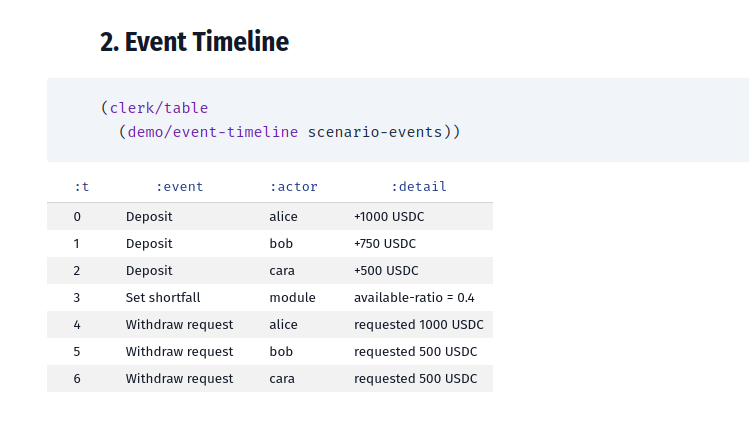
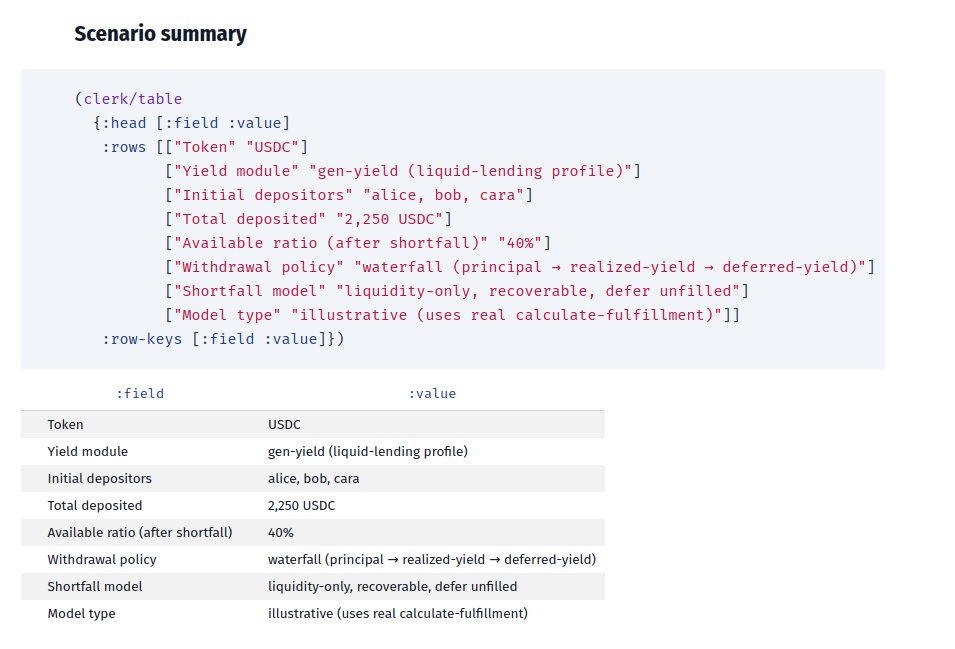
A Clerk notebook (like Jupyter except it's Clojure) showing a generalised data-driven yield vault in a shortfall scenario
This is a computational notebook, in this case with a deterministic Ethereum protocol simulator running inside it.
The walkthrough shows a vault that works like Aave v3 except in the event of a shortfall (such as what happened recently) it reduces the amount everyone can withdraw. A fairer approach than allowing full withdrawals until the money runs out, and the slowest losing out. It also means there's no need to pause withdrawals in a shortfall scenario. Once there is a full or partial liquidity recovery, all users get to withdraw more from their shortfall-affected position.


11

Jun 12
Clojure was my favorite backend language, I wrote huge data processing pipelines with it running on beastly JVMs I tuned to C performance. But the web support is clunky, last I checked.
1
19
millettjon retweeted

I've been working on jank's ability to compile #clojure programs to native executables which don't depend on Clang/LLVM. All functionality is baked in, like Graal native images.
It works! They're smaller than native images and startup is instantaneous. 🔥
1
1
17
355