
28 Nov 2025
Artificial Intelligence Driven Workflow for Accelerating Design of Novel Photosensitizers
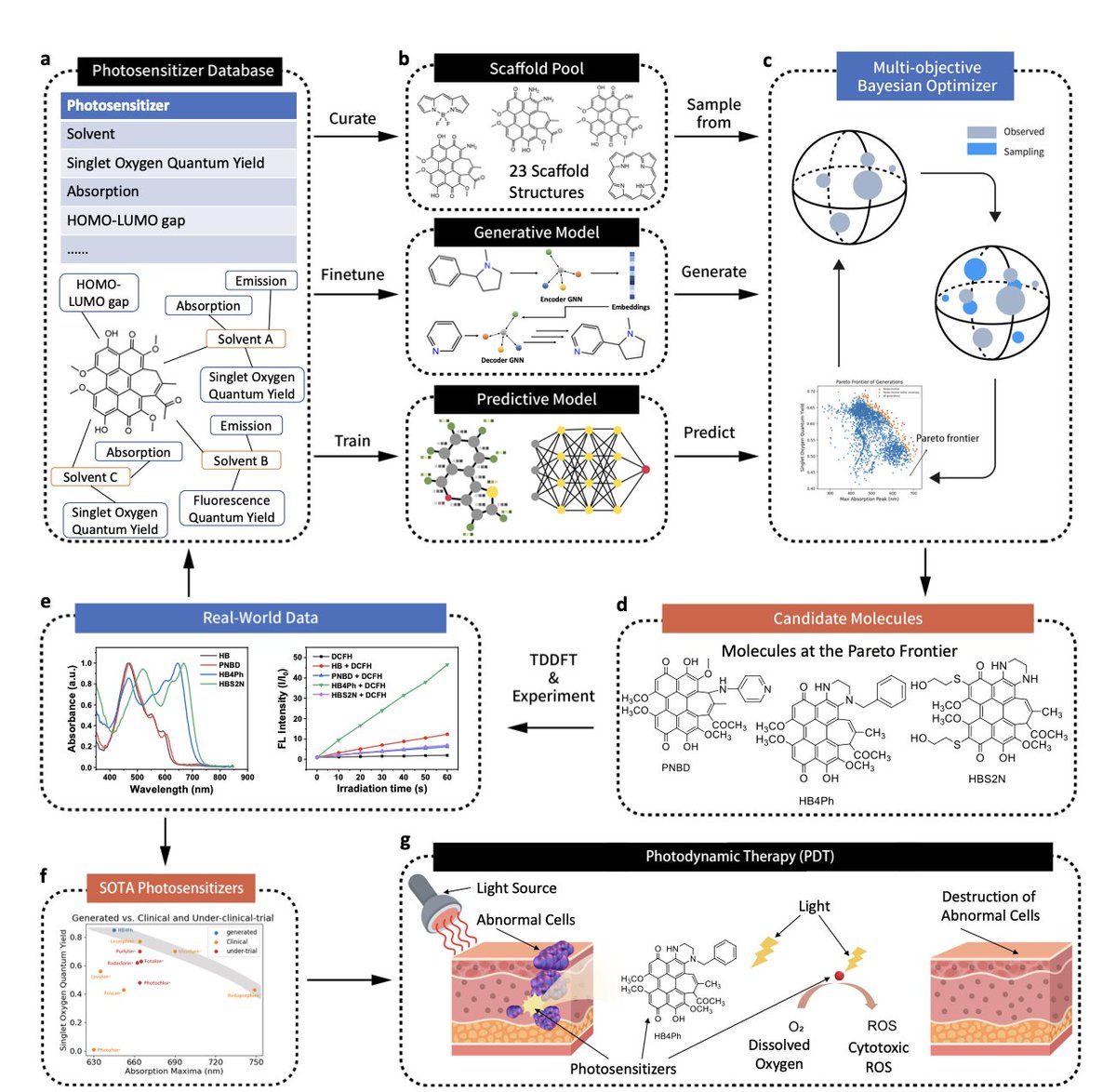
1. A novel study presents AAPSI, an AI-driven workflow that integrates expert knowledge, scaffold-based molecule generation, and Bayesian optimization to accelerate the design of novel photosensitizers. This approach addresses the challenges of traditional trial-and-error methods by leveraging a curated database of 102,534 photosensitizer-solvent pairs and generating 6,148 synthetically accessible candidates.
2. The core innovation lies in the closed-loop integration of AI and experimental validation. AAPSI uses graph transformers trained to predict singlet oxygen quantum yield (φ∆) and absorption maxima (λmax), identifying candidates with optimal properties for photodynamic therapy (PDT). The workflow prioritizes high φ∆ and long λmax, which are critical for effective PDT.
3. Among the synthesized candidates, HB4Ph, a hypocrellin-based photosensitizer, demonstrates exceptional performance with a φ∆ of 0.85 and λmax of 645 nm. This places HB4Ph at the Pareto frontier of current photosensitizers, showcasing AAPSI's ability to generate high-performance molecules tailored for clinical applications.
4. The study establishes a comprehensive database of photosensitizers, covering a wide range of structural classes and photodynamic properties. This database, available online, serves as a valuable resource for researchers in the field, facilitating further exploration and optimization of photosensitizers.
5. AAPSI represents a paradigm shift in photosensitizer design, merging AI-driven innovation with domain expertise to streamline the discovery process. The workflow's success in generating and validating high-performance photosensitizers highlights its potential for accelerating material innovation in biotechnology and medicine.
📜Paper: arxiv.org/abs/2511.19347v1
#AI #Photosensitizers #PhotodynamicTherapy #MaterialInnovation #ClosedLoopWorkflow #Database #GraphTransformers
1
12
1,211