


Jun 13
Bhai CockroachDB use kare ki nhi
inn cockroaches ki wajh se usko use karne se phle bhi sochna padrha hai
17

Jun 12
ChartDB is the database diagramming tool you didn't know you needed — and it's fully open-source.
One query and your entire schema is visualized. PostgreSQL, MySQL, SQL Server, SQLite, MariaDB — it imports from all of them instantly. No account needed.
The AI export is where it gets interesting: you can migrate from MySQL to PostgreSQL or SQLite to CockroachDB with a single prompt. It generates the DDL script in your target dialect.
Self-host options:
- `npm run dev` for local
- Docker with OpenAI key for AI features
- Supports custom LLM endpoints (vLLM, local models)
Privacy note: analytics via Fathom (GDPR-friendly), fully disable-able.
This is what good developer tooling looks like — zero friction to start, powerful when you need it.
github.com/chartdb/chartdb
1
19

Jun 11
Excited to have Form3 at RoachFest London, where they'll walk through how they evolved from AWS into a cloud-agnostic, active/active/active architecture across AWS, GCP & Azure using CockroachDB, Kubernetes, NATS, and Go. cockroachlabs.com/roachfest/…

170


Jun 11
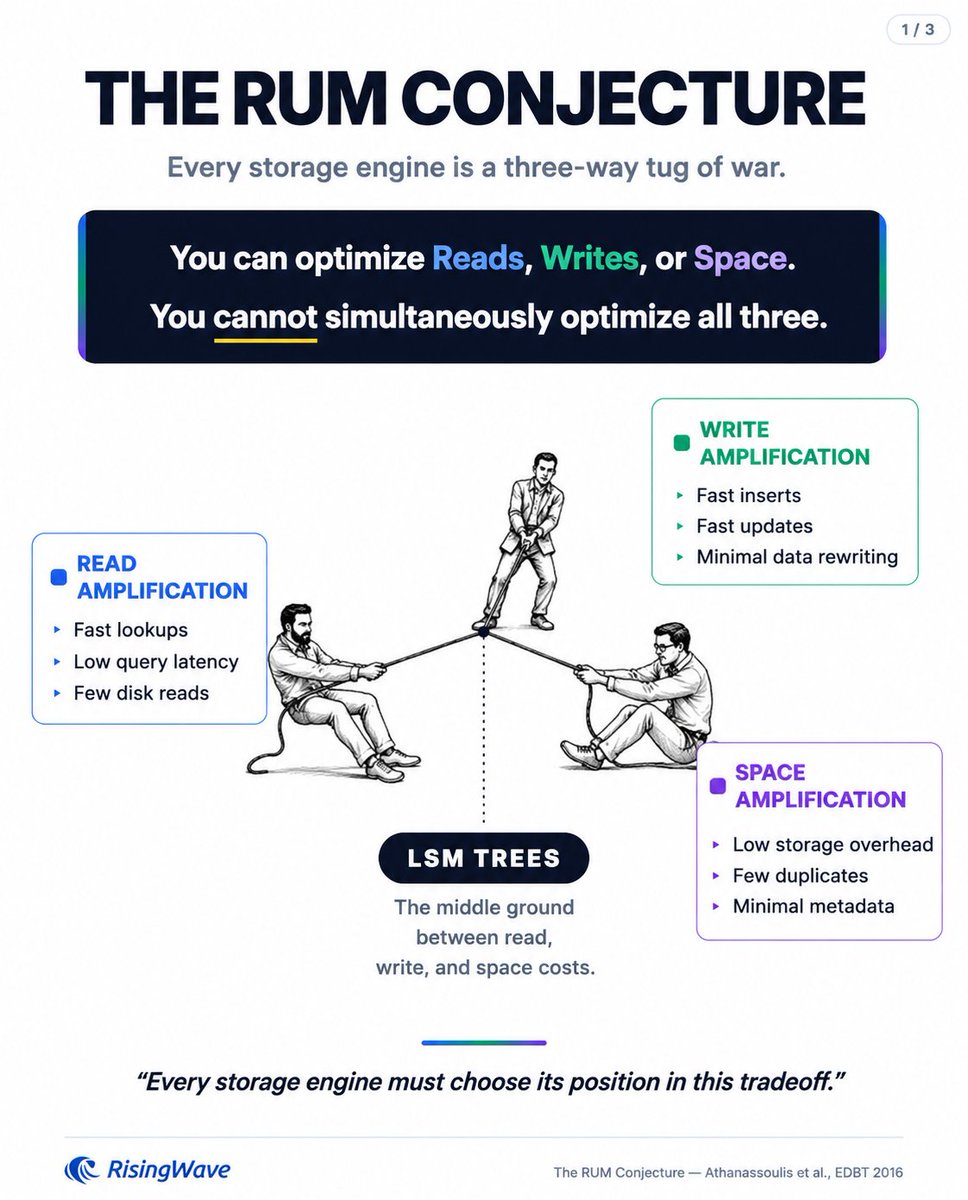
The RUM Conjecture explains why there is no perfect storage engine.
Storage engine designers optimize for tradeoffs.
You can optimize:
Reads
Writes
Space
But you cannot simultaneously optimize all three.
That's why:
B Trees favor reads
Logs favor writes
Hash tables favor reads writes (at the cost of memory)
LSM Trees sit in the middle
This is one of the key ideas behind databases like RocksDB, Cassandra, TiKV, ScyllaDB, CockroachDB, YugabyteDB, and RisingWave.
Every storage engine is choosing where to sit in the RUM triangle.
2
3
18
865
Albert Riopel VE7JW 🇨🇦🇺🇲 retweeted
May 29
At RoachFest, Igor Stanko is sharing what's next for CockroachDB: BYOC, AI-powered migration tooling, agent-ready architecture, and the path to price-performance at scale. Learn more: cockroachlabs.com/roachfest/…

2
3
294
Albert Riopel VE7JW 🇨🇦🇺🇲 retweeted
Jun 10
Introducing The Crawl Space RoachFest London's intimate interview series with silent disco headphones, unfiltered convos & maybe some spilled tea 🫖
Hot takes on AI. Real talk. Less keynote, more behind-the-scenes: cockroachlabs.com/roachfest/…

1
3
281

Jun 10
the honest answer is that db landscapes have changed drastically since 2026 started and even the big ones are experimenting with novel solutions like google's bigtable or cockroachdb, so your next bet might not be on a traditional one
1
24


Looking at the product CockroachDB (Published on September 26, 2024) do I see it as a sign that Cockroach Janata Party is going to morph into Bharatiya Janata Party?
Or was this sign for suspended City Magistrate Alankar Agnihotri meant when he said CJP as C-team of BJP?
1
28
Jun 8
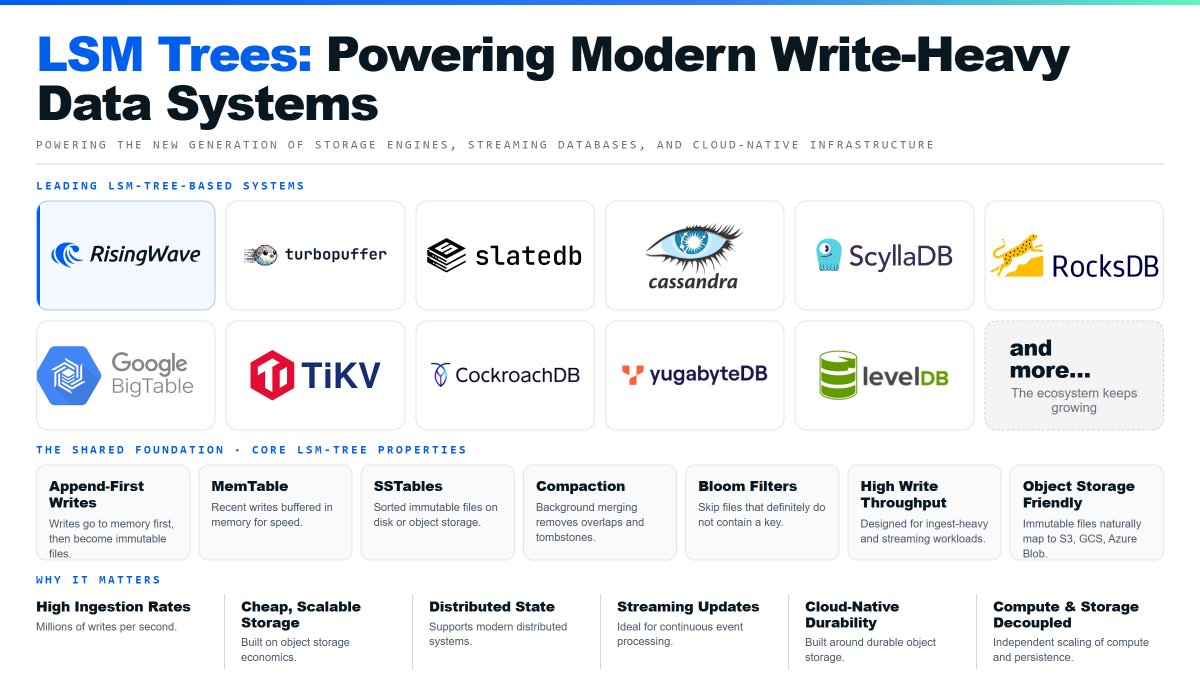
LSM Trees power a huge portion of today's modern data infrastructure.
Data systems like:
RocksDB
Cassandra
ScyllaDB
TiKV
CockroachDB
YugabyteDB
Google Bigtable
Apache HBase
LevelDB
SlateDB
turbopuffer
RisingWave
all build on the same fundamental idea:
Optimize for writes first. Organize data later.
But in the era of object-storage-native systems, the story has become even more interesting.
Most databases face a fundamental challenge:
How do you support massive write throughput without constantly rewriting data?
Traditional B-Tree systems update data in place:
Find page → Modify page → Write page back
LSM Trees take a different approach:
Write to MemTable → Flush to SSTables → Compact later
In other words:
Write fast now. Organize later.
That simple idea unlocked a generation of systems optimized for:
high-ingestion workloads
stream processing
object-storage-native systems
The reason LSM Trees fit so naturally with object storage is that both favor:
immutable files
sequential writes
append-heavy workloads
This makes them a natural foundation for systems built on S3, GCS, and other object stores.
But every design comes with tradeoffs.
LSM-based systems gain:
Fast writes
Sequential I/O
Efficient object storage utilization
Excellent scalability
while paying for:
Compaction
Write amplification
Read amplification
This is why concepts such as:
SSTables
Bloom Filters
Compaction
MVCC
Snapshots
Caching
are so important.
They are not isolated database features.
They are the mechanisms that make LSM architectures practical at scale.
Modern systems extend traditional LSM ideas even further.
RisingWave's Hummock storage engine combines:
LSM Trees
Object Storage
Distributed State Management
MVCC Snapshots
Barrier-Based Checkpointing
Schema-Aware Bloom Filters
to support real-time stream processing at scale.
Similarly, modern object-storage-native systems increasingly combine:
LSM-inspired storage layouts
Object storage as the durable layer
Intelligent caching as the performance layer
Separation of storage and compute
The result is a new generation of cloud-native data systems designed around the economics and scalability of object storage.
Understanding LSM Trees today is no longer just about storage engines.
It's about understanding one of the foundational building blocks behind modern data infra architectures.
2
3
26
1,943

Jun 8
Databases and Their Programming Languages
• 🐘 PostgreSQL - C, PL/pgSQL, SQL
• 🐬 MySQL - C, C , SQL
• 🍃 MongoDB - C , JavaScript
• ⚡ Redis - C, Lua
• 🔍 Elasticsearch - Java
• 🏛️ SQLite - C
• 🪳 CockroachDB - Go
• 🌊 Cassandra - Java
• 🔥 Firebase - C , Java, TypeScript
• 🐍 Neo4j - Java, Cypher
32
3
43
1,590
Akbar Shroff retweeted

Now Available
Learn how to build resilient, scalable and distributed application with CockroachDB, one of the world's leading cloud-native SQL databases.
Publisher - @shroffpub & @OReillyMedia
Link to buy - short-link.co.in/5g
#cloudcomputing #guide #application #datascienc

1
2
38

Jun 5
Scalable Leader Leases For Multi Consensus Groups in CockroachDB: dl.acm.org/doi/abs/10.1145/3…. A new lease mechanism to enable quorum-less serving of read-only requests in Raft which scales to millions of Raft groups. If this excites you then you're a database nerd like me.
6
136

Jun 5
Tensorlake’s sandbox scheduler uses a replicated state machine (RSM) to replicate cluster and sandbox metadata across multiple machines for high availability. Recently, we increased our throughput for scheduling sandboxes by 12x.
RSMs linearize writes across nodes to provide strong consistency.
As we scaled our sandbox infrastructure, we found that creating a burst of 100k sandboxes concurrently competed for the replication pipeline with scheduler updates that place sandboxes on dataplanes. Worse, dataplane updates which inform users that their sandboxes have started were jammed behind create and placement messages across nodes.
To solve this problem, we borrowed ideas from massively distributed databases such as TiKV and CockroachDB and implemented Multi-Raft. Among other use cases, these databases use Multi-Raft to replicate databases independently of one another.
We now have three replication lanes across scheduler nodes:
1. Intent to create/delete/update sandboxes, driven by users
2. Scheduler placement updates
3. Dataplane updates
Multi-Raft concurrently transfers messages across these three lanes. Both (1) and (3) drive the scheduler, so the scheduler is never blocked waiting for more messages.
3
5
73
15,644

Jun 5
CockroachDB is called cockroach because cockroaches are partition tolerant
5
242