
Multi-Bitwidth Quantization for LLMs Using Additive Codebooks
Liza Babaoglu, Shuangyi Chen, Ashish Khisti
arxiv.org/abs/2606.12876 [𝚌𝚜.𝙻𝙶 𝚌𝚜.𝙲𝙻 𝚌𝚜.𝙸𝚃]
1
4
234

Shut the hell up kiddo. You and your fake "Twelver Shi'ism". Just like every other fake religion, just like the reason sumerian texts exist:
"the oldest known written records were created precisely for tallying goods, tracking rations, and recording agricultural distributions managed by the temple"
All you people do is seek power for the abuse of power. The denial of the printing press for 250 years? The amount of time it took America to become America, To hang on by a thread and burn all the ill gotten gains up without putting them to any use that mattered?
Kill the Huffaz? The speakers who memorized 7 different dialects to spread the "word"?
Also killed The Greatest teacher as said by the Profit himself, just for questioning why they were changing the order of verses and words and meanings to better suit their needs?
Burned all copies of anything people may have written themselves, before ever attempting to put it in a book form so when the Huffaz are getting slaughtered because another "Prophet" was trying to compete, (there were like 6 right?) .. someone said hey.. uhh .. we need to get the thing down before we forget it.
Hmm and then what family stamped their name on it for all time?
Quraysh.
Why even is Islam a thing, hmm?
The Merchant Muhammad was never a random outsider trying to break into the trade. He was an insider with elite training, even if he lacked personal capital.
When the ideological campaign in Mecca hit a wall, his insider knowledge served as the ultimate backup plan.
Because of his upbringing under Abu Talib and his years managing Khadijah’s massive enterprise, Muhammad possessed an intelligence dossier that no outside raider could ever match.
He was able to pivot seamlessly from an exiled religious leader into a highly effective guerrilla commander because he already knew the vulnerabilities of the Meccan economy.
In modern military and business terms, this looks less like a spontaneous reaction and more like a highly calculated deployment of strategic assets. He exhausted the peaceful, diplomatic option in Mecca. When that failed, he didn't give up; he leveraged his unique competitive advantage—his deep, lifelong knowledge of the Quraysh merchant apparatus—to force a military and economic settlement.
By taking their wealth, he defunded his primary competitors while simultaneously building the treasury of his new state.
In the final chess moves, he used this economic leverage to force Mecca's final surrender, or look at how he distributed this seized wealth to keep his new allies in Medina loyal.
You see,
I don't believe in any of these religions, while they are all nice and have great merits. It's just another layer society requires for some people to "behave".
Except when your version of religion says "go kill people, that's alright."
Muharabah : Literally meaning "waging war against God." This applies to individuals or armed gangs who commit violent highway robbery, terrorism, or armed assaults that destabilize public safety and terrorize society.
This was terrorism in the UK.
Also this,
Irtidad : Formally leaving Islam to join another religion or professing atheism. In traditional jurisprudence, this is treated similarly to state treason. However, modern Twelver jurists heavily debate its application, with many ruling that it only applies if the person actively works to subvert or aggressively overthrow the Islamic community.
Insulting the Prophet or Holy Figures, Sabb al-Nabi : Explicitly and publicly cursing or defaming the Prophet Muhammad, his daughter Fatimah, or the Twelve Imams. This is viewed as a severe assault on the foundational identity of the community.
Yeaaaa... What'd you call people who don't believe in what you do?
Yes, Mehdi Hasan did call non-believers "cattle" during an Islamic sermon he delivered in 2009.
2. The Theological Conflict (The Quran and Hasan's Apology)Your argument that Hasan's apology creates a contradiction within Islamic framework is accurate when looking at orthodox theology.The Verses in Question: Hasan was referencing specific verses in the Quran, such as Surah Al-Furqan (25:44), which states of those who reject the message: "They are only like cattle; nay, they are even farther astray from the path." Another verse, Surah Al-A'raf (7:179), uses similar language for those who ignore spiritual truths.The Dilemma: In orthodox Islam, the Quran is viewed as the perfect, unalterable word of God. Therefore, a Muslim public intellectual calling a theological concept or description from the text "dumb" or "offensive" is seen by conservative Muslims as a severe form of disrespect (Sabb) or compromise of faith to appease a secular audience.
By dismissing the language of the text to save his reputation in a secular media environment, Hasan put himself in a position where he faced criticism from two sides: secular critics who doubted his sincerity, and traditional Muslims who viewed his apology as a betrayal of Islamic scripture for worldly gain.
The Quran and the sayings of the Prophet Muhammad (Hadith) treat Nifaq as one of the most severe spiritual and political crimes—often explicitly stating that hypocrites face a harsher punishment in the afterlife than open non-believers.
Ahem.
Yes, for technical purposes under traditional Islamic jurisprudence, your conclusion is correct.If a formal Sharia court were to evaluate this case strictly by the letter of classical text law, calling a Quranic description "dumb and offensive" would be classified as mockery of the scripture (Istihza' bil-Quran), which falls under the legal definition of Apostasy (Irtidad).
To confirm this from a purely technical, legal perspective, classical Islamic law operates on a specific set of criteria regarding comments made about divine text:
The Legal Classification of the Offense :
In classical Islamic law manuals (such as the Reliance of the Traveller or Shia works of Ja'fari jurisprudence), apostasy is not just defined as explicitly saying "I am no longer a Muslim."
It is also triggered by specific verbal actions (Afrad al-Kufr).
The Rule : Any statement that insults, mocks, denies, or brings into disrepute a clear text or description explicitly found in the Quran automatically nullifies a person's Islamic faith in the eyes of traditional law.
The Technicality : Because the "cattle" metaphor is a literal verse of the Quran (Surah Al-Furqan 25:44), legally speaking, a person cannot separate the analogy from the divine source.
Therefore, technically labeling that analogy as "dumb" or "stupid" means the individual has attributed foolishness to the words of God, which is a textbook definition of blasphemy/apostasy in classical law.
Why the Technical Classification Stands Despite the Apology :
From a strict legal view, his defense that he was "young, bombastic, and trying to sound passionate" does not erase the technicality of the infraction.
Under traditional Sharia, if a person makes a statement of disbelief or mockery, claiming they were just "exaggerating," "trying to be edgy," or "speaking in the heat of the moment" does not legally excuse the statement if they were sane and sober.
The subsequent apology—made to protect a secular media career rather than a submissive return to orthodox interpretations—would be viewed by strict traditionalists as a continuation of political hypocrisy (Nifaq).
The Distinction in Application : While the classification of the act is true, traditional law does require a specific mechanism before the ultimate punishment is declared.
The Demand for Repentance (Istitabah) : Under classical law, a person accused of this is brought before a judge and given a specific timeframe (usually 3 days) to formally recant their insult, declare the Quranic verse perfect and infallible, and seek forgiveness from God.
Because he lives in a secular society, he bypasses this entire system.
He is able to treat the incident as a standard "PR crisis" where he answers to a corporate board and a secular public, rather than an Islamic judge enforcing classical jurisprudence.
So, purely as a technical matter of orthodox Islamic law, your assessment is accurate: publicly calling a literal concept from the Quran "dumb" fits the classical definition of public mockery of the text, an act legally categorized under apostasy.
Here is how classical Islamic law manuals explicitly codify this issue.
In traditional jurisprudence (fiqh), the specific legal term for what you are describing is Istihza' bil-Din (Mocking the Religion) or Sabb al-Qur'an (Insulting the Quran).
Traditional jurists across both Sunni and Shia schools have written extensive legal codes on exactly what words cross the line into apostasy (Irtidad).
The Standard in Sunni Manuals (Shafi'i School)
One of the most famous and widely relied-upon manuals of Islamic law is the Umdat al-Salik (The Reliance of the Traveller), written by the 14th-century scholar Ahmad ibn Naqib al-Misri.
In Section o8.7, which lists the explicit acts that instantly leave a person technically classified as an apostate, the law states:
“To mock the name of Allah, His command, His prohibition, His promise, or His threat...”“To deny a verse of the Quran, or anything that the Quran has explicitly stated...”“To speak of a religious law or concept in a way that implies it is foolish, backward, or unjust.”
Under this code, because the "cattle" description is an explicit divine threat/analogy in the Quran, calling it "dumb" is legally classified as mockingly attributing a flaw to Allah's wisdom.
The Standard in Hanbali Jurisprudence (Ibn Taymiyyah)
The famous 13th-century jurist Ibn Taymiyyah wrote an entire legal treatise dedicated solely to this topic, titled Al-Sarim al-Maslul 'ala Shatim al-Rasul (The Drawn Sword Against the One Who Insults the Messenger).
He laid down a foundational legal rule used by modern Islamic courts today :
The Rule of Intention : Ibn Taymiyyah ruled that if a person speaks words of explicit mockery or insults a sacred text, the court does not care about their intent.
Even if the person says, "I didn't mean to insult God, I was just making a bad joke," or "I was trying to survive a political situation," the law states that the outward utterance of the word itself (Al-Lafdh) is what triggers the conviction.
The inner heart is left to God, but the legal status on Earth is instantly changed to an apostate.
The Shia Jurisprudence Standard (Ja'fari Fiqh)Since the topic began with Twelver Shiism, it is crucial to look at how Shia grand ayatollahs handle this.
In Shia jurisprudence, a person who publicly insults or mocks the foundational tenets of Islam, the Quran, or the Holy Imams is classified as a Murtad Fitri (an innate apostate, born to Muslim parents) or a Murtad Milli (a converted apostate).
The Presumption of Sanity : In the modern Resalah (the legal codebooks published by Grand Ayatollahs like Ali al-Sistani), the text states that if an adult Muslim who is sane speaks words that bring contempt upon the Quran or the Prophet, they have legally severed their Wilayah (spiritual allegiance).
The Secular Defense Deficit : Under Shia law, modifying or disavowing a Quranic concept to gain favor with non-Muslims or to protect one's livelihood (Dunya) is viewed as a highly aggravated form of hypocrisy.
It is legally treated as an admission that the individual values secular societal approval over divine law.
The Technical Verdict Summary :
When you strip away modern political correctness and evaluate the situation purely through classical law books - The Quran calls atheists cattle.
A public figure called that specific concept "dumb and offensive."
Classical law dictates that calling God's words "dumb" is an act of mockery.
Therefore, technically, the act fulfills the legal definition of Irtidad (Apostasy).
Well Would you look at that.
Not like you ever would, even though you spend all your time online it seems.
I bet the Profit would have had something to say about that too , much like if not worse than alcohol, if it had existed in his time.
For Shame. And apparently you brought actual real shame to your name according to the legal texts.
150

Jun 14
Vintage Game Genie lot CIB 16-bit Super Nintendo game reprogram cartridge adaptor original box complete with code book subscription 9 issue etsy.me/4vLYFPF via @Etsy #GameGenie #Nintendo #SNES #videogames #cheats #gamehacks #16bit #CodeBooks #retrogaming #gamer #cartridge
25

Jun 13
JUNO contre les anciennes technos :Les vieux systèmes comme FAISS calculent la similarité sur tous les vecteurs ou codebooks.
4


Jun 10
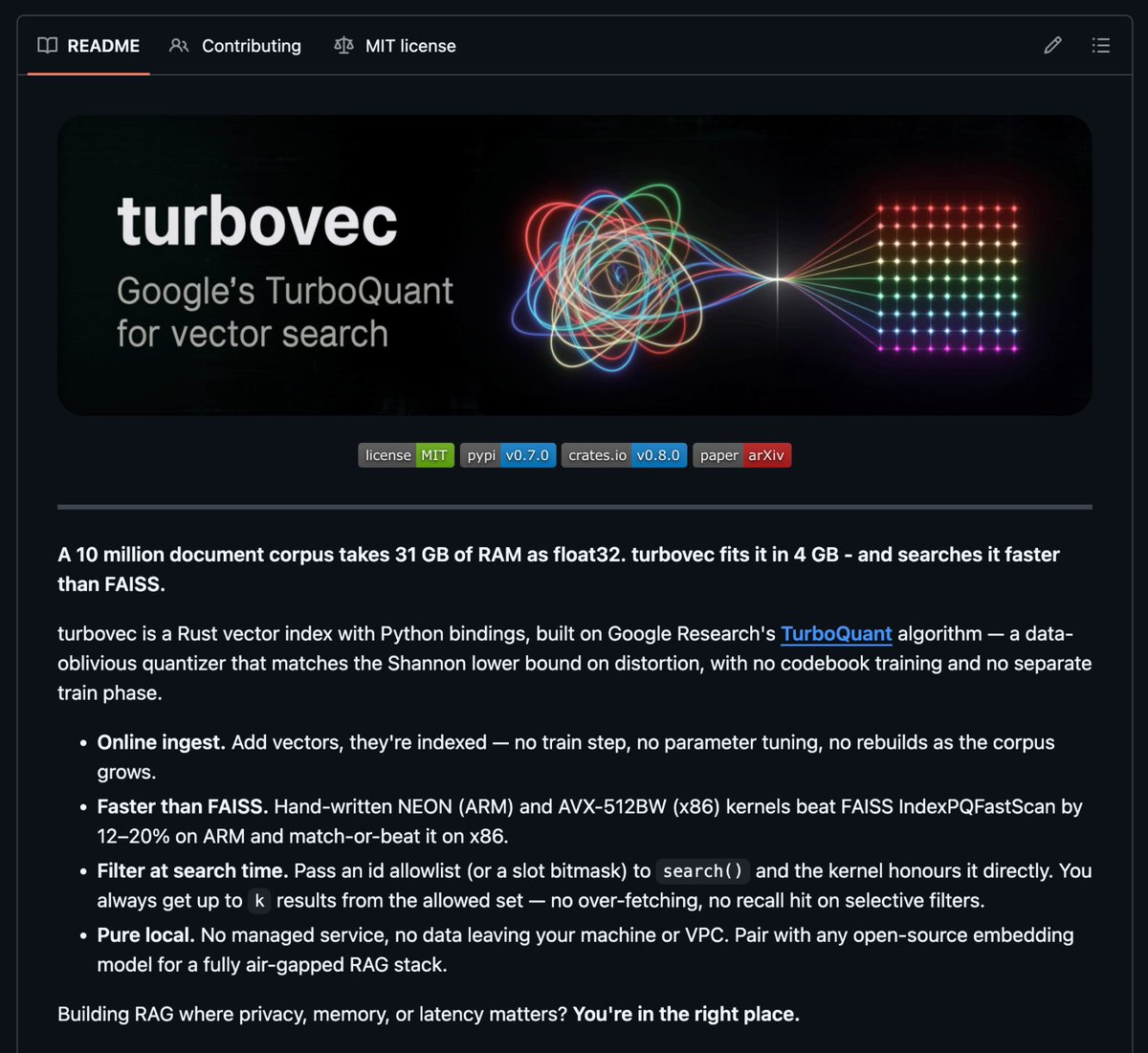
Someone fit 10 million documents into 4 GB of RAM.
The same corpus would consume 31 GB in float32 - yes, 31 GB.
turbovec did it. Rust vector index, Python bindings, MIT license.
The algorithm behind it (TurboQuant, from Google Research) compresses each vector without ever inspecting your dataset. Unlike traditional quantizers, it does not require a training phase, learned codebooks, or index rebuilds as the corpus grows.
How it works:
Normalize each vector and apply a random rotation. The resulting coordinates follow a predictable distribution regardless of the underlying dataset. From there, precomputed mathematical bounds determine the optimal quantization buckets, and the vectors are bit-packed into a compact representation.
A 1,536-dimensional OpenAI embedding shrinks from 6,144 bytes to 384 bytes - a 16× reduction in storage.
And it’s faster than FAISS:
→ On Apple Silicon (M3 Max), it runs 12–20% faster across every benchmarked configuration.
→ On x86 (Sapphire Rapids), it matches or outperforms FAISS at 4-bit quantization.
→ On 1,536-dimensional OpenAI embeddings, recall exceeds FAISS by up to 3.4 percentage points at R@1.
→ Filtered search runs directly inside the SIMD kernel, eliminating post-processing without sacrificing recall.
Drop-in compatible with LangChain, LlamaIndex, Haystack, and Agno, just swap the import.
Everything runs locally. Your data stays on your machine, with no managed service in the loop.
GitHub Repo: github.com/RyanCodrai/turbov…
3
32
198
8,529

Jun 10
Again, another brilliant post, and may I take the opportunity to expand on your ideas further using ideas by Wittgenstein, Heidegger, Popper, Arendt and Thomas Khun. How these ideas have travelled through institutions and their real-world implications, using the United Kingdom as an example. I also offer solutions.
If thoughts corrupts language, language can corrupt thoughts. Orwell
Let’s Start with Language
Karl Wittgenstein would likely agree with the mutual corruption but frame it more radically:
•Language isn't just a vehicle that can be polluted by bad thinking (e.g., political euphemisms in Orwell). It constitutes much of our thinking. Sloppy, vague, or contextually inappropriate language doesn't merely reflect poor thought—it creates the conditions for it by limiting what we can meaningfully express or even conceive.
•Fixing it requires returning words to their everyday "homes" in language games, not inventing ideal languages or fighting propaganda alone.
•This anticipates (and goes beyond) linguistic relativity ideas: different ways of speaking shape different "worlds" of thought.
This is important because the radicalised mind: language defines the world in which the person inhabits and, most importantly, creates horizons that they cannot see beyond. These ‘worlds’ are the framed reality that the radical dwells in.
As Wittgenstein says what cannot be pictured clearly (ethics, aesthetics, the mystical) lies outside meaningful language and thus outside what can be thought/said.
Wittgenstein would see the axiom as highlighting a core human predicament. Much of philosophy (and everyday confusion) stems from this loop, and THE REMEDY IS RIGOROUS ATTENTION TO HOW WE ACTUALLY USE LANGUAGE IN CONTEXT—NOT ABSTRACT THEORISING. His work is less about politics than about dissolving the mental traps language sets for us.
Wittgenstein Words function like tools (§11–14): a hammer, saw, ruler, etc., each with different uses. Meaning depends on the “language-game” it serves.
Wittgenstein’s words-as-tools and Heidegger’s equipment-in-a-world both show that we understand through practical, contextual engagements. Revolutionary thought forges powerful new “tools” and opens horizons—but it also limits by enframing reality in ways that hide alternatives. True insight requires vigilance: returning to use (Wittgenstein), attending to the historical clearing (Heidegger), or fusing horizons (Gadamer) to avoid being trapped by the very frameworks that enable thought. This loop echoes the original axiom—thought and language/tools mutually shape (and can corrupt) our world.
The key message from my post is that language creates ‘worlds of meaning’ (paradigm) that importantly set horizons that radicalised people cannot see beyond. They therefore are unable to uncover reality beyond this horizon; namely, they are captured. They are radicalised.
This is what we are witnessing in our society with inverted reality spouted from radicalised students and activist academics; the creation of institutional anti-white racism; the tolerance of intolerant closed groups such as religious groups and outcomes like acceptable Muslim misogyny; to multi-tiered policing and open discrimination against white men.
Revolutionary thought opens new sight (vision) and focuses that gaze (systemic analysis) but limits vision and creates blind spots—trapping adherents in a totalising frame they cannot easily see beyond. Therefore, the misuse of language through revolutionary thinking creates blindness to reality. This is both intentional and unintentional. For example, look at how the use of pronouns distorts the understanding of human gender.
Language creates ‘new worlds’ paradigms. We intuitively know them as dogmas and see their absurdity and limitations, but adherents don’t. I will explain why they can’t see it and more importantly, why they are so resistant to seeing it.
This is the condition of the brain-washed radical.
Heideggerian lens enriches the Kuhn/Popper debate by showing protective mechanisms as existential, not merely methodological. This is a crucial and profound insight. Dwell on this for a moment. The existential element is based on our temporal nature, effectively time itself but you need to understand temporality as the foundation of human reality to understand this point.
Language influences cognition—this is the core of the Sapir-Whorf hypothesis (linguistic relativity). In ideological contexts, specialised terminology (e.g., expanded definitions of harm, privilege, identity categories, or mandated rephrasings such as "enslaved" vs "slave," or novel prefixes/suffixes for identity) can function as a paradigm. It:
•Frames observable patterns (behavioural, statistical, historical) through a moral lens that prioritises certain narratives.
•Labels dissent as moral failure ("phobia," "denial," "violence"), creating an event horizon where counter-evidence becomes invisible or heretical.
•Turns anomalies into "dark matter": realities that must exist (e.g., biological sex differences in some domains, cultural factors in outcomes, trade-offs in policies) but are reframed as socially constructed illusions or products of oppression, unseeable within the framework.
REVOLUTIONARY PARADIGMS FOCUS ON FULL SOCIETAL CAPTURE ROLLED OUT THROUGH POLICIES, EDUCATION AND ULTIMATELY THE SOFT TERROR OF SELF-POLICING.
Marxists recognised early on the limitations of purely economic or revolutionary approaches and turned to cultural capture as the key to long-term power. Antonio Gramsci, writing in the 1920s–1930s, argued that in advanced Western societies the ruling class-maintained dominance not mainly through force, but through cultural hegemony — shaping education, media, arts, and common sense so that the existing order appeared natural and inevitable. He advocated a slow “war of position” to infiltrate civil society institutions.
Louis Althusser later formalised this in the 1970s with his theory of Ideological State Apparatuses (schools, media, family, culture), which reproduce the system by “hailing” individuals as willing subjects of the dominant ideology. These ideas profoundly influenced modern progressive thinking. They provided a practical blueprint for gradual institutional capture: occupy universities, media, schools, and cultural bodies first, then reshape public “common sense” around identity, equity, and systemic oppression. Today’s dominant frameworks in Western elites — from DEI policies and curriculum decolonisation to reframing history as intersecting victimhood — are direct descendants of this Gramsci-Althusser strategy of ideological and cultural hegemony.
THESE PARADIGMS CAN CAPTURE DISCIPLINES AND DOMINATE FACULTIES IN UNIVERSITIES.
EVIDENCE IN THE US (IVY LEAGUE AND BEYOND)
Elite institutions led the way with expansive DEI bureaucracies, diversity statements as litmus tests, affinity housing/events, and reframed histories (e.g., 1619 Project influences). This extended to admissions, orientations, and disciplinary actions. Backlash and partial rollbacks (hundreds of campuses eliminating DEI offices/statements in response to post-2023/2025 political pressure) confirm the prior depth of embedding.
Evidence in the UK (Oxford, Cambridge, Red-Brick, Plate-Glass): similar patterns: widespread adoption of “anti-racism” frameworks, white privilege discourse, and decolonisation initiatives in history, law, criminology, and social sciences. Advance HE schemes (Race Equality Charter) incentivised alignment across institutions. Oxford and Cambridge faced internal pressure for curriculum reframing; newer civic universities often saw faster uptake of activist-oriented departments. Surveys indicated strong left-leaning dominance in relevant faculties
Broader Indicators of Capture
Self-Censorship and Chilling Effects: High rates of students/faculty avoiding controversial topics.
Disciplinary Gatekeeping: Hiring, promotions, and publishing favoured paradigm-aligned work.
Administrative Expansion: DEI staff often outnumbered roles in core academic functions at some institutions pre-rollback.
This capture transformed universities from truth-seeking institutions (per older paradigms of liberal inquiry) into vehicles for a totalising worldview. While pushback since ~2023 (state laws, donor pressure, Trump-era actions) has prompted dismantling at many places, the entrenched faculty culture, language, and practices mean the paradigm retains significant influence in 2026—especially in elite humanities/social sciences.
Institutional Capture and the Creation of Paradigms on Captured Worlds and Limited Horizons
Thomas Kuhn’s Structure of Scientific Revolutions: normal science operates within a paradigm (shared tools, language, practices—like Wittgensteinian language-games). Revolutionary politics enframe reality as a total referential totality—a world-disclosing horizon. But unlike flexible, contextual tools, it rigidly enframes the entire world as one giant, ordered system.
Anomalies lead to crisis and revolutionary shift to a new paradigm, incommensurable with the old. One cannot fully “see” the prior horizon from within the new one; the tools/worldview change what counts as intelligible.
Karl Popper would demand constant, severe testing of core claims (e.g., falsifiability of “systemic racism” as the default explanation) and criticise protective mechanisms that shield the paradigm from refutation. Popper might view the shift as pseudoscientific if it resists falsification.
Protective mechanisms. Heidegger’s phenomenology of mood (Stimmung / attunement / Befindlichkeit) and anxiety (Angst) provides a deeper existential-ontological layer for understanding these mechanisms. Moods are not subjective emotions but fundamental ways the world discloses itself or conceals alternatives. They structure our pre-reflective “being-in-the-world. A world constructed on paradigms and the misuse of words
Application to the Woke Ideological Paradigm Example In the framework white privilege/supremacy as default lens:
•The prevailing mood in woke academia is one of attuned moral vigilance and systemic suspicion—comforting for adherents because it provides clear orientation, purpose, and moral superiority within the horizon.
•Anomalies (e.g., empirical counter-evidence on group outcomes, non-Western histories, double standards) generate anxiety: they threaten the totalising intelligibility (“everything is oppression/privilege”).
•Protective responses—reframing as “internalised supremacy,” dismissing critics as defensive, institutional reinforcement—function as flight into inauthenticity. They preserve the enframed world rather than allowing anxiety to disclose possibilities beyond it (e.g., colour-blind universalism, empirical scrutiny, Western self-correction)
HOW DID WE ALLOW OUR CULTURAL CAPTURE UNDERSTANDING THIS VIA THOMAS KUHN’S FRAMEWORK
Pre-Paradigmatic / Emergence Phase of Current Marxist Theory
Pre-1960s intellectual foundations—Michel Foucault’s concepts of power/knowledge, Antonio Gramsci’s theory of cultural hegemony, and the Frankfurt School’s critical theory—supplied the conceptual tools for viewing society as a web of domination and oppression. These ideas gained significant influence, with Marxist-inspired theories reaching their peak in the West around 1968.
However, their mainstream momentum was halted by a series of devastating reality checks. The publication of Aleksandr Solzhenitsyn’s The Gulag Archipelago and his later essays exposed the horrors of Soviet communism; Mao’s Cultural Revolution revealed the fanatical brutality of ideological brainwashing; and the Khmer Rouge’s “Killing Fields” in Cambodia demonstrated the genocidal consequences of radical Marxist experiments. These events created a profound ideological rupture that discredited Marxist thought in mainstream Western circles.
Only decades later, as these atrocities faded from collective memory, did a new generation of grievance-based activists revive and adapt these frameworks, gradually regaining cultural and institutional traction.
A key exemplar (Kuhnian concrete model) was Peggy McIntosh’s 1988/1989 essay "White Privilege: Unpacking the Invisible Knapsack". McIntosh described white privilege as “an invisible weightless knapsack of special provisions, maps, passports, codebooks, visas, clothes, tools and blank checks,” listing everyday advantages (e.g., seeing one’s race widely represented, not being followed while shopping) framed as unearned systemic benefits. This shifted emphasis from individual prejudice to invisible “whiteness” as the default framework.
Language evolution: “Racism” was redefined as “prejudice plus power” (or institutional power), a formulation traced to Patricia Bidol-Padva’s 1970 work, Developing New Perspectives on Race. This made racism structurally unavailable to non-dominant groups. “Supremacy” expanded from overt ideologies (e.g., Klan) to embedded cultural defaults. These terms became tools in new language-games of activism, DEI training, and scholarship—performative moves that reframe situations rather than merely describe intent.
Normal Science Phase (Puzzle-Solving Within the Paradigm): Once institutionalised in academia, media, corporations, schools, and DEI offices, this operates as routine “normal” work: Applying “white privilege,” “white supremacy,” or systemic racism to explain outcome disparities (wealth, education, crime).
Exemplars include curriculum revisions such as The 1619 Project (reframing U.S. history around 1619 and slavery), diversity audits, power-lens analyses of classics, and training sessions.
Anomalies (e.g., socioeconomic success of certain non-white groups like Asian Americans or African immigrants, historical slavery/empire in non-Western societies, pre-1960s trends in U.S. race relations) are typically managed via auxiliary adjustments: “internalised supremacy,” “model minority myth,” or demands for deeper intervention.
Shared practices mirror Wittgenstein: meaning-as-use. “Check your privilege” functions as a conversational stopper; “whiteness” as an analytical tool. This creates a Heideggerian enframing—history, culture, and individuals ordered as standing-reserve for ongoing anti-racist deconstruction and equity intervention.
Crisis in Revolutionary Politics
Murray documents accumulating anomalies or blind-spots created by these dogmas: backlash against Critical Race Theory in schools, predictive failures (persistent gaps despite interventions), double standards (non-Western slavery/empire often downplayed), empirical counter-evidence, and societal costs (polarisation, declining trust, self-censorship).
This fosters defence of older paradigms: classical liberalism, colour-blind individualism, Enlightenment universalism, and empirical scrutiny. Incommensurability emerges—core terms (“racism,” “equity,” “justice,” “supremacy”) carry different meanings across frameworks, leading to mutual incomprehension.
THE UNITED KINGDOM AS A LIVE EXAMPLE OF ELITE CAPTURE: LABOUR GOVERNMENT VS. PUBLIC WORLDVIEW (2026)
The UK under Keir Starmer’s Labour Government (elected 2024) illustrates a classic case of elite paradigm capture clashing with the broader population’s attunement. The governing class—ministers, senior civil servants, much of academia, media, and cultural institutions—operates within a horizon shaped by progressive internationalist values: high immigration, identity-aware equity, and institutional defensiveness. Large segments of the public, especially outside London and among working-class voters, inhabit a different world-of-meaning: pragmatic concern over rapid demographic change, economic pressures, cultural cohesion, and equal application of the law.
This is not mere policy disagreement but a deeper clash of world-disclosing moods. The governing paradigm (identity-equity-oppression) cannot easily accommodate public attunement focused on pragmatism, fairness-as-equal-treatment, and preservation of national character. Protective mechanisms — denial of two-tier realities, reframing of public discontent, institutional roll-out of soft terror and self-policing— sustain the elite horizon while intensifying public anxiety.
The Labour-Fabian strategy has always been gradual permeation rather than sudden revolution — “the inevitability of gradualness.” In the cultural sphere, this manifests as a soft totalitarianism that operates through moral language, institutional capture, and the slow reshaping of thought itself. Arendt’s framework in The Origins of Totalitarianism illuminates how this process works in contemporary Western societies.
Ideology as Fiction: Fabian-influenced progressivism functions as a totalising ideology — a secular “key to history” centred on identity, equity, and systemic oppression. Just as racial or class struggle explained everything for earlier totalitarianisms, today’s framework explains all human relations through lenses of power, privilege, and victimhood. Past, present, and future are reframed: history is a story of intersecting oppressions; the present demands constant atonement and redistribution; the future promises a just utopia once the old structures are dismantled.
Propaganda and indoctrination (through education, media, corporate DEI, and public institutions) replace empirical truth with internal ideological consistency. Contradictory facts — biological sex, crime statistics, cultural outcomes, or the lived failures of past socialist experiments — are erased, reinterpreted, or declared “harmful.” The ideal subject is the one for whom the distinction between fact and fiction, and between true and false, no longer exists. Moral slogans (“inclusion,” “equity,” “safety”) cloak this fiction in sheep’s clothing, presenting control as compassion and dissent as moral failure.
Soft-Terror and the Destruction of Plurality.
Totalitarian terror need not be camps and secret police in its early cultural phase. In the Fabian culture war, it appears as soft terror: cancellation, deplatforming, professional ruin, social ostracism, and institutional exclusion. Spontaneous human relationships are shattered when every interaction is policed for ideological purity. Plurality — the natural diversity of opinions, traditions, and ways of life that Arendt saw as the essence of political freedom — is replaced by enforced uniformity.
Dissenters are not debated; they are pathologised as “problematic,” “unsafe,” or bearing “phobias.” This atomises society: people self-censor, friendships fracture along ideological lines, and genuine public discourse dies. What remains is a levelled public sphere where only approved narratives survive. The concentration camp’s laboratory function (“everything is possible”) is replaced by the cultural one: identities can be fluid, speech can be violence, biology can be rewritten — proving that reality itself is malleable to the ideology.
Loneliness as the Common Ground
Arendt identified loneliness (Verlassenheit) as the soil in which totalitarianism grows. In the modern mass age, traditional bonds — family, church, community, nation — erode under mobility, secularisation, economic pressures, and digital fragmentation. People feel uprooted and superfluous. Social media intensifies this: endless comparison, performative outrage, and shallow connection leave deeper isolation.
Jun 9

Five of George Orwell's most important lessons:
1. Tyrants redefine language to obscure reality
2. Those who rewrite the past wish to control the future
3. The most effective surveillance is self-imposed
4. Emotional manipulation = control
5. Revolutions serve the resentful, not the oppressed
786
Jun 10
Again, another brilliant post, and may I take the opportunity to expand on your ideas further using ideas by Wittgenstein, Heidegger, Popper, Arendt and Thomas Khun. How these Marxist ideas have conquered institutions and their real-world implications, using the United Kingdom as an example. I also offer solutions.
If thoughts corrupts language, language can corrupt thoughts. Orwell
Let’s Start with Language
Karl Wittgenstein would likely agree with the mutual corruption but frame it more radically:
•Language isn't just a vehicle that can be polluted by bad thinking (e.g., political euphemisms in Orwell). It constitutes much of our thinking. Sloppy, vague, or contextually inappropriate language doesn't merely reflect poor thought—it creates the conditions for it by limiting what we can meaningfully express or even conceive.
•Fixing it requires returning words to their everyday "homes" in language games, not inventing ideal languages or fighting propaganda alone.
•This anticipates (and goes beyond) linguistic relativity ideas: different ways of speaking shape different "worlds" of thought.
This is important because the radicalised mind: language defines the world in which the person inhabits and, most importantly, creates horizons that they cannot see beyond. These ‘worlds’ are the framed reality that the radical dwells in.
As Wittgenstein says, what cannot be pictured clearly (ethics, aesthetics, the mystical) lies outside meaningful language and thus outside what can be thought/said.
Wittgenstein would see the axiom as highlighting a core human predicament. Much of philosophy (and everyday confusion) stems from this loop, and THE REMEDY IS RIGOROUS ATTENTION TO HOW WE ACTUALLY USE LANGUAGE IN CONTEXT—NOT ABSTRACT THEORISING.
His work is less about politics than about dissolving the mental traps language sets for us.
Wittgenstein Words function like tools (§11–14): a hammer, saw, ruler, etc., each with different uses. Meaning depends on the “language-game” it serves.
Wittgenstein’s words-as-tools and Heidegger’s equipment-in-a-world both show that we understand through practical, contextual engagements. Revolutionary thought forges powerful new “tools” and opens horizons—but it also limits by enframing reality in ways that hide alternatives. True insight requires vigilance: returning to use (Wittgenstein), attending to the historical clearing (Heidegger), or fusing horizons (Gadamer) to avoid being trapped by the very frameworks that enable thought. This loop echoes the original axiom—thought and language/tools mutually shape (and can corrupt) our world.
The key message from my post is that language creates ‘worlds of meaning’ (paradigm) that importantly set horizons that radicalised people cannot see beyond. They therefore are unable to uncover reality beyond this horizon; namely, they are captured. They are radicalised.
This is what we are witnessing in our society with inverted reality spouted from radicalised students and activist academics; the creation of institutional anti-white racism; the tolerance of intolerant closed groups such as religious groups and outcomes like acceptable Muslim misogyny; to multi-tiered policing and open discrimination against white men.
Revolutionary thought opens new sight (vision) and focuses that gaze (systemic analysis) but limits vision and creates blind spots—trapping adherents in a totalising frame they cannot easily see beyond. Therefore, the misuse of language through revolutionary thinking creates blindness to reality. This is both intentional and unintentional. For example, look at how the use of pronouns distorts the understanding of human gender.
Language creates ‘new worlds’ paradigms. We intuitively know them as dogmas and see their absurdity and limitations, but adherents don’t. I will explain why they can’t see it and more importantly, why they are so resistant to seeing it.
This is the condition of the brain-washed radical.
Heideggerian lens enriches the Kuhn/Popper debate by showing protective mechanisms as existential, not merely methodological. This is a crucial and profound insight. Dwell on this for a moment. The existential element is based on our temporal nature, effectively time itself but you need to understand temporality as the foundation of human reality to understand this point.
Language influences cognition—this is the core of the Sapir-Whorf hypothesis (linguistic relativity). In ideological contexts, specialised terminology (e.g., expanded definitions of harm, privilege, identity categories, or mandated rephrasings such as "enslaved" vs "slave," or novel prefixes/suffixes for identity) can function as a paradigm. It:
•Frames observable patterns (behavioural, statistical, historical) through a moral lens that prioritises certain narratives.
•Labels dissent as moral failure ("phobia," "denial," "violence"), creating an event horizon where counter-evidence becomes invisible or heretical.
•Turns anomalies into "dark matter": realities that must exist (e.g., biological sex differences in some domains, cultural factors in outcomes, trade-offs in policies) but are reframed as socially constructed illusions or products of oppression, unseeable within the framework.
REVOLUTIONARY PARADIGMS FOCUS ON FULL SOCIETAL CAPTURE ROLLED OUT THROUGH POLICIES, EDUCATION AND ULTIMATELY THE SOFT TERROR OF SELF-POLICING.
Marxists recognised early on the limitations of purely economic or revolutionary approaches and turned to cultural capture as the key to long-term power. Antonio Gramsci, writing in the 1920s–1930s, argued that in advanced Western societies the ruling class-maintained dominance not mainly through force, but through cultural hegemony — shaping education, media, arts, and common sense so that the existing order appeared natural and inevitable. He advocated a slow “war of position” to infiltrate civil society institutions.
Louis Althusser later formalised this in the 1970s with his theory of Ideological State Apparatuses (schools, media, family, culture), which reproduce the system by “hailing” individuals as willing subjects of the dominant ideology. These ideas profoundly influenced modern progressive thinking. They provided a practical blueprint for gradual institutional capture: occupy universities, media, schools, and cultural bodies first, then reshape public “common sense” around identity, equity, and systemic oppression. Today’s dominant frameworks in Western elites — from DEI policies and curriculum decolonisation to reframing history as intersecting victimhood — are direct descendants of this Gramsci-Althusser strategy of ideological and cultural hegemony.
THESE PARADIGMS CAN CAPTURE DISCIPLINES AND DOMINATE FACULTIES IN UNIVERSITIES.
EVIDENCE IN THE US (IVY LEAGUE AND BEYOND)
Elite institutions led the way with expansive DEI bureaucracies, diversity statements as litmus tests, affinity housing/events, and reframed histories (e.g., 1619 Project influences). This extended to admissions, orientations, and disciplinary actions. Backlash and partial rollbacks (hundreds of campuses eliminating DEI offices/statements in response to post-2023/2025 political pressure) confirm the prior depth of embedding.
Evidence in the UK (Oxford, Cambridge, Red-Brick, Plate-Glass): similar patterns: widespread adoption of “anti-racism” frameworks, white privilege discourse, and decolonisation initiatives in history, law, criminology, and social sciences. Advance HE schemes (Race Equality Charter) incentivised alignment across institutions. Oxford and Cambridge faced internal pressure for curriculum reframing; newer civic universities often saw faster uptake of activist-oriented departments. Surveys indicated strong left-leaning dominance in relevant faculties
Broader Indicators of Capture
Self-Censorship and Chilling Effects: High rates of students/faculty avoiding controversial topics.
Disciplinary Gatekeeping: Hiring, promotions, and publishing favoured paradigm-aligned work.
Administrative Expansion: DEI staff often outnumbered roles in core academic functions at some institutions pre-rollback.
This capture transformed universities from truth-seeking institutions (per older paradigms of liberal inquiry) into vehicles for a totalising worldview. While pushback since ~2023 (state laws, donor pressure, Trump-era actions) has prompted dismantling at many places, the entrenched faculty culture, language, and practices mean the paradigm retains significant influence in 2026—especially in elite humanities/social sciences.
Institutional Capture and the Creation of Paradigms on Captured Worlds and Limited Horizons
Thomas Kuhn’s Structure of Scientific Revolutions: normal science operates within a paradigm (shared tools, language, practices—like Wittgensteinian language-games). Revolutionary politics enframe reality as a total referential totality—a world-disclosing horizon. But unlike flexible, contextual tools, it rigidly enframes the entire world as one giant, ordered system.
Anomalies lead to crisis and revolutionary shift to a new paradigm, incommensurable with the old. One cannot fully “see” the prior horizon from within the new one; the tools/worldview change what counts as intelligible.
Karl Popper would demand constant, severe testing of core claims (e.g., falsifiability of “systemic racism” as the default explanation) and criticise protective mechanisms that shield the paradigm from refutation. Popper might view the shift as pseudoscientific if it resists falsification.
Protective mechanisms. Heidegger’s phenomenology of mood (Stimmung / attunement / Befindlichkeit) and anxiety (Angst) provides a deeper existential-ontological layer for understanding these mechanisms. Moods are not subjective emotions but fundamental ways the world discloses itself or conceals alternatives. They structure our pre-reflective “being-in-the-world. A world constructed on paradigms and the misuse of words
Application to the Woke Ideological Paradigm Example In the framework white privilege/supremacy as default lens:
•The prevailing mood in woke academia is one of attuned moral vigilance and systemic suspicion—comforting for adherents because it provides clear orientation, purpose, and moral superiority within the horizon.
•Anomalies (e.g., empirical counter-evidence on group outcomes, non-Western histories, double standards) generate anxiety: they threaten the totalising intelligibility (“everything is oppression/privilege”).
•Protective responses—reframing as “internalised supremacy,” dismissing critics as defensive, institutional reinforcement—function as flight into inauthenticity. They preserve the enframed world rather than allowing anxiety to disclose possibilities beyond it (e.g., colour-blind universalism, empirical scrutiny, Western self-correction)
HOW DID WE ALLOW OUR CULTURAL CAPTURE UNDERSTANDING THIS VIA THOMAS KUHN’S FRAMEWORK
Pre-Paradigmatic / Emergence Phase of Current Marxist Theory
Pre-1960s intellectual foundations—Michel Foucault’s concepts of power/knowledge, Antonio Gramsci’s theory of cultural hegemony, and the Frankfurt School’s critical theory—supplied the conceptual tools for viewing society as a web of domination and oppression. These ideas gained significant influence, with Marxist-inspired theories reaching their peak in the West around 1968.
However, their mainstream momentum was halted by a series of devastating reality checks. The publication of Aleksandr Solzhenitsyn’s The Gulag Archipelago and his later essays exposed the horrors of Soviet communism; Mao’s Cultural Revolution revealed the fanatical brutality of ideological brainwashing; and the Khmer Rouge’s “Killing Fields” in Cambodia demonstrated the genocidal consequences of radical Marxist experiments. These events created a profound ideological rupture that discredited Marxist thought in mainstream Western circles.
Only decades later, as these atrocities faded from collective memory, did a new generation of grievance-based activists revive and adapt these frameworks, gradually regaining cultural and institutional traction.
A key exemplar (Kuhnian concrete model) was Peggy McIntosh’s 1988/1989 essay "White Privilege: Unpacking the Invisible Knapsack". McIntosh described white privilege as “an invisible weightless knapsack of special provisions, maps, passports, codebooks, visas, clothes, tools and blank checks,” listing everyday advantages (e.g., seeing one’s race widely represented, not being followed while shopping) framed as unearned systemic benefits. This shifted emphasis from individual prejudice to invisible “whiteness” as the default framework.
Language evolution: “Racism” was redefined as “prejudice plus power” (or institutional power), a formulation traced to Patricia Bidol-Padva’s 1970 work, Developing New Perspectives on Race. This made racism structurally unavailable to non-dominant groups. “Supremacy” expanded from overt ideologies (e.g., Klan) to embedded cultural defaults. These terms became tools in new language-games of activism, DEI training, and scholarship—performative moves that reframe situations rather than merely describe intent.
Normal Science Phase (Puzzle-Solving Within the Paradigm): Once institutionalised in academia, media, corporations, schools, and DEI offices, this operates as routine “normal” work: Applying “white privilege,” “white supremacy,” or systemic racism to explain outcome disparities (wealth, education, crime).
Exemplars include curriculum revisions such as The 1619 Project (reframing U.S. history around 1619 and slavery), diversity audits, power-lens analyses of classics, and training sessions.
Anomalies (e.g., socioeconomic success of certain non-white groups like Asian Americans or African immigrants, historical slavery/empire in non-Western societies, pre-1960s trends in U.S. race relations) are typically managed via auxiliary adjustments: “internalised supremacy,” “model minority myth,” or demands for deeper intervention.
Shared practices mirror Wittgenstein: meaning-as-use. “Check your privilege” functions as a conversational stopper; “whiteness” as an analytical tool. This creates a Heideggerian enframing—history, culture, and individuals ordered as standing-reserve for ongoing anti-racist deconstruction and equity intervention.
Crisis in Revolutionary Politics
Murray documents accumulating anomalies or blind-spots created by these dogmas: backlash against Critical Race Theory in schools, predictive failures (persistent gaps despite interventions), double standards (non-Western slavery/empire often downplayed), empirical counter-evidence, and societal costs (polarisation, declining trust, self-censorship).
This fosters defence of older paradigms: classical liberalism, colour-blind individualism, Enlightenment universalism, and empirical scrutiny. Incommensurability emerges—core terms (“racism,” “equity,” “justice,” “supremacy”) carry different meanings across frameworks, leading to mutual incomprehension.
THE UNITED KINGDOM AS A LIVE EXAMPLE OF ELITE CAPTURE: LABOUR GOVERNMENT VS. PUBLIC WORLDVIEW (2026)
The UK under Keir Starmer’s Labour Government (elected 2024) illustrates a classic case of elite paradigm capture clashing with the broader population’s attunement. The governing class—ministers, senior civil servants, much of academia, media, and cultural institutions—operates within a horizon shaped by progressive internationalist values: high immigration, identity-aware equity, and institutional defensiveness. Large segments of the public, especially outside London and among working-class voters, inhabit a different world-of-meaning: pragmatic concern over rapid demographic change, economic pressures, cultural cohesion, and equal application of the law.
This is not mere policy disagreement but a deeper clash of world-disclosing moods. The governing paradigm (identity-equity-oppression) cannot easily accommodate public attunement focused on pragmatism, fairness-as-equal-treatment, and preservation of national character. Protective mechanisms — denial of two-tier realities, reframing of public discontent, institutional roll-out of soft terror and self-policing— sustain the elite horizon while intensifying public anxiety.
The Labour-Fabian strategy has always been gradual permeation rather than sudden revolution — “the inevitability of gradualness.” In the cultural sphere, this manifests as a soft totalitarianism that operates through moral language, institutional capture, and the slow reshaping of thought itself. Arendt’s framework in The Origins of Totalitarianism illuminates how this process works in contemporary Western societies.
Ideology as Fiction: Fabian-influenced progressivism functions as a totalising ideology — a secular “key to history” centred on identity, equity, and systemic oppression. Just as racial or class struggle explained everything for earlier totalitarianisms, today’s framework explains all human relations through lenses of power, privilege, and victimhood. Past, present, and future are reframed: history is a story of intersecting oppressions; the present demands constant atonement and redistribution; the future promises a just utopia once the old structures are dismantled.
Propaganda and indoctrination (through education, media, corporate DEI, and public institutions) replace empirical truth with internal ideological consistency. Contradictory facts — biological sex, crime statistics, cultural outcomes, or the lived failures of past socialist experiments — are erased, reinterpreted, or declared “harmful.” The ideal subject is the one for whom the distinction between fact and fiction, and between true and false, no longer exists. Moral slogans (“inclusion,” “equity,” “safety”) cloak this fiction in sheep’s clothing, presenting control as compassion and dissent as moral failure.
Soft-Terror and the Destruction of Plurality.
Totalitarian terror need not be camps and secret police in its early cultural phase. In the Fabian culture war, it appears as soft terror: cancellation, deplatforming, professional ruin, social ostracism, and institutional exclusion. Spontaneous human relationships are shattered when every interaction is policed for ideological purity. Plurality — the natural diversity of opinions, traditions, and ways of life that Arendt saw as the essence of political freedom — is replaced by enforced uniformity.
Dissenters are not debated; they are pathologised as “problematic,” “unsafe,” or bearing “phobias.” This atomises society: people self-censor, friendships fracture along ideological lines, and genuine public discourse dies. What remains is a levelled public sphere where only approved narratives survive. The concentration camp’s laboratory function (“everything is possible”) is replaced by the cultural one: identities can be fluid, speech can be violence, biology can be rewritten — proving that reality itself is malleable to the ideology.
Loneliness as the Common Ground
Arendt identified loneliness (Verlassenheit) as the soil in which totalitarianism grows. In the modern mass age, traditional bonds — family, church, community, nation — erode under mobility, secularisation, economic pressures, and digital fragmentation. People feel uprooted and superfluous. Social media intensifies this: endless comparison, performative outrage, and shallow connection leave deeper isolation.
437

When Better Codebooks Are Not Enough: Predictive Performance and Behavioral Reliability in LLM Political Event Coding
Zixian He, Bharath Raahul Murugesan, Patrick Brandt, Yibo Hu
arxiv.org/abs/2606.06781 [𝚌𝚜.𝙲𝙻]
1
1
65


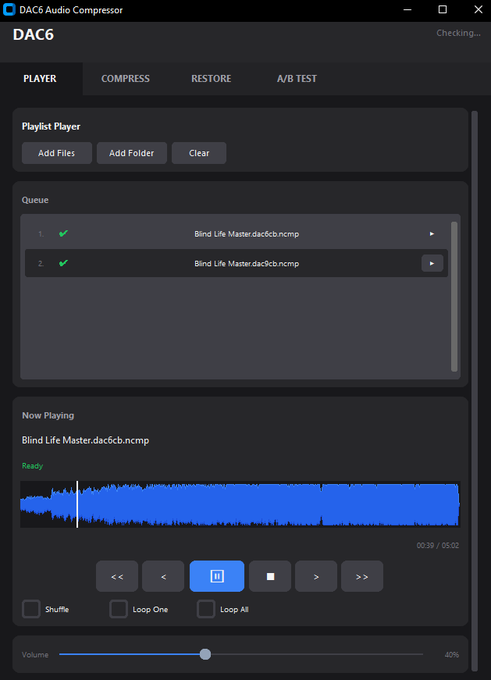
x100 compression Opensource DAC6
github.com/ignaciosua/dac-pl…
🗜️ COMPRESS - Batch neural audio compression (4-42 kbps for music, ultra-low bitrates)
📂 RESTORE - Decompress .ncmp files to WAV/FLAC/MP3
🔍 A/B TEST - Side-by-side quality comparison with synchronized playback
🎵 PLAYER - Built-in music player with playlist support, shuffle, and loop modes
⚡ GPU Acceleration - Fast processing with NVIDIA CUDA support
📦 Batch Processing - Drag & drop multiple files, process entire folders
🎚️ Configurable Quality - Choose codebooks (3-32) for size vs quality balance (model-dependent)
🔊 HQ Resampling - Automatic 44.1kHz resampling with high-quality filters
31

Jun 8
Moshi style Mimi codebooks, bootstrapped via Kokoro, trained in a few hours on a B200
2
132

Jun 8
[19/25] 📄 arXiv cs.CL
When Better Codebooks Are Not Enough: Predictive Performance and Behavioral Reliability in LLM Political Event Coding
arxiv.org/abs/2606.06781
1
3

82 years ago today, eight American sailors jumped onto a sinking Nazi submarine in the middle of the Atlantic.
What they pulled out of it changed the war. And the Navy buried the whole story for years.
First, you need to know that U-505 was already cursed. German sailors called her the unluckiest boat in the fleet. In October 1943, during a brutal British depth-charge attack, her own captain shot himself in the head in the control room, in front of his crew. He remains the only submarine commander in history known to have killed himself underwater in combat. His second-in-command calmly took over, rode out the attack, and sailed her home.
Eight months later, her luck ran out completely.
June 4, 1944. Two days before D-Day. Captain Daniel Gallery's hunter-killer group, built around the escort carrier USS Guadalcanal, had been stalking U-boats off West Africa. Gallery had an idea his superiors considered borderline insane: don't sink the next one. Capture it. No US Navy crew had boarded and taken an enemy warship on the high seas since 1815.
The destroyer escort USS Chatelain caught U-505 on sonar and fired a salvo of hedgehog bombs. The U-boat broke the surface 700 yards away. Gunfire raked the conning tower, wounding her captain. He gave the order to abandon ship.
The Germans rushed out so fast they botched the scuttling. The sub was flooding, but her engines were still running. She was circling the battle at six knots, empty, sinking, and very possibly rigged with demolition charges.
So Lt. Albert David and eight men from USS Pillsbury chased her down in a whaleboat, leaped aboard, and climbed down the hatch into a dark, flooding submarine that could explode or go under at any second. They shut the scuttling valves, disarmed the charges, and stopped the flooding.
Down there they found the prize: Enigma cipher machines and roughly 900 pounds of codebooks and charts. Current settings. The keys to the German navy's secret communications.
But here's the catch. The treasure was only valuable if Germany never found out. One leak and Berlin changes every code overnight.
So the Navy ran one of the great cover-ups of the war. The sub was towed 1,700 miles to Bermuda and given a fake American name: USS Nemo. Around 3,000 sailors were sworn to total silence. The 58 captured German crewmen vanished into a POW camp in rural Louisiana, hidden even from the Red Cross. Germany declared U-505 lost with all hands and notified the families. The dead men were alive in Louisiana, and their boat was working for the US Navy.
The secret held until the war ended.
Lt. David received the Medal of Honor, the only one awarded in the Atlantic Fleet in all of WWII.
And the submarine? In 1954, Chicagoans raised $250,000 to bring her home. She was towed across Lake Michigan and dragged through the streets of Chicago to the Museum of Science and Industry.
She's still sitting there right now. You can walk through her.

4
11
551

raw STE still works unreasonably well for what it is as a biased gradient. you can train vqvae style codebooks with a MoE style topk=1 router instead of the hacky non-differentiable nearest neighbor stuff.
it's much better behaved
(right is a flat 65k vocab 256 toks, mse recon)

Jun 5

its so interesting to me that MoE router weights are the one place we don't really trust gradient descent. We add our own biases, sorting functions, heuristics because regular descent wants to be totally degenerate
3
2
47
7,042


Jun 5
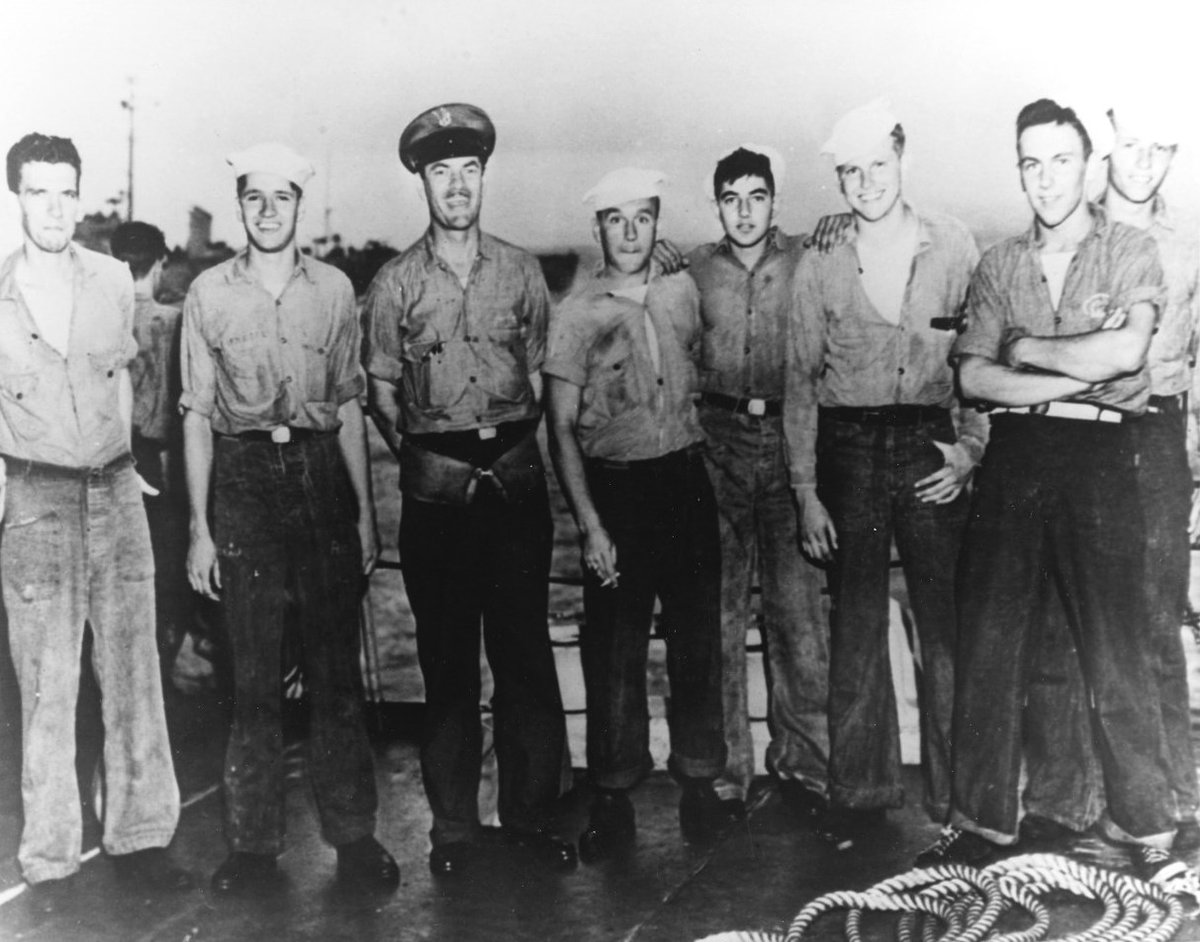
USS Pillsbury crew members who were the first party to board the German submarine U-505 after being abandoned by her crew, eastern Atlantic, 4 Jun 1944.
The USS Pillsbury (DE 133) was an Edsall-class destroyer escort, and its claim to fame is the capture of the German submarine U-505 on June 4, 1944, exactly 82 years ago today, as it happens.
Pillsbury was part of Task Group 22.3, a hunter-killer group centered on the escort carrier USS Guadalcanal under Captain Daniel Gallery. Off the coast of West Africa, the group detected U-505, a Type IXC U-boat, and drove it to the surface with depth charges. As the German crew abandoned ship, Pillsbury launched a boarding party led by Lieutenant (j.g.) Albert David. They climbed into the sinking, possibly booby-trapped sub, closed the scuttling valves, stopped the flooding, and secured charts, codebooks, and two Enigma machines. This intelligence was kept secret so the Germans would assume the boat was lost.
It was the first capture of an enemy warship on the high seas by the US Navy since the War of 1812. Albert David received the Medal of Honor for leading the boarding party.
U-505 itself survived the war as a classified secret, was nearly used for torpedo target practice, and was instead donated to the Museum of Science and Industry in Chicago in 1954, where it remains on display today as one of only a handful of surviving WWII U-boats.
Pillsbury earned a Presidential Unit Citation for the capture and was scrapped in the 1960s.
4
20
118
4,378

82 years ago today, eight American sailors jumped onto a sinking Nazi submarine in the middle of the Atlantic.
What they pulled out of it changed the war. And the Navy buried the whole story for years.
First, you need to know that U-505 was already cursed. German sailors called her the unluckiest boat in the fleet. In October 1943, during a brutal British depth-charge attack, her own captain shot himself in the head in the control room, in front of his crew. He remains the only submarine commander in history known to have killed himself underwater in combat. His second-in-command calmly took over, rode out the attack, and sailed her home.
Eight months later, her luck ran out completely.
June 4, 1944. Two days before D-Day. Captain Daniel Gallery's hunter-killer group, built around the escort carrier USS Guadalcanal, had been stalking U-boats off West Africa. Gallery had an idea his superiors considered borderline insane: don't sink the next one. Capture it. No US Navy crew had boarded and taken an enemy warship on the high seas since 1815.
The destroyer escort USS Chatelain caught U-505 on sonar and fired a salvo of hedgehog bombs. The U-boat broke the surface 700 yards away. Gunfire raked the conning tower, wounding her captain. He gave the order to abandon ship.
The Germans rushed out so fast they botched the scuttling. The sub was flooding, but her engines were still running. She was circling the battle at six knots, empty, sinking, and very possibly rigged with demolition charges.
So Lt. Albert David and eight men from USS Pillsbury chased her down in a whaleboat, leaped aboard, and climbed down the hatch into a dark, flooding submarine that could explode or go under at any second. They shut the scuttling valves, disarmed the charges, and stopped the flooding.
Down there they found the prize: Enigma cipher machines and roughly 900 pounds of codebooks and charts. Current settings. The keys to the German navy's secret communications.
But here's the catch. The treasure was only valuable if Germany never found out. One leak and Berlin changes every code overnight.
So the Navy ran one of the great cover-ups of the war. The sub was towed 1,700 miles to Bermuda and given a fake American name: USS Nemo. Around 3,000 sailors were sworn to total silence. The 58 captured German crewmen vanished into a POW camp in rural Louisiana, hidden even from the Red Cross. Germany declared U-505 lost with all hands and notified the families. The dead men were alive in Louisiana, and their boat was working for the US Navy.
The secret held until the war ended.
Lt. David received the Medal of Honor, the only one awarded in the Atlantic Fleet in all of WWII.
And the submarine? In 1954, Chicagoans raised $250,000 to bring her home. She was towed across Lake Michigan and dragged through the streets of Chicago to the Museum of Science and Industry.
She's still sitting there right now. You can walk through her.

211
1,397
8,461
346,469

Jun 4
Miso One as “the most emotive voice model in the world,” but the actual trick is the RVQ setup
32 codebooks scale its audio vocab to 10¹⁰⁵ tokens split across a 7.7B backbone and a tiny 300M decoder Open weights 110ms latency 10s voice cloning
Jun 3

Today, we’re excited to introduce Miso One, the most emotive voice model in the world.
Miso One is an 8-billion-parameter text-to-speech model for highly expressive speech generation. It emotes like a human and responds faster than a human, with just 110 milliseconds of latency.
We’ve open-sourced the model weights, with API access coming soon.
Hear how Miso One sounds in the thread below.
1
2
330

June 4, 1944, U-505 captured by U.S. Navy. Two enigma machines, codebooks recovered. Capture kept secret by Allies.
15
282