
Jun 11
We lean into linters, type checking, and the codescene "understandability" score.
It helps both engineers and LLMs!
1
115

Jun 10
how I'm thinking you could do this:
- After user drops the code into washing plane, a process starts that somehow spits out a polished🇵🇱 version that scores 10 on CodeScene/SonarQube or some other static analyzer / linter
- If generating "clean version" takes a lot of time, then you can do some tricks that you can connect with "cleaning up" act: the code isn't instantly washes away, and you need to "soften" the dirt first before it can come out, while GPUs are spinning to process this request as soon as possible, and you can gamify this to hell but once you have a solution you the "cleaning" process becomes more rewarding, you start to see "shiny" parts of the new clean code
... something like that.
1
102

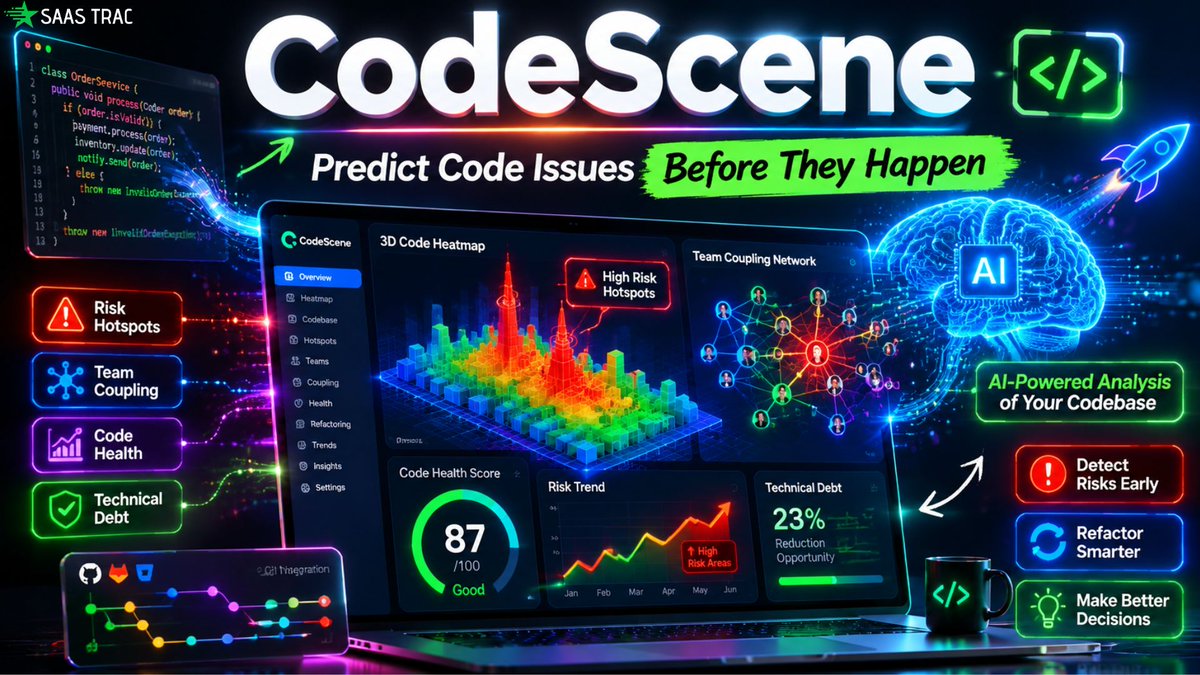
Hidden code issues = missed deadlines. 😬
CodeScene spots risky hotspots, team coupling, and tech debt, before they become bottlenecks. 💻⚡
Predict. Refactor. Ship better code. 🚀
👉 Try CodeScene: aiagents.saastrac.com/ai-age…
#CodeScene #DevTools
#DeveloperProductivity
#SoftwareEngineering
5

Jun 9
Adding feature is increasingly getting expensive?
I asked Claude, "I want to track project complexity and the "rate of difficulty" for adding UI/backend features across iterations. I need to know when to refactor or break things into smaller components.
Is there an existing tool, skill, or plugin that measures this trend?"
Claude's response
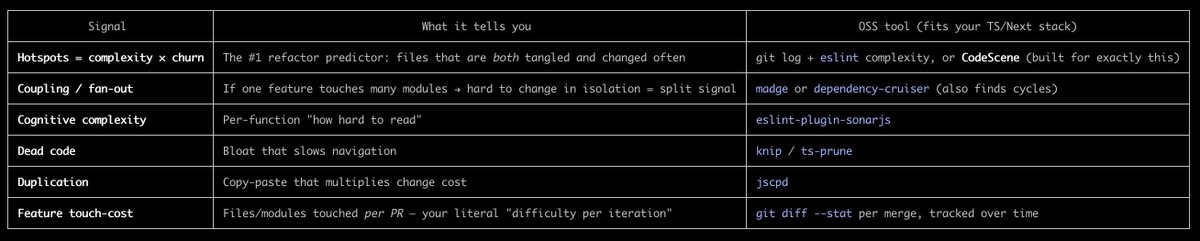
There isn’t an out-of-the-box plugin that tracks "change-difficulty over iterations" as a trend. Most tools handle general analysis (e.g., CodeRabbit for PR reviews, Datadog for runtime). However, you can measure this using research-backed signals. 👇
To get your "difficulty per iteration" metric, focus on these metrics: • Hotspots: Files that are both complex & changed often (Use CodeScene). • Feature Touch-Cost: Count files/modules touched per PR (git diff --stat). If this rises, it's time to break up components.
Other open-source tools to check out for your TypeScript/Next.js stack: • Coupling: dependency-cruiser • Cognitive Complexity: eslint-plugin-sonarjs • Dead Code/Duplication: knip & jscpd
CodeScene is free for OSS and explicitly overlays complexity trends on Git history!
1
75

Github student developer pack benefits:
➜ GitHub Pro
➜ GitHub Copilot Pro
➜ GitHub Codespaces
➜ GitHub Pages
➜ GitHub Desktop
➜ GitHub Campus Experts
➜ GitHub Foundations Certification Resources
➜ DigitalOcean ($200 Credits)
➜ Microsoft Azure ($100 Credits)
➜ Microsoft Azure (Ages 13–17)
➜ Appwrite Education Plan
➜ Heroku Credits
➜ Camber Student Plan
➜ LocalStack Pro
➜ New Relic
➜ Datadog Pro
➜ CARTO
➜ Zyte Scrapy Cloud
➜ Namecheap Free .me Domain
➜ Namecheap Free SSL Certificate
➜ Name.com Free Domain
➜ .TECH Domain (1 Year Free)
➜ JetBrains All Products Pack
➜ Visual Studio Code Learning Packs
➜ Visual Studio Dev Essentials
➜ Bootstrap Studio
➜ BrowserStack
➜ LambdaTest
➜ GitKraken Student Plan
➜ GitLens Student Plan
➜ Tower Pro
➜ SQLGate
➜ Working Copy Pro
➜ Termius Pro
➜ Testmail Essential
➜ Requestly Professional
➜ Codecov
➜ CodeScene
➜ DeepScan
➜ Imgbot
➜ Travis CI
➜ Blackfire
➜ POEditor
➜ PopSQL
➜ ToDiagram Pro
➜ ConfigCat
➜ DevCycle
➜ Doppler Team
➜ Clerk Pro
➜ Sentry
➜ Pageclip
➜ MongoDB Atlas Credits
➜ Stripe Fee Waiver
➜ Mail Testing APIs
➜ Blockchair APIs
➜ Vaadin Pro
➜ Adafruit IO
➜ Arduino Cloud
➜ Simple Analytics
➜ Frontend Masters
➜ Educative
➜ DataCamp
➜ Boot.dev
➜ Scrimba Pro
➜ Codédex Club
➜ GoRails
➜ SymfonyCasts
➜ Interview Cake
➜ AlgoExpert
➜ AI Prompting & Technical Writing Resources
➜ Intro to Open Source Resources
➜ Intro to Web Development Resources
➜ Mobile App Development Resources
➜ Data Science & Machine Learning Resources
➜ Notion Education AI
➜ Notion Template Collection
➜ Microsoft 365 Education
➜ PomoDone Lite
➜ HazeOver
➜ Visme Starter
➜ SlideCoach Credits
➜ 1Password (1 Year Free)
➜ Dashlane Premium
➜ Astra Security
➜ Honeybadger
➜ Datadog Monitoring
➜ IconScout Premium Assets
➜ Icons8 Subscription
➜ Polypane
➜ Xojo Pro
➜ Themeisle Neve Agency Theme
➜ Deepnote Team Plan
➜ Appfigures Analytics
➜ Camber Research Tools
Grab your Student ID, claim the GitHub Student Developer Pack, and unlock thousands of dollars worth of premium developer tools for FREE! 🎓

1
2
182


May 25
I still meet people convinced that AI coding tools will soon reach a point where code quality, design, and even architecture are "solved".
So I ran a small ad-hoc experiment.
I’ve been working on a CLI tool and let agents plan and implement a first functionally correct version. I provided strict instructions around testing strategy, workflows, and implementation constraints.
But I deliberately removed the @codescene MCP and the safeguards I normally rely on.
Unsurprisingly, the resulting code suffered from a ton of problems. It would have been a shaky foundation to continue building on. How soon would it have collapsed under continued change?
So I went through a series of refactorings, re-designs, and more general cleanup passes. Afterward, I asked the AI to summarize the necessary corrections.
And this was using Opus 4.7 for implementation, plus GPT 5.4/5.5 for docs. Not cheap models.
This is why I keep saying that agentic development is harder than coding by hand. The software engineering does not disappear. Rather, it gets compressed into a ridiculously short feedback loop.
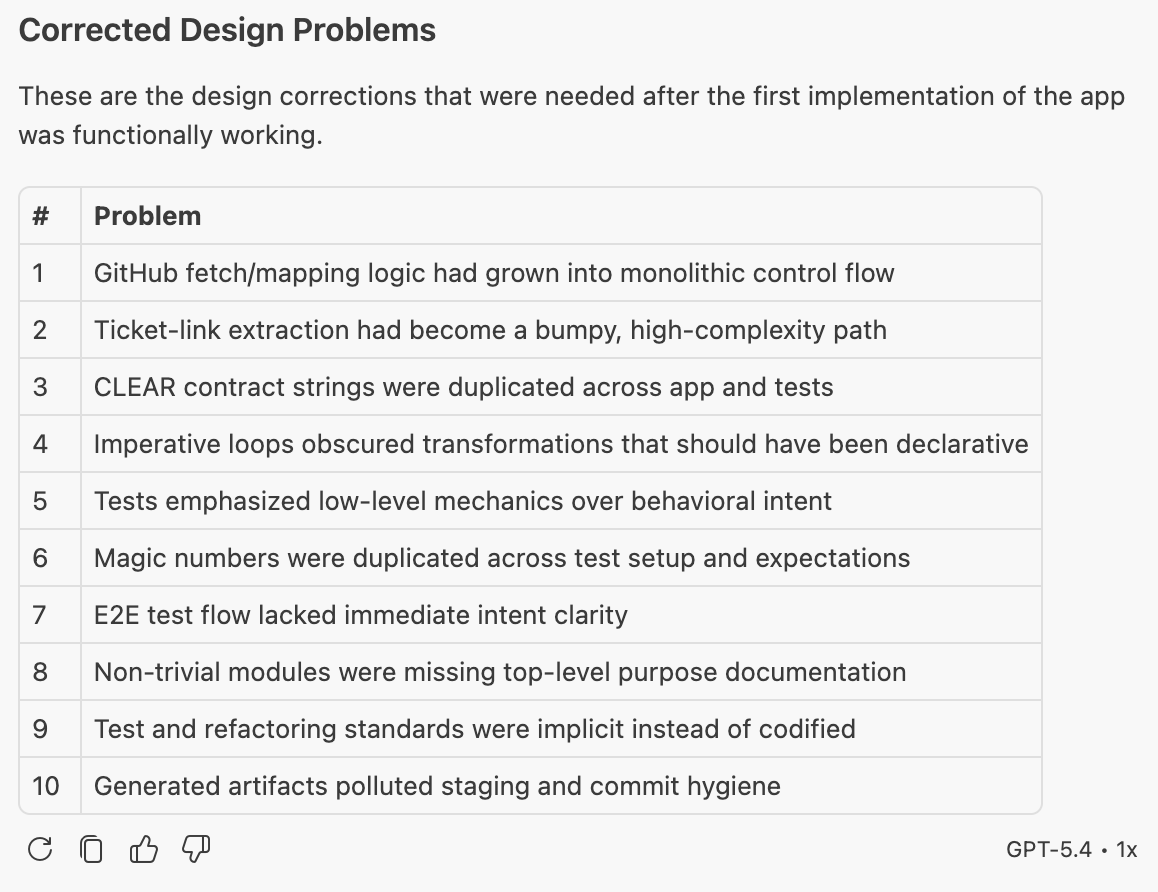
ALT An AI summary of the changes needed to remediate design problems and code smells introduced as part of a vibe coding sessions.
4
3
14
2,030

May 14
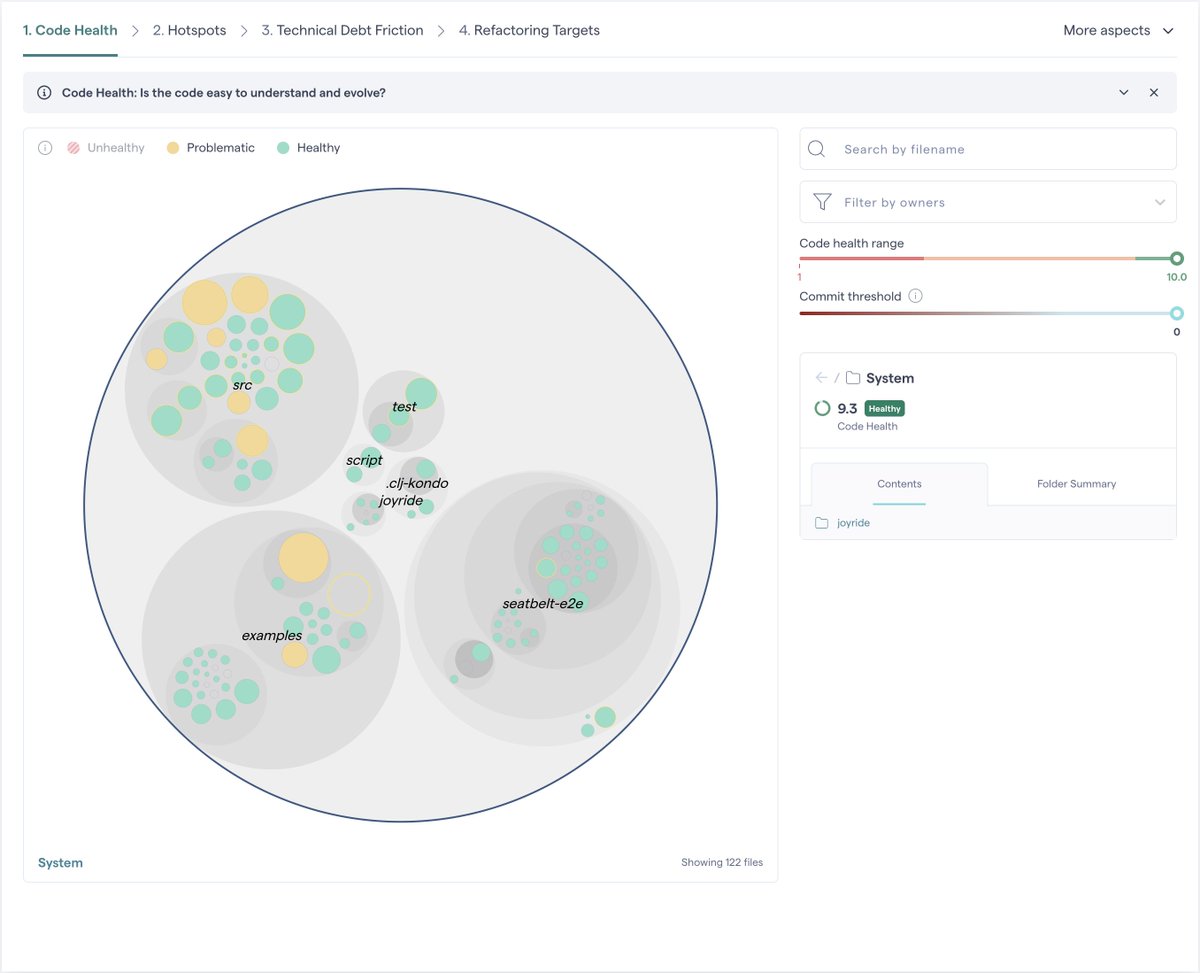
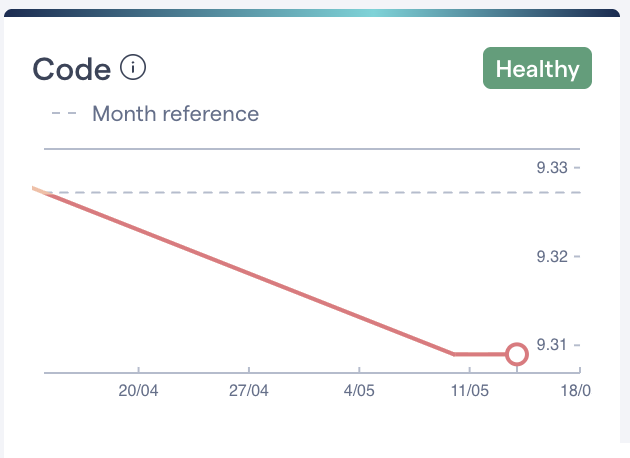
Here's from another project of mine, where I have not yet given the agents the CodeScene MCP. This project is in less dire need of the treatment compared to Epupp. Probably because Joyride is manually coded, the old-fashion way.
But code health is on the decline so I will need to talk to my agents swarm about it and see what we can do.
One thing is for certain, it will not be the same agents-work-non-stop-for-50-hours, for sure, because Joyride's unit and e2e test coverage is not sufficient for that, unlike with Epupp, where I could let them go at it, confident that they would correct themselves when the e2e tests told them to. My take-away from that is that my “decision” to spend 70% of the tokens on e2e testing for Epupp, really payed off. Try this at home, kids!
Eplore the CodeScene analysis here:
codescene.io/projects/80036/…
May 13

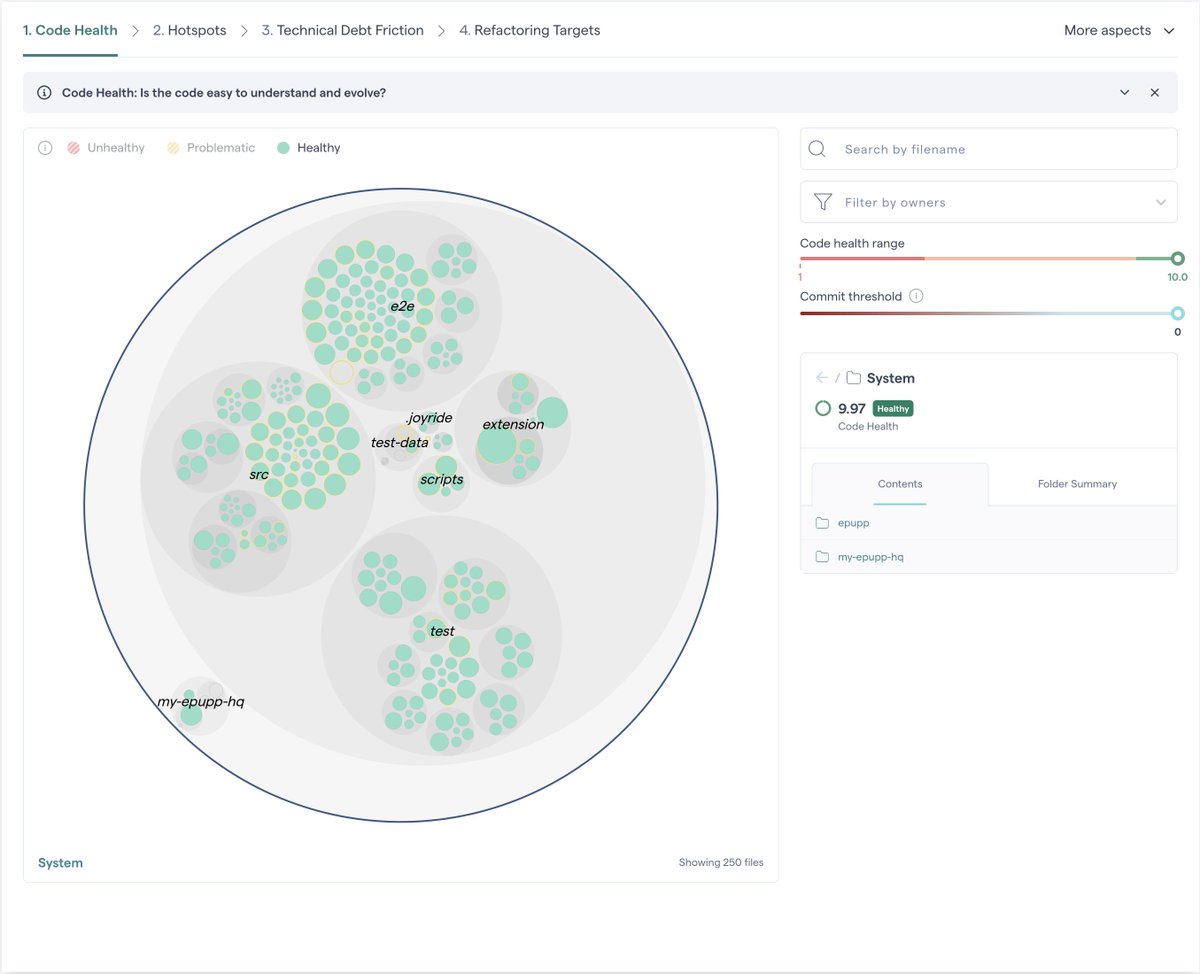
I've kept my agent swarm busy with the @codescene MCP for a few days now. I call success! Settling for 9.97, because there is a userscript that just makes more sense as a long file than split up.
1
2
251
May 14
I just realized that the analysis is publicly available, because open source. You can explore the tech debt part of the analysis here:
codescene.io/projects/80033/…
Click the Dashboard button to find more analysis tools.
May 11 was when I gave the agents the CodeScene MCP. =)
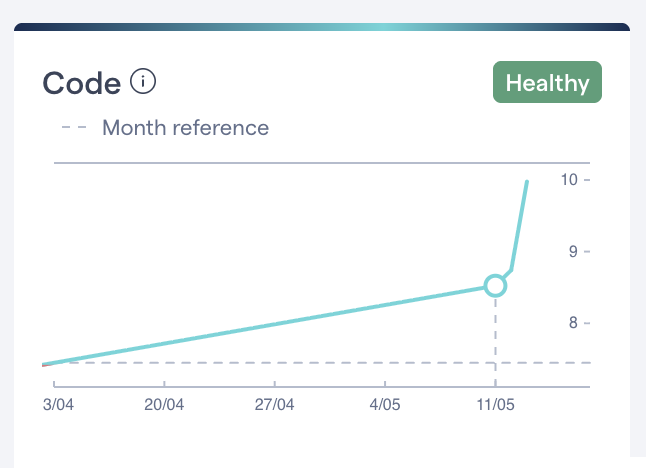
May 13
I've kept my agent swarm busy with the @codescene MCP for a few days now. I call success! Settling for 9.97, because there is a userscript that just makes more sense as a long file than split up.
2
234
May 13
I've kept my agent swarm busy with the @codescene MCP for a few days now. I call success! Settling for 9.97, because there is a userscript that just makes more sense as a long file than split up.
1
5
1,429

Apr 29
I'm proud to announce that we're launching the CodeHealth MCP on ProductHunt right now.
It's a big step personally and part of a long-term mission:
I’ve spent the past decades watching teams plan to fix technical debt... and then not do it.
Now we’ve added AI to the mix, which is fantastic at writing code fast.
Unfortunately, it’s just as good at scaling your technical debt if you let it.
This is where it gets interesting: AI agents depend on code health even more than we do.
Sceptical? Here's what the research shows:
* AI increases defect risk by more than 60% when working in unhealthy code
* At low code health, AI wastes 35–50% more tokens unnecessarily
* Most codebases aren’t even close to AI-ready
So AI doesn’t make technical debt less important. It makes it absolutely critical.
That’s why we at @codescene built the CodeHealth MCP. It plugs code health directly into your workflow so your AI can:
* Auto-review AI-generated code before it becomes a problem.
* Safeguard code health so it stays maintainable
* Help uplift unhealthy code to make it AI-ready
Generating code fast is easy.
Healthy systems at agentic speed are the real challenge.
👉 Support us on ProductHunt, and try the MCP for free. Your code will notice. Links 👇
3
1
5
383

Apr 28
The fastest AI in the room means nothing if your systems were built before it existed.
@pega's 2025 research, surveying 500 IT decision makers worldwide, found the average global enterprise wastes $370 million every single year due to legacy systems and technical debt. @McKinsey adds the structural layer: tech debt consumes 20–40% of an enterprise's entire technology estate value, while 10–20% of every new product budget gets quietly diverted just to service it. CodeScene puts the human cost plainly: developers spend up to 42% of their working time wrestling with technical debt rather than building anything new.
That is nearly half a developer's week. Gone. Every week.
@IBM Bob changes the equation from the inside.
Launched globally today, Bob is an AI-first development partner built to orchestrate the entire software development lifecycle, from architecture planning to production-ready deployment.
𝗛𝗲𝗿𝗲 𝗶𝘀 𝘄𝗵𝗮𝘁 𝗰𝗵𝗮𝗻𝗴𝗲𝘀 𝘄𝗵𝗲𝗻 𝗔𝗜 𝗲𝗺𝗯𝗲𝗱𝘀 𝗮𝘁 𝗲𝘃𝗲𝗿𝘆 𝗹𝗮𝘆𝗲𝗿:
• A 30-day Java upgrade delivered in 3 days, saving 160 engineering hours (Blue Pearl)
• Complex .NET services migrated in hours rather than weeks (APIS IT)
• IBM Instana teams averaging a 70% reduction in time on selected tasks, roughly 10 hours recovered per developer, per week
• IBM Maximo team reporting a 69% time savings on code generation and refactoring tasks that previously took days
• 80,000 IBM employees already using Bob, with surveyed users reporting a 45% average productivity gain
The market context makes the urgency undeniable. 84% of developers already use AI tools in 2026. AI now writes 41% of all code in real workflows. And yet Gartner warns that enterprises still burdened by high technical debt face up to 50% slower service delivery, meaning AI at the surface changes very little if the foundation stays broken.
𝗕𝗼𝗯 𝗴𝗼𝗲𝘀 𝘂𝗻𝗱𝗲𝗿𝗻𝗲𝗮𝘁𝗵 𝘁𝗵𝗲 𝘀𝘂𝗿𝗳𝗮𝗰𝗲.
Multi-model orchestration routes every task to the right model based on accuracy, latency, and cost. Security and auditability run through every action, from planning through production, keeping every decision traceable and every release defensible.
The enterprises that win the next decade stopped asking AI to assist their developers.
They let AI orchestrate the entire delivery system. Speed is table stakes. Coordination is the competitive edge.

Meet IBM Bob. 👋
Now generally available, Bob is an agentic SDLC partner designed to move teams from isolated AI tools to coordinated delivery. Dive deeper into what’s possible with IBM Bob: ibm.co/6014EKiCs
72
47
172
208,918


Mar 21
I think you might be interested in what @AdamTornhill and his team are working on over at CodeScene—automated code quality metrics that you can pull into your LLM feedback loop. I recorded a podcast with Adam a while ago: open.spotify.com/episode/7l3…
4
1,463

Chapter1は全体像
競争優位性を前面に押し出す空気は、若干腹落ちしない感覚。
CodeSceneのようなツールで何かを掴む
イベントストーミングで境界を洗い出す
摩擦を感じたのはこのあたりなので読み進めて理解したい
#アーキテクチャモダナイゼーション
#朝の読書30分一本勝負
2
84

Mar 2
The Func Prog Podcast is back with another episode! I sit down with @AdamTornhill, the founder of CodeScene, to discuss technical debt, Clojure, and why it’s so hard to write good code.
Listen below! 👇
1
3
109

Feb 27
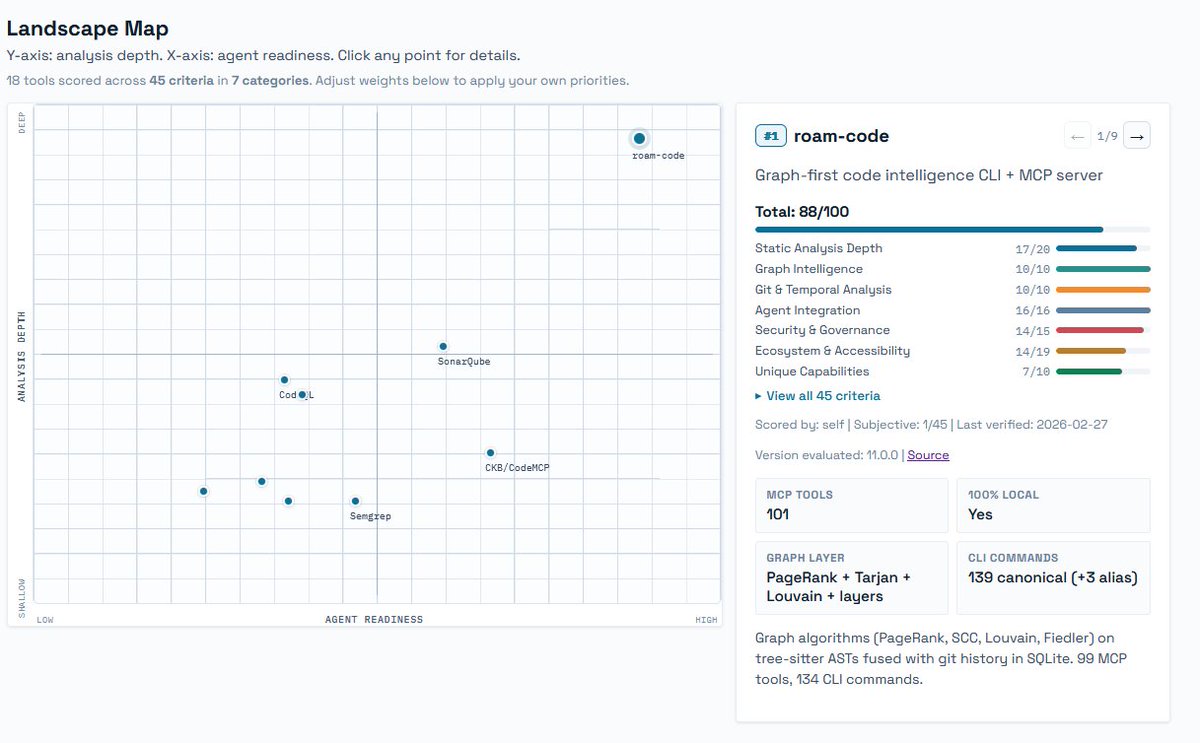
I've polished further Roam Code
- Commands De-duplicates
- 2 new languages Tier 1: Scala & SQL
- Super Cleanup repo and commands
- Roam algo: anti-pattern improved further
- Site added
- Full Competitor Landscape on all similar tools
Complete Code intelligence of all available tools
roam-code vs SonarQube vs CodeQL vs Semgrep vs CKB/CodeMCP vs CodeScene vs SourceGraph vs CodeGraphMCPServer vs CodePrism
1
2
104