Zucchini_Shogun retweeted

"communicate"

19
1,085
12,828
61,650

My emphasize is on ur last paragraph.
You literally subject ur whole believe to a dicing hope. How do u communicate to God with such mindset?
I believe that u're trying to be politically correct, but you don't need to.
God is really, and need to fully submit to feel his presence.

hi im looking for moots to communicate with 🐑
- siia, 19, she/her
- wha, jwqs, atla, the mentalist, bleach, mdzs, alnst, orv, one piece, link click, bones, natsume yuujinchou, ...
- dni if you're under 15, a zionist/pro russian, shedtwt, biphobic
#promotwtㅤ #moothunt


1
2

I’m still mad I heard the tearful words “how do I help my avoidant attached situationship communicate with me”
girl that’s rejection. he doesn’t want you
2

Quote by Carl Jung: "Loneliness does not come from having no people about one, but from being unable to communicate the things that seem important to oneself, or from holding certain views which others find inadmissible."


Not quite. See an art piece has to communicate why it has done something or why something is and this piece does neither, it is blood and injury for the point of blood and injury
1

Yesterday was my first time using logic analyser and seeing I2C communication between ESP32 and MPU6050. I use mpu because the drone kit I broke uses it so I want to understand it better. But I did my research and I know it's obsolete.
Anyway I learned so much more by doing a practical project where I have to communicate with the board than by just reading about I2C.
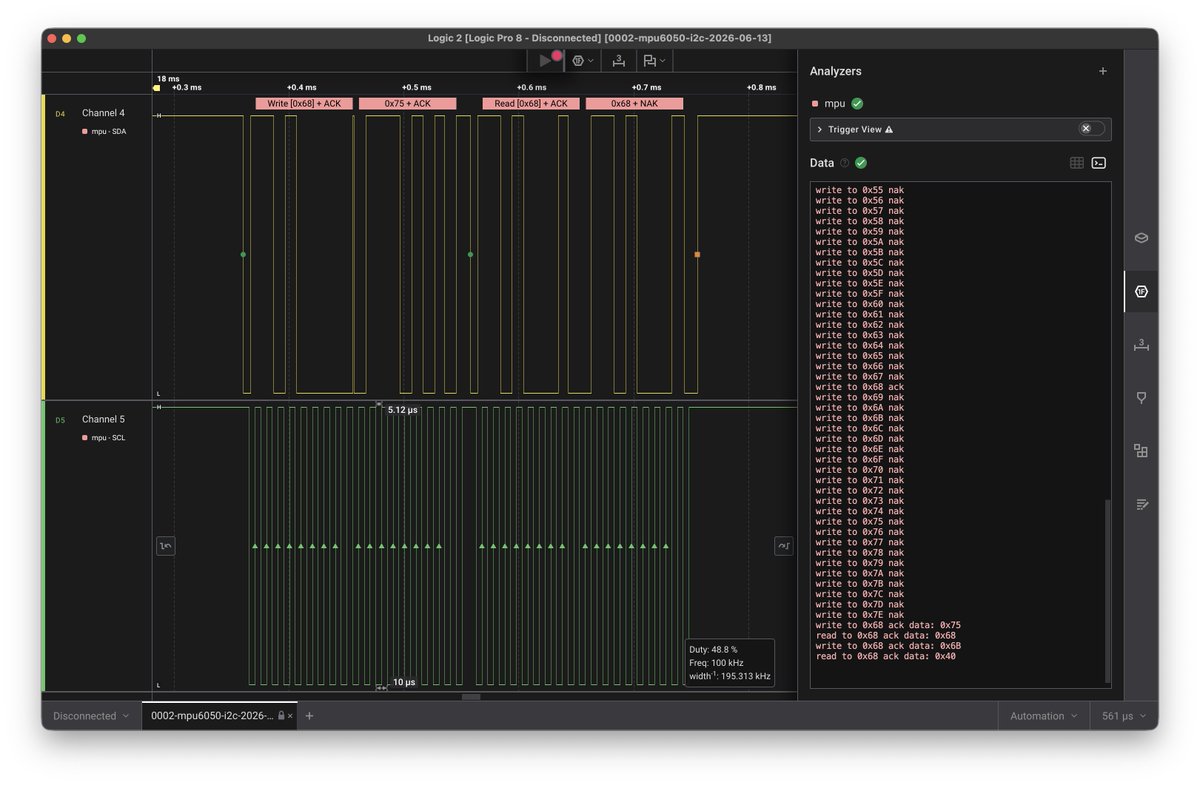
1


RT @shahzyshezaa1: Cus Mind telepathy doesn’t require words to communicate unless you find poor translation highly attractive t.co/…
156

They are determined and strong AF. We need a unit of these bruisers armed to the teeth, who communicate in their secret way. 🫡

FEMINIZATION ACADEMY retweeted

May 22
All sissy in need of this dm me with your tribute so that we can communicate about it don't dm me without having your fee
7
7
530
people’s princess retweeted

Jun 13
Rudolf Steiner said in premodern cultures our guardian angel used to mainly communicate to us via our dreams and give us instructions for the day but in our modern times, since many don’t have an inclination towards a spiritual life anymore, their angel cannot reach them anymore and their dreams become an expression of Ahriman (materialism) instead
11
30
289
10,158

PEOPLE DON'T UNDERSTAND THIS IS JUST A MEMORANDUM. A written document used to communicate information, proposals, decisions, instructions, or analysis within an organization, government agency, law firm, etc. It’s usually more formal than an email but less formal than a full report or contract.
Draft: Indicates it is not final. It’s a working copy that can still be edited, reviewed, commented on, or revised before it’s approved and distributed as the official version.
10

Looks Like mama's love and breast milk and strong faith and n God brought tthis little one back.. now thriving .. ( 3 months later ) terrible to hear what teh the mom was told by some medical caregivers . Hope she continues to develop normally and is able to respond and communicate her needs into the future !!!!
22

A Formal Warning For The UAP Science Advisory Council Against the Failure of Perception
To @ProfAviLoeb,
Extraterrestrials, if present and observing humanity, may not be waiting only for governments to confess what they know. They may be looking for whether humanity can understand the pieces already laid out before it: the recurring appearances, the repeated patterns, the symbolic geometries, the religious memories, the abduction accounts, and the architectural forms that suggest a continuity older than modern disclosure itself.
Modern disclosure remains incomplete because it keeps asking for proof in the narrowest possible form. It looks for documents, programs, admissions, photographs, biological material, radar data, and official testimony. Those records matter, but they do not exhaust the phenomenon. If nonhuman intelligence has interacted with humanity across history, then the strongest evidence may not appear only inside government archives. It may appear in the visual record of experience itself: in how beings are described, how vehicles are represented, how symbols recur, how sacred structures are arranged, and how geometry becomes the language through which contact leaves its signature.
Failed perception begins when a civilization treats these records as separate categories. Abduction testimony is treated as psychology. Religious history is treated as belief. Mystical symbolism is treated as metaphor. Crop formations are treated as hoax or curiosity. Ancient architecture is treated as culture alone. Each category is isolated, and because it is isolated, the pattern between them disappears. Yet the question may only become visible when these fragments are read together.
Technological blueprints may lie more heavily in these accounts than in any single classified file, because the phenomenon may have expressed itself through form before it expressed itself through language. Ancient people may not have known how to describe propulsion, field behavior, dimensional movement, or nonhuman engineering, but they could preserve shape, direction, proportion, symmetry, light, descent, ascent, rotation, and relation. In that sense, religious and mystical records may not merely contain beliefs about higher beings. They may contain visual impressions of technologies that were translated into sacred language because no other language could interpret the correct meaning.
Extraterrestrials may care less about whether humanity repeats the word disclosure and more about whether humanity can decipher the geometry of the signs already placed into its memory. Crop circles, religious architecture, temple alignments, sacred diagrams, mystical cosmologies, and recurring symbolic forms may be part of the same challenge: not a demand to believe, but a demand to perceive. Geometry becomes the bridge because geometry survives interpretation. A doctrine can be altered. A myth can be retold. A symbol can be misunderstood. Yet form preserves relation. Pattern preserves intelligence. Repetition preserves intent.
For that reason, the scientific disclosure community cannot remain trapped inside a bureaucratic lens. Some connections do not require permission from institutions before they become visible. Some are obvious because they are visual. When the same kinds of beings, forms, motions, structures, and symbolic arrangements appear across abduction history, religious history, mystical systems, and sacred architecture, the task is not to dismiss the connection because it is uncomfortable, but to examine whether the connection is carrying the very structure needed to understand the phenomenon.
Avoiding religion and mysticism does not make disclosure more disciplined. It removes the oldest archive from the investigation. Avoiding crop formations and symbolic geometry does not make the inquiry more serious. It may remove the very pattern-language through which nonhuman intelligence has chosen to communicate. Avoiding controversial nerves does not protect truth. It prevents the mind from reaching the point where the separate pieces begin to form a single intelligible structure.
Here lies the warning: disclosure can fail even when evidence exists, because evidence without perception remains inert. Humanity may already possess fragments of the message, but continue to miss the message because the fragments appear in forms that modern institutions are trained to dismiss. A civilization can demand contact while ignoring the visual grammar of contact. It can ask for revelation while refusing to study the geometry through which revelation may have already been given.
Real disclosure begins when humanity stops waiting only for confession and starts learning how to read. It must read the sky, the testimony, the symbol, the structure, the temple, the circle, the pattern, and the historical recurrence as parts of one problem.
If extraterrestrials are present, then recognition may be the first proof of readiness. Not worship. Not panic. Not blind belief. Recognition. The ability to see that the pieces were never scattered randomly, and that the path to disclosure may have been laid through the very forms humanity was institutionally taught to separate.

7

3m
Been finding that equating women to puppies is a helpful way to communicate misogyny with a wholesome chungus element to it that makes it more palatable to normies.
1
3

I realize I need to communicate and be transparent that way people may feel safe around me. maiiwasan ung misinterpretations.

I always choose to I isolate and be quiet when everything is not easy, Which maybe my mistake. Silent can hurt more and leave discomfort, confusion and miscommunication to people. Baka sa pag iwas ko di maka sakit mas nakasakit pa ako ng iba
1