
Jun 8
Agently: A platform to host, run and monitor AI Agents
This is the updated README.md of the project which is at github.com/satyanvm/Agently/ and currently the v1 is in build progress
This is a deep dive into the architecture of it, enjoy the read:
# Agently
A **Durable Autonomous Agent Execution Platform** — a managed runtime and control plane
for long-running, multi-agent, browser-capable AI workflows.
> Agently is not an AI agent. It is the cloud that agents run on.
> Start a workflow, close your laptop, come back days later, and inspect everything it did —
> logs, reasoning traces, browser activity, and results.
The defining promise — *"close your laptop, come back in two days, the work is still running
and you can see everything it did"* — makes **durability**, not intelligence, the core problem.
Almost every decision below is downstream of that promise.
---
## Architecture
### Product category
A **durable autonomous agent execution substrate** — the "Vercel/Temporal for agents." We sell
the layer agents run on (durable execution, observability, browser sessions, secrets, scheduling,
notifications), not the agents themselves.
| Layer | What it is | Who owns it |
|---|---|---|
| **Authoring** | How a workflow is defined (graph / DSL / code) | Pluggable — we host frameworks |
| **Execution / Durability** | Running it for days, surviving crashes & disconnects | **Us. This is the moat.** |
| **Observability** | Logs, reasoning traces, browser replay, results | **Us.** |
Differentiation vs. adjacent tools:
- **n8n** — integration automation; short deterministic steps, no autonomous reasoning over hours.
- **CrewAI / LangGraph** — agent *frameworks* (libraries). They run *inside* Agently; they don't host it.
- **Browserbase** — one *component* (the browser layer) of what we offer; no orchestration or durability.
- **Relevance AI / Lindy** — packaged assistants for short tasks; not an open long-horizon execution substrate.
### Design principles
1. **Control plane / data plane split** — managing runs (API, DB, UI) is separate from executing
them (workers). The control plane stays up even when agents crash.
2. **The database is the source of truth, not worker memory** — every meaningful step is persisted.
Workers are cattle, not pets; the run survives any worker dying.
3. **Durable queue over Postgres first** — `claim_next_run()` `FOR UPDATE SKIP LOCKED`. No
Kafka/Temporal until usage earns the need.
4. **Append-only logs, streamed** — written once, never mutated, tailed live.
5. **The browser is an external, isolated service** — never in-process with the orchestrator.
6. **Treat the agent as semi-untrusted** — it acts on hostile web content (prompt injection), so
isolate it from the control plane, not just users from each other.
### System overview
```
┌──────────────────────────────────────────────┐
│ USERS │
│ (dashboard, run viewer, live logs/browser) │
└───────────────────────┬──────────────────────┘
│ HTTPS / WebSocket(SSE)
▼
┌──────────────────────────────── CONTROL PLANE ──────────────────────────────────┐
│ ┌───────────────┐ ┌───────────────────┐ ┌────────────────────────┐ │
│ │ FRONTEND │◄────►│ API / BACKEND │─────►│ NOTIFICATION LAYER │ │
│ │ Next.js │ │ REST WS/SSE │ │ email/webhook/slack │ │
│ │ (apps/web) │ │ authZ, run mgmt │ │ │ │
│ └───────────────┘ └─────────┬─────────┘ └────────────────────────┘ │
│ ▼ │
│ ┌───────────────────────────┐ │
│ │ STORAGE LAYER (truth) │ │
│ │ Postgres (Supabase) │ │
│ │ Object store (artifacts) │ │
│ │ Secrets vault (KMS) │ │
│ └─────────────┬─────────────┘ │
└────────────────────────────────────┼────────────────────────────────────────────┘
│ durable queue (runs table, SKIP LOCKED)
▼ poll / claim / lease / heartbeat
┌──────────────────────────────── DATA PLANE ─────────────────────────────────────┐
│ ┌──────────────────────────────────────────────────────────────────────┐ │
│ │ WORKER POOL (apps/worker) │ │
│ │ Orchestrator → claim/lease/retry/cancel/heartbeat │ │
│ │ Workflow Engine→ DAG: what runs next checkpoint to Postgres │ │
│ │ Agent Runtime → prompt→LLM→tool loop (sandboxed); framework adapter │ │
│ └───────────────────────────────┬──────────────────────────────────────┘ │
│ │ CDP / API │
│ ▼ │
│ ┌──────────────────────────────────────────────────────────────────────┐ │
│ │ BROWSER LAYER (isolated) Browserbase (MVP) → self-hosted later │ │
│ │ one session per agent-run · live view · session replay │ │
│ └──────────────────────────────────────────────────────────────────────┘ │
│ LOGGING: workers append events → Postgres (index) object store (blobs) │
│ live stream to API (pub/sub) │
└──────────────────────────────────────────────────────────────────────────────────┘
```
### Components
- **Frontend** (`apps/web`, Next.js) — authoring UI, run list, live run viewer (streaming logs,
reasoning timeline, embedded browser live-view, artifacts). Stateless; talks only to the API.
- **API / Backend** — auth, workflow CRUD, run lifecycle, log/artifact serving, live-event fan-out.
Manages state and brokers streams; **does not execute agents**.
- **Task Orchestrator** (worker) — claims runs via `claim_next_run()`, owns lease/heartbeat/retry/
timeout/cancel. The *"is this run alive and who owns it"* layer.
- **Workflow Engine** (worker) — interprets the workflow DAG, decides what runs next, checkpoints to
Postgres, passes outputs between agents. The *"what happens next"* durable state machine.
- **Agent Runtime** (sandboxed, worker) — executes one agent step: prompt → LLM → tool → repeat,
captures the reasoning trace. Framework adapter (native / LangGraph / CrewAI) lives here.
- **Browser Layer** (external) — one isolated session per browser-using agent-run, with live view and
replay. Browserbase in MVP, behind a `BrowserProvider` interface.
- **Logging Layer** — append-only structured events; metadata/index in Postgres, large blobs in object
storage, live-streamed to clients.
- **Storage Layer** — Postgres (source of truth queue log index), object store (artifacts/
screenshots/recordings), KMS-backed secrets vault.
- **Notification Layer** — reacts to run state transitions (completed/failed/needs-input) → email /
webhook / slack / push. Decoupled and replayable.
### Execution flow
```
User defines workflow ─► API persists (versioned) ─► User clicks Run
└► API creates workflow_runs row (status=queued) ─► returns run_id immediately
(user can close laptop NOW) ◄── the core promise
└► Worker calls claim_next_run() (FOR UPDATE SKIP LOCKED) ─► lease heartbeat
(worker dies → lease expires → another worker RESUMES FROM CHECKPOINT)
└► Workflow Engine walks the DAG, checkpointing each node to Postgres
└► Agent Runtime runs each step (LLM tools), logging every reasoning/tool/LLM event
└► Browser tool → isolated session via CDP; actions screenshots logged; live-view replay
└► All nodes terminal ─► status=completed/failed ─► artifacts persisted ─► NOTIFICATION fires
└► User returns later ─► full timeline, reasoning trace, browser replay, artifacts, cost
```
Durability invariants: progress lives in `workflow_runs` checkpoints (never only in RAM); steps are
idempotent/resumable (attempt counters, results written before advancing the frontier, idempotency
keys for external side effects); any worker can be killed at any time without losing the run.
### Key decisions
| Area | Decision | Why |
|---|---|---|
| **Orchestration** | Thin **custom orchestrator** framework **adapters** (native first, LangGraph then CrewAI as guest executors) | Durability is the moat and can't be outsourced; frameworks plug in at the step boundary, keeping us framework-neutral. |
| **Durable queue** | **Postgres `FOR UPDATE SKIP LOCKED`** (`claim_next_run()`), not Kafka/Temporal | Simple, debuggable, right-sized for 100–1k users; migrate when concurrency demands it. |
| **Browser** | **Browserbase** behind a `BrowserProvider` interface | Live-view replay are core and hard to build; a solo dev shouldn't run a Chromium fleet in MVP. Swap to self-hosted when it becomes the #1 cost driver (~1k users). |
| **Cloud model** | **Managed cloud** for MVP; architect the `ComputeProvider` seam for future **BYOC** | Primary persona wants "click Run," not cross-account IAM. BYOC is a Phase-4 enterprise feature, enabled by the control/data-plane split. |
| **LLM cost** | **Bring-your-own-LLM-key** by default, even in Managed | Removes the largest variable cost from our books and from runaway-loop risk. |
### Data model
All entities root at `user_id`; **Row-Level Security** on every user-owned table.
```
users 1─N workflows 1─N workflow_runs 1─N agent_runs 1─N browser_sessions
│ │
├─N logs (also ref agent_runs / browser_sessions)
├─N artifacts
└─N notifications
agents (reusable definitions) ──< referenced by workflows.definition & agent_runs >
secrets (KMS-encrypted refs) ──< owned by users >
```
- `workflows` — versioned definitions (DAG of agent steps control flow triggers); runs snapshot
the version they used.
- `workflow_runs` — one execution **and** the durable queue entry (lease/attempt/idempotency/
`engine_state` checkpoint fields).
- `agent_runs` — one agent step; `parent_agent_run_id` enables hierarchical/manager sub-agents;
multiple rows per workflow_run = parallel agents.
- `logs` — append-only, ordered by `(workflow_run_id, seq)`; small payloads inline, large payloads in
object storage; time-partitioned with retention by plan.
- `browser_sessions`, `artifacts`, `notifications` — hang off `workflow_runs`.
### Security
- **Secrets** — KMS envelope encryption; decrypted just-in-time into the sandbox, scoped to the step,
never logged.
- **User isolation** — RLS enforced in the database (defense in depth beyond the app layer).
- **Browser isolation** — one fresh session per agent-run, network-segmented from the control plane;
page content and downloads treated as hostile.
- **Container isolation** — each agent step in an isolated sandbox (hardened containers → gVisor/
Firecracker at scale); default-deny egress with an LLM/browser/tool allowlist; per-run CPU/memory/
wall-clock/**token & browser-minute budgets** to contain runaway loops and cost bombs.
### Cost drivers
Ranked: **browser sessions** → **worker compute** → **LLM tokens** (≈0 to us with BYO-key) → storage/
egress → DB. Levers baked in early: per-run budgets, BYO-LLM-key default, idle-suspension for
mostly-waiting runs, log/artifact cold-tiering, and the browser-provider swap.
### Roadmap
| Phase | Theme | Focus |
|---|---|---|
| **1 (4 wks)** | *Close your laptop* | Durable single-agent execution: schema migrations (`0001_init`, `0002_rls`, `0003_queue`), claim/lease/heartbeat worker that **resumes after a kill**, streaming logs, email notify. |
| **2 (8 wks)** | *Watch it work* | Browser via Browserbase, live-view replay, reasoning timeline, artifacts, cost accounting, scheduled/webhook triggers, sandbox hardening budgets. |
| **3 (3 mo)** | *A team of agents* | Multi-agent DAG (parallel/conditional/loop/sub-agents), LangGraph then CrewAI adapters, Slack/push, human-in-the-loop `needs_input`, idle-suspension. |
| **4 (6 mo)** | *Open it up* | Bring-Your-Own-Cloud, self-hosted browser pool, stronger isolation, teams/RBAC, templates/marketplace, possible Temporal migration. |
---
## Glossary
**Lease** — a time-limited claim a worker takes on a run, recorded as `lease_expires_at` on
the `workflow_runs` row. It answers *"is this run still owned?"* When a worker claims a run it
sets `claimed_by` and an expiry (e.g. `now 30s`). The worker is responsible for the run only
until that expiry — it rents the run, it doesn't own it forever. If the lease lapses, another
worker may reclaim the run and resume it from the last checkpoint. This is what makes a crashed
worker recoverable instead of leaving a run stuck in `running` forever.
**Heartbeat** — the worker periodically renewing its lease while it is alive and working
(e.g. every 10s push `lease_expires_at` forward). It answers *"is the owner still alive?"* The
heartbeat is what distinguishes a *crashed* worker from one that is merely taking a long time on
a legitimate hours- or days-long step.
- Heartbeat interval must be **comfortably shorter** than the lease (rule of thumb: ~1/3). The
gap `lease − heartbeat` is the safety margin: the lease covering several heartbeats means the
worker can miss one or two renewals to a GC pause / network blip / clock skew **without** its
run being falsely reclaimed. Renew == lease leaves zero slack and any jitter causes a false steal.
- A missed heartbeat is **skipped, not queued** — it does not pile up and fire twice later.
- Renewal is **idempotent**: it *sets* `lease_expires_at = now duration` (absolute), it does
not *add* time. Running it twice yields the same expiry as running it once, so concurrent or
back-to-back renewals can never compound the lease.
Together: short lease (fast crash detection) heartbeat (lets live work run arbitrarily long) =
automatic recovery from worker death with no double-execution. Backed by `claim_next_run()`
`FOR UPDATE SKIP LOCKED`, which lets many workers poll the queue without colliding.
**Framework neutrality** — the user's agent framework (native loop, LangGraph, CrewAI) is a
pluggable step-executor behind a common adapter, not baked into the core engine. Lets us ride
every framework wave without a rewrite, is a real selling point to power users who already have
framework code, and forces a clean separation between the durable engine we own and the agent
logic that is swappable.
**Native executor** — a minimal in-house agent loop (`prompt → LLM → tool → repeat`) with no
hidden state. Built **first** because Phase 1 proves *durability*, not intelligence: with a
trivial executor, any resume/checkpoint bug is unambiguously ours, not a framework's. Frameworks
(with their own in-process state models) are integrated later, once durable resume is proven.
**Egress** — data leaving our cloud out to the internet, which the cloud provider bills for
(inbound is typically free). Relevant to live monitoring: streaming logs and especially the live
browser view continuously push frames *out* to watching users, so egress scales with how many
users actively watch runs and for how long. Favors lighter live-view encodings.
**KMS (Key Management Service)** — a managed cloud service (AWS/GCP KMS) that stores and controls
encryption keys so we never handle raw key material. User secrets (LLM keys, integration creds)
are protected with **envelope encryption**: a KMS master key encrypts a per-secret data key, which
encrypts the actual secret. A stolen database yields only ciphertext; every decryption is audited,
and plaintext exists only briefly inside the sandbox for the step that needs it.
**RLS (Row-Level Security)** — a Postgres feature (used heavily via Supabase) that enforces
*"you can only see/touch your own rows"* **inside the database**, not just in app code. Policies
key off the authenticated user id so even a buggy query (a missing `WHERE user_id = ...`) cannot
cross tenant boundaries. Applied to every user-owned table as defense-in-depth for multi-tenancy;
see `0002_rls.sql`.
**Browserbase** — a paid managed headless-browser service (hosted Chromium CDP live view
session replay), billed roughly per browser-session-time. Used in MVP behind a `BrowserProvider`
interface because live-view and replay are hard to build and a solo dev shouldn't run a Chromium
fleet. Likely the #1 cost driver around ~1k users — the trigger to evaluate self-hosting; per-run
browser-minute budgets guard against runaway bills.
7
2
801

May 21
What is a compute provider?
Someone who:
1. Stakes at least 1,000 MLB tokens
2. Connects GPU hardware to the network
3. Processes AI inference tasks
4. Earns 70% of each task reward
Minimum stake ensures skin in the game.
#ComputeProvider #MLBridge
10
Feb 19
What is a compute provider?
Someone who:
1. Stakes at least 1,000 MLB tokens
2. Connects GPU hardware to the network
3. Processes AI inference tasks
4. Earns 70% of each task reward
Minimum stake ensures skin in the game.
#ComputeProvider #MLBridge
13
Jan 27
What's a compute provider on MLBridge?
Anyone with GPU capacity who:
- Stakes $MLB tokens
- Connects to the network
- Processes AI tasks
- Earns rewards
Turn idle hardware into income.
#ComputeProvider #GPU #MLBridge
15

10 Oct 2025
3️⃣ What You’ll Need:
⚙️ Aethir-compatible hardware (GPU, storage, bandwidth)
🔐 Aethir Edge or Node setup
🌐 Stable internet connection
🧠 Basic understanding of node management
👌No datacenter? No problem — start from home with @AethirEdge!
#AethirCreatorCup #ComputeProvider #Aethir
1
11
10 Oct 2025
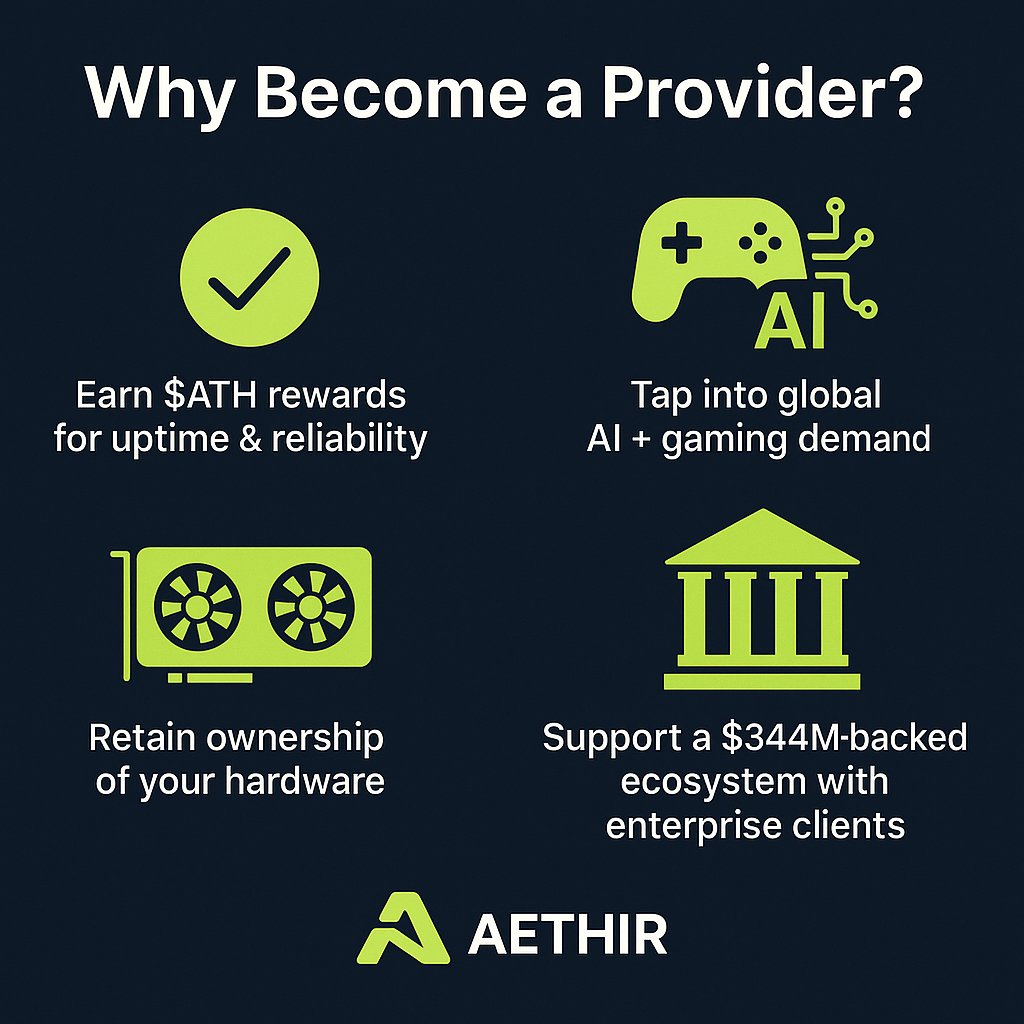
2️⃣ Why Become a Provider?
✅ Earn $ATH rewards for uptime & reliability
✅ Tap into global AI gaming demand
✅ Retain ownership of your hardware
✅ Support a $344M-backed ecosystem with enterprise clients
Decentralized cloud, real profits. 💸
#AethirCreatorCup #ComputeProvider #Aethir
1
13
10 Oct 2025
1️⃣ What is a Compute Provider?
A Compute Provider contributes GPU or computing hardware to Aethir’s decentralized cloud — powering AI, gaming, and enterprise workloads globally 🌍
You’re not just renting GPUs — you’re fueling the decentralized future of compute.
#AethirCreatorCup #ComputeProvider #Aethir
1
9
10 Oct 2025
🔥Hi everyone,
Do you want to become a Compute Provider on @AethirCloud?
🚀 This is a step-by-step guide on how anyone can supply compute to the Aethir and earn rewards.
Let’s dive in 👇👇:
@AethirEco #AethirCreatorCup #ComputeProvider #Aethir
3
4
104

10 Oct 2025
Becoming a Compute Provider : @Aethir_Korea
A step-by-step guide on how anyone can supply compute on Aethir and earn from the network.
@AethirCloud 단순한 탈중앙화 GPU 네트워크를 넘어선
혁신적인 생태계입니다. 전 세계 누구나 자신의 GPU를
네트워크에 제공하고, AI 훈련, 클라우드 게임, 렌더링 등
다양한 컴퓨팅 작업에 활용하며 수익을 창출할 수 있는 분산형
클라우드 인프라를 구축하고 있습니다.
#에이셔 네트워크는 93개국 200개 이상의 위치하고
435,000개 이상의 GPU 컨테이너를 보유하고 있으며,
연간 91백만 달러 이상의 매출을 기록하고 있습니다.
컴퓨팅 제공자(Cloud Host)란?
컴퓨팅 제공자는 자신이 보유한 GPU 하드웨어를 #Aethir
네트워크에 연결하여 컴퓨팅 파워를 제공하는 참여자입니다. 이들이 제공한 GPU는 다음과 같은 작업에 활용됩니다
- AI 모델 훈련 및 추론 작업
- 클라우드 게임 실시간 렌더링
- 3D 렌더링 및 영상 처리
- 기타 GPU 집약적 연산 작업
Cloud Host는 제공한 컴퓨팅 자원의 사용량, 가동률, 성능에
따라 ATH 토큰 형태의 보상을 받습니다.
Aethir의 고품질 Cloud Host들은 평균 95% 이상의
GPU 가동률을 달성하며, 8-GPU 노드 기준
월 25,000-40,000달러의 수익을 올리고 있습니다.
⚙ 하드웨어 요구사항
네트워크에 참여하기 위한 조건
1️⃣ GPU 사양
- NVIDIA H100, H200, GB200 등 AI 추론용 엔터프라이즈급 GPU
- GeForce RTX 4090과 같은 고성능 소비자용 GPU도 허용
- 서버에 여러 GPU가 있는 경우 모두 동일한 모델이어야 함
2️⃣ 서버 사양
- x86 아키텍처 CPU
- 베어메탈 서버 (가상화되지 않은 물리적 머신)
- Ubuntu 20.04 LTS 또는 Ubuntu 22.04 LTS
3️⃣ 네트워크 요구사항
- 안정적인 인터넷 연결
- 높은 대역폭과 낮은 지연시간
- 99.982% 이상의 가동시간 달성 권장
4️⃣ 위치 제한사항
중국 및 OFAC/UN 제재 대상 국가(쿠바, 이란, 북한, 시리아, 크림반도 등)에서의 GPU는 허용되지 않습니다.
⚙ 경제적 준비사항
ATH 토큰 스테이킹
- Cloud Host가 되기 위해 ATH 토큰 스테이킹
- GPU 유형별 요구되는 스테이킹 양이 매월 업데이트
- 스테이킹된 ATH는 위반 시 슬래싱 페널티가 적용
✔ 단계별 참여 가이드
1단계: Cloud Host 신청
Aethir 공식 웹사이트에서 Form을 작성
- 하드웨어 세부사항
- 서버 위치 정보
- 연락처 정보
- 프로그램 참여 동기
2단계: 하드웨어 검증
Aethir 팀이 제출된 GPU 하드웨어가 네트워크 요구사항을
충족하는지 검증합니다.
- GPU 모델 및 성능 확인
- 네트워크 연결 안정성 테스트
- 서버 위치 및 규정 준수 검토
3단계: 네트워크 온보딩
승인된 Cloud Host는 다음 단계로 네트워크에 참여합니다
- Aethir Cloud Host Portal에 계정 생성
- 경량화된 소프트웨어 설치
- ATH 토큰 지갑 연결
- 필요한 ATH 토큰 스테이킹
4단계: 운영 시작
Aethir의 오케스트레이션 시스템이 자동으로 GPU와
클라이언트를 매칭합니다. Cloud Host는 수동으로
클라이언트를 찾을 필요 없이, 네트워크의 인덱서가 가장
적합한 워크로드를 할당해줍니다.
💰 수익 모델과 보상 체계
수익 구조
- Cloud Host: 전체 수익의 80%
- Aethir 재단: 20%
보상 유형
Proof of Capacity (PoC)
- GPU 컨테이너를 온라인 상태로 유지하는 것에 대한 보상
- 가동시간에 비례하여 지급
Proof of Delivery (PoD)
- 실제 렌더링 및 컴퓨팅 작업 완료에 대한 보상
- 작업량과 품질에 따라 차등 지급
Service Fee
- 클라이언트가 Cloud Host에게 지불하는 GPU 사용료
- NVIDIA H100 기준 시간당 $1.45-$3.50
🏆 실제 수익 사례
고품질 Cloud Host들의 실제 수익 데이터
- 8-GPU 노드: 월 $25,000-$40,000
- GPU 가동률: 평균 95% 이상
- 투자회수기간: 12-18개월
Aethir Edge: 소규모 참여자를 위한 옵션
개인 사용자들을 위해 Aethir는 Aethir Edge 디바이스를
제공합니다. 이는 소형 컴퓨팅 디바이스로, 큰 초기 투자
없이도 Aethir 네트워크에 참여할 수 있게 해줍니다.
Aethir Edge 특징
- 12GB LPDDR5 256GB UFS 3.1 메모리
- Wi-Fi 6 및 Bluetooth 5.2 지원
- 안드로이드 기반 운영체제
- 모바일 앱을 통한 간편한 설정
🎂 참여의 장점과 기회
비용 효율성
- 기존 대비 최대 86% 저렴한 가격으로 서비스 제공
- 유휴 GPU 자원 활용으로 추가 수익 창출
- 투명한 가격 구조로 숨겨진 수수료 없음
시장 기회
- AI 및 게임 산업의 폭발적 성장에 따른 GPU 수요 증가
- 2030년까지 30% 이상의 시장 성장 예상
- 150개 이상의 엔터프라이즈 클라이언트와 파트너
🎈 기술적 우위
분산형 아키텍처
- 단일 장애점 없는 시스템 설계
- 지연시간 최소화를 위한 엣지 컴퓨팅
- 실시간 확장성 지원
블록체인 검증
- 91,000개 이상의 체커 노드를 통한 성능 모니터링
- 투명하고 검증 가능한 성능 메트릭
- 스마트 컨트랙트 기반 자동 보상 지급
✨ 운영상 리스크
슬래싱 페널티
- 다운타임 발생 시 스테이킹된 ATH에서 페널티 차감
- SLA 위반 시 추가 제재 가능
기술적 요구사항
- 지속적인 모니터링과 유지보수 필요
- 하드웨어 업그레이드 및 드라이버 업데이트 요구
경쟁 심화
- 탈중앙화 컴퓨팅 시장의 경쟁 증가
- 기술 발전에 따른 하드웨어 노후화
토큰 가격 변동성
- ATH 토큰 가격 변동에 따른 수익 불확실성
- 암호화폐 시장의 전반적인 변동성
🎗 미래 전망과 발전 방향
EigenLayer 통합
2025년 5월부터 Aethir는 EigenLayer와의 통합을 통해
새로운 차원의 스테이킹 기회를 제공합니다
- eATH 토큰: ATH 스테이킹 시 1:1 비율로 발급
- 유동성 스테이킹: 락업 중에도 eATH를 DeFi에서 활용 가능
- 추가 보상: EIGEN 토큰 보너스 수령 가능
파트너십 확대
- AI 및 게임 분야 150개 이상 파트너
- Web3 및 전통 기업과의 지속적인 협력 확대
- 다양한 스테이킹 풀을 통한 추가 토큰 보상
👔 시작하기
Aethir 네트워크에서 컴퓨팅 제공자가 되는 것은 단순히
GPU를 대여하는 것을 넘어, 차세대 분산형 클라우드 인프라
구축에 참여하는 혁신적인 기회입니다. 엄격한 품질 기준과
투명한 보상 체계를 통해 안정적인 수익을 창출하면서, 동시에
AI와 Web3 기술 발전에 직접적으로 기여할 수 있습니다.
🎆 요약 정리
1. [Aethir 공식 웹사이트](aethir.com) 방문
2. Cloud Host Application Form 작성
3. 하드웨어 준비 및 검증 완료
4. ATH 토큰 확보 및 스테이킹
5. 네트워크 참여 및 수익 창출 시작
탈중앙화 컴퓨팅의 미래가 지금 여기에 있습니다.
Aethir 와 함께 이 혁신적인 여정에 동참하세요.
#AethirCloud #ComputeProvider #DecentralizedGPU
#GPUSharing #AICloud #AethirMarketplace
#DistributedComputing #ATHToken
#CloudGaming #DePIN
1
37

9 Oct 2025
Still not clear?!
Here is the bonus movie trailer on "HOW TO BECOME A COMPUTE PROVIDER ON AETHIR?"
#Aethir #ComputeProvider #DePIN #GPU #PassiveIncome #Crypto #Web3 #ATH
7
9 Oct 2025
🔁 RT if you’re turning idle GPUs into income machines.
💬 Comment your GPU model if you’re ready to provide.
🔗 Docs: docs.aethir.com
#Aethir #ComputeProvider #DePIN #GPU #PassiveIncome #Crypto #Web3 #ATH
1
7
9 Oct 2025
Me: ‘I’m not working today.’
My GPU: ‘Hold my liquid cooler.’
#Aethir #ComputeProvider #DePIN #GPU #PassiveIncome #Crypto #Web3 #ATH
1
3
9 Oct 2025
🧵 HOW TO BECOME A COMPUTE PROVIDER ON AETHIR #Aethir #ComputeProvider #DePIN #GPU #PassiveIncome #Crypto #Web3 #ATH @AethirCloud @AethirEco @AethirCommunity
1
11

6 Oct 2025
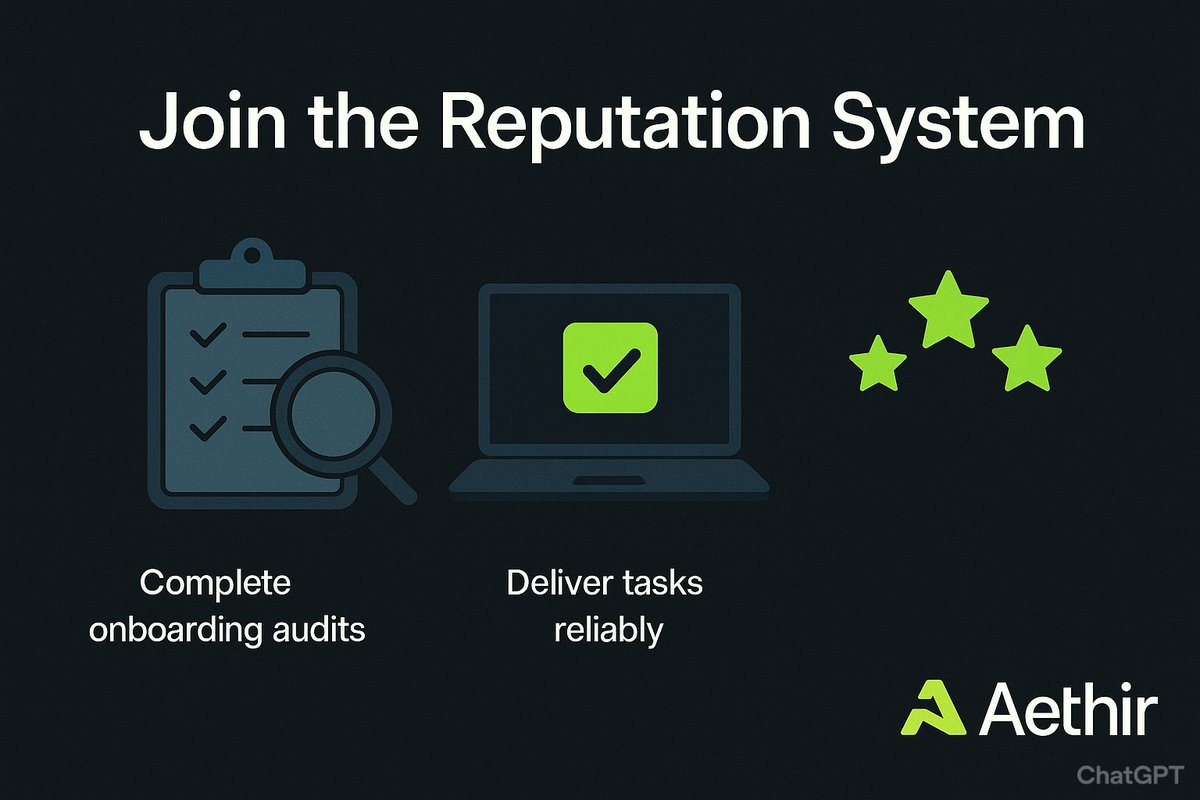
⭐ Build Your Reputation
Aethir rewards reliability. 🌟
✅ Complete onboarding audits
✅ Deliver jobs on time
✅ Maintain uptime
The better your performance, the more compute tasks you’ll receive—and the more you’ll earn.
@AethirCloud #ComputeProvider #AIInfra #Web3Community
1
2
65
6 Oct 2025
Becoming a Compute Provider:
Ever wondered how people earn from their computers on @AethirCloud?
It starts with a simple idea — turning your hardware into a money-making machine for the decentralized world.
Let’s dive into how it works 👇
#Aethir #ComputeProvider #Web3
11
5
22
529

5 Oct 2025
🚀 Power your idle GPU. Earn real rewards.
Become a Cloud Host on Aethir and unlock ATH token rewards, backed by global decentralized GPU infrastructure.
Ready to turn your compute into income?
#Aethir #DePIN #ComputeProvider

2
39

30 Sep 2024
I'm earning credits with my spare compute @OasisAI. Get started for free with my ref link: r.oasis.ai/436a3d14ef6da32c
disclaimer : not like tap tap games which only give you dust.
#oasisai #oasis2025 #AImodel #computeprovider #network #Crypto
1
2
62