
Jun 10
Hmmm. MIs is OK for such a high risk tumor but not a 5mm cervix cancer removed by conization?? Make that make sense. 😂😂 been a while since stirred up the MIs cervix pot!
3
221


This large international cohort study, published in JAMA Surgery, compares long-term outcomes after cold knife conization vs LEEP for the treatment of CIN and early cervical cancer
ow.ly/4hJV50Z9ebU
#meded #ObGyn
114

Cold knife conization was tied to a lower risk of recurrence of cervical lesions and higher HPV clearance compared with the LEEP among women with cervical intraepithelial neoplasia or carcinoma in situ, a cohort study suggested.
medpagetoday.com/obgyn/cervi…
3
274

Jun 7
Among women with cervical intraepithelial neoplasia or carcinoma in situ, cold knife conization was associated with a lower risk of recurrent cervical lesions and higher #HPV clearance rates compared with the loop electrosurgical excision procedure.
ja.ma/4vcmTCZ
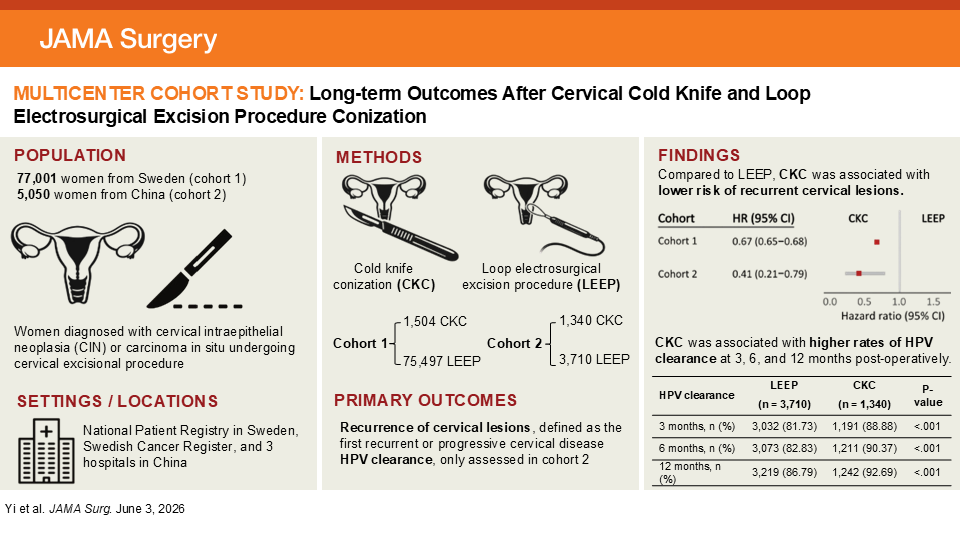
ALT JAMA Surgery study: 'Long-term Outcomes After Cervical Cold Knife & Loop Electrosurgical Excision Procedure Conization'. Finds Cold Knife Conization (CKC) has lower risk of recurrent cervical lesions & higher HPV clearance vs. LEEP. Details population, methods, & data.
5
13
2,260
Jun 3
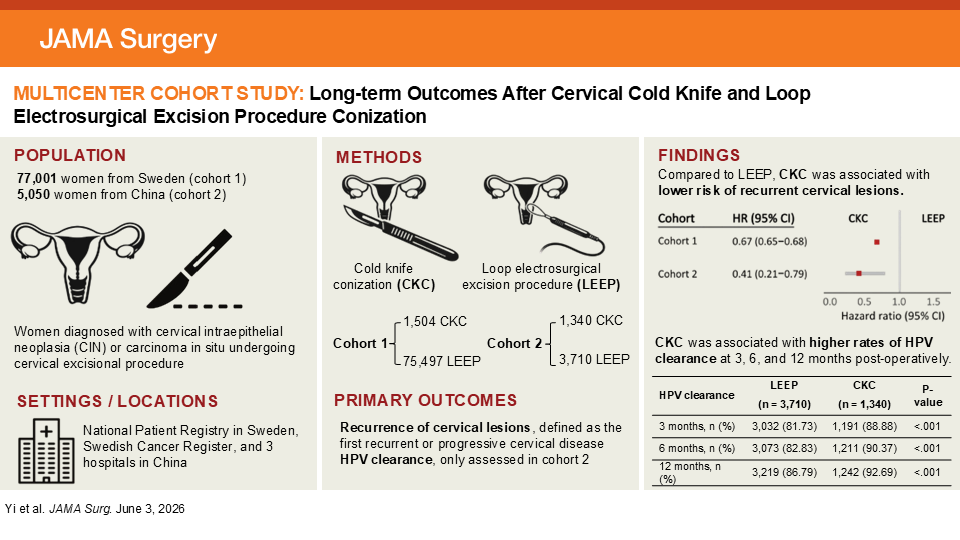
Among women with cervical intraepithelial neoplasia or carcinoma in situ, cold knife conization was associated with a lower risk of recurrent cervical lesions and higher #HPV clearance rates compared with the loop electrosurgical excision procedure. ja.ma/49Ff3sD
3
12
1,964

Jun 1
The West did not get wealthy from colonization they could colonize because they were wealthy,
Conization was an endless money pit of development, investment and a self righteous vanity project to bring civilization to the world

18
374

May 28
Sixteen days of struggle are behind me: first a conization, and today finally the life-saving vaccination, Nick? I'm incredibly proud of myself.


6
1
11
233

May 28
This is so scary to me.
I even had a colonoscopy & conization surgery in 4/2021 & my doctors NEVER told me to get vaxed.
I have NEVER taken the shot OR had Covid. How was I EVER a danger to them⁉️🤔😳
Everyone around me who got vaxed got Covid. THEY were a danger to ME‼️😬😒
1
2
26
May 28
So you’ve never experienced a period & the pain?
Do you get mammograms?
Do you get a Pap smear?
I have endometriosis.
I’ve had several bad paps & conization surgery. Some things you’ll never worry about or understand because you’re not a woman.
3
47

Apr 30
Let’s say you’re like me and had stage 1 cervical cancer. These treatments may not be enough to leave you cancer free. A Conization may be enough to remove the cancer.
1
4
66
Apr 30
The second is a conization, a cone of cervical tissue is removed with either a scalpel, laser or cryotherapy device. The last option is a LEEP, where an electrified loop is used to scrape away the cells.
1
7
189


For a LEEP they would be using some sort of sedation, and a conization definitely needs anesthesia or twilight. But I guess they don't for a regular colpo since all they're doing is swabbing the solution onto the cervix... but still I'd imagine that's super uncomfortable yeah!?
1
7
201

Apr 13
酷い検体提出といえば、conizationが裏返し(粘膜が下)でボードに貼り付けられていたことがあります。
あまりにもキッチリ貼ってあったので怒るより先に「こういう…流派なのか…」?と考えてしまった
7
291

Mar 19
The #OncoAlertColloquium 2026 GYN Malignancies🚨 ESGO SESSION
Presentation by Dr. Nicolò Bizzarri🇮🇹 : Year in Review Surgical #CervicalCancer
REGISTER HERE TO WATCH: buff.ly/xwD5G2D
Surgical trials for cervical cancer in 2025 focused on de-escalation of surgical radicality.
In particular, the SENTIX and PHENIX trials showed the oncological safety of sentinel lymph node (SLN) alone. The GOG278 study demonstrated the efficacy and safety of conservative surgery in low-risk disease. 📊
Sub-analyses of the SHAPE trial generated hypotheses supporting the potential safety of a minimally invasive approach to simple hysterectomy, as well as the safety of conization prior to hysterectomy.
The LASH trial is ongoing and will further assess the oncologic safety of minimally invasive simple hysterectomy in low-risk cervical cancer. ⏳
GynOnc
@NicoloBizzarri 🇮🇹
Vanda Salutari 🇮🇹
@AStrojnaMD 🇩🇪
Alejandra Martinez 🇫🇷
@CoquardRay 🇫🇷
Christina Fotopoulou 🇬🇧@CF_PC_OvCaGroup
Giorgia Garganesse 🇮🇹
Ms. Anne De Middelaer @EngageEsgo
@agz_eriksson
@womenofteal
#OncoAlertAF
@nataliagandur @acampsmalea @BRicciutiMD
@HHorinouchi @FadiHaddad_MD @Abdallah81MD @FernandoOnco @ElisaAgostinett @to_be_elizabeth @bavilima @realbowtiedoc @Erman_Akkus @Lucarecco @GaiaGriguolo @JankovicK
@MarioBalsaMD @DrMirallas @OscarTahuahua @UOzkerim @DrRishabhOnco @Onco_Cifu88 @PaulJiL @DaisukeKotani @DraMartinezLago
Our Partners
@ESGO_society @ESSOnews @CancerCareMASCC @SIOGorg
9
14
2,104

Feb 20
That’s BS. Because of pap smears they gave me a horrible and unnecessary conization surgery 20 years ago in order to find out I had „preliminary“ stage of cancer 🤡. Didn’t find any proof of cancer. And mammograms cause cancer ☝️. Follow the money 💰.I avoid doctors if I can ✌️
2
3
224

Feb 7
This news circulates on social media with the headline "Mexican scientist completely eliminated HPV" and generates excitement. Rightfully so, because HPV is responsible for 99 percent of cervical cancers and over 300,000 women worldwide die from this disease annually. But understanding what this news actually conveys, what was achieved, and what wasn't requires digging deeper.
Eva Ramón Gallegos is a serious researcher working in biomedical sciences and nanobiotechnology at Mexico's National Polytechnic Institute (IPN). She has been studying photodynamic therapy (PDT) for over 20 years. This isn't a "miracle cure" claim but a long-term research program published in peer-reviewed journals with traceable methodology (1).
How does photodynamic therapy work? The mechanism is elegant and biochemically logical. Delta-aminolevulinic acid (5-ALA) is applied to the cervix. This substance is a naturally occurring amino acid and precursor in the heme biosynthesis pathway. Within approximately 4 hours, it converts to protoporphyrin IX (PpIX) in cells. The beauty is this: cancer and precancerous cells, due to their disrupted metabolism, accumulate this substance far more than normal cells. When light of a specific wavelength is then applied, the accumulated PpIX produces reactive oxygen species and selectively destroys these cells (2).
The difference from chemotherapy emerges here: while chemotherapy attacks healthy and diseased cells indiscriminately, PDT targets only abnormal cells. Moreover, it doesn't threaten fertility because it preserves cervical structure. Surgical procedures like LEEP or conization remove tissue from the cervix and increase preterm birth risk; PDT doesn't (3).
Now let's look at the numbers. Gallegos' 2023 study published in Photochemistry and Photobiology included 29 women. In these women diagnosed with CIN I (cervical intraepithelial neoplasia grade 1) and/or HPV, HPV infection was eliminated at 100 percent after 6 months (p<0.01). Clearance rate for CIN I HPV combination was 64.3 percent, for CIN I alone 57.2 percent (4). The 2017 earlier study reported 80-83 percent clearance rates for HPV-16 and HPV-18 infections in 30 women (5).
These numbers appear impressive. But scientific evaluation requires asking several critical questions.
First: was there a control group? The 2023 study has no placebo or untreated control group. This is a major methodological deficiency because we know the natural course of HPV infections. Literature data shows that 80-90 percent of high-risk HPV infections spontaneously clear by the immune system within 18-24 months (6). 57-80 percent of CIN I lesions can regress without treatment (7). So when evaluating the "100 percent HPV elimination" figure, we cannot distinguish how much was due to treatment versus natural regression.
Second: sample size. 29-30 women isn't sufficient to prove a treatment's efficacy. From a statistical power analysis perspective, results obtained from such small samples cannot be generalized to larger populations. This is why the scientific community demands phase 3 clinical trials (8).
Third: long-term follow-up. 6-12 month follow-up isn't sufficient to determine whether HPV was permanently eliminated. Recurrence rates should be evaluated with 5-10 year monitoring.
But here's where the story gets interesting: there's a large-scale phase 3 randomized controlled trial published in 2025. Hexaminolevulinate-based PDT called APL-1702 was tested in 402 women. Results: 41.1 percent response rate in treatment group, 21.7 percent in placebo group (p<0.001). HPV 16/18 clearance rates were 31.4 percent in treatment group, 15.4 percent in placebo (p=0.011) (9). This study shows PDT is significantly superior to placebo but far from the 100 percent figures Gallegos reported.
Snopes verified this news as "TRUE," but what was verified wasn't "Mexican researcher developed a treatment that completely eliminates HPV" but rather "Eva Ramón Gallegos and her team have been working on photodynamic therapy for 20 years and achieved promising results" (10). There's a significant difference between the two.
Is this research worthless then? Absolutely not. PDT's potential in cervical lesions is real. Being minimally invasive, preserving fertility, and being repeatable are important advantages. Gallegos' work is pioneering in this field and lays groundwork for larger studies. But the headline "completely eliminated HPV" is an exaggeration not supported by the current evidence base.
Eva Ramón Gallegos is a serious scientist and her work is valuable. Photodynamic therapy is a promising approach for cervical precancerous lesions. But the data we currently have isn't sufficient to call this a "definitive cure." Larger, randomized, controlled studies with long-term follow-up are needed. This is how science works: promising findings, rigorous verification, gradual progress. Not miracle headlines.
Sources:
1-ResearchGate. Eva Ramon-Gallegos Research Profile. National Polytechnic Institute, Mexico City.
2-Malik Z, et al. Fundamentals of 5-aminolevulinic acid photodynamic therapy and diagnosis: An overview. Transl Biophotonics. 2020;2(1-2):e201900022.
3-Therapeutic Advances in Chronic Disease. Photodynamic therapy of cervical cancer: a scoping review on the efficacy of various molecules. PMC. 2024.
4-López-Cárdenas S, et al. Elimination of Human Papillomavirus and Cervical Pathological Microbiota with Photodynamic Therapy in Women from Mexico City with Cervical Intraepithelial Neoplasia I. Photochem Photobiol. 2023.
5-Maldonado Alvarado E, et al. Effectiveness of Photodynamic Therapy in Elimination of HPV-16 and HPV-18 Associated with CIN I in Mexican Women. Photochem Photobiol. 2017;93(5):1269-1275.
6-PMC. Human papillomavirus persistence or clearance after infection in reproductive age. 2022.
7-PMC. Low-Grade Cervical Intraepithelial Neoplasia (CIN1) Evolution. 2023.
8-PMC. Efficacy and safety of photodynamic therapy for cervical intraepithelial neoplasia and human papilloma virus infection: A systematic review and meta-analysis. 2018.
9-ScienceDirect. Photodynamic therapy for high-grade squamous intraepithelial lesions: A randomized controlled trial. 2025.
10-Snopes. Did a Mexican Researcher Develop a Potential Treatment for HPV? February 2019.
5
98
Feb 7
This news circulates on social media with the headline "Mexican scientist completely eliminated HPV" and generates excitement. Rightfully so, because HPV is responsible for 99 percent of cervical cancers and over 300,000 women worldwide die from this disease annually. But understanding what this news actually conveys, what was achieved, and what wasn't requires digging deeper.
Eva Ramón Gallegos is a serious researcher working in biomedical sciences and nanobiotechnology at Mexico's National Polytechnic Institute (IPN). She has been studying photodynamic therapy (PDT) for over 20 years. This isn't a "miracle cure" claim but a long-term research program published in peer-reviewed journals with traceable methodology (1).
How does photodynamic therapy work? The mechanism is elegant and biochemically logical. Delta-aminolevulinic acid (5-ALA) is applied to the cervix. This substance is a naturally occurring amino acid and precursor in the heme biosynthesis pathway. Within approximately 4 hours, it converts to protoporphyrin IX (PpIX) in cells. The beauty is this: cancer and precancerous cells, due to their disrupted metabolism, accumulate this substance far more than normal cells. When light of a specific wavelength is then applied, the accumulated PpIX produces reactive oxygen species and selectively destroys these cells (2).
The difference from chemotherapy emerges here: while chemotherapy attacks healthy and diseased cells indiscriminately, PDT targets only abnormal cells. Moreover, it doesn't threaten fertility because it preserves cervical structure. Surgical procedures like LEEP or conization remove tissue from the cervix and increase preterm birth risk; PDT doesn't (3).
Now let's look at the numbers. Gallegos' 2023 study published in Photochemistry and Photobiology included 29 women. In these women diagnosed with CIN I (cervical intraepithelial neoplasia grade 1) and/or HPV, HPV infection was eliminated at 100 percent after 6 months (p<0.01). Clearance rate for CIN I HPV combination was 64.3 percent, for CIN I alone 57.2 percent (4). The 2017 earlier study reported 80-83 percent clearance rates for HPV-16 and HPV-18 infections in 30 women (5).
These numbers appear impressive. But scientific evaluation requires asking several critical questions.
First: was there a control group? The 2023 study has no placebo or untreated control group. This is a major methodological deficiency because we know the natural course of HPV infections. Literature data shows that 80-90 percent of high-risk HPV infections spontaneously clear by the immune system within 18-24 months (6). 57-80 percent of CIN I lesions can regress without treatment (7). So when evaluating the "100 percent HPV elimination" figure, we cannot distinguish how much was due to treatment versus natural regression.
Second: sample size. 29-30 women isn't sufficient to prove a treatment's efficacy. From a statistical power analysis perspective, results obtained from such small samples cannot be generalized to larger populations. This is why the scientific community demands phase 3 clinical trials (8).
Third: long-term follow-up. 6-12 month follow-up isn't sufficient to determine whether HPV was permanently eliminated. Recurrence rates should be evaluated with 5-10 year monitoring.
But here's where the story gets interesting: there's a large-scale phase 3 randomized controlled trial published in 2025. Hexaminolevulinate-based PDT called APL-1702 was tested in 402 women. Results: 41.1 percent response rate in treatment group, 21.7 percent in placebo group (p<0.001). HPV 16/18 clearance rates were 31.4 percent in treatment group, 15.4 percent in placebo (p=0.011) (9). This study shows PDT is significantly superior to placebo but far from the 100 percent figures Gallegos reported.
Snopes verified this news as "TRUE," but what was verified wasn't "Mexican researcher developed a treatment that completely eliminates HPV" but rather "Eva Ramón Gallegos and her team have been working on photodynamic therapy for 20 years and achieved promising results" (10). There's a significant difference between the two.
Is this research worthless then? Absolutely not. PDT's potential in cervical lesions is real. Being minimally invasive, preserving fertility, and being repeatable are important advantages. Gallegos' work is pioneering in this field and lays groundwork for larger studies. But the headline "completely eliminated HPV" is an exaggeration not supported by the current evidence base.
Eva Ramón Gallegos is a serious scientist and her work is valuable. Photodynamic therapy is a promising approach for cervical precancerous lesions. But the data we currently have isn't sufficient to call this a "definitive cure." Larger, randomized, controlled studies with long-term follow-up are needed. This is how science works: promising findings, rigorous verification, gradual progress. Not miracle headlines.
Sources:
1-ResearchGate. Eva Ramon-Gallegos Research Profile. National Polytechnic Institute, Mexico City.
2-Malik Z, et al. Fundamentals of 5-aminolevulinic acid photodynamic therapy and diagnosis: An overview. Transl Biophotonics. 2020;2(1-2):e201900022.
3-Therapeutic Advances in Chronic Disease. Photodynamic therapy of cervical cancer: a scoping review on the efficacy of various molecules. PMC. 2024.
4-López-Cárdenas S, et al. Elimination of Human Papillomavirus and Cervical Pathological Microbiota with Photodynamic Therapy in Women from Mexico City with Cervical Intraepithelial Neoplasia I. Photochem Photobiol. 2023.
5-Maldonado Alvarado E, et al. Effectiveness of Photodynamic Therapy in Elimination of HPV-16 and HPV-18 Associated with CIN I in Mexican Women. Photochem Photobiol. 2017;93(5):1269-1275.
6-PMC. Human papillomavirus persistence or clearance after infection in reproductive age. 2022.
7-PMC. Low-Grade Cervical Intraepithelial Neoplasia (CIN1) Evolution. 2023.
8-PMC. Efficacy and safety of photodynamic therapy for cervical intraepithelial neoplasia and human papilloma virus infection: A systematic review and meta-analysis. 2018.
9-ScienceDirect. Photodynamic therapy for high-grade squamous intraepithelial lesions: A randomized controlled trial. 2025.
10-Snopes. Did a Mexican Researcher Develop a Potential Treatment for HPV? February 2019.
4
67
Feb 7
This news circulates on social media with the headline "Mexican scientist completely eliminated HPV" and generates excitement. Rightfully so, because HPV is responsible for 99 percent of cervical cancers and over 300,000 women worldwide die from this disease annually. But understanding what this news actually conveys, what was achieved, and what wasn't requires digging deeper.
Eva Ramón Gallegos is a serious researcher working in biomedical sciences and nanobiotechnology at Mexico's National Polytechnic Institute (IPN). She has been studying photodynamic therapy (PDT) for over 20 years. This isn't a "miracle cure" claim but a long-term research program published in peer-reviewed journals with traceable methodology (1).
How does photodynamic therapy work? The mechanism is elegant and biochemically logical. Delta-aminolevulinic acid (5-ALA) is applied to the cervix. This substance is a naturally occurring amino acid and precursor in the heme biosynthesis pathway. Within approximately 4 hours, it converts to protoporphyrin IX (PpIX) in cells. The beauty is this: cancer and precancerous cells, due to their disrupted metabolism, accumulate this substance far more than normal cells. When light of a specific wavelength is then applied, the accumulated PpIX produces reactive oxygen species and selectively destroys these cells (2).
The difference from chemotherapy emerges here: while chemotherapy attacks healthy and diseased cells indiscriminately, PDT targets only abnormal cells. Moreover, it doesn't threaten fertility because it preserves cervical structure. Surgical procedures like LEEP or conization remove tissue from the cervix and increase preterm birth risk; PDT doesn't (3).
Now let's look at the numbers. Gallegos' 2023 study published in Photochemistry and Photobiology included 29 women. In these women diagnosed with CIN I (cervical intraepithelial neoplasia grade 1) and/or HPV, HPV infection was eliminated at 100 percent after 6 months (p<0.01). Clearance rate for CIN I HPV combination was 64.3 percent, for CIN I alone 57.2 percent (4). The 2017 earlier study reported 80-83 percent clearance rates for HPV-16 and HPV-18 infections in 30 women (5).
These numbers appear impressive. But scientific evaluation requires asking several critical questions.
First: was there a control group? The 2023 study has no placebo or untreated control group. This is a major methodological deficiency because we know the natural course of HPV infections. Literature data shows that 80-90 percent of high-risk HPV infections spontaneously clear by the immune system within 18-24 months (6). 57-80 percent of CIN I lesions can regress without treatment (7). So when evaluating the "100 percent HPV elimination" figure, we cannot distinguish how much was due to treatment versus natural regression.
Second: sample size. 29-30 women isn't sufficient to prove a treatment's efficacy. From a statistical power analysis perspective, results obtained from such small samples cannot be generalized to larger populations. This is why the scientific community demands phase 3 clinical trials (8).
Third: long-term follow-up. 6-12 month follow-up isn't sufficient to determine whether HPV was permanently eliminated. Recurrence rates should be evaluated with 5-10 year monitoring.
But here's where the story gets interesting: there's a large-scale phase 3 randomized controlled trial published in 2025. Hexaminolevulinate-based PDT called APL-1702 was tested in 402 women. Results: 41.1 percent response rate in treatment group, 21.7 percent in placebo group (p<0.001). HPV 16/18 clearance rates were 31.4 percent in treatment group, 15.4 percent in placebo (p=0.011) (9). This study shows PDT is significantly superior to placebo but far from the 100 percent figures Gallegos reported.
Snopes verified this news as "TRUE," but what was verified wasn't "Mexican researcher developed a treatment that completely eliminates HPV" but rather "Eva Ramón Gallegos and her team have been working on photodynamic therapy for 20 years and achieved promising results" (10). There's a significant difference between the two.
Is this research worthless then? Absolutely not. PDT's potential in cervical lesions is real. Being minimally invasive, preserving fertility, and being repeatable are important advantages. Gallegos' work is pioneering in this field and lays groundwork for larger studies. But the headline "completely eliminated HPV" is an exaggeration not supported by the current evidence base.
Eva Ramón Gallegos is a serious scientist and her work is valuable. Photodynamic therapy is a promising approach for cervical precancerous lesions. But the data we currently have isn't sufficient to call this a "definitive cure." Larger, randomized, controlled studies with long-term follow-up are needed. This is how science works: promising findings, rigorous verification, gradual progress. Not miracle headlines.
Sources:
1-ResearchGate. Eva Ramon-Gallegos Research Profile. National Polytechnic Institute, Mexico City.
2-Malik Z, et al. Fundamentals of 5-aminolevulinic acid photodynamic therapy and diagnosis: An overview. Transl Biophotonics. 2020;2(1-2):e201900022.
3-Therapeutic Advances in Chronic Disease. Photodynamic therapy of cervical cancer: a scoping review on the efficacy of various molecules. PMC. 2024.
4-López-Cárdenas S, et al. Elimination of Human Papillomavirus and Cervical Pathological Microbiota with Photodynamic Therapy in Women from Mexico City with Cervical Intraepithelial Neoplasia I. Photochem Photobiol. 2023.
5-Maldonado Alvarado E, et al. Effectiveness of Photodynamic Therapy in Elimination of HPV-16 and HPV-18 Associated with CIN I in Mexican Women. Photochem Photobiol. 2017;93(5):1269-1275.
6-PMC. Human papillomavirus persistence or clearance after infection in reproductive age. 2022.
7-PMC. Low-Grade Cervical Intraepithelial Neoplasia (CIN1) Evolution. 2023.
8-PMC. Efficacy and safety of photodynamic therapy for cervical intraepithelial neoplasia and human papilloma virus infection: A systematic review and meta-analysis. 2018.
9-ScienceDirect. Photodynamic therapy for high-grade squamous intraepithelial lesions: A randomized controlled trial. 2025.
10-Snopes. Did a Mexican Researcher Develop a Potential Treatment for HPV? February 2019.
4
66