
Jun 6
Hi guys
I have got exciting news for you
What if you could test on mainnet without the risk?
That's exactly what Contract.dev is building. 🔥🔥
@contractdotdev
contact.dev
#crypto #Web3 #contractdev
1
2
30

Jun 2
Today I set up my first Stagenet on @contractdotdev.
Steps it took:
1. Created a project → got my private RPC URL
2. Added the RPC to MetaMask (yes, it works with standard wallets)
Building in public from here.
#BuildingInPublic #Contractdev #Ethereum
2
5
120
May 29
Free Resource Friday:
Things I wish I had when learning Smart Contract Development on Ethereum Network:
1. solidity-by-example.org — Real contract examples with clear explanations. Much better than the official docs for learning.
2. hardhat.org — Professional development environment. Use this instead of Remix when you're ready to build seriously.
3. etherscan.io/opcode-tool — Understand what your Solidity compiles to at the bytecode level. Nerdy but useful.
4. github.com/OpenZeppelin/open… — Study these contracts. They're the gold standard for Solidity security patterns.
5. Contract.dev — A platform that Simulate a real Mainnet Behaviour on private Testnet.
Have a productive weekend. Build something.
#Solidity #Contractdev #Web3Dev #FreeResources
4
1
7
170

May 28
Most smart contracts don’t fail in testing.
They fail when reality shows up.
That’s because most Web3 devs rely on testnets like Sepolia or local tools like Hardhat and those environments are too “clean.”
No real liquidity.
No real users.
No real pressure.
So yeah, your contract passes tests… but that doesn’t mean it’s ready for mainnet.
Because in the real world (on Ethereum):
* Prices move fast (oracles)
* Liquidity shifts
* Bots compete
* Transactions pile up
That’s where things break.
This is why production-like testing matters.
Instead of simulating assumptions, new approaches like stagenets replay real conditions so you can see how your contract behaves under actual stress before deployment.
Platforms like contract.dev
are building this kind of infrastructure not just testing tools, but environments that reflect reality.
Because in Web3, passing tests isn’t the goal.
👉 Surviving production is.
#Web3 #SmartContracts #Ethereum #DeFi #BlockchainDev #contractdev
44
65
1,530
May 28
1/4
"Mainnet Replay" sounds complex. Let me break it down simply.
The core idea behind
@contractdotdev Stagenets
#Web3 #SmartContracts #Ethereum #Contractdev
6
7
158

May 27
most smart contracts fail because the environment trained them to expect a world that doesn’t exist.
contract.dev feels like a bet on something Web3 desperately needs:
testing against reality before reality tests you first
#Web3 #Ethereum #DeFi #contractdev #stagenet
4
38

May 27
Stagenets is a testing environment that actually feels like mainnet before you even get to use one.
As a developer you get to replay real mainnet behavior with real protocols and simulate thousands of transactions to test your contracts.
Your dashboard tracks everything automatically and your workspace launches the moment you push to GitHub.
For me, it is about using the right tools and not a skill issue.
This video is for every developer who felt confident in testing but watched things break on mainnet and how @contractdotdev solves the problem.
#Web3 #SmartContracts #Ethereum #DeFi #contractdev #BlockchainDev
3
3
18
2,453

the protocol that lost $2.3 million 48 hours after deployment had done everything right by the standards that existed.
- full test suite.
- complete audit.
- testnet deployment.
- clean results.
the standard was the problem.
testing in environments that don't reflect production conditions isn't rigorous testing.
it's organized optimism.
the question every developer should ask before deployment is not " did my tests pass "
it's " did my tests pass against conditions that
actually reflect mainnet "
if the answer is no the contract isn't ready.
contractdotdev builds the environment that makes the answer yes.
start your Stagenet today → contract.dev
#Web3 | #SmartContracts | #Ethereum | #DeFi #BlockchainDev | #contractdev
2
35

I don't know why most smart contracts not fail in testing, but fail when in mainnet ?
Because many testing environments don't actually reflect mainnet conditions 💯.
A contract can pass local tests and perform perfectly on a testnet, but production isn't an isolated environment. Real networks have moving liquidity, active oracles, changing market conditions, transaction pressure, and unpredictable interactions happening all at once.
Passing tests only proves your code works under expected conditions.
Surviving production proves your protocol works under real conditions. And why do traditional testnets simulate assumptions. Stagenets replay actual protocol behavior instead of isolated simulations, creating an environment closer to what developers will face after deployment.
Production, like testing before launch matters because finding problems after deployment is far more expensive than finding them before mainnet.
This is the problem @contractdotdev is solving.
Real infrastructure for real developer challenges, not just another testing tool.
#Web3 #SmartContracts #Ethereum #DeFi #BlockchainDev #contractdev

12
7
18
364

May 26
The future of smart contract development isn’t just writing code
It’s understanding how that code behaves under real world conditions
And that’s where production like testing matters most
For more info: contract.dev
#Web3 #SmartContracts #Ethereum #DeFi #contractdev

3
36

May 26
Most smart contracts don’t fail during testing.
They fail when reality finally shows up.
Traditional testnets and local forks often create artificial conditions: • fake liquidity
• limited transaction pressure
• inactive oracle behavior
• predictable environments
So developers end up testing assumptions instead of real-world execution.
That’s the dangerous gap between “passing tests” and surviving production.
In reality, mainnet conditions are chaotic: users behave unpredictably, liquidity moves fast, oracle updates change outcomes, and network activity creates pressure most test environments never simulate properly.
This is where the idea of Stagenets becomes important 👀
Instead of isolated simulations, Stagenets replay actual protocol behavior under production-like conditions allowing developers to identify weaknesses before deployment.
The future of Web3 infrastructure won’t just be about building faster.
It’ll be about testing smarter.
That’s part of why platforms like @contractdotdev.dev are becoming important for the next generation of DeFi development.
#Web3 #SmartContracts #Ethereum #DeFi #BlockchainDev #contractdev

5
1
16
102

May 26
If we want safer, more resilient dApps, we have to test against reality, not just our code.
How are you currently validating your contracts before shipping to mainnet? Are you still relying on basic local simulations?
Let’s talk in the comments. ☕👇
#Web3 #SmartContracts #Ethereum #DeFi #BlockchainDev #contractdev
3
35

May 26
Testnets simulate assumptions.
Stagenets replay conditions.
Ship accordingly.
@contractdotdev
#Web3 #SmartContracts #Ethereum #DeFi #BlockchainDev #contractdev
3
19
77

May 26
Most smart contracts don’t fail in testing.
They fail when reality shows up.
Testnets simulate assumptions. Stagenets replay conditions.
Why production-like testing matters in web3 👇👇 👇
#Web3 #SmartContracts #Ethereum #DeFi #BlockchainDev #contractdev

14
5
22
364

May 26
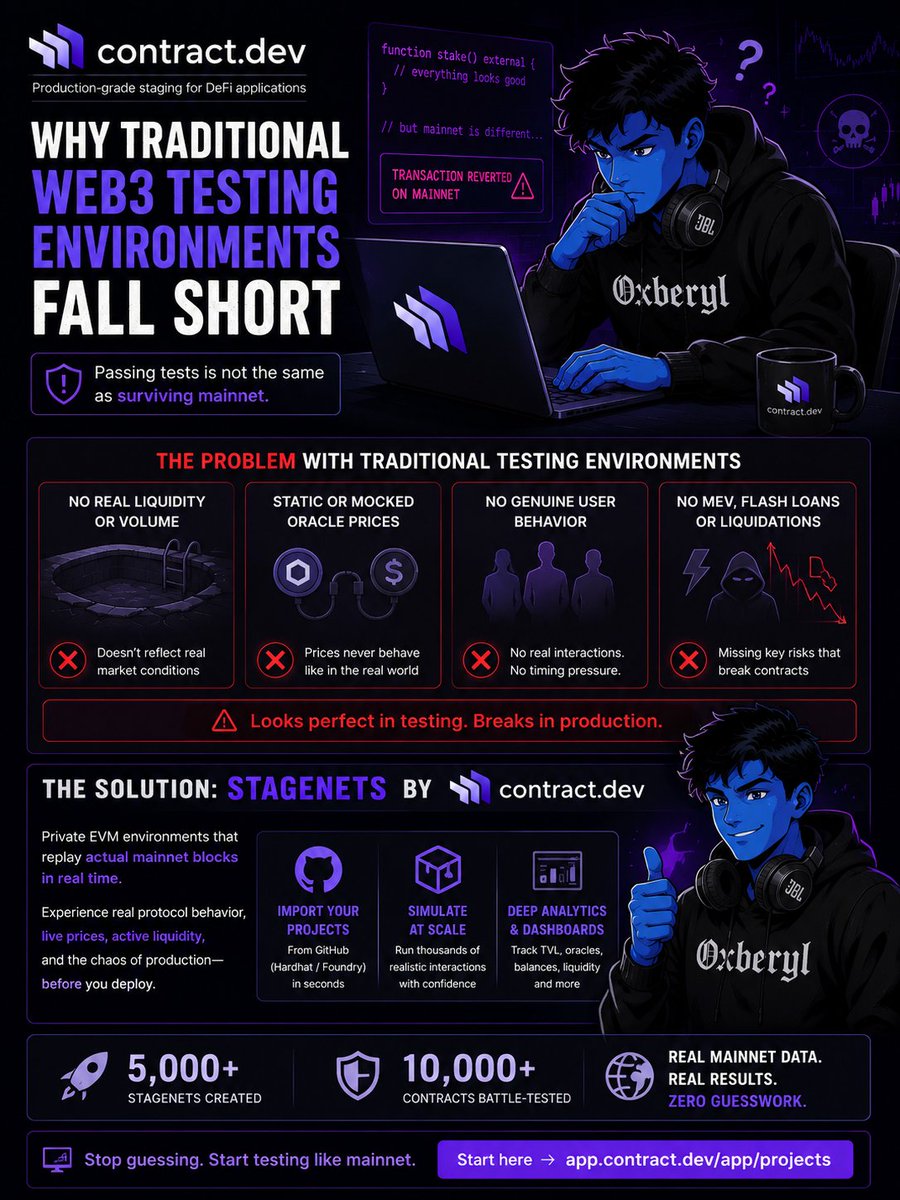
WHY TRADITIONAL WEB3 TESTING ENVIRONMENTS FALL SHORT
New builders often think: “If it works on testnet and passes the audit, I’m safe.”.......Unfortunately, that’s one of the most expensive myths in crypto.
Traditional testnets and local forks create a false sense of security. They’re too clean. Too empty. Too predictable.
✓ No real liquidity or trading volume
✓ Static or mocked oracle prices
✓ No genuine user behavior or timing pressure
✓ Zero MEV, flash loans, or cascading liquidations
Your contract might pass every test… but completely break when it meets the real world.
@contractdotdev solves this critical problem with Stagenets.
These are private EVM environments that replay actual mainnet blocks in real time. Your smart contracts experience real protocol behavior, live prices, active liquidity pools, authentic transaction flow, and all the chaos of production..
You can:
• Import your full Hardhat or Foundry project from GitHub instantly
• Simulate thousands of realistic interactions
• Track deep analytics and dashboards (TVL, oracles, balances, etc.)
Over 5,000 Stagenets created and 10,000 contracts already battle-tested.
@contractdotdev isn’t just another dev tool.
It’s essential production-grade infrastructure helping teams move from:
“It Works In Testing” to “IT’S READY FOR MAINNET.”
If you’re building serious DeFi infrastructure, production-like testing should become the standard, not an afterthought.
Start here → app.contract.dev/app/project…
#Web3 #SmartContracts #Ethereum #DeFi #BlockchainDev #contractdev
83
24
96
5,034

May 26
Most smart contracts don’t fail in testing.
They fail when reality shows up.
Why do so many projects survive testnet… then break on mainnet?
Let’s talk about why traditional Web3 testing environments often fall short and how Stagenets from @contractdotdev are changing that.
Traditional testnets like Sepolia and local forks are useful for basic checks.
But they still run in isolated environments:
• fake liquidity
• static oracles
• low transaction activity
• limited protocol interaction
Mainnet is completely different.
Liquidity shifts constantly.
Oracle feeds update in real time.
Thousands of transactions compete for block space.
MEV and protocol interactions create unpredictable behavior.
A contract can pass tests locally…
…and still fail under real production conditions.
This gap between “works on testnet” and “survives mainnet” is where real damage happens:
• exploits
• broken integrations
• failed liquidations
• unexpected edge cases
• poor user experience
Passing local tests doesn’t mean your contracts are production-ready.
Testnets simulate assumptions.
Stagenets replay conditions.
@contractdotdev’s Stagenets are private EVM environments that replay actual mainnet blocks.
That means developers can test against:
• real liquidity conditions
• live oracle behavior
• transaction pressure
• realistic protocol state
before deployment.
You can import contracts from GitHub, run large-scale simulations, and analyze behavior deeply all in a production-like environment.
This is infrastructure solving a real developer problem, not just another testing tool.
As DeFi, AI agents, and on-chain applications become more complex, realistic staging becomes essential.
Because in Web3, “it worked on testnet” is no longer enough.
Try it here:
app.contract.dev/app/project…
Website:
contract.dev
What’s one challenge you’ve faced moving from testnet to mainnet? 👇
#Web3 #SmartContracts #Ethereum #DeFi #BlockchainDev #contractdev
5
1
14
188

May 26
Passing local tests doesn’t mean your smart contracts are production ready.
Because most testnets and local forks don’t reflect what actually happens on mainnet.
In production, protocols face:
• real liquidity movement
• live oracle updates
• transaction congestion
• unpredictable user behavior
• cross-protocol interactions
That’s where many contracts break.
The problem isn’t always bad code.
The problem is unrealistic testing environments.
Traditional testnets simulate assumptions.
Stagenets replay real protocol behavior under production-like conditions.
And that difference matters.
There’s a huge gap between:
✅ passing tests
and
✅ surviving real market pressure
Developers need environments that expose failures before deployment not after users and funds are at risk.
That’s why @contractdotdev stands out.
It’s not just another testing tool.
It’s infrastructure designed to solve a real Web3 developer problem:
making smart contract testing behave closer to reality.
@contractdotdev
#Web3 #SmartContracts #Ethereum #DeFi #BlockchainDev #contractdev
32
3
231
5,142
been lookin to @contractdotdev lately. their usecase is too good for the testnet users .
I will be dropping a detailed thread about contractdev soon ⌛
3
49

𝗯𝘂𝗶𝗹𝗱 𝘄𝗶𝘁𝗵 𝗰𝗼𝗻𝗳𝗶𝗱𝗲𝗻𝗰𝗲: 𝘄𝗵𝘆 𝗰𝗼𝗻𝘁𝗿𝗮𝗰𝘁.𝗱𝗲𝘃 𝗶𝘀 𝗿𝗲𝗱𝗲𝗳𝗶𝗻𝗶𝗻𝗴 𝘀𝗺𝗮𝗿𝘁 𝗰𝗼𝗻𝘁𝗿𝗮𝗰𝘁 𝘁𝗲𝘀𝘁𝗶𝗻𝗴.
The Problem Most Builders Learn Too Late.
▪️ In crypto, code is not just code.
▪️Code controls money.
Every smart contract deployed to mainnet carries real consequences. One overlooked vulnerability, one failed integration, or one broken assumption can lead to exploits, frozen liquidity, or millions in losses.
𝗧𝗵𝗮𝘁’𝘀 𝘁𝗵𝗲 𝗵𝗮𝗿𝘀𝗵 𝗿𝗲𝗮𝗹𝗶𝘁𝘆 𝗼𝗳 𝗪𝗲𝗯𝟯 𝗶𝗻𝗳𝗿𝗮𝘀𝘁𝗿𝘂𝗰𝘁𝘂𝗿𝗲.
For years, developers relied on public testnets to prepare applications before launch. But there’s one major problem:
Most testnets don’t behave like the real world.
Fake liquidity. Empty ecosystems. Unrealistic market conditions. Limited protocol interactions.
And when projects finally hit mainnet, many discover problems they never saw during testing.
👉 𝗧𝗵𝗶𝘀 𝗶𝘀 𝘁𝗵𝗲 𝗲𝘅𝗮𝗰𝘁 𝗴𝗮𝗽 @contractdotdev 𝗶𝘀 𝘀𝗼𝗹𝘃𝗶𝗻𝗴.
▫️𝗧𝗵𝗲 𝗕𝗶𝗴𝗴𝗲𝘀𝘁 𝗪𝗲𝗮𝗸𝗻𝗲𝘀𝘀 𝗶𝗻 𝗪𝗲𝗯𝟯 𝗗𝗲𝘃𝗲𝗹𝗼𝗽𝗺𝗲𝗻𝘁
Traditional test environments create a dangerous illusion.
A protocol may appear stable in testing, but real blockchain conditions are far more chaotic:
▪️ Real users behave unpredictably
▪️Liquidity constantly changes
▪️Protocols interact simultaneously
▪️Gas conditions fluctuate rapidly
▪️MEV and transaction ordering affect outcomes
This is why many applications break under real market pressure.
🔹𝗧𝗵𝗲 𝗶𝘀𝘀𝘂𝗲 𝗶𝘀𝗻’𝘁 𝗮𝗹𝘄𝗮𝘆𝘀 𝗯𝗮𝗱 𝗰𝗼𝗱𝗲.
Sometimes developers simply lacked an environment realistic enough to expose hidden risks before launch.
🔹@contractdotdev 𝗧𝗲𝘀𝘁𝗶𝗻𝗴 𝗧𝗵𝗮𝘁 𝗔𝗰𝘁𝘂𝗮𝗹𝗹𝘆 𝗙𝗲𝗲𝗹𝘀 𝗟𝗶𝗸𝗲 𝗠𝗮𝗶𝗻𝗻𝗲𝘁
@contractdotdev introduces something different:
🔹𝗦𝘁𝗮𝗴𝗲𝗻𝗲𝘁𝘀.
Private blockchain environments that replay real mainnet conditions so developers can test applications under realistic scenarios before deployment.
🔹𝗛𝗲𝗿𝗲’𝘀 𝘄𝗵𝗮𝘁 𝘁𝗵𝗮𝘁 𝗺𝗲𝗮𝗻𝘀:
▪️Real liquidity states
▪️Real token balances
▪️Real DeFi integrations
▪️Real transaction activity
▪️Real protocol behavior
Instead of testing inside empty simulations, developers can experience how their applications behave in environments that mirror production conditions.
That changes everything.
🔹𝗕𝘂𝗶𝗹𝗱𝗶𝗻𝗴 𝗳𝗼𝗿 𝘁𝗵𝗲 𝗥𝗲𝗮𝗹 𝗪𝗼𝗿𝗹𝗱, 𝗡𝗼𝘁 𝗮 𝗙𝗮𝗸𝗲 𝗢𝗻𝗲
Web3 is becoming increasingly interconnected.
Protocols no longer operate in isolation. A single application may depend on:
▪️DEX liquidity
▪️Oracles
▪️Cross chain bridges
▪️Automation systems
▪️Yield protocols
▪️External smart contracts
Testing these interactions properly is critical.
@contractdotdev allows builders to simulate complex behaviors like:
▪️High transaction loads
▪️Automated swaps
▪️Liquidations
▪️Vault interactions
▪️Recurring onchain activity
This helps teams discover weaknesses before users do.
🔹𝗦𝗶𝗺𝗽𝗹𝗶𝗳𝘆𝗶𝗻𝗴 𝗗𝗲𝘃𝗲𝗹𝗼𝗽𝗲𝗿 𝗪𝗼𝗿𝗸𝗳𝗹𝗼𝘄𝘀
Infrastructure should remove friction, not create more of it.
That’s why @contractdotdev integrates directly with tools developers already use:
▪️GitHub
▪️Foundry
▪️Hardhat
▪️CI/CD workflows
Developers can import repositories, deploy contracts, monitor analytics, and test environments faster without rebuilding their workflow from scratch.
𝗧𝗵𝗲 𝗿𝗲𝘀𝘂𝗹𝘁 𝗶𝘀 𝘀𝗶𝗺𝗽𝗹𝗲:
Less time configuring. More time building securely.
🔹𝗪𝗵𝘆 𝗧𝗵𝗶𝘀 𝗠𝗮𝘁𝘁𝗲𝗿𝘀 𝗳𝗼𝗿 𝗪𝗲𝗯𝟯
As crypto matures, infrastructure quality becomes everything.
The next generation of applications will not win because they launch fastest.
𝗧𝗵𝗲𝘆 𝘄𝗶𝗹𝗹 𝘄𝗶𝗻 𝗯𝗲𝗰𝗮𝘂𝘀𝗲:
▪️they are reliable
▪️they are resilient
▪️they survive real usage conditions
Users may never see the testing layer behind a protocol.
But they will absolutely feel the difference between infrastructure built carefully and infrastructure rushed into production.
#Web3 #DeFi #SmartContracts #BlockchainDevelopment #contractdev

4
6
50

May 20
Gm✨
Building in Web3 is broken. Devs spend 20% of their time coding and 80% fighting clunky, fragmented tooling. It’s like assembling furniture in the dark.
Time to change that.
Enter contract.dev the ultimate command center for Web3 builders.
#ContractDev #Web3
6
10
60