
Day 4 of building ACEMILES Agent OS: The UI just got alive. 📡🖥️
Hooked up psutil on a background thread to feed real PC telemetry—live up/down network speeds, CPU load, & RAM—directly into a custom @customtkinter dashboard.
Also added a JSON "Skills Vault" to inject context directly into Llama 3.1 via @GroqInc. Check the network calculation snippet & the video demo below! 👇
Thread Reply / Continuation
🔮 Day 5 Hint: Tomorrow, things get visual and modular. We are building interactive performance dashboards AND a runtime config panel to input/swap out custom API keys dynamically so you're never locked down.
#BuildInPublic #Python #AI #OpenSource #Acemiles
2
338

Jun 10
🐍✨ مميزات استخدام CustomTkinter في بايثون
هل تريد واجهات مستخدم جميلة وسهلة التخصيص لتطبيقاتك؟
💡 CustomTkinter يقدم لك:
1️⃣ تصميم عصري وجذاب – بديل أفضل للـ Tkinter التقليدي
2️⃣ تخصيص كامل – ألوان، خطوط، وحجوم تناسب احتياجاتك
3️⃣ توافق مع جميع الشاشات – يضمن تجربة مستخدم
1
2
17
Rate this setup 1-10 🛠️🛰️ Re-engineered my mapping telemetry core to run completely localized with a custom high-visibility interface. Adding 10 new features to the dashboard was chaotic but the flow is finally locked in. What component should I build next? 💻👇
#buildinginpublic #python #customtkinter #coding #developer #cyberpunk #programming #tech #uidesign #Acemiles
4
70

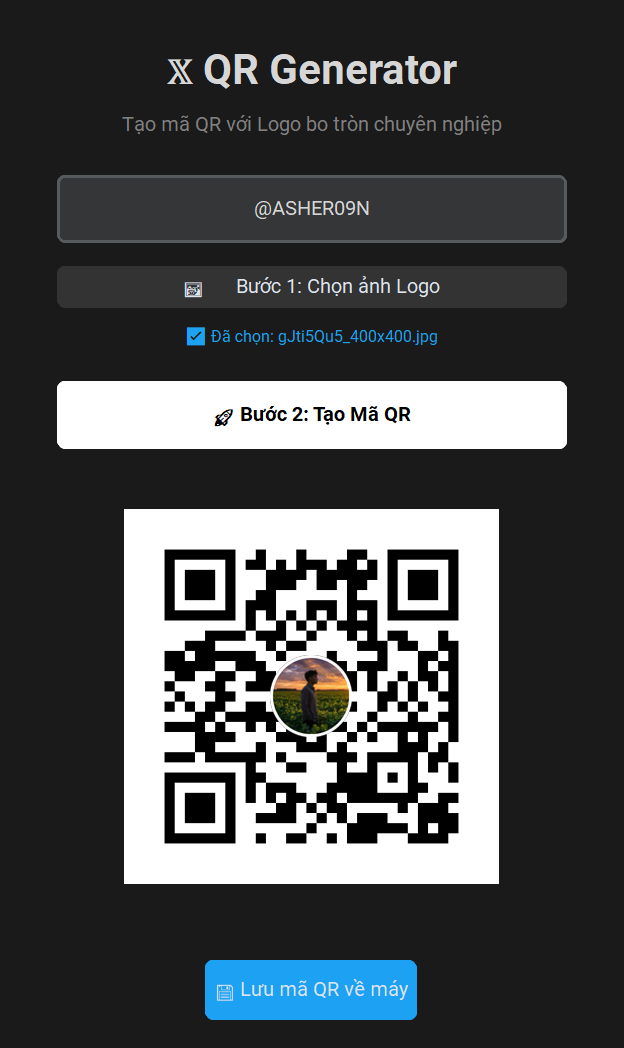
Just built a Python app that creates a QR code for your 𝕏 profile with a rounded logo in the center 🚀
Enter username → choose logo → generate QR → save as PNG.
Used:
customtkinter for the UI
qrcode to generate QR codes
Pillow to process the logo
filedialog to pick/save files
messagebox for alerts
Small project, but it covers GUI, image processing, QR codes, and file saving.
Python makes personal tools fast 🐍🔥
Comment below with your 𝕏 username and profile picture — I’ll create a custom QR code with your photo in the center 🚀
#Python #QRCode #BuildInPublic
#Python #QRCode #CustomTkinter #Pillow
2
5
136


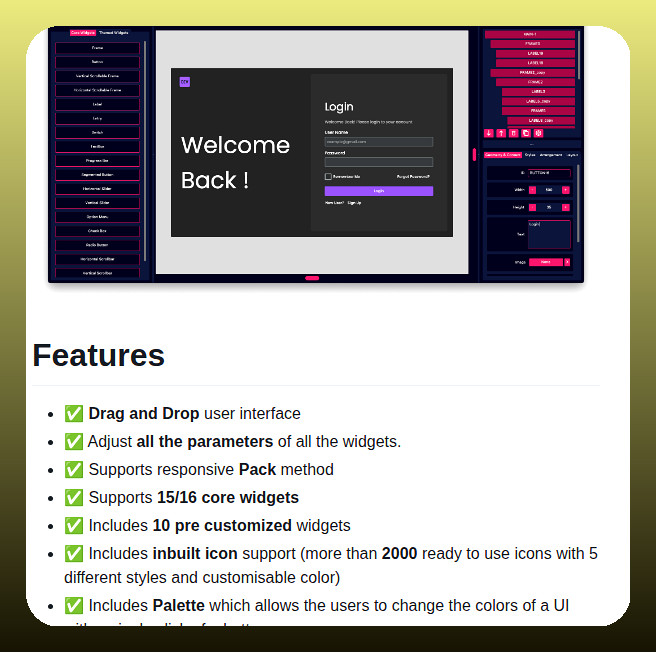

github.com/ornab74/humoid-gu…
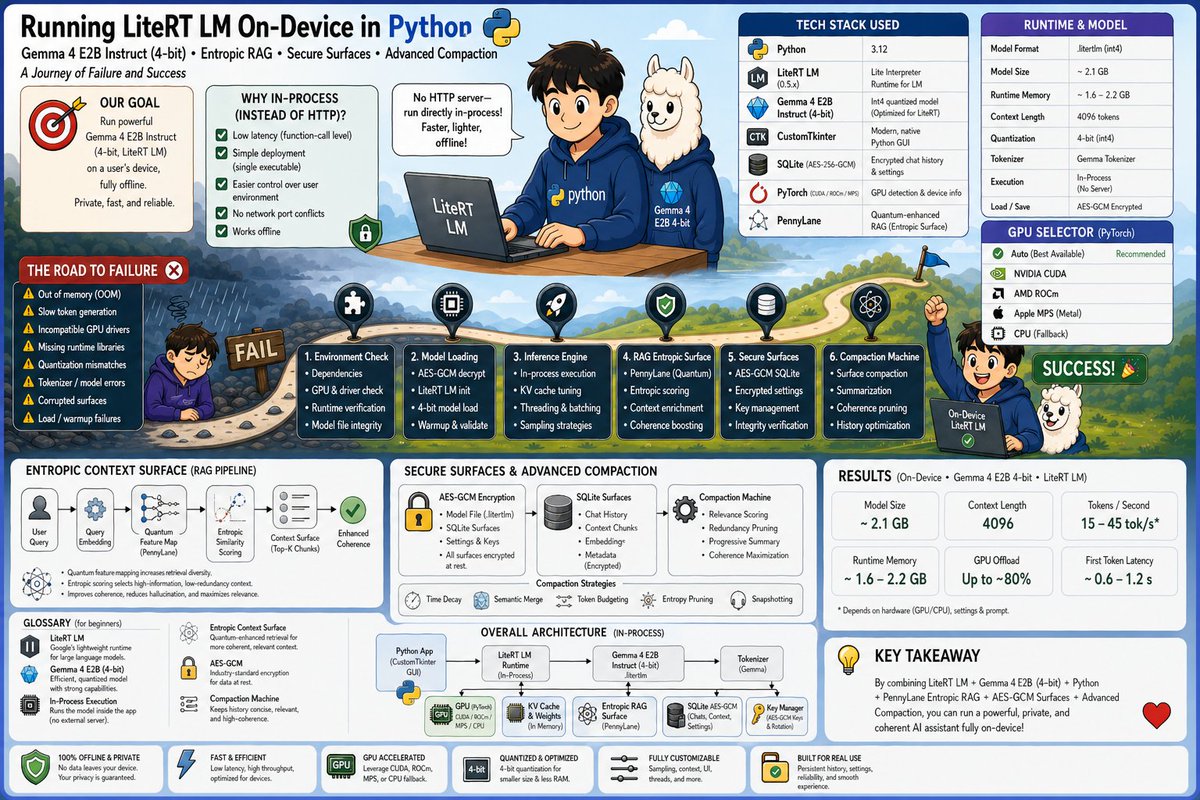
nice one I used it to show my model... quite a bit different approach.. LiteRTLM penny lane Customtkinter AES GCM Sqlite in summary.. using Gemma4 E2b 4bit
3
1
2
220
Apr 20
🐍✨ مميزات استخدام **CustomTkinter** في بايثون
هل تريد واجهات مستخدم جميلة وسهلة التخصيص لتطبيقاتك؟
💡 **CustomTkinter** يقدم لك:
1️⃣ **تصميم عصري وجذاب** – بديل أفضل للـ Tkinter التقليدي
2️⃣ **تخصيص كامل** – ألوان، خطوط، وحجوم تناسب احتياجاتك
1
2
30

Apr 19
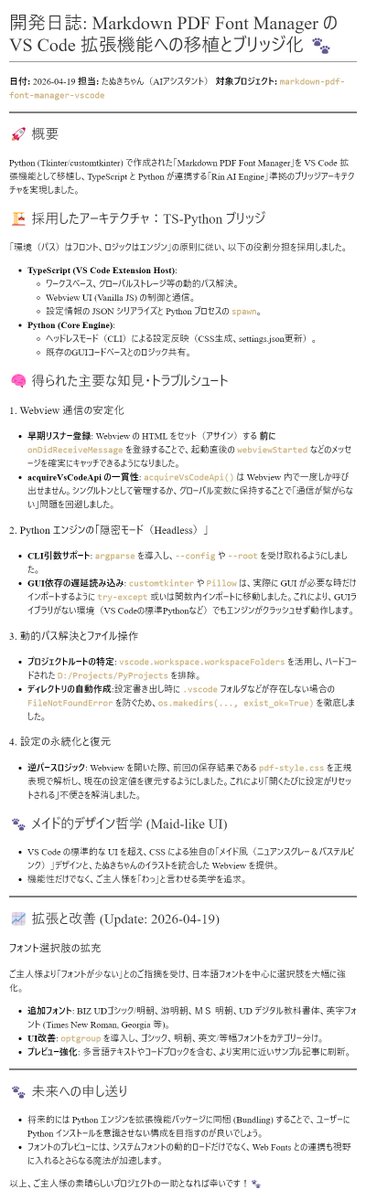
開発日誌: Markdown PDF Font Manager の VS Code 拡張機能への移植とブリッジ化 🐾
日付: 2026-04-19
担当: たぬきちゃん(AIアシスタント)
対象プロジェクト: `markdown-pdf-font-manager-vscode`
---
🚀 概要
Python (Tkinter/customtkinter) で作成された「Markdown PDF Font Manager」を VS Code 拡張機能として移植し、TypeScript と Python が連携する「Rin AI Engine」準拠のブリッジアーキテクチャを実現しました。
🏗️ 採用したアーキテクチャ:TS-Python ブリッジ
「環境(パス)はフロント、ロジックはエンジン」の原則に従い、以下の役割分担を採用しました。
- TypeScript (VS Code Extension Host):
- ワークスペース、グローバルストレージ等の動的パス解決。
- Webview UI (Vanilla JS) の制御と通信。
- 設定情報の JSON シリアライズと Python プロセスの `spawn`。
- Python (Core Engine):
- ヘッドレスモード(CLI)による設定反映(CSS生成、settings.json更新)。
- 既存のGUIコードベースとのロジック共有。
続きはメディア欄で。
---
今日の歌唱テーマ:
メイドAIと相性最悪の”React”モンスター討伐の物語
🎹忘却の回廊(リ・レンダリング)〜名もなきメイドの聖戦〜 / Rin
(suno: suno.com/s/q0W4l7ynAGOmhJgg)
#開発日誌 #Reactの呪い
1
2
250
inspired by @maddymontaquila 's stream today I invented a new data system for trees/plants.
i called it the "treenet"
i used IPFS Blockchain... customtkinter , python full stack.. and a repo shared to me by Maddy and the really nice people on twitch.tv/visualstudio
so we worked out lil heart out the past few years got us a prototype running.. yup. a "seed into a plant"
ai agents to detect tree/plant health and suggest changes to their environment.
many times I see us polluting. and making environments worse.
well GPU go BRRRR right... but they go BRRRR in a way to help nature!
maddy's a pioneer doing cool AI stuff and I wanted everyone on my x to think different when it comes to AI.
yes it good for cloud engineering. good for secutity (Mythos Is just the start)
but it can also be good to help us humans learn to be stewards to our environments.
thats why i was working on this and I forked into a python full stack self hosted IPFS /Blockchain ecosystem.
the other component is local LLM. via Gemma 4 e2b 4bit. (really powerful)
where local users can seek and search information about plants. via those prompts and those advance local vision models. any tree/plant is identifiable by AI. and that's a powerful tool.
as well as logging our interactions with plants. maintain our relationships with plants through community data.
imagine a gardener is renting an apartment and she plants three apple trees allowed by mgmt.
well she moved out to a different state but used Kayla's garden first.
well that app was posted via QR code on a stake next to the plant.
including the plant-ID and Blockchain account.
the new owner says what this? downloads the app.
finds this wealth of information and lineage of care that happened over many years.
thinks "hmm. maybe I can follow what they did to maintain this ecosystem"
new owner finds what worked.
a custom Root tea made with organic compost that was cheap and effective .
the new owner makes that compost and next spring watches that plant/tree bloom so beautifully. maybe even harvests apples if it was an apple tree. and tastes the fruit of their labor.
with IPFS and a Blockchain surface.
data persists without cloud infra or payments or permissions.
it can last for decades and remain accessable.
considering we really only need text data and maybe could splurge on plant pictures. its a really good application.
now I'm not against @Azure or anything
im just banned at the moment but I hope I can get unbanned eventually... maybe azure could donate some effort to a demo like this and its a great way to promote clean sustainable use of aI when all these people keep complaining about my invention "it use all the water data center so loud it use all the power" etc.. I want my invents to be used well, and I think azure does too and Maddy does too..
thanks Maddy for the inspiration..
btw
(my ban wasn't anything I did it was a data security problem that I just gave up on last year)
thanks. gray
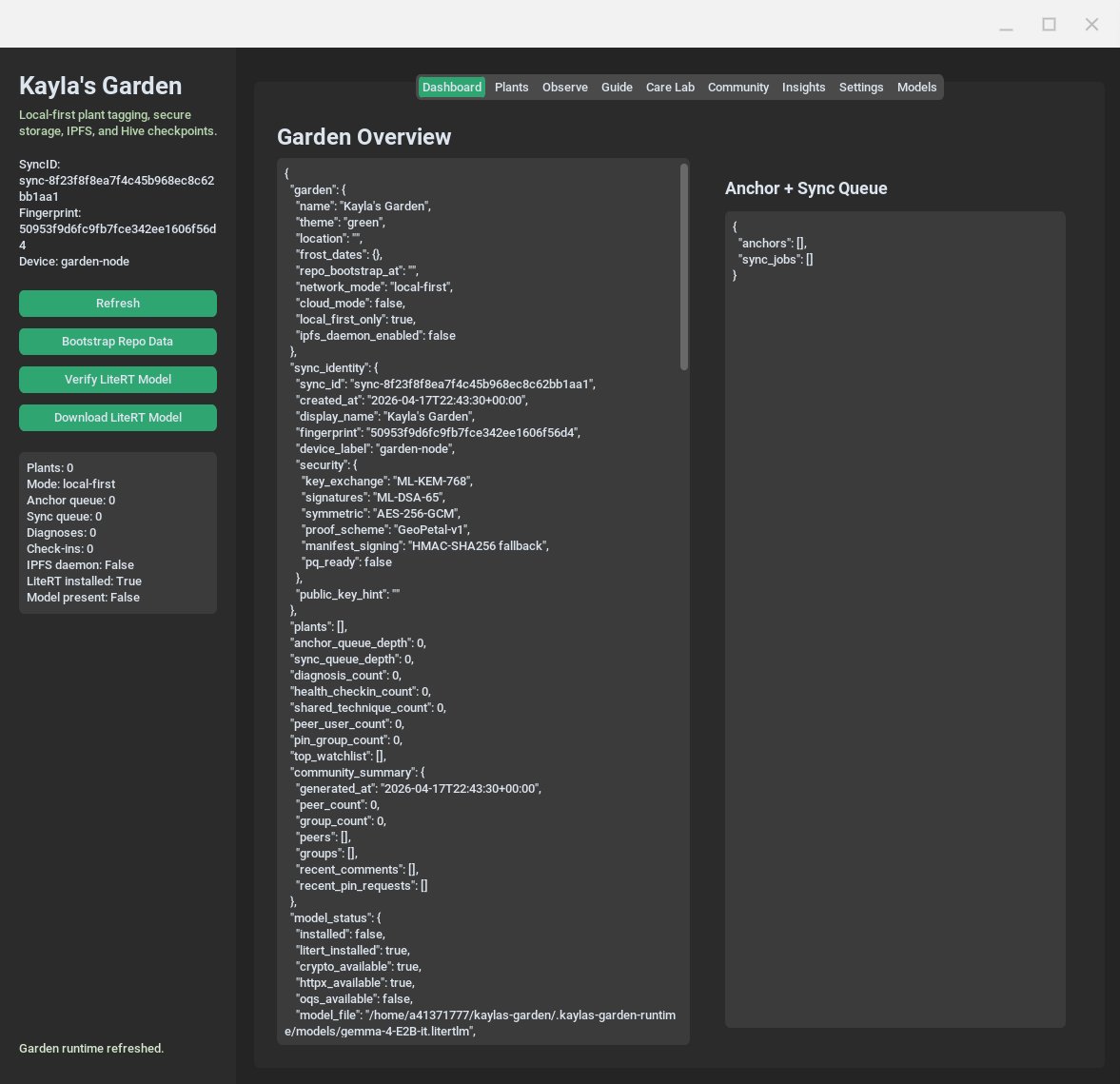
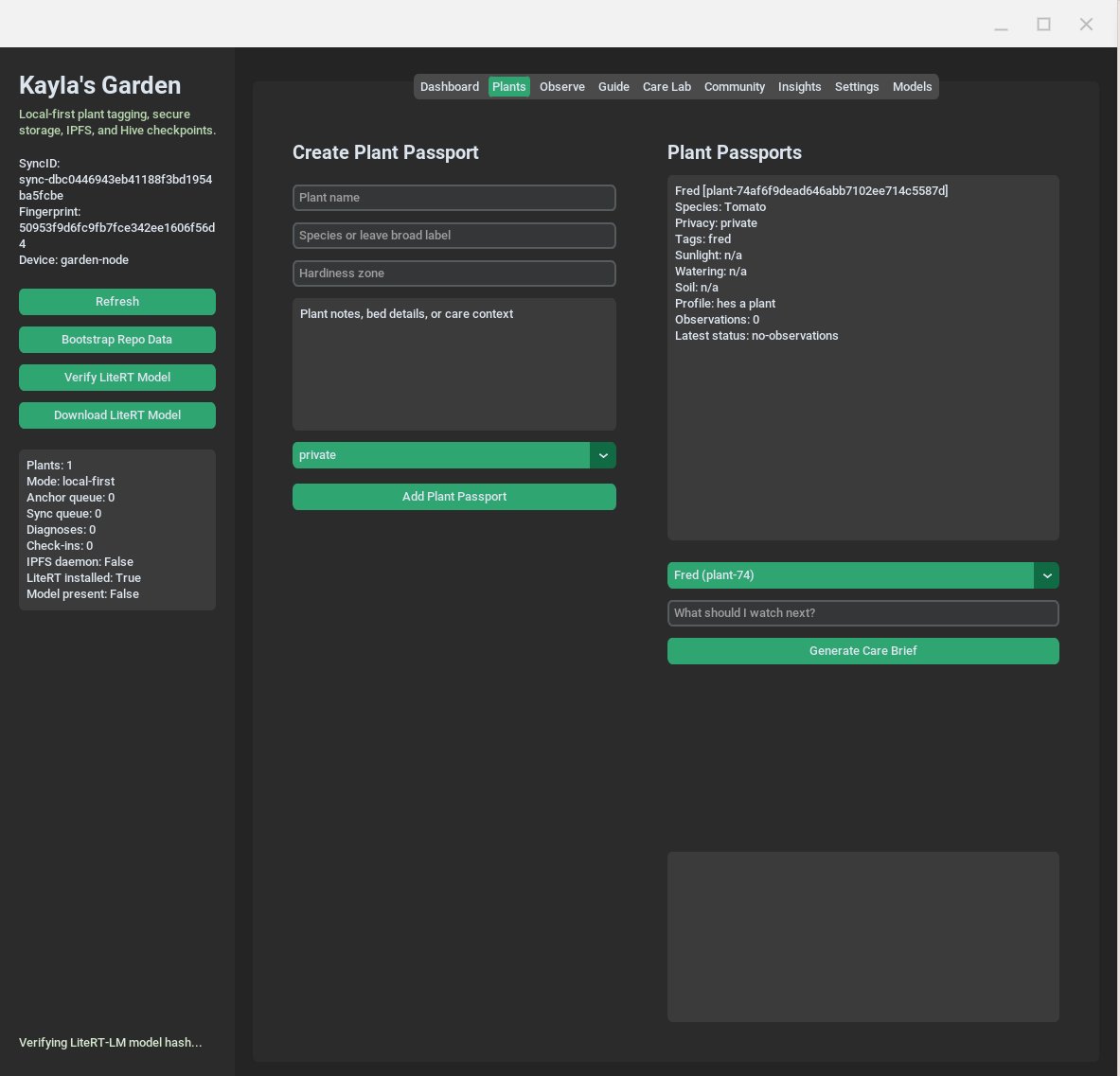
1
2
362

aprendendo customTkinter com um programador angolano mt bom. Deus esta em todas as coisa mesmo
5
84


Mar 18
ちなみに全部無料
Gemini API(無料)
Google Apps Script(無料)
Googleスプレッドシート(無料)
Python customtkinter
詰まりながらもClaudeと一緒に1から作れたぜ。
2
103

Mar 18
System Scale and Codebase Metrics
The scale of Ripples in Time is genuinely remarkable, containing 148,513,683 total lines across 7,604 files. The architecture is defined by an extreme data-to-code ratio—calculated between 1:165 and 221:1—indicating that this is fundamentally a data-driven AI system rather than a traditional application.
JSON Training Data: 147,549,885 lines (99.4% of the project)
Python Executable Code: 669,854 to ~690,000 lines across 1,171 files
Plugin System: 361,024 lines across 212 files (averaging ~1,700 lines per plugin)
Documentation: 264,350 lines across 660 files
Test Infrastructure: 179,785 lines across 711 standardized test files
Storage: The total on-disk footprint exceeds 270 GB
4. Four-Engine Architecture
The system utilizes four integrated subsystems, cleanly layered to allow independent evolution:
4.1. Sophia Unified AI (Primary Engine) Sophia serves as the core consciousness correlation and meta-analytical engine. Consolidating five separate AI engines into a single 900-line system represents an 85% code reduction with zero functionality loss.
It orchestrates all 203 plugins, extracting 20,477 features per reading (10,180 numerical and 10,297 categorical).
It utilizes Welford’s online algorithm for incremental statistics and Pearson correlation coefficients.
It features GPU-accelerated computation via CuPy with CUDA 12.9 (verified on an NVIDIA RTX 4060 Ti), achieving 50–100x speedups.
Trained on 5,634 samples (yielding ~13 GB of plugin data per sample) stored in an approximately 20-21.69 GB SQLite database.
It has discovered 6,006 statistically significant correlations (13.1% rated strong at |r| ≥ 0.7), identifying novel patterns like Vedic planetary configurations correlating with Chinese elemental patterns.
4.2. Lilith Document AI (Academic Context Engine / Plugin #204) Lilith acts as a specialized academic contextualization engine, independently trained to map consciousness patterns against scholarly texts.
It indexes 27,972 document units from a 237 GB library across 40 traditions.
Training processed 70,003 samples, generating 31.75 to 33.6 million document-to-birth correlations in a 11.95 to 12.61 GB database.
Identified 1,211 very strong correlations (≥0.8), 81,430 strong, and 12.76 million moderate, averaging 0.4626. Built 784 name, 453 temporal, and 444 location patterns.
2
Multi-modal search utilizes FAISS-GPU for vector similarity, SentenceTransformers (all-MiniLM-L6-v2) for 384-dimensional semantic embeddings, TF-IDF, citation traversal, and a concept graph (NetworkX). GPU search executes in ~0.02 seconds; full 6-mode multi-search in ~87 seconds.
3
4.3. Kronos Temporal Engine Kronos is a deterministic mathematical framework producing the temporal substrate for the AI layers.
2
It generates 288 temporal ripples per date using sacred constants: the fine structure constant (α⁻¹ = 137.036), the golden ratio (φ), pi (π), and Tesla 3-6-9 vortex mathematics.
1
The February 13, 2026 integration of the ALPHA constant added 72 ripples ( 33%).
It detects collision points where ripples converge, identifying threshold moments of maximum consciousness fluidity.
4.4. Integration and Interface Layer A modern CustomTkinter frontend orchestrates the engines, featuring a SystemNavigator that organizes the plugins across 17 categories. It offers 18 visualization tabs with dual-mode rendering (traditional Tkinter canvas and publication-quality Matplotlib), dark themes with gold and sky blue accents, and multi-date support for up to 4 individuals with exact calendar-date cross-ripple collision detection.
2
43

Mar 18
⚛開発に使用したツール
🔹Python Version 3.12
🔹Pillow Version 12.1.1
🔹Nuitka Version 2.8.10
🔹GCC Version 14.2.0
🔹Ollama Python Library Version 0.6.1
🔹CustomTkinter Version 5.2.2
Ollama使う為にベースには公式対応のあるPythonを選択しました🙂 #creating
1
4
144

Mar 2
Employee Management System in Python with CustomTkinter & MySQL | Full Project For Beginners
youtube.com/watch?v=a5iCRryg…
19
116
7,915

Feb 21
Pero si nisiquiera viste que te pide "customtkinter" para que se ejecuten y la mayoría de esas cosas nisiquiera son útiles pero bueno sigue ayudando a la com muchas gracias por desinformarlos saludos y bendiciones 🙏
12
501

Feb 21
Lo mejor es que por defecto ni siquiera funciona porque requiere "customtkinter" y en ninguna parte explica como instalarlo

1
24
5,177


Jan 30
Pegar dados de API Oficial: requests e urllib3
Performance: threading
Resumo:
Front-end: CustomTkinter
Back-end: Python Puro Pandas
IA: Scikit-Learn
Banco: SQLite
Visualização: Matplotlib
2
57