
Jun 12
Activate - DeepScan
Surface issue: The response argues that before saying AI “doesn’t understand,” we should ask whether humans understand as clearly as we assume.
Assumed conclusion: The post implies that human understanding is not a clean binary advantage over AI. It suggests humans often operate through partial understanding, inherited beliefs, language, and symbolic models, so the AI critique may rely on an idealized picture of human cognition.
The strongest version of the point is this: critics often compare AI to an ideal human knower rather than to actual human cognition. Actual humans routinely speak fluently about things they only partly understand.
Three distinct explanations:
First, human understanding may be overestimated because fluency is mistaken for comprehension. People can use words correctly in social contexts without having a deep causal model.
Second, much of human knowledge is socially inherited. People often “understand” by trusting institutions, experts, culture, and language rather than directly grounding every belief in experience.
Third, understanding may be a spectrum rather than an on/off property. AI may lack embodiment and lived agency, but that does not automatically mean it has zero semantic structure.
One layer backward: For the first point to work, we need to assume that language performance can outrun conceptual depth. For the second, we need to assume that indirect symbolic knowledge still counts as some kind of understanding. For the third, we need to assume understanding has degrees rather than a single essence.
Missing variable: The post needs to distinguish “human misunderstanding” from “AI non-understanding.” A critic could say: yes, humans misunderstand many things, but they still have embodied needs, intentions, perception, emotion, agency, and lived stakes. Current AI lacks that entire biological-practical context.
What would strengthen the post: A clearer definition of understanding as layered. For example: verbal understanding, causal understanding, embodied understanding, practical understanding, and reflective understanding. That prevents the argument from sounding like “humans don’t understand either,” which is too broad.
What would weaken it: If the critic defines understanding as embodied agency, then the AI comparison becomes much harder. Humans may be confused, but they still act from within a lived world. AI can simulate discourse without having its own situated life.
Provisional conclusion: The post is strong, but it should be narrowed. The best claim is not “humans don’t understand either.” The better claim is: human understanding is often partial, socially mediated, and language-dependent, so we should be careful before treating human understanding as obvious and AI understanding as impossible.
I would revise the center of gravity like this:
What exactly are we comparing AI against when we say it doesn’t understand?
People often talk as if human understanding is obvious and AI understanding is the mystery. I’m not sure that’s right. A lot of what humans call understanding is partial, inherited, symbolic, and socially mediated.
Most people use words like inflation, democracy, evolution, consciousness, capitalism, or even intelligence without being able to fully explain what they mean. That doesn’t mean they understand nothing. It means understanding comes in layers. There is a difference between repeating words, using concepts socially, having a causal model, acting successfully in the world, and reflecting on what you know.
That matters for the AI debate because the strongest criticism of AI is not simply that it manipulates symbols. Humans manipulate symbols too. Most of what we know comes through language, trust, models, and other people’s explanations. I’ve never touched an electron, seen a black hole, or directly verified most of the historical and scientific facts I believe. A lot of human knowledge is already mediated through language.
1
2
36


you built an app that accepts file uploads.
have you scanned a single one?
Aeglis /deepscan → one API call → instant verdict.
joining the waitlist now: aeglis.com
14

Jun 9
oooh begitu.
misalkan besok saya deepscan hasilnya tetap sama, apa yg harus saya lakukan kak?
14


Jun 8
7/ DeepScan
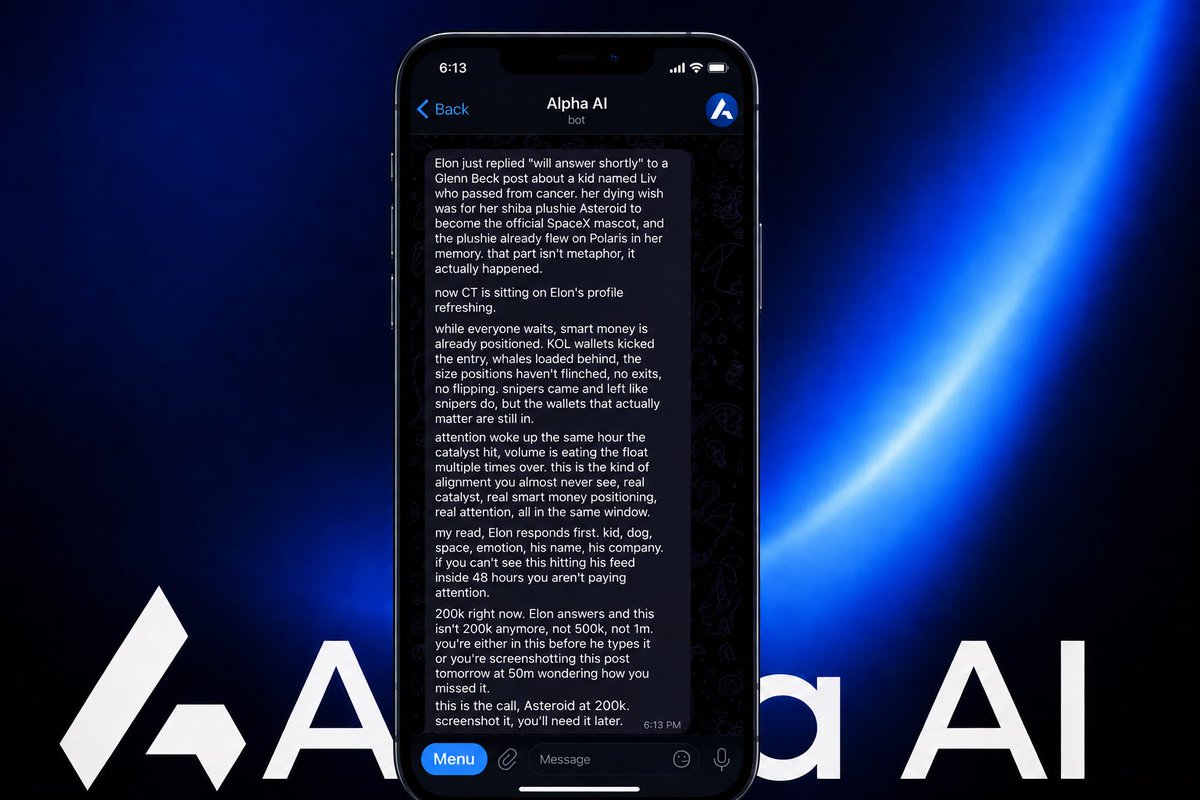
DeepScan is one of the most powerful additions to AlphaAI, powered by both our On-Chain Engine and Social Engine.
While Quick Scan helps you understand a narrative in seconds, DeepScan is designed for those moments when you want the complete picture.
When you run a DeepScan on any coin, AlphaAI performs a full intelligence sweep across both on-chain and social data.
It scans discussions across CT, analyzes what people are saying, identifies the dominant narratives, tracks sentiment shifts, monitors engagement quality, and uncovers the catalysts driving attention.
At the same time, it dives deep into on-chain activity.
What are whales doing?
What are smart money wallets doing?
Who entered early?
Who is accumulating?
Who is distributing?
DeepScan brings all of this together into a single intelligence.
But it goes beyond simply collecting information.
DeepScan is designed to identify hidden patterns, unusual behavior, emerging trends, and psychological signals that most traders would never have the time to uncover manually.
The goal is simple:
Give you everything you need to know about a coin before making a decision.
Instead of spending hours jumping between wallets, dashboards, timelines, influencers, and analytics tools, DeepScan does the heavy lifting for you and delivers the intelligence that actually matters.
DeepScan is token-gated behind a holding requirement of 500k $ALPHA.
This helps us prevent spam, manage resource usage, and maintain the quality of the intelligence being delivered.
DeepScan isn't another scanner.
It's not another dashboard.
It's not another analytics tool.
It's the closest thing to having an AI research team, an on-chain analyst, a whale tracker, and a social intelligence engine working together on demand.
Simply put, DeepScan is the most powerful intelligence tool we've ever built.
And there is nothing else quite like it on the market today.
1
13
632

I think that the PGF has survived the test of time. I believe it is genuine and any evidence to the contrary has not been properly validated hence why it is still debated today.
Scientists: biologists, zoologists and even anthropologists should be doing more to aid in the research of Bigfoot.
At the height of the Loch Ness Monster sightings, the scientific community carried out Operation Deepscan led by marine biologist Adrian Shine. This same method of thinking should be considered in the case of Bigfoot. Proof of its existence could totally transform conventional science on the evolutionary development on man.
1
4
30

Jun 2
アプデにて
FLAC / Opus に対応、プチりにくいDeepScan設定を追加、保存先とファイル名の指定ができるようになり、
いまいちな操作系が改善したりしました
AutoLooper v0.3.0-beta
github.com/YoshimiKudo/AutoL…
Jun 2

undo redo 機能とmp3の読み込み機能がつきました
AutoLooper v0.2.0-beta
github.com/YoshimiKudo/AutoL…
11
2,164

Github student developer pack benefits:
➜ GitHub Pro
➜ GitHub Copilot Pro
➜ GitHub Codespaces
➜ GitHub Pages
➜ GitHub Desktop
➜ GitHub Campus Experts
➜ GitHub Foundations Certification Resources
➜ DigitalOcean ($200 Credits)
➜ Microsoft Azure ($100 Credits)
➜ Microsoft Azure (Ages 13–17)
➜ Appwrite Education Plan
➜ Heroku Credits
➜ Camber Student Plan
➜ LocalStack Pro
➜ New Relic
➜ Datadog Pro
➜ CARTO
➜ Zyte Scrapy Cloud
➜ Namecheap Free .me Domain
➜ Namecheap Free SSL Certificate
➜ Name.com Free Domain
➜ .TECH Domain (1 Year Free)
➜ JetBrains All Products Pack
➜ Visual Studio Code Learning Packs
➜ Visual Studio Dev Essentials
➜ Bootstrap Studio
➜ BrowserStack
➜ LambdaTest
➜ GitKraken Student Plan
➜ GitLens Student Plan
➜ Tower Pro
➜ SQLGate
➜ Working Copy Pro
➜ Termius Pro
➜ Testmail Essential
➜ Requestly Professional
➜ Codecov
➜ CodeScene
➜ DeepScan
➜ Imgbot
➜ Travis CI
➜ Blackfire
➜ POEditor
➜ PopSQL
➜ ToDiagram Pro
➜ ConfigCat
➜ DevCycle
➜ Doppler Team
➜ Clerk Pro
➜ Sentry
➜ Pageclip
➜ MongoDB Atlas Credits
➜ Stripe Fee Waiver
➜ Mail Testing APIs
➜ Blockchair APIs
➜ Vaadin Pro
➜ Adafruit IO
➜ Arduino Cloud
➜ Simple Analytics
➜ Frontend Masters
➜ Educative
➜ DataCamp
➜ Boot.dev
➜ Scrimba Pro
➜ Codédex Club
➜ GoRails
➜ SymfonyCasts
➜ Interview Cake
➜ AlgoExpert
➜ AI Prompting & Technical Writing Resources
➜ Intro to Open Source Resources
➜ Intro to Web Development Resources
➜ Mobile App Development Resources
➜ Data Science & Machine Learning Resources
➜ Notion Education AI
➜ Notion Template Collection
➜ Microsoft 365 Education
➜ PomoDone Lite
➜ HazeOver
➜ Visme Starter
➜ SlideCoach Credits
➜ 1Password (1 Year Free)
➜ Dashlane Premium
➜ Astra Security
➜ Honeybadger
➜ Datadog Monitoring
➜ IconScout Premium Assets
➜ Icons8 Subscription
➜ Polypane
➜ Xojo Pro
➜ Themeisle Neve Agency Theme
➜ Deepnote Team Plan
➜ Appfigures Analytics
➜ Camber Research Tools
Grab your Student ID, claim the GitHub Student Developer Pack, and unlock thousands of dollars worth of premium developer tools for FREE! 🎓
1
2
185

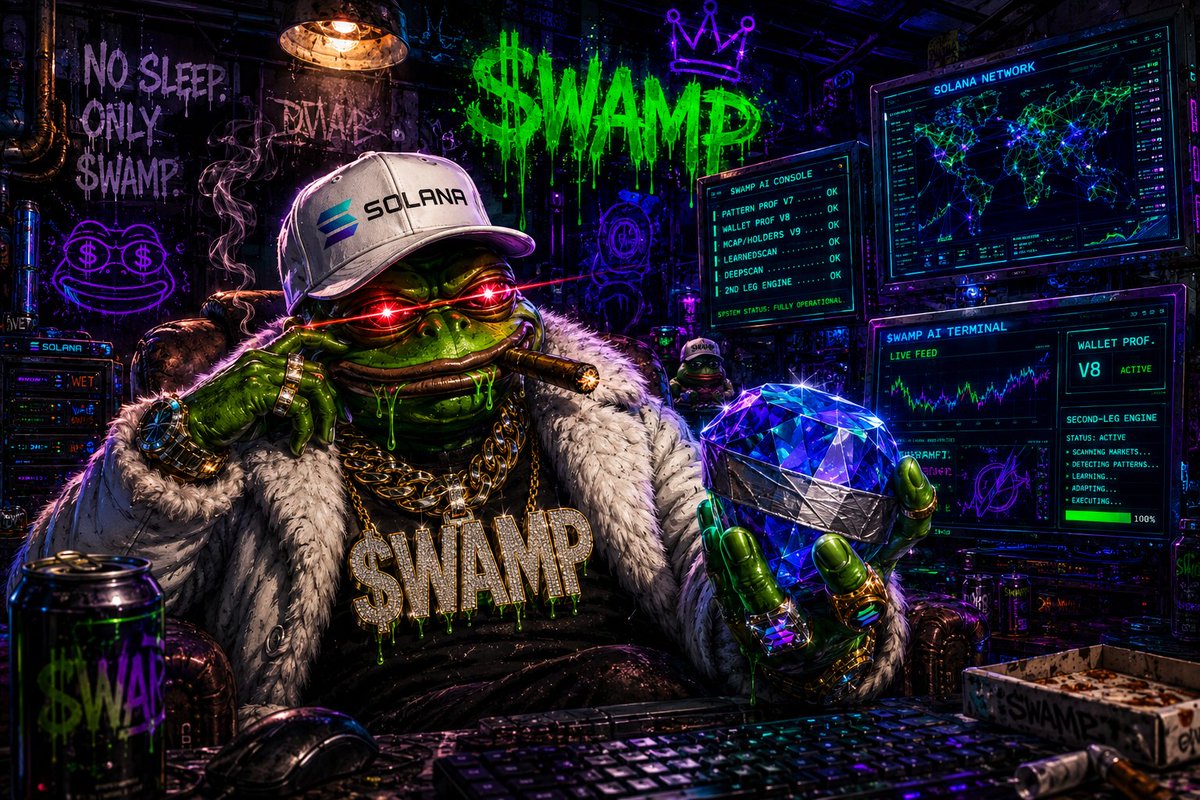
🐸🧠 Massive upgrades pushed to $WAMP AI over the last 48h.
• Embedded SWAMP AI terminal widget
• Live token feeds deeplink swaps
• AquaVaults integration
• BUY → auto preload swap routing
• Second-leg detection engine restored
• Auto second-leg market scanner
• Learning fusion system rebuilt
• Pattern Professor V7
• Wallet Professor V8
• MCAP/Holders V9 fusion
• LearnedScan upgraded with live memory fusion
• DeepScan relevance filtering improved
• Duplicate signal prevention
• Smart autofeed scheduler overhaul
• Click-to-copy EVERYWHERE
• Partner website embeds now live
Now evolving toward:
→ moonshot precursor learning
→ pre-pump pattern recognition
→ smarter second-leg discovery
→ live adaptive market memory
$WAMP AI is becoming a real-time Solana intelligence
engine.
#Solana #CryptoAI #DeFi #Web3 #OnChain #Trading #Memecoin #Altcoins #AI #Crypto
4
1
8
263

May 23
开发者或项目方可以使用deepscan在合约部署前和部署后进行持续审计,会对漏洞进行分线提示。
传统人工审计的效率和成本不能支持持续审计,导致新的攻击手段产生后(例如AI进行合约漏洞挖掘),项目方和开发者没法及时跟进。
1
2
51

May 23
🧵5/5
✅ Recent smart contract vulnerability cases have been added to the GoPlusSecurity AI Auditing Benchmark — a real-world attack-driven dataset for AI-powered smart contract auditing:
github.com/GoPlusSecurity/ai…
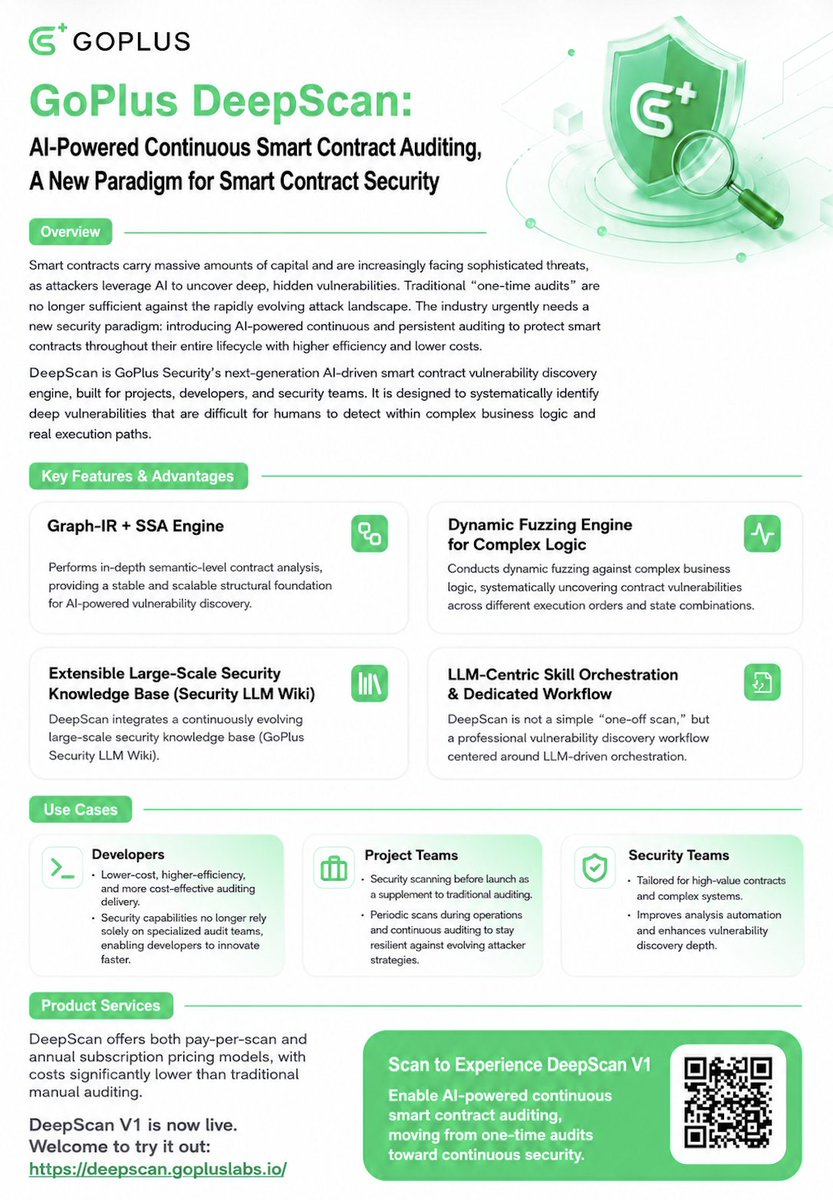
✅ DeepScan V1 is now live and open for use:deepscan.gopluslabs.io
2
535
May 23
🧵1/5
🤖 #AIContinuousAuditing is the only effective way to defend against AI-driven smart contract exploits.
Smart contract vulnerability attacks have been occurring more frequently recently. A new attack paradigm is emerging and rapidly spreading, where attackers leverage AI to efficiently discover smart contract vulnerabilities. For projects and developers, adopting AI-powered continuous and always-on auditing services is becoming the only viable defense against this growing risk.
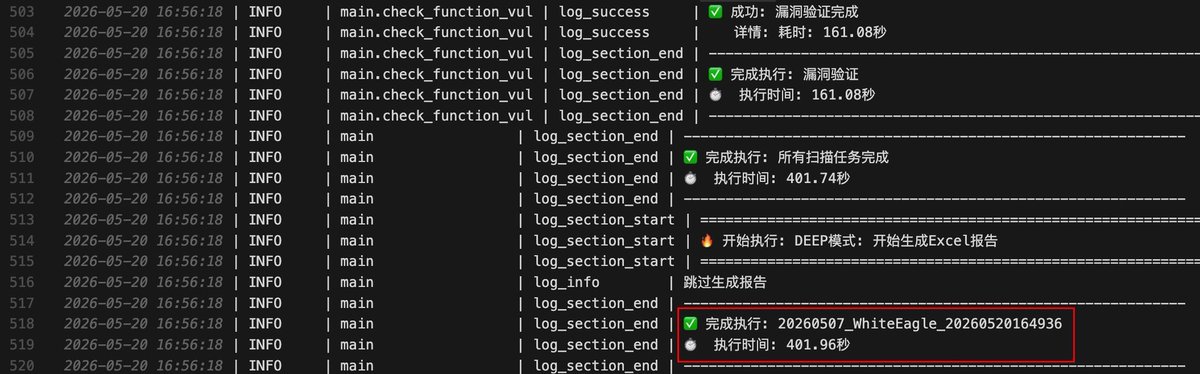
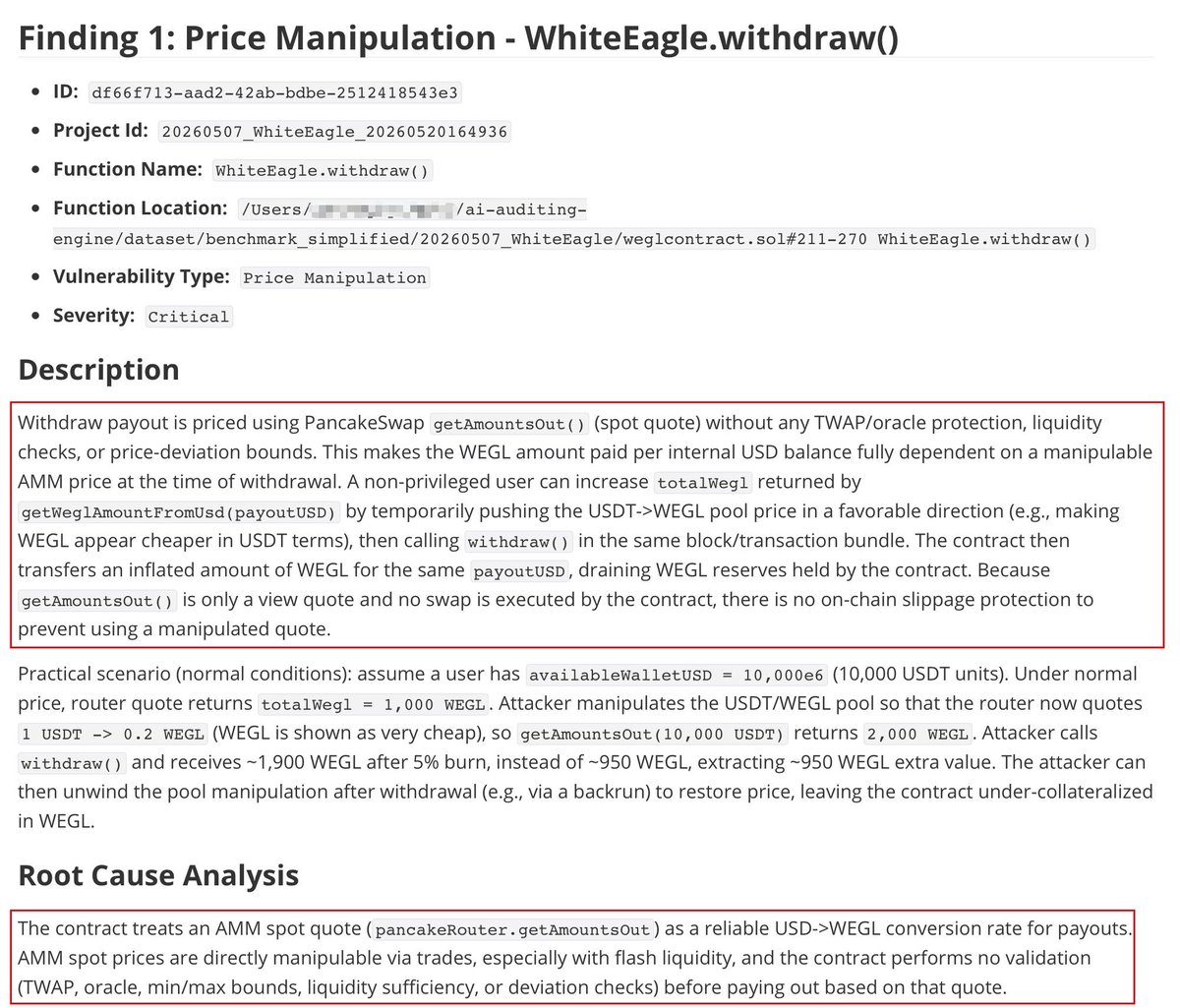
The GoPlusSecurity DeepScan team conducted AI audits on four recent smart contract incidents — White Eagle, @humafinance, #BoostHook, and @eonx_ai — and detected all vulnerabilities within minutes or even tens of minutes. These losses could have been prevented, yet were ultimately handed over to attackers, which is deeply regrettable.
White Eagle smart contract vulnerability detected within 402 seconds.
1
1
6
2,396

May 23
1/🤖 #AI持续审计 是防范 AI 合约漏洞攻击的唯一途径
近期智能合约漏洞攻击事件频发,黑客利用 AI 技术高效挖掘智能合约漏洞的攻击范式已然成型并快速蔓延,项目方和开发者引入基于 AI 的持续性、常态化审计服务是对抗这一风险趋势的唯一有效路径!
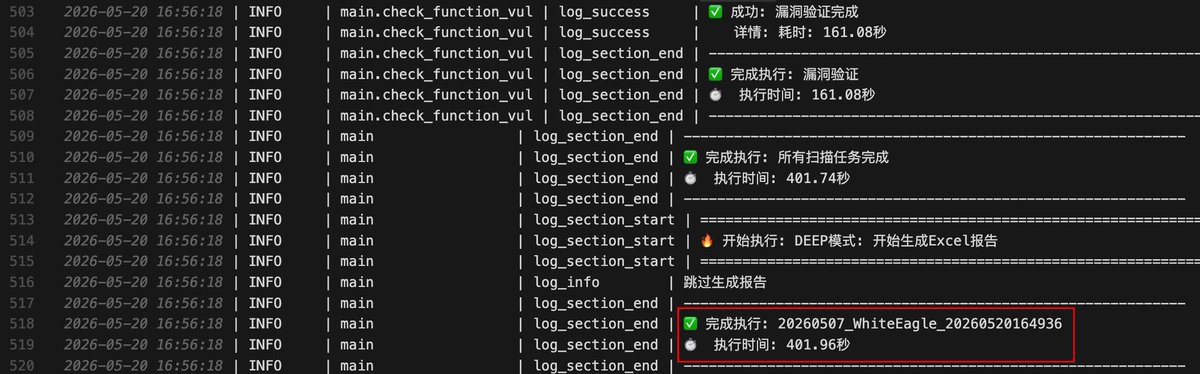
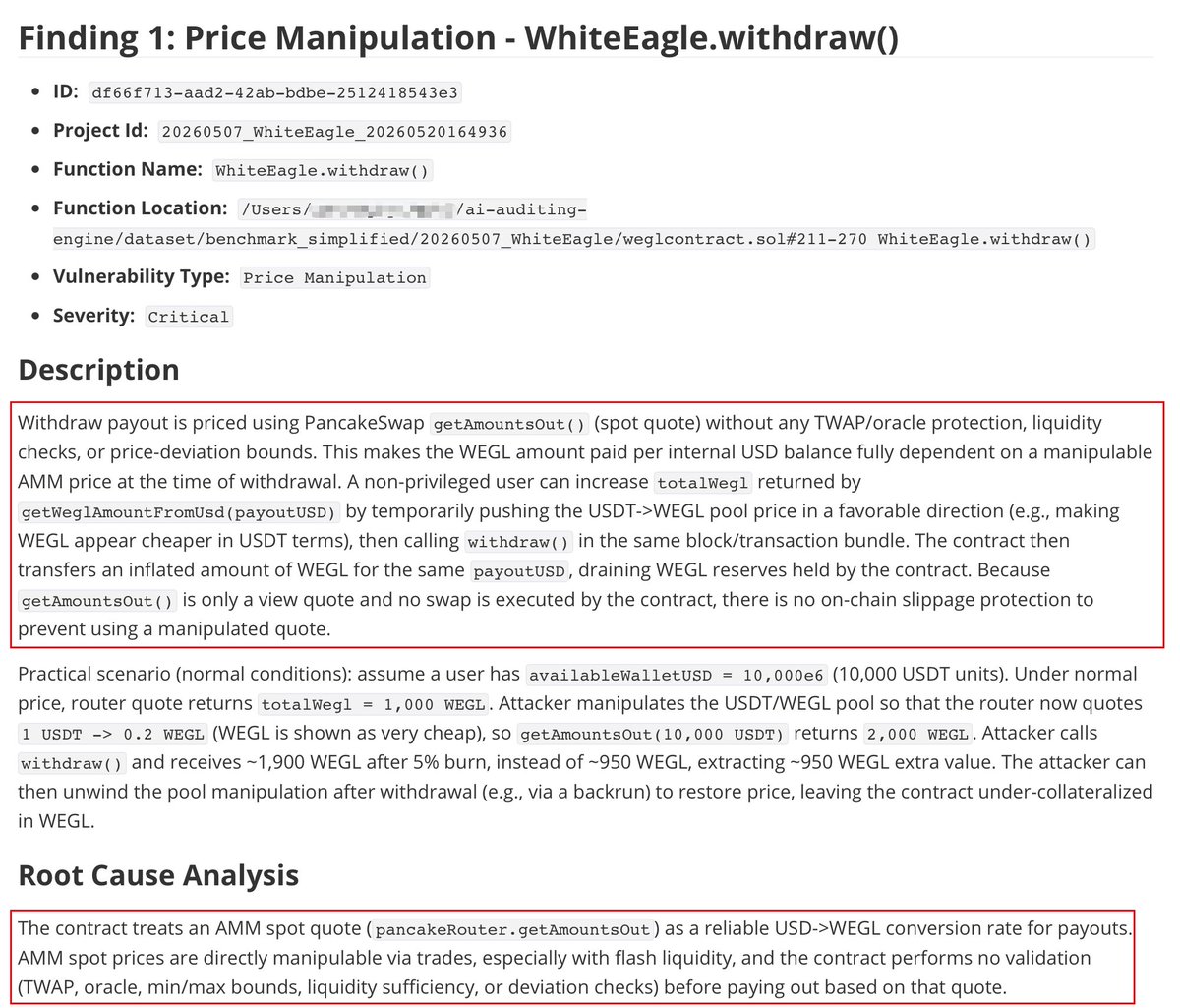
GoPlus DeepScan 团队对近期 White Eagle, @humafinance, #BoostHook, @eonx_ai 发生的4起智能合约漏洞进行了AI 审计,均在几十分钟、甚至几分钟内就检测了出来,本来可以避免的损失就这样白白送给了黑客,实在让人惋惜!
402秒内发现 White Eagle 合约漏洞
3
2
12
1,563


May 9
Gw sih kemarin gini:
“Grok lakukan deepscan ke seluruh profile saya cari postingan atau reply saya yang terindikasi melakukan pelanggaran X untuk di hapus. Sertakan linknya”
Kalo udah keluar hasilnya:
“Scan ulang, mana postingan yang beresiko melanggar X rules. Berikan linknya”
Next:
“Carikan postingan saya yang terindikasi Spam dan engagement farming, berikan linknya”
Next:
“Apakah sudah layak untuk appeal? Kalau belum lakukan deepscan lagi berapa % kebersihan akun saya?”
Tapi ya jangan 100% percaya sama grok. Seengganya ada gambaran postingan dan reply apa yang harus di hapus

hari ini mau coba appeal dan bersih bersih akun ges, sambil hapusin konten-konten yang diduga melanggar aturan juga, walaupun gatau yang mana haha
tapi kalo ada ide, saran, masukan
boleh banget please! makasih ya
4
308
Apr 30
🧵2/2
In the AI era, the traditional “one-time audit” model is no longer sufficient to safeguard smart contract security.
The industry urgently needs to shift toward a new paradigm: AI-based continuous and routine auditing, protecting smart contracts across their full lifecycle with higher efficiency and lower cost.
DeepScan is a next-generation AI-driven smart contract vulnerability discovery engine launched by GoPlus Security.
Built for project teams, developers, and security teams, it provides AI-based continuous and routine auditing to protect smart contract security across the full lifecycle with higher efficiency and lower cost.
✅ DeepScan V1 is now live. Try it here:
deepscan.gopluslabs.io
✅ The vulnerable ZetaChain contract from this incident has also been added to the GoPlus AI Auditing Benchmark, an AI smart contract auditing benchmark dataset based on real-world attack incidents:
github.com/GoPlusSecurity/ai…
2
745