
May 29
Kubernetes Security – More Than Just One Ingredient
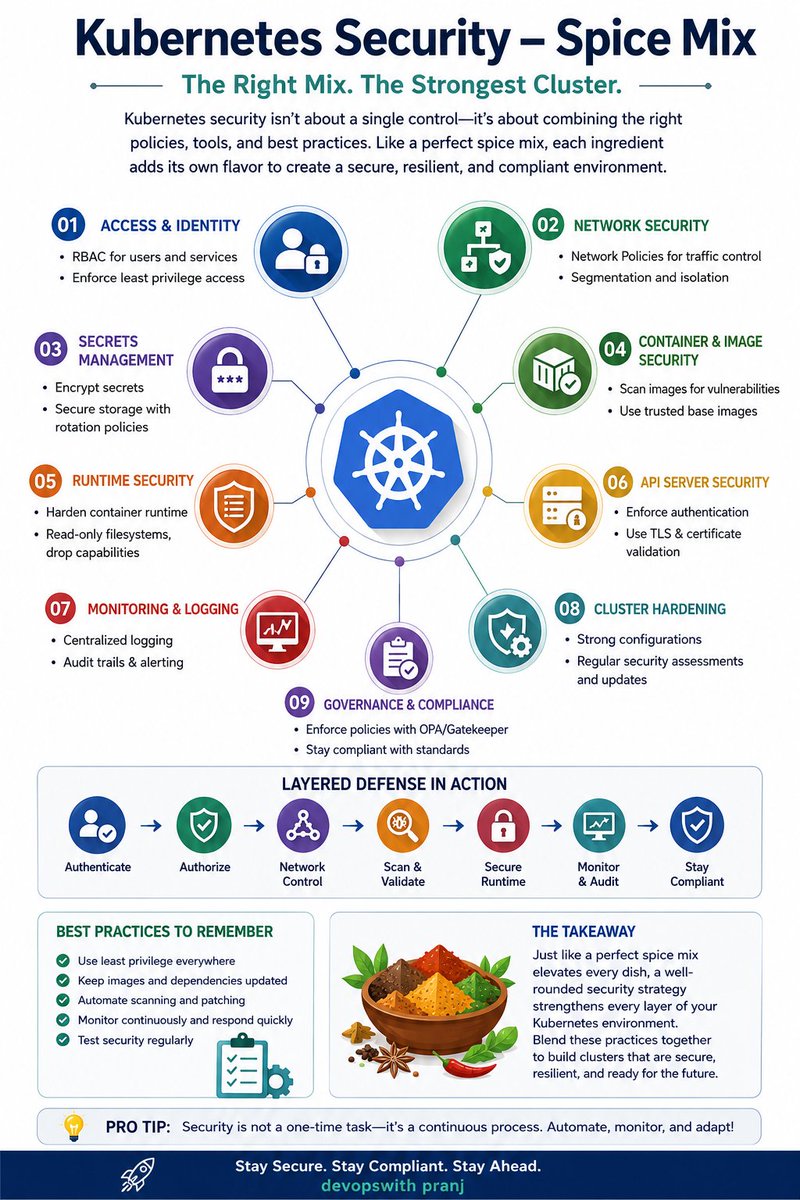
Kubernetes security is not a single tool or a one-time setup. It’s a complete “security recipe” where every layer matters.
Just like a perfect spice mix needs balance, a secure Kubernetes cluster needs multiple security controls working together.
Here are the core ingredients of a strong Kubernetes security strategy:
🔐 Identity & Access Management (RBAC)
1- Restrict user permissions
2- Apply least privilege access
3- Separate admin and developer roles
4- Avoid unnecessary cluster-wide access
🌐 Network Security
1- Use Network Policies
2- Restrict pod-to-pod communication
3- Control ingress and egress traffic
4- Isolate sensitive workloads
📦 Container & Image Security
1- Scan images before deployment
2- Use trusted registries only
3- Prevent privileged containers
4- Enable runtime protection
🔑 Secrets Management
1- Encrypt Kubernetes secrets
2- Rotate credentials regularly
3- Avoid hardcoding secrets in YAML files
4- Integrate with Vault or cloud secret managers
📊 Audit Logging & Monitoring
1- Track cluster activities
2- Monitor suspicious events
3- Centralize logs using ELK or Loki
4- Enable alerting with Prometheus & Alertmanager
🛡️ Cluster Hardening
1- Keep Kubernetes updated
2- Secure etcd and API server
3- Disable anonymous access
4- Apply CIS benchmark recommendations
⚙️ Admission Controllers & Policies
1-Enforce security standards automatically
2-Validate workloads before deployment
3-Block insecure configurations
4-Implement policy-as-code
🚀 Continuous Security Updates
1- Patch vulnerabilities quickly
2- Continuously scan workloads
3- Keep dependencies updated
4- Regularly perform security assessments
Kubernetes security is strongest when every layer works together. One weak layer can impact the entire cluster. Security is not a feature. It’s an ongoing practice.
#Kubernetes #DevOps #CloudSecurity #CyberSecurity #PlatformEngineering #K8s #ContainerSecurity #SRE #AWS #DevSecOpsOne
1
1
14
480