
16 Oct 2025
Enhancing Diffusion-Based Sampling with Molecular Collective Variables
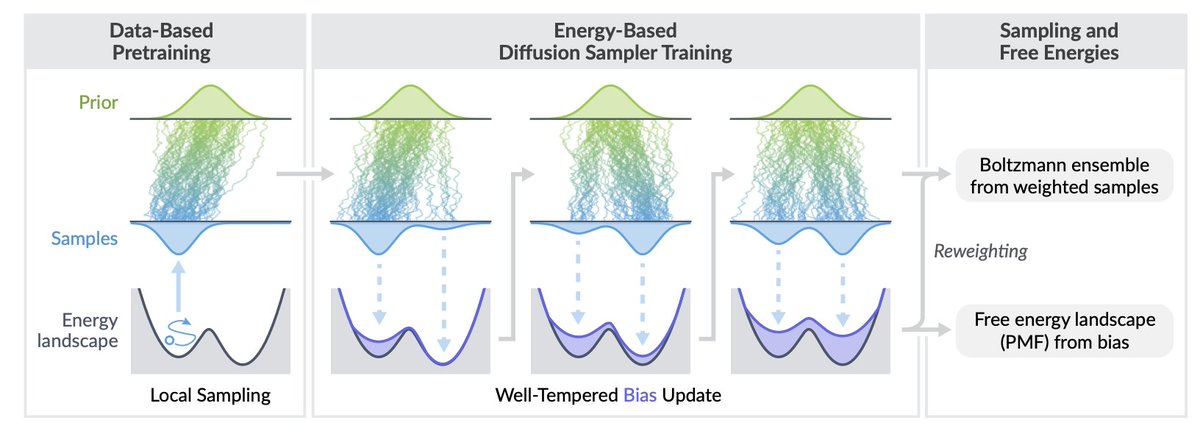
1. A new method called Well-Tempered Adjoint Schrödinger Bridge Sampler (WT-ASBS) is introduced to improve molecular sampling efficiency. This method combines diffusion-based sampling with a well-tempered bias in collective variable (CV) space, enabling more efficient exploration of molecular configurations and accurate estimation of free energy differences.
2. The WT-ASBS method addresses the limitations of traditional diffusion-based samplers, which often suffer from slow sampling speeds and mode collapse. By introducing a repulsive potential centered on CVs from recent samples, it pushes future samples towards novel CV regions, effectively increasing the temperature in the projected space and enhancing exploration.
3. The method is demonstrated on peptide conformational sampling benchmarks, where it recovers diverse conformational states and accurate free energy profiles. It is also the first to demonstrate reactive sampling using a diffusion-based sampler, capturing bond breaking and formation with universal interatomic potentials at near-first-principles accuracy.
4. WT-ASBS achieves significant improvements in sampling efficiency compared to traditional methods like well-tempered metadynamics (WTMetaD). For example, in sampling reactive landscapes involving bond formation, WT-ASBS required significantly fewer energy evaluations and shorter wall-clock times than WTMetaD.
5. The approach resolves reactive energy landscapes at a fraction of the wall-clock time of standard sampling methods, advancing diffusion-based sampling towards practical use in molecular sciences. This opens up new possibilities for studying complex molecular systems and reactions with high accuracy and efficiency.
📜Paper: arxiv.org/abs/2510.11923
#MolecularSampling #DiffusionBasedSampling #CollectiveVariables #FreeEnergy #ReactiveLandscapes
7
52
2,736