Antonella degani retweeted

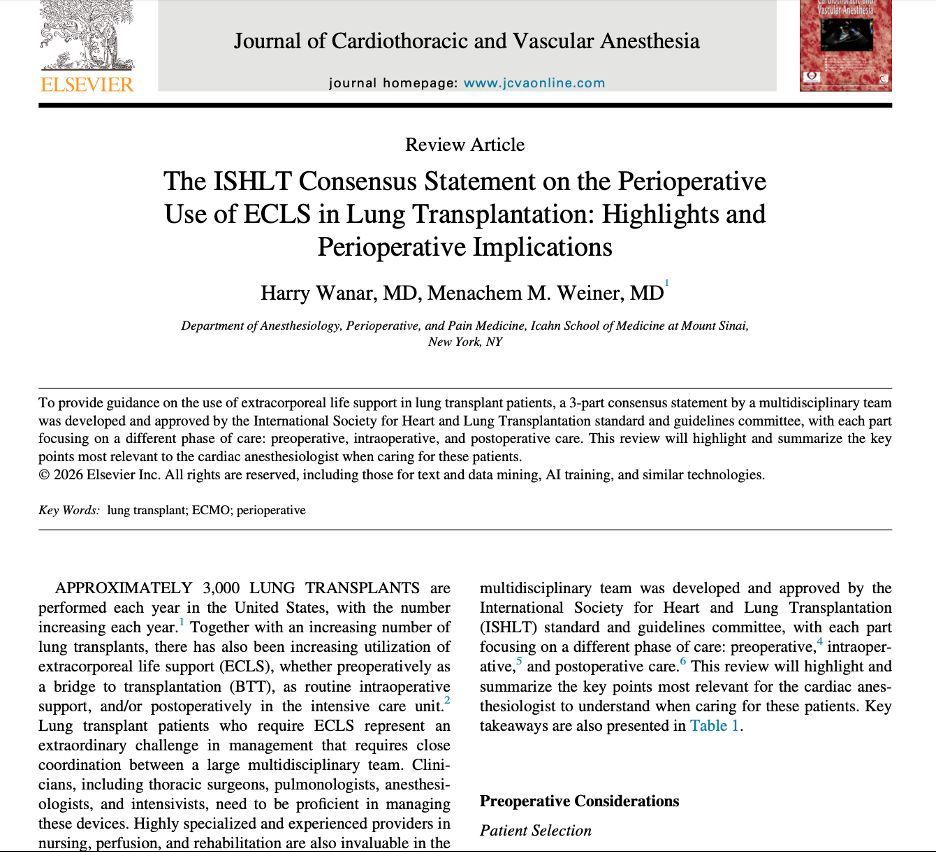
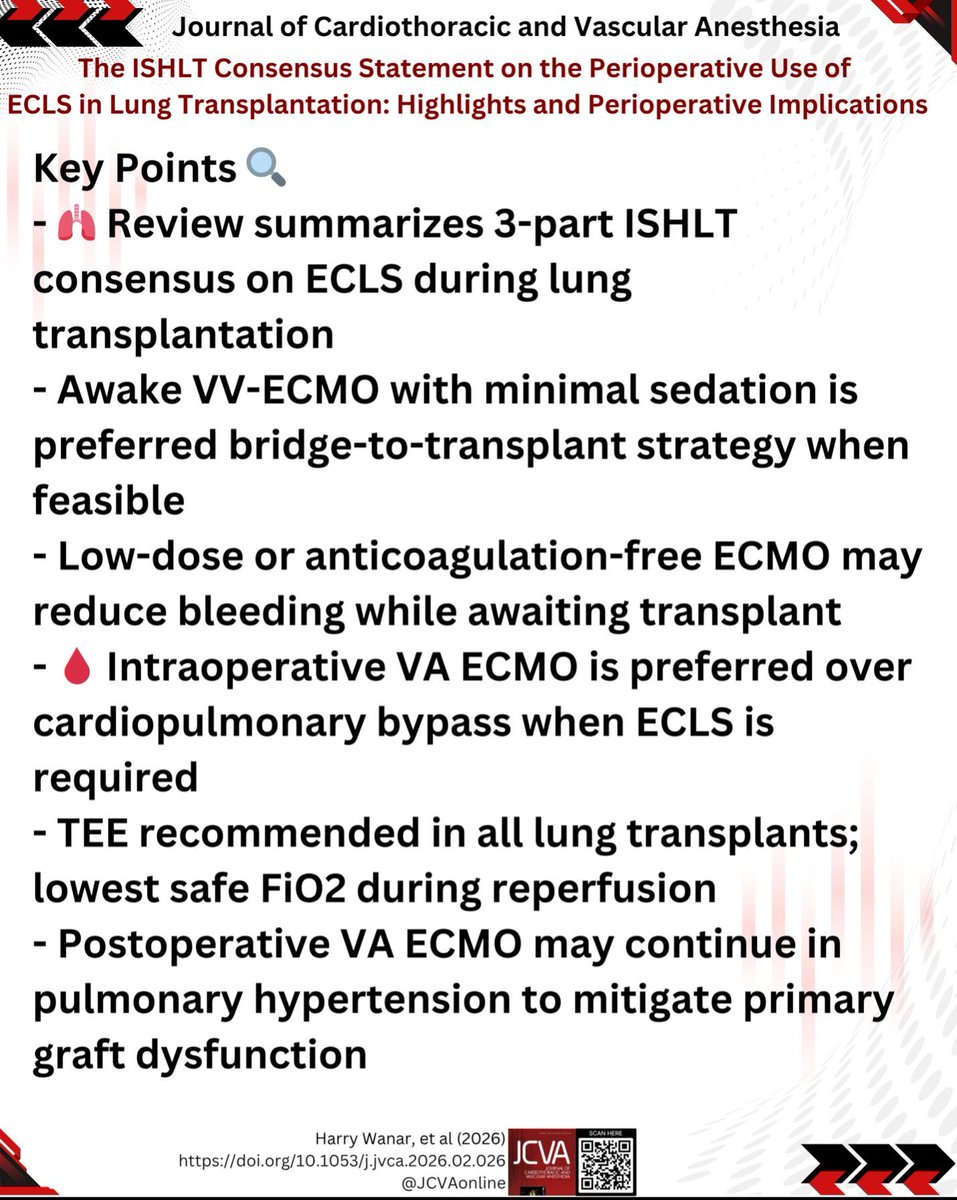
The ISHLT Consensus Statement on the Perioperative Use of ECLS in Lung Transplantation: Highlights and Perioperative Implications
🫁 A new review distills the 3-part ISHLT consensus on extracorporeal life support during lung transplantation
doi.org/10.1053/j.jvca.2026.…
5
17
844

Jun 13
すべてのクロウズロケーション構造、略して ECLS に対する ab 算の計算練習中、いままでは疎にこだわり過ぎていた、2重に重なっててもめったに強制されないのが3クロウズの特徴、
17


The ISHLT Consensus Statement on the Perioperative Use of ECLS in Lung Transplantation: Highlights and Perioperative Implications
🫁 A new review distills the 3-part ISHLT consensus on extracorporeal life support during lung transplantation
doi.org/10.1053/j.jvca.2026.…
59

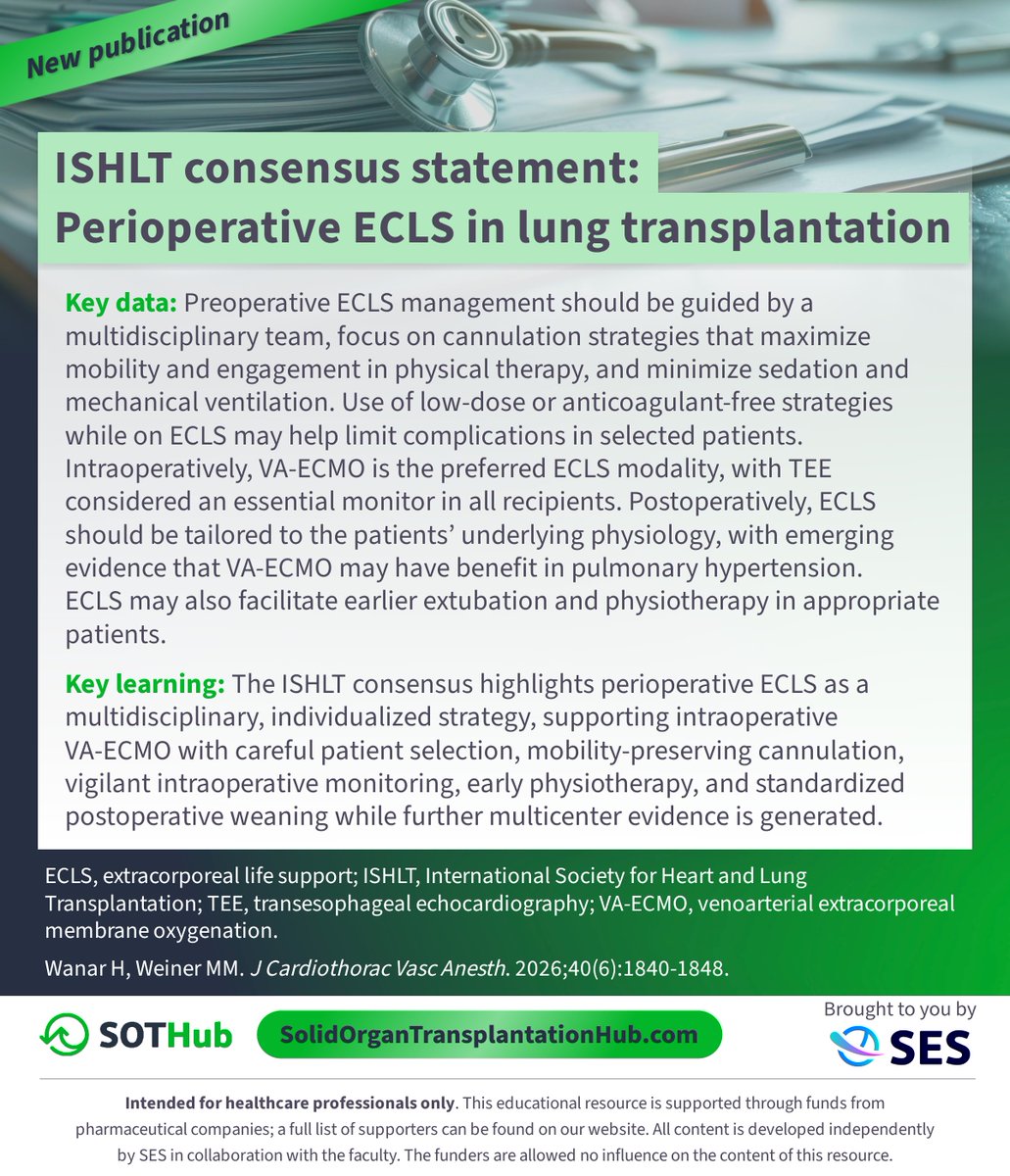
New publication 📝 Review article, published in @JCVAonline, highlights ISHLT recommendations on the use of perioperative ECLS in #LungTransplantation, summarizing key points most relevant to the cardiac anesthesiologist.
Learn more about lung transplantation: solidorgantransplantationhub…
#transplant #OrganTransplant #TransplantMedicine #MedNews #MedEd
3

Jun 11
Maybe hold off on the hourly launch talk until you can deliver a basic ECLS for Artemis? Just a thought.
Jun 11

SpaceX a few days ago: "hourly launches in 5 years!"
SpaceX on Tuesday: "The best we can do for Artemis 3 in a year is put a docking port on a normal Ship"
This is just too funny, like why are they not able to build an extra pressurized cabin with ECLS. Doesn't need anything special inside, just a pressurized area and a control screen. This mission is designed to test the landers to reduce risk and the only thing you are doing is testing your docking system.
1
2

Jun 11
SpaceX a few days ago: "hourly launches in 5 years!"
SpaceX on Tuesday: "The best we can do for Artemis 3 in a year is put a docking port on a normal Ship"
This is just too funny, like why are they not able to build an extra pressurized cabin with ECLS. Doesn't need anything special inside, just a pressurized area and a control screen. This mission is designed to test the landers to reduce risk and the only thing you are doing is testing your docking system.
Jun 9
Well let's just say I'm very disappointed with Starship for Artemis 3.
It was just announced that Blue Origin will have a full lander (maybe a mix between Mk1 and Mk2), with a crew cabin that Artemis 3 crew will enter. They will stay docked for 2 days.
For Starship, they are going to put a normal V3 Starship on orbit and the only difference is that it has a docking adapter on it and maybe some more RCS. It will stay docked for only a day most likely due to it not being able to stay on orbit for more than 48 hours.
You are telling me that the best SpaceX can do is putting a docking adapter on the side of Starship? No cabin, airlock, solar panels, landing legs, HLS engines, just a docking adapter. That is only validating the docking system and nothing else of HLS. How can they only do that in mid 2027 but expect an uncrewed landing late 2027 and a crewed landing in 2028?
Blue has an actual cabin&lander that can be tested in orbit for Artemis 3 but SpaceX just has a docking adapter. If Blue cannot meet the Artemis 3 timelines then Artemis 3 will just be a rendezvous and docking demo which isn't a lot.
Also SpaceX's updated on Starship was basically "trust me, we are working on HLS". No pictures of the HLS cabin (a lot less progress on it than I thought tbh), no pictures of landing legs, the other completed HLS cabin article, landing engines, solar panels or any other hardware. Just a few renders we have already seen. They did mention that they still plan the refilling demo this year but I have doubts. They also mentioned the possibility of pushing Orion from LEO to LLO.
11
37
3,619

Jun 10
Sorry I just took opposite from long post.
NASA confident that Starship ECLS can be based on well demonstrated Dragon systems.
But docking and axial thrust is unproven.
Issacman is trying to get a program that wandered for at least 18 years solidly rolling again. Tough job
4
63

Jun 9
Artemis III is the second crewed mission in NASA's Artemis program, targeted for launch in late 2027 (no earlier than around mid-to-late 2027, with some references to targets like March–June initially adjusted).27b4e7
It was originally planned as the first crewed lunar landing since Apollo 17 in 1972 but was restructured in early 2026 into a critical crewed demonstration mission in low Earth orbit (LEO). This change prioritizes risk reduction for the actual lunar landing on Artemis IV (targeted for early 2028).
Mission Aim
The primary objective of Artemis III is to demonstrate and validate key systems and operations necessary for future crewed lunar landings. Specifically:
Rendezvous and docking between the Orion spacecraft and one or both commercial Human Landing Systems (HLS): SpaceX's Starship HLS and/or Blue Origin's Blue Moon (pathfinder versions launched separately by their providers).
Integrated operations and checkout of docked vehicles, including life support systems (ECLS), communications, propulsion, and overall interoperability.
Testing of the Axiom Extravehicular Mobility Unit (AxEMU) spacesuit, including potential vehicle interfaces for lunar surface use.
Extended validation of Orion's capabilities (e.g., life support for longer durations than Artemis II) in a crewed environment to reduce risks ahead of more complex missions.
This mission acts as a "dress rehearsal" in Earth orbit, similar in spirit to Apollo 9 (which tested the lunar module in Earth orbit). It allows more flexible launch windows and focuses on proving the complex interactions between Orion and the landers without the added complexities (and risks) of a translunar injection and lunar orbit.
Success on Artemis III is seen as essential for enabling the first crewed lunar landing on Artemis IV.
How the Mission Will Be Carried Out
Launch: Four crew members will launch aboard NASA's Space Launch System (SLS) rocket (Block 1 or evolved configuration) from Launch Complex 39B at Kennedy Space Center, Florida. The Orion spacecraft (CM-004 with European Service Module) will be delivered to orbit.
Orbit Insertion and Preparation: After launch, Orion's service module will perform maneuvers to reach and circularize in a suitable low Earth orbit. This orbit is chosen to maximize launch opportunities for the separate commercial lander launches and overall mission success.
Rendezvous and Docking: The commercial HLS vehicles (Starship HLS and/or Blue Moon) will be launched uncrewed on their respective rockets (e.g., SpaceX Starship/Super Heavy or Blue Origin New Glenn). Orion will rendezvous and dock with at least one (potentially both, if timelines align) in LEO. The crew will perform close-proximity operations, docking tests, and integrated system checkouts while docked.
In-Orbit Operations: Activities include testing life support, communications, propulsion systems, and suit interfaces. Potential science or additional demonstrations may occur, though the focus is engineering validation. The crew will remain in Orion (with possible transfers or evaluations involving the docked landers).
Undocking and Return: After completing objectives, Orion will undock, perform de-orbit maneuvers, and splash down in the Pacific Ocean.
The landers will likely be disposed of or de-orbited after the tests. The mission profile emphasizes safety and iterative learning, with commercial partners heavily involved.
Duration
The mission is planned to last approximately two weeks (around 14 days), though exact timelines will be refined closer to launch. This is longer than Artemis II (~10 days) but shorter than the original 3–4 week lunar concepts. The duration supports thorough testing while managing consumables and crew fatigue in LEO.
Crew
NASA announced the Artemis III crew on June 9, 2026. All four are experienced astronauts:74a349
Commander: Randy Bresnik (NASA) — Veteran astronaut with prior ISS command experience.

Introducing Artemis III.
Four astronauts. Three launches. Two dockings. One splashdown.
In 2027, the Artemis III mission will practice docking the Orion spacecraft with two lunar landers in low Earth orbit — the capability we need to return humanity to the Moon’s surface.
1
194

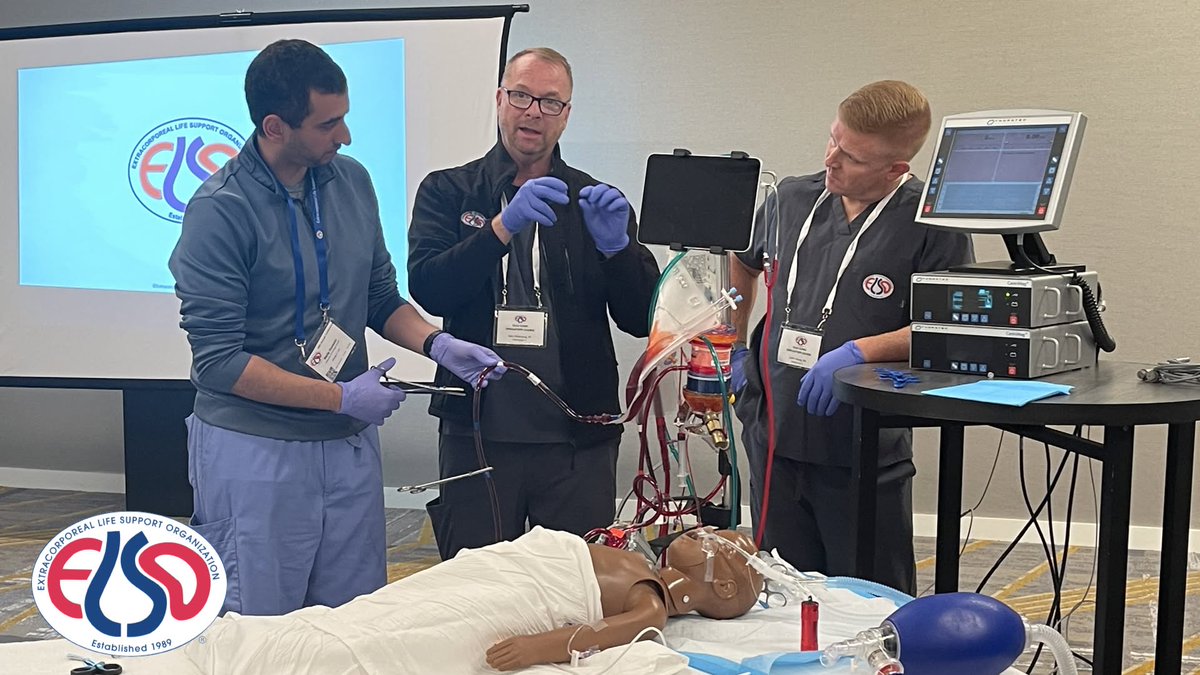
Ready to level up your #ECLS education/training? Don’t miss next ELSO courses & workshops!
🎓 Adult #ECMO #simulation
📆 Nov 9-10 or 11-12
🧸 Neo/Peds simulation
📆 Oct 13-14
🎓 Adult cannulation workshop
📆 Oct 10 or 11, Nov 13 or 14 or 15
📌 Ann Arbor MI
bit.ly/ELSOAcademy
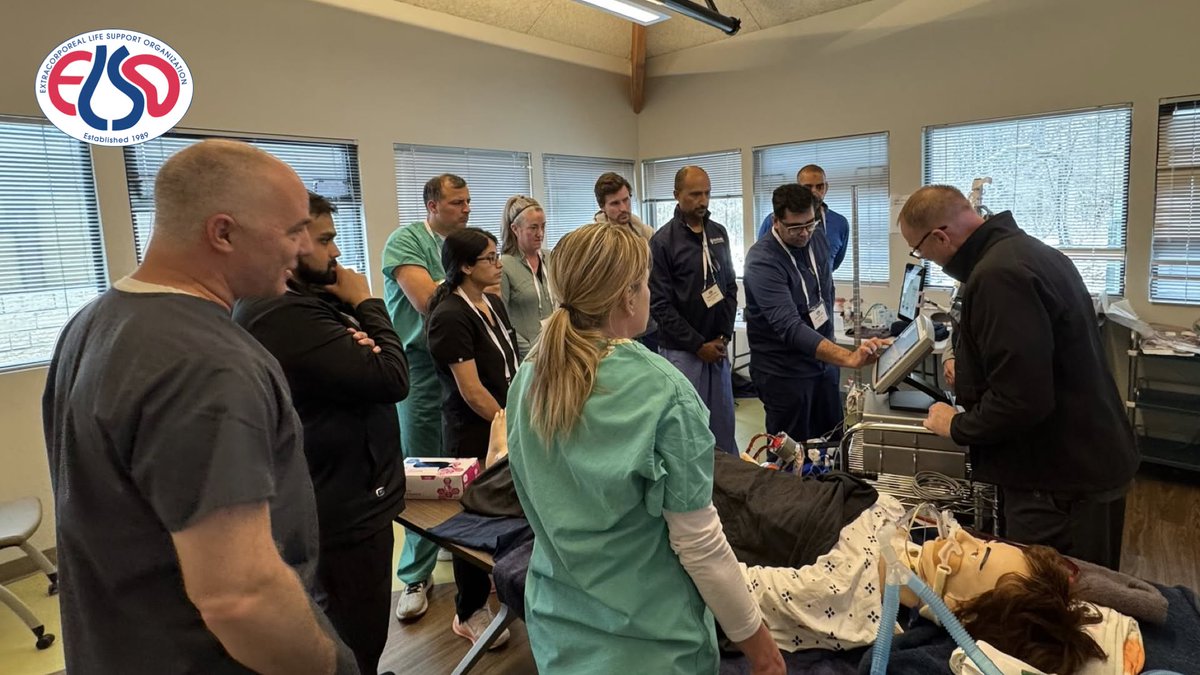
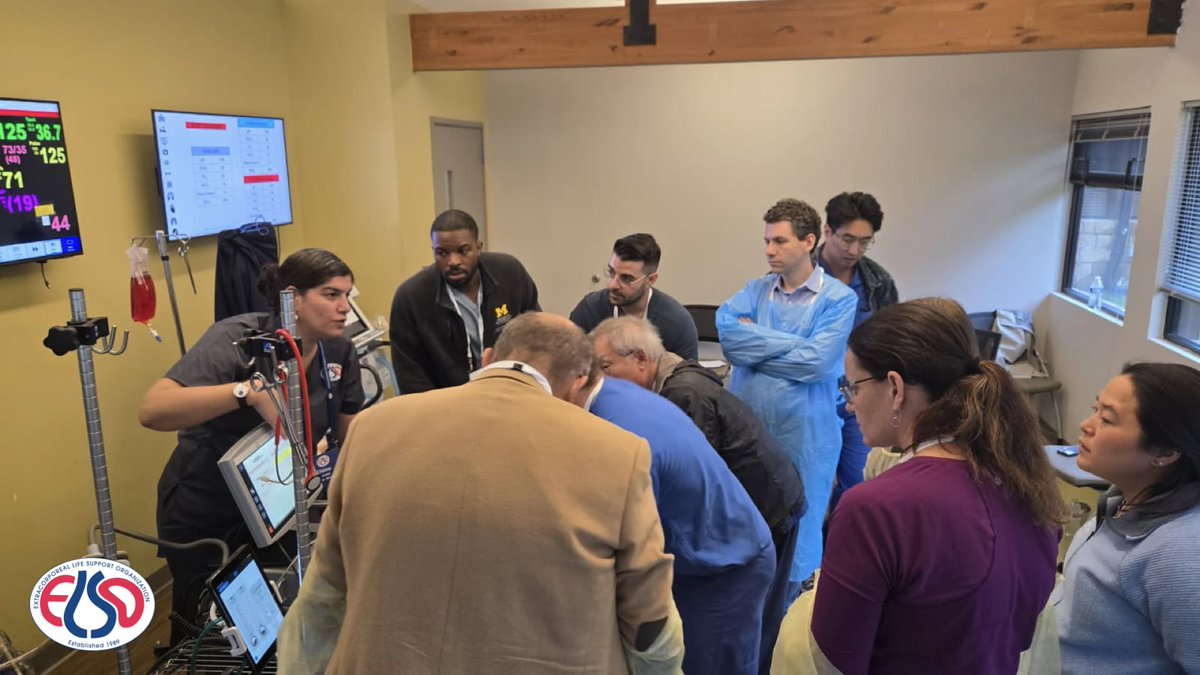
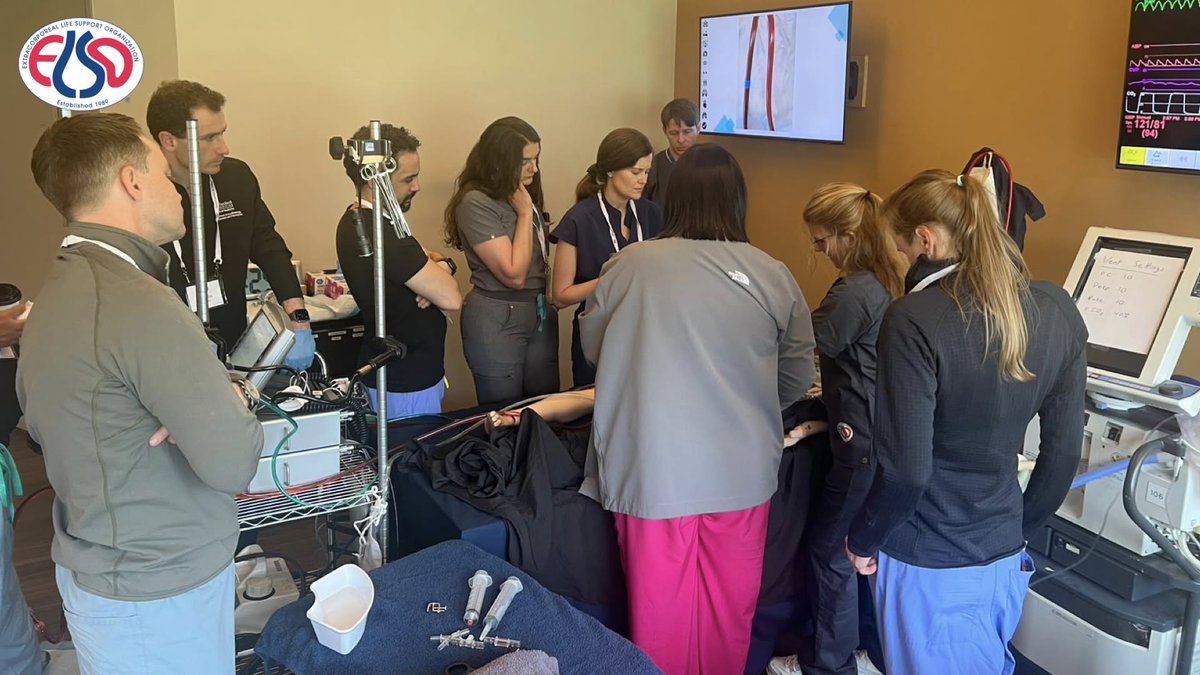
4
649
asaiojournal retweeted

Jun 3
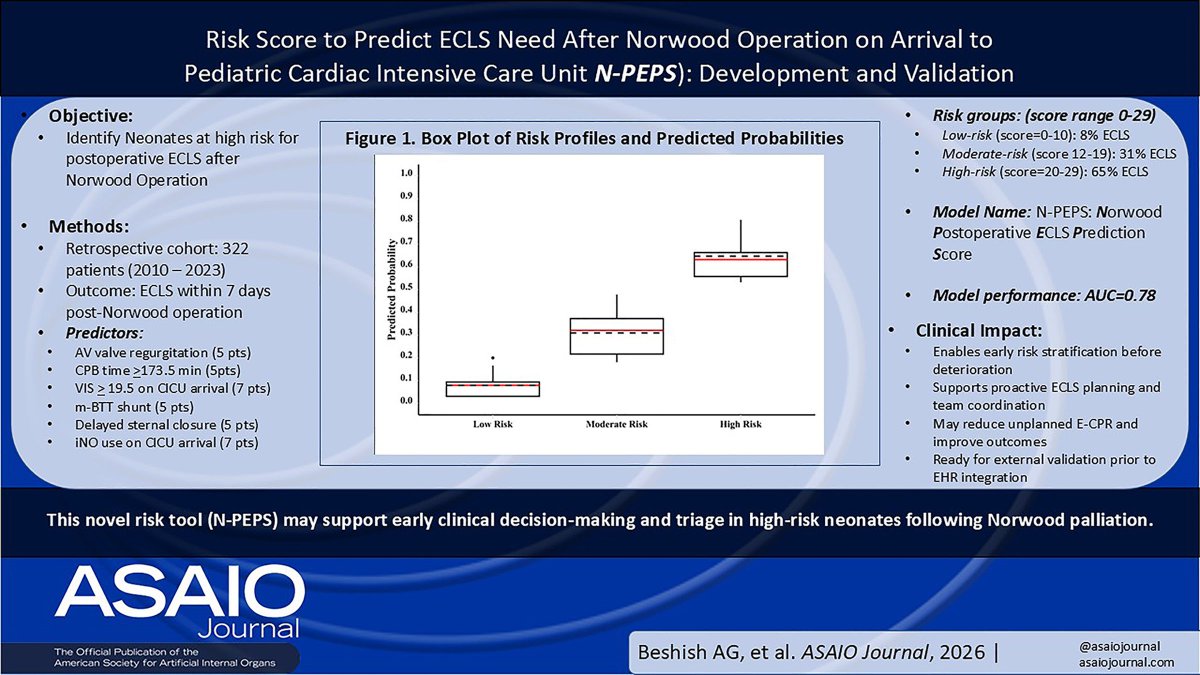
Development and internal validation of perioperative bedside risk score to assess #ECLS need after Norwood in #PedICU:
🔍 322 neonates (2010-2023)
🫀 22% postoperative #ECMO
🩺 6 independent predictors: moderate-severe atrioventricular valve regurgitation, modified BTT shunt, CPB duration >173.5', VIS > 19.5 on ICU arrival, delayed sternal closure, postop iNO use
⚖️ score stratified pts into low, moderate, high-risk, with corresponding ECLS rates of 8%, 31%, 65%
This novel risk tool demonstrated good discrimination, and may support early clinical decision-making and triage in high-risk neonates.
@asaiojournal
🖇️ bit.ly/4e5tgR6
2
5
655
asaiojournal retweeted
Jun 6
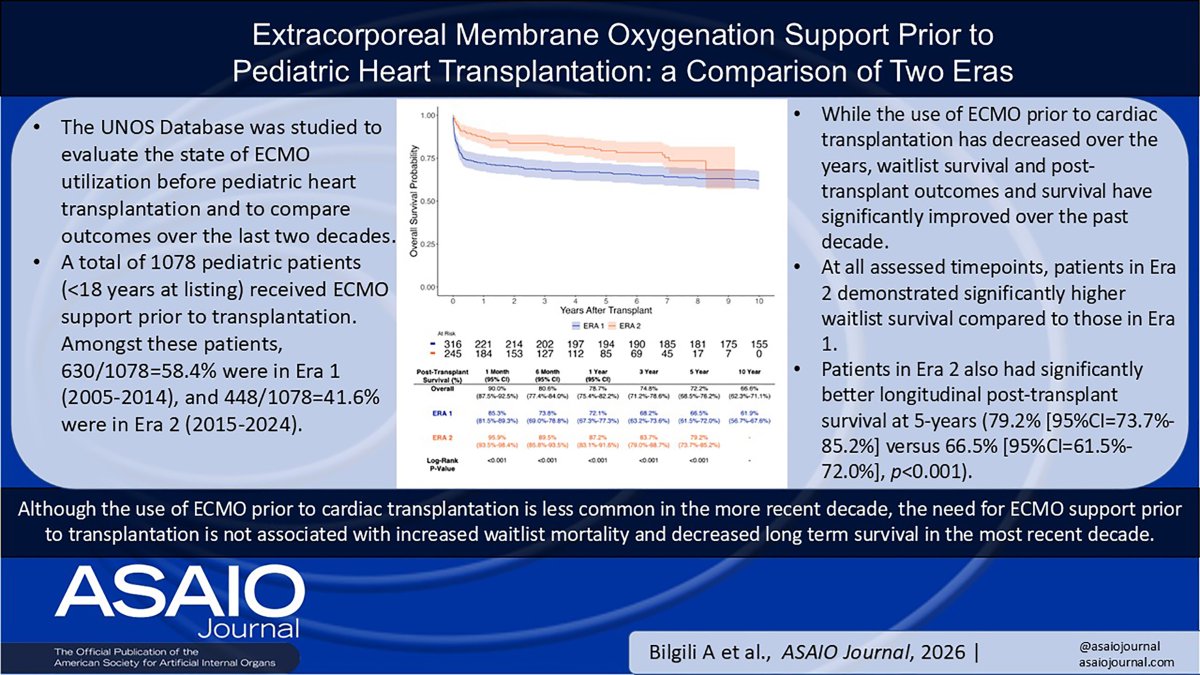
#ECMO before pediatric heart #transplantation: comparing two eras
🔍 >1K #ECLS supported children from UNOS Database included: 58% in era 1 (2005–14), 42% in era 2 (2015-24)
🫀 52% transplanted, 56% in era 1, 44% in era 2
🪦 total waitlist mortality 34.9%; patients in era 2 demonstrated significantly higher survival
Although use of ECMO before #Tx decreased over the years, survival and outcomes significantly improved. Compared to previous decade, ECMO is associated with lower waitlist mortality and improved long-term survival.
#PedsICU @asaiojournal
🔗 bit.ly/4fwcVHp
4
7
625
Jun 8
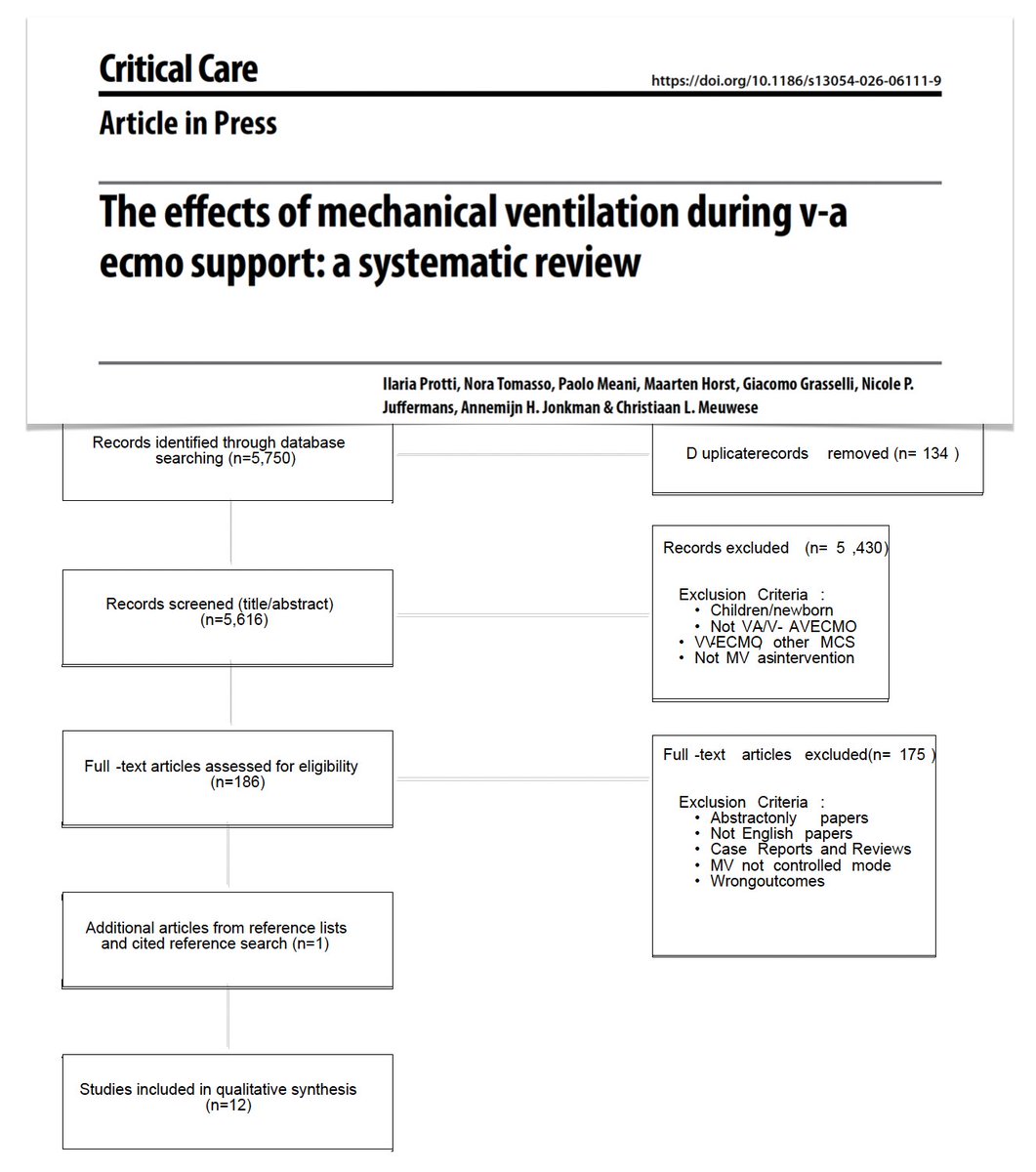
Mechanical ventilation during VA #ECMO, systematic review aimed to summarize & describe studies investigating effects of MV settings and adjunctive respiratory interventions on hemodynamics, cardiac recovery, clinical outcomes.
📖 MV cornerstone for patients in #ECLS, but available evidence is sparse/low quality, highly heterogeneous, and at considerable risk of bias, preventing any reliable inferences.
#FOAMcc #FOAMecmo @Crit_Care
🔓 rdcu.be/fnfsg
13
30
1,304

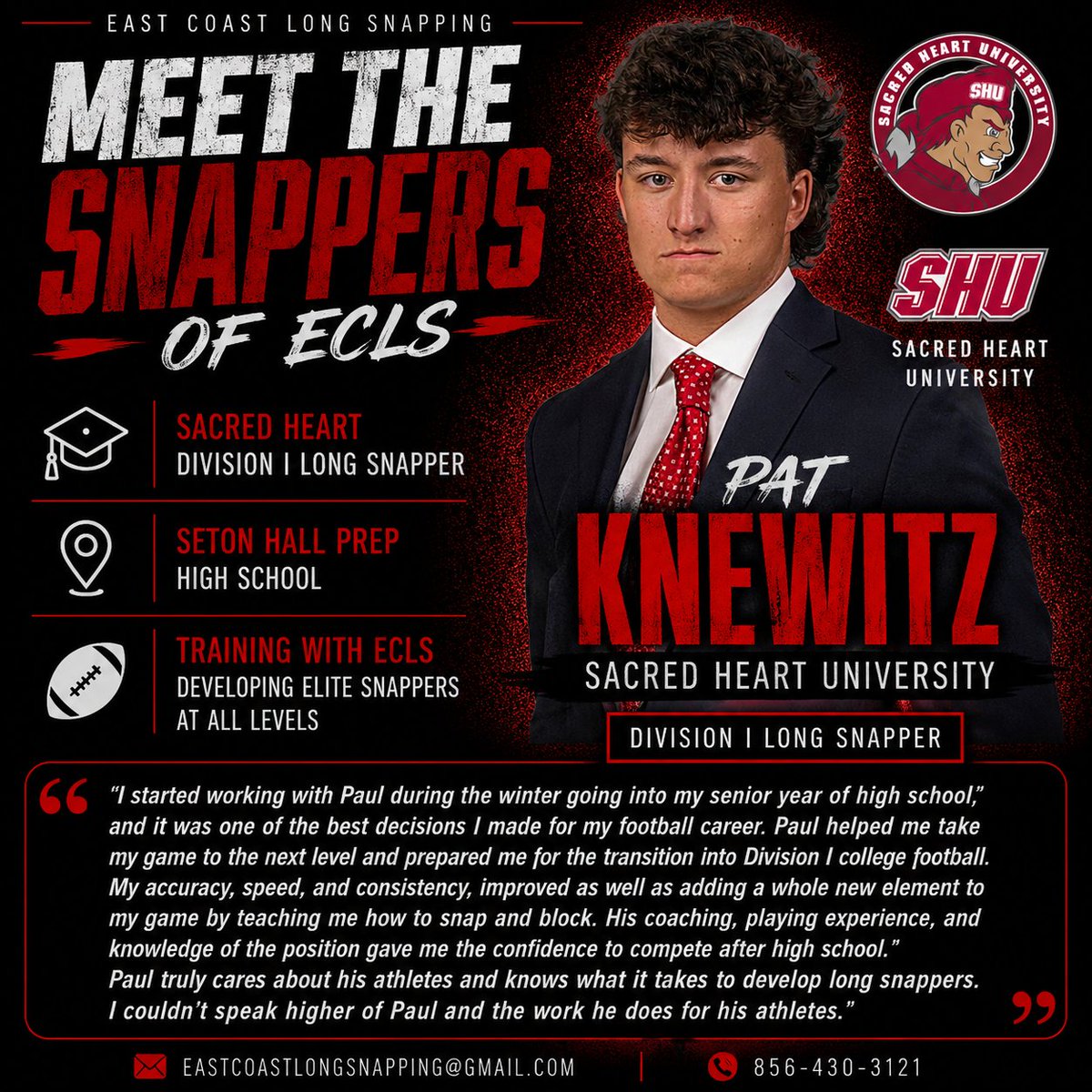
🚨 MEET THE SNAPPERS OF ECLS 🚨
Pat Knewitz 🏈
Sacred Heart Long Snapper and Seton Hall Prep graduate. Proud to have Pat represent the ECLS family and share his journey with the next generation of long snappers. 💪🔥 @KnewitzPatrick
#ECLS #LongSnapper #SacredHeartFootball
6
132
Andrew Reicherter 🏈
Getting quality reps in with Coach Paul Rucci at ECLS. Check out some work from a recent session as the Cherry Hill West Long Snapper continues to develop his craft. 💪
#ECLS #LongSnapper #CherryHillWest #SpecialTeams
1
1
197

Jun 7
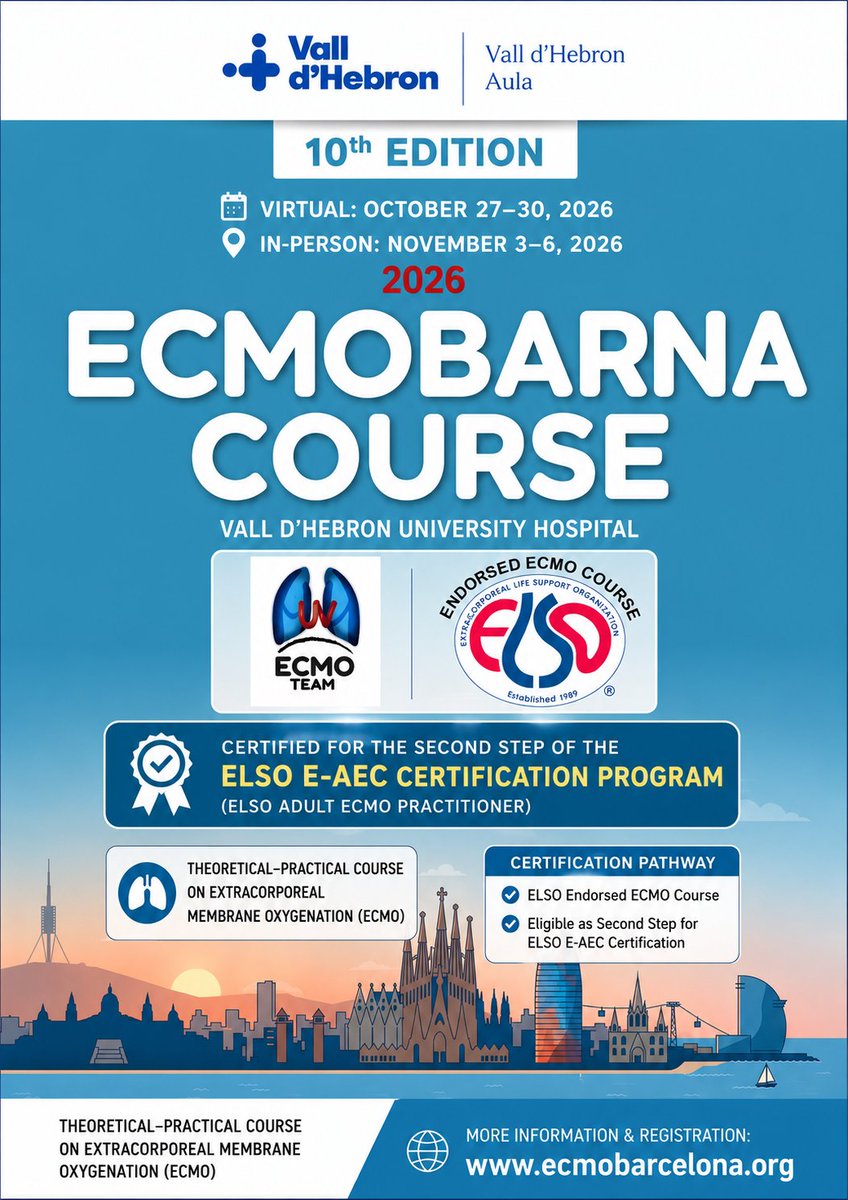
🚨 #ECMOBARNA2026 is here! 🚨
🏆 ELSO Endorsed Course (2 Step ELSO E-AEC)
🌍 NEW: Two dedicated English-speaking groups
🫀 Hands-on #ECLS workshops
🎮 Hybrids VITA ECMO simulation
🐷 Animal lab training
⚠️ Limited places!
🌐 ecmobarcelona.org
4
7
752