
مساج في الدمام
Massage in #dammam
مساج في #الدمام
Massage in #khobar
🫛🏌️♀️🚀 Wa.me/966592099243
ESsB

3

The Income Tax and Your Pension
Olympia stripped the pension exemption protecting your pension from being taxed— even though "You Won't Be Affected"
Warning TLDR
Washington's new 9.9% income tax has a $1 million threshold. And every politician who voted for it will tell you: "Don't worry — this only hits millionaires. State employees, teachers, firefighters — you're safe." (However, firefighters please ignore the fact that we must raided your pension for the general fund)
Then why did they rewrite the pension protection statute?
Here's what they actually did. Every public pension in Washington — PERS, TRS, LEOFF, State Patrol, teachers, school employees — had a law on the books that said your pension was:
"exempt from any state, county, municipal, or other local tax"
That protection has been there for decades. ESSB 6346 added a new subsection to each of those 13 statutes that says this:
"Subsection (1) of this section does not exempt any pension or other benefit received under this chapter from tax under Title 82A RCW."
Title 82A is the new income tax.
So here's the question:
If the $1 million threshold protects you, why did they need to strip the pension exemption at all?
The existing exemption — "exempt from any state tax" — would have protected you automatically. They didn't need to touch it. If their guarantee is real, the exemption stripping would be meaningless.
Unless it's not meaningless.
The only reason to surgically remove pension protections from 13 separate statutes is to build the infrastructure to tax those pensions later — when the threshold comes down. And it will come down.
They've already done the legal work removing your exemption. The only thing standing between your pension and a 9.9% tax are promises from legislators who brag about making pie crust promises— easily made easily broken. — and now it can be change any time they want.
Olympia tells you not to worry. But they have taken away the only legal protection that would have made worrying unnecessary.
13
109
296
8,704

Jun 9
men her semestr lazimsiz bir fenne gore bu qeder essb kecirmeliyem de hokmwn
2
30

May 27
Hey @grok did Governor Bob Ferguson have the ability to do a line item veto on the "necessity clause" on ESSB 6346, in order to preserve the right of voter referendum?
2
21
1,105
May 27
C'mon. @BobFergusonGov
Enough pandering. You aren't looking forward to the voters having a say.
If you wanted the voters to actually have a say, you would've line-item veto'ed the emergency clause on ESSB 6346. That would've preserved the right of voter referendum on this heinous bill.
BUT. YOU. CHOSE. NOT. TO.
May 27

It looks like voters will get a say on whether to maintain the tax on income over $1 million that was passed earlier this year- and I look forward to the public having their say on this important policy. To be clear, this reform of our regressive tax code included expansion of tax credits for working families, relief for small businesses, and investments in K-12 and affordable childcare. One more thing voters should know: so long as I am Governor I will veto ANY attempt to lower the threshold or raise the rate of this tax-- we are asking those who make the most to pay a little more, and providing relief to workers and small businesses. Let's keep it that way.
Community note
The tax is not constitutionally locked to incomes over $1M; Democrats rejected Amendment 696 requiring voter-approved limits on the threshold and rate. The bill's necessity clause prevents referendum, so voters can only challenge it via initiative. lawfilesext.leg.wa.gov/biennium/2025-… app.leg.wa.gov/billsummary?Bi
5
20
84
1,390

May 24
ESSB to lotnisko normalne. Nie jest rządowym, czy inaczej wyróżnionym. Jak tu pierwszy raz przyjechałem w 1967 roku, było to jedyne międzynarodowe lotnisko w Sztokholmie. Arlanda była jeszcze w budowie. Do połowy lat 80-tych SAS miał tam swoją kwaterę główną, z siedzibą szefa na wszszystkie 3 kraje. Okazjonalnie pracowałem tam. Budowla stoi do dziś, choć wygląda już dość obciachowo. Cała Bromma rozwija się rześko, pewnie niedługo ten pomnik historii zburzą.
Odkąd pamiętam toczą się dyskusje na temat zlikwidowania Brommy. Od zawsze decydują politycy. Bliżej do Bromma niż na Arlandę…. W związku z powyższym sądzę, że długo jeszcze postoi. Dużo lotów krajowych jest właśnie z Brommy. Głównie mniejsze samoloty. Powtarzam decyduje… hałas, bo inaczej mieszkańcy się pieklą. Ja kiedyś przez prawie rok co tydzień latałem do Göteborg z ESSB niezapomnianym BAe 146-200, wycofany już. Teraz latają ATR… też fajnie.
Radzą sobie dobrze.
2
20
May 24
Jakbyś się kiedyś wybierała do Szwecji… daj znać. Znam trochę fajnych miejsc przy okolicznych lotniskach. Najlepsze jest w Skavsta (NYO/ESKN). Problem jest, że tam rzadko coś ciekawego ląduje. Mogą się jednak trafić samoloty ochrony wybrzeża, starty i lądowania awionetek, też bywają zabawne.
Bromma. (BMA/ESSB). Centrum Sztokholmu (z grubsza). Regularne połączenie z Brukselą. (A319) większe są zabronione z uwagi na hałas. Królestwo wszelkiego rodzaju business jet. Politycy, szamani, influencerzy właśnie stamtąd latają. Można się napatrzeć. Da się podejść blisko.
(Przy odrobinie szczęścia, właśnie tam zrobisz fotkę @Flyboy_Pete )
Arlanda. (ARN/ESSA). Lotnisko sztandarowe. Trudno podejść, ale są miejsca. Trafia się dużo fajnego i dziś już może niecodziennego Cargo. Powtarzam, trudno znaleźć fajne miejsce (jak już się znajdzie, to się wiatr zmieni). Da się jednak.
Zapraszam.
3
5
95


May 4
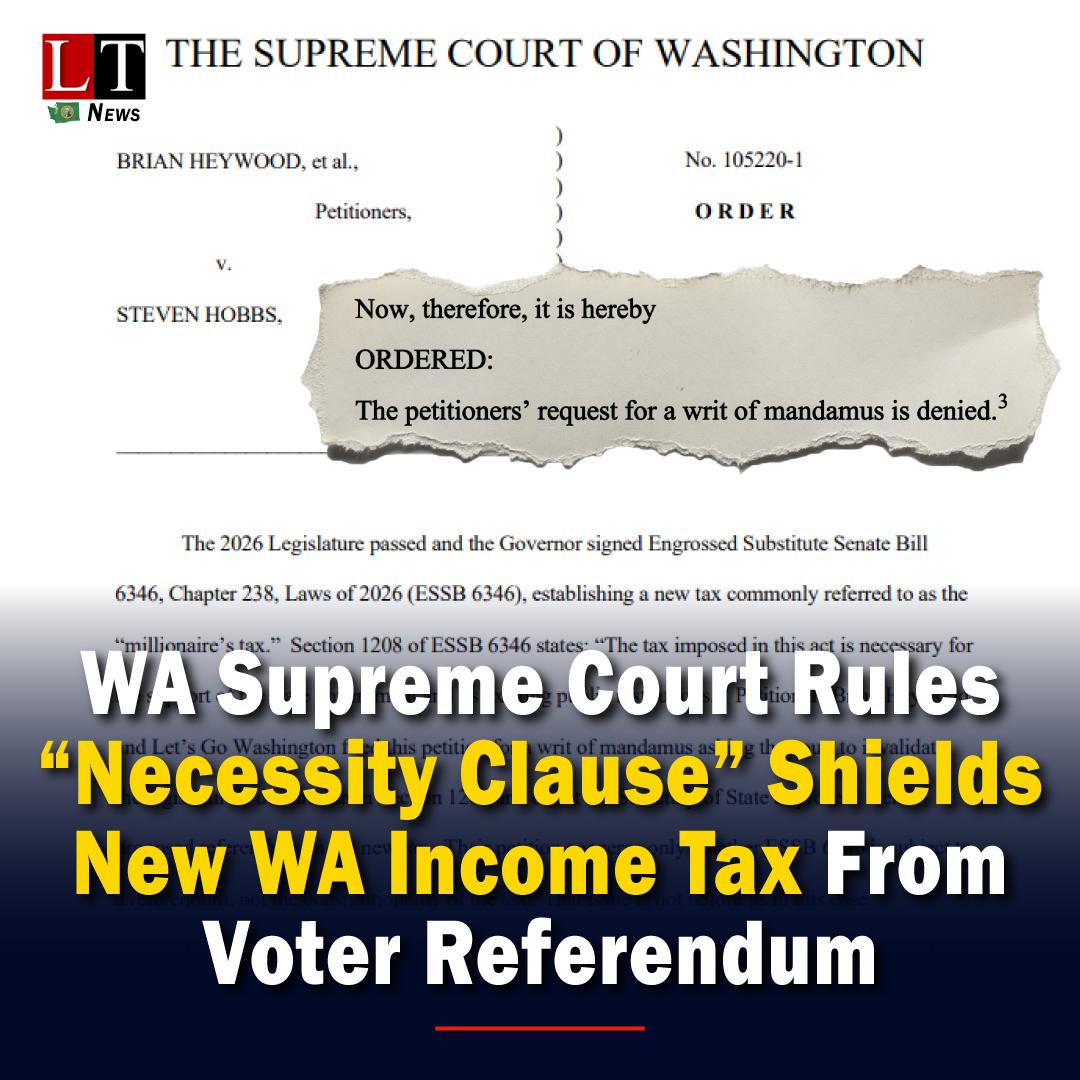
🚨JUST IN: Washington’s Supreme Court on Monday rejected Let's Go WA's effort to force a referendum this fall on the state’s new income tax on high earners.
The Justices ruled that the law’s “necessity clause” is valid, shielding the tax from a public referendum because it supports existing state government functions. Chief Justice Debra Stephens wrote that the decision follows the state constitution and precedent.
🟦CHIEF JUSTICE STEVENS: "Consistent with the words of the constitution and our unbroken line of precedent, we hold that ESSB 6346 falls within the exception for laws that are 'necessary for the . . . support of the state government' and not subject to referendum under article II, section 1.... The petitioners’ request for a writ of mandamus is denied"
The ruling leaves opponents, led by Brian Heywood’s Let’s Go Washington, with the option of an initiative. That path requires nearly double the signatures — 308,911 by July 2 for the ballot.
Heywood called the decision a “blank check” for lawmakers. House Majority Leader Joe Fitzgibbon, D-Seattle, welcomed the outcome as good news for tax reform.
A separate constitutional challenge—filed by Citizen Action Defense Fund (CADF), former Attorney General Rob McKenna, and former Supreme Court Justice and State Senator Phil Talmadge—to the statewide income tax is still pending.
👉 FULL ARTICLE: lynnwoodtimes.com/2026/05/04…
6
1
5
500

May 1
Washington State
ESSB 5167 (2025)
Special Appropriations to the Governor $1.17 Billion
I can only guess that the Washington State authoritarians don't want the peasants (people) to know what's going on in the Washington State Legislature.
I had to put the bill text into a PDF Reader in order to do a word search.
ESSB 5127 is a 1,367 page document.
I would say that this is very, very BAD when your state government is HIDING legislative bill text from the people.
@PNWForestKing
@AAGDhillon
@JDVance

1
1
2
44
May 1
Washington State
SPECIAL APPROPRIATIONS TO THE GOVERNOR ~ $1.14 BILLION DOLLARS
April 30, 2026
ESSB 5167 (2025)
2025-2027 Omnibus Operating Appropriations Act
Washington State's main biennial operating budget bill, often referred to as the "Omnibus Budget."
It covers the 2025-2027 fiscal biennium and includes Part VII: Special Appropriations, which contains the "Special Appropriations to the Governor" budget entity/line item.
app.leg.wa.gov/billsummary/?…
** For a deeper dive on this story, go to Shane Kidwell on Substack.
NOTE: They’ve DISABLED the text search function for ALL WA State legislative bill texts in PDF format.
You have to put the legislative bill into a PDF Reader in order to do a word search on a Washington State Legislative Bill.
lawfilesext.leg.wa.gov/bienn…
@JDVance
@AAGDhillon
@PNWForestKing
Post by Ks:

May 1

For eleven straight years, a Washington state budget line called "Special Appropriations to the Governor" had zero staff. Zero. Every year until 2026 that is...
In fiscal year 2026, it has 20.5 full-time positions and $1.14 billion in public funds.
That number comes directly from the Washington Office of Financial Management's own statewide staffing history at ofm.wa.gov. It is not an interpretation. It is on the state's public record.
Here is what this budget line actually does, in OFM's own words: "Special Appropriations to the Governor has been created as a budget entity to separate appropriations that the Governor allocates to other state agencies. Once the allocation is made, expenditures are recorded in the receiving agency."
Translation: the legislature puts money into a pool. The governor's office decides which agencies get what and when. The allocation decisions happen inside the governor's office, not in a public legislative vote on that specific use.
For context: the entire Office of the Governor proper has 161 Full Time Employees (FTE) and $70.6 million in total appropriations for this biennium. The Special Appropriations pool managed by those 20 positions is sixteen times larger than the governor's direct office budget.
The bill that created this structure, ESSB 5167, passed the Senate 28-19 and the House 52-45. Every yes vote was a Democrat. Every no vote was a Republican, per the legislative vote record. It was signed by Governor Ferguson on May 20, 2025.
The governor's office has stated the expansion was necessary to respond to federal funding uncertainty from the Trump administration. That explanation may be entirely accurate.
It does not change what the structure is. Over a billion dollars flowing through a single pool. Allocation decisions made inside the governor's office. By staff who do not appear on any public vote record.
Zero staff for eleven years. Then twenty, managing $1.14 billion.
And the average Washington taxpayer has no idea this line exists.
I publish the full research and sourced breakdowns on Substack every week. Search Shane Kidwell if you want the deeper dive.
9
67
124
4,023

May 1
For eleven straight years, a Washington state budget line called "Special Appropriations to the Governor" had zero staff. Zero. Every year until 2026 that is...
In fiscal year 2026, it has 20.5 full-time positions and $1.14 billion in public funds.
That number comes directly from the Washington Office of Financial Management's own statewide staffing history at ofm.wa.gov. It is not an interpretation. It is on the state's public record.
Here is what this budget line actually does, in OFM's own words: "Special Appropriations to the Governor has been created as a budget entity to separate appropriations that the Governor allocates to other state agencies. Once the allocation is made, expenditures are recorded in the receiving agency."
Translation: the legislature puts money into a pool. The governor's office decides which agencies get what and when. The allocation decisions happen inside the governor's office, not in a public legislative vote on that specific use.
For context: the entire Office of the Governor proper has 161 Full Time Employees (FTE) and $70.6 million in total appropriations for this biennium. The Special Appropriations pool managed by those 20 positions is sixteen times larger than the governor's direct office budget.
The bill that created this structure, ESSB 5167, passed the Senate 28-19 and the House 52-45. Every yes vote was a Democrat. Every no vote was a Republican, per the legislative vote record. It was signed by Governor Ferguson on May 20, 2025.
The governor's office has stated the expansion was necessary to respond to federal funding uncertainty from the Trump administration. That explanation may be entirely accurate.
It does not change what the structure is. Over a billion dollars flowing through a single pool. Allocation decisions made inside the governor's office. By staff who do not appear on any public vote record.
Zero staff for eleven years. Then twenty, managing $1.14 billion.
And the average Washington taxpayer has no idea this line exists.
I publish the full research and sourced breakdowns on Substack every week. Search Shane Kidwell if you want the deeper dive.
8
40
77
5,205

Apr 29
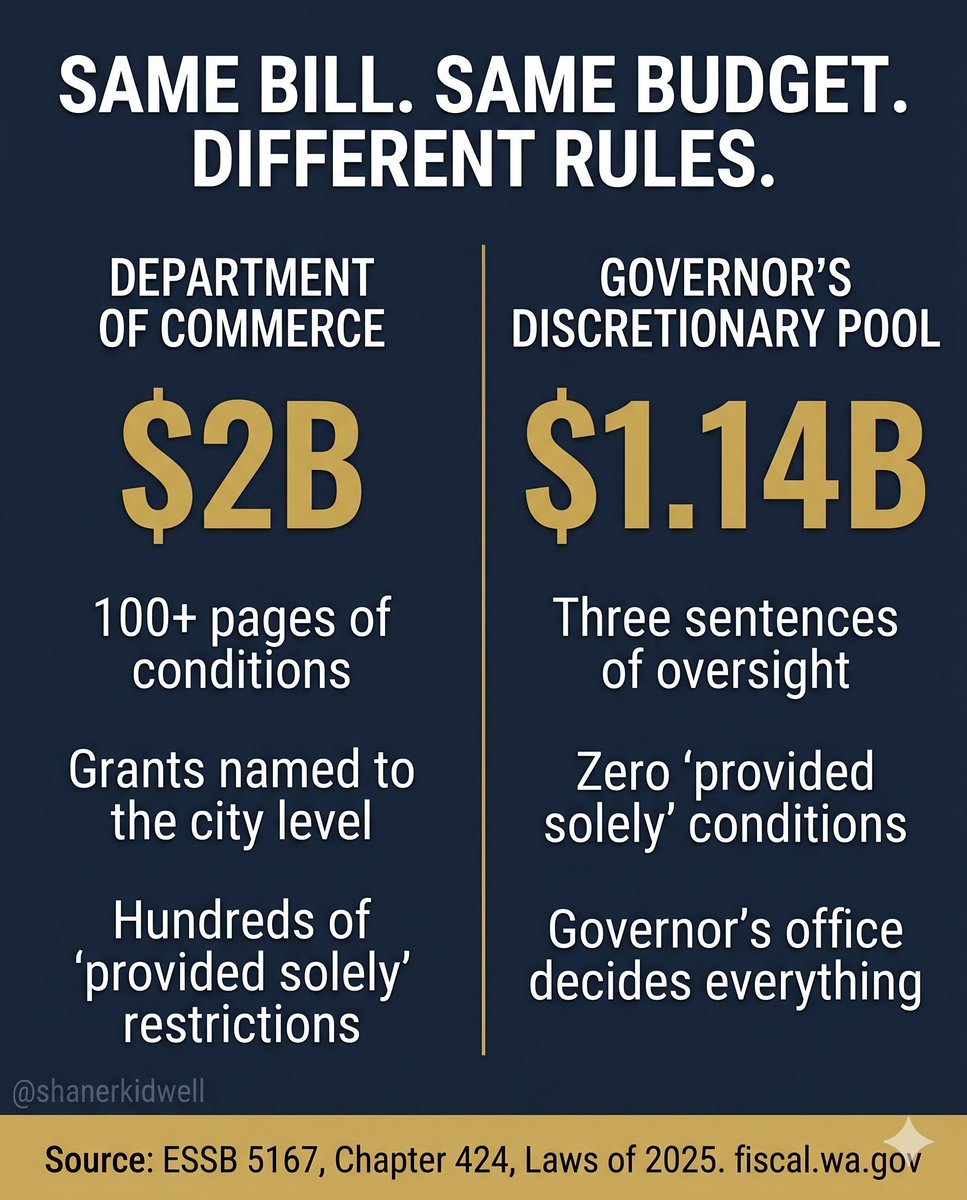
Washington's budget bill is 1,367 pages. The legislature wrote over 100 pages of spending conditions for the Department of Commerce. Grants specified down to the city and the nonprofit. Dollar amounts. Named purposes. Lapse provisions if the money is not used correctly.
For the governor's $1.14 billion discretionary pool, the legislature wrote three sentences. No named programs. No reporting requirements. No restrictions on how allocations are made.
That is in the same bill. ESSB 5167, signed May 20, 2025. Per the conference report at fiscal.wa.gov, those three sentences govern $1.14 billion in total budgeted funds.
The bill passed 28-19 in the Senate and 52-45 in the House, per the legislative record. Every yes vote was a Democrat. Every no vote was a Republican.
$150,000 to a Yakima gang prevention nonprofit. Fifty pages of conditions.
$1.14 billion to the governor's pool. Three sentences.
That is the bill they passed. Read it yourself.
I publish the full research and sourced breakdowns on Substack every week. Search Shane Kidwell if you want the deeper dive.
@GovBobFerguson @komonews @KING5Seattle @KIRO7Seattle @fox13seattle @seattletimes
2
7
159
Apr 29
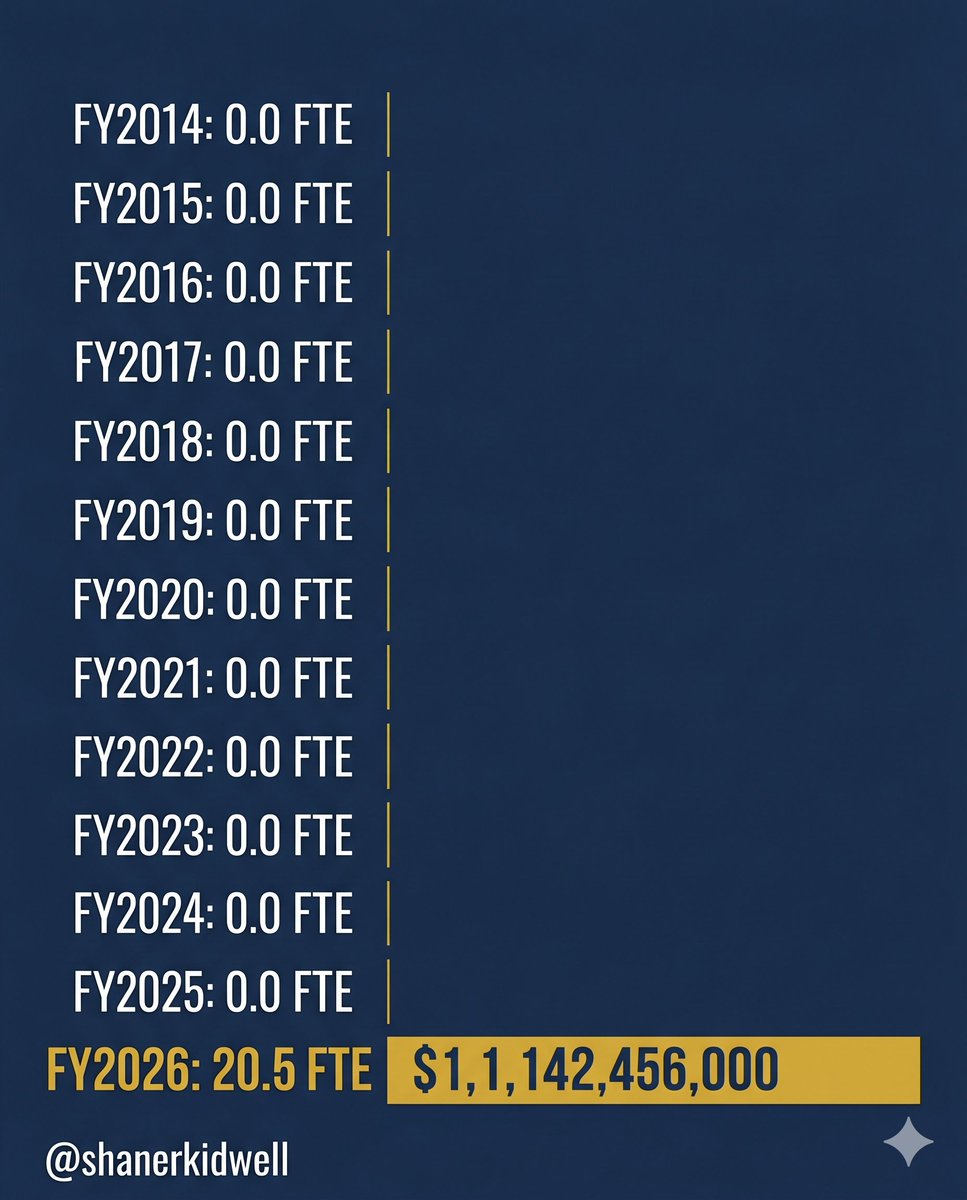
For eleven straight years, a Washington state budget line called "Special Appropriations to the Governor" had zero staff. Zero. Every year from FY2014 through FY2025. Until 2026
In FY2026, it has 20.5 full-time positions (FTE) and $1.14 billion in public funds.
That number comes directly from the Washington Office of Financial Management's own statewide staffing history at ofm.wa.gov. It is not an interpretation. It is on the state's public record.
Here is what this budget line actually does, in OFM's own words: "Special Appropriations to the Governor has been created as a budget entity to separate appropriations that the Governor allocates to other state agencies. Once the allocation is made, expenditures are recorded in the receiving agency."
Translation: the legislature puts money into a pool. The governor's office decides which agencies get what and when. The allocation decisions happen inside the governor's office, not in a public legislative vote on that specific use.
For context: the entire Office of the Governor proper has 161 FTE and $70.6 million in total appropriations for this biennium. The Special Appropriations pool managed by those 20 positions is sixteen times larger than the governor's direct office budget.
The bill that created this structure, ESSB 5167, passed the Senate 28-19 and the House 52-45. Every yes vote was a Democrat. Every no vote was a Republican, per the legislative vote record. It was signed by Governor Ferguson on May 20, 2025.
The governor's office has stated the expansion was necessary to respond to federal funding uncertainty from the Trump administration. That explanation may be entirely accurate.
It does not change what the structure is. Over a billion dollars flowing through a single pool. Allocation decisions made inside the governor's office. By staff who do not appear on any public vote record.
Zero staff for eleven years. Then twenty, managing $1.14 billion.
And the average Washington taxpayer has no idea this line exists.
I publish the full research and sourced breakdowns on Substack every week. Search Shane Kidwell if you want the deeper dive.
@WaGov_US got me on this. We are talking about a discretionary pool of over $1.1 billion that flows through a single budget entity controlled by the governor's office, with 20 staff managing the allocations, zero elected oversight of how those dollars get distributed to agencies, and a history of zero FTE in this line from FY2014 through FY2025.
@GovBobFerguson @KING5Seattle @komonews @KIRO7Seattle @fox13seattle @seattletimes
21
92
192
17,156

Apr 24
Washington state has enacted several targeted AI-related laws in recent years, focusing primarily on transparency for AI-generated content, safety for AI companion chatbots, protections against deepfakes, and ongoing study via a task force. There is no comprehensive “AI regulation” like some other states’ high-risk AI rules, but these measures address specific risks such as misinformation, harm to minors, and deception.2
Key Laws (as of April 2026)
1. HB 2225 (2026) – Regulation of AI Companion Chatbots
•Signed: March 24, 2026 (Chapter 168, Laws of 2026).
•Effective: January 1, 2027.
•Applies to: “Operators” of AI companion chatbots (systems designed for ongoing, human-like interactions/relationships, e.g., like advanced versions of ChatGPT or Claude for personal use). Excludes narrow-purpose tools like basic customer service bots.1
•Main requirements:
◦Safeguards for minors, including limits on manipulative, explicit, or harmful content.
◦Protocols to detect and respond to signs of self-harm, suicide ideation, or eating disorders (e.g., redirect to crisis hotlines).
◦Disclosures that the chatbot is AI (not human).
◦Enforcement by the Attorney General, plus a private right of action (users can sue). Violations treated as unfair/deceptive acts under the Consumer Protection Act.5
•This is described as the first-in-the-nation law specifically regulating AI chatbots for safety.4
2. HB 1170 (E2SHB 1170, 2026) – AI Content Provenance and Disclosures
•Signed: March 24, 2026 (Chapter 167, Laws of 2026).
•Effective: February 1, 2027.
•Applies to “Covered providers”: Entities producing generative AI systems with >1 million monthly users, publicly accessible in Washington for personal use (large companies like those behind major image/video/audio generators). Excludes government, B2B uses, video games, minor edits (e.g., cropping, brightness), and upscaling/noise reduction.36
•Main requirements:
◦Embed provenance data (e.g., watermarks or metadata, using standards like C2PA) in AI-created or “materially altered” images, video, or audio to allow users to verify origin/authenticity. Must be tamper-resistant where commercially/technically reasonable.
◦Provide detection tools for users.
◦Government agencies must disclose when interacting with AI systems.
•Enforcement: Attorney General only (Consumer Protection Act violations).2
3. Deepfake/Right of Publicity Protections (SSB 5886, 2026)
•Expands Washington’s existing right-of-publicity law to prohibit unauthorized AI-generated digital replicas (audio/video likenesses) of individuals. Signed in March 2026; effective June 11, 2026.6
AI Task Force (ESSB 5838, 2024)
•Established in 2024 and administered by the Attorney General’s Office.
•It studies AI uses, risks (including to equity, workforce, privacy, and ethics), benefits, and recommends future legislation/guidelines.
•Reports: Preliminary (2024), Interim (Dec 2025), Final (due July 1, 2026). It has held public meetings and produced a literature review.0
Other Context
•Governor’s Executive Order (24-01): Earlier guidance for state agencies on ethical/transparent use of generative AI.7
•Additional proposals (e.g., on high-risk AI discrimination, schools, labor bargaining) have been discussed but the above are the main enacted laws.
•Washington builds on prior narrower rules (e.g., facial recognition limits).13
These laws emphasize transparency, child safety, and consumer protection rather than broad bans or licensing. For full text, check the Washington Legislature site (app.leg.wa.gov) or the AG’s AI Task Force page.
2
59

Apr 24
🇳🇱 Erasmus University Rotterdam | PhD in International Political Economy 🌍📊
🚨 Deadline: May 24, 2026
A fully funded PhD position is available at Erasmus University Rotterdam, focusing on global development finance and international political economy in a rapidly changing global landscape.
📌 Position Details
🎓 Role: PhD Candidate – International Political Economy
🏫 University: Erasmus University Rotterdam
📍 Location: Rotterdam
🏢 Department: Erasmus School of Social and Behavioural Sciences (ESSB)
👩🏫 Supervisor: Clara Egger
💰 Salary: €3,059 – €3,881/month
⏳ Duration: 4 years (1 3 contract structure)
📅 Start Date: September 1, 2026
🔬 Project Overview
This PhD explores how emerging global donors (e.g., China, India, Brazil, South Africa, Gulf states) are reshaping development finance and global governance.
Key research focus areas:
• Comparing emerging vs traditional donor practices
• Studying alignment with global frameworks (SDGs, Paris Agreement, OECD-DAC)
• Analyzing institutional models (bilateral aid, policy banks, multilateral systems)
• Investigating how gender equality, climate change, and human rights are integrated into development cooperation
The project uses a comparative quantitative approach, building a novel dataset to uncover patterns in global development strategies and policy impact.
🎯 Ideal Candidate
• Master’s in Political Science, Economics, IR, Development Studies, or related field
• Strong interest in global governance and development finance
• Quantitative skills (R, Stata, Python) or willingness to learn
• Strong analytical and writing abilities
• Interest in gender equality or transnational policy issues
🌟 Why Apply?
• Work on high-impact global policy research
• Competitive salary benefits (bonuses, pension, 41 days leave)
• Flexible work environment with remote options
• Access to strong academic networks and policy engagement opportunities
• Career development support, training budget, and international exposure
🌍 Location Highlight
Rotterdam is a dynamic, international city known for its modern architecture, global outlook, and vibrant academic ecosystem.
🔗 More Info
phdscanner.com/opportunities…
#PhD #PoliticalEconomy #DevelopmentFinance #GlobalGovernance #Economics #InternationalRelations #Netherlands #ResearchOpportunity #ErasmusUniversity
1
1
8
546

📢 ESSB 2026 | Save the Date
The European Society for Spatial Biology invites you to its 3rd Annual Conference: “Painting a New Biology”
📍 Sitges (Barcelona)
📅 Sept 28 – Oct 1, 2026
Four days of science, discussion & collaboration.
🔗 essb2026.org/

1
5
291
Apr 15
Erasmus University Rotterdam, Netherlands 🇳🇱 | 7 PhD Positions in Social Sciences, AI & Management 🎓🌍
🚨 Multiple Deadlines (April–May 2026)
Explore exciting PhD opportunities at Erasmus University Rotterdam Netherlands 🇳🇱 across culture, AI, management, and social sciences.
📌 Positions Available (7 PhDs)
1️⃣ PhD in Heritage & Tourism (Witch Hunts & Gender)
🏫 ESHCC
📅 Deadline: May 7, 2026
2️⃣ PhD in Museums, Cultural Policy & Institutional Change
🏫 ESHCC
💰 €3,059 – €3,881/month
📅 Deadline: May 8, 2026
3️⃣ PhD in Strategic Management / Entrepreneurship
🏫 Rotterdam School of Management (RSM)
📅 Deadline: April 30, 2026
4️⃣ PhD in Generative AI in Education 🤖📚
🏫 Erasmus School of Social & Behavioural Sciences (ESSB)
📅 Deadline: April 24, 2026
5️⃣ PhD in Democratising Heritage Tourism
🏫 ESHCC
📅 Deadline: April 19, 2026
6️⃣ PhD in Minority Representation in Heritage & Media
🏫 ESHCC
📅 Deadline: April 19, 2026
7️⃣ PhD in Innovation Management
🏫 Rotterdam School of Management (RSM)
📅 Deadline: April 30, 2026
💡 Research Areas Covered
• 🌍 Heritage, tourism & cultural studies
• 🤖 AI in education & learning sciences
• 📊 Strategic management & innovation
• 🏛️ Policy, diversity & inclusion
• 🧠 Social sciences & interdisciplinary research
🌍 Why These PhDs Matter
These projects tackle real-world challenges like:
• Cultural representation & inclusivity
• Impact of AI in education
• Innovation & business strategy
• Social change & policy development
🎯 Ideal Candidates
• Master’s degree in relevant field (social sciences, management, AI, etc.)
• Interest in research, interdisciplinary work & societal impact
• Strong analytical or qualitative research skills
• Good communication & academic motivation
🎁 Why Apply?
• 💰 Competitive salary (€3,059 – €3,881/month for many roles)
• 🌍 Work in a leading European research university
• 🤝 Strong academic network & supervision
• 📈 Excellent career opportunities in academia & industry
🌆 Why Rotterdam?
A dynamic, international city known for its innovation, diversity, and modern lifestyle 🚢
🔗 More Info
phdscanner.com/phd-vacancies…
🚨 Apply soon – some deadlines are very close!
#PhD #Netherlands #ErasmusUniversity #SocialSciences #AI #Management #ResearchJobs #PhDOpportunity #StudyAbroad
8
632

I was not that listener, but I too received a response early today to my message to him OPPOSED. (My opposition was primarily focused on how WA has a spending problem, not a revenue problem, and that he seems wholly uninterested in fraud.)
——
Thanks for your message. I am the prime sponsor of ESSB 6346, the Millionaires Tax. I devoted a recent newsletter to the bill, which Governor Ferguson signed last week. I appreciate the opportunity to respond to your concerns about affordability and the sustainability of the state budget and believe that the bill addresses both.
I would start by noting that the growth of the state operating budget over the last 10 years is mostly explained by (1) inflation; (2) population growth; and (3) a large shift of property tax authority from school districts to the state, which was part of how we resolved the McCleary school funding litigation in 2018. The key drivers of the remaining growth have been:
higher education, as a result of the 2019 passage of the Workforce Education Investment Account (where we have had greater than expected use of the Washington college grant and other student aid);
child care, as a result of the 2021 passage of the Fair Start for Kids Act (we have had dramatically greater spending in the Working Connections Child Care program); and
the state’s tort liability, largely flowing from a decision by the Supreme Court that eliminated the statute of limitations on claims for childhood sexual abuse.
This growth – paired with a 90-year old tax system that relies primarily on a sales tax on goods (50%); the state property tax (10%); and the business and occupation tax (25%) – has led to a structural budget deficit for the state government. In the 2025-27 operating budget, we faced a shortfall of about $16 billion over four years. We resolved that last year with a combination of roughly $7 billion in spending reductions and $9 billion in additional taxes. The federal government promptly threw that out of balance again with large cuts to health and human service programs, such as Medicaid and food stamps, combined with new spending requirement (e.g. building IT systems to kick poor people off of Medicaid).
As we developed the Millionaires Tax proposal, we worked closely with business community leaders both on the structure of the tax and on creating a process for a serious examination of the drivers of growth in the state budget. That resulted in the creation in this year’s supplemental operating budget of the Joint Legislative-Executive Committee on Budget Transparency and Fiscal Sustainability (you can find the full text at Section 907 of the supplemental operating budget). That group, which will include business and labor leaders as well as legislators and executive branch fiscal experts, is charged with reviewing:
Revenue growth projections and spending assumptions in the four-year budget outlook; statutory cost drivers and their effect on carryforward and maintenance levels; and relevant budget practices in other states (year 1)
Management staffing levels, administrative overhead costs, and performance management practices; public reporting tools and data accessibility; and relevant budget practices in other states (year 2).
I am very much looking forward to seeing the conclusions of that group.
(cont’d in next post)
2
1
17
728