PJN retweeted

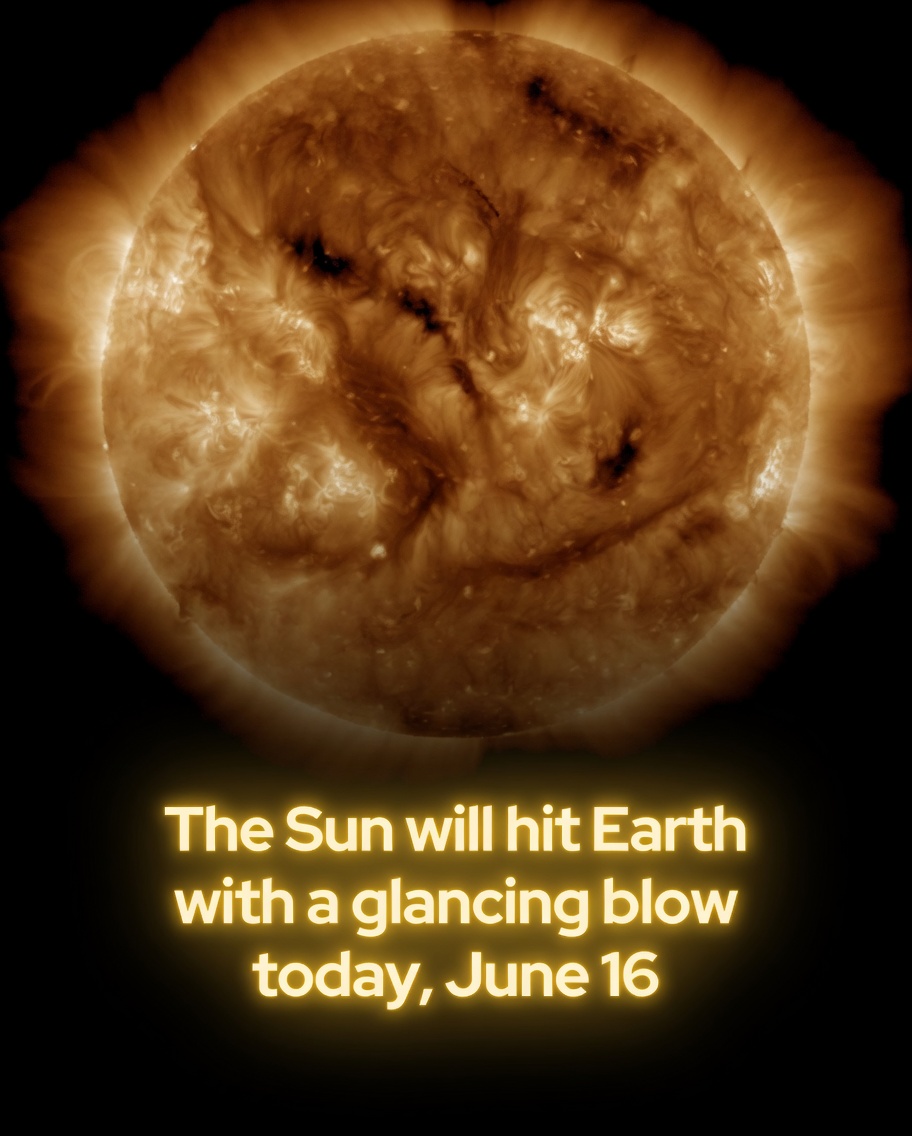
🚨 A cloud of solar plasma is on course to reach Earth today
Space weather experts report that a coronal mass ejection (CME) launched by the Sun on June 12 is expected to deliver a glancing blow to Earth’s magnetic field as early as June 16.
The impact will not be direct, but even a near miss can disturb our planet’s magnetic shield and spark spectacular aurora displays.
A CME is a massive eruption of electrically charged plasma and magnetic fields hurled into space from the Sun. These events can eject billions of tons of solar material and travel millions of miles across the solar system. While most CMEs pass Earth harmlessly, those that come close can trigger geomagnetic storms by interacting with our planet’s magnetic field.
In this instance, forecasters anticipate only a minor disturbance. The Sun has been relatively quiet in recent days, with only small flares from a few inactive sunspot regions. Nevertheless, the earlier CME remains on track to pass near enough to Earth to cause a temporary increase in geomagnetic activity.
A weak G1 geomagnetic storm is possible. While this level is unlikely to cause significant disruptions, it can push the northern lights farther south than usual. Under favorable conditions, residents in cities such as Calgary, Edmonton, Oslo, and Stockholm may get a chance to see the auroras if skies are clear.
The visibility of auroras will ultimately depend on the orientation of the CME’s magnetic field upon arrival. A well-aligned field can allow more solar energy to reach Earth, boosting the chances of a visible display.
For now, experts stress that this will likely be nothing more than a glancing blow, a minor space weather event rather than a major storm.
6
29
76
9,865

that sounds about right.
@Grimezsz can you confirm about the hidden Queef Unit Ejection Air System Yanker? (QUEASY)
1
Herrera retweeted

The B-52 has ejection seats, but I don’t know how modernized they are. Four crew seats eject upward, while two crew eject downward.
I’m hoping, but it doesn’t look good so far.

BREAKING 🔴
A U.S. Air Force B-52 Stratofortress has crashed near Edwards Air Force Base in California.

122
63
1,390
217,553


✅ The correct answer is- B. Boot shaped heart.
✓ Tetralogy of Fallot (TOF).
• It is the M/C cyanotic Congenital heart disease (CHD) beyond infancy.
∆ C/F- TOF tetrad- VSD, Pulmonary stenosis, RVH, overriding of aorta.
• Cyanotic spell relieved by squatting, clubbing, DOE, Tet spells, Rt. to Lt. shunt & rarely pink Fallot (Lt. to Rt. shunt).
• This results in a harsh, crescendo-decrescendo systolic ejection murmur, best heard at the left upper sternal border.
• Severity of cyanosis depends on: Degree of pulmonary stenosis.
✓Dx= X-ray finding: Boot-shaped heart, Echo-2D.
∆ T/t- Palliative surgery: Blalock–Taussig shunt. Definitive repair: Intracardiac repair.
2

Izzy ejection 17pts
AR 15pts 17rbs. W by 20 plus. Excuse me Izzy did what? lol same girl that got sent to bench when AR got drafted ? That Izzy?
1


13m
Ahh Angel throwing punches against Izzy and not being called. Shocker.
She flops into Harrison and it’s a flagrant 2 ejection, come on now.
 Raquel (MHG👼🏾)
1
3
27


We have never voted for this. It wasn’t in Labour’s manifesto. We don’t want it. Never have. The bigger question is how can we the citizens veto or influence change when a despotic dictator is in charge? There needs to be an ejection seat installed at Number 10
5




Looks like a swipe for the ball that missed but I can see the foul. Neither instances warranted a ejection
1
1
24