
Entropy Quantum Computing for Fixed-Backbone Protein Design
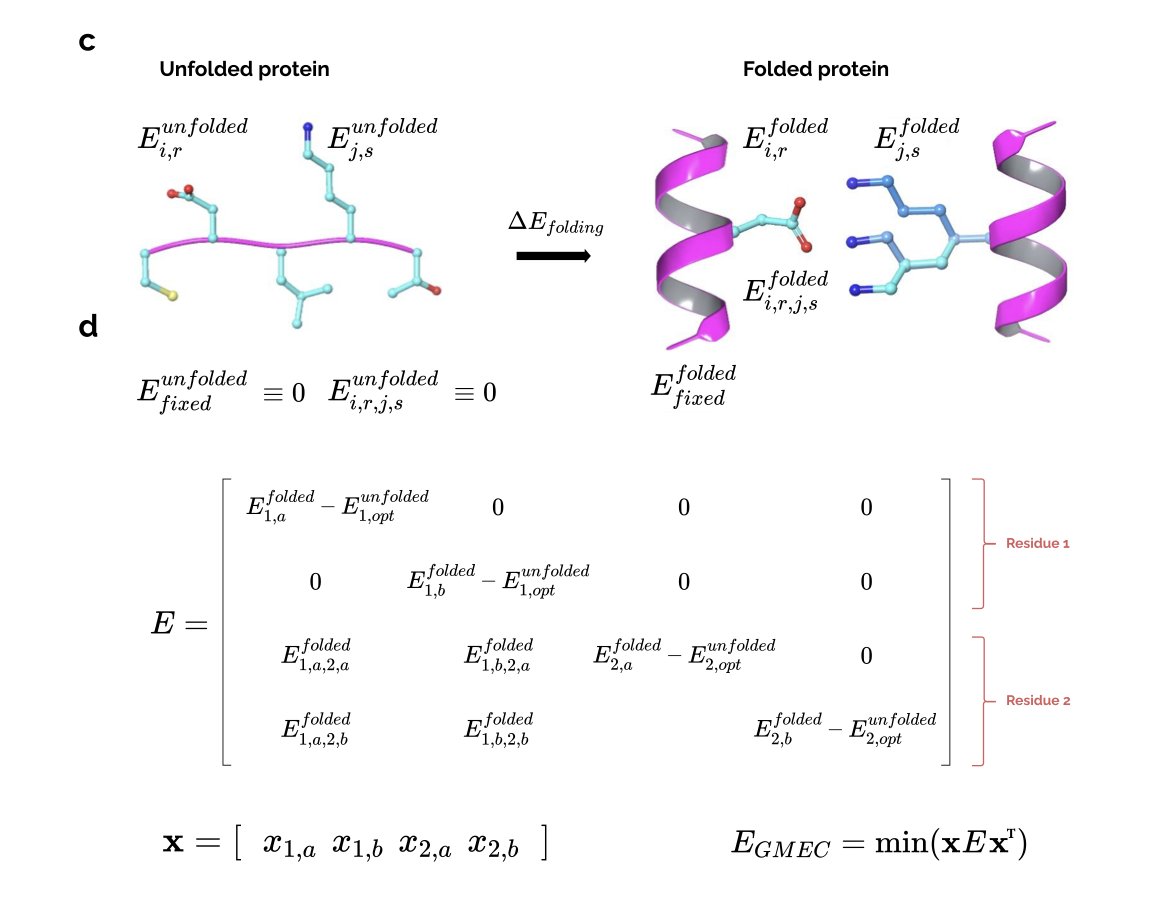
1 A new study demonstrates how entropy quantum computing on QCi's Dirac-3 device can tackle the NP-hard challenge of fixed-backbone computational protein design, achieving solution energies within 0.16-2.47% of classical optima for proteins with 493-943 variables.
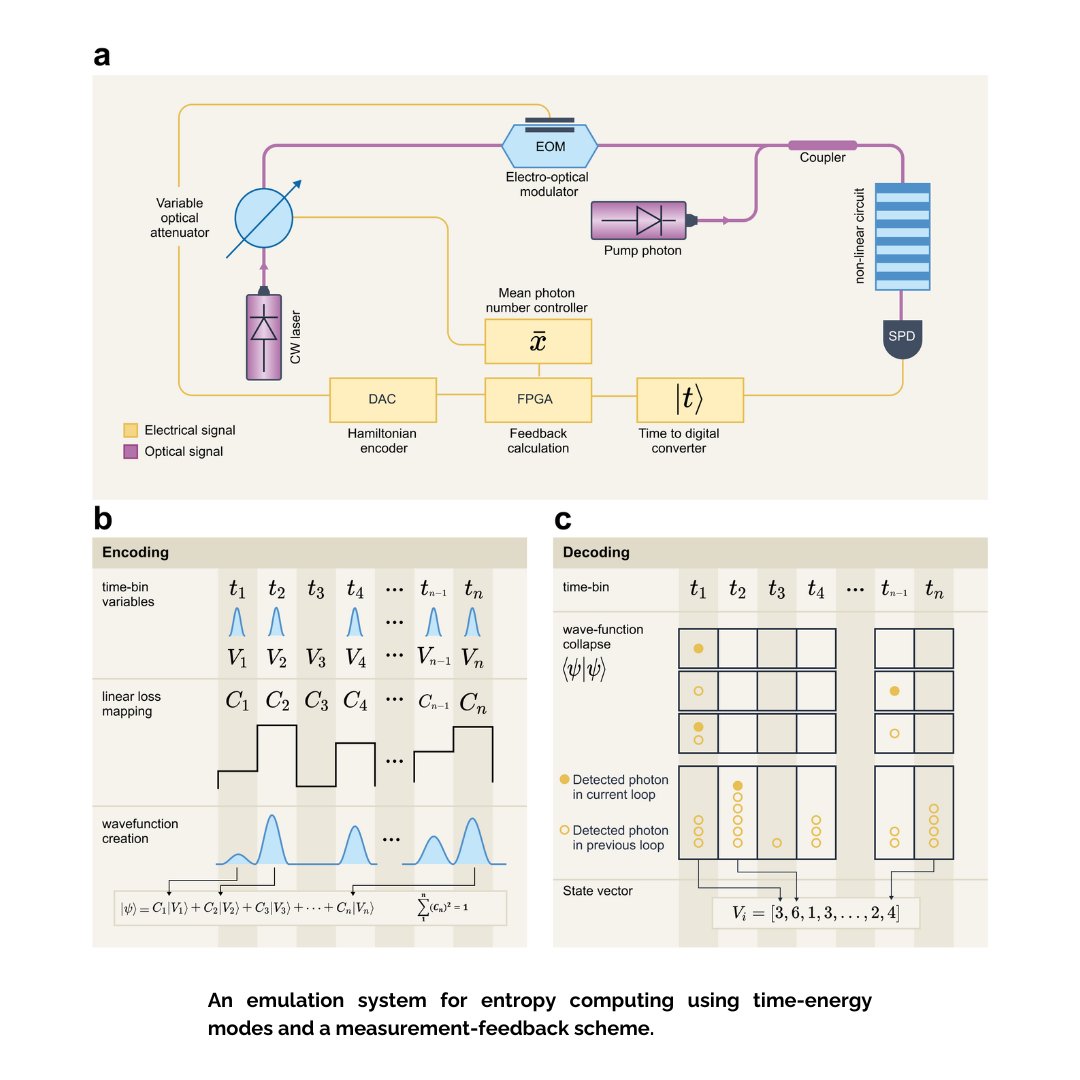
2 The key innovation lies in formulating CPD as a quadratic Hamiltonian over rotamer variables that naturally maps onto Dirac-3's hybrid photonic entropy computing platform, enabling continuous-variable optimization without complex embedding or rescaling.
3 For larger proteins exceeding device capacity (1RIS: 3,276 variables, 1GVP: 3,826 variables), the authors developed a graph-partitioning workflow using METIS to decompose problems into hardware-fitting subproblems, achieving ~7% energy gaps from global optima.
4 Runtime scaling analysis reveals a striking contrast: while the exact classical CFN solver shows sharp super-polynomial growth beyond ~1,000 variables, Dirac-3 exhibits gentle near-linear scaling, suggesting a practical crossover regime for large-scale protein design.
5 The Hamiltonian formulation incorporates penalty terms for normalization and integrality constraints, with hyperparameter studies identifying optimal operating regimes (mean photon number ~0.003, schedule depth of 2) that balance solution quality against runtime.
6 This work establishes entropy computing as a viable near-term approach for high-dimensional sequence optimization, with potential implications for enzyme engineering and therapeutic protein design where classical exact methods become intractable.
📜Paper: biorxiv.org/content/10.64898…
#QuantumComputing #ProteinDesign #ComputationalBiology #EntropyComputing #Dirac3 #QuantumOptimization #StructuralBiology #Bioinformatics #DrugDiscovery #EnzymeEngineering
4
34
2,229

DAITA‑XQ update: We’re building a new computing approach that treats physical entropy as a programmable input—something you can allocate and route like compute or memory.
Early internal experiments suggest this “entropy‑as‑input” framing can steer dynamical optimization/inference systems in reproducible ways across different entropy sources.
We’re currently preparing publications and IP filings and are looking for design partners in optimization, embedded/edge, and security‑sensitive decision systems.
If you’re interested in pilots or collaboration, DM me.
#DAITAXQ #EntropyComputing #UnconventionalComputing #Optimization #EdgeComputing #EdgeAI #EmbeddedSystems #AI #MachineLearning #ComputationalScience #DynamicalSystems #Cybersecurity #QuantumRandomness #TRNG #QRNG
3
53

30 Sep 2024
🚀QCi is excited to announce that the company has extended its Cooperative Research and Development Agreement (CRADA) with @LosAlamosNatLab!
Read more🔗: bit.ly/3Y5fA1N
#QCi #Dirac3 #LANL #collaboration #CRADA #entropycomputing #EQC #pressrelease
1
4
14
860
31 Jul 2024
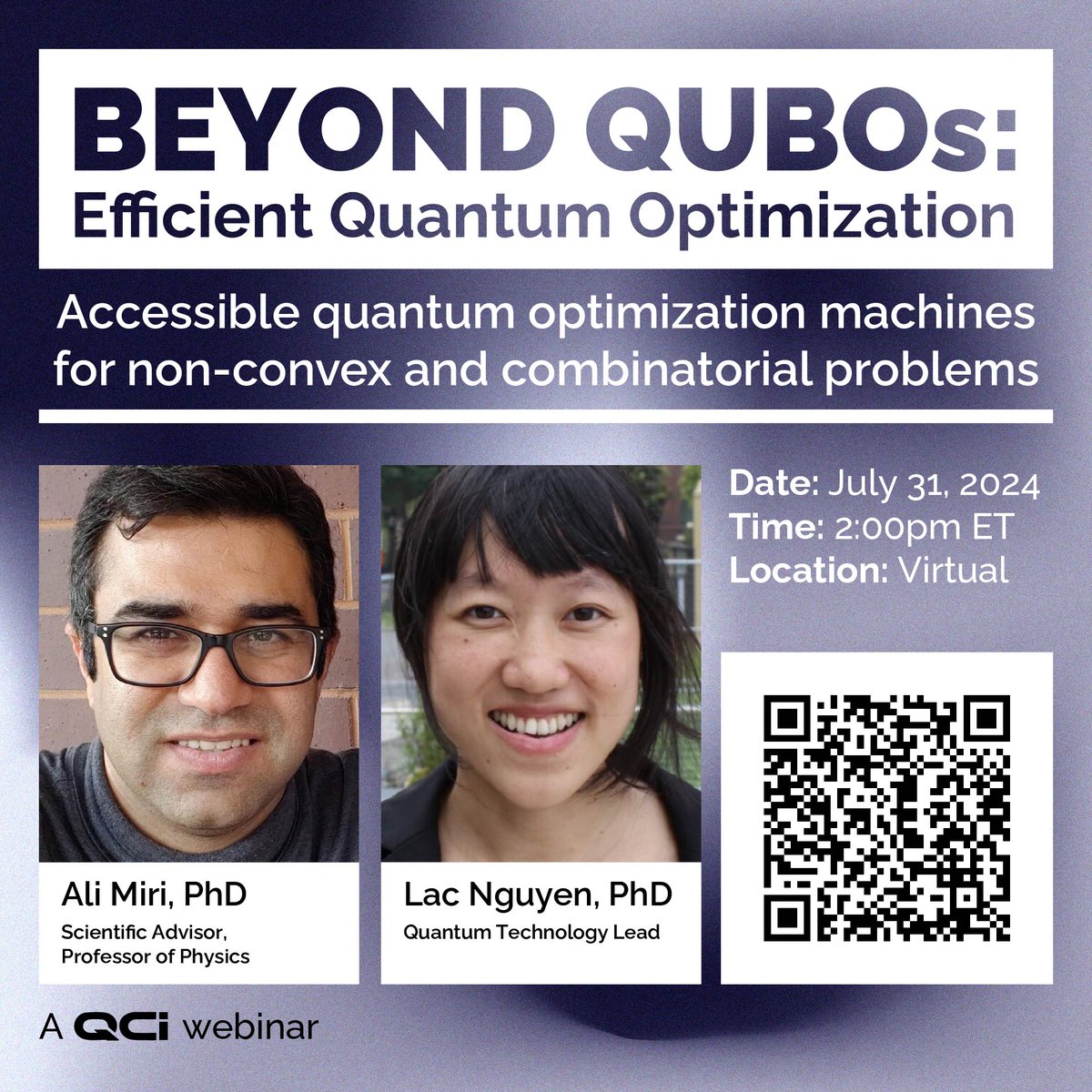
HAPPENING NOW: QCi's webinar is now live!
JOIN NOW: bit.ly/Beyond-Qubos
Do not miss your opportunity to be a part of this transformative discussion.
#QCi #QCiWebinar #BeyondQubos #entropycomputing #EQC #EQCwebinar #quantum #quantumcomputing #optimization #quantumsystems
1
2
9
624
12 Jul 2024
Save The Date: QCi is excited to announce its upcoming webinar, “Beyond Qubos: Efficient Quantum Optimization.” Reserve your spot today and be a part of this transformative discussion.
🔗Register here: bit.ly/BeyondQubos
#QCi #QCiWebinar #BeyondQubos #entropycomputing #EQC
2
11
741
10 Jul 2024
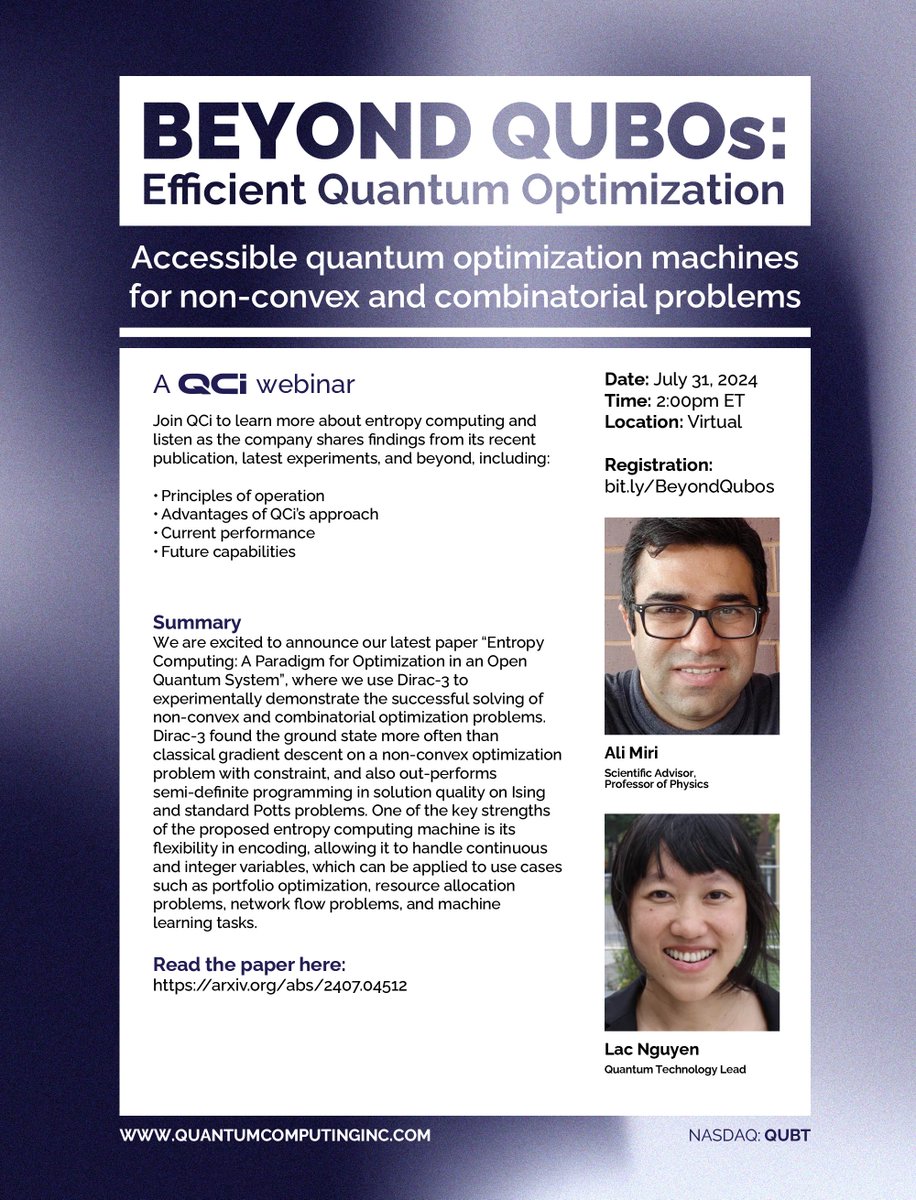
QCi is excited to announce our latest paper “Entropy Computing: A Paradigm for Optimization in an Open Quantum System." Read the full paper here: bit.ly/3zA40lv
#QCi #entropycomputing #optimization #quantumsystem
3
16
753