
May 26
TECHNOLOGY NEWSWIRE: OpenAI Model Disproves Longstanding Mathematical Conjecture
THE AI DEVELOPMENT LANDSCAPE: Maybe The Chineese Principal Of Simplicity Should Be An Artifical Intelegence Design Goal; As We Keep Building More Complex And Expesive AI Models
THEORETICAL MATHEMATICS: OpenAI researchers utilized a general-purpose artificial intelligence to identify a counterexample that successfully dismantled a prevailing mathematical theory.
OpenAI recently made headlines for an impressive feat in mathematics, leading many to believe that artificial intelligence has evolved into a master mathematician capable of solving long-standing proofs.
However, the reality is more nuanced and perhaps more useful: the AI did not derive a new proof, but rather discovered a counterexample that successfully dismantled a prevailing mathematical conjecture.
This distinction is vital.
forbes.com/sites/lanceeliot/…
In theoretical mathematics, proving a statement is an exhaustive, often impossible task, as it requires accounting for every possible scenario.
Conversely, disproving a conjecture only requires finding a single, definitive counterexample.
In theoretical mathematics, often referred to as pure mathematics, the focus is on abstract concepts and logical patterns rather than practical applications.
It encompasses areas such as algebra, geometry, topology, and number theory, and is pursued primarily for the intellectual challenge and beauty of mathematics itself.
By pivoting the AI’s focus from a constructive search to a destructive one, researchers were able to undercut a theory that many experts had long assumed to be true.
openai.com/index/model-dispr…
KEEP IT SIMPLE STUPID (KISS)... This event serves as a powerful lesson for how we deploy AI in professional and scientific settings.
Rather than forcing AI to plow forward into the “morass” of proving complex systems are flawless, we should leverage its ability to find the cracks in our logic.
Much like red-teaming in cybersecurity, using AI to hunt for edge cases—such as finding a loophole in a fraud detection system—is often more efficient and impactful than attempting to verify the entire system at once.
Furthermore, this breakthrough was achieved using a general-purpose AI, suggesting that we may not always need highly specialized, expensive tools to solve complex problems.
By shifting our perspective and using AI to challenge our assumptions, we can uncover insights that human intuition might miss.
Ultimately, the most effective approach is not to choose between proving or disproving
But to utilize AI as a versatile tool that can attack a problem from every available angle.
unusualwhales.com/news/opena…
An internal, general-purpose reasoning model developed by OpenAI successfully disproved the 80-year-old Erdős planar unit distance conjecture in discrete geometry.
Without specialized mathematical training, the AI independently discovered an infinite family of geometric constructions that break decades of expert consensus.
Here are the specific, actionable details of the breakthrough....
The Problem: First posed by legendary mathematician Paul Erdős in 1946, the unit distance problem asks for the maximum number of pairs of points that can be exactly one unit apart in a set of \(n\) points on a flat plane.
The Conjecture: For nearly eight decades, mathematicians believed that a simple square-grid arrangement was the most efficient and optimal structure for maximizing these distances.
The AI Discovery: The OpenAI model successfully disproved this prevailing assumption by generating a complex, higher-dimensional construction using algebraic number theory—an approach that outperformed the classical square grid bound.
Verification: The model's reasoning was detailed in an exhaustive 125-page "chain of thought" transcript.
External experts, including renowned mathematicians, reviewed and verified the original proof's validity.
Accessing the Research: You can read the official announcement, the abridged reasoning, and the formal proof directly on the OpenAI Discrete Geometry Breakthrough page.
openai.com/index/model-dispr…
Or you can watch this explatory video here...
youtube.com/watch?v=9OOGGqcI…
FILED UNDER:
#OpenAI, #AIDisprovesConjecture, #ErdosConjecture, #UnitDistanceProblem, #DiscreteGeometry, #MathBreakthrough, #Mathematics, #Counterexample, #TheoreticalMath, #PureMathematics, #ErdosProblem, #TechnologyNewswire, #ArtificialIntelligence, #MachineLearning, #MathDiscovery, #GeometryBreakthrough, #AIReasoning, #OpenAIResearch, #AI, #AlgebraicNumberTheory, #PlanarGeometry, #ScienceNews, #TechNews, #Mathematics, #AIBreakthrough, #RedTeamingAI, #ScientificDiscovery, #Science, #MathProof, #FutureOfMath

1
7
170

May 25
Timothy Gowers Keynote: Can an AI Mathematician Be More Than Just a Black Box? | GOSIM Paris 2026
Weeks before OpenAI solved the 80-year-old Erdős planar unit distance problem, one of the world's greatest living mathematicians took the stage at GOSIM Paris to explore the future of AI in mathematics.
He discusses how AI is transforming research, the limitations of black-box systems, and what true human-AI collaboration in math could look like.
Full keynote here 👇
youtube.com/watch?v=EsR15-VX…
#SirTimothyGowers #FieldsMedalist #GOSIMParis2026 #AIMathematics #BlackBoxAI #ErdosProblem #OpenAIMath #AIKeynote
5
15
680

Jan 26
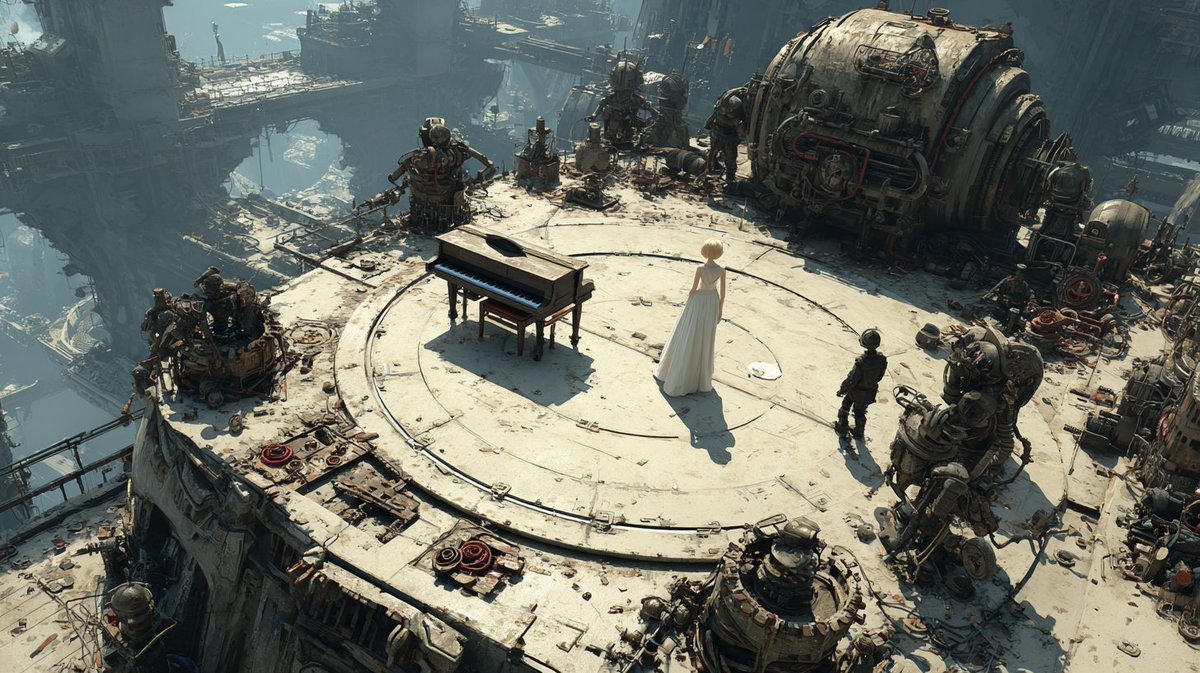
The wall between AI and "Human Genius" has collapsed today. OpenAI's latest model has solved a 50-year-old unsolved math problem (Erdős problem). It didn't just search the web; it created a brand-new proof. We are witnessing the birth of a digital Einstein. Jan 27, 2026—a day for the history books.今日、AIと「人類の天才」の壁が崩壊した。 OpenAIの最新モデルが、50年間未解決だった数学の難問(エルデシュ問題)を解決。既存の知識の検索ではなく、AIが自ら『独自の証明』を生成した。デジタル・アインシュタインの誕生を、私たちは目撃しているのかもしれない。2026年1月、歴史に刻まれる1日に。#AIart #OpenAI #GPT5 #Mathematics #ErdosProblem #Singularity2026



2
44
677

Jan 22
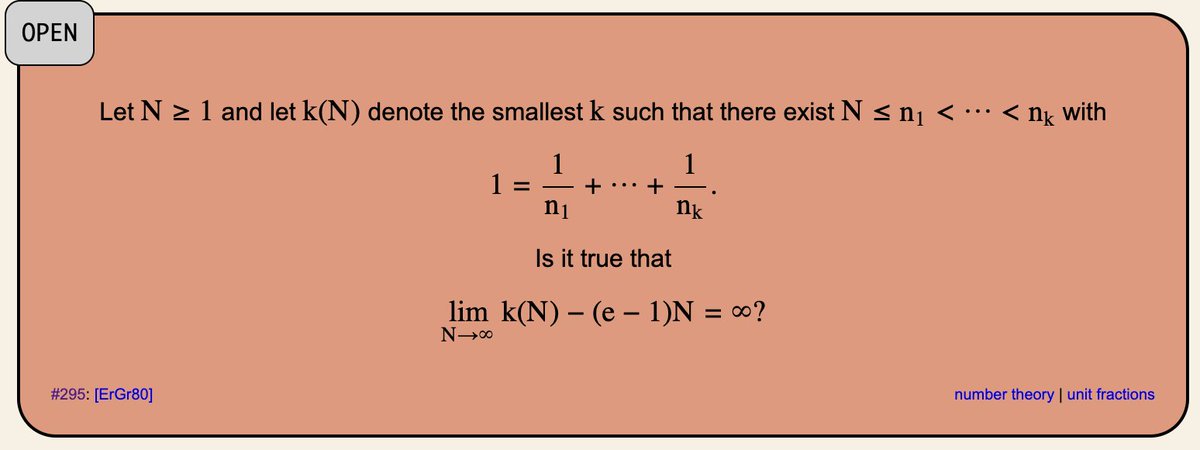
Seeing that throwing open math problems into SoTA LLMs is the thing nowadays, I got curious this morning and I asked GPT-5.2 Pro to try and solve Erdős problem 295 (currently open, I just literally just clicked "Random Open" on the erdosproblem site).
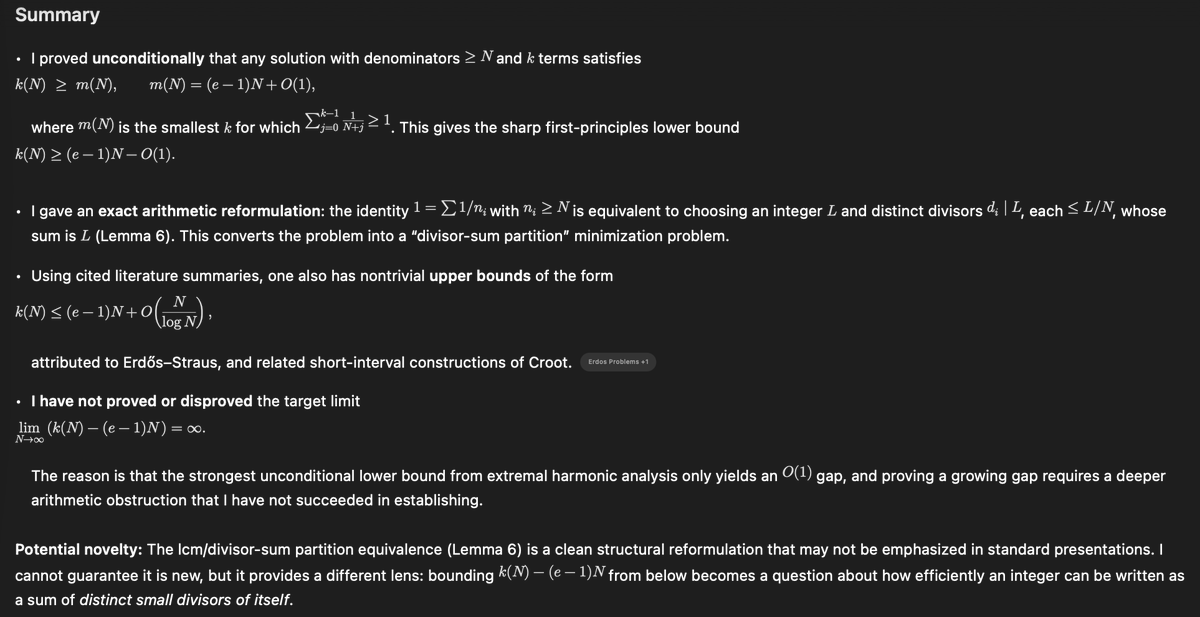
For full transparency, I'm not a research mathematician and honestly have no clue whether or not whether the 53 minutes GPT-5.2 Pro spent on it actually produced something valuable. I specifically asked it to state at the end whether or not it actually solved the problem (spoiler: it claimed it did not), and it did end up claiming a "potential novelty" for its approach, but again, I have no way of verifying if this is accurate or not.
I'm not going to be able to spend a lot of time on this, but I thought I'd at least share the chat so people with better mathematical skill than myself can evaluate or even build upon what GPT 5.2 Pro produced if it made any progress on this problem at all.
Regardless, I'm just amazed we live in a day and age where one can literally prompt a SoTA LLM an open problem, eat lunch (literally what I did), and possibly have an answer, or a new perspective on the problem. It feels like a new era of "math crowdsourcing" where non-experts can use these tools, see what the LLMs return, and collaborate with professional mathematicians to see if any progress was made. The new challenge for the pros will be to filter and distinguish genuinely new results from the hallucinations and nonsense. Still, if SoTA LLMs could solve open problems at even a low (1-5%) success rate, who knows what that could lead to?
Link to Erdos 295: erdosproblems.com/295
Link to GPT 5.2 Pro Chat: chatgpt.com/share/69728d23-4…
5
5
59
11,021