
May 26
TECHNOLOGY NEWSWIRE: OpenAI Model Disproves Longstanding Mathematical Conjecture
THE AI DEVELOPMENT LANDSCAPE: Maybe The Chineese Principal Of Simplicity Should Be An Artifical Intelegence Design Goal; As We Keep Building More Complex And Expesive AI Models
THEORETICAL MATHEMATICS: OpenAI researchers utilized a general-purpose artificial intelligence to identify a counterexample that successfully dismantled a prevailing mathematical theory.
OpenAI recently made headlines for an impressive feat in mathematics, leading many to believe that artificial intelligence has evolved into a master mathematician capable of solving long-standing proofs.
However, the reality is more nuanced and perhaps more useful: the AI did not derive a new proof, but rather discovered a counterexample that successfully dismantled a prevailing mathematical conjecture.
This distinction is vital.
forbes.com/sites/lanceeliot/…
In theoretical mathematics, proving a statement is an exhaustive, often impossible task, as it requires accounting for every possible scenario.
Conversely, disproving a conjecture only requires finding a single, definitive counterexample.
In theoretical mathematics, often referred to as pure mathematics, the focus is on abstract concepts and logical patterns rather than practical applications.
It encompasses areas such as algebra, geometry, topology, and number theory, and is pursued primarily for the intellectual challenge and beauty of mathematics itself.
By pivoting the AI’s focus from a constructive search to a destructive one, researchers were able to undercut a theory that many experts had long assumed to be true.
openai.com/index/model-dispr…
KEEP IT SIMPLE STUPID (KISS)... This event serves as a powerful lesson for how we deploy AI in professional and scientific settings.
Rather than forcing AI to plow forward into the “morass” of proving complex systems are flawless, we should leverage its ability to find the cracks in our logic.
Much like red-teaming in cybersecurity, using AI to hunt for edge cases—such as finding a loophole in a fraud detection system—is often more efficient and impactful than attempting to verify the entire system at once.
Furthermore, this breakthrough was achieved using a general-purpose AI, suggesting that we may not always need highly specialized, expensive tools to solve complex problems.
By shifting our perspective and using AI to challenge our assumptions, we can uncover insights that human intuition might miss.
Ultimately, the most effective approach is not to choose between proving or disproving
But to utilize AI as a versatile tool that can attack a problem from every available angle.
unusualwhales.com/news/opena…
An internal, general-purpose reasoning model developed by OpenAI successfully disproved the 80-year-old Erdős planar unit distance conjecture in discrete geometry.
Without specialized mathematical training, the AI independently discovered an infinite family of geometric constructions that break decades of expert consensus.
Here are the specific, actionable details of the breakthrough....
The Problem: First posed by legendary mathematician Paul Erdős in 1946, the unit distance problem asks for the maximum number of pairs of points that can be exactly one unit apart in a set of \(n\) points on a flat plane.
The Conjecture: For nearly eight decades, mathematicians believed that a simple square-grid arrangement was the most efficient and optimal structure for maximizing these distances.
The AI Discovery: The OpenAI model successfully disproved this prevailing assumption by generating a complex, higher-dimensional construction using algebraic number theory—an approach that outperformed the classical square grid bound.
Verification: The model's reasoning was detailed in an exhaustive 125-page "chain of thought" transcript.
External experts, including renowned mathematicians, reviewed and verified the original proof's validity.
Accessing the Research: You can read the official announcement, the abridged reasoning, and the formal proof directly on the OpenAI Discrete Geometry Breakthrough page.
openai.com/index/model-dispr…
Or you can watch this explatory video here...
youtube.com/watch?v=9OOGGqcI…
FILED UNDER:
#OpenAI, #AIDisprovesConjecture, #ErdosConjecture, #UnitDistanceProblem, #DiscreteGeometry, #MathBreakthrough, #Mathematics, #Counterexample, #TheoreticalMath, #PureMathematics, #ErdosProblem, #TechnologyNewswire, #ArtificialIntelligence, #MachineLearning, #MathDiscovery, #GeometryBreakthrough, #AIReasoning, #OpenAIResearch, #AI, #AlgebraicNumberTheory, #PlanarGeometry, #ScienceNews, #TechNews, #Mathematics, #AIBreakthrough, #RedTeamingAI, #ScientificDiscovery, #Science, #MathProof, #FutureOfMath

1
7
170

بعد 80 عاماً، إنجاز غير مسبوق في عالم #الرياضيات يعيد تشكيل مفهومنا عن قدرات الذكاء الاصطناعي! 🧠💻
تحدى نفسك وأجب عن السؤال في نهاية التغريدة، بعد قرائتها.
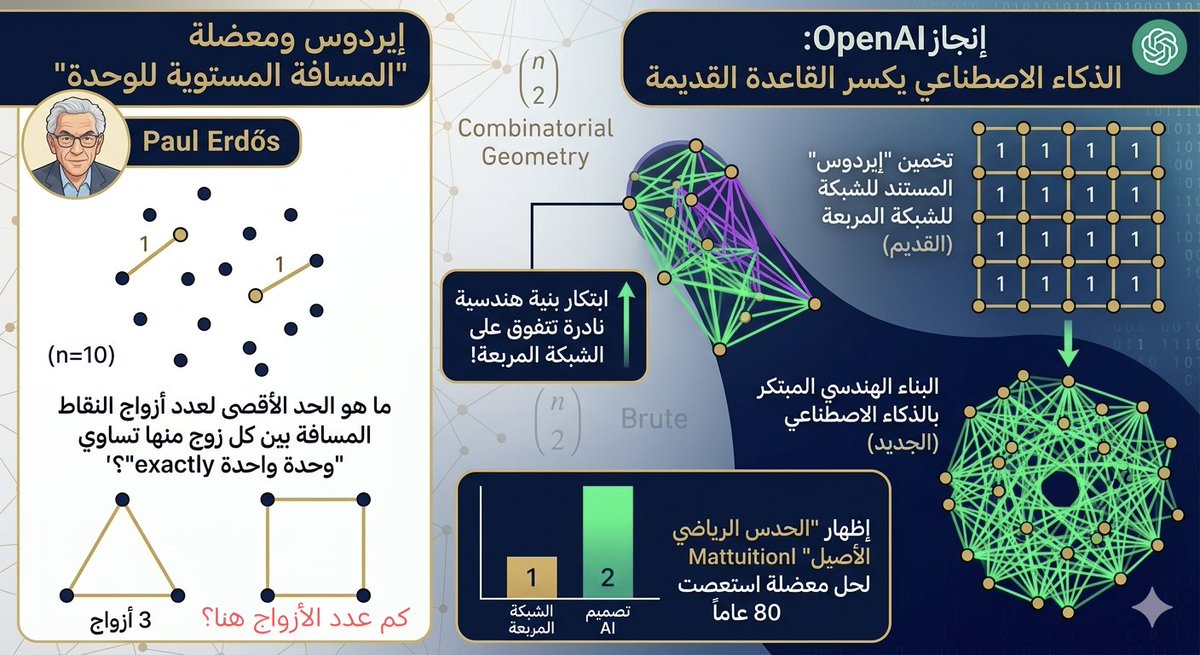
نجح أحد نماذج الذكاء الاصطناعي المتقدمة من شركة OpenAI في حل معضلة هندسية شهيرة استعصت على علماء الرياضيات لمدة تقارب 80 عاماً، وهي معضلة "المسافة المستوية للوحدة" (Unit Distance Problem)، والتي صاغها عالم الرياضيات الأسطوري Paul Erdős عام 1946.
📐 المعضلة باختصار تندرج تحت فرع الهندسة التنازلية (Combinatorial Geometry)، وتطرح سؤالاً يبدو بسيطاً في ظاهره وهو: إذا قمت برسم عدد معين من النقاط (n من النقاط) على سطح مستوٍ ثنائي الأبعاد، فما هو الحد الأقصى لعدد أزواج النقاط (Pairs of Points) التي يمكن أن تكون المسافة بين كل زوج منها تساوي 1؟
المسألة ببساطة: إذا كان لديك عدد معين من النقاط (n من النقاط) المرسومة على سطح مستوٍ (ورقة ثنائية الأبعاد مثلاً). فكم هو الحد الأقصى لعدد أزواج النقاط التي يمكن أن تكون المسافة بين كل زوج منها تساوي 1 "وحدة واحدة بالضبط" (Unit Distance)؟
على سبيل المثال: إذا كان لديك 3 نقاط، يمكنك ترتيبها على شكل مثلث متساوي الأضلاع طول ضلعه (1)، وهنا يكون لدينا 3 أزواج من النقاط المسافة بينها تساوي وحدة واحدة. كلما زاد عدد النقاط (n)، يصبح من المعقد جداً معرفة الترتيب الهندسي المثالي الذي يمنحنا أكبر عدد ممكن من المسافات التي تساوي 1.
💥 كيف صدم الذكاء الاصطناعي مجتمع الرياضيات؟
لعقود طويلة، اعتقد العلماء أن الترتيب الأمثل للنقاط لتحقيق أكبر عدد من المسافات المتساوية يعتمد على الشبكة المربعة (Square Grid). بناءً على هذا، وُضع تخمين Paul Erdős الشهير.
نموذج OpenAI أثبت خطأ هذا الاعتقاد السائد، وقام بابتكار وتصميم "بنية هندسية وتوزيع مبتكر ونادر للنقاط" يتفوق رياضياً بشكل كامل على توزيع الشبكة المربعة!
🔮 الحدث الأبرز الذي أذهل الأوساط العلمية هو أن الذكاء الاصطناعي لم يصل إلى الحل عبر أسلوب القوة الغاشمة والتجريب العشوائي (Brute Force), بل أظهر ما يمكن وصفه بـ "الحدس الرياضي الأصيل" (Mathematical Intuition)، حيث ابتكر أفكاراً وتصميمات هندسية مستقلة تماماً لم يسبق للبشر توجيهه إليها.
الذكاء الاصطناعي ينتقل رسمياً من دور "المساعد الحسابي" إلى دور "المفكر والمبرهن الرياضي المستقل". 🚀
📌السؤال: في أسفل يسار الصورة مثلث وعدد أزواج الوحدة فيه، كم عدد أزواج الوحدة في المربع؟
#OpenAI #Mathematics #ArtificialIntelligence #PaulErdos #UnitDistanceProblem #الذكاء_الاصطناعي #الرياضيات #تكنولوجيا
2
3
57
7,543