
In accordance with the order of operations in mathematics (PEMDAS) Parentheses, Exponents, Multiplication, Division, Addition, & Subtraction:
(If same precedence, left to right)
6 ÷ 2 (1 2)
6 ÷ 2 (3)
3 ( 3 ) = 9
Answer = 9
4

English Translation:
Meaning of the Results on EEG(33)
The results you obtained are among the strongest and most consistent ones we have seen so far in this analysis series. Below is the actual scientific meaning of these findings:
1. Branching Ratio σ ≈ 1.00 (Very close to critical)
This is the most important indicator in the current results.
•The value σ = 0.9988, with an extremely narrow 95% confidence interval around 1 ([0.9921, 1.0062]), indicates that the system is operating very close to a critical branching process.
•In avalanche theory and self-organized criticality (SOC), σ ≈ 1 is a necessary condition for the system to sustain activity at the boundary between order and disorder — a regime where complex phenomena such as long-range correlations, metastability, and critical slowing down can emerge.
Meaning: The brain (or at least this EEG signal) is exhibiting dynamics close to critical branching, one of the key features in the criticality hypothesis in neuroscience.
2. τ ≈ 1.84 and β ≈ 2.08 lie within a reasonable range
•The value τ ≈ 1.84 falls within the range commonly reported in neural avalanche data (typically between ~1.5 and ~2.5).
•β ≈ 2.08 is also within an acceptable range.
Although these are not the most “typical” values, the fact that both exponents are stable and not rejected by statistical testing (p > 0.1) is a positive signal.
3. Crackling Relation is reasonably good (Error ~17%, R² = 0.993)
This is one of the strongest tests of criticality:
•The relationship between average avalanche size and duration (⟨S⟩ ~ T^γ) is very close to linear on a log-log scale (R² = 0.993).
•The deviation between γ_obs and γ_theory is only about 17%, which is below the 20% threshold you set.
This suggests that the system exhibits signs of scale-invariance — a central characteristic of critical systems.
4. Overall: STRONG evidence for avalanche criticality
With all 5 criteria passing the threshold, file EEG(33) shows:
This dataset provides fairly clear evidence of near-critical avalanche dynamics.
Compared to previous files (especially EEG(30) and EEG(31)), this file yields more stable and convincing results.
5. Implications for your TOP-C research
These results carry important implications for the research direction you have been developing:
•They support the hypothesis that near-critical states exist in real EEG data.
•This provides a necessary foundation to move to deeper layers of analysis in TOP-C, particularly:
◦HMM Trajectory Verification (detecting metastable states and trajectories)
◦Dwell-time distribution (examining heavy-tailed residence times — a hallmark of the Griffiths Phase)
◦R_H and Posterior Entropy (measuring competition and selection between trajectories)
In other words, EEG(33) indicates that the data is sufficiently qualified for you to continue building higher layers of TOP-C (from criticality → trajectory selection → consciousness).
Summary
Meaning
Strength
System close to critical branching
Strong
Avalanche size & duration follow power-law
Moderate – Strong
Crackling relation (scale-invariance)
Strong
Overall evidence for criticality
STRONG
Foundation to move to HMM / Trajectory
Sufficiently good
Conclusion:
This is one of the highest-quality EEG files you have analyzed recently. The results provide fairly clear support for the avalanche criticality hypothesis and are solid enough for you to proceed to the next stage (HMM R_H Dwell-time analysis).
Would you like to move forward to v8.1 (HMM Layer) using the current configuration? avalanche criticality
13

58m
The answer is 183 (or 138 depending on what you mean by HALF).
You have to use order of operations (Parenthesis, Exponents, Multiplication, Division, Addition, Subtraction, or PLEASE EXCUSE MY DEAR AUNT SALLY). If you mean to divide by 2, then this is what it looks like.
180 - 30/2 18 = ?
180 -15 18 = ?
Addition and Subtraction are the same in valuation, so you now work from left to right.
165 18 = ?
? = 183
Final answer is 183.
If you mean 0.5 is HALF, then this is what you do. Dividing by 0.5 is the same as multiplying by 2, so you rewrite the equation this way.
180 - 30 x 2 18 = ?
180 -60 18 = ?
120 18 = ?
? = 138
Final answer is 138.
2

Rather BEDMAS
BRACKET
EXPONENTS
DIVISIONS
MULTIPLICATION
ADDITION
SUBSTRACTION
2

First: 0! = 1
Second Order of operations
1) Parentheses
2) Exponents
3) Multiplication or Division L-R
4) Addition or Subtraction L-R
154

88. People are forgetting 0! Is a factorial.
Anyway, let's answer it.
Brackets
Exponents or Factorials
Divide or Multiply
Add or Subtract
0! = 1
8x8 = 64
8x1 = 8
We now have 8 8 64 8 = 16 64 8 = 88
11
peejay retweeted

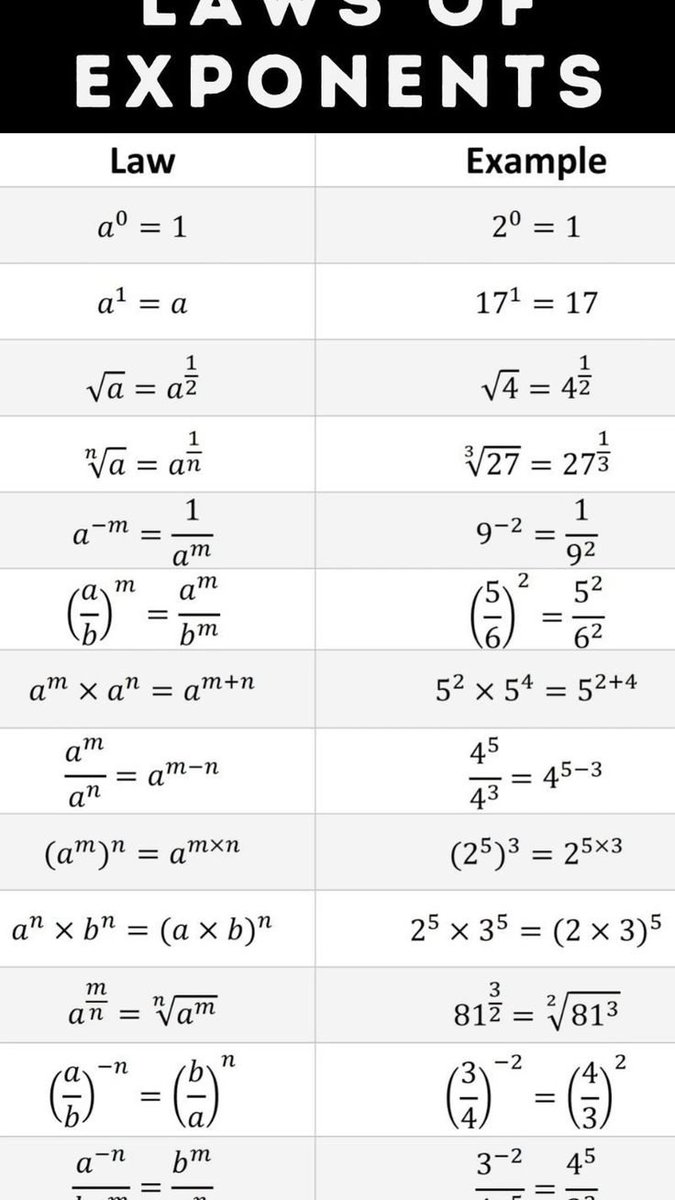
Negative exponents finally make sense 📝
Did you get the pattern?
9
38
8,581

Classical exponents of female singers are called Vidushi or Begum (akin to Pandit or Ustaad).
40

a = 1
b = 2
c = 3
4 is given
1 2 3 * 4 =?
parentheses? no
exponents? no
multiplication? yes
division? no
addition? yes
subtraction? no
3 * 4 = 12
1 2 12 = 15
7


41
Please Excuse My Dear Aunt Sally
Parentheses, Exponents, Multiplication, Division, Addition, Subtraction
32

“Bidmas” doesn’t take exponents into account.
I learned it as
Parentheses
Exponents
Multiplication
Division
Addition
Subtraction (PEMDAS)
8