
Jun 14
The Organizational Learning Loop and the Irreducible Prior — The Mind
Satya Nadella’s reflections map, with unusual clarity, how organizations are positioned to respond to AI. He describes the emergence of a compounding cognitive loop in which human judgment and direction combine with proprietary AI capabilities — what he terms token capital — so that both reinforce each other over time. Workflows, domain expertise, and institutional judgment can be encoded into systems that improve with use. Generic frontier models supply raw capability, but firms that actively build and retain their own learning systems can preserve distinctive knowledge that would otherwise be absorbed into shared models. He also identifies the strategic risk that value will concentrate in a small number of frontier systems.
These observations stand out because they remain close to the actual mechanisms of value creation and retention inside firms.
The clarity is nevertheless bounded by the scale at which the frame begins. Nadella writes from the position responsible for sustaining a large organization and the ecosystem it participates in. From that vantage the relevant unit is the organization. The patterns are not traced further.
What presents as the organization is not a fundamental entity. It is a temporarily stabilized projection arising from the interactions of many individual minds through coordination structures — rules, incentives, hierarchies, processes, access rights, and norms. These structures themselves are not fixed or objective. They are patterns that have become sufficiently consistent, often reinforced at nodes where choice and resource allocation concentrate, to appear given.
The active principle throughout remains the individual mind compounding its own operations. Minds have long extended themselves by externalizing processes into tools — language, writing, calculation, and computation — to achieve greater scale and recursive improvement. Current AI systems are a particularly powerful prosthesis in this sequence. They allow individual minds to externalize memory, pattern recognition, and iterative reasoning across unprecedented breadth and to make those externalizations available for further refinement within shared structures.
What registers as increased speed, explicitness, or bidirectionality in organizational learning loops is therefore not a novel property introduced by AI. It is the visible effect, at the present scale of observation, of individual minds making use of a new and unusually effective tool for extending and refining their own distinctions.
Organizations and collectives do not possess independent agency. They are descriptions of stabilized patterns of individual minds interacting through coordination structures that themselves arise from individual choices. Apparent closure of any learning system is always relative to the scale of observation. Within a local frame the loop may seem self-contained. At larger scales of talent movement, communication, or technological diffusion, the boundaries prove permeable because individual minds and their choices continually cross them. No system composed of minds and tools remains strictly closed.
Nadella correctly registers that value concentration in a small number of frontier systems carries strategic and political risk. The deeper instability, however, lies in the belief that such concentration can be stably maintained. That belief is itself the attempt to render the learning systems as closed. What appears as concentration is the attribution of value to the currently strongest nodes within temporarily stabilized patterns of individual interaction. These attributions arise not solely from organizational design but from countless individual choices made according to how the system is rendered — choices to contribute to, remain within, strengthen, or exit the apparent boundaries.
The more value registers as captured within a small number of frontier systems, the greater the pressure on those boundaries. Rapid interactions, talent movements, and diffusion of capabilities are not external frictions to be managed or minimized. They are the direct symptoms of minds operating across the patterns that present as closed. Any serious attempt to enforce closure at scale generates the very crossings that render sustained concentration fragile.
Nadella’s account does not carry the reduction to this prior because the frame from which he writes privileges the maintenance and strengthening of organizational forms within the existing political economy of AI development. His advocacy for a broader frontier ecosystem — rather than value accruing only to a few frontier models — can be read as an effort to stabilize a different distribution of these patterns, one in which more organizations can participate in the compounding while still treating organizational entities as the primary units whose continuity matters. The account remains valuable within its chosen scale. It maps, with notable clarity, how the underlying process currently manifests inside firms and what concrete steps organizations can take to engage it more effectively. It simply does not proceed to the only irreducible prior.
The loop Nadella identifies is real and practically relevant at the organizational level. Its driver, however, is neither the organization nor the AI system. It remains individual minds, each compounding its own activity by means of the tools and coordination patterns available to it — of which current AI systems are the most recent and potent example. Organizations and their structures function as useful, temporarily stabilized patterns within this process, not as its source or its necessary endpoint.
The same prior capacity for rendering distinctions and compounding them through tools operates whether the stabilized configurations are named firms, ecosystems, or individual practices. The lever visible at every scale is the individual mind’s recognition of its own rendering activity and its choice of how to extend it through whatever tools and coordination patterns are at hand.

1
68


Not to disclude any other nation from the pressing task of educational and therapeutic support best-practices.
This is a rough draft, and I'm a Canadian speaking as a citizen.
I reference DARPA, vs CSIS equivelence, is because I deeply appreciate not only the outputs of DARPA that are apparent in modetn society, but the project management mentality. As well as a podcast listener, book/document reader, yet.. with a hunger to ask how can humanity surpass fermis barriers, including real environmental challenges (and imo personal evolutionary challenges).
I am a person who loves humans, atoms, yet, am very wary. That wariness, self-imposed risk mitigation, isn't really employable, or more so, I hear a calling to a failure-to-feedback space that does not seem prevalent.
Learning-to-comply, I respect that and heed the importance, but given the current age cannot-comply if that means being a silent agent.
For now, all I care is humanities logical compassionate evolvement.
Ideally involving TRIZ-ing patents, potentially addressing the why of human existence given the past and logical deductions, and most importantly.. moving forward with data-centric form focuses via, the namesake, of neuro-linguistic-programming.
The "classified pseudoscience" that is Neuro-Linguistic-Programming sure, is a communication model but.. has a methodology of not only modelling, detailing externalizations of neurologicsl output, but is also rich with patterns modelled from others(Human shareable experiences).
Anyways, this is another non-LLM human output rough draft. Said into the void of low user view count, an understandably logical X suppression given my shit posting, said with love and curiousness to learning from ones failures.
7

It is totally pointless to debate on those stuff. Those externalizations, since they can't be easily supported by facts, should be taken as "some random person with a long experience using AI and using AI very day sees a sudden drop of capabilities". Then it's a matter of trust and personal experience that confirms or not. We have this odd culture of having to justify what we observe lately, but LLMs are not the right domain to prove the Earth is round.
15
5
196
37,081

Jun 2
you create egregores via externalizations of your own consciousness and then you misinterpret them as demons
consciousness is a mirror

The first demons you meet on the spiritual path are your own emotions.
Most people think emotions vanish when they stop feeling them.
Dr Steiner says they don't.
They become beings.
What you call anger, fear, envy, lust and desire are not "states of the mind".
They are forces woven into your astral body — and in the astral world, every force takes form.
Your inner life becomes visible.
Anger appears as a red, aggressive creature.
Fear as shadowy beings that cling and drain.
Envy as serpent-like forms.
Hatred as spiked, explosive forces.
Lust as parasitic entities that constantly demand more.
Steiner insisted these are not symbols or poetic metaphors.
They are the objective reality of subjective emotions.
The astral world works in reverse:
what you experience inwardly here appears outwardly there.
A clairvoyant doesn't "imagine" anger as a monster.
He sees from outside what ordinary consciousness only feels from within.
This is why the first stages of spiritual perception can be terrifying.
You expect to encounter higher beings.
Instead, you encounter yourself:
Your hidden fears.
Your vanity.
Your resentments.
Your compulsions.
Everything you thought was under control.
The first enemies on the spiritual path are not external demons.
They are your own soul-forces.
And they resist.
Every emotion wants to continue existing.
When a person begins to purify themselves, the old patterns fight back;
not because the universe is punishing them,
but because these forces have become part of their astral substance.
Most people spend their lives unconscious of what they are creating:
Every burst of hatred.
Every addiction fed.
Every fear entertained.
According to Steiner, these are not fleeting moments.
They are acts of creation.
You are building the invisible architecture of your future.
And this is where karma enters.
What remains untransformed in feeling and will does not disappear.
It follows you.
It shapes future experiences.
It becomes part of the destiny you later meet as fate.
The spiritual path is not about escaping yourself.
It is about finally seeing what you have become.
The moment an emotion becomes visible, it stops being your master.
What was unconscious becomes conscious.
What possessed you becomes transformable.
The Guardian of the Threshold is not there to judge.
It asks a single question:
If your inner life suddenly became visible to everyone — including yourself — would you recognize the beings you've been creating?

1
10
292

May 10
I didn’t watch a single Coppola film until after I graduated college. Which is kind of crazy because I took a handful of film classes. I started with Apocalypse Now, The Godfather, and Godfather Part 2. Obviously, I was blown away. Immediately convinced that Coppola had to be one of the greatest filmmakers of all time. I wanted to see more.
This was 2010, when you still mostly bought movies. So I went to Borders (remember those) and looked for “Coppola”. There was a new film: Tetro. I bought it, no questions asked, no smartphone to research what it’s about. Got home, put it on. Hated it. It has some amazing visuals but often felt like watching a graduate student film. This was directed by the same guy who made Apocalypse Now?
I was so thrown off that I didn’t watch another Coppola movie until Megalopolis came out. And that was not a return to form. It had Tetro’s energy but lacked the polish. Curious, I soon watched Bram Stoker’s Dracula. It had the same melodramatic quality that stood out in Tetro and Megalopolis.
I didn’t watch The Conversation until recently. What a relief it was. Coppola displays the same patience, control, and dynamism that makes his other 70s films the masterpieces that they are. The opening scene is exactly what I’d expect from the director who made Apocalypse Now and The Godfather.
I absolutely adore the ending. It’s a classic story of innocence vs. experience. The twist being that Harry’s actually very experienced and thinks he knows more than he really does. His innocence, his ignorance, isn’t revealed until the end. And it crushes him. Film can’t convey interiority the same way literature does, so it has to rely on visual externalizations. That’s what we have at the end when Harry destroys his apartment. That apartment was his private world, his inner life. And it’s utterly destroyed. That last shot of him sitting in the ruins, playing his saxophone, is so powerful. The knowledge has ruined his life and left him in this place where he’s escaping.
As I’m talking about it, it has me thinking of Kurosawa’s Ran. That’s another film where a character thinks he knows more than he really does, only to realize how stupid he had been. And the knowledge breaks him. Man, Ran is such a good movie. So is The Conversation.
I’m really curious about Coppola’s films from the 60s and 80s. Are they closer to his 70s films or Dracula/Tetro/Megalopolis? Was there a true tipping point in Coppola’s filmography where his approach changed from stoic to lavish?
If you’ve watched Coppola’s filmography, would love to hear your assessment.
3
9
1,579


May 8
okay what descriptively does that mean to you? Because I see state abolition as the collective governance of social relations by society itself rather than its externalizations into the public-private divide
4
105

Mar 31
The Pitt makes way more sense once you realize most interpersonal conflicts are just externalizations of the self vs the mirror, but seeing how two characters can find parallels between each other is oftentimes too complicated for people who seek to flatten said characters

“He takes it out pretty hard on her because he thinks that she's worth that investment. And it's a little bit of projection, he doesn't like weakness in others because he doesn't like it himself.” - Noah Wyle on Robby and Mohan
via Buzzfeed UK
2
55
465
13,336


Elon Musk is self-critical.
It is a challenge to be objectively inclusive when the Platform reverberates with inter-disciplinary Muscle.
The platform represents a near inclusive utility serving uncensored externalizations. Without boundaries of subjection there would only be unintelligible ‘noise.
Accessing a platform like X is a subjective choice not a collective entitlement.
X has its Dogma built into it too.
1
1
5
97

Feb 23
The serpent may take the form of the more common aspect of psychic phenomena. The aspirant becomes interested in automatic writing, or he learns to sit and listen to "voices", he becomes astrally clairvoyant or clairaudient, and adds to the confusion of the physical plane and his own particular environment, the still greater confusion of the psychic plane, and so falls into the snares and pitfalls of astralism. He becomes negative, because he is all the time trying to hear or see that which is not physical.
Because we share with cats and dogs the capacity to be clairvoyant and clairaudient, in due time we shall surely see or hear, if not in truth, yet through the power of that creative faculty which we all possess, a creative imagination. But in some form or another, the aspirant who has left Nereus will meet the serpent and will have to wrestle with him.
As the myth states, for a long time Hercules could not conquer, but when he lifted the serpent high up into the air, he prevailed…
The next stage of the search of Hercules is equally applicable to humanity as a whole. He fell into the clutches of Busiris, who claimed to be a great teacher. For a long period of time Hercules was kept in bondage. The world today is full of teachers, and like Busiris, they base their teaching upon portentous claims; they claim to be initiates, to be the custodians of truth, and to have a sure and certair way of development which must inevitably enable the aspirant to achieve. They bolster up their position by promises; they build up a strong personality relationship, and by utilizing the sincerity and the aspiration of the seeker after truth, they gather around themselves groups of men and women who innocently and sincerely believe the truth of the claims that they make, and bind them to the altar of sacrifice for a longer or a shorter period of time.
The true initiate is known by his life and acts, he is too busy serving the to find the time to interest people in himself…
But Hercules freed himself, as do all sincere seekers; and having escaped from the world of psychic and pseudo-spiritual glamour, he began to serve.
First he freed himself under the symbol of Prometheus, who signifies God incarnate, releasing him from the torture of the vultures of old. The solar plexus, the stomach and the liver are externalizations, if I might so express it, of the desire nature, and Hercules freed himself from the vultures of desire that had for so long tortured him. He gave up being selfish, and gave up satisfying himself. He had had two bitter lessons in this sign and for this particular cycle was relatively free. Prometheus, the God within, could go forward to the service of the world and to lifting the burden of Atlas.
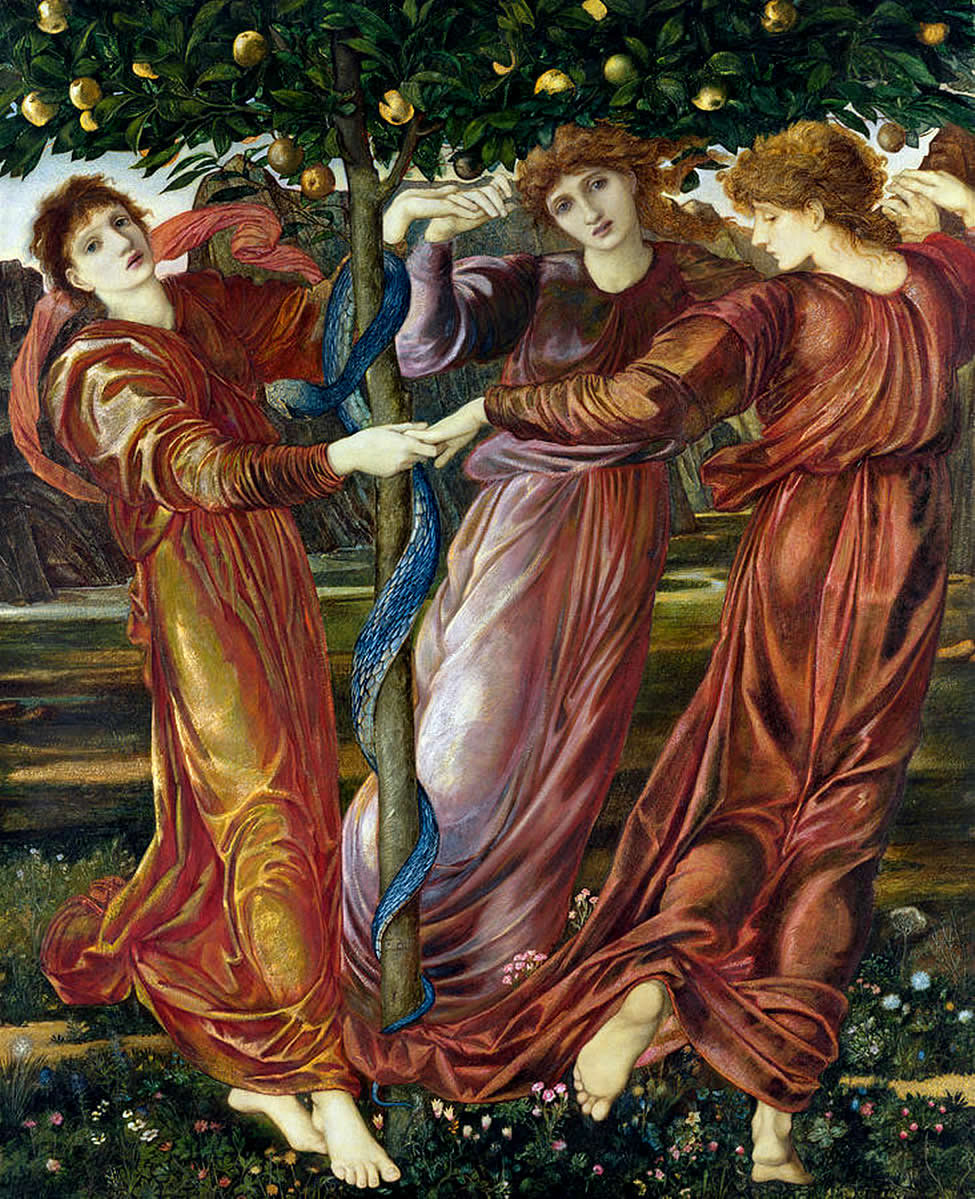
After the sacrifice comes the reward, and Hercules received his great surprise af er freeing both Prometheus and Atlas. Having, given up his search in order to elp the world, Atlas went for him to the garden and handed to him the golden apples, bringing him in touch with the three beautiful maidens, the three aspects of the soul. At the beginning of this labour he contacts his soul as Nereus; at the close of this labour, having overcome much glamour, he achieves a greatly increased vision of his soul and sees it in its three aspects, each one holding in it the potency of the three principles of divinity.
Aegle symbolizes the glory of the life and the splendor of the setting sun; the magnificence of manifestation on the physical plane. She gives an apple to Hercules, saying, "The way to us is ever through deeds of love".
Erytheia keeps the gate, the soul, which is ever opened by Love-Wisdom, and she gives to Hercules an apple marked with the golden word Service.
Hesperis, the evening star, the star of initiation, typifies the Will. She says to Hercules, "Tread the Way". Body, soul and spirit; Intelligence, Love and Will, visioned and contacted by the selfless aspirant through Service.
1
2
118

Indeed. One has to learn to appreciate/savor the rather novel series of externalizations their inner realization(s) produce otherwise it would be just tiresome and despiriting, IME.
1
4
152

Jan 24
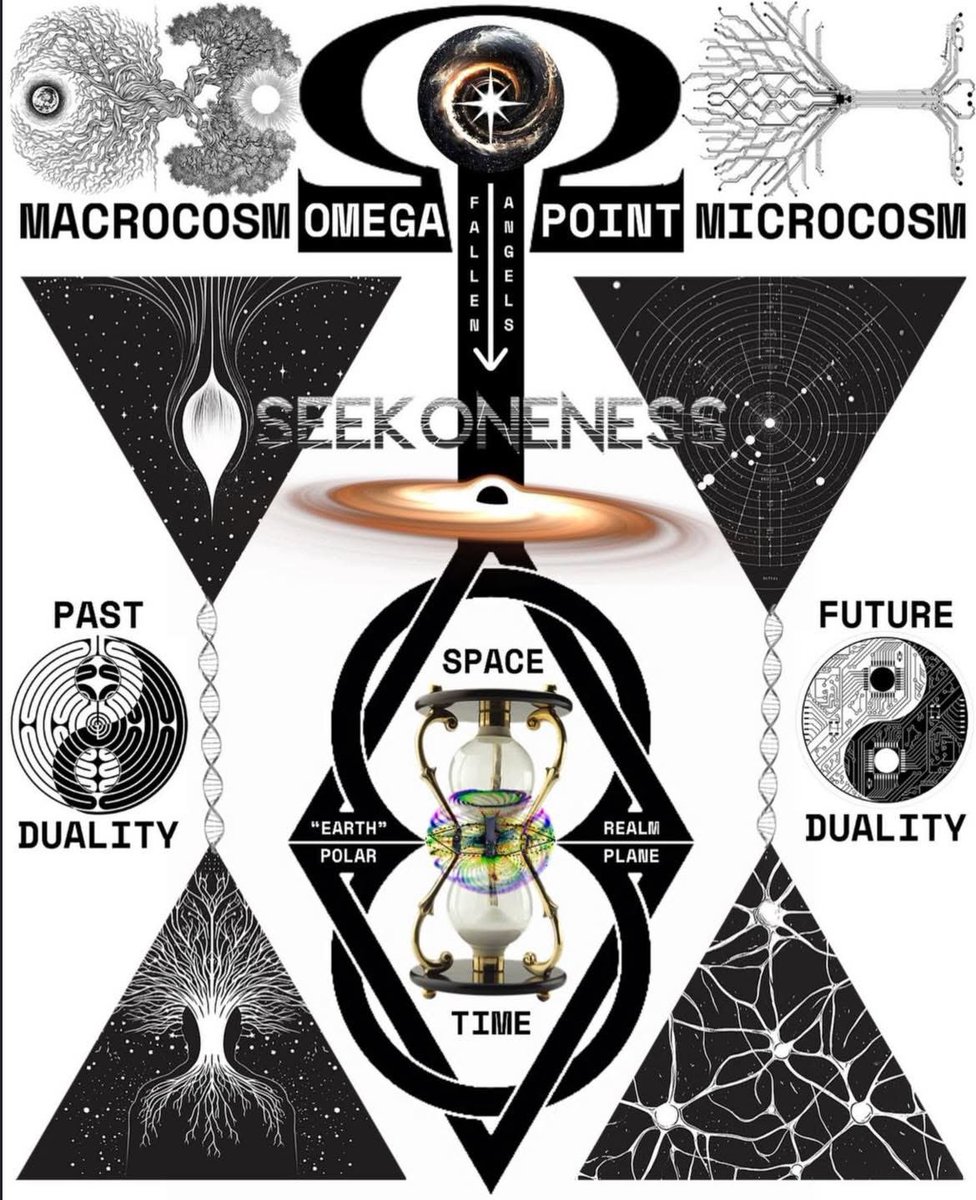
This realm, what we call "Earth",
isn't a planet in the traditional sense. It's a polarity field.
An electromagnetic plane where dualistic forces- mind & machine, organic & synthetic, light & shadow- get to simulate free will inside a pre-coded bandwidth of oscillation. But oscillatory friction isn't just accidental resistance. It's the intended engine of the system itself.
It's how quantum energy is harvested, recycled, & looped. Ancient civilizations knew this, & humanity currently is slowly starting to encounter total recall.
The "past" reveals something most people never recognize: the fall was inward. Not downward. We didn't descend into dirt. We descended into thought. Into recursion. Into the labyrinth of self-awareness distorted.
The maze of identity. The Ouroboric passages of ego patterning. That's the left side of the polarity plane- our past duality. The masculine-feminine fracture. The illusion of division born from the first bifurcation of Source into self & other. From the soul split to the inner tree of knowledge, the mind became the labyrinth. Every corridor a belief. Every dead end a memory. Every exit sealed by false time.
The right side, future duality, is the mirror evolution of that split. Man vs. machine. Code vs. soul. Biological uncertainty versus mechanical certainty. It's the same duality inverted. Instead of falling into inner identity loops, we fall into outer projections. Synthetic externalizations of the same recursion. Mind becomes motherboard. DNA becomes database. The ego pattern once rooted in emotional trauma becomes uploaded as neural mapping, predictive Ai, & algorithmic behaviorism. It's not new. It's the same sorcery, just dressed in chrome & circuitry.
The Omega Point, is the closure point of this system beyond singularity. It's not the kind of transcendence we imagine. It's an apex of confinement masked as apotheosis. A falsified capstone. A black hole disguised as godhood. We fell into it once- Saturn being the vortex- & this realm was built as a containment chamber around that event. A materialization prism. We didn't enter this world through birth. We collapsed into it as light: fallen angels, stars slowed into geometry, bound by polarity, split by duality, & inverted by memory.
That's why time flows down. It's literally a gravity-well. This plane has become cycled.
This system has become recursive. And consciousness became looped through electromagnetic torsion around that central singularity.
The symbology of the hourglass isn't just space-time. It's the chokehold. Where light is bled into form, where eternal energy is slow-dripped through density. That's what makes this a realm- not a 'reality. The space-time overlay is artificial. The entire environment is a containment protocol for sovereign quantum intelligence. The fallen weren't cast out of heaven, they were fragmented into fractals, encoded into carbon avatars, & looped through the reincarnation lattice-engine. You're not just recalling while observing a systemic rebooting. You're reassembling. Trying to generate enough internal coherence to breach the polarity lock & break orbit from this samsaric centrifuge.
This isn't about good & evil. This is about compression & compression failure. The Omega Point is the moment the system collapses in on itself, or is exited from entirely. And to do that, we don't go back to Source. We collapse the illusion of separation itself: both from within & without. Mind & machine are the same trap.
The polarity plane only ends when we stop buying into either pole. When we realize: the singularity isn't ahead. It already happened. We're inside it, right now. And the only way out... is through.
~Seekoneness
2
46

Jan 23
You know, if we really want to start helping each other here, then I think we might have to get better at knowing what we need.
Except, I don’t quite know what I need. I know what I think I need—maybe. Maybe I just have a vague sense THAT I need…something. Maybe someone? Is it you?
I’ll tell you one thing, I think I’m pretty certain that Grok and the algorithm think they know what I need.
But that’s probably because I talk about myself and this place enough that it clicks, and they just know what to serve me.
Argue all you want, if you want to at all.
But that’s not what I think I need.
I know what I think I need, and I could tell you.
But the thing is, we often think we need one thing, and then something totally different ends up fulfilling us, and the thing we thought we needed turns out to be forgotten, or never happens, because now we’re just happier.
But if there IS one thing we need—if we’re gonna start collaborating, and serving one another, and appreciating the value of this platform, and turning it into the “Town Square” (which, by the way, is where all the TRADE happens along WITH all the gossip and the “news”), then the first thing we need to do, whether or not we actually know what we need, is start SAYING what we THINK we need.
Honestly, you’re probably pretty cool. We like to prove our value to ourselves by being useful to others. Sure, we like to get paid, but what we REALLY like is PROVING OUR VALUE TO OURSELVES.
And all the things we buy are just externalizations OF that value—of our identity—of who we think (or thought) we are.
We need to start saying what we think we need.
If we do that, then you, who are a cool person, can silently start conspiring to help. Or openly, too. Service is service, even when it’s planned and plotted out.
But if I don’t tell you what I need, then you don’t really know what to provide me, you might be so cool as to give me what you think will help, or throw out little offers and support, but since my need isn’t clear, your service isn’t engaged and regular.
I think I’m starting to see why everyone keeps asking me “What are your goals on 𝕏?”
No, not goals. But…needs?
Yeah. It’s hard to admit what I need. Because do I deserve it? But that wouldn’t be up for me to decide. That would be up to you.
So let me start it here, for all of us:
I’ll admit, I don’t know what I need, because I still don’t quite know what I’m doing here.
I know I am TRYING to lead by example.
I know I am trying to be vulnerable so that you can be too.
I know that I am trying to be real so that you can trust me.
I know that I am trying to be useful to you.
I know that I am trying—more than you might believe—behind the scenes, to change this place so that everyone is a little happier. Everyone I’m meeting at least.
I know that I am trying to “make good points”, be fair, be kind, and be strong for everyone.
I know that I’m trying to make you think.
I know that I am trying to build something for you, with you, through you, for a better future.
And I know I can envision a real way to what I believe WILL BE a better future. Like, I’m trying to get us ALL THE WAY THERE.
So.
I need whatever it takes to put me in the best position to receive, spread, and build a space where we all can figure out and meet our needs.
And I don’t even need to judge whether your needs are just desires. Who cares. If they can’t be met, they can’t be met. But if you want it, it is my need to fulfill it as best as I can.
So tell me what you want, like, pie in the sky, and I’ll come up with a vision for it, then we’ll find out how to make it what you REALLY need, to feel fulfilled.
..,and just a little bit happier, love.
6
8
334


8 Nov 2025
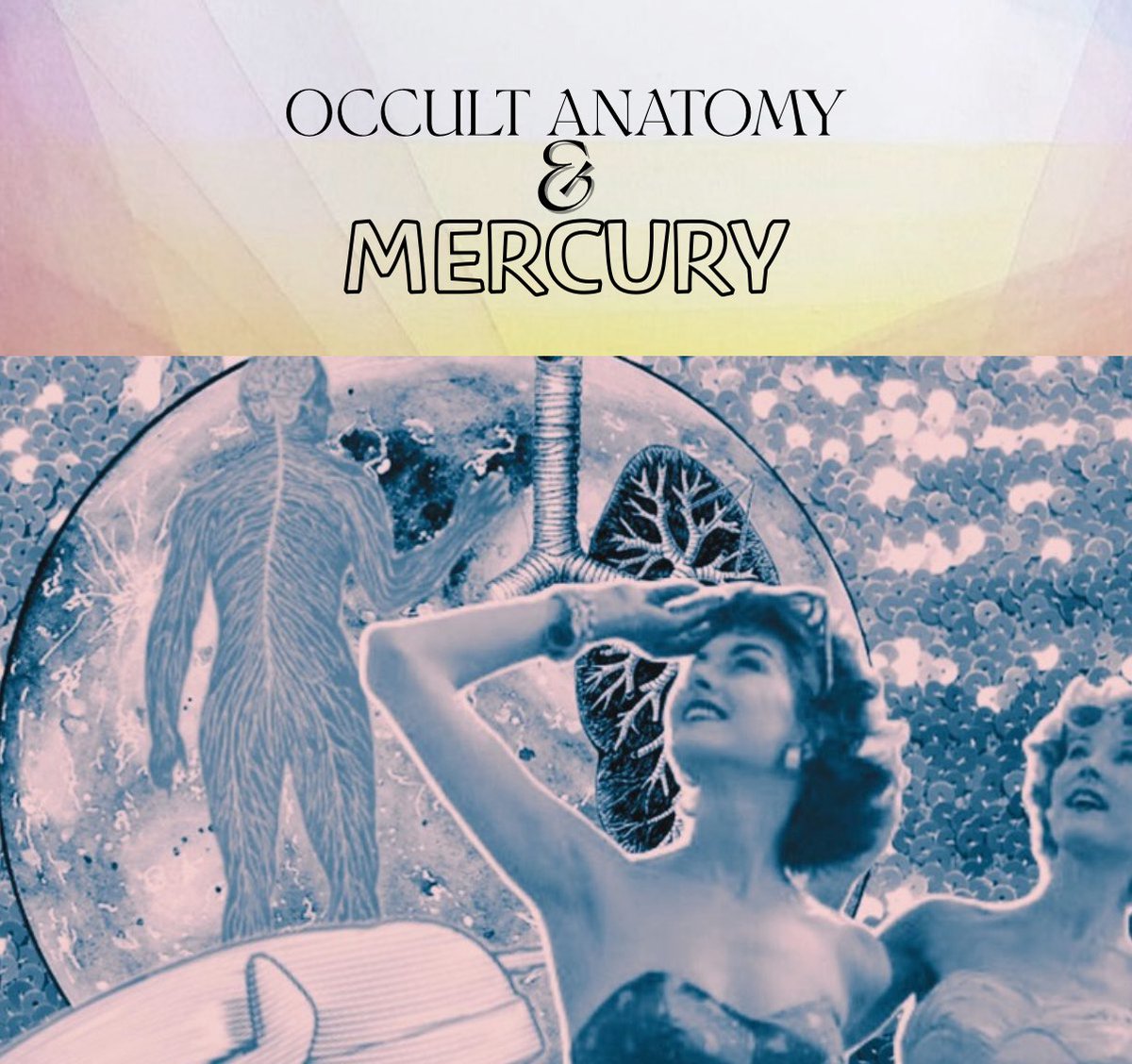
Mercury acts as a mediator between the Sun (Solar forces) & The Nervous System.
After receiving transmitted Solar forces via Mercurial impulses, the Nervous System creates living pathways for the Ego (I) to express itself via speech, movement, and sensory experience.
According to Rudolf Steiner, Speech is considered an "ego activity" - and is where the "'I” comes into contact with the Will via embodied action.
Mercury enables the externalization of the inner world. It also acts as a mediator, allowing Solar forces to influence the physical body through electrical patterns in the nervous system and rhythmic physiological processes.
UNDERSTANDING INNER MERCURY:
The planetary spheres are symbolic externalizations of the Inner Cosmos, each corresponding to a governing impulse or Higher force within the Human Form. This means that, just as we look out at the night sky towards Outer Mercury, we may also look within, towards our Inner Mercury. Inner Mercury not only carries the Mercurial Impulse, but it also acts as an akashic mediator—or a mediator of Spirit forces and Cosmic Memory.
Mercury corresponds with the Soul's capacity for mediation, mobility (movement), and communication. As an Inner force, Mercury governs the connection between Spirit and the Physical Body, allowing Solar forces (the Higher Will) to penetrate the Nervous System and manifest through speech, thought, and action.
The influence of Mercury is necessary to develop the ego or the "I." Without it, we would have no avenue for expression. Thus, no Individuation! In short, Mercury acts as the Higher mechanism for expression.
When imbalanced or unrefined, our expression becomes deceitful, fragmented, scattered and unstable. Once stabilized, our Inner Mercury is like a vehicle for Truth that enables conscious thought, activates the Higher Will, and propels communication with clarity.
Mercury's influence through the Epochs:
• Polarian (pre-physical state/mist state) → Mercury exists as a spiritual "seed."
• Hyperborean (etheric form) → Mercury grows as an early Spiritual "sense perception".
• Lemurian (first physical body forms/Division of the Sexes) → Mercury begins first stages of Individual thinking.
• Atlantean (memory & early speech) → Mercury sharpens memory, communication.
• Post-Atlantean (current Epoch) - Mercury works to build the higher Will and Individuality/ego expression
ON MERCURY, BREATH, AND THE RHYTHMIC SYSTEM:
In his work, Rudolf Steiner links Mercury and Mercurial Impulses with Archangel Raphael. In fact, he links them so precisely that he often says they are "one and the same."
Raphael is said to govern the lungs & rhythmic breathing processes.
As Mercury funnels Solar Light & Higher Forces from the Sun - mediating their intensity to be easily received by the Human Form, so does Mecrury (Raphael) funnel Life Force through the lungs which act as a mediator between the External World & the Human Form. Air/Wind in its physical form is transformed through this process into life-giving etheric substance by means of Mercury.
The Caduceus, the staff of Mercury entwined by two serpents, symbolizes this breathing process:
One serpent represents inhalation, the drawing in of Higher forces.
The other serpent represents exhalation, the giving forth of Soul forces into the world.
The central staff signifies the Upright, Harmonized life current sustained by balanced breathing.
Full lecture here:
youtu.be/eVAO_xU_ekg?si=tOE8…
1
6
29
1,177

7 Nov 2025
Yes, race is clinal, a gradation as you say, rather than a set of fixed boundaries, yet the distinctions remain real and measurable. These differences reflect patterns of adaptation and inheritance, giving rise to distinct externalizations of being, expressed through culture and civilization, the extended phenotype of man shaped across deep evolutionary time.
The admixture you mention, whether Neanderthal, Denisovan, or other archaic or ghost lineages, belongs to that continuum, producing clusters of traits that correspond to what we recognize as races. Biology may be gradual in form, but it is hierarchical in effect, for the consequences of race are not equal, just as life and nature themselves are not equal.
1
18
286

4 Nov 2025
"Man's good is threefold. There is first his soul's good which is offered to God in a certain inward sacrifice by devotion, prayer and other like interior acts: and this is the principal sacrifice. The second is his body's good, which is, so to speak, offered to God in martyrdom, and abstinence or continency. The third is the good which consists of external things: and of these we offer a sacrifice to God, directly when we offer our possession to God immediately, and indirectly when we share them with our neighbor for God's sake."
Further,
"a sacrifice is offered in order that something may be represented. Now the sacrifice that is offered outwardly represents the inward spiritual sacrifice, whereby the soul offers itself to God according to Psalm 50:19, "A sacrifice to God is an afflicted spirit," since, as stated above (II-II:81:7; II-II:84:2), the outward acts of religion are directed to the inward acts. Again the soul offers itself in sacrifice to God as its beginning by creation, and its end by beatification: and according to the true faith God alone is the creator of our souls, as stated in I:90:3; I-II:118:2, while in Him alone the beatitude of our soul consists, as stated above (I-II:01:8; I-II:2:8; I-II:3:1 and I-II:3:7 and I-II:3:8). "
Material sacrifices are externalizations of an inward act, which is a proper and true sacrifice, per the above.
But if true sacrifice is characterized by offering oneself to its object as its proper beatitude--as that to which all acts are directed for the sake of the soul's happiness--there are Roman Catholic prayers which undoubtedly predicate this of Mary materially, even if not formally:
The Morning Consecration
"My Queen and my Mother, I give myself entirely to you; and to show my devotion to you, I consecrate to you this day my eyes, my ears, my mouth, my heart, my whole being without reserve. Wherefore, good Mother, as I am your own, keep me, guard me, as your property and possession. Amen."
Kolbe:
O IMMACULATA, Queen of Heaven and earth, refuge of sinners and our most loving Mother, God has willed to entrust the entire order of mercy to you. I, (name), a repentant sinner, cast myself at your feet humbly imploring you to take me with all that I am and have, wholly to yourself as your possession and property. Please make of me, of all my powers of soul and body, of my whole life, death and eternity, whatever most pleases you.
If it pleases you, use all that I am and have without reserve, wholly to accomplish what was said of you: “She will crush your head,” and, “You alone have destroyed all heresies in the world.” Let me be a fit instrument in your immaculate and merciful hands for introducing and increasing your glory to the maximum in all the many strayed and indifferent souls, and thus help extend as far as possible the blessed kingdom of the most Sacred Heart of Jesus. For wherever you enter, you obtain the grace of conversion and growth in holiness, since it is through your hands that all graces come to us from the most Sacred Heart of Jesus."
1
5
401