The “infrastructure tax” is killing your AI agents.
One Python decorator. Far less setup.
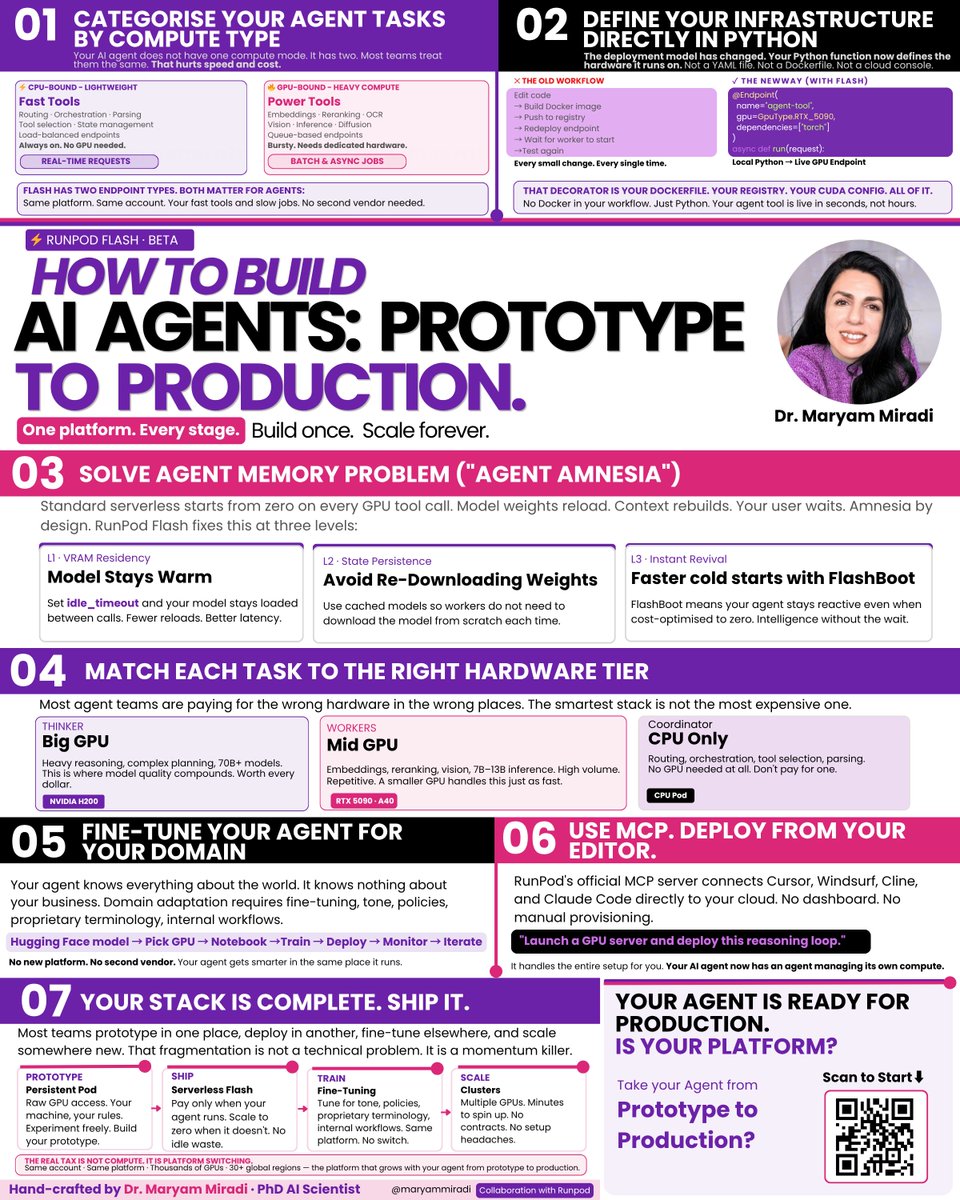
Your agent is not one compute unit.
It is a system of specialized tools.
Some are CPU-bound:
routing, orchestration, parsing, tool selection
Some are GPU-bound:
embeddings, reranking, OCR, vision, local inference, diffusion
And GPU-bound tasks are where many teams hit the wall:
- Expensive compute.
- Less iteration.
- Slower path to production.
That is why
@runpod Flash stands out.
✦ THE NO-DOCKER MANDATE
Runpod launched Flash as a Python SDK for Serverless GPU workloads.
You write Python functions locally, decorate them, choose hardware and dependencies, and Flash handles the endpoint setup and execution.
No Docker in your workflow. Just Python.
The old way:
Edit code → Build Docker image → Push to registry → Redeploy → Wait for worker → Test again
Every small change. Every single time.
The Flash way:
- Decorate your function with Endpoint
- Choose your GPU
- Run it
Your local Python becomes a live GPU-backed endpoint.
↳ Flash GitHub:
github.com/runpod/flash
✦ WHY THIS MATTERS FOR AI AGENT BUILDERS
Because agent systems usually need both:
- fast user-facing tools
- longer background jobs
Flash has two endpoint types. Both matter for agents:
- Queue-based endpoints → batch, async, long-running jobs
- Load-balanced endpoints → low-latency APIs with shared workers
That is a clean fit for real agent systems.
A reranker or vision tool can serve live requests.
A heavier indexing or batch job can run in the background.
Same platform. Cleaner architecture.
✦ SOLVING AGENT AMNESIA (MEMORY TIERING)
Every GPU tool call can force your agent to start from zero.
Model weights reload. Context rebuilds. Your user waits.
Amnesia by design.
Runpod Flash fixes this at three levels:
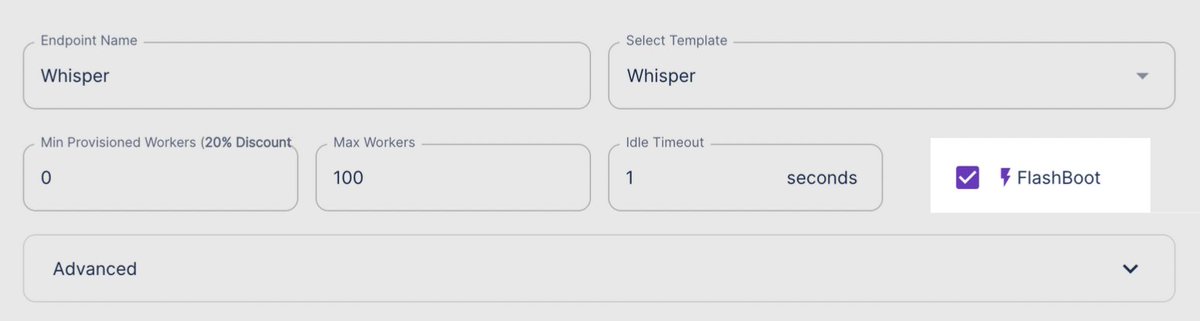
- L1. VRAM Residency: Warm workers to reduce reloads
- L2. State Persistence: Cached models to reduce repeated downloads
- L3. Instant Revival: FlashBoot for faster cold starts
✦ THE 2026 HARDWARE STRATEGY
Most agent teams are also overpaying for hardware.
A simple strategy:
- Thinker → Big GPU
- Workers → Mid GPU
- Coordinator → CPU only
Do not pay for a GPU where you do not need one.
And you do not need to keep changing platforms.
- Start → Persistent Pod
- Ship → Serverless Flash
- Scale → Clusters
Same account. Same platform. Same agent lifecycle.
✦ FINE-TUNING MATTERS TOO
Agents often need domain adaptation:
tone, policies, proprietary language, internal workflows.
Runpod supports fine-tuning too, including Hugging Face-based workflows and Axolotl-powered training.
↳ Fine-tuning docs:
docs.runpod.io/fine-tune
✦ MCP IS ANOTHER SMART MOVE
Runpod’s MCP server supports tools like Cursor and Claude Desktop, so your coding environment can talk directly to your cloud workflow.
Your job is agents.
Not Docker.
Huge thanks to Runpod for this collaboration.
---
P.S. Building AI agents? Explore Runpod for fast, lower-friction deployment.
⫸ꆛ
fandf.co/3Ng5Y1w
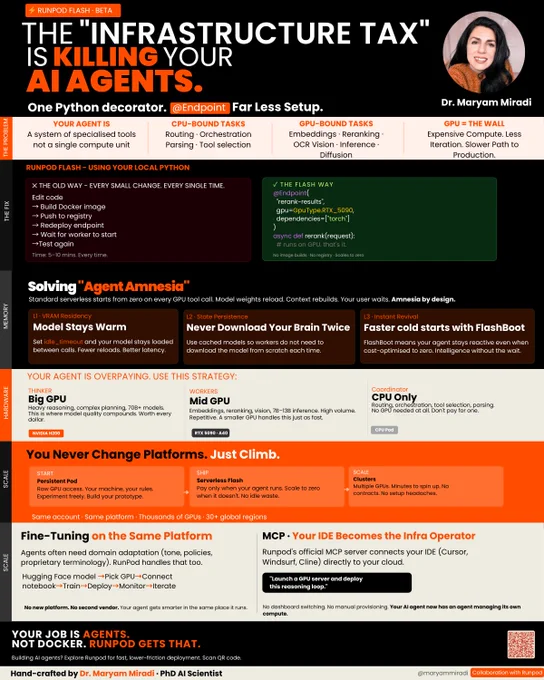
ALT Technical infographic by Dr. Maryam Miradi titled "The Infrastructure Tax is Killing Your AI Agents," in collaboration with RunPod. The chart outlines a roadmap for optimizing AI agent deployment. It highlights the "Old Way" of slow Docker builds (5-10 mins) versus the "Flash Way" using a single Python @Endpoint decorator on GPUs like the RTX 5090. Key concepts include solving "Agent Amnesia" through L1-L3 memory tiers: Model Stays Warm (VRAM residency), State Persistence (never download weights twice), and FlashBoot (instant revival). It provides a hardware strategy using NVIDIA H200 for "Thinker" agents, mid-range GPUs (RTX 5090/A40) for "Workers," and CPU pods for "Coordinators." Additional sections cover fine-tuning on a single platform and using MCP (Model Context Protocol) to connect IDEs like Cursor, Windsurf, and Cline directly to GPU infrastructure. The core message: Developers should focus on Agents, not Docker.