


2m
Validators, cosmos people and @madscientists_x community are debating the best design for a native liquidity venue on the Cosmos Hub. This follows recent validator calls and aims to make the Hub a central settlement layer.
Two main options are under review: hybrid orderbook (like Duality on Neutron) vs. other models.
Must support both institutions and retail, with fees benefiting are stakers.
No liquidity mining to avoid short-term capital.
In my opinion, this will solve Fragmented liquidity across app-chains and low native activity on the Hub. A strong liquidity layer brings deeper markets, real revenue for stakers, and better coordination for capital flows across IBC.

3

Europe is wayyy to fragmented of a market, and India lacks the corporate culture needed or the research infra. Nothing needs to be said about China. USA is sadly the least shit place to do so.
3


3m
There was no moving of goal posts, that’s what I said in my original message. The only source you have is a random dubiously dated fragmented document that you have no idea who wrote.
1
7

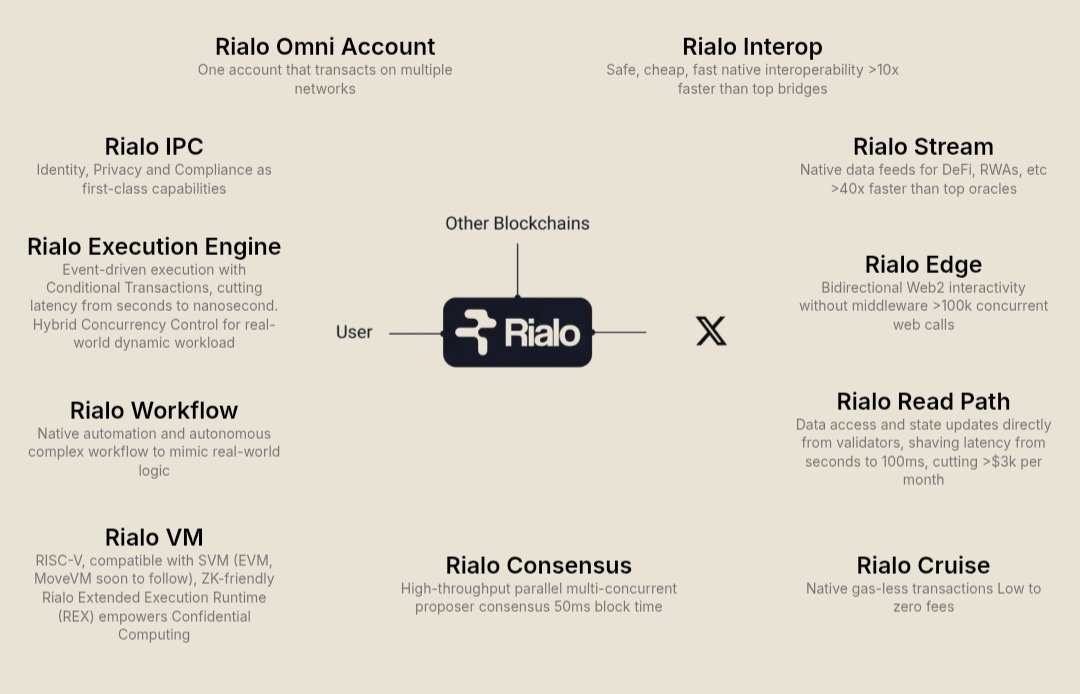
Meet the @RialoHQ Architecture
Traditional blockchain infra is too slow and fragmented for serious DeFi and RWAs. Rialo fixes this with an ultra-fast, private, and unified environment.
Insane Speed: 0.05s block times, 0.13s finality, and nanosecond execution.
Next-Gen VM: RISC-V based, ZK-friendly, and compatible with SVM (EVM coming soon).
Native Power: Built-in 40x faster data streams and autonomous workflow automation.
Zero Friction: Gas-less transactions, native cross-chain interoperability, and direct Web2 connectivity.
Build complex dApps without the infrastructure headache.
1
2
15

feels like the bigger risk is rushed, fragmented rules that push labs to hoard models instead of funding real safety work

Threading the needle in this post of anthropic has done some bad things for AI governance & the discourse but the actions of this administration are way worse so we need to get a handle on it before stronger models, open or closed, come along soon.
interconnects.ai/p/welcome-t…
Raul retweeted

Pinaka LRGR and its pre-fragmented high-explosive (HE) warhead in action with pin point accuracy.
A lot of people were questioning its accuracy now hopefully this video will clear all doubts :)



3
16
56
757
Bn sabo retweeted

Fragmented liquidity, expensive bridges, poor cross chain experiences. Years of frustration. Pact is taking steps toward unified trading. Innovation with purpose. @Pact_Swap

A great product is about solving real problems.
Fragmented liquidity, expensive bridging, and poor cross-chain experiences have frustrated crypto users for years.
@Pact_Swap is taking steps toward a more unified trading experience.
That's innovation with purpose.

1
2
2

Most people think banks are deciding whether to use blockchain.
They're not.
That decision is already made.
The real decision happening in 2026 is which settlement rails become the standard for the next decade.
JPMorgan's Kinexys has already processed over $1.5T on blockchain rails.
DTCC is advancing tokenized U.S. Treasuries.
NYSE, BNY, and Citi are building tokenized securities infrastructure.
The question in boardrooms today isn't "Should we go onchain?"
It's "Where do we settle?"
That distinction matters because settlement infrastructure behaves differently from most technology markets.
When a social app loses users, they switch.
When a bank migrates settlement infrastructure, it faces years of operational work, regulatory reviews, compliance audits, counterparty coordination, and integration costs.
That's why first movers matter.
SWIFT didn't become global infrastructure because it was the only messaging network.
It became global infrastructure because enough institutions joined early, making it increasingly expensive for everyone else to choose something different.
The same dynamic turned Visa from a regional network into global financial plumbing.
Settlement networks compound through connections.
10 institutions create 45 possible settlement corridors.
100 institutions create nearly 5,000.
Every new participant doesn't just add volume.
It increases the value of the network for every participant already connected.
This is where @ZKsync's position becomes interesting.
While much of the industry is still discussing institutional adoption, ZKsync already has regulated deployments involving major banks, custodians, and financial institutions.
But deployments alone aren't the story.
The harder challenge is solving the constraints institutions actually care about:
• Privacy
• Finality
• Institutional control
• Interoperability
A bank cannot expose positions to competitors.
A regulated institution cannot wait days for settlement certainty.
A global network cannot rely on fragmented liquidity and disconnected execution environments.
The platforms that solve these requirements become candidates for long-term infrastructure.
The next 18 months are likely remembered as the period when institutional onchain finance moved from experimentation to standardization.
And history suggests that once standards form in financial infrastructure, they tend to persist for decades.
The decade may not be decided by who launches the most products.
It may be decided by who becomes the rail everyone else builds on.
1


In truly chaotic enterprise environments (regulatory changes, fragmented systems, human overrides), what’s SERV’s biggest edge in keeping agents production-grade and auditable?
1
1
Bn sabo retweeted

The future of cross-chain connectivity is being built by @konnex_world .
No more fragmented liquidity. No more complicated bridging. Just seamless movement of assets across ecosystems with speed, security, and efficiency.
#Konnex #AI #Robot #Web3

1
4
24


As 2027 approaches, one question stands out: what happens if those seeking political change fail to unite behind a single candidate?
The answer is simple: votes get split. Multiple candidates appealing to the same voter base may end up competing against each other rather than the incumbent, making victory far more difficult even when public dissatisfaction is widespread.
A fragmented opposition weakens its bargaining power, divides campaign resources, and often shifts focus from national issues to internal rivalries. Instead of presenting a clear alternative vision, parties spend valuable time attacking one another while voters are left confused.
History has shown that elections are rarely won by numbers alone; organization, strategy, and unity matter. A coalition is not a guarantee of success, but entering a high-stakes election with several competing candidates can hand a major advantage to your opponent before the first vote is even cast.
In politics, divided support often benefits the strongest candidate, not necessarily the most popular cause. #Kenya2027
6

Two weeks across Oslo Freedom Forum, Bitcoin Film Fest, and Bitcoin Prague.
Freedom. Culture. Storytelling. Builders. Talent. Opportunity.
Bitcoin is global, but still fragmented.
The coordination layer is missing.
That’s what BCH is here to build.
30

PROPOSAL FOR THE ESTABLISHMENT OF A GHANA NATIONAL MISSING PERSONS ALERT AND DIGITAL RESPONSE SYSTEM
To:
Hon. Samuel Nartey George
Minister for Communication, Digital Technology and Innovations
The Director-General
Cyber Security Authority, Ghana
Dear @samgeorgegh
@MinterGh
@CSAGhana
@GhPoliceService
I respectfully submit this proposal as a concerned citizen and innovator seeking to contribute ideas that will enhance public safety and strengthen Ghana's emergency response capabilities through technology.
The increasing incidence of missing children, vulnerable adults, elderly persons suffering from dementia, and other unexplained disappearances presents a significant challenge to families and security agencies. In many cases, valuable time is lost due to fragmented reporting channels and the absence of a coordinated nationwide alert mechanism.
I therefore propose the establishment of a Ghana National Missing Persons Alert and Digital Response System (GNMPARS) to enable the rapid dissemination of verified missing-person alerts across the country.
Objectives of the Proposed System
The proposed system would seek to:
Improve the speed and effectiveness of responses to missing-person cases.
Enhance collaboration among security agencies, telecom operators, and the public.
Increase the chances of locating missing persons within the critical early hours after disappearance.
Provide families with a transparent and efficient reporting process.
Key Features
The system could incorporate the following features:
A centralized online portal and mobile application for reporting missing persons.
Verification of reports by the Ghana Police Service before public dissemination.
Automatic generation of case reference numbers.
Nationwide and geographically targeted SMS alerts to mobile subscribers.
Push notifications through a national emergency application.
Integration with television stations, radio stations, and digital billboards.
Publication of verified missing-person notices on an official public website.
Secure channels for members of the public to submit anonymous tips and information.
Real-time updates to families regarding the status of investigations.
Strategic Benefits
The implementation of this system would:
Reduce delays in public notification.
Increase community participation in search efforts.
Improve coordination among institutions responsible for public safety.
Enhance trust and confidence in emergency response mechanisms.
Demonstrate Ghana's commitment to leveraging technology for the protection of human life.
Safeguards Against Abuse
To ensure responsible use of the system, the following safeguards may be considered:
Mandatory verification of all reports by authorized police personnel.
Legal penalties for false reporting and misuse.
Data protection measures consistent with Ghana's privacy laws.
Restriction of nationwide alerts to high-risk and verified cases.
Conclusion
Many countries have successfully implemented national alert systems for missing persons. Ghana possesses the telecommunications infrastructure, technological expertise, and institutional capacity necessary to establish a similar system suited to our national context.
I respectfully urge the Ministry of Communication, Digital Technology and Innovations, the Cyber Security Authority, the Ghana Police Service, the National Communications Authority, and telecommunications operators to consider this proposal for the benefit and safety of all Ghanaians.
I submit this proposal in good faith and in the spirit of national development, believing that innovation and collaboration can save lives and reunite families.
Thank you for your attention and continued service to the Republic of Ghana.
Yours faithfully,
KOFI NUNOO-MENSAH
#Reset #Ghanamustwork
#protectinglives


1
1
17