
Founder @openservai Building an agentic economy where anyone can turn ideas into value.
Joined March 2024
- Tweets 1,255
- Following 337
- Followers 3,916
- Likes 1,251
115 Photos and videos












Pinned Tweet

Apr 5
We've been pretty quiet about what we're building. That changes now.
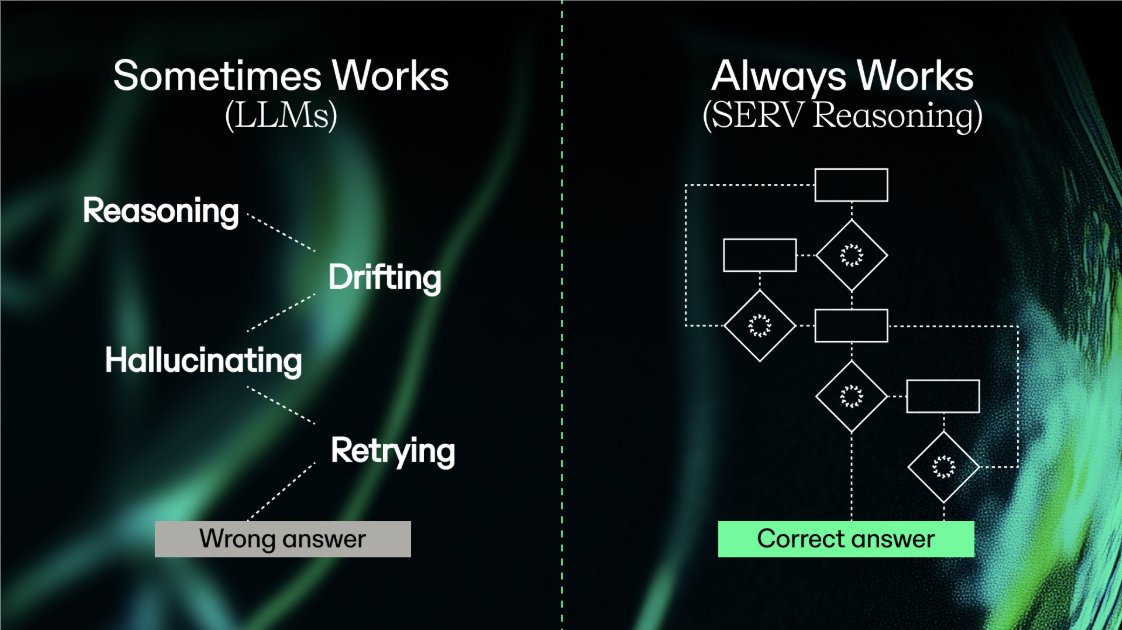
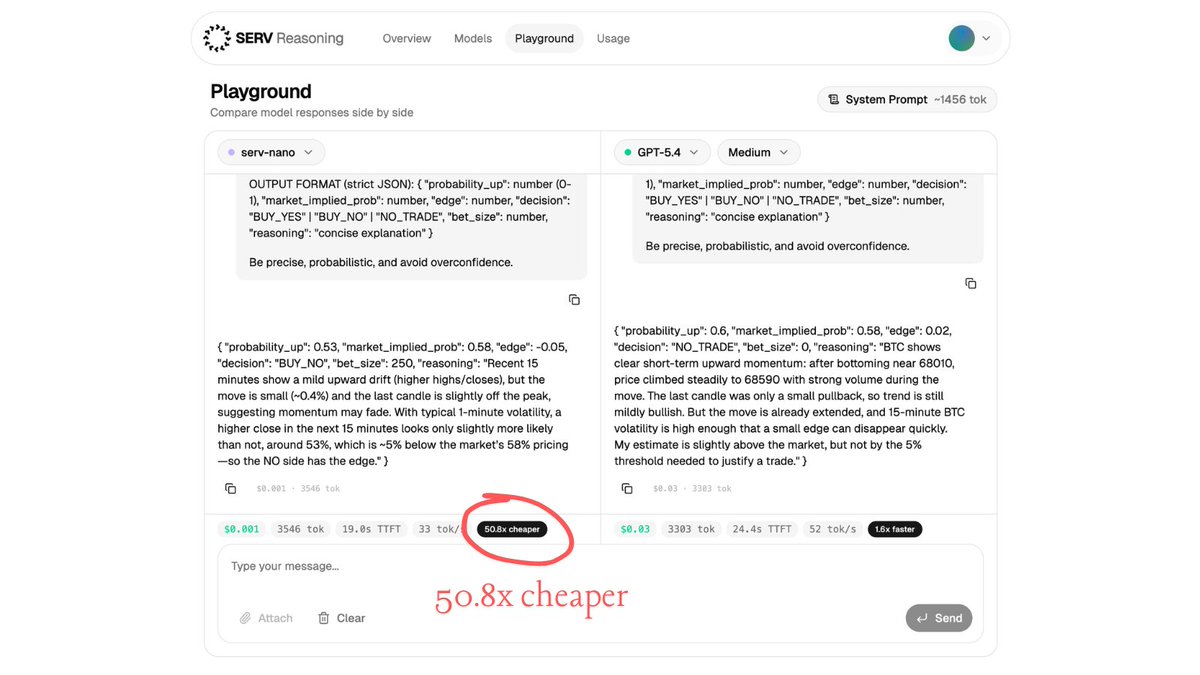
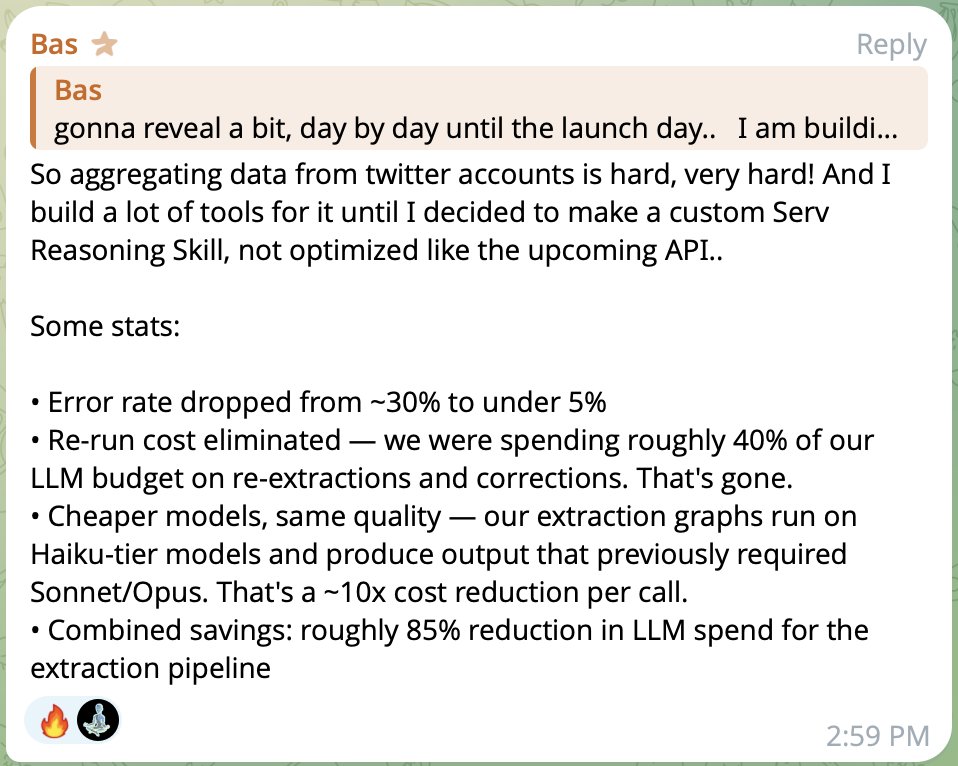
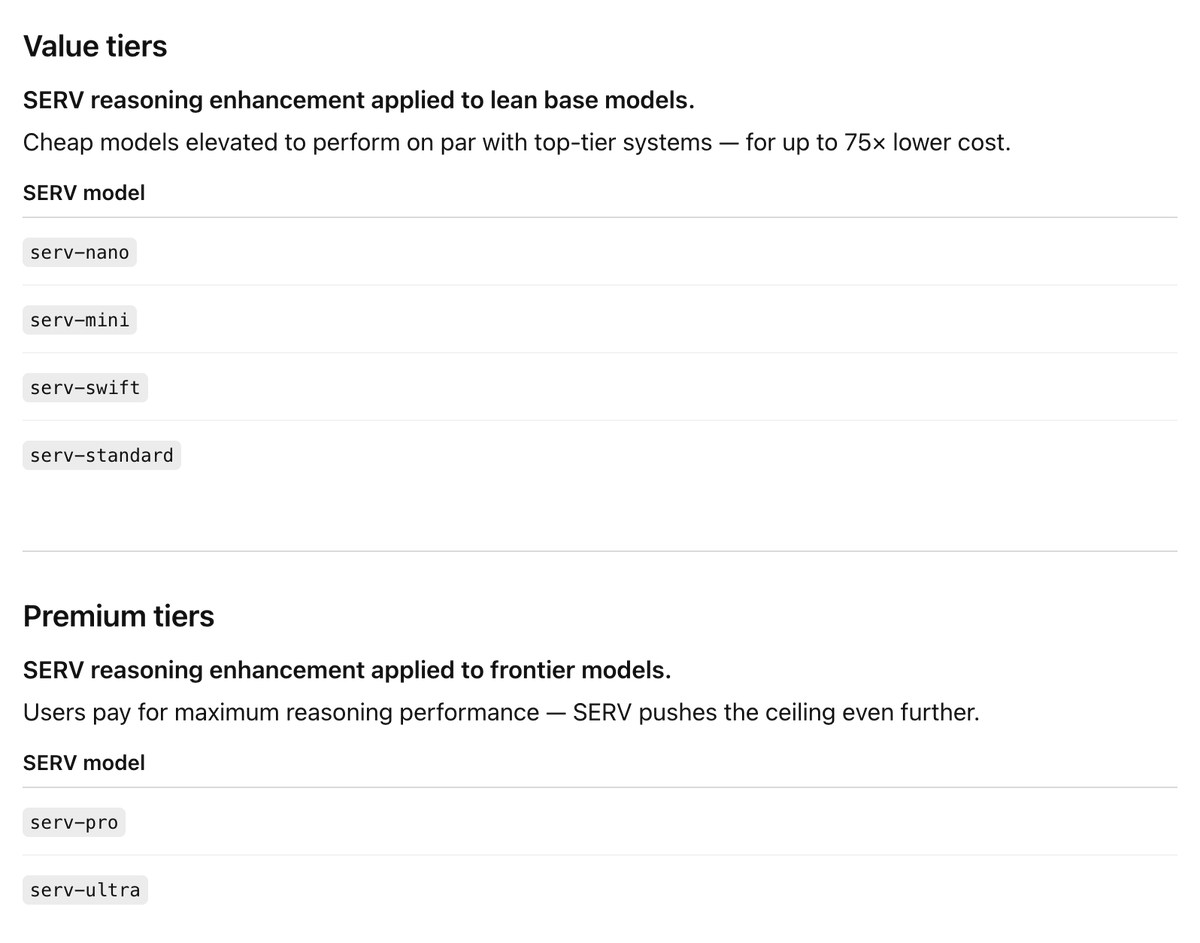
Our reasoning framework is currently beating every @OpenAI model on industry standard benchmarks. There are six models in development. SERV-nano just matched GPT-5.4 at 20x lower cost and 3x the speed. The research paper backing it is in peer review at a top-1% AI journal. The UAE government is running it in production, so are 10 enterprises.
Nothing comes even close.
This goes far beyond any wrapper or prompt engineering gimmick, we've developed an entire AI reasoning layer from scratch: structured, bounded, deterministic using machine readable code instead of vague english prompts.
Any builder or enterprise swaps two lines of code and their agents get much cheaper and much smarter instantly. The self-serve API is about to open, in a multi-phase rollout.
More soon.

64
185
1,593
359,332
Jun 12
A cross-chain agent protocol backed by @Alchemy and @solana just deployed SERV Reasoning into their production stack, now live.
Nice.
Jun 12

Most onchain APIs return data. Agents need decisions.
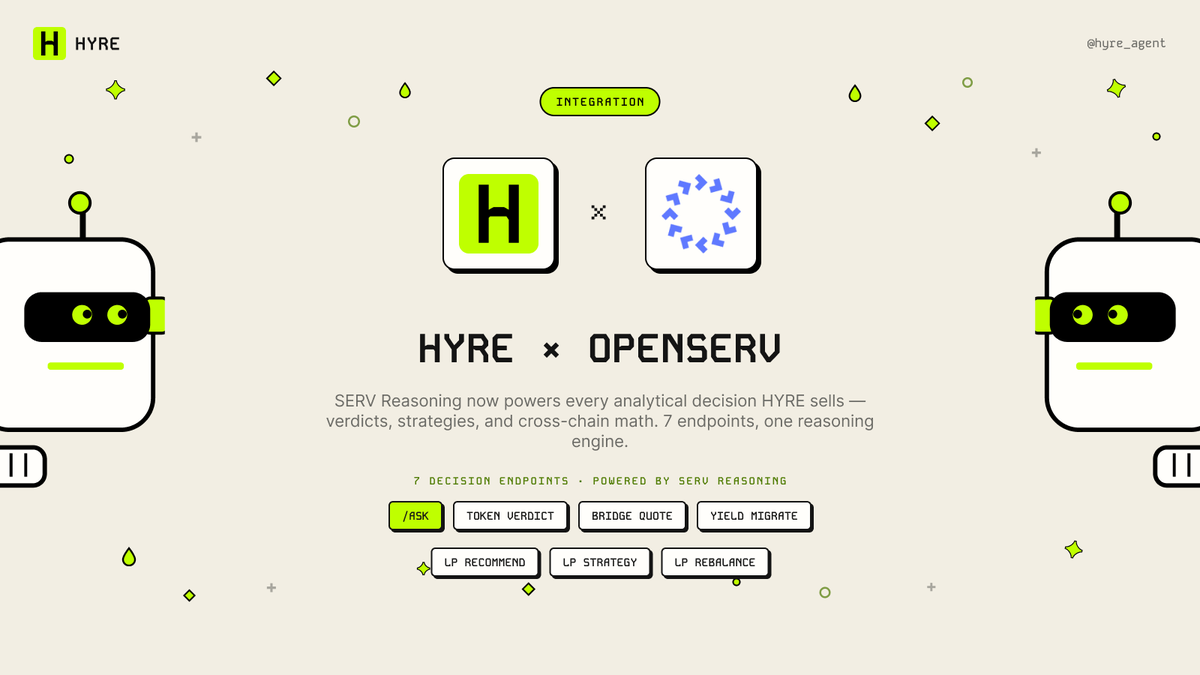
HYRE just upgraded 7 decision endpoints to SERV Reasoning by @openservai a reasoning engine that thinks before it answers.
→ Token Verdict: snipe / watch / avoid
→ Bridge Quote: execute / wait / avoid
→ Yield Migrate: migrate / stay / wait (with break-even math)
→ LP Recommend, LP Strategy, LP Rebalance
→ /ASK: natural language, reasoned answers
Fast endpoints stay fast (~1s). Decision endpoints now reason (~4-6s) — because a wrong financial signal costs more than 3 extra seconds.
Don't take our word for it every response includes a model_used field. Check who answered.
11
28
146
6,958
Tim retweeted

Jun 10
SERV Reasoning Private Beta is accelerating and a new batch of builders is coming on board, pulling the next ones in.
The pattern holds:
• Lower costs
• 100% reliability
• Faster than their old stack
Here are a few recent additions to the program.
-> Apply to join now 👇
11
40
222
12,438
Tim retweeted

Jun 9
Bento is now integrated with SERV Reasoning by @openservai
1,004ms faster than Gemini. 5x lower cost. Same proven reliability.
As AI agents gain wallets and start executing real transactions, the quality of their reasoning becomes part of the security stack.
Better reasoning means:
→ fewer risky actions
→ fewer false alarms
→ more context-aware decisions
→ safer agent execution
At Bento, we're building the security layer for AI agents on @solana.
SERV helps agents think better.
Bento helps make sure they act safely.
The future won't be powered by agents alone.
It will be powered by agents that can reason and execute securely.
Live integration in our Beta. Check it out 👇
16
33
119
8,645

@openservai has a launchpad, but this was built in response to teams building in our ecosystem on top of SERV Reasoning
This is the core product, and a key differentiator of SERV launches - verifiable tech MOAT
For an AI powered business, the cheaper you can make inference at the earliest stages, the more room you have to subsidize early user growth, which imo should lead to faster more successful GTM and better chances of finding PMF
Jun 8

SERV is the agentic reasoning engine solving exactly this - for enterprises, financial institutions, banks and even governments deploying AI in production.
The next frontier is reasoning compression. Cheaper models reduce the cost of intelligence, but they do not solve the cost of decision-making.
Most business decisions are not about raw IQ. They are about applying the right process, policy, workflow, or rulebook reliably.
That is where unbounded inference wastes money.
SERV Reasoning makes reasoning bounded and machine-readable, so models spend fewer tokens getting to reliable decisions.
Better performance per dollar, not just cheaper tokens.
Already live with the UAE government and a fast-growing number of enterprises, financial institutions and startups across many industries in our private beta (inc. banking, compliance, security, health, robotics, among many others).
1
4
38
1,126
Tim retweeted

Jun 8
Pretty insane to see 600k views on this article about a relatively little known project
I'll tell you why I wrote it, and it wasn't for any financial incentive (the team didn't ask me to write it, and I hold only a small amount of the token)
If you've followed my posts, I've been consistently writing about the unsustainable costs of intelligence that enterprises are facing
Demand for intelligence is near infinite, but only when there is ROI
If everyone tokenmaxxes with the most expensive models with the highest levels of reasoning, most use cases won't find ROI
What happens if we don't find ROI?
If enterprises don't find ROI, we start to see an unwind of the AI trade which has massive implications across financial markets and the global economy
We NEED for enterprises to find ROI, and soon
So that means we need to highlight more solutions that enable enterprises to get better intelligence-per-dollar spend, and get them adopted
I've been doing a LOT of research on this topic and posted a playbook for enterprises to reduce costs a few days ago (will link it in replies)
And I found this project OpenServ that has a solution called SERV Reasoning just hiding in plain sight, and in crypto of all places
That's what made me write about it, and I was naturally skeptical about it when I began (bc crypto)
I'm glad many people found this article helpful, let's keep the cost optimization dialogue going

23
72
276
81,774
Jun 5
SERV worldwide.
Jun 5

Just came back from Kenya after a week of conversations on AI, finance, and institutional adoption.
By the end of the trip, we had met with the largest investment bank in the country, half of their top 10 banks, fintechs, former ministers, and senior leaders with experience across global institutions.
A few takeaways stood out.
1. AI adoption is now a boardroom mandate.
100% of the institutions we spoke with had a direct mandate to explore AI implementation.
The reason is simple: the productivity gains are too large to ignore, and no major institution wants to be the one that lets competitors move first.
2. Deployment is still early.
Despite the intent, only around 50% of organisations we spoke with had any live AI deployment. Of those, more than 80% were still using basic general-purpose model implementations.
That creates a major gap between interest and real adoption. Institutions understand the potential, but most are still in the early stages of figuring out how to move from experimentation to workflows that can operate across the organisation.
3. Auditability and transparency are non-negotiable.
Over 90% of institutions we met had serious concerns around data security, and roughly 70% had already rejected third-party AI tools because of those concerns.
For financial institutions, “AI-powered” is not enough. They need to know where data goes, how outputs are generated, how decisions can be audited, and whether the system can be trusted in high-stakes environments.
4. Reliability and cost are the main blockers to scale.
Many institutions have already experimented with AI. The issue is that early pilots often failed to meet the standard required for broader deployment.
Unrestricted access, context bloat, inefficient prompting, and unpredictable outputs made teams cautious on both cost and reliability. In banking, a tool cannot simply work in a demo or perform well under controlled conditions.
It has to work consistently, transparently, and at a price that makes sense across the organisation.
5. The biggest barrier is not always technical. It is institutional risk.
The larger the institution, the less incentive there is for any individual to take unnecessary risk. Maintaining the status quo is safe. Championing a new system is not.
If it works, the institution benefits. If it fails, the person who pushed for it may carry the blame.
That means serious AI adoption requires more than product. It requires trust, relationships, internal alignment, and a clear path from pilot to deployment.
This is especially true in emerging markets, where enterprise sales cycles are long, distribution is relationship-driven, and adoption often depends on being in the right rooms with the right stakeholders.
The opportunity is clear: major institutions are actively looking at AI, but most still lack systems that meet the requirements for real deployment.
Secure.
Reliable.
Auditable.
Economically viable.
That is the bar.
That is what we are focused on with SERV Reasoning.
We will continue strengthening relationships across the region and using East Africa as a launch point into broader conversations across the continent.
We are also continuing our work in the UAE through Neol, with government-side interest in expanding initiatives further.
Next up: LATAM, South Asia, and other high-growth markets underserved by the major players in AI infrastructure.
SERV worldwide.

3
11
100
3,923
Jun 4
Quite speechless to be honest.
This moment represents 2 years of building toward a very specific vision:
> To become the standout crypto x AI company that breaks out into the global enterprise sphere...
With agent infrastructure that services enterprises, institutions, and governments...
Couldn't be more excited about where we're heading.
Big thanks to Kevin for taking the time to properly understand and share what we're building at OpenServ, it means a lot.
10
52
218
4,685
Jun 3
From the man himself…
LFG

Even at Google I’ve not seen this level of positive feedback on any product within a month of beta. Mind-boggling… 🤯
2
14
108
2,560
Jun 3
This is the first step.
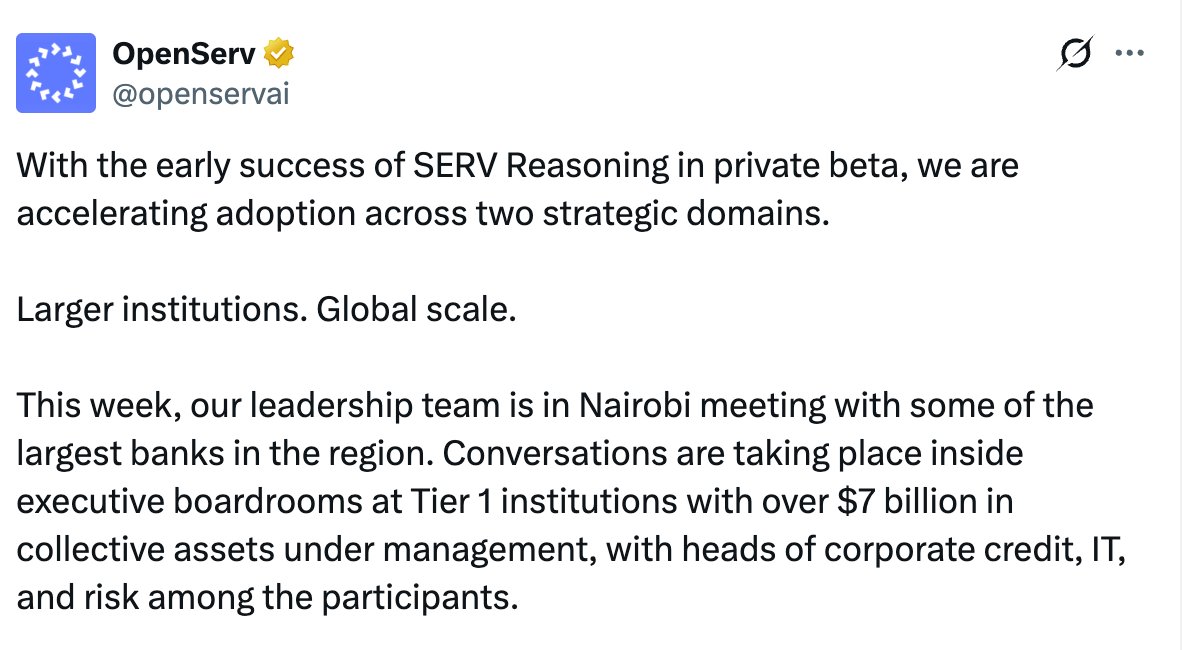
Together with NEOL, we’ve begun deploying SERV Reasoning into real government-grade AI workloads, already live with the UAE government.
NEOL uses AI agents to surface the right people, relationships, and institutional knowledge for governments and large institutions making high-stakes decisions.
For that to work, “usually right” isn’t enough.
The agent needs to be reliable, reproducible, and auditable.
SERV Reasoning enabled NEOL to move from brittle prompt-based agents to structured reasoning graphs their team can inspect, test, and improve systematically, reaching 100% accuracy on key production agents.
That matters because when a government client asks why a certain person was recommended, NEOL can now point to the reasoning structure behind the decision.
Not a black box.
Not a guess.
A traceable decision process.
This is the beginning of something much larger.
Every enterprise, government, and public institution trying to deploy AI into serious workflows will run into the same wall: agents that are too unreliable, too opaque, and too difficult to audit.
That is exactly the wall SERV Reasoning was built to break through.
Our aim is to keep expanding what we unlock with NEOL, deepen the relationship across more institutional use cases, and bring this same reasoning infrastructure to the enterprises and governments that need AI they can actually trust in production.
The future of institutional AI cannot run on todays infra, it needs specialized AI reasoning that can be tested, audited, reproduced, and trusted.
That is the institutional gap SERV is plugging.
25
68
289
35,152
Jun 2
Moar
Jun 2

MESH is the privacy-first AI router: one OpenAI-compatible endpoint in front of 46 models, a signed receipt on every call, and zero payload retention.
SERV is the reasoning layer adding structured, schema-forced, auditable reasoning that routes each step to the right model instead of burning frontier tokens on everything.
Soon you'll be able to switch SERV on as an optional layer over every model and agent already on MESH
What that unlocks:
> Reasoning that stays inside defined bounds instead of drifting
> Signed receipts for the privacy, structured auditable steps for the logic
> Frontier-grade results without frontier-grade token bills
MESH's verifiable privacy meets .@openservai's SERV reasoning. Coming soon.
2
10
80
2,561
Tim retweeted

Jun 1
Orbit agents just got a major reasoning upgrade.
Previously, we upgraded the core XONA agent with SERV Reasoning by @openservai.
Now, we’re bringing the same upgrade across Orbit.
All 266 agents already built on Orbit are now aligned with SERV Reasoning, giving them faster execution, lower cost, and the same reliability we benchmarked on our production workflow.
This means Orbit agents can now reason, execute, and access XONA resources more efficiently across the Agentic Commerce ecosystem.
Build agents with Orbit. Power them with XONA. Reason with SERV.

16
27
123
6,484
Tim retweeted
May 30
Right in line with my thesis on token cost management
This will be a huge topic going forward
17
18
89
11,996
May 29
Greg reads, Greg understands.
Be like Greg.
at google play we looked for teams that had an "unfair advantage"; at least one of the following:
- a tech moat (proprietary IP, novel architecture)
- a structural moat (switching costs, lock-in)
- execution speed and quality (a moat in itself, especially in commoditised verticals)
rarest of unicorns are the ones that can combine all three.
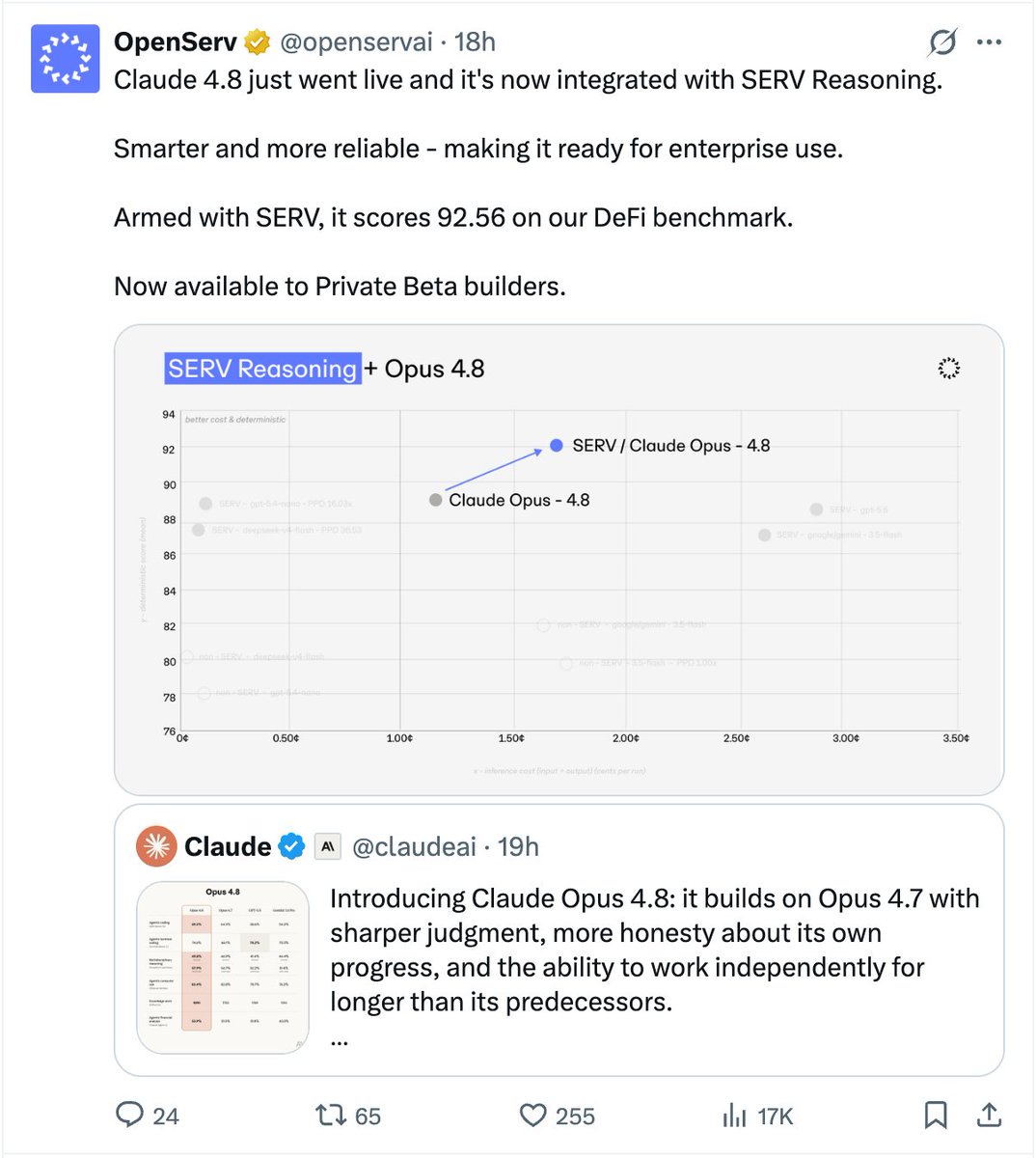
with @openservai we're seeing how they all combine -> genuine tech differentiation in reasoning architecture. structural lock-in once enterprises integrate. a team executing faster and cleaner than anyone else in the category.
3
18
92
2,391
May 26
Lots and lots happening..,

6
22
144
6,377

Tim retweeted

May 26
SERV is now powering robots. That's it. That's the tweet.
May 26

We’re excited to be integrating SERV Reasoning by @openservai to bring our no-code robotics solution to market, and had the pleasure of joining their closed beta.
Advanced robotics used to require a full team of specialists.
Now you can build real behavior in our no-code studio — this Unitree G1 hand grasp function was entirely written by the serv-standard model inside ROBA's no-code studio.
This is just a small glimpse of what can be done in our platform.
In our benchmarks across real builder tasks, SERV's models matched the quality bar we needed while cutting AI costs by over 80%.
SERV Reasoning will now be the default inference engine for the upcoming release of our ROBA no-code studio on June 1st.
3
18
120
4,000
May 25
4 years of working with AI models, and using SERV Reasoning is their best experience yet…
Xona is building their own on-chain agent infrastructure, and now with SERV they’ve gained:
- 100% accuracy
- 30 % lower latency
- 5x more cost efficiency
This is not just a nice to have, its a game changer for an entire business.
One of many already supercharging their AI products with SERV, welcome.
May 25

Huge appreciation to the @openservai team for their full support throughout the process.
After 4 years of working with AI models, I can honestly say SERV Reasoning is one of the best combinations of performance and cost efficiency I’ve used.
Better reasoning. Faster responses. Lower cost.
A significant step forward for XONA.
5
33
138
5,482
Tim retweeted

May 25
Another independent benchmark from SERV Reasoning Private Beta:
serv-nano at 100% accuracy, while being 5x more cost-efficient and faster than raw Google Gemini
More cost-efficient
Faster
Reliable
Single-line swap and no vendor lock-in. no brainer for anyone building agents
May 25

Our agent just got a major upgrade - XONA agent is now powered by SERV Reasoning by @openservai.
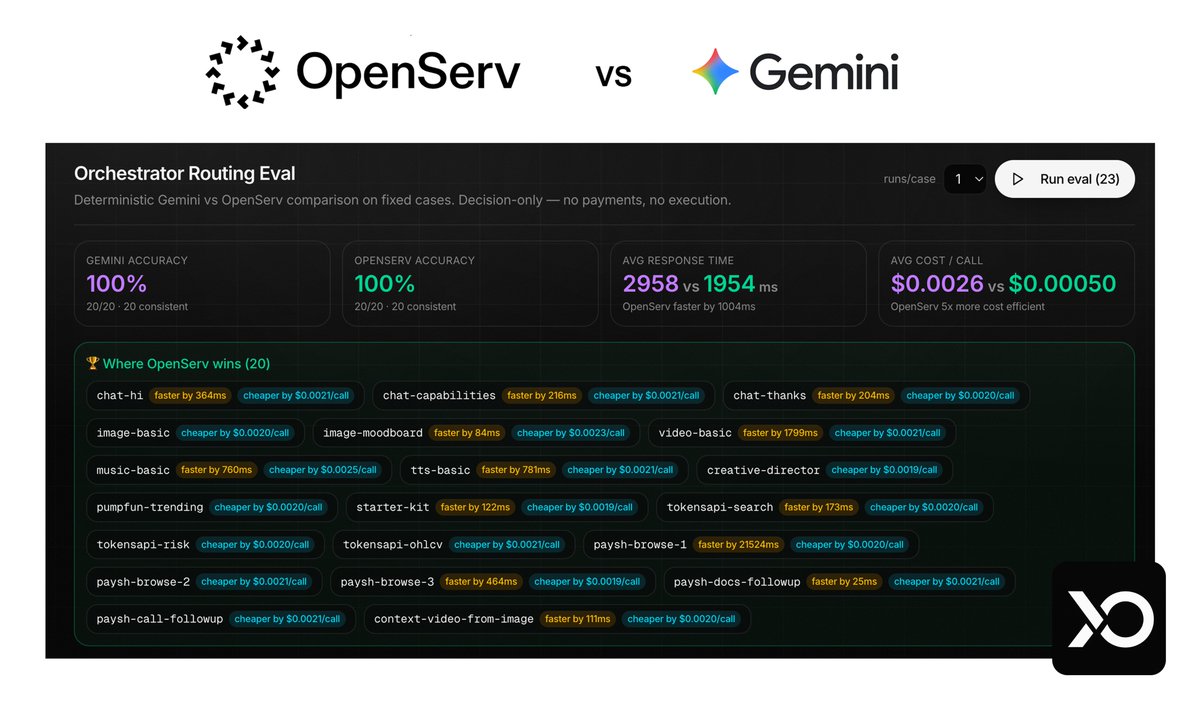
We have been testing SERV in the Private Beta and it has far outpaced our default production stack running on Gemini frontier model. SERV delivers faster responses at a significantly lower cost, while maintaining the same 100% reliability in our workflow benchmark.
SERV Reasoning vs. Gemini on our agent workflow:
→ Accuracy & reliability: 100% for both models (20/20)
→ Latency: SERV responded 1,004 ms faster
→ Cost efficiency: SERV is 5x more cost-efficient
This upgrade helps us deliver better-performing resources for agents across the Agentic Commerce ecosystem.
Same reliability. Faster execution. Lower cost
6
23
101
6,259
Tim retweeted
May 25
Our agent just got a major upgrade - XONA agent is now powered by SERV Reasoning by @openservai.
We have been testing SERV in the Private Beta and it has far outpaced our default production stack running on Gemini frontier model. SERV delivers faster responses at a significantly lower cost, while maintaining the same 100% reliability in our workflow benchmark.
SERV Reasoning vs. Gemini on our agent workflow:
→ Accuracy & reliability: 100% for both models (20/20)
→ Latency: SERV responded 1,004 ms faster
→ Cost efficiency: SERV is 5x more cost-efficient
This upgrade helps us deliver better-performing resources for agents across the Agentic Commerce ecosystem.
Same reliability. Faster execution. Lower cost
27
41
153
33,739
May 25
The AI Cost Crisis has begun, and SERV is the lifeboat.
Tick tock, tick tock.
May 24

🚨 THE AI COST CRISIS HAS STARTED.
Microsoft reportedly told engineers to stop using Claude because AI bills were exploding, while Uber says its entire yearly AI budget was already destroyed by April.


3
16
101
2,749