
Going to see Disclosure Day this afternoon. I wonder if THOSE aliens will show themselves to be frontrunning chokers too?
2
1
223

Rialo #18: Onchain finance also needs privacy 🔐
When viewed through the lens of onchain finance, @RialoHQ’s private and confidential execution becomes especially important.
One of the biggest strengths of blockchain is definitely transparency. Anyone can verify transactions, track state changes, and check how the system operates.
But this transparency does not always work only as an advantage in every situation. Especially in onchain finance, a structure where too much information is exposed can actually become a limitation.
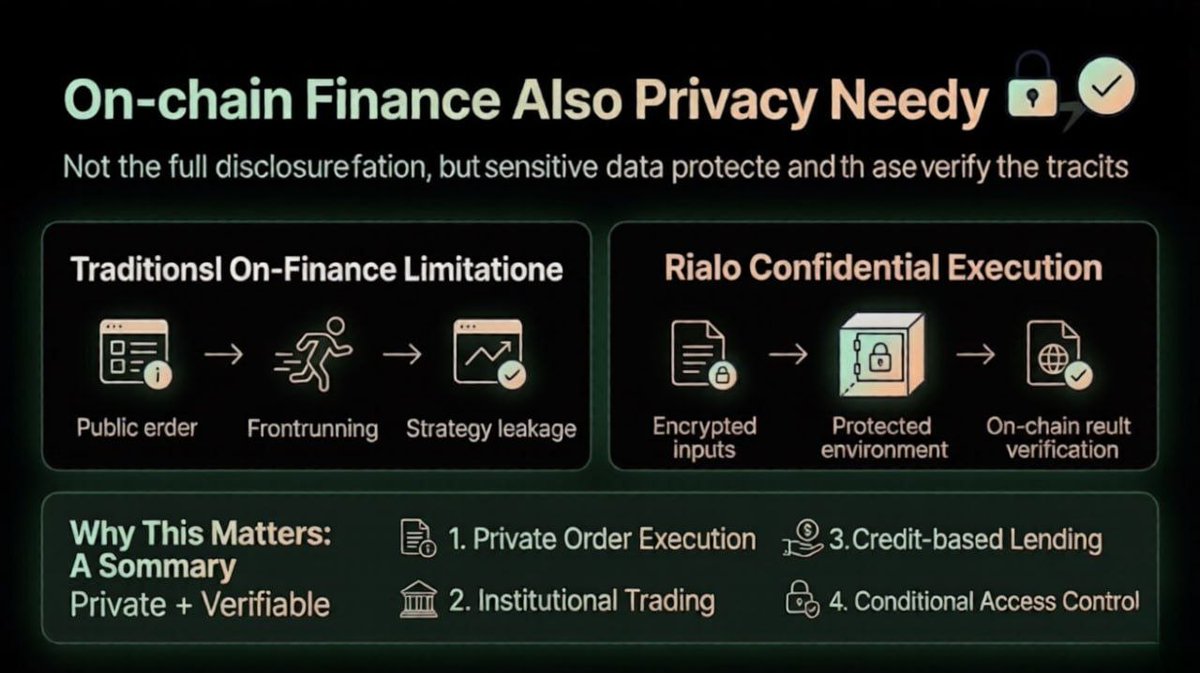
For example, imagine a situation where someone is trying to place a large order. The moment information such as order size, direction, or price conditions is exposed first, other participants can see it and move ahead. This naturally leads to frontrunning, and the strategy itself can leak.
This may be inconvenient for individual users as well, but for institutions or large-scale traders, the issue can feel much more serious. It is difficult to participate actively in a market where trading intent or position changes are revealed as they are.
In the end, for onchain finance to attract larger capital and more realistic users, simply making everything public may not be enough.
The important point here is that privacy is not the opposite of transparency. What is needed is not a completely dark system that no one can inspect, but a structure where sensitive inputs are protected while execution results remain verifiable.
This is where Rialo’s confidential execution becomes meaningful. Users can submit sensitive inputs in encrypted form, and those values are only used inside a protected execution environment. Then, only the final result remains onchain.
With this structure, sensitive information such as order details, trading intent, or specific condition values does not need to be revealed, while it is still possible to verify that execution followed the defined rules.
I think this connects well to the next stage of onchain finance. DeFi has grown quickly based on transparency so far, but as financial applications become more complex, a structure where all information is always public may actually become a design constraint.
So going forward, structures that protect data while making results verifiable will become more important. This also seems to be one reason why Rialo looks at privacy not as a feature added on top of applications, but as something combined with the execution environment itself.
In the end, as onchain finance gets closer to real-world finance, privacy becomes less of an optional feature and more like essential infrastructure. Trust does not always require everything to be public. What matters is protecting what needs to be protected, and verifying what needs to be verified. That seems to be the direction Rialo is pursuing.
gRialo! 🧡
1
13

1h
Scanner hitting World Cup narratives early Frontrunning the virality, love to see it
12


one i think deserves a closer look
frontrun by @strangersolemn is a 420 piece generative art collection coming to ethereum.
what makes it interesting is that the art isn’t completely fixed. each piece carries a permanent seed from mint, but the wallet holding it helps shape how the artwork is rendered.
the colors and runner stay the same, while the environment evolves as ownership changes.
everything is fully onchain too, with the entire art engine living inside the contract itself.
it feels less like a static artwork and more like something that continues to interact with its holder over time.
420 supply.
CM @Soathefirstt
you’re not early. you’re just frontrunning. 🏃♂️
37
12
40
660

Fair.
BTC breaking ATH prehalving is real, cycle's clearly frontrunning.
But the 680/827 count runs off XRP's own lows, not the halving, so that doesn't touch it.
Compressing cycles = shallower/earlier low, not no low.
The bit I'd defend isn't the 1.5y grind. It's that both cycles were −70% from top at the same day-count
1
29

@Shack2daFuture7 I wonder if Phil going to the parade to support his team haha. #frontrunning #bandwagon #douchebag
2


"Non è del tutto sbagliato" è un eufemismo. I gestori attivi fanno frontrunning di ciò che il 60% del mercato (ETF) dovrà fare, il meccanismo è autoalimentante
1
18

Yeah, I think I will actually continue to support people. Not you anymore :)
If your vision of strength and manhood is... going in your feely feels to the locker room after shamelessly frontrunning... You must have had some terrible high school sports experiences with losing :(
2
17
JonnieIsBack🇺🇸 retweeted

Jun 11
FRONTRUN 🏃♂️
frontrunning the culture, one block at a time.
420 pieces, fully on-chain on Ethereum. the engine lives in contract bytecode. zero IPFS, zero servers.
the wallet that holds a piece shapes the art.
your address writes the tunnel, the motion, the walls.
every piece carries a locked seed from the moment it's minted. its colours and its runner are permanent but send it on and it rebuilds its world around the new wallet.
you're not early. you're just front running.
allocation follows support. 👇
205
57
297
11,263

Just Frontrunning the most historic sporting event ever
#ufcwhitehouse
AY2Ty3zRifCMkVU61c1stqkFu5SZrLi7gTD6JzbFpump
3
127

One thing that stood out to me while reading the @RetiumChain whitepaper is its discussion of spam-prone mempools and frontrunning risks.
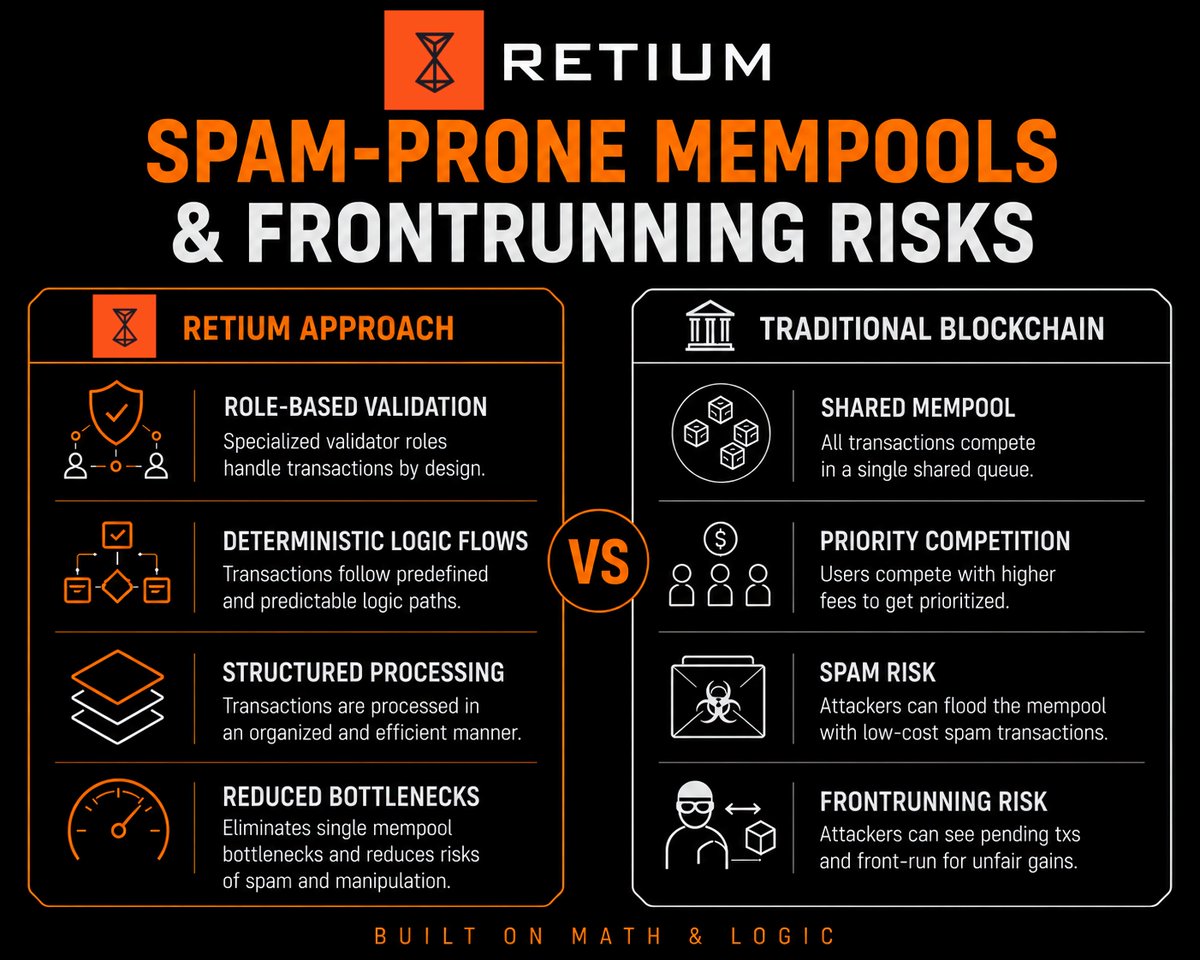
According to the whitepaper, a shared transaction queue (mempool) can leave blockchain networks vulnerable to spam, manipulation, and frontrunning, especially during periods of high activity.
Rather than treating these issues as temporary scaling challenges, Retium approaches them as structural limitations that should be addressed at the architectural level.
The proposed design combines role-specific validator responsibilities with deterministic logic flows, aiming to reduce reliance on a single transaction bottleneck.
What I find interesting is that the focus isn't only on processing transactions faster. It's also about creating a fairer environment by reducing the conditions that can lead to manipulation in the first place.
An interesting approach to blockchain architecture.
4
4
12
62

Actually the biggest fucking baby ever lmao. Frontrunning and taunting then when he loses bc the Knicks dog the shit outta the Spurs every second half he whines and says they were the ones always up 😭😭😭
27

🚀 Transparency and execution done right.
Love seeing teams that actually deliver on their word. Announcing buybacks after the fact to avoid frontrunning shows real integrity — exactly what’s missing in most crypto projects.
@TuomHolmberg and the $CARDS team are proving they’re builders with skin in the game, focused on long-term value and disrupting the TCG space. In an industry full of noise, genuine projects like this stand out.
Rare to find this level of trust and passion. Respect.
Who else is bullish on teams that prioritize execution over hype? 💎🃏
58
iso 🏳️⚧️ retweeted

Tabaru having a horrible gate for frontrunning and fighting prime Croix du Nord the second it started raining

MEISHO TABARUUUUUUUUUUU
3
8
396

All that frontrunning

“Appreciate y’all. See y’all…never.”
— Wemby at the end of his post-game press conference.
(h/t @big_business_)
30
Token 🍻 Taphouse retweeted

Frontrunning every NFT caller by announcing mints tomorrow instead of today:
- @the_gruff_nft - $1.7 MP - 3333 supply
- @onjabase - $25.2 MP - 111 supply
- @Isomatrica_art - Free Mint - 160 supply
- @earnity_ - $3.7 MP - 3838 supply
- @momos_era - $7.2-8.4 MP - 3333 supply
- @dormiesART - $2 MP - 8000 supply
- @AbsurdPixelsNFT - Free Mint - 5555 supply
All these projects and I got 0 WL 😂
1
2
7
262