Sjoe! 🇿🇦 The Old Framework Is Cracking – Is South Africa Finally Ready to Let Go? 🔧📉 ~ 🚧 From Redress to Restraint: When Policy Starts Holding Back Progress ~ 🧠 Policy vs Reality: Why the Debate Is No Longer Academic.
Sjoe! You feel that low, familiar creak, don’t you? Like an old braai grid groaning under one too many boerewors, or a minibus taxi suspension finally surrendering on the N1. Three decades after apartheid ended with promises of a non-racial rainbow nation, the very policies designed to heal old wounds have quietly become the heaviest chain holding the country back.
Broad-Based Black Economic Empowerment (B-BBEE) scorecards and Employment Equity numerical targets, once a constitutional bridge, now function as a permanent racial engineering machine.
They prioritise group percentages over individual merit, connected insiders over broad opportunity, and ideological continuity over the jobs and growth that millions of ordinary South Africans need to put food on the table and hope in their children’s eyes.
The central question is no longer academic: will South Africa finally dismantle or substantially dilute these race-based laws before they dismantle its future?
From courtroom filings and parliamentary bills to think-tank reports and stubborn economic data — points to one clear trajectory. The scaffolding is creaking louder than ever. The dawn of a new growth era is not a distant dream; it is becoming an economic and political necessity.
1: The Legal Reckoning
In a Pretoria courtroom, the first audible cracks appeared in 2026. The Employment Equity Amendment Act, with its sectoral numerical targets that can require 90–96% representation for designated groups in certain categories for firms with 50 or more employees, was intended to accelerate redress after apartheid’s distortions.
Yet by March 2026 the Supreme Court of Appeal dismissed attempts to stay implementation of these targets, while the Democratic Alliance’s constitutional challenge — heard in the North Gauteng High Court in May 2025, with judgment still pending deep into 2026 — directly questions the Minister’s power to impose them.
The challenge argues that these measures cross into unfair discrimination, violating the fairness benchmarks of Section 9 of the Constitution (Statistics South Africa, 2026; Democratic Alliance, 2026).
Additional suits from groups like Sakeliga and employer organisations raise the same concern: what began as a constitutional allowance for temporary advancement after 1994 has hardened into rigid quotas that judge South Africans by ancestry rather than ability or need.
Retention of these mandates risks endless litigation, investment hesitation, and accelerated skills emigration — precisely the factors blocking the kind of growth the IMF suggests could add up to 2% or more to output through regulatory easing (International Monetary Fund, 2026).
We all see it, don’t we? The government insists there is “nothing sinister” here, yet every new filing feels like another test of whether the legal fortress can hold. If courts ultimately affirm merit and individual dignity over racial arithmetic, judicial or legislative override becomes not merely possible but inevitable.
The legal reckoning is the system beginning to reject its own over-extension.
Questions Stirring:
What happens when a temporary constitutional measure becomes permanent policy?
Does endless court battles serve justice or simply freeze capital and talent?
And if the courts rule that race can no longer be the decisive proxy for disadvantage after 32 years of majority rule, what other questions about fairness, efficiency, and national cohesion suddenly demand honest answers?
These questions matter together because they expose the core tension: a tool meant to heal has become a legal and economic straitjacket. Until resolved, South Africa remains stuck at the crossroads, watching opportunities slip away while the debate circles the same tired track.
2: The Coalition Fracture
From the courtroom we move to Parliament, where the fracture lines of the Government of National Unity are now impossible to ignore. In March 2026 the Democratic Alliance formally introduced its Economic Inclusion for All Bill and requested a first-reading debate. The Bill seeks to amend the Public Procurement Act by repealing race-based preferential provisions and replacing them with scorecards that reward verifiable poverty reduction, jobs created, and skills development.
It draws on long-standing ideas such as the Institute of Race Relations’ Economic Empowerment for the Disadvantaged (EED) model of means-tested vouchers and echoes first-principles calls to delete unnecessary complexity (Democratic Alliance, 2026).
The ANC’s firm rejection — framing BEE as “non-negotiable” — lands with all the gentle irony of two coalition partners trying to steer the same vehicle while pulling the steering wheel in opposite directions. Retention of the current framework perpetuates compliance costs and elite capture, with estimates suggesting potential annual procurement savings exceeding R150 billion through a genuine shift to value-for-money.
The Bill’s progress reveals genuine political space opening for reform. Dismantling or substantially diluting race preferences via this legislative route is becoming inevitable if South Africa hopes to unlock SME dynamism, foreign direct investment, and the broad-based upliftment required for its next economic chapter.
Currently South Africa is watching coalition partners politely attempt to govern together while one tries to rewrite the rulebook the other holds sacred.
Questions Stirring:
Can a coalition government function effectively when one partner is actively legislating against the core policies of the other?
If race-based procurement is replaced by outcomes-based incentives, who truly benefits and who loses the comfortable status quo?
And if the alternative proves more effective at lifting the poor, what does that say about three decades of the old approach?
These questions matter together because they test whether ideology or evidence will ultimately guide policy. The fracture is not merely political; it is the first visible crack in the long-held consensus that race must remain the organising principle of economic life.
3: The Decentralisation Surge
The turning point is not with fireworks in Cape Town but with the methodical work of ideas and communities finding their voice. In February 2026 Lex Libertas under Dr Ernst Roets released its “Honest SONA 2026” — an unvarnished diagnosis stripped of political softening — followed by the Future of Nations Conference in Pretoria. Additional initiatives, including the White Cross Project and open letters on diplomatic consistency, underscore a growing emphasis on subsidiarity: decisions taken at the lowest effective level where communities can actually see and feel the results (Lex Libertas, 2026).
Centralised race mandates have thrived on national uniformity. Their gradual erosion through greater provincial and local autonomy would allow tailored experiments with non-racial policies — merit-based hiring or needs-focused incentives in different regions. This could reduce the division and compliance burdens that have helped keep annual GDP growth capped around 1.1–1.5% in recent years.
Decentralisation emerges not as dangerous fragmentation but as the practical mechanism that could hollow out the centre’s overreach without a single dramatic confrontation, opening the door to Singapore-style meritocracy or India-style liberalisation at the local level.
The image is almost poetic: a think tank delivering an “honest” diagnosis while the official version recites the familiar script of transformation-as-investment. The satire writes itself.
Questions Stirring:
If provinces and communities can opt out of national race targets and run their own merit-based experiments, will the successful ones pull the rest forward or deepen regional divides?
What happens when people begin to govern themselves based on what actually works rather than what the centre decrees?
And if decentralisation delivers better growth and cohesion, why did we wait so long to try it seriously?
These questions matter together because they shift the debate from “whether to change” to “how to change fastest and fairest.” The centre’s grip is loosening; the periphery is quietly awakening.
4: The Economic Verdict
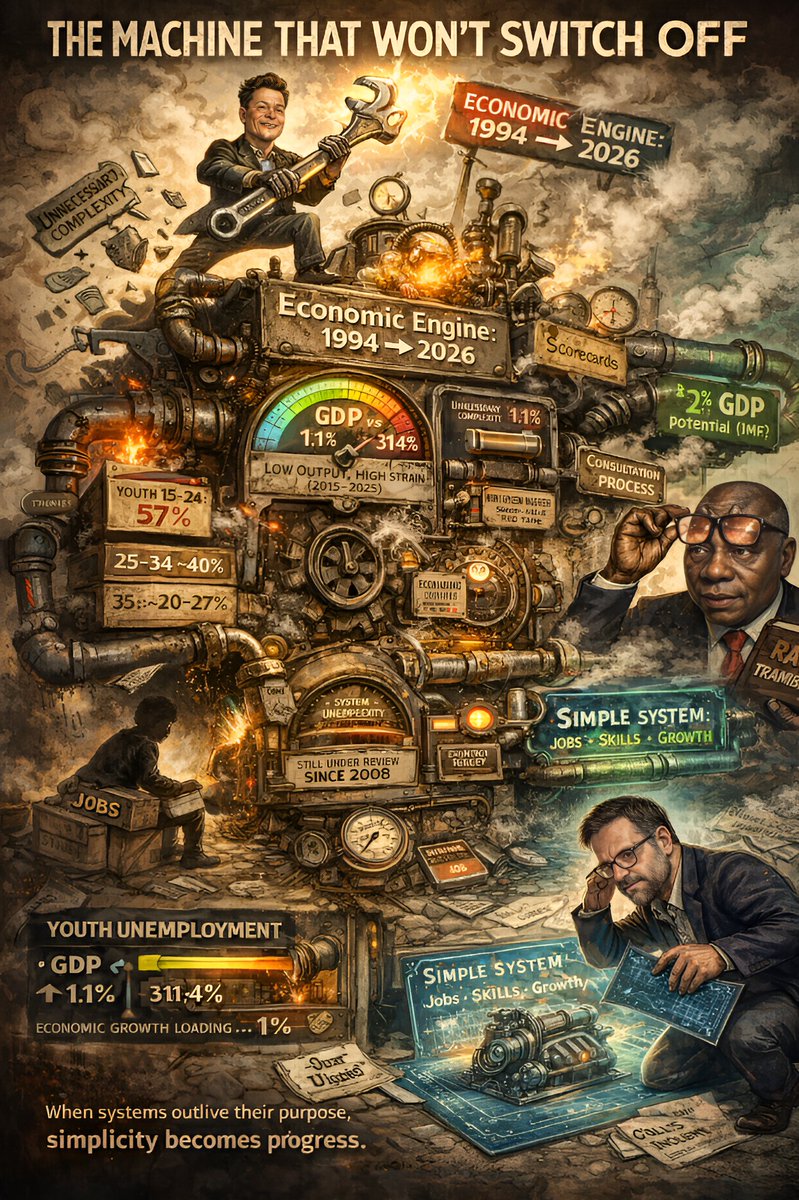
Then come the cold numbers, landing like a bucket of ice water after a warm bath of rhetoric. Stats SA data for Q4 2025 show GDP growth of 1.1% for the full year, with the fourth quarter expanding by 0.4% quarter-on-quarter. Official unemployment stood at 31.4% — its lowest in five years — yet the expanded rate including discouraged workers hovers around 42–45%, and youth unemployment remains near 57% (Statistics South Africa, 2026a, 2026b).
Modest gains in services, agriculture, and construction are welcome, but the economy still fails to absorb the hundreds of thousands of new labour market entrants each year amid persistent skills mismatches and regulatory red tape.
IMF analyses suggest that closing even half the gap to emerging-market best practices in business regulation and governance could lift real output by around 2% in the medium term, with broader reforms potentially delivering significantly more (International Monetary Fund, 2026).
Race-based compliance — ownership dilution requirements, numerical targets, and procurement premiums — diverts resources, deters investment, and fails to deliver transformative job creation or poverty reduction for the majority. The human cost is visible in discouraged workers, skilled emigration, and young South Africans watching opportunities evaporate while the list of historical excuses grows longer than the unemployment queue.
Dismantling these laws becomes not ideological preference but economic necessity if South Africa is to shift toward merit- and needs-based incentives capable of delivering the 4–6% sustained growth that marks the threshold for its next chapter of inclusive prosperity.
Questions Stirring:
If marginal quarterly gains are the best that three decades of race engineering can deliver, what would genuine, sustained growth actually look like without it?
How many more young people must join the ranks of the discouraged before we admit the current path is mathematically unsustainable?
And if regulatory reform alone could add meaningful output, why are we still prioritising race scorecards over jobs and skills?
These questions matter together because they ground the entire debate in cold, unforgiving reality. Numbers do not have ideology; they simply reveal what is working and what is not.
5: The Rhetorical Recalcitrance
The final stubborn obstacle is the one that refuses to read the room. In SONA 2026 and subsequent April statements, ANC figures reaffirmed BEE and affirmative action as “non-negotiable,” while announcing reviews aimed at “refining” and “strengthening” the framework, including proposals for a Transformation Fund (South African Government, 2026).
Yet simultaneous court setbacks, the DA Bill’s parliamentary advance, Lex Libertas advocacy, and stubbornly stagnant metrics expose the tension. Race laws, by design, prioritise group outcomes over individual merit and aggregate growth. Their retention risks prolonged low growth, continued emigration, and deepening social division.
Independent estimates have long pointed to cumulative economic costs running into trillions of rand and millions of foregone jobs.
The deeper the hole is dug, the louder the shouts of “progress!” Political rhetoric notwithstanding, sustained sub-par growth and the realities of coalition governance in the GNU era make comprehensive reform or dismantling increasingly inevitable.
This would free resources for genuine investment in education, infrastructure, and market-led job creation — the true foundations of South Africa’s next developmental chapter.
Questions Stirring:
How long can rhetoric outrun reality before the gap becomes too wide to bridge with another review or fund?
If BEE is truly an investment in growth, why has the broad-based growth not materialised after 32 years?
And if coalition partners cannot agree on the basic rules of the economic game, what does that say about the longevity of the current arrangement?
These questions matter together because they force us to confront the final, very human barrier: the reluctance to admit that a once-necessary policy has become part of the problem.
Final Resolution and Takeaway
All five sections converge on a single inescapable truth forged across the long arc of debate, data, and developing events from 1994 to mid-2026: South Africa’s race-based laws, born of genuine historical pain after colonialism and apartheid, have morphed into a gilded cage that now prevents the country from stepping boldly into its next chapter of merit-driven, inclusive growth.
The courts are stirring with constitutional challenges, Parliament is moving with alternative legislation, provinces and communities are awakening to the possibilities of decentralisation, the numbers refuse to lie despite modest quarterly gains, and even the most defiant rhetoric is beginning to sound hollow against three decades of mixed results and persistent structural drags.
The dismantling — whether through judicial rulings, legislative reform, or the quiet erosion of central control — is no longer a distant hypothetical but a trajectory shaped by mounting multi-front pressures. The sooner it occurs, the brighter the dawn.
The real choice before South Africa is no longer between redress and growth; it is between clinging to the scaffolding of the past and building a future where every citizen is judged by what they can contribute, not by the racial box they once ticked.
The crossroads is here. The road ahead — one of higher growth, broader opportunity, and genuine non-racial cohesion — is clear. All that remains is for the country to choose to take it.
Sjoe! The scaffolding is creaking louder than ever. The dawn is waiting. South Africa has the people, the resources, and the resilience. What it needs now is the courage to let go of what no longer serves and step forward into what can.
The evidence network proves the inevitability of dismantling race-based laws for South Africa’s next chapter of growth with undeniable evidence.
#SjoeSA 🇿🇦🔥
#SjoeMoments 😱
#SjoeEconomy 📉😬
#SAatCrossroads ⚖️🇿🇦
#PolicyPressure 💥📊
#GrowthOrNothing 🚀😤
#EconomicRealityCheck 📉🧠
#FixSAFast 🛠️🇿🇦
#FutureLoading ⏳🌅
#MeritMatters 💼✨
#LetSAWork 🙌🇿🇦
#NumbersDontLie 📊😬
#PolicyVsPeople 🤯👥
#SAReboot 🔄🇿🇦
#BreakTheBarriers 🚧💥
#UnlockGrowth 🔓📈
#FromRedTapeToResults 🧵➡️📊
#SAFutureNow 🌍⚡
#BoldChoicesOnly 💪🔥
#TimeToChoose ⏰⚖️
References
Democratic Alliance. (2026, March 13). DA requests debate on Economic Inclusion for All Bill.
da.org.za/2026/03/da-request…
International Monetary Fund. (2026, March 11). Enhancing South Africa’s business environment to boost growth and create jobs.
imf.org/en/news/articles/202…
Lex Libertas. (2026, February 12). Honest SONA 2026: Addressing the crisis, the symptoms and the root cause.
lexlibertas.org.za/media/hon…
Statistics South Africa. (2026a). Quarterly Labour Force Survey, Q4 2025.
statssa.gov.za/publications/…
Statistics South Africa. (2026b). Gross domestic product, fourth quarter 2025.
statssa.gov.za/?p=19291
South African Government. (2026). Statement on the Cabinet meeting of 25 March 2026.
gov.za/news/cabinet-statemen…