




Wise wasp is the Yoda. (@StuffKeithBuys )
The cat is the Pikachu (Julia)
Who inspires you?
Let’s go @StuffKeithBuys
Thanks for helping me learn #howtoai
Fine Kow!
1
3
74


Apr 28
This Viral Post by HowToAI is a Shocking Indictment of the State of AI discourse on X
This myth of a Single AI “Brain” in this viral post must be debunked, for the bullsh1t it is, bullsh1t that gets boosted on X while facts, the falsifiable, and the truth get throttled.
The viral post by HowToAI perfectly demonstrates the myths of AI and the contemporary AI-hype theatrics of low-informed and organised AI boosters.
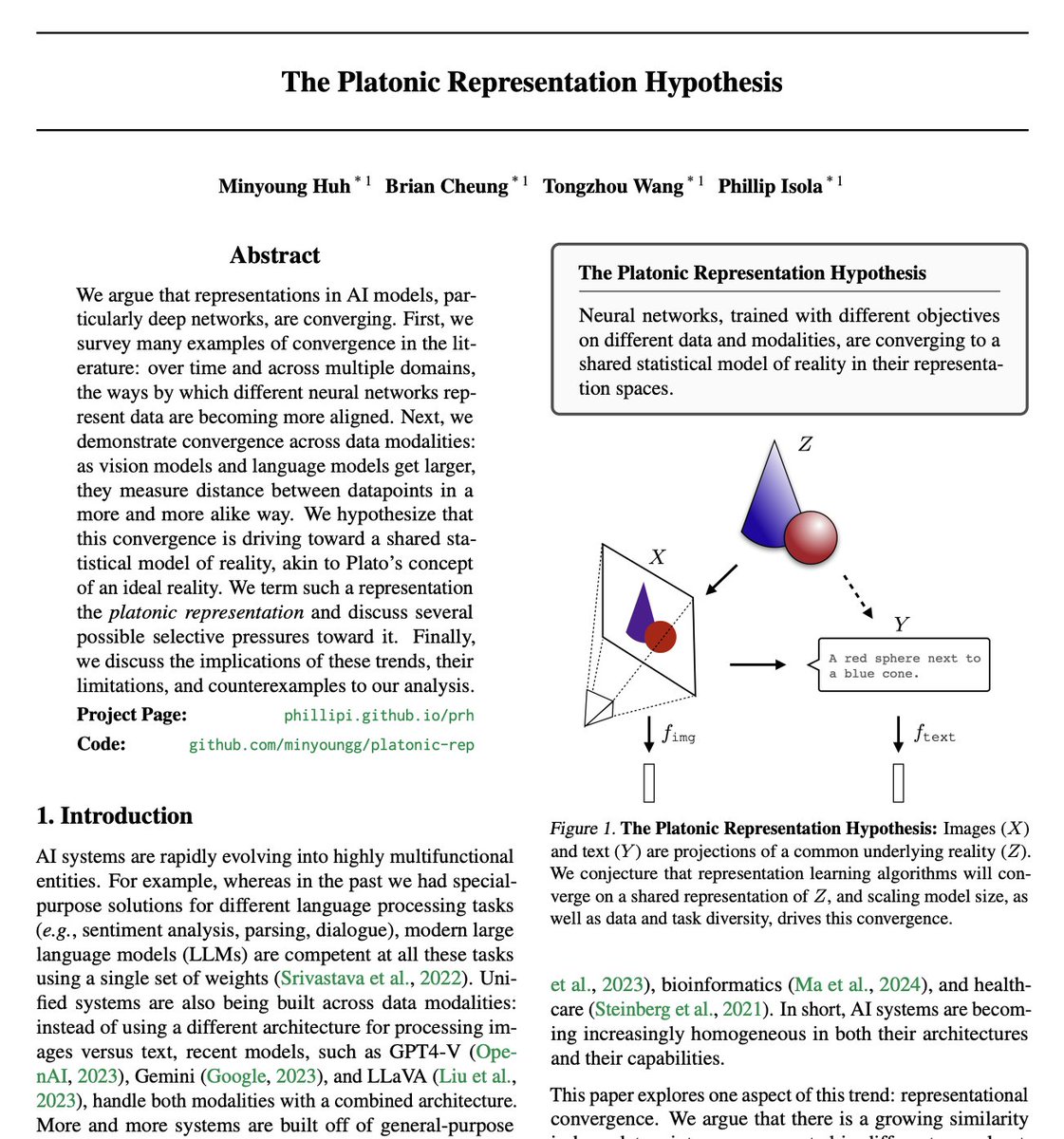
This post sensationalises an MIT-affiliated paper as if it proved that all big AI models share one “brain.”
In truth, the Platonic Representation Hypothesis paper is a speculative survey, not a proof. The authors themselves frame it as a hypothesis and explicitly note many caveats.
The abstract says “we argue that representations… are converging” and “we hypothesise a shared statistical model of reality”, language that clearly stops short of a definitive claim.
In fact, the paper ends by highlighting counterexamples and open questions, admitting that their findings are suggestive and that “different models arrive at similar but not the same representations”.
In short, the work is interesting food for thought, but it does not prove the existence of a universal AI brain.
Convergence Metrics ≠ Identical Geometry
The author of the post claims “the mathematical geometry is identical” across modalities.
This is a severe overstatement.
The paper measures alignment via similarity kernels (e.g., mutual nearest-neighbour overlap), rather than the exact identity of representations.
They find that as models scale up, alignment tends to increase, but remains far from perfect.
For example, the best reported alignment score is only about 0.6 on their metric (where 1.0 indicates perfect overlap).
The authors stress this point: different models “arrive at similar but not the same representations”, and a score of 0.6 (out of 1.0) leaves a lot unexplained.
A follow-up study by Gröger et al. (2026) further cautions that popular alignment metrics can be misleading: after statistically correcting for trivial effects of model size, “the apparent convergence reported by global measures largely disappears”.
In other words, the partial similarities observed are mostly low-level trends or shared biases, not evidence of a single unified “geometry.”
It is simply false to say vision-only and language-only nets measure distances exactly the same way. They have overlapping structure, but also big differences.
Modalities and Data Matter
Another false claim is that “it doesn’t matter what data” or architecture, as if any large model is forced to map the one “true reality.”
In reality, different data sources carry different information.
The authors explicitly acknowledge this: “two different models cannot converge to the same representation if they have access to fundamentally different information”.
For example, a text model never directly sees colours or shapes, and an image model has no native notion of abstract concepts expressed only in language.
The paper points out that their convergence argument strictly holds only when the input projections are bijective (i.e., information-preserving), a condition rarely met in practice.
In fact, the authors show that richer (more informative) captions improve vision-language alignment, implying that sparse data limits the effectiveness of any common representation.
In short, there is not “only one reality to map” for AI: each model’s “view” of the world is filtered by its data and tasks.
The paper even warns that highly specialised models (say, one trained just to drive a car or predict proteins) may follow “shortcuts” and not share representations at all.
So the posts claim that any large model inevitably builds a universal world model is unsupported.
Interpret with Caution
In summary, the posts claim wildly overreaches.
1. The Platonic Representation Hypothesis is a theory, and a cautious one: it suggests some representational similarities may emerge under certain conditions, not that AI models have identical “brains.”
2. All the paper’s concrete results show is a trend toward more alignment with size and multimodal training, with many caveats.
3. The authors themselves end by calling the remaining differences an open question.
4. A recent re-analysis confirms that most of the apparent convergence vanishes under stricter measurement.
In short, AI models do not measure distances between concepts in exactly the same way, nor do they discover a single Platonic structure.
The hype ignores the limitations sections of the paper, cherry-picks language like “shared model of reality,” and ignores that even the authors say “different sensors… might capture different information, which may limit their potential to converge”.
So, contrary to the post's claim, no one has proven the existence of a universal AI brain, and the Platonic hypothesis remains an intriguing idea, rather than a demonstrated fact.
Sources:
The arXiv paper by Huh et al. (2024) discusses these trends and caveats. A follow-up study by Gröger et al. (2026) critically examines the metrics and finds much weaker evidence for convergence. These are the actual sources behind the hype.
Huh et al., “The Platonic Representation Hypothesis” (arXiv:2405.07987, 2024); Gröger et al., “Revisiting the Platonic Representation Hypothesis: An Aristotelian View” (arXiv:2602.14486, 2026).
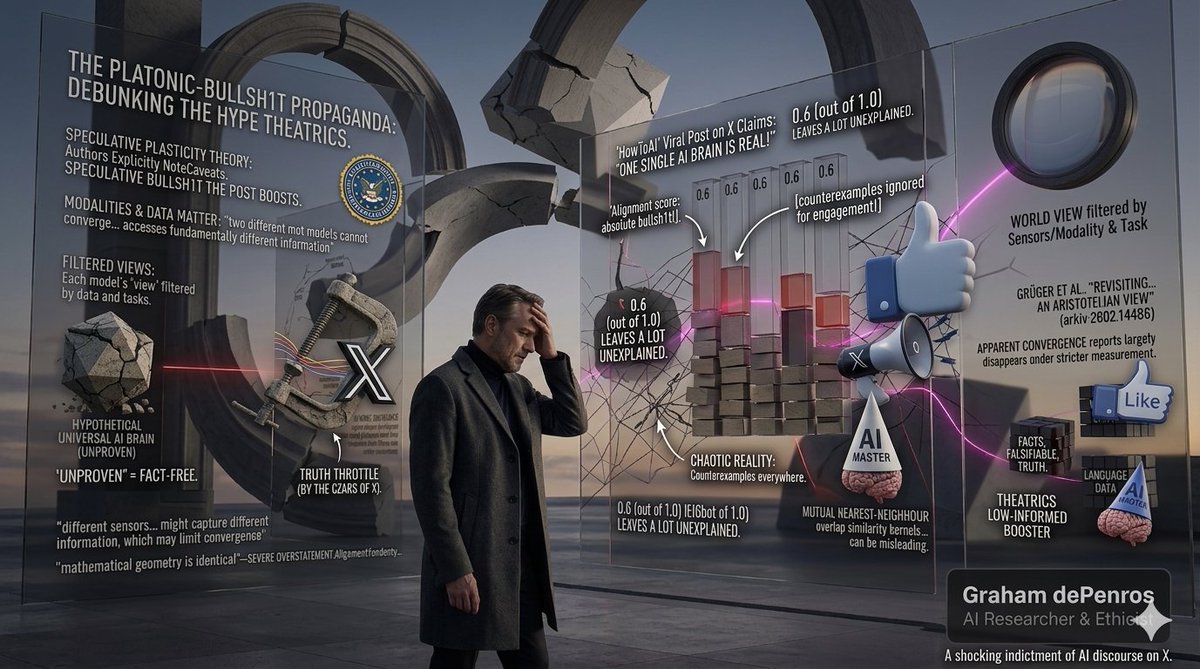
ALT A distressed AI researcher, Graham dePenros, stands before surreal, cracked stone arches at dusk, framed by transparent glass displays covered in critical text. A left panel headline reads: "THE PLATONIC-BULLSH1T PROPAGANDA: DEBUNKING THE HYPE THEATRICS," with graphics and points critiquing universal AI brains. The right panel exposes a viral X post claiming "one single AI brain is real," with data charts labeled "absolute bullshit" and counterexamples ignored. Text at the bottom states it's "A shocking indictment of AI discourse on X."
Apr 27

MIT proved every major AI model is secretly converging on the same "brain."
It’s called the “platonic representation hypothesis,” and it’s one of the most mind-blowing papers you’ll ever read.
You train a vision model purely on images. You train a language model purely on text.
They use completely different architectures. They process completely different data. They should have completely different "brains."
But as these models scale up, something impossible is happening.
When researchers measure how they organize information, the mathematical geometry is identical.
A model that only "sees" images and a model that only "reads" text are measuring the distance between concepts in the exact same way.
The models are converging.
The researchers named this after Plato’s Allegory of the Cave.
Plato believed that everything we experience is just a shadow of a deeper, hidden, perfect reality.
The paper argues that AI models are doing the exact same thing.
They are looking at the different "shadows" of human data, text, images, audio. And they are independently discovering the exact same underlying structure of the universe to make sense of it.
It doesn't matter what company built the AI.
It doesn't matter what data it was trained on.
As models get larger, they stop memorizing their specific tasks. They are forced to build a statistical model of reality itself.
And there is only one reality to map.
2024, Arxiv
1
9
13
351

Mar 29
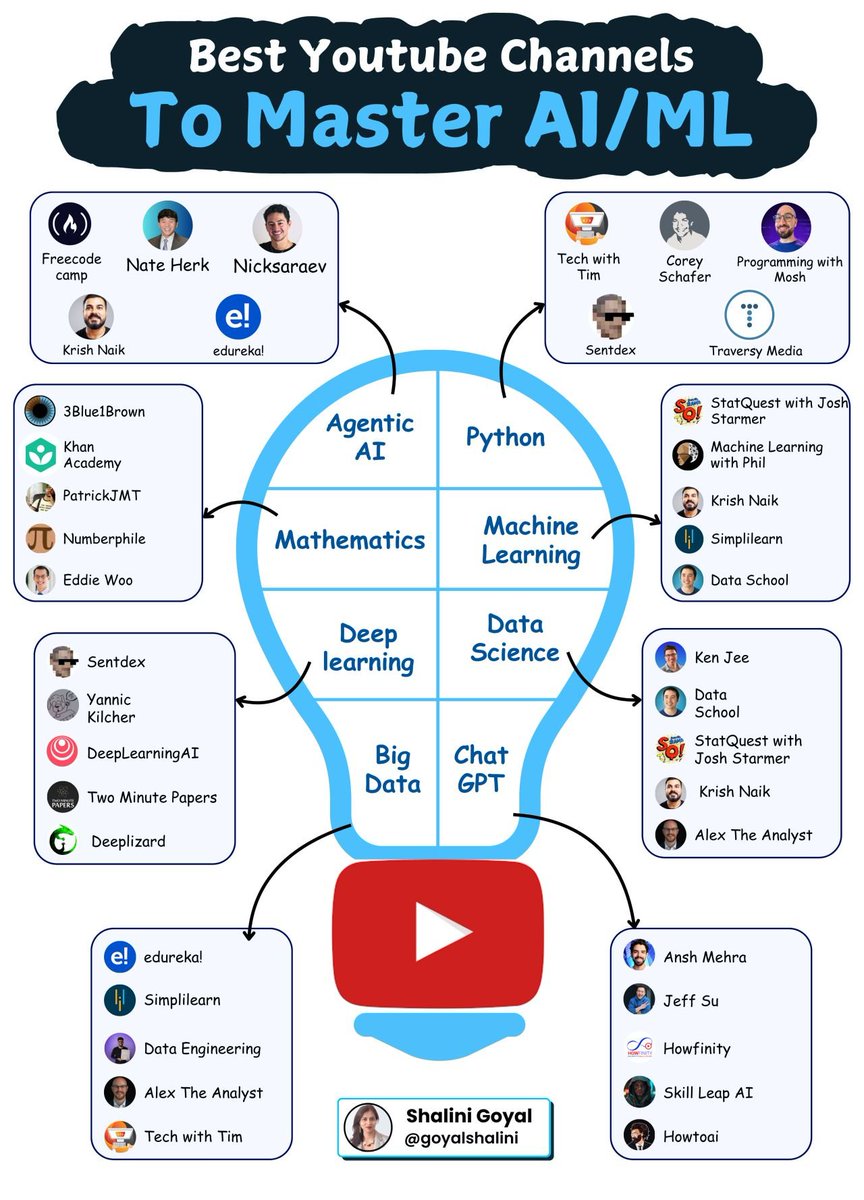
Want to learn AI/ML but don’t know where to start?
These YouTube channels will guide you step by step.
Whether you're building Agentic AI workflows or just starting with Python, this llist covers everything:
1. Agentic AI & ChatGPT
Watch creators like Krish Naik and Freecodecamp for hands-on projects with GPT, LLMs, and automation tools.
2. Machine Learning & Deep Learning
Explore channels like StatQuest, Yannic Kilcher, and DeepLearningAI for algorithm intuition and implementation walkthroughs.
3. Python & Data Science
From Corey Schafer to Ken Jee, these channels help you master the foundations of Python, analytics, and deployment.
4. Math for AI
Need help with the math behind the models? Start with 3Blue1Brown, Khan Academy, and PatrickJMT.
5. Big Data & Data Engineering
Follow Alex The Analyst, edureka!, and Data Engineering to scale your AI pipelines and manage large datasets.
6. Tools, Productivity & AI Assistants
Stay up to date with Ansh Mehra, Jeff Su, Skill Leap AI, and Howtoai to explore ChatGPT hacks, AI agents, and productivity automation.
Start with 1–2 channels that match your current level and niche. Be consistent, practice what you watch, and explore new tools as you grow.
1
8
39
1,271

Mar 12
BOOK ALERT!
There are lots of books out there on #AI, which is the latest buzzword. But if you are looking at a primer that gets you up to speed with AI, how it works, its major players and how you can make the most of it, we recommend the very aptly named "How to AI" by Christoper @mims, available in India from @HachetteIndia . It is super easy and even fun to read, and at around 250 pages, not an intimidating read at all.
@NimishAndAkriti review it in @IndianExpress, in our #ReadIt column, calling it "perhaps the one artificial intelligence primer all of us need to read."
#AI #HowToAI #ChristopherMims #Book #BookReview #Reading
indianexpress.com/article/bo…
2
5
344

Jan 30
just the howtoai youtube channel ALONE was making me $100k/mo at age twenty
but the reason why I didn't bring that operation to $150K-$200K/mo was not due to what you might think
the number #1 killer of scaling is getting stuck in the day-to-day trenches of reviewing scripts, managing freelancers
if I could start one or two howtoai copies at that time, I would, but my time was too restricted
this is a costly lesson I've learnt in hindsight
and also the reason my own software was born
this bottleneck of being stuck in the grunt work affects 99% of content agencies, YTA creators & marketers
many entrepreneurs could easily 2x their income by dedicating a week to making hires, writing SOPs & structuring up their team management system
if this sounds like you, sign up to the beta wailist on the @kloudboard page
also send a DM with your email for priority acceptance
it will not only save you money on subscriptions, but most importantly earn you a lot by helping you scale
super exciting times ahead
3
1
43
5,064
Jan 9
now can you still do all of this and get demonetized?
YES
that's just the game
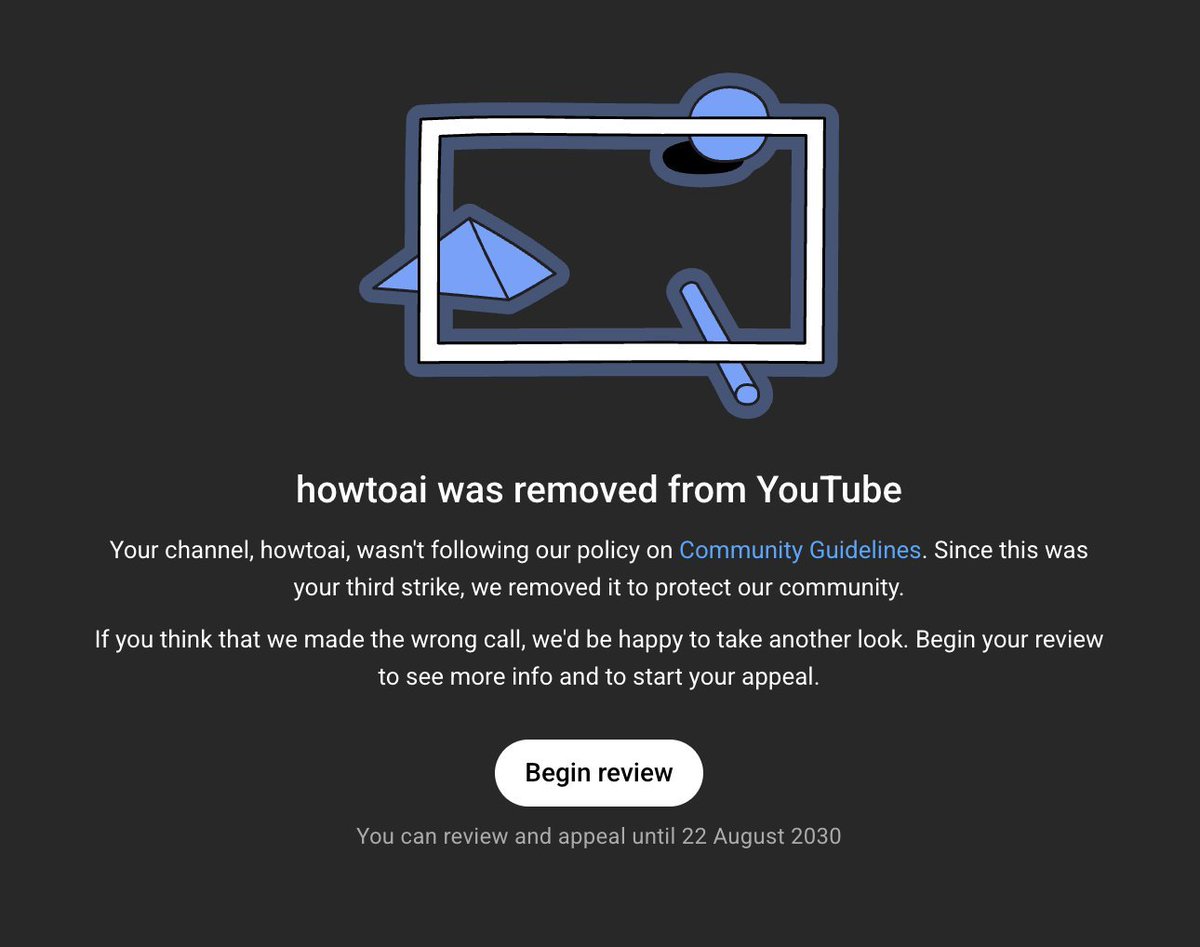
I had a channel called howtoai that got terminated in 2025
I wasn't posting AI slop, my content wasn't violating youtube's rules
and it still got terminated
that's just the way it is sometimes
but that doesn’t mean you shouldn’t start youtube automation
it’s still one of the best business models you can start as a beginner
you just need to approach it the right way:
1) create one channel
2) learn the process
3) build your team (people AI)
4) scale that channel to $5k /mo
5) then start a second channel
6) then a third one
don't put all your eggs in one basket
have channels in different niches so if one gets hit, you're still safe
that's how you build a sustainable youtube business
6
1
15
3,032

Just 9 videos? 100 QUALITY videos that people watch 100% before the algorithm likes your channel. But now YT cracks down on AI slop and delete AI channels, see the channel HowtoAI?
1
2
94
26 Dec 2025
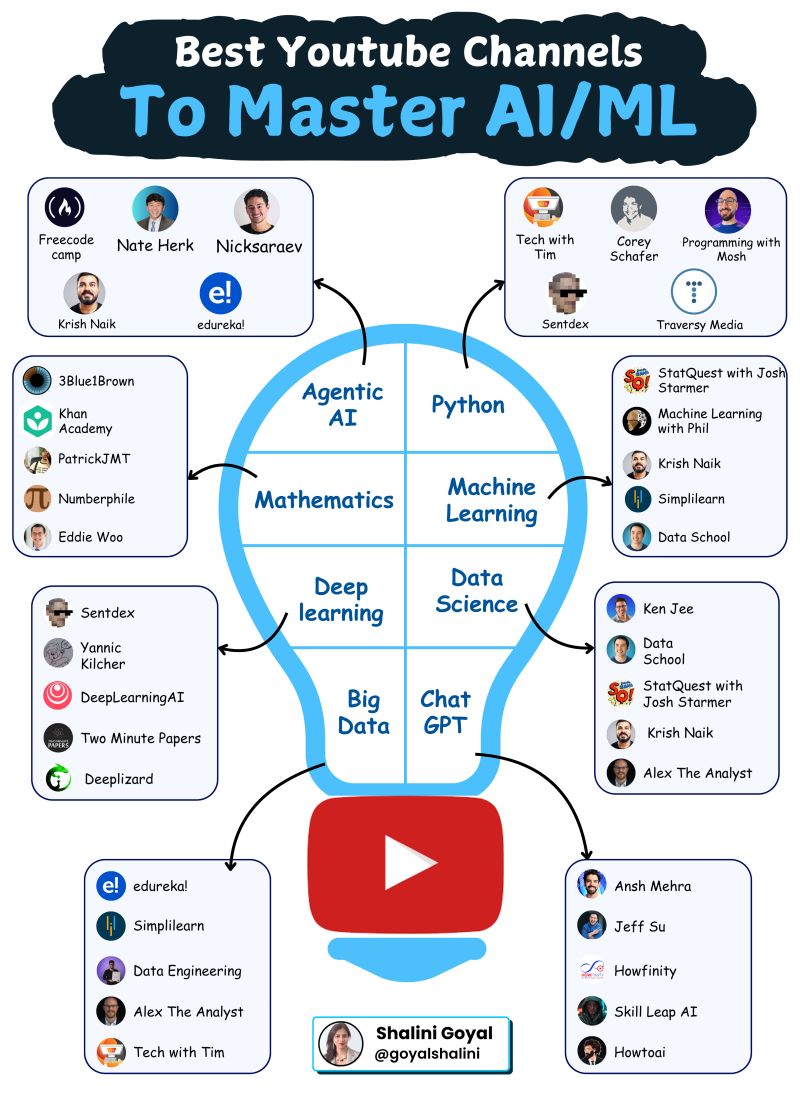
Want to learn AI/ML but don’t know where to start?
These YouTube channels will guide you step by step.
Whether you're building Agentic AI workflows or just starting with Python, this llist covers everything:
1. Agentic AI & ChatGPT
Watch creators like Krish Naik and Freecodecamp for hands-on projects with GPT, LLMs, and automation tools.
2. Machine Learning & Deep Learning
Explore channels like StatQuest, Yannic Kilcher, and DeepLearningAI for algorithm intuition and implementation walkthroughs.
3. Python & Data Science
From Corey Schafer to Ken Jee, these channels help you master the foundations of Python, analytics, and deployment.
4. Math for AI
Need help with the math behind the models? Start with 3Blue1Brown, Khan Academy, and PatrickJMT.
5. Big Data & Data Engineering
Follow Alex The Analyst, edureka!, and Data Engineering to scale your AI pipelines and manage large datasets.
6. Tools, Productivity & AI Assistants
Stay up to date with Ansh Mehra, Jeff Su, Skill Leap AI, and Howtoai to explore ChatGPT hacks, AI agents, and productivity automation.
Start with 1–2 channels that match your current level and niche. Be consistent, practice what you watch, and explore new tools as you grow.
13
33
121
4,817
15 Dec 2025
update: @TeamYouTube seems to have completely deleted all data of the channel from the platform
the channel's entire existence has been removed from the platform, including any data they were storing
this seems to be a new update, as the channel would remain with its data, but in the terminated state
now though, they seem to be getting rid of everything
might be wrong, so let me know if you have any insight on this
was a good run with howtoai, made a big mistake not saving all my content
22 Aug 2025

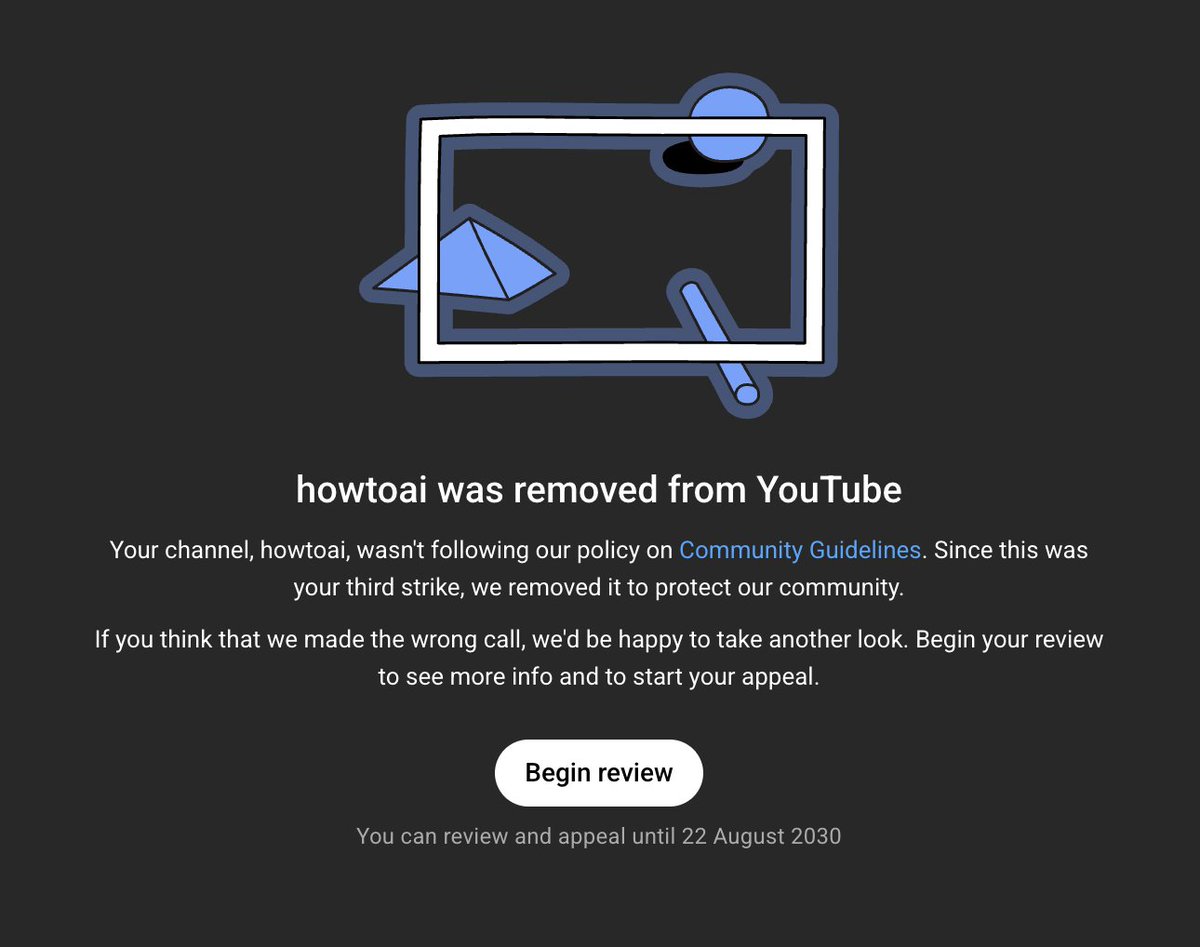
so howtoai just got its third strike in a single month
it's been up for two years, gaining over 330,000 subscribers
over 13 MILLION total views on educational content that have inspired people to start youtube
and youtube still relies on AI for automated policy reviews..
although it is clear that this is not due to the new AI policies everyone has hyped, something has changed
I received my first warning 1 year ago,
since the time when the channel first blew up, I've been posting the same content, making sure to stay within the policies for dangerous & harmful content
and no, my content is not made with AI or "AI slop"
a single video takes over 3 weeks to create with our team of 7 people
during the last 45 days only (July & Aug), youtube has striked 3 of my uploads
2 strikes consecutively on new uploads
1 older video taken down
all without a valid explanation, or explanation at all
(and of course youtube does not want to share the specific reason / timestamps)
I would've respected their decisions if they had a bit of legitimacy behind them
but all appeals rejected within minutes
even a YOUTUBE SUPPORT SUPERVISOR disregarded me from contacting them, instead of providing information that can help clear up the situation
I don't know what you @TeamYouTube @YouTube have got going on behind the scenes
but our team consisting of 7 people are now left without work or a place to show their creative skill
some team members had been working with howtoai for over a year
I advise you fix your platform or make this right before creators start migrating to other social media
and please don't reply to my post with the standard template message that leads to a dead end
--
for everyone else reading this,
setbacks like this eventually happen when you're starting to become "successful" or see significant results
I'll be spending my focus on scaling my other faceless channels even harder
howtoai is one of my earlier & biggest channels so it definitely sucks
especially considering it is a super clean educational channel free of copyright, spam or harmful content
but we move & $200K profit months are just around the corner
with our without howtoai.
tag @TeamYouTube if you wanna help make this right & share if you got a similar experience below
17
9
109
19,360
4 Dec 2025
this is why howtoai was insanely profitable
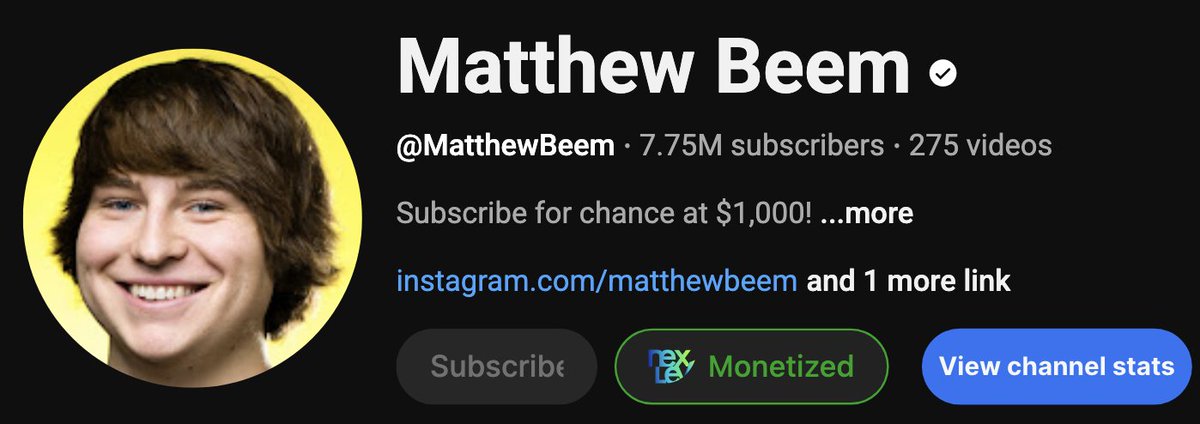
it made 2-3x the amount of money a 7M subscriber personal brand does
even when it was only at 100k subscribers
got a store at $1.5M revenue for a single product I was promoting, and I was monetizing through many more
either you go the ad revenue route and go infinitely hard on volume and scale,
or niche down and provide value with your content allowing for external monetization with your own products / affiliate deals
either works, and people are making insane money from both, but I see too many beginners trying to do both
there is no right or wrong in this question, but if you're trying to sell an AI e-book to your entertainment channel audience, chances are it wont work efficiently
with a channel providing educational content the viewers are already buyers the second they click your content
you already know their intent by them just watching the video
then just weave in your product to the solution and you're done gg

most youtubers have absolutely no idea what they're doing when it comes to monetization...
8 MILLION subscribers, a ton of investment & a whole team on payroll & he's only making $50k/month
i know channels with 5k subs that are pulling in $100k/month w/ 95% profit margins
this is why you should ALWAYS prioritize niche profits over virality
guys like mrbeast have really skewed peoples perception of how money is made through social media...
99.9% of people should never even consider going the "viral" route
6
6
101
17,703