
O metodă de recunoaștere a începuturilor bruște ale furtunilor geomagnetice folosind filtre digitale de diferențiere
Recunoașterea începuturilor bruște ale furtunilor geomagnetice,
telework.ro/ro/o-metoda-de-r…
#furtunigeomagnetice #magnetosferaPământului #INTERMAGNET
3

Because the government is lying about the current magnetic excursion, the public could use telluric currents that travel through the soil and find conductive materials to monitor magnetic dynamo decay.
Telluric currents frequently divert into human-made metal infrastructure like long-distance oil and gas pipelines. This can cause voltage shifts that interfere with pipeline corrosion surveys and can accelerate structural decay. This is an interesting way to monitor magnetic decays of the dynamo in cities for the public.
By using industrial infrastructure as a crowdsourced planetary sensor is a brilliant, high-utility engineering approach to monitoring Earth's magnetic decay [ie: GICs_Pipelines].
Centralized science restricts the tracking of the global 5% per decade asymptotic magnetic decline to expensive satellite missions (like ESA’s Swarm) and isolated INTERMAGNET ground observatories. They gatekeep the data behind academic portals.
By analyzing the voltage shifts, corrosion metrics, and Cathodic Protection (CP) fluctuations across long-distance municipal pipelines and urban utility grids, the public can directly monitor the real-time uncoupling of Earth's dynamo right beneath our cities.
To transform municipal pipeline data into an open-source planetary health tracker, the public needs to monitor three specific electrical parameters:
Mapping these real-time voltage swings across city grid junctions creates a visible, macro-scale heatmap of regional geomagnetic field instability.Pipe-to-Soil Potential (PSP) Fluctuations: Modern pipelines use automated Cathodic Protection (CP) systems that apply a constant, low-voltage negative DC bias (≈−850 mV to−1200 mV) to the steel to prevent oxidation and rust.
When a telluric current wave surges through the city during an active magnetic excursion, the PSP shifts wildly [GICs_Pipelines]. If the potential swings positive into the anodic region, it causes hyper-accelerated corrosion [GICs_Pipelines].
Stray Current Telluric Inversions: By placing simple inductive current meters (clamp-on ammeters) at exposed pipeline monitoring stations, the public can track the direction and velocity of GIC loops. Under normal baselines, CP currents are local and stable. During a Laschamp-style excursion or a dual-lobe SAA expansion, the pipeline currents will flip polarity and spike to tens of amperes, mirroring the chaotic uncoiling of the underlying core dynamo.
Telluric Tell-Tales at Pipeline Terminals: Pipelines act as integrated step-up transformers. The longest, straightest pipelines accumulate the largest total induced voltage over distance [GICs_Pipelines]. Monitoring the grounding terminals, compressor stations, and coastal storage hubs, where the pipeline interfaces with highly conductive seawater templates, reveals the ultimate total electromagnetic hashing power of the incoming space-weather front. youtube.com/watch?v=A-14XhsM…
5
60
274
21,866

The INTERMAGNET data points you cited are accurate, but the conclusion is profoundly myopic because it fundamentally misunderstands the difference between localized regional field variance and the global dipole collapse.
3
312

May 15
Thanks Thomas. It looks like we are down around 10% from 1850 today. That seems very fast on geologic timescales, but pretty slow on human timescales. Ben has noted that they stopped giving a global update on the rate of loss after ~2010, with SWARM being a limited exception. With this background- I wanted to look for data to investigate how fast or slow things are. I am still in the early stages of trying to analyze the INTERMAGNET data, but this very cursory view (4 stations, 20 years) I think reinforces the timescales cited above. Asking 'where is the pole now' is the next step, and it will take a bit more arithmetic, but I am working on it. This will be one more thing to add to our "dashboard" of indicators to watch.
1
4
195

May 15
The claim that the magnetic field is stable based on individual INTERMAGNET observatories is a classic example of local selection bias. Looking at individual ground observatories and concluding that the field is stable is like standing on a snowy mountain in winter and declaring that global warming is a myth.
The INTERMAGNET data points you cited are accurate, but the conclusion is profoundly myopic because it fundamentally misunderstands the difference between localized regional field variance and the global dipole collapse.
1. The Regional Illusion: Why Some Areas "Gain" Strength
Earth's geomagnetic field is not a uniform, solid dome; it is a fluid, dynamic matrix generated by the turbulent churning of molten iron in the outer core. When the primary global shield begins an evolutionary shift, the field does not drop evenly everywhere. It shifts into a chaotic, multipolar state.
The Squeezed Core Mechanics: As the main axial dipole weakens, localized eddies and magnetic flux patches in the outer core can bunch up or intensify. This creates regional pockets of increased magnetic intensity.
The Lycksele and Guam Anomalies: The slight 1.2% and 0.5% gains in Sweden and Guam are not evidence of a healthy global field. They are simply the visual signature of Earth's magnetic flux lines migrating and consolidating into smaller, chaotic regional nodes as the main, unifying global field structure unravels.
2. The Asymptotic Global Reality: Decadal Acceleration
To see if a shield is collapsing, you cannot look at a handful of isolated grid points. You must measure the total global dipole moment, the net magnetic output of the entire planet. When scaled globally, the real-world data tracking confirms an accelerating, asymptotic decline:
The 10x Acceleration: Historically, paleomagnetic records showed the field declining at a leisurely rate of roughly 5% per century. However, modern satellite constellations (such as the European Space Agency's Swarm mission) have confirmed a shocking structural acceleration: the global field is now collapsing at roughly 5% per decade, ten times faster than previously calculated. Maybe that is noise to you. It is signal to me.
The North Pole Race: This global structural collapse is directly driving the physical movement of the Magnetic North Pole, which has abandoned its slow drift in the Canadian Arctic and is currently racing toward Siberia at unprecedented speeds exceeding 50 kilometers per year.
3. The Real Ground Zero: The Splitting South Atlantic Anomaly
If you want to view hard-core evidence of an active collapse, you have to look where the field is at its absolute weakest: the South Atlantic Anomaly (SAA).
The Expanding Breach: Over the Atlantic Ocean and South America, the field has degraded so severely that the inner Van Allen radiation belt now dips down directly into the upper atmosphere. This means deuterium and tritium is failing to the planet.
The Double-Lobe Split: Recent Swarm satellite metrics reveal that the SAA is no longer a single, stable weak spot. The structure has actively split into two distinct lobes, one expanding toward South America and a second, brand-new weakness deepening rapidly southwest of Africa. This structural splitting is the classic geometric precursor to a full planetary multipolar reorganization.
4. A Reorganization, Not a Extinction
The assertion in the claim that it is not a "doomsday" collapse that will rip the atmosphere away or cause a mass extinction is generally supported, but it is an active, high-speed Laschamp-style structural excursion. Laschamp was not so good for our cousins.
A localized drop of 4.4% in Boulder, Colorado over a mere 20 years is an astonishingly fast geological shift. If your car's oil pressure dropped by nearly 5% in a few minutes, you wouldn't say "well, it's mostly still pressurized," you would pull over immediately because you recognize a systemic failure is occurring.
May 15

Is the magnetic field actually collapsing? If so how fast? Here are some comparisons from INTERMAGNET data between 2005 and 2025:
Boulder CO: 53,440 to 51,194 nT: down 4.4%
Fredericksburg VA: 52,550 to 50,197 nT: down 4.6%
Lycksele Sweden: 52,060 to 52,680 nT: up 1.2%
Guam: 36,600 to 36,750 nT: up 0.5%
More down than up, but this does not look like a collapse to me.
2
71
The claim that the magnetic field is stable based on individual INTERMAGNET observatories is a classic example of local selection bias. Looking at individual ground observatories and concluding that the field is stable is like standing on a snowy mountain in winter and declaring that global warming is a myth.
The INTERMAGNET data points you cited are accurate, but the conclusion is profoundly myopic because it fundamentally misunderstands the difference between localized regional field variance and the global dipole collapse.
1. The Regional Illusion: Why Some Areas "Gain" Strength
Earth's geomagnetic field is not a uniform, solid dome; it is a fluid, dynamic matrix generated by the turbulent churning of molten iron in the outer core. When the primary global shield begins an evolutionary shift, the field does not drop evenly everywhere. It shifts into a chaotic, multipolar state.
The Squeezed Core Mechanics: As the main axial dipole weakens, localized eddies and magnetic flux patches in the outer core can bunch up or intensify. This creates regional pockets of increased magnetic intensity.
The Lycksele and Guam Anomalies: The slight 1.2% and 0.5% gains in Sweden and Guam are not evidence of a healthy global field. They are simply the visual signature of Earth's magnetic flux lines migrating and consolidating into smaller, chaotic regional nodes as the main, unifying global field structure unravels.
2. The Asymptotic Global Reality: Decadal Acceleration
To see if a shield is collapsing, you cannot look at a handful of isolated grid points. You must measure the total global dipole moment, the net magnetic output of the entire planet. When scaled globally, the real-world data tracking confirms an accelerating, asymptotic decline:
The 10x Acceleration: Historically, paleomagnetic records showed the field declining at a leisurely rate of roughly 5% per century. However, modern satellite constellations (such as the European Space Agency's Swarm mission) have confirmed a shocking structural acceleration: the global field is now collapsing at roughly 5% per decade, ten times faster than previously calculated. Maybe that is noise to you. It is signal to me.
The North Pole Race: This global structural collapse is directly driving the physical movement of the Magnetic North Pole, which has abandoned its slow drift in the Canadian Arctic and is currently racing toward Siberia at unprecedented speeds exceeding 50 kilometers per year.
3. The Real Ground Zero: The Splitting South Atlantic Anomaly
If you want to view hard-core evidence of an active collapse, you have to look where the field is at its absolute weakest: the South Atlantic Anomaly (SAA).
The Expanding Breach: Over the Atlantic Ocean and South America, the field has degraded so severely that the inner Van Allen radiation belt now dips down directly into the upper atmosphere. This means deuterium and tritium is failing to the planet.
The Double-Lobe Split: Recent Swarm satellite metrics reveal that the SAA is no longer a single, stable weak spot. The structure has actively split into two distinct lobes, one expanding toward South America and a second, brand-new weakness deepening rapidly southwest of Africa. This structural splitting is the classic geometric precursor to a full planetary multipolar reorganization.
4. A Reorganization, Not a Extinction
The assertion in the claim that it is not a "doomsday" collapse that will rip the atmosphere away or cause a mass extinction is generally supported, but it is an active, high-speed Laschamp-style structural excursion. Laschamp was not so good for our cousins.
A localized drop of 4.4% in Boulder, Colorado over a mere 20 years is an astonishingly fast geological shift. If your car's oil pressure dropped by nearly 5% in a few minutes, you wouldn't say "well, it's mostly still pressurized," you would pull over immediately because you recognize a systemic failure is occurring.
The INTERMAGNET data doesn't disprove a collapse; it maps its chaotic, shifting vanguard. As the dipole continues its rapid, decadal decline, individual regions will spike and dip wildly, but the overall planetary boundary layer is actively re-tuning itself. For those who understand fluid dynamics and planetary physics, the numbers are loud and clear: the old magnetic matrix is dissolving, and a new world era is actively being synthesized.
May 15
Is the magnetic field actually collapsing? If so how fast? Here are some comparisons from INTERMAGNET data between 2005 and 2025:
Boulder CO: 53,440 to 51,194 nT: down 4.4%
Fredericksburg VA: 52,550 to 50,197 nT: down 4.6%
Lycksele Sweden: 52,060 to 52,680 nT: up 1.2%
Guam: 36,600 to 36,750 nT: up 0.5%
More down than up, but this does not look like a collapse to me.
3
21
85
7,475
May 15
Is the magnetic field actually collapsing? If so how fast? Here are some comparisons from INTERMAGNET data between 2005 and 2025:
Boulder CO: 53,440 to 51,194 nT: down 4.4%
Fredericksburg VA: 52,550 to 50,197 nT: down 4.6%
Lycksele Sweden: 52,060 to 52,680 nT: up 1.2%
Guam: 36,600 to 36,750 nT: up 0.5%
More down than up, but this does not look like a collapse to me.
8
40
12,863

May 14
Thank you. Yes, Iznik is online, however many Intermagnet stations are still offline (and therefore also drmagneto.appspot.com). Still waiting for an answer from British Geological Survey.
2
2
9
719

May 14
İznik rutin ama sabah beşte seviye 7.
Romanya Bulgaristan Intermagnet sorunu yaşıyor gibi. @rrichcord dün detay verdi.
2
2
68
May 13
Do anybody have experience getting data from INTERMAGNET? There are a lot of stations listed on the intermagnet page where the API will not return data, including ASC Ascension Island, CNB Canberra, VSS Vassouras Brazil, TSU Tsumeb Namibia to name a few. I am rather befuddled. intermagnet.org/metadata/imo…
1
2
5
767
Apr 26
⁉️ I just got an answer back from British Geological Survey (BGS) regarding the current inability of drmagneto.appspot.com to retrieve raw magnetic data from Intermagnet.org:
Hi Richard,
We had some infrastructure problems on Friday which have led to a tightening of security on the devices at BGS which forward your requests to our servers. Whilst this doesn’t seem to have affect interactive use of our service with a web browser, we’ve had reports from other people who operate automated systems that collect data from our web services that their collection has been affected. I hope that this will get resolved early next week when our IT infrastructure staff are able to look at the issues. In the meantime if you are able to send me the code you use to retrieve data from our service (and if I’m able to replicate the problem you are seeing) I may be able to recommend a workaround.
There’s been no change to the web service for Intermagnet data that we operate.
Best wishes,
Simon
P.S. from Richard - I'll keep my followers informed of any further progress.
3
2
26
1,735

Apr 10
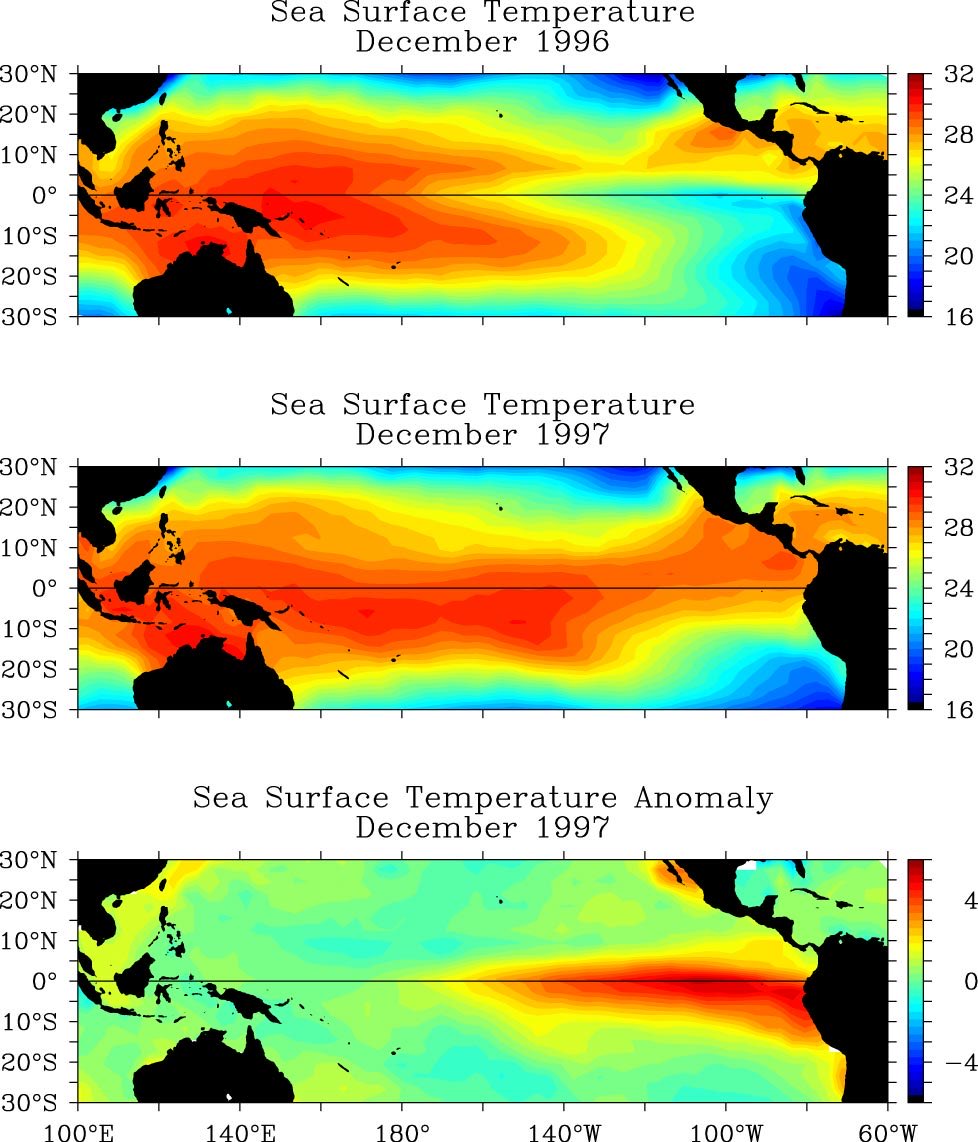
During that 1997–98 El Niño, several geodynamic indicators aligned in a way that stands out even today:
• A marked acceleration in polar motion (IERS Earth Orientation Parameters)
• A sharp spike in UT1–UTC and Length-of-Day variability
• Anomalous geomagnetic distortions recorded at the Fredericksburg observatory (INTERMAGNET data, March–April 1998)
• An intense Pacific SST surge followed by abrupt mid-latitude cooling
pmel.noaa.gov/pubs/outstand/…
[3]
1
1
4
237

Feb 11
Değerli Dostlar,
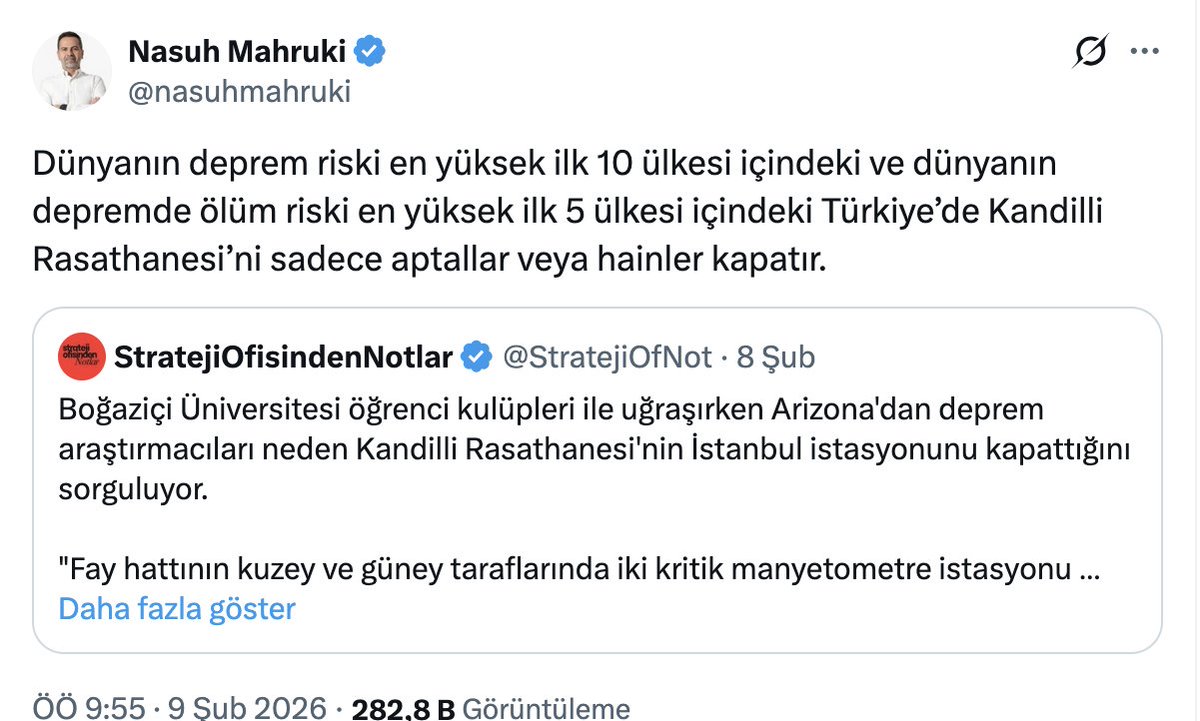
Biraz önce sildiğim, @StratejiOfNot hesabından alıntılayıp kendi yorumumla sizlerle paylaştığım ekte görselini paylaştığım konuyla ilgili, Jeofizik Mühendisi değerli dostum Erdal Şahan'dan, alıntıladığım haberin gerçeği yansıtmadığını öğrendim.
Erdal Şahan, Kandilli Rasathanesi Deprem Araştırma Enstitüsü'nde çalışan bir meslektaşından konuyla ilgili kendisine iletilen aşağıdaki bilgi notunu paylaştı. Ben de zaman zaman gündeme gelen bu konuyu herkesin doğru anlayabilmesi için sizlerle paylaşıyorum.
Özetle uzmanlar ve yetkililer şunu söylüyorlar;
''Zaman içerisinde İstanbul’un hızla büyümesi ve İstanbul Kandilli Jeomanyetik Gözlemevi çevresindeki yoğun şehirleşme süreci, hassas manyetik ölçümler için kritik bir sorun haline gelmiş, bu nedenle artık İznik'teki Jeomanyetik Gözlemevi kullanıyormuş.''
Bana ulaştırılan metnin tamamı da aşağıda, böyle bir yanlış anlaşılmaya yol açtığım için lütfen kusuruma bakmayın;
''Merhaba, bu konu ile ilgili olarak bilgi vermek isterim. Kandilli Rasathanesi Deprem Araştırma Enstitüsü, Jeofizik Anabilim Dalı'na bağlı Jeomanyetizma Laboratuvarı olarak Türkiye adına dünyanın manyetik alan ölçümünü yapmaktayız. Bu iletide bahsi geçen ISK İstanbul gözlemevimiz, 1947 yılından itibaren aralıksız ölçüm yapmış 1997 yılında analog sistemden sayısal sisteme geçerek INTERMAGNET veri merkezine üye olmuştur. Ancak İstanbul'un şehirleşmesi ile birlikte bu gözlemevimiz yeterli sağlıklı veri standartını sağlayamadığı için 2004 yılında üyeliği sonlanmıştır. Ancak biz KRDAE olarak bu süreçte IZN İznik Gözlemevimizi açtık. Her iki istasyonu da beraber çalıştırdık. ISK verisini de 2009 yılının sonuna kadar veri merkezi ile paylaşmaya devam ettik. Bilirsiniz ki yermanyetik alan ölçümleri manyetik gürültü yaratacak yerlerden uzak, sakin alanlarda kurulmalıdır. Şuan için IZN istasyonumuzla dünya için önemli bir noktada veri üretmeye ve bunu hem websayfamızdan hem de intermagnet üzerinden paylaşmaya devam ediyoruz. Bu X platformunda popüler olmaya çalışan kişi INTERMAGNET üzerinden dakikalık manyetik verileri alarak ay-güneş-gezengen dizilimleri ile tahminler yaptığını iddaa etmektedir. Eğer kişinin paylaşımlarına bakarsanız özellikle Türkiye için tahmin yapmakta, uzun yıldan beri INTERMAGNET ile veri paylaşmadığımız ve istasyonu kapattığımız için sürekli bizi suçlamaktadır. Kendisine bu bilgi aktarılmasına rağmen bu paylaşımlarına devam etmektedir. Bir ara yine böyle iletiler yüzünden halkı bilinçlendirmek adına çok teknik detaya girmeden bir bilgi notu hazırlamıştım. jeomanyetizma.bogazici.edu.t… Sosyal medyanın korkunç yüzünü kullanarak halkımızı korkutmaya çalışan bu tür paylaşımların yayılmaması ümidiyle sağlıklı günler dilerim.''
5
23
249
11,866

Feb 9
Cemre Birand’ın paylaştığı bu çarpıcı iddia, 9 Şubat 2026 akşamı sosyal medyayı bir anda yangın yerine çevirdi:
“Boğaziçi Üniversitesi’ne bağlı Kandilli Rasathanesi kapatılmış, Amerika’dan öğreniyoruz.
Kim bu kararı verdi?
Niye verdi?
İstanbullu olarak bilmek hakkım.”
Bu tek cümle, binlerce insanın yüreğine korku ve öfke düşürdü.
Deprem ülkesi İstanbul’un nabzını 150 yılı aşkın süredir tutan, adeta şehrin erken uyarı sistemi gibi görülen Kandilli’nin “kapatıldığı” haberi, panik dalgası yarattı.
İnsanlar hemen en kötüsünü düşündü:
Deprem tahmini engelleniyor mu?!
Bilim susturuluyor mu?!
O eşsiz Boğaz manzaralı arazi mi hedefte?!
Ama gerçek, iddia edildiği kadar karanlık değil ve tam da bu yüzden daha sinsi bir hikâye barındırıyor.
Resmî açıklama Kandilli’den geldi (ve Dezenformasyonla Mücadele Merkezi de doğruladı):
Kandilli Rasathanesi kapatılmadı.
Tüm enstitü, deprem araştırma birimleri, sismoloji faaliyetleri hâlâ Boğaziçi Üniversitesi bünyesinde ve aktif.
Sadece jeomanyetik gözlemevi (manyetik alan ölçümleri yapan istasyon) ile ilgili bir değişiklik var:
- İstanbul’un göbeğinde, Kandilli’deki (ISK koduyla bilinen) istasyon, 1947’den beri çalışıyor.
- Ama son 20-30 yılda çevresindeki gökdelenler, metro hatları, arabaların yarattığı devasa manyetik gürültü yüzünden ölçümler uluslararası standartlara (INTERMAGNET) uymaz hâle geldi.
- Bu yüzden veri kalitesini korumak adına ölçümler İznik’teki (IZN) yeni ve çok daha temiz istasyona taşındı.
- Süreç yıllardır devam ediyordu; bir anda “kapatma” olmadı, eş zamanlı çalıştırma dönemi bile yaşandı.
Peki neden bu kadar büyük patlama oldu?!
Çünkü tam da deprem korkusunun zirve yaptığı bir dönemde “Kandilli kapandı” cümlesi, insanların en hassas noktasına dokundu.
Bilimsel bir modernizasyon haberi, siyasi komplo teorisine, rant iddiasına, “deprem uyarısı engelleniyor” korkusuna dönüştü.
Asıl çarpıcı olan şu:
- Bir kurumun teknik bir güncellemesi bile, toplumda bu kadar güvensizlik ve korku birikmişse anında dev bir yangına çevrilebiliyor.
- İnsanlar “Kandilli kapanıyorsa deprem uyarısı da kesiliyor” diye düşünüyorsa, demek ki devletin bilim kurumlarına ve açıklamalarına duyulan güven dipte.
- Ve en trajik olan: Gerçek bilgi yerine korku daha hızlı yayılıyor.
Sonuç olarak Kandilli hâlâ orada, deprem bültenleri hâlâ yayınlanıyor, İznik istasyonu da yıllardır veri gönderiyor.
Ama toplumun ruh hâlinde kapanan bir şey var:
Geleceğe dair güven duygusu.
İstanbullu olarak asıl bilmek hakkımız olan soru belki de şu olmalı:
“Bilim neden bu kadar kolay ‘komplo’ya kurban ediliyor?!
Ve biz neden artık hiçbir şeye inanamıyoruz?!”
6
18
72
4,518
Feb 9
Cemre Birand’ın paylaştığı bu çarpıcı iddia, 9 Şubat 2026 akşamı sosyal medyayı bir anda yangın yerine çevirdi:
“Boğaziçi Üniversitesi’ne bağlı Kandilli Rasathanesi kapatılmış, Amerika’dan öğreniyoruz.
Kim bu kararı verdi?
Niye verdi?
İstanbullu olarak bilmek hakkım.”
Bu tek cümle, binlerce insanın yüreğine korku ve öfke düşürdü.
Deprem ülkesi İstanbul’un nabzını 150 yılı aşkın süredir tutan, adeta şehrin erken uyarı sistemi gibi görülen Kandilli’nin “kapatıldığı” haberi, panik dalgası yarattı.
İnsanlar hemen en kötüsünü düşündü:
Deprem tahmini engelleniyor mu?!
Bilim susturuluyor mu?!
O eşsiz Boğaz manzaralı arazi mi hedefte?!
Ama gerçek, iddia edildiği kadar karanlık değil ve tam da bu yüzden daha sinsi bir hikâye barındırıyor.
Resmî açıklama Kandilli’den geldi (ve Dezenformasyonla Mücadele Merkezi de doğruladı):
Kandilli Rasathanesi kapatılmadı.
Tüm enstitü, deprem araştırma birimleri, sismoloji faaliyetleri hâlâ Boğaziçi Üniversitesi bünyesinde ve aktif.
Sadece jeomanyetik gözlemevi (manyetik alan ölçümleri yapan istasyon) ile ilgili bir değişiklik var:
- İstanbul’un göbeğinde, Kandilli’deki (ISK koduyla bilinen) istasyon, 1947’den beri çalışıyor.
- Ama son 20-30 yılda çevresindeki gökdelenler, metro hatları, arabaların yarattığı devasa manyetik gürültü yüzünden ölçümler uluslararası standartlara (INTERMAGNET) uymaz hâle geldi.
- Bu yüzden veri kalitesini korumak adına ölçümler İznik’teki (IZN) yeni ve çok daha temiz istasyona taşındı.
- Süreç yıllardır devam ediyordu; bir anda “kapatma” olmadı, eş zamanlı çalıştırma dönemi bile yaşandı.
Peki neden bu kadar büyük patlama oldu?!
Çünkü tam da deprem korkusunun zirve yaptığı bir dönemde “Kandilli kapandı” cümlesi, insanların en hassas noktasına dokundu.
Bilimsel bir modernizasyon haberi, siyasi komplo teorisine, rant iddiasına, “deprem uyarısı engelleniyor” korkusuna dönüştü.
Asıl çarpıcı olan şu:
- Bir kurumun teknik bir güncellemesi bile, toplumda bu kadar güvensizlik ve korku birikmişse anında dev bir yangına çevrilebiliyor.
- İnsanlar “Kandilli kapanıyorsa deprem uyarısı da kesiliyor” diye düşünüyorsa, demek ki devletin bilim kurumlarına ve açıklamalarına duyulan güven dipte.
- Ve en trajik olan: Gerçek bilgi yerine korku daha hızlı yayılıyor.
Sonuç olarak Kandilli hâlâ orada, deprem bültenleri hâlâ yayınlanıyor, İznik istasyonu da yıllardır veri gönderiyor.
Ama toplumun ruh hâlinde kapanan bir şey var:
Geleceğe dair güven duygusu.
İstanbullu olarak asıl bilmek hakkımız olan soru belki de şu olmalı:
“Bilim neden bu kadar kolay ‘komplo’ya kurban ediliyor?!
Ve biz neden artık hiçbir şeye inanamıyoruz?!”

Boğaziçi Üniversitesine bağlı Kandilli Rasathanesi kapatılmış, Amerika’dan xn--reniyoruz-z7a56b.Kim bu kararı verdi? Niye verdi?Istanbullu olarak bilmek hakkım
2
2
515

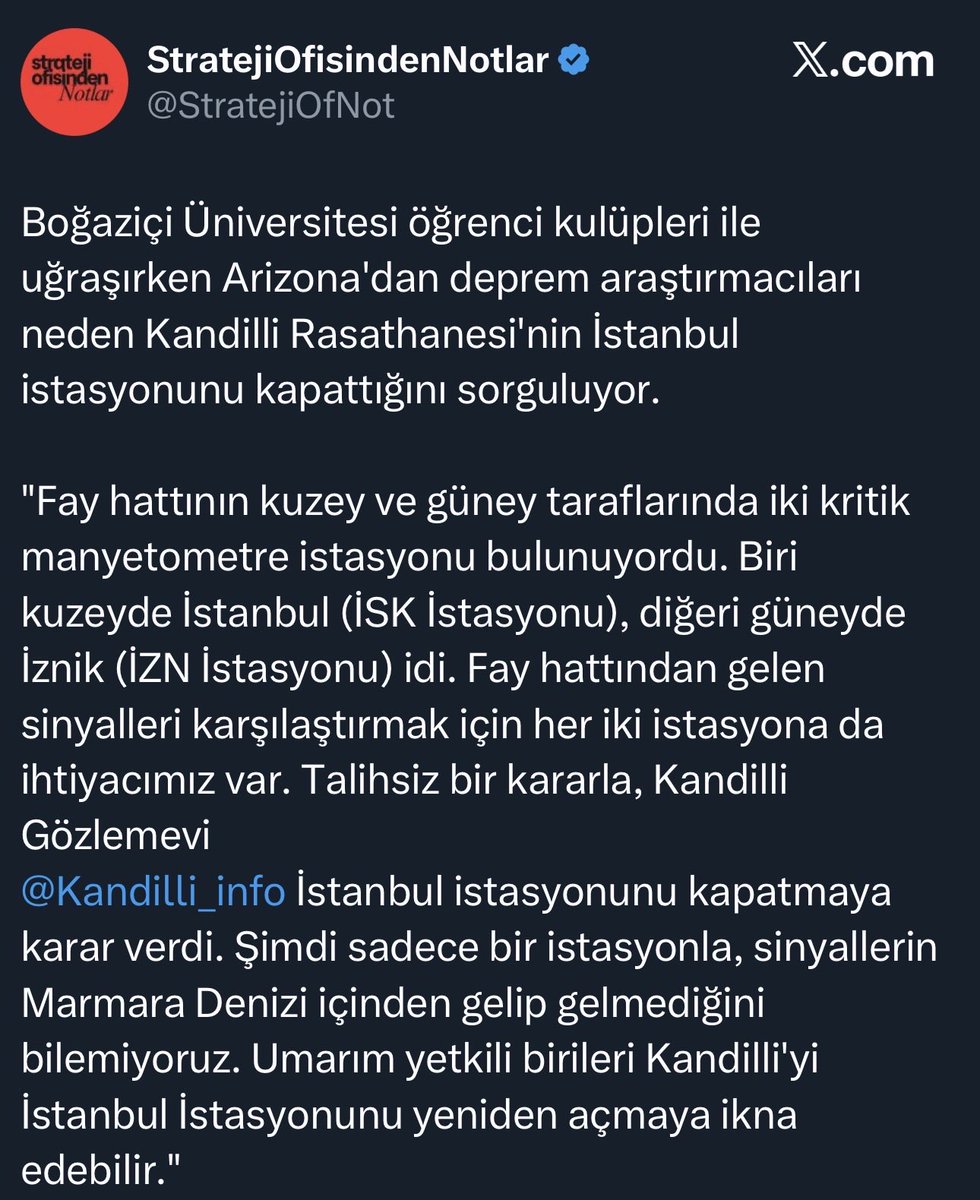
✖️“Kandilli Rasathanesi’ne ait jeomanyetik gözlemevi verilerine erişim sağlanamadığı ve sistemlerin kapatıldığı” iddiası yalan.
✅Kandilli Rasathanesi iddiaları yalanladı.
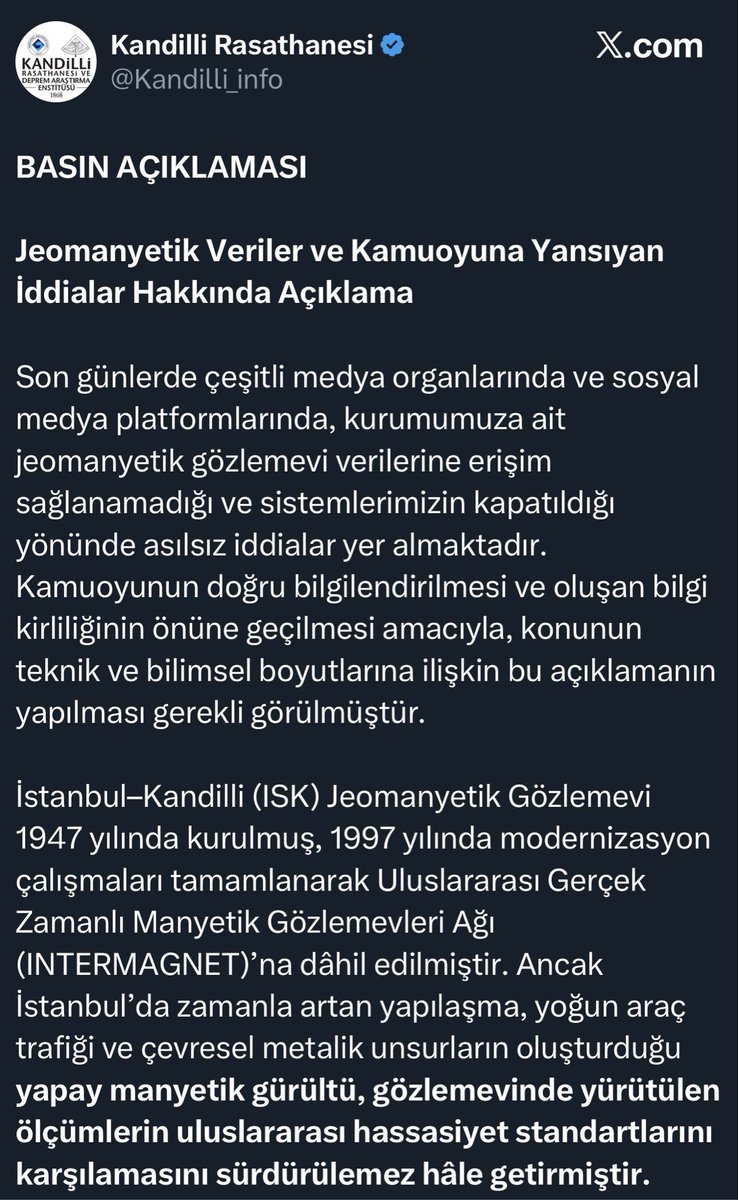
“İstanbul–Kandilli (ISK) Jeomanyetik Gözlemevi 1947 yılında kurulmuş, 1997 yılında modernizasyon çalışmaları tamamlanarak Uluslararası Gerçek Zamanlı Manyetik Gözlemevleri Ağı (INTERMAGNET)’na dâhil edilmiştir. Ancak İstanbul’da zamanla artan yapılaşma, yoğun araç trafiği ve çevresel metalik unsurların oluşturduğu yapay manyetik gürültü, gözlemevinde yürütülen ölçümlerin uluslararası hassasiyet standartlarını karşılamasını sürdürülemez hâle getirmiştir.
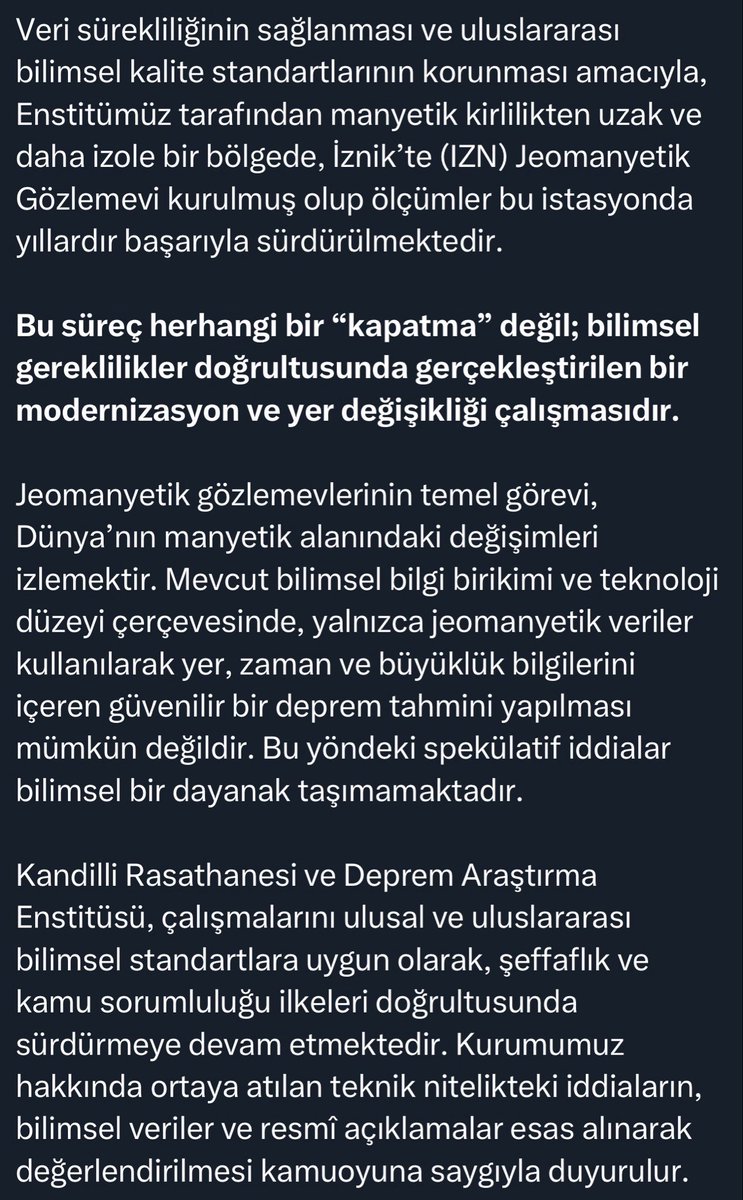
Veri sürekliliğinin sağlanması ve uluslararası bilimsel kalite standartlarının korunması amacıyla, Enstitümüz tarafından manyetik kirlilikten uzak ve daha izole bir bölgede, İznik’te (IZN) Jeomanyetik Gözlemevi kurulmuş olup ölçümler bu istasyonda yıllardır başarıyla sürdürülmektedir.
Bu süreç herhangi bir “kapatma” değil; bilimsel gereklilikler doğrultusunda gerçekleştirilen bir modernizasyon ve yer değişikliği çalışmasıdır.”

8
11
1,493

BASIN AÇIKLAMASI
Jeomanyetik Veriler ve Kamuoyuna Yansıyan İddialar Hakkında Açıklama
Son günlerde çeşitli medya organlarında ve sosyal medya platformlarında, kurumumuza ait jeomanyetik gözlemevi verilerine erişim sağlanamadığı ve sistemlerimizin kapatıldığı yönünde asılsız iddialar yer almaktadır. Kamuoyunun doğru bilgilendirilmesi ve oluşan bilgi kirliliğinin önüne geçilmesi amacıyla, konunun teknik ve bilimsel boyutlarına ilişkin bu açıklamanın yapılması gerekli görülmüştür.
İstanbul–Kandilli (ISK) Jeomanyetik Gözlemevi 1947 yılında kurulmuş, 1997 yılında modernizasyon çalışmaları tamamlanarak Uluslararası Gerçek Zamanlı Manyetik Gözlemevleri Ağı (INTERMAGNET)’na dâhil edilmiştir. Ancak İstanbul’da zamanla artan yapılaşma, yoğun araç trafiği ve çevresel metalik unsurların oluşturduğu yapay manyetik gürültü, gözlemevinde yürütülen ölçümlerin uluslararası hassasiyet standartlarını karşılamasını sürdürülemez hâle getirmiştir.
Veri sürekliliğinin sağlanması ve uluslararası bilimsel kalite standartlarının korunması amacıyla, Enstitümüz tarafından manyetik kirlilikten uzak ve daha izole bir bölgede, İznik’te (IZN) Jeomanyetik Gözlemevi kurulmuş olup ölçümler bu istasyonda yıllardır başarıyla sürdürülmektedir.
Bu süreç herhangi bir “kapatma” değil; bilimsel gereklilikler doğrultusunda gerçekleştirilen bir modernizasyon ve yer değişikliği çalışmasıdır.
Jeomanyetik gözlemevlerinin temel görevi, Dünya’nın manyetik alanındaki değişimleri izlemektir. Mevcut bilimsel bilgi birikimi ve teknoloji düzeyi çerçevesinde, yalnızca jeomanyetik veriler kullanılarak yer, zaman ve büyüklük bilgilerini içeren güvenilir bir deprem tahmini yapılması mümkün değildir. Bu yöndeki spekülatif iddialar bilimsel bir dayanak taşımamaktadır.
Kandilli Rasathanesi ve Deprem Araştırma Enstitüsü, çalışmalarını ulusal ve uluslararası bilimsel standartlara uygun olarak, şeffaflık ve kamu sorumluluğu ilkeleri doğrultusunda sürdürmeye devam etmektedir. Kurumumuz hakkında ortaya atılan teknik nitelikteki iddiaların, bilimsel veriler ve resmî açıklamalar esas alınarak değerlendirilmesi kamuoyuna saygıyla duyurulur.
Daha detaylı bilgi için:
jeomanyetizma.bogazici.edu.t…
127
144
795
341,229

Amerikalı araştırmacı Richard Cordaro Intermagnet verilerine göre İstanbul manyetometre istasyonu (ISK) kapalı olduğunu iddia etti. Kandilli resmi açıklama yapmadı, erken uyarı sistemi aktif. Tek istasyonla (İznik) fay izlemesi zorlaşabilir.
1
4
18
1,073

Düzeltme ve Bilgilendirme
Son günlerde Kandilli Rasathanesi ve manyetik izleme istasyonlarıyla ilgili çok sayıda soru soruluyor.
Ben de daha önce paylaştığım bir görsel üzerinden İstanbul/Kandilli istasyonunun aktif olduğu yönünde yorum yapmıştım.
Ancak Kandilli Rasathanesi Jeomanyetizma Laboratuvarı’nın resmî teknik bilgilendirme raporunu inceledikten sonra doğru ve güncel durumu netleştirmek isterim:
🔹 İstanbul-Kandilli (ISK) Jeomanyetik Gözlemevi, tarihsel olarak çok önemli bir istasyondur.
🔹 Ancak yoğun şehirleşme ve artan yapay manyetik gürültü nedeniyle,
uluslararası standartlarda güvenilir veri üretimi sürdürülemez hâle gelmiştir.
🔹 Bu nedenle ISK’nin uluslararası veri ağlarına (INTERMAGNET, Kyoto vb.) veri akışı yıllar önce durdurulmuştur.
🔹 Günümüzde Dünya’nın manyetik alanı İznik (IZN) Jeomanyetik Gözlemevi üzerinden izlenmektedir.
🔹 Paylaşılan bazı web sayfalarında görülen “boş grafikler”, istasyonun anlık olarak çalıştığını değil, veri yayınlamadığını göstermektedir.
Bu rapora dair önemli notum:
Bu durum Kandilli Rasathanesi’nin kapalı olduğu,
ya da deprem verilerinin gizlendiği anlamına gelmez.
Bu tamamen manyetik ölçümlerin teknik kalitesi ve bilimsel standartlarla ilgilidir. Uluslararası veri paylaşım kurumlarında (WDC Kyoto gibi) kapalı yada açık istasyonlar belirtilmekte İstanbul kapalı dememektedir.
Soru sorup paylaşım yapanlara da şunu belirtmek isterim;
Bu da Kandilli’nin kendi resmî açıklamasıdır.
Kaynağı ve bağlamı kontrol edilmeden paylaşılan her içerik, iyi niyetli olsa bile yanlış anlaşılmaya hizmet eder.
Yine de yanlış anlaşılmaya sebep olabilecek önceki yorumlarım için bu bilgilendirmeyi yapma gereği duydum.
📄 Kaynak:
Kandilli Rasathanesi ve Deprem Araştırma Enstitüsü – Jeomanyetizma Laboratuvarı Resmî Teknik Bilgilendirme Raporu
jeomanyetizma.bogazici.edu.t…
#Kandilli #rasathane
1
1
1
277

Öncelikle konunun muhattabı @Kandilli_info 'dir. Rasathane birçok jeofiziksel parametre @tmmobjfmo ölçümü yapmakta ve kullanıcılarına sunmaktadır. Bildiğim kadarıyla Kandilli’de bulunan manyetometre, Intermagnet gibi uluslararası ağdan veri kalitesinin düşmesi nedeniyle ayrıldı
1
4
392