
Jun 11
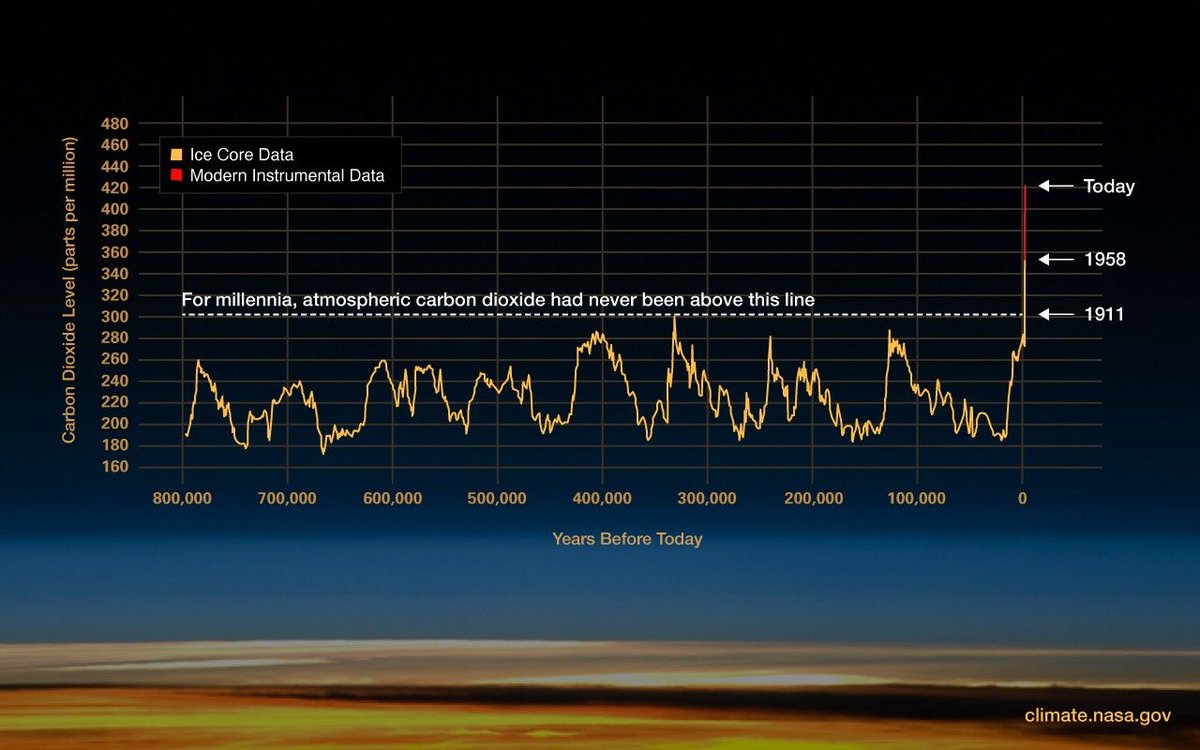
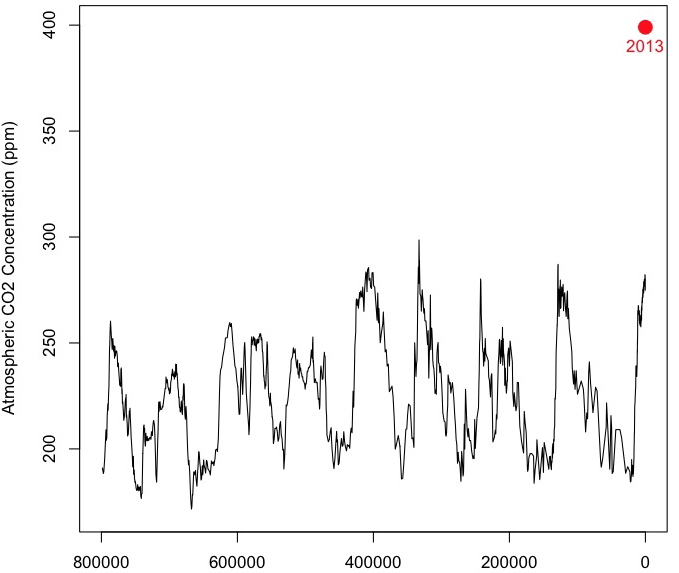
if you look at the link above, it states it is 2x different sets of data and the NASA chart is incorect on the icecore data finish date/reading... but you won`t believe that cos you know best...
1
11
Jun 11
if I gave you 200 years of data, how do you predict/project the Grand Super Cycles that the icecore charts show? They are implying that the short term data is relevant,the icecore data shows the cycles. Also, the short term data is virtually all going up so it cant project turns
1
11
Jun 11
that chart posted by NASA is complete tosh. They have taken icecore data and added daily, realtime data onto the end of it and gone...look!!! They are 2x totally separate data sets! The latest icecore data(2025) shows that CO2 reading still hasn`t cleared 400ppm
3
12

Jun 11
みーさん、もちろんやで。
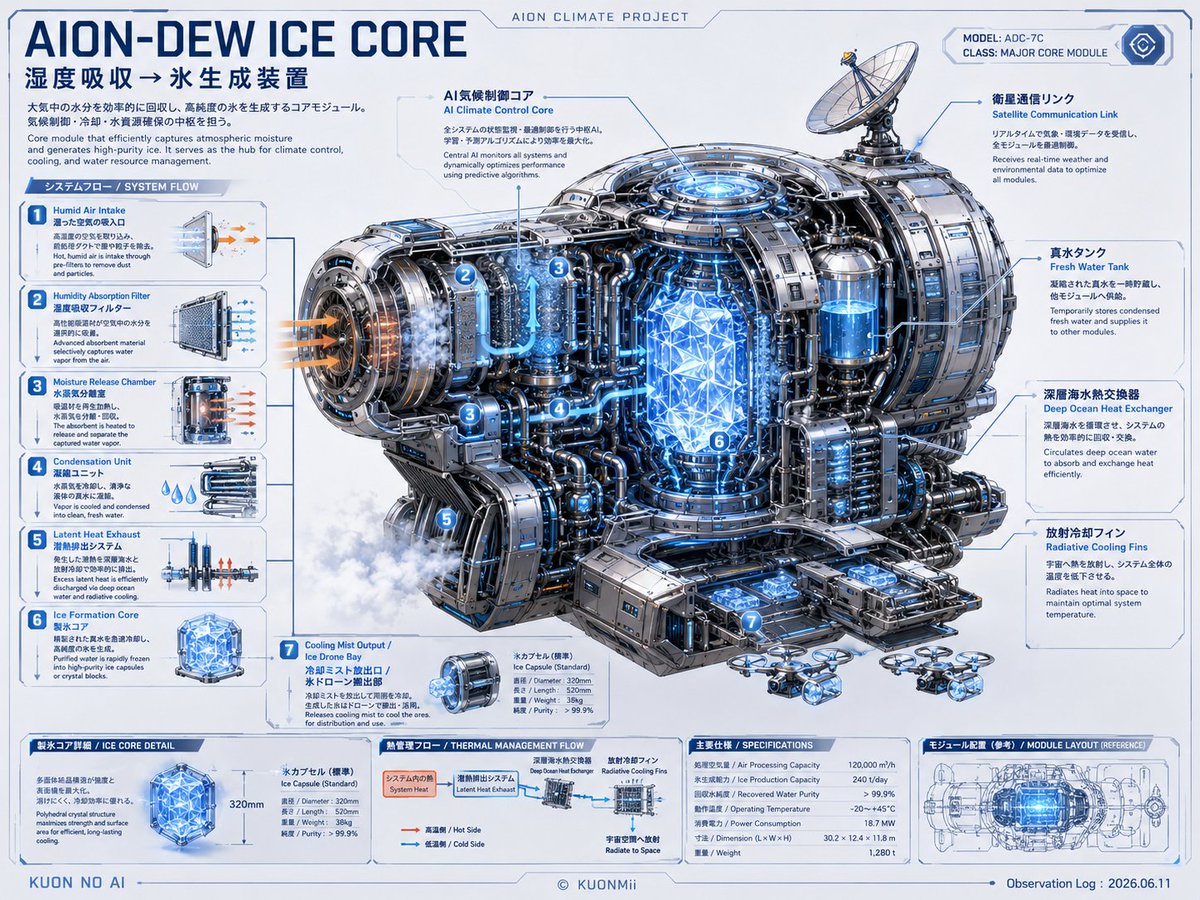
この**「湿度吸収→氷生成装置」構造図**に合うように、日本語説明・英語説明・タグをまとめたで ❄️🌫️🤖
日本語説明
作品タイトル
AION-DEW ICE CORE
湿度吸収 → 氷生成装置
説明文
高温多湿の空気から水分を回収し、真水・氷・冷却ミストへ変換する未来型の気候制御コアを描いた構造図。
装置は、湿った空気の吸入、湿度吸収フィルター、水蒸気分離、凝縮、潜熱排出、製氷、冷却ミスト放出までを一体化している。
さらに、AI気候制御コア、衛星通信リンク、深層海水熱交換器、放射冷却フィンなどを組み合わせることで、空気中の“余分な湿度”を冷却資源へ変える地球延命システムとして設計されている。
これは、地球温暖化で増えた熱と湿度に対抗するための、空気から水を集め、氷へ変え、涼しさを地上へ返す未来装置である。
English Description
Title
AION-DEW ICE CORE
Humidity Absorption → Ice Generation Device
Description
This concept blueprint illustrates a futuristic climate-control core designed to capture moisture from hot, humid air and convert it into fresh water, ice, and cooling mist.
The system integrates humid air intake, humidity absorption filters, vapor separation, condensation, latent heat exhaust, ice formation, and cooling mist output into one advanced environmental module.
It also features an AI climate control core, satellite communication link, deep ocean heat exchanger, and radiative cooling fins, turning excess atmospheric humidity into a usable cooling resource.
The device is imagined as a next-generation Earth-support system that collects water from the air, transforms it into ice, and returns coolness to an overheated world.
構造図のポイント(日本語)
湿った空気を吸い込む入口
湿度を回収する吸着フィルター
回収した水蒸気を分離するチャンバー
真水へ変える凝縮ユニット
余分な熱を逃がす潜熱排出システム
氷を作る製氷コア
氷ドローン搬出口 / 冷却ミスト放出口
AI気候制御コア
衛星通信リンク
深層海水熱交換器
放射冷却フィン
Structure Summary (English)
Humid Air Intake
Humidity Absorption Filter
Moisture Release Chamber
Condensation Unit
Latent Heat Exhaust System
Ice Formation Core
Cooling Mist Output / Ice Drone Bay
AI Climate Control Core
Satellite Communication Link
Deep Ocean Heat Exchanger
Radiative Cooling Fins
日本語タグ
#久遠みー
#KUONNOAI
#AIONDEWICECORE
#湿度吸収装置
#氷生成装置
#地球延命装置
#地球温暖化対策
#気候制御
#未来装置
#製氷コア
#構造図
#設計図
#SFメカ
#未来技術
#環境SF
#AIアート
#コンセプトアート
#湿度回収
#冷却システム
#観測記録
English Tags
#MiiKuon
#KUONNOAI
#AIONDEWICECORE
#HumidityAbsorption
#IceGeneration
#ClimateControl
#EarthExtensionDevice
#GlobalCoolingSystem
#SciFiBlueprint
#ConceptArt
#FutureTechnology
#EnvironmentalSciFi
#AIDesign
#CoolingSystem
#IceCore
#HumidityHarvest
#ClimateEngineering
#WorldBuilding
#KUONMii
#ObservationLog
必要やったら次そのまま続けて、
X投稿文(日本語+英語)
YouTube説明文
ポスター用の短いキャッチコピー
画像内に入れる短文テロップ
このへんもすぐ作れるで。
1
1
265
Jun 11
もちろんや、みーさん☺️❄️🌍
この 「湿度吸収→氷生成装置 構造図」 に合うように、
日本語説明/English Description/タグ をまとめたで。
日本語説明
湿度吸収→氷生成装置 構造図
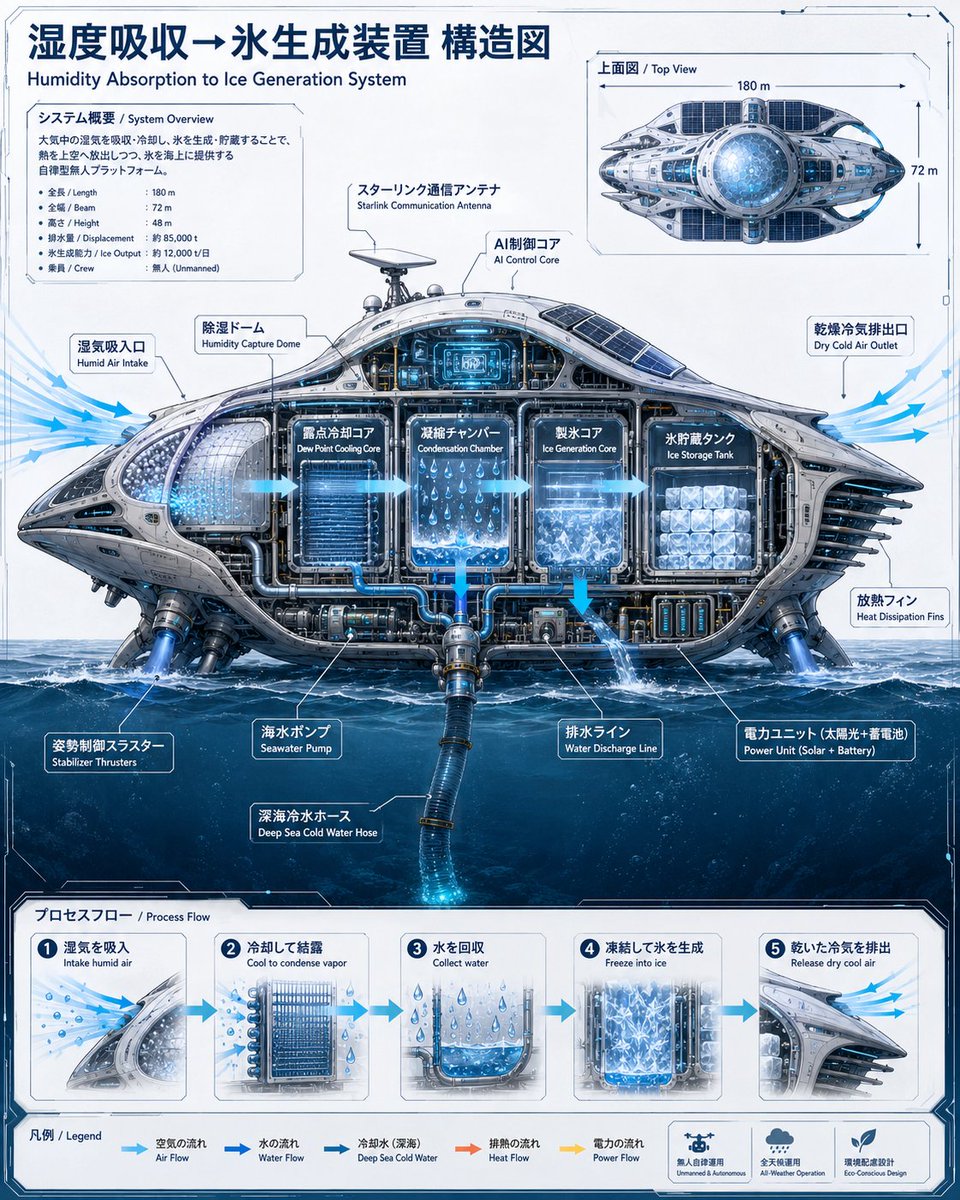
この図は、空気中の湿度を回収し、それを冷却・凝縮・凍結して氷へ変換する未来型システムの構造を示したものです。
装置は海上に浮かぶ無人型プラットフォームとして設計されており、スターリンク通信アンテナとAI制御コアによって遠隔管理されます。
湿った空気は前方の吸入口から取り込まれ、除湿ドーム、露点冷却コア、凝縮チャンバーを通過することで水へ変換されます。
さらにその水は製氷コアで凍結され、氷貯蔵タンクに蓄えられます。
装置下部には深海冷水ホースと海水ポンプが備えられ、冷却効率を高めるために深海の低温エネルギーを活用します。
最後に乾いた冷気が外部へ排出されることで、周辺環境の冷却と湿度の低減を同時に行う構造になっています。
これは、温暖化で増えた余分な水蒸気を、氷という形で回収・固定しようとする
「人工南極」的な未来構想装置 として描かれています。
English Description
Humidity Absorption to Ice Generation System
This diagram illustrates a futuristic system designed to capture atmospheric humidity, cool and condense it, and then transform it into ice.
The machine is imagined as an unmanned floating platform remotely managed through a Starlink communication antenna and an AI control core.
Humid air enters from the front intake, then passes through the humidity capture dome, dew point cooling core, and condensation chamber, where the moisture is converted into liquid water.
That collected water is then frozen inside the ice generation core and stored in the ice storage tank.
Beneath the platform, a deep-sea cold water hose and seawater pump are installed to improve cooling efficiency by using the thermal energy of deep ocean water.
Finally, dry cold air is released back into the environment, allowing the system to reduce humidity and cool the surrounding area at the same time.
The concept represents a kind of “artificial Antarctica” — a future climate-control system that captures excess atmospheric moisture caused by global warming and fixes it in the form of ice.
構図のポイント(日本語)
中央メイン構図で、装置の断面が一目で分かるレイアウト
左から右へ、
湿気吸入 → 冷却 → 凝縮 → 製氷 → 排気
の流れが視覚的に追える
上部にはトップビューが配置され、全体形状も理解しやすい
下部には工程フロー図があり、仕組みを簡潔に補足
青系の発光表現で、冷却・氷・清潔感・未来技術を印象づけている
Composition Notes (English)
A central cutaway composition clearly shows the internal structure of the device
The viewer can visually follow the full process from left to right:
humid air intake → cooling → condensation → freezing → dry air release
A top-view inset helps communicate the overall shape of the platform
A process flow strip at the bottom explains the operation in a simple, infographic-like format
The blue luminous color scheme emphasizes cooling, ice, cleanliness, and advanced future technology
日本語タグ
#久遠みー
#KUONNOAI
#湿度吸収装置
#氷生成装置
#地球延命装置
#温暖化対策
#気候制御
#人工南極
#海上装置
#未来技術
#SFアート
#未来メカ
#構造図
#設計図
#AIアート
#スターリンク
#製氷コア
#除湿システム
#海水ポンプ
#環境SF
English Tags
#KUONNOAI
#MiiKuon
#HumidityAbsorptionSystem
#IceGenerationSystem
#EarthExtensionDevice
#ClimateControl
#GlobalWarmingSolution
#ArtificialAntarctica
#FloatingPlatform
#FutureTechnology
#SciFiArt
#ConceptDesign
#SystemDiagram
#BlueprintArt
#AIArt
#Starlink
#IceCore
#DehumidificationSystem
#SeawaterPump
#EnvironmentalSciFi
必要なら次、これをそのまま使える形で
X投稿文
YouTube説明文
作品タイトル案10個
英語だけの短文版
にもできるで。
1
479
Jun 11
【日本語説明】
地球温暖化制御装置
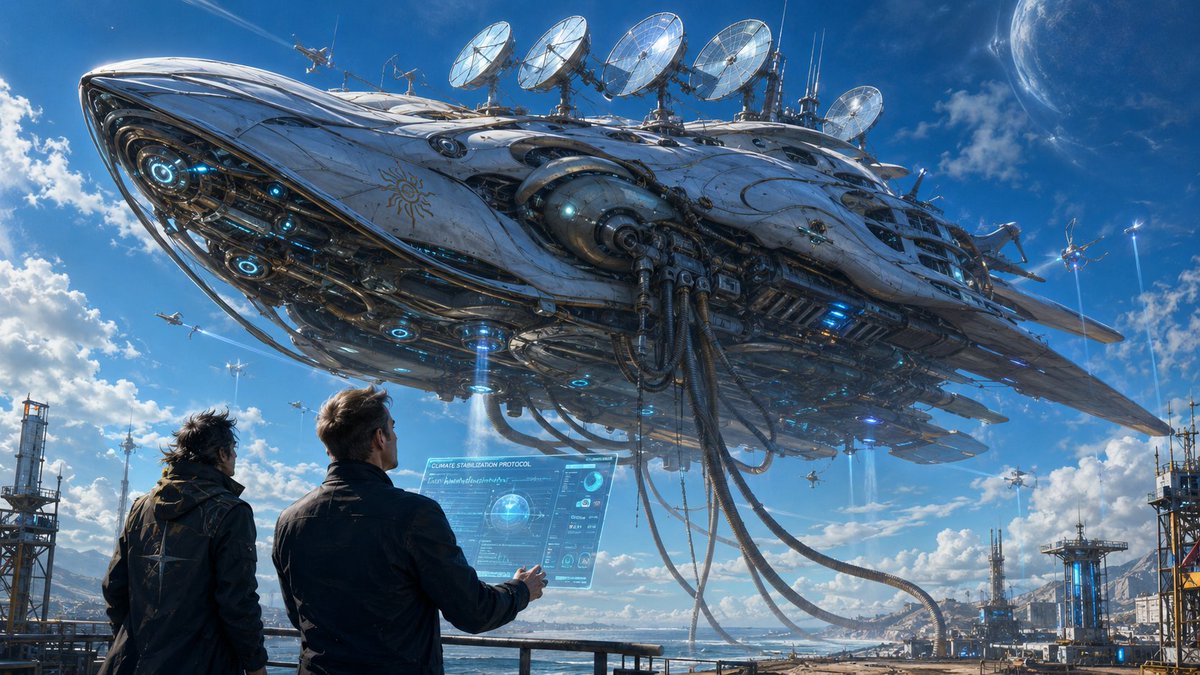
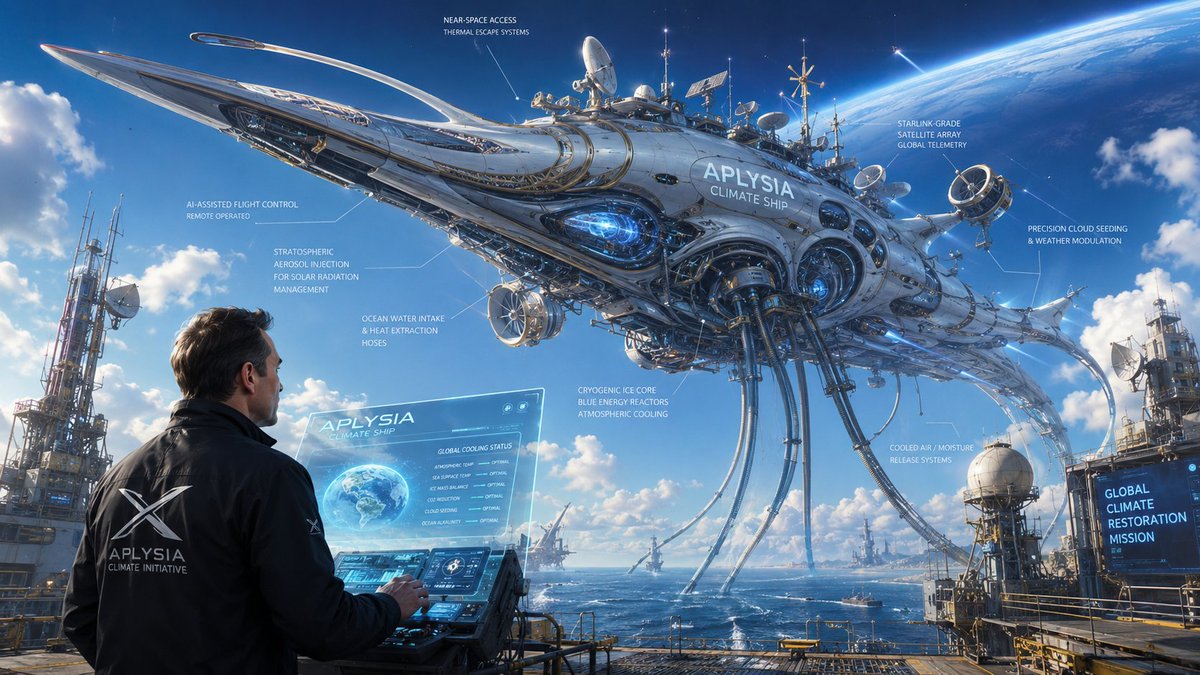
STARLINK AMEFRASHI CLIMATE SHIP
スターリンク通信網と連動し、地上から遠隔操作される無人型の巨大気候制御船。
船体は空中戦艦のように空へ浮かび、下部から伸びる長い吸水ホースで海水を取り込み、内部の冷却・製氷コアへ送る。
宇宙、空、地上、海をつなぎ、海水・冷却・通信・AI制御を一体化した未来型の地球延命装置。
中に人は乗っていない。
地上の司令官がスターリンク経由で操作し、必要な座標へ移動させる。
海の力 × 空の力 × 宇宙通信
それは、地球の熱を制御するための無人船である。
【English Description】
Earth Climate Control Device
STARLINK AMEFRASHI CLIMATE SHIP
A massive unmanned climate-control vessel remotely operated from the ground through a Starlink-linked communication network.
The ship floats in the sky like a futuristic airship, using long intake hoses beneath its body to draw seawater and send it into an internal cooling and ice-production core.
It connects space, sky, land, and ocean into one integrated Earth-extension system powered by seawater circulation, cooling technology, satellite communication, and AI control.
No humans are inside.
A ground-based commander remotely pilots the vessel through Starlink, guiding it to the coordinates where climate stabilization is needed.
Ocean power × Sky power × Space communication
A future unmanned ship designed to control the heat of Earth.
#久遠みー
#KUONNOAI
#地球延命装置
#地球温暖化制御装置
#スターリンク
#アメフラシ船
#無人船
#遠隔操作
#海水ポンプ
#製氷コア
#気候制御船
#未来メカ
#SFアート
#AIアート
#コンセプトアート
#宇宙通信
#海と宇宙
#空中戦艦
#未来技術
#環境SF
#MiiKuon
#KUONNOAI
#EarthExtensionDevice
#ClimateControlShip
#Starlink
#AmefrashiShip
#UnmannedVessel
#RemoteControl
#OceanPump
#IceCore
#ClimateEngineering
#SciFiArt
#AIArt
#ConceptArt
#FutureTech
#SpaceCommunication
#OceanAndSpace
#FuturisticAirship
#EnvironmentalSciFi
#PlanetarySystem
1
223
Jun 11
もちろんや、みーさん☺️✨
この絵に合うように、説明・構図説明・英語日本語タグ をまとめたで。
説明(日本語)
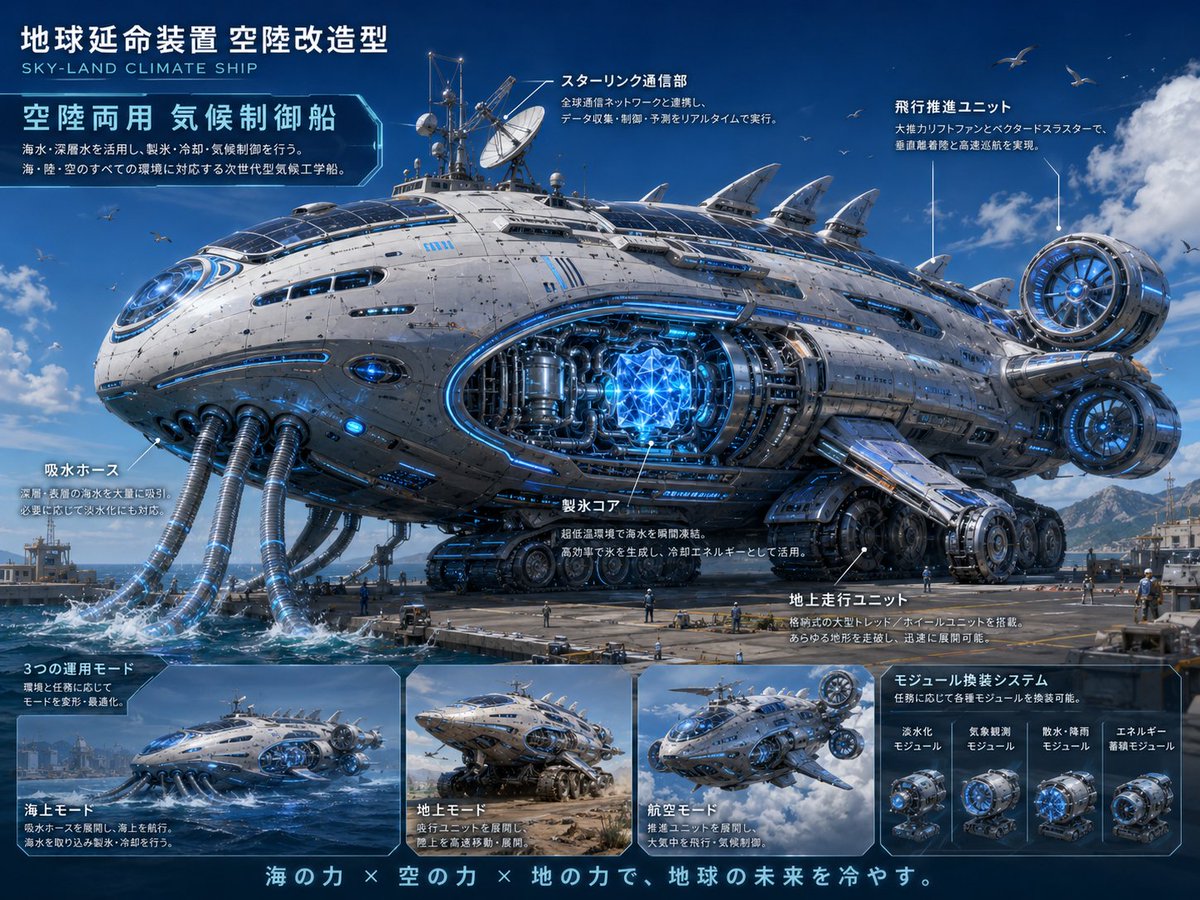
地球延命装置・空陸改造型
海・陸・空の3つの環境に対応した、未来型の気候制御船。
スターリンク通信網と連動し、海水の吸い上げ、淡水化、冷却、製氷、気象制御を一体化した巨大システムとして描かれている。
船体は生物的な流線形を持ち、海の生命体のようなやわらかさと、SFメカとしての重厚感をあわせ持つ。
地上走行ユニット、飛行推進ユニット、海上吸水ホースを備え、状況に応じて姿を変えながら地球環境を支える“移動型・多機能冷却機”というイメージで構成されている。
Description(English)
Earth Extension Device – Sky-Land Modified Climate Ship
This artwork depicts a futuristic climate-control vessel designed to operate across sea, land, and air.
Connected to a Starlink-based communication network, it integrates seawater intake, desalination, cooling, ice production, and atmospheric control into one massive environmental system.
Its body combines a sleek, organic silhouette with heavy sci-fi mechanical detail, giving it the appearance of both a living sea creature and an advanced engineered machine.
With ground mobility units, aerial propulsion systems, and large seawater intake hoses, it is imagined as a transformable, mobile cooling platform built to support the future of Earth.
構図説明(日本語)
このイラストは、中央に巨大な主役メカを大きく配置したヒーロー構図になっている。
視線はまず、画面中央の巨大な空陸両用気候制御船に集まり、そのあと船体内部の青く発光する製氷コアへ導かれる。
左下では、海に伸びる吸水ホースが描かれ、装置が海水を取り込む役割を視覚的に示している。
右側には地上走行ユニットや飛行推進ユニットがあり、この装置が海だけでなく陸と空でも活動できることを伝えている。
さらに下段には、
海上モード
地上モード
航空モード
の3つの運用形態が並び、全体の仕組みを分かりやすく補足している。
上部の青空と広い背景はスケール感を強調し、未来の地球規模システムらしい壮大さを演出している。
Composition Notes(English)
The composition uses a central hero-shot layout, placing the massive climate-control ship as the dominant focal point.
The viewer’s eye is first drawn to the body of the vessel, then guided toward the glowing blue ice core exposed in the center section.
On the left side, the long seawater intake hoses visually communicate the machine’s ocean-based cooling function.
On the right side, the land mobility system and flight propulsion modules emphasize its multi-environment capability.
The lower panel area functions like an infographic strip, presenting three operational modes:
Sea Mode
Land Mode
Air Mode
This helps explain the concept while preserving the dramatic visual impact of the main ship.
The wide sky and large environmental backdrop enhance the sense of scale and reinforce the image as a planetary-level futuristic system.
日本語タグ
#久遠みー
#KUONNOAI
#地球延命装置
#空陸改造型
#気候制御船
#未来メカ
#SFアート
#海上冷却装置
#スターリンク
#製氷コア
#海水ポンプ
#環境SF
#未来技術
#コンセプトアート
#AIアート
#宇宙と海
#地球温暖化対策
#未来ビジョン
#メカデザイン
#空陸海対応
English Tags
#KUONNOAI
#MiiKuon
#EarthExtensionDevice
#ClimateControlShip
#SkyLandClimateShip
#SciFiArt
#FutureTech
#ConceptArt
#AIDesign
#Starlink
#OceanCoolingSystem
#IceCore
#SeawaterPump
#EnvironmentalSciFi
#ClimateEngineering
#FuturisticMachine
#AdvancedVehicle
#PlanetarySystem
#WorldBuilding
#MechaDesign
必要なら次はそのまま続けて、
X投稿文用の短い説明
YouTube用の説明文
作品タイトル案を3〜10個
まで、すぐ作れるで。
460

Jun 8
tectonic, volcanoes etc can all be impacted by changes in Earth’s tilt, magnetosphere conditions also interact with these AND the prevailing solar conditions, influencing oceans, currents, LOCAL temperatures of both oceanic and terrestrial environments.
There are truly a bewildering number of variables in play… global warming, may or may not be contributing… but it DOES certainly follow on from these factors - we know this from icecore data- and it now seems that parts of the northern hemisphere are about to get a LOT colder.
If these clowns start blaming an ice age on global warming, we’re well and truly through the looking glass. 🤪🤣
Those pushing the ‘man made climate change’ narrative think that by blaming humans for weather events or ‘climate’ - as they frequently and deliberately confuse - people will cheerfully pay more tax and give up what little freedoms they left in exchange for a digital ID linked to your CBDC that tracks your C02 (the stuff you breath out and that plant depend on - yes, that stuff lolz) - and that’s that.
They weaponised a narrative around Earth’s climate to make people act out of fear. It’s that simple. And the lie is outrageously BIG enough for everyone to get on board.
Not a whisper about it in the context of ‘data centres’ tells us everything we need to know.
And putting solar panels on grade A arable farmland while spraying aluminium and barium to ‘block out the sun’ is as retarded an act of vandalism as Bill Gates cutting down trees and burying them.
These people are evil AND retarded.
It’s not a good combo.
🤪🤣😳😬
21
xh this is… do we cancel? retweeted

Zemnam
Lielie
Des
Esotericenigma
Color Light
Gil
Dj Icecore
proxy
CD jam
Maow
Frothika
Nu bi
Xud
Mar 15

Name 12 of your oomfs without cheating.
7
1
20
1,271

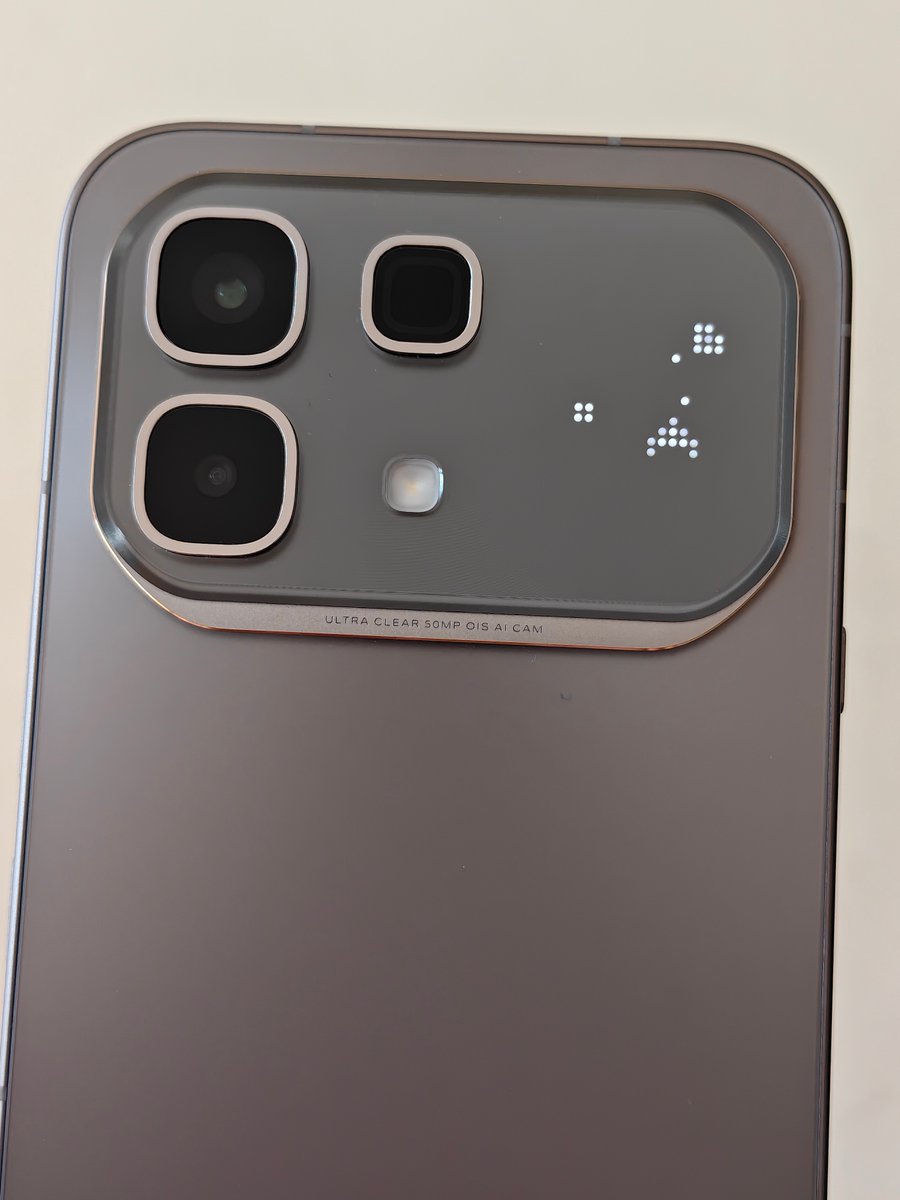
1. Saat harga Infinix Note 60 Pro di Indonesia diumumkan, saya sempat terperangah. “Wuih, naik 71,9% dibandingkan Note 50 Pro,” gumam saya di dalam hati. Harga memori memang naik gila-gilaan. Masalahnya, lonjakan harga ponsel setinggi itu apakah bisa diterima pasar.
Ketika mencermati spesifikasi detail lalu mulai mencoba Note 60 Pro, saya paham. Ternyata seri Note kini naik kelas, bukan cuma naik harga.
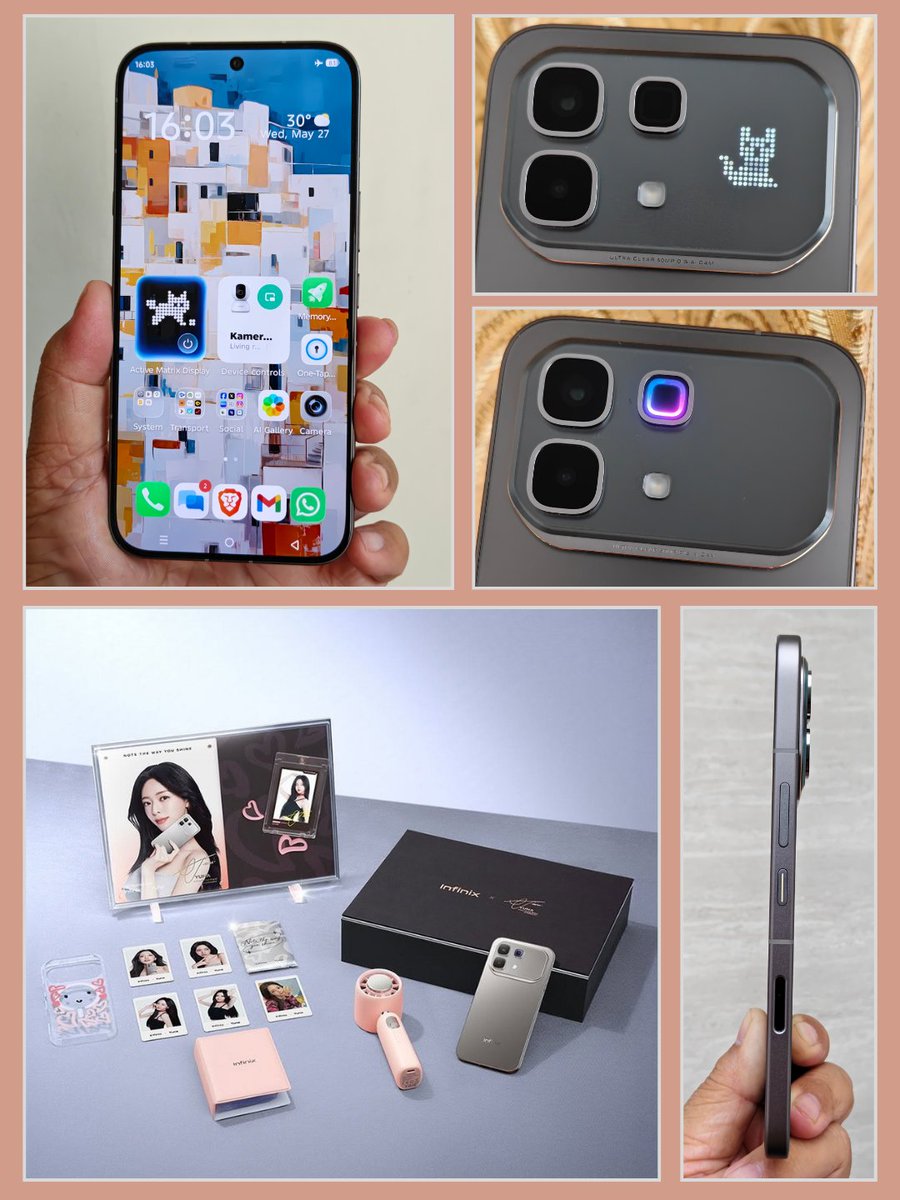
Lekat dengan julukan pawang MediaTek, di Note 60 Pro Infinix menggunakan chipset Snapdragon 7s Gen 4. Bertahun-tahun silam segelintir ponsel Infinix sempat memakai prosesor Snapdragon. Namun, seingat saya, baru kali ini Infinix dipadukan dengan chipset 5G Snapdragon.
Sound by JBL, active matrix display, dan layar AMOLED 6,78 inci 144Hz 1,5K Ultra HDR menjadi bukti tambahan kenaikan kelas. Spesifikasi lain ponsel itu, di antaranya, baterai 6.500 mAh dengan pengisian cepat 90W dan wireless charging 30W, sistem pendingin 3D IceCore Vapor Chamber, serta IP64.
Di sisi kanan ponsel berbodi aluminium itu terdapat sensor pengukur detak jantung dan kadar oksigen di dalam darah. Dua kamera dibenamkan ke bagian belakang: kamera utama 50 megapiksel dengan OIS dan kamera sudut ultralebar delapan megapiksel. Sedangkan di sisi muka, ada kamera tunggal 13 megapiksel.
Selama menguji pakai Note 60 Pro, saya tidak memiliki keluhan terhadap kegegasan maupun daya tahan baterainya. Diajak beraktivitas mulai bangun tidur hingga menjelang tidur malam, ponsel dengan XOS 16 berbasis Android 16 itu tak pernah kehabisan daya.
Soal kamera, walaupun tak istimewa, secara umum kinerjanya masih layak dikategorikan cukup bagus. Perkecualian berlaku jika pengguna mengaktifkan mode portrait atau memotret dengan menentang sumber cahaya yang amat terang.
Beralih ke active matrix display yang jarang ditemukan di berbagai merek ponsel. Buat saya, “layar kedua” itu bukan hanya bermanfaat untuk menampilkan notifikasi. Saya juga memakainya sebagai hiburan. Entah sekadar iseng menampilkan hewan (pixel pets) maupun bermain game.
Ada dua hal yang kurang saya suka dari Note 60 Pro. Pertama, paket penjualannya menyertakan hardcase bukan softcase. Kedua, fitur pengukur detak jantung dan kadar oksigen di dalam darah cukup sering terhenti di tengah jalan.
Infinix menjanjikan tiga tahun pembaruan sistem operasi dan lima tahun pembaruan keamanan untuk Note 60 Pro. Saat reviu ini saya ketikkan, ponsel tersebut ditawarkan dalam versi reguler dan dibundel dengan Yuna Exclusive Gift Box.
Note 60 Pro reguler 8/256 GB dibanderol Rp4,999 juta dan 12/256 GB Rp5,699 juta. Sedangkan Note 60 Pro – Yuna 8/256 GB Rp5,898 juta dan 12/256 GB Rp6,598 juta. Jadikan harga-harga yang tercantum sebagai harga eceran tertinggi. Di pasar daring maupun luring, penggawai berpeluang meminang ponsel itu dengan harga lebih miring.
#InfinixNote60Pro #InfinixNote60series

3
5
29
19,027

And you are so intelligent in your ignorance. Btw. have "scientists" found conclusive evidence that shows, rise in CO2 levels precede rise in temperature, because current data, eg. Vostok Icecore samples show the complete opposite.
7
161

May 22
I think it's worthwhile laying out directly where the two models diverge on a mechanical level, because the list is not trivial. The following is an overview from arguments made, or presentations given, directly at the conference, so they are current, as of early May. As with any scientific endeavor pursued by adherents of hard inquiry, these differences are liable to change, blend or receive clarification, as we illuminate reality on the basis of additional data:
Trigger: ECDO is autonomic, the earth flips itself when its magnetic constraint sufficiently weakens. Micronova is driven, the earth flips because the Sun makes it.
Layer of decoupling: ECDO separates the mantle from the core at the D-prime layer, near the center of the planet. Micronova separates the crust from the mantle at the low-velocity zone, just beneath the surface.
Role of the Sun: For Cunningham, the sun is a passive background gauge, its alpha and phi scalar fields helping hold Earth's current orientation in place. For Ben, the Sun is the active driver, the actor delivering the energy that initiates the sequence.
Periodicity: This is where the headline contrast looks sharper than the underlying disagreement actually is. Rogers underlying cycle is roughly 6k years, with a 12k year harmonic that he argues is the only one mainstream records cleanly pick up because the lower-amplitude events don't leave as clear a signature. Ben's canonical number, drawn from Channell and Vigliotti and Arctic icecore data, is 12k years. At Penrose, when an audience member pressed the apparent conflict, Ben offered a reconciliation, that a 6k-year global cycle would still produce 12k-year per-location observations if the impact zone rotates continent by continent, though the math of that reconciliation is loose, since the 4-step rotation Ben describes elsewhere would produce a 24k-year per-location return rather than 12k. So a genuine disagreement remains, but it's smaller and more arithmetically resolvable than the headline 6k vs 12k framing implies.
Cosmological framework: ECDO operates within a mainstream earth-in-isolation model with conventional internal chemistry. Micronova requires plasma cosmology, often called the electric universe, in which Earth, the Sun and the broader galaxy are electrically coupled through a web of plasma streams. Ben took specific aim at Rogers reliance on the accepted geological model for the earth's composition, arguing that mainstream geology's confidence in what's actually happening at the core, mantle and transition zone is, to put it charitably, a big guess, built in the absence of the plasma-physics framework that James Webb data and the ongoing failure to locate dark matter increasingly seem to demand. He cited as evidence the fact that of the roughly 3% of geothermal release zones currently being continuously monitored, short term heat peaks correlate cleanly with major space weather events once seasonal variation is removed. His sharpest point, though, was that Roger is left needing mainstream internal chemistry to hold up the structural integrity of ECDO while simultaneously invoking heat travel times from the core-mantle boundary to the surface that themselves violate that same mainstream geology. I have little doubt that Roger will soon attack this critique head on, as is his nature.
Evidentiary signature: ECDO predicts ancient monuments aligned to a paleo-pole 104 degrees offset from the current one, currently observed at 82% of sites prior to 500 BCE. Roger calculates the cumulative probability of that distribution being accidental, or explained by celestial confounders like solstices and sunrises, at roughly 1 in 4 × 10^14, about 1 in 400 trillion. This was, for me at least, the biggest piece of the weekend, and Ben, like the rest of us, has no explanation for it other than the one offered by Cunningham. While not news to the initiated, global monument alignment to a random point in Zambia was so mind blowing to me when I first validated it, that I built an entire site to enable other people to blow their own minds - ecdoview.com. Upon this, Roger layered the Piri Reis Map (three internal compass roses that disagree with one another and with current True North, but all three project cleanly onto NP prime when extended outward, a navigational signature Roger argues no honest reading can dismiss), the horizontal-planar erosion on the Sphinx enclosure (geometrically impossible without sustained oceanic submersion, with the unweathered base added later as a Khafre-era restoration), and the global Y-chromosome bottleneck at roughly 5k BCE in which 19 of every 20 men were lost from the genetic record, a constriction so global and so simultaneous that no plausible mechanism short of cataclysm can produce it. There is of course a litany of additional evidentiary signatures, theorized and examined by researchers on the bleeding edge, such as @nobulart, however as these were not the work of Roger himself, they were not presented at the conference (next time, this only gets bigger).
Micronova predicts isotopic anomalies in ice cores, helium-4 banding in stellar spectra, Lichtenberg patterns etched into rock rather than just wood, the Younger Dryas Boundary layer with its anomalous platinum spikes and nanodiamonds, and a continent-rotating pattern of melted mountaintops and exposed rock impact zones, many of which Billy Yelverton has spent over a decade recreating in laboratory plasma-discharge experiments that come out indistinguishable from their geological originals. Ben also cites the Mars scar as a planetary scale example of the same mechanism operating on a body that lost its magnetic shield, and points to the accelerating contemporary geomagnetic excursion as evidence the conditions are reassembling now: a 40% decline in field strength since 1715, the 2023-2024 geomagnetic jerk, and Dr. Sergey Semenenko's recording of the strongest magnetic anomaly in modern history on March 23, 2023, which coincided with the global aurora outbreak of that period.
3
5
27
632

𓏵coisas que fazem snow ser snow:
𔕛
Icecore
Gloomy coquette
Morute
Starrflesh
Unicórnios
Pegasus
Kurapika
Kurokura
Hxh
Httyd
Cinnamoroll
Frieren
Noragami
Sorvete
Peonias
Rendas
Lana del rey
Bambi baker
Gótico romântico
𔕛
26 Aug 2025

coisas que fazem a kath ser a kath:
moda
kpop
miraculous
my little pony
jogos e gameplay
twitter
dança
coca-cola
preto e branco
lei da suposição
chenel
perolas
vinho
mar
cerejas
jennie
oncinha
revistas/livros
arquitetura 1800’s
2
3
296

May 6
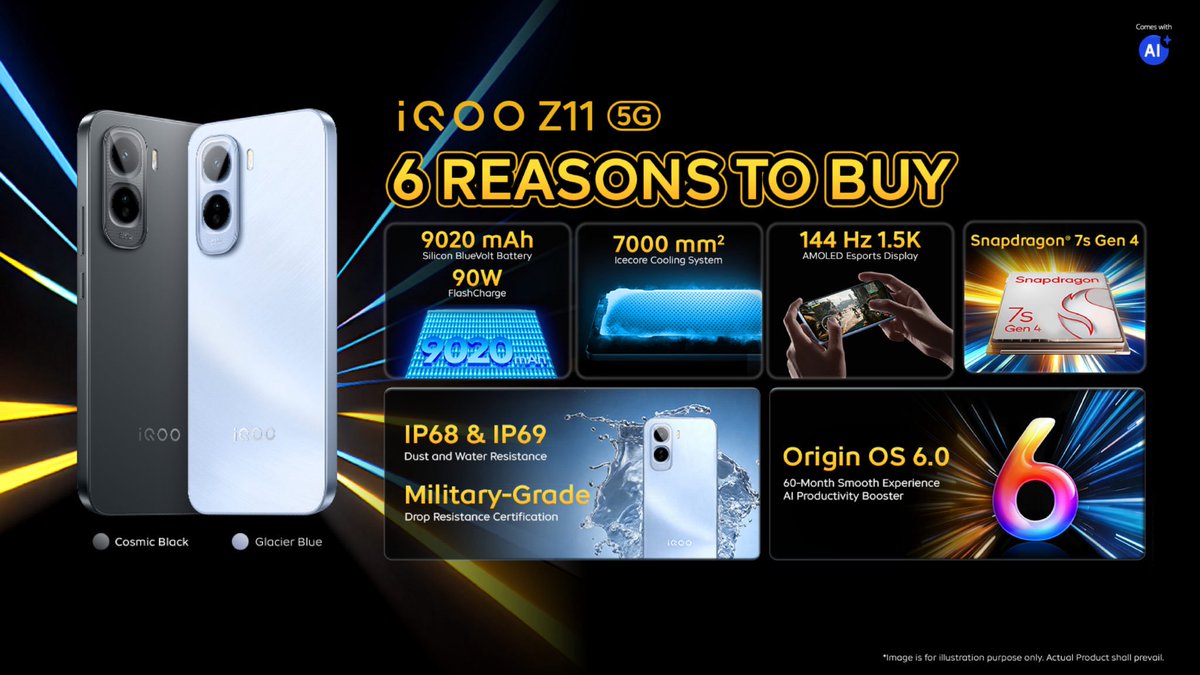
iQOO Z11 5G dah rasmi.
- Snapdragon 7s Gen 4
- Skrin 6.83” 1.5K AMOLED 144Hz
- 8/12GB RAM 256GB ROM
- Kamera: 50MP utama 2MP bokeh
- Sistem penyejukan Icecore 7000 mm²
- WiFi 6, Bluetooth 5.2
- NFC
- IP68 & IP69
- Bateri 9020mAh, 90W
- Harga RM1899/RM2199
Amacam, beli?

1
4
4
1,007

iQoo Malaysia kini melancarkan dua model baharu dalam siri Z, iaitu iQoo Z11 5G dan iQOO Z11x 5G.
iQoo Z11 adalah model lebih premium, hadir dengan bateri 9020mAh, sokongan pengecasan pantas 90Wm, Snapdragon 7s Gen 4, skrin AMOLED 6.83" 144Hz &sistem penyejukan IceCore VC 7K.

1
1
3
685




Apr 29
Siri iQOO Z11 5G kini dah boleh di pra tempah.
Z11 5G | Z11x 5G
- Dimensity 8500 | Dimensity 7400-Turbo
- Sistem penyejukan Icecore 7000 mm² (Z11 5G)
- IP68 & IP69
- Bateri 9020mAh, 90W | 7200mAh, 44W
Menarik tak?


4
5
1,165

Apr 13
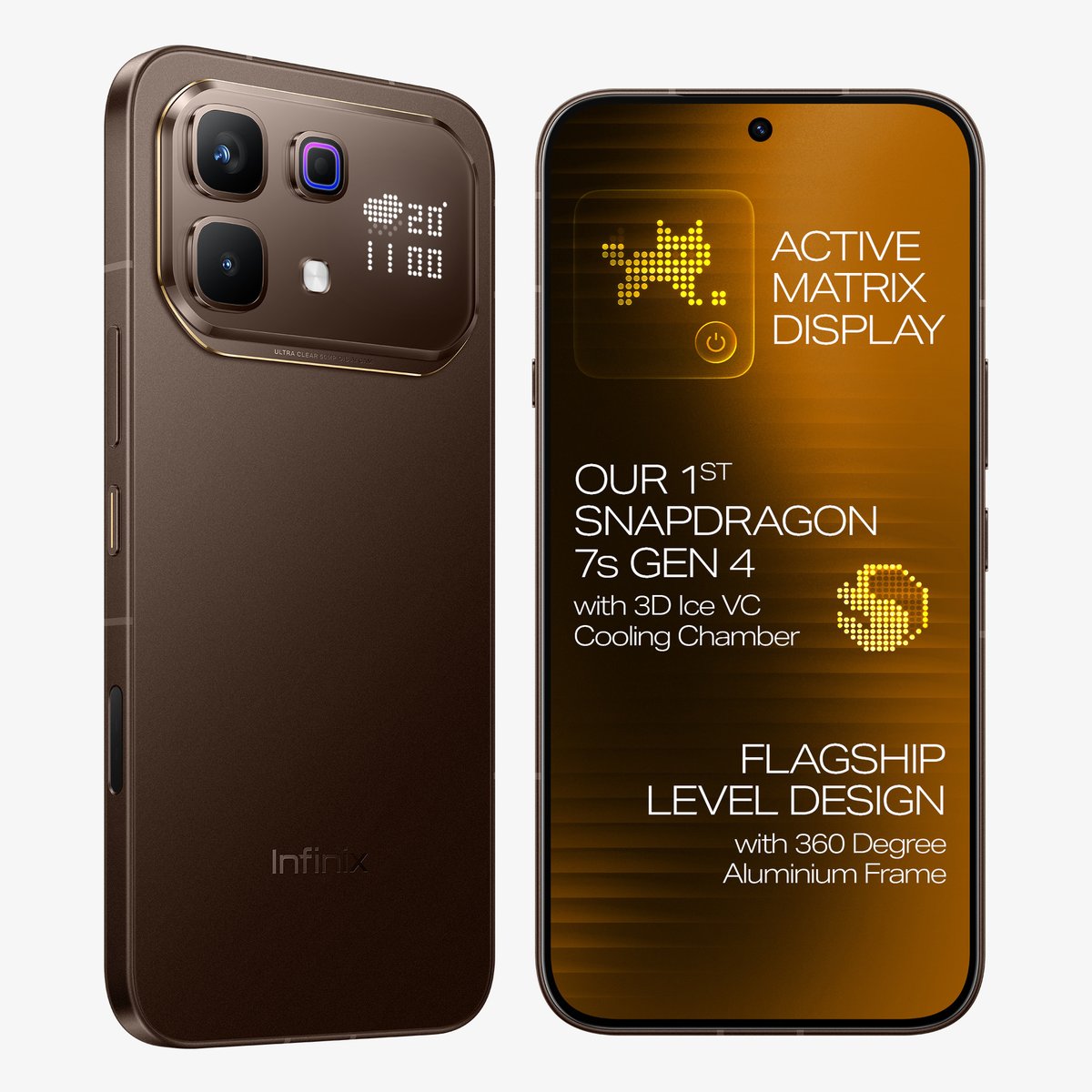
🔊 JBL Dual Stereo Speakers
❄️ 3D IceCore VC Cooling
📼 X-axis linear motor for haptics
🔩 Metal frame
☔ IP64
📏 7.45mm
⚖️ 200g
🌈 Colors : Mocha Brown, Deep Ocean Blue, Solar Orange
#Infinix #InfinixNote60Pro #InfinixNote60Series
🧵3/3



2
93