
Wow I was reading all the comments. So much hate. Hang in there Mr. Enes.
Remember...."Yes, and all who desire to live godly in Christ Jesus will suffer persecution."
Perilous Times and Perilous Men
2 Timothy 3-17
3 But know this, that in the last days perilous times will come: 2 For men will be lovers of themselves, lovers of money, boasters, proud, blasphemers, disobedient to parents, unthankful, unholy, 3 unloving, unforgiving, slanderers, without self-control, brutal, despisers of good, 4 traitors, headstrong, haughty, lovers of pleasure rather than lovers of God, 5 having a form of godliness but denying its power. And from such people turn away! 6 For of this sort are those who creep into households and make captives of gullible women loaded down with sins, led away by various lusts, 7 always learning and never able to come to the knowledge of the truth. 8 Now as Jannes and Jambres resisted Moses, so do these also resist the truth: men of corrupt minds, disapproved concerning the faith; 9 but they will progress no further, for their folly will be manifest to all, as theirs also was.
10 But you have carefully followed my doctrine, manner of life, purpose, faith, longsuffering, love, perseverance, 11 persecutions, afflictions, which happened to me at Antioch, at Iconium, at Lystra—what persecutions I endured. And out of them all the Lord delivered me. 12 Yes, and all who desire to live godly in Christ Jesus will suffer persecution. 13 But evil men and impostors will grow worse and worse, deceiving and being deceived. 14 But you must continue in the things which you have learned and been assured of, knowing from whom you have learned them, 15 and that from childhood you have known the Holy Scriptures, which are able to make you wise for salvation through faith which is in Christ Jesus.
16 All Scripture is given by inspiration of God, and is profitable for doctrine, for reproof, for correction, for [c]instruction in righteousness, 17 that the man of God may be complete, thoroughly equipped for every good work.
2
97

Carly retweeted

Acts 14:22 — 'They returned to Lystra, Iconium and Antioch, strengthening the disciples and encouraging them to remain true to the faith.' Strengthening. Encouraging.
Those are the verbs of discipleship. 🙏
1
2
25

The politician Velopoulos is also a Nigde cappadocian from Iconium although he is half pontic he has a pretty cappadocian phenotype.
2
24
Wdym study? Cappadocian from Nigde family lived in Iconium and had a store there. Also my own paternal line is vlach we can trace ourselves to the vlachs mentioned by kekaumenos which is pretty cool.
2
3
222

It ain’t #QuantumMechanics, folks; it’s basic neighborhood common sense.
Inspect. Trim. Prevent.
Your neighborhood #EagleScout has about six chainsaws if you wanna canx a workout —and— the #DeLorean of ice-cream makers to recreate the #Iconium #PeachNehiFloat #afterburner. 🍑👌🏻

Jun 11

Obligatory reminder via the GREAT @realErikDPrince, at a security symposium in #WashingtonDC, circa 2005, on why Neo-#Marxism and Corporatist-#Globalists will fail:
“We have our own business, we do full-on construction of tactical training facilities, we have our own aviation arm with twenty aircraft, canine operation with sixty dog teams deployed overseas, full-on construction, and a private intelligence service.” At the time, Prince said Blackwater had eighteen hundred people deployed around the world, “all of them in dangerous places.”
Prince also spoke with remarkable candor about his vision for the future of mercenaries. “When you ship overnight, do you use the postal service or do you use FedEx?” he asked the crowd and his fellow panelists. “It’s kind of our corporate goal is to do for the national security apparatus what FedEx did to the postal service—never going to replace it, but we want to make it run better, faster, smarter, make people think out of the box.” The Department of Defense, Prince told the audience, consumes 48 percent of the world’s military spending, “and it’s very hard for an organization that large to transform itself. But if it has outside parties that are doing somewhat similar things, it gives people something to benchmark against.”
“Comparing the military industry to the auto industry, Prince said, “General Motors can only get better if it looks at how Toyota and Honda do. It makes them think out of the box and it gives them a vehicle to perform against.” Prince told a story of how in 1991, after the fall of the Berlin wall, he was driving down the Autobahn in Germany in a rented car. Suddenly, “a Mercedes S500 blew by me at about 140 mph. It was the latest and greatest Mercedes that was available, 300 horsepower, airbags, automatic transmissions, all the bells and whistles.” But after the West German-manufactured Mercedes passed Prince, a slow-moving Trabant—the national car of communist East Germany—changed lanes in front of the Mercedes, almost causing an accident. “I thought, what a study in contrasts,” Prince said. “You have the same two countries, the same language, same culture, same background, different command structure: one of them was central planning, one of them was much more free-market oriented, innovative, risk-taking, and efficient.”
Scahill, Jeremy. #Blackwater: The Rise of the World’s Most Powerful Mercenary Army. Nation Books, 2007.
112

At 12:57 PM CDT, 2 SW Iconium [St. Clair Co, MO] Mesonet reports Rain of 3.06 Inch. 12hr total from Mesonet station GW3465 OSCEOLA. #mowx mesonet.agron.iastate.edu/ls…

17

At 8:34 AM CDT, 5 NW Iconium [St. Clair Co, MO] Dept of Highways reports Flash Flood. Route HH southbound is closed due to flooding. #mowx mesonet.agron.iastate.edu/ls…

28

At 8:34 AM CDT, 5 NW Iconium [St. Clair Co, MO] Dept of Highways reports Flash Flood. Route HH southbound is closed due to flooding. #mowx mesonet.agron.iastate.edu/ls…

23
At 8:34 AM CDT, 5 NW Iconium [St. Clair Co, MO] Dept of Highways reports Flash Flood. Route HH southbound is closed due to flooding. #mowx mesonet.agron.iastate.edu/ls…

12

At 8:34 AM CDT, 5 NW Iconium [St. Clair Co, MO] Dept of Highways reports Flash Flood. Route HH southbound is closed due to flooding. #mowx mesonet.agron.iastate.edu/ls…

13

Jun 13
She jumps in: in the name of Jesus I baptised myself on my last day
The beasts got struck by lightening fire goes out. She walks out naked.
Men converted to Christianity on that spot.
She was just 17 years old at the time and she heard Paul preaching in iconium.
49

Jun 13
2 Timothy 3
King James Version
Holy Bible
3 This know also, that in the last days perilous times shall come.
2 For men shall be lovers of their own selves, covetous, boasters, proud, blasphemers, disobedient to parents, unthankful, unholy,
3 Without natural affection, trucebreakers, false accusers, incontinent, fierce, despisers of those that are good,
4 Traitors, heady, highminded, lovers of pleasures more than lovers of GOD;
5 Having a form of godliness, but denying the power thereof: from such turn away.
6 For of this sort are they which creep into houses, and lead captive silly women laden with sins, led away with divers lusts,
7 Ever learning, and never able to come to the knowledge of the truth.
8 Now as Jannes and Jambres withstood Moses, so do these also resist the truth: men of corrupt minds, reprobate concerning the faith.
9 But they shall proceed no further: for their folly shall be manifest unto all men, as their's also was.
10 But thou hast fully known my doctrine, manner of life, purpose, faith, longsuffering, charity, patience,
11 Persecutions, afflictions, which came unto me at Antioch, at Iconium, at Lystra; what persecutions I endured: but out of them all the LORD delivered me.
12 Yea, and all that will live godly in Christ JESUS shall suffer persecution.
13 But evil men and seducers shall wax worse and worse, deceiving, and being deceived.
14 But continue thou in the things which thou hast learned and hast been assured of, knowing of whom thou hast learned them;
15 And that from a child thou hast known the holy scriptures, which are able to make thee wise unto salvation through faith which is in Christ JESUS.
16 All scripture is given by inspiration of GOD, and is profitable for doctrine, for reproof, for correction, for instruction in righteousness:
17 That the man of GOD may be perfect, thoroughly furnished unto all good works. @POTUS @VP @WhiteHouse @elonmusk #Trump #Church #ChristianNationalist #America #America #LawEnforcement #DemonChaser
24
KathyA11 retweeted

May 8
Rev. Timothy McDonald III, Senior Pastor, First Iconium Baptist Church: Voting matters. Your vote matters. You want to defeat what the Supreme Court has done to us? Then vote. You want to eliminate the racism that exists in our voting system? Then vote. If you want your voice to be heard, the only thing that you can do that will really count is to vote. Not just in Fulton County, but all across this state and nation.
173
1,376
3,321
41,777


Jun 12
The question is: Were the books of the Apocrypha accepted in Orthodoxy and Catholicism *before* the Protestant Reformation? The answer is: There was serious controversy in both traditions.
So what I meant was that before Luther stated that the Apocrypha was not Scripture per se (although he also said that it is very good to read, and he put the Catholic Apocrypha in a section between the OT and NT)—*before* all that, it was quite normal for Church leaders and theologians in Catholicism to *dispute* about the status of the Apocrypha. The best example of this is the author of the Vulgate, Jerome. Claude informs me about other skeptics of the Apocrypha from the Western Church, including Latin father Hilary of Poitiers, Rufinus of Aquileia, Pope Gregory the Great (!), Bede (!), Nicholas of Lyra, and Cardinal Cajetan—in 1532! The standard medieval biblical commentary used in universities, the Glossa Ordinaria, followed Jerome's classification. This was *not* a fringe position.
FWIW—I also had to ask Claude about the Orthodox tradition. Here the position of "do respect but do not canonize" is endorsed by these:
Athanasius of Alexandria (39th Festal Letter, 367) is probably your strongest single example. He lists the OT canon following the Hebrew books, then says Wisdom, Sirach, Esther (additions), Judith, and Tobit are "not indeed included in the Canon, but appointed by the Fathers to be read." That's almost exactly Luther's later position, from the man who championed Nicene orthodoxy.
Cyril of Jerusalem (Catechetical Lectures 4.35, c. 350) instructs catechumens to read "the twenty-two books of the Old Testament"—the Hebrew numbering—and says explicitly, "Read none of those that are not read in the churches."
Gregory of Nazianzus composed a poetic catalogue of Scripture (Carmen 1.1.12) that excludes the deuterocanonicals entirely.
Amphilochius of Iconium (Iambics for Seleucus) does the same, and even notes that some dispute Esther—showing how live the canon question was.
John of Damascus (8th century, Exact Exposition 4.17) lists the OT following the Hebrew canon, mentioning Wisdom and Sirach as "admirable" but outside the numbered canon.
Origen and Melito of Sardis (c. 170) both give early canon lists that essentially follow the Hebrew books, Melito's being one of the earliest we have—he traveled to Palestine specifically to settle the question.
Thus saith Claude.
But back to Luther. He took a definite stand because he was committed, on principle, to reclaiming the original Christianity from the various ways in which it had, even by 1517, been twisted by Catholicism. Thus he was committed to Sola Scriptura; but this then raises the question, "What is Scripture?" So he took a stand on that question of the status of the Apocrypha. The Catholics DID NOT similarly take a stand on the question until the Council of Trent.
Similarly, I am informed (again by Claude) that Orthodoxy settled the matter in 1672 by the Synod of Jerusalem, in direct response to the Protestant reformers. There is still variation, however. "The Russian tradition under Philaret of Moscow (1839 catechism) distinguished canonical from non-canonical books in a way that echoes the older patristic pattern."

I didn't understand your reply. Please elaborate.
15
1
25
3,529

The Acts of Barnabas: The Journeyings and Martyrdom of Saint Barnabas the Apostle.
.
Since from the descent of the presence of our Saviour Jesus Christ, the unwearied and benevolent and mighty Shepherd and Teacher and Physician, I beheld and saw the ineffable and holy and unspotted mystery of the Christians, who hold the hope in holiness, and who have been sealed; and since I have zealously served Him, I have deemed it necessary to give account of the mysteries which I have heard and seen.
.
I John, accompanying the holy apostles Barnabas and Paul, being formerly a servant of Cyrillus the high priest of Jupiter, but now having received the gift of the Holy Spirit through Paul and Barnabas and Silas, who were worthy of the calling, and who baptized me in Iconium. After I was baptized, then, I saw a certain man standing clothed in white raiment; and he said to me: Be of good courage, John, for assuredly thy name shall be changed to Mark, and thy glory shall be proclaimed in all the world. the darkness in thee has passed away from thee, and there has been given to thee understanding to know the mysteries of God.
And when I saw the vision, becoming greatly terrified, I went to the feet of Barnabas, and related to him the mysteries which I had seen and heard from that man. And the Apostle Paul was not by when I disclosed the mysteries. And Barnabas said to me: Tell no one the miracle which thou hast seen. For by me also this night the Lord stood, saying, Be of good courage: for as thou hast given thy life for my name to death and banishment from thy nation, thus also shall thou be made perfect. Moreover, as for the servant who is with you, take him also with thyself; for he has certain mysteries. Now then, my child, keep to thyself the things which thou hast seen and heard; for a time will come for thee to reveal them.
.
And I, having been instructed in these things by him, remained in Iconium many days; for there was there a holy man and a pious, who also entertained us, whose house also Paul had sanctified. Thence, therefore, we came to Seleucia, and after staying three days sailed away to Cyprus; and I was ministering to them until we had gone round all Cyprus. And setting sail from Cyprus, we landed in Perga of Pamphylia. And there I then stayed about two months, wishing to sail to the regions of the West; and the Holy Spirit did not allow me. Turning, therefore, I again sought the apostles; and having learned that they were in Antioch, I went to them.
.
And I found Paul in bed in Antioch from the toil of the journey, who also seeing me, was exceedingly grieved on account of my delaying in Pamphylia. And Barnabas coming, encouraged him, and tasted bread, and he took a little of it. And they preached the word of the Lord, and enlightened many of the Jews and Greeks. And I only attended to them, and was afraid of Paul to come near him, both because he held me as having spent much time in Pamphylia, and because be was quite enraged against me. And I gave repentance on my knees upon the earth to Paul, and he would not endure it. And when I remained for three Sabbaths in entreaty and prayer on my knees, I was unable to prevail upon him about myself; for his great grievance against me was on account of my keeping several parchments in Pamphylia.
.
And when it came to pass that they finished teaching in Antioch, on the first of the week they took counsel together to set out for the places of the East, and after that to go into Cyprus, and oversee all the churches in which they had spoken the word of God. And Barnabas entreated Paul to go first to Cyprus, and oversee his own in his village; and Lucius entreated him to take the oversight of his city Cyrene. And a vision was seen by Paul in sleep, that he should hasten to Jerusalem, because the brethren expected him there. But Barnabas urged that they should go to Cyprus, and pass the winter, and then that they should go to Jerusalem at the feast. Great contention, therefore, arose between them. And Barnabas urged me also to accompany them, on account of my being their servant from the beginning, and on account of my having served them in all Cyprus until they came to Perga of Pamphylia; and I there had remained many days. But Paul cried out against Barnabas, saying: It is impossible for him to go with us. And those who were with us there urged me also to accompany them, because there was a vow upon me to follow them to the end. So that Paul said to Barnabas: If thou wilt take John who also is surnamed Mark with thee, go another road; for he shall not come with us. And Barnabas coming to himself, said: The grace of God does not desert him who has once served the Gospel and journeyed with us. If, therefore, this be agreeable to thee, Father Paul, I take him and go. And he said: Go thou in the grace of Christ, and we in the power of the Spirit.
Therefore, bending their knees, they prayed to God. And Paul, groaning aloud, wept, and in like manner also Barnabas, saying to one another: It would have been good for us, as at first, so also at last, to work in common among men; but since it has thus seemed good to thee, Father Paul, pray for me that my labour may be made perfect to commendation: for thou knowest how I have served thee also to the grace of Christ that has been given to thee. For I go to Cyprus, and hasten to be made perfect; for I know that I shall no more see thy face, O Father Paul. And failing on the ground at his feet, he wept long. And Paul said to him: The Lord stood by me also this night, saying, Do not force Barnabas not to go to Cyprus, for there it has been prepared for him to enlighten many; and do thou also, in the grace that has been given to thee, go to Jerusalem to worship in the holy place, and there it shall be shown thee where thy martyrdom has been prepared. And we saluted one another, and Barnabas took me to himself.
.
And having come down to Laodiceia, we sought to cross to Cyprus; and having found a ship going to Cyprus, we embarked. And when we had set sail, the wind was found to be contrary. And we came to Corasium; and having gone down to the shore where there was a fountain, we rested there, showing ourselves to no one, that no one might know that Barnabas had separated from Paul. And having set sail from Corasium, we came to the regions of Isauria, and thence came to a certain island called Pityusa; and a storm having come on, we remained there three days; and a certain pious man entertained us, by name Euphemus, whom also Barnabas instructed in many things in the faith, with all his house.
.
And thence we sailed past the Aconesiae, and came to the city of Anemurium; and having gone into it, we found two Greeks. And coming to us, they asked whence and who we were. And Barnabas said to them: If you wish to know whence and who we are, throw away the clothing which you have, and I shall put on you clothing which never becomes soiled; for neither is there in it anything filthy, but it is altogether splendid. And being astonished at the saying, they asked us: What is that garment which you are going to give us? And Barnabas said to them: If you shall confess your sins, and submit yourselves to our Lord Jesus Christ, you shall receive that garment which is incorruptible for ever. And being pricked at heart by the Holy Spirit, they fell at his feet, entreating and saying: We beseech thee, father, give us that garment; for we believe in the living and true God whom thou proclaimest. And leading them down to the fountain, he baptized them into the name of Father, and Son, and Holy Ghost. And they knew that they were clothed with power, and a holy robe. And having taken from me one robe, he put it on the one; and his own robe he put on the other. And they brought money to him, and straightway Barnabas distributed it to the poor. And from them also the sailors were able to gain many things.
.
And they having come down to the shore, he spoke to them the word of God; and he having blessed them, we saluted them, and went on board the ship. And the one of them who was named Stephanus wished to accompany us, and Barnabas did not permit him. And we, having gone across, sailed down to Cyprus by night; and having come to the place called Crommyacita, we found Timon and Ariston the temple Servants, at whose house also we were entertained.
.
And Timon was afflicted by much fever. And having laid our hands upon him, we straightway removed his fever, having called upon the name of the Lord Jesus. And Barnabas had received documents from Matthew, a book of the word of God, and a narrative of miracles and doctrines. This Barnabas laid upon the sick in each place that we came to, and it immediately made a cure of their sufferings.
.
And when we had come to Lapithus, and an idol festival being celebrated in the theatre, they did not allow us to go into the city, but we rested a little at the gate. And Timon, after he rose up from his disease, came with us. And having gone forth from Lapithus, we travelled through the mountains, and came to the city of Lampadistus, of which also Timon was a native; in addition to whom, having found also that Heracleius was there, we were entertained by him. He was of the city of Tamasus, and had come to visit his relations; and Barnabas, looking stedfastly at him, recognised him, having met with him formerly at Citium with Paul; to whom also the Holy Spirit was given at baptism, and he changed his name to Heracleides. And having ordained him bishop over Cyprus, and having confirmed the church in Tamasus, we left him in the house of his brethren that dwelt there.
.
And having crossed the mountain called Chionodes, we came to Old Paphos, and there found Rhodon, a temple servant, who also, having himself believed, accompanied us. And we met a certain Jew, by name Barjesus, coming from Paphos, who also recognised Barnabas, as having been formerly with Paul. He did not wish us to go into Paphos; but having turned away, we came to Curium.
And we found that a certain abominable race was being performed in the road near the city, where a multitude of women and men naked were performing the race. And there was great deception and error in that place. And Barnabas turning, rebuked it; and the western part fell, so that many were wounded, and many of them also died and the rest fled to the temple of Apollo, which was close at hand in the city, which was called sacred.
.
And when we came near the temple, a great multitude of Jews who were there, having been put up to it by Barjesus. stood outside of the city, and did not allow us to go into the city; but we spent the evening under a tree near the city, and rested there.
.
And on the following day, we came to a certain village where Aristoclianus dwelt. He being a leper, had been cleansed in Antioch, whom also Paul and Barnabas sealed to be a bishop, and sent to his village in Cyprus, because there were many Greeks there. And we were entertained in the cave by him in the mountain, and there we remained one day. And thence we came to Amathus and there was a great multitude of Greeks in the temple in the mountain, low women and men pouring libations. There also Barjesus, getting the start of as, gained over the nation of the Jews, and did not allow us to enter into the city; but a certain widow woman. eighty years old. being outside of the city, and she also not worshipping the idols, coming forward to us, took us into her house one hour. And when we came out we shook the dust off our feet over against that temple where the libation of the abominable took place.
.
And having gone out thence, we came through desert places, and Timon also accompanied us. And having come to Citium, and there being a great uproar there also in their hippodrome, having learned this, we came forth out of the city, having all shaken the dust off our feet; for no one received us, except that we rested one hour in the gate near the aqueduct.
.
And having set sail in a ship from Citium, we came to Salamis, and landed in the so-called islands, where there was a place full of idols; and there there took place high festivals and libations. And having found Heracleides there again, we instructed him to proclaim the Gospel of God, and to set up churches, and ministers in them. And having gone into Salamis. we came to the synagogue near the place called Biblia; and when we had gone into it, Barnabas, having unrolled the Gospel which he had received from Matthew his fellow-labourer, began to teach the Jews.
.
And Barjesus, having arrived after two days, after not a few Jews had been instructed, was enraged, and brought together all the multitude of the Jews; and they having laid hold of Barnabas, wished to hand him over to Hypatius, the governor of Salamis. And having bound him to take him away to the governor, and a pious Jebusite, a kinsman of Nero, having count to Cyprus, the Jews, learning this, took Barnabas by night, and bound him with a rope by the neck; and having dragged him to the hippodrome from the synagogue, and having gone out of the city, standing round him, they burned him with fire, so that even his bones became dust. And straightway that night, having taken his dust, they cast it into a cloth; and having se cured it with lead. they intended to throw it into the sea. But I, finding an opportunity in the night, and being able along with Timon and Rhodon to carry it. we came to a certain place, and having found a cave, put it down there, where the nation of the Jebusites formerly dwelt. And having found a secret place in it, we put it away, with the documents which he had received from Matthew. And it was the fourth hour of the night of the second of the week.
.
And when we were hid in the place. the Jews made no little search after us; and having almost found us, they pursued us as far as the village of the Ledrians; and we, having found there also a cave near the village, took refuge in it, and thus escaped them. And we were hid in the cave three days; and the Jews having gone away, we came forth and left the place by night. And taking with us Ariston and Rhodon, we came to the village of Limnes.
.
And having come to the shore, we found an Egyptian ship; and having embarked in it, we landed at Alexandria. And there I remained, teaching the brethren that came the word of the Lord, enlightening them, and preaching what I had been taught by the apostles of Christ, who also baptized me into the name of Father, and Son, and Holy Ghost; who also changed my name to Mark in the water of baptism, by which also I hope to bring many to the glory of God through His grace; because to Him is due honour and everlasting glory. Amen.
.
The journeyings and martyrdom of the holy apostle Barnabas have been fulfilled through God.
1
7
239
Saint Barnabas the Apostle: The Golden Legend by Jacobus da Voragine, 1527.
.
Here followeth the Life of Saint Barnabas the Apostle, and first the interpretation of his name.
.
Barnabas is as much to say as the son of him that cometh, or the son of consolation, or the son of a prophet, or a son concluding. He is four times said a son by four manners of expositions, he is said son in scripture by reason of generation, of erudition, of imitation, and of adoption. He was regenerate of Jesu Christ by baptism, and he was taught by the gospel and followed him by martyrdom, and adopted by heavenly reward, and this was touching himself. As touching others he was coming, comforting, prophesying and concluding. Coming, in running and preaching over all, and that appeareth for he was fellow of Saint Paul. Comforting poor people and desolate, to poor people in giving alms, to desolate in sending epistles in the name of the apostles. Prophesying for he flowered by the spirit of prophecy. In concluding, for he concluded a great multitude of people and converted them to the faith, as it appeareth when he was sent to Antioch. And that saith the book called the Acts of the Apostles. As to the first he was a man and manly, to the second good; as to the third, full of the Holy Ghost, and as to the fourth, true. His passion Bede compiled out of Greek into Latin.
.
Of Saint Barnabas the Apostle.
.
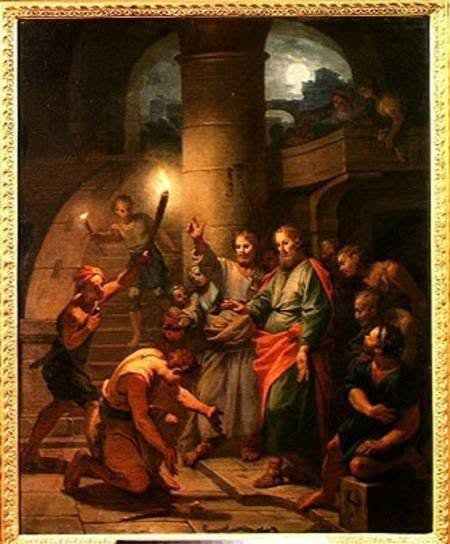
Saint Barnabas was a deacon, and was born in Cyprus, and was one of the seventy-two disciples of our Lord, and is greatly praised in the history of the Acts of the Apostles of many good things that were in him, for he was right well informed and ordinate, as well to himself as to God and to his neighbour. He was well ordinate in himself after three virtues that be in the soul, that is to say reason, desire, and strength; he had reason illumined with the clearness of very knowledge, hereof is said in the Acts of the Apostles, the thirteenth chapter. It is said that there were in the church of Antioch doctors, prophets and great masters in holy scripture among whom were Barnabas, Simon, and many other great clerks, yet had he desire well ordinate and expurged them from the dust of all worldly affection, and thereof is found in the Acts of Apostles the fourth chapter, that he sold a field that he had, and the value and price thereof he laid at the feet of the apostles. And the gloss saith: Saint Barnabas showed to us herein that we ought leave the things that men should not put thereon their desire ne their heart, and taught us to despise gold and silver, by that that he laid the silver at the feet of the apostles, yet had he the virtue of the soul which is called strength, well affrmed with prowess of patience, and that may we see on the great things and high that he emprised, and on the great penances that he did, and on the great torments and pains that he suffered. Great things then he emprised, and that may we see when he took upon him to convert so great a city as was Antioch. For when Saint Paul came into Jerusalem anon after his conversion, and would accompany him with the disciples, they fled all away, like sheep do from wolves, but Barnabas went anon to him, and took and brought him in to the company of the apostles. After, he enforced his body with great penances that he did, for he tormented it with aspre and hard fastings, yet was Saint Barnabas a man enforced to suffer pains and torments; for he and Saint Paul abandoned their lives overall for the love of our Lord Jesu Christ. Secondly, he was ordained as touching to God in bearing, authority, majesty, and bounty. He bare honour and reverence unto the great authority of God, after that we find in the Acts of the Apostles the thirteenth chapter, when the Holy Ghost said: Take ye to me apart, Barnabas and Paul, for to do the office that I have chosen them to. Yet Saint Barnabas bare honour to the great majesty of God, for when there should be done reverence to him and sacrifice as to a God, and was called Jupiter as he that went before, and they called Paul, Mercury, as a fair and wise speaker. Anon Barnabas and Paul rent and tare their coats, and cried all on high: Ye people, what do ye? We be mortal as ye be, which warn you to turn and convert to the very God living, Jesu Christ. After, Saint Barnabas bare reverence to the bounty of God, after that is found in the Acts of Apostles the fifteenth chapter. Some converts of the Jews would minish the bounty of the grace of God, and said that this grace that our Lord had done in his passion sufficed not to save us without circumcision. Against this error Saint Paul and Barnabas withstood vigorously, and showed to them appertly that the grace and bounty that God hath done is sufficient, without the law, to our salvation. After they sent to the apostles this question, the which they sent anon through the world in epistles against this foolish error. After, Saint Barnabas was right strongly well ordained against his neighbours, for all them that were committed to his cure he nourished and fed, in word, in example and in benefits. In word, for he pronounced to them the holy word of God and the gospel. Hereof is said in the Acts of the Apostles, that Paul and Barnabas abode in Antioch preaching the word of God. That may be seen by the great multitude of people that he converted in the city of Antioch, for they converted so much people there, that the disciples lost their special name and were called christian men as the other. Yet nourished he them that he had charge of by good ensample, for his life was to all them that saw him as a mirror of holiness and the exemplar of all religion. For he was in all his works noble and hardy, and well embellished of all good works, and was full of the Holy Ghost, and enlumined and light in the faith of our Lord. All these four things be touched of him in the Acts of the Apostles, and yet nourisheth he them by benefits in two manners, that is in alms temporal, is administering to the poor their necessity, and in other alms spiritual, in forgiving all rancour and evil will. The first alms did Saint Barnabas, for he bare to such as were in right great poverty and misery, that as was needful for them to live, for after that we find in the Acts of the Apostles, there was a great famine in the time of Claudius the emperor, which famine had Agabus prophesied, and because the disciples that would return to their brethren into Judea, sent unto the most ancient their alms by the hands of Barnabas and Paul. The second alms did Saint Barnabas when he pardoned his anger to John, surnamed Mark. For when the said John, which was one of the disciples, was departed from the company of Barnabas and of Paul, he repented him, and would return to them, and Barnabas forgave it him and took him again to his disciple, but Paul would not receive him with him; nevertheless that which was done between them both was by good intention, for in this that Barnabas took him again, we may see the sweetness of his pity, and in this that Saint Paul would not receive him, is showed the great savour of right that was in him, after that the gloss saith, Acts xv., because this John had been tofore the master of the law to defend the law of Jesu Christ, and had not contained him vigorously for to repress them, but had been negligent. For this reason Saint Paul would not accord to receive him in to the company of the other. Nevertheless this departing that John was thus departed from the company of Saint Paul and from the other, was for no vice that was in him, but for the sharpness and inspiring of the Holy Ghost, to the end that they might preach in divers places; after that it happed after. For when Barnabas was on a time in the city of Iconium, a man with a clear shining visage appeared by night to this John aforesaid, his cousin, and said to him thus: John, have in thee no doubtance, but be strong and vigorous, for from henceforth thou shalt no more be called John, but thou shalt be called right high enhanced. And when he had told this to his cousin Saint Barnabas, he answered and said to him: Keep thee well that thou tell this vision to no man, for in the same form he appeared to me that night after.
.
When Saint Barnabas and Saint Paul had long preached in the city of Antioch, the angel of God appeared to Saint Paul and said to him: Go hastily in to Jerusalem, for thou shalt find there some of the brethren that abide thee. Then Barnabas would go in to Cyprus to visit his friends and kin that were there, and Saint Paul would go to Jerusalem; thus departed that one from that other by enticement of the Holy Ghost, that so had ordained it. And when Saint Paul had showed to Saint Barnabas this that the angel said, Saint Barnabas answered to him: The will of God be done like as he hath ordained it. I go now into Cyprus, and more hereafter shall I not see thee, for there shall I end my life. Then he humbly kneeled down and fell to his feet weeping, and Saint Paul, which had compassion of him, said unto him these words by consolation: Barnabas, weep no more, for our Lord will that it be so, our Lord hath appeared to me this night, and hath said to me: Let not ne give none empeshment to Barnabas for to go into Cyprus, for he shall there enlumine many folk and shall suffer there martyrdom. On a time that Barnabas and John issued out of Cyprus and found an enchanter named Elymas, which by his enchantment had taken away the sight from some and after given it to them again, he was much contrary to them and would not suffer them enter into the temple. After this, Barnabas saw on a day men and women, being all naked, running through the town, and made then great feast, whereof he was much angry and gave his malediction and curse to the temple, and suddenly a great part thereof fell down and slew a great part of the people. At the last Saint Barnabas came into the city of Salome, but this enchanter aforesaid moved the people greatly against him, so much that the Jews came and took him and led him through the city with great shame, and would have delivered him to the judge of the city for to punish him and to put him to death. But when they heard say that a great and a puissant man was come in to the city, which was named Euseblus, and was of the lineage of the emperor Nero, the Jews had doubt that he would take him out of their hands and let him go, and therefore anon they bound a cord about his neck, and drew him out of the city, and there anon burnt him, but yet the felon Jews were not satisfied to martyr him so, for they took the bones of him and put them in a vessel of lead, and would have cast them into the sea, but John, his disciple, with two other of his disciples went by night into the place and took the holy bones and buried them in an holy place. Then, after that Sigbert saith, they abode in that place unto the time of the emperor Zeno and Gelasius the pope, that was the year of our Lord five hundred. After that then, as Saint Dorotheus said, they were found by the revelation of Saint Barnabas himself, and were from thence translated in to another place, and Saint Dorotheus saith thus: Barnabas preached first at Rome of Christ. and was made bishop of Milan.
1
178