
27 Aug 2025
Steve Jobs predicted Generative AI in 1985 🤯
"My hope is that someday — when the next Aristotle is alive — we can capture their worldview in a computer. And someday, a student will not only be able to read what Aristotle wrote, but also ask him a question — and get an answer." – Steve Jobs, 1985
Here’s what strikes me:
We don’t need to wait for the next Aristotle.
ChatGPT already makes this possible. A GPT can be trained on Aristotle’s body of work as a domain-specific model — so students today could literally “ask” Aristotle questions.
In my view, that’s both incredible and unsettling. Jobs envisioned this nearly four decades ago, and now we’re living it. But the more I think about it, the bigger questions come up:
👉 What would Steve Jobs say about OpenAI’s ChatGPT?
👉 How would he feel about Apple’s current AI strategy, with Siri still unable to compete against today’s leading AI tools?
As I understand it, Jobs wasn’t just predicting a tool. He was predicting a new way of learning — an interactive future where knowledge becomes alive. Today, that vision is here. But it might also be just the starting point.
Because if we can converse with Aristotle today, what stops us from training models on Steve
Jobs’ worldview, or Mandela’s leadership, or even creating entirely new digital thinkers that history never gave us?
That’s not just fulfilling Jobs’ prophecy. That’s redefining what knowledge, memory, and identity even mean.
So I keep coming back to the same question:
What would Steve Jobs do?
And perhaps even more intriguingly: What would Steve Jobs say, if we asked an AI trained on his words?
#AI #GenerativeAI #ArtificialIntelligence #FutureOfAI #Education #TechDebate #IrreplaceableAI
2
5
838
8 Aug 2025
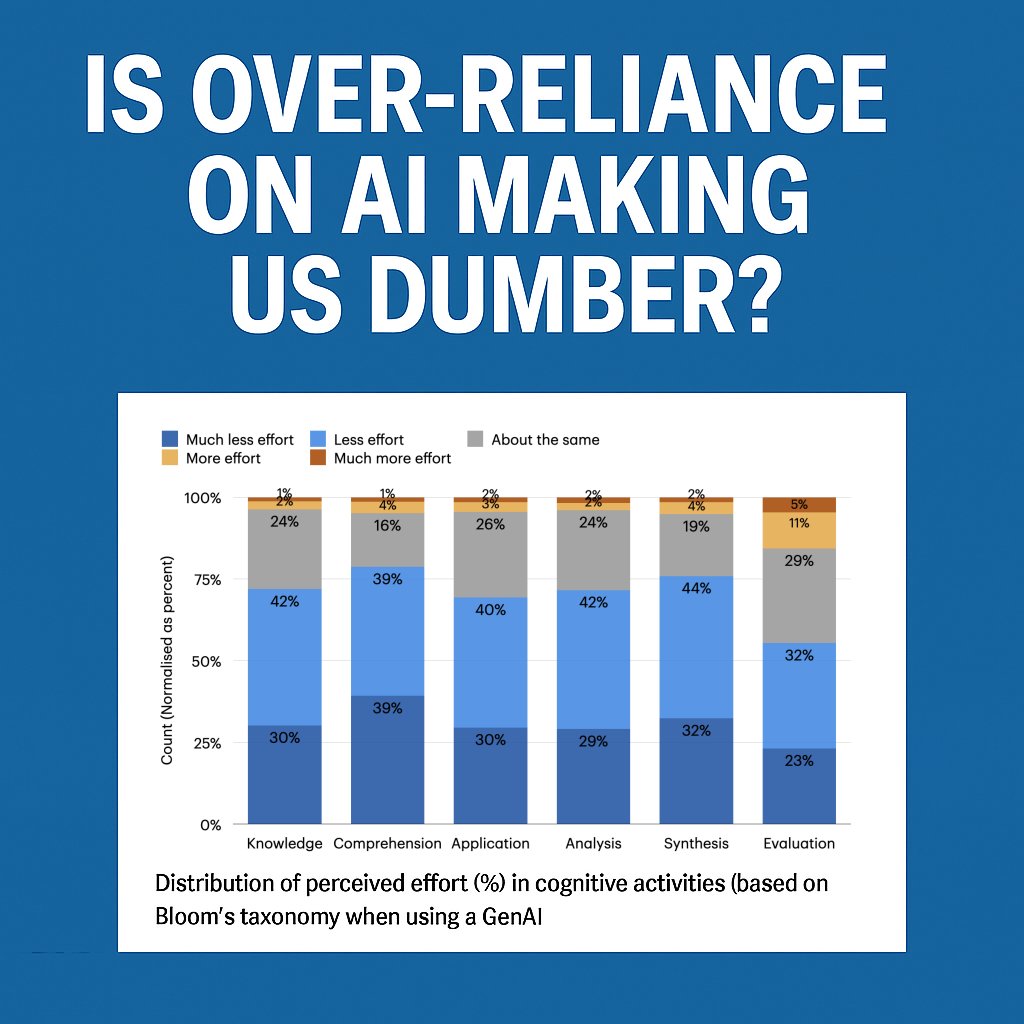
🧠 Is Over-Reliance on AI Making Us Dumber — or Just Different Thinkers?
Try this:
→ 16,951 ÷ 67?
You reached for your phone.
→ Grocery list?
No notes, no chance.
Now scale that.
300M people use GenAI every week.
Not to think harder —
To think less.
📉 New study. 936 AI-assisted tasks.
Across healthcare, education, engineering.
The result?
→ More trust in AI = less critical thinking
→ More trust in yourself = more critical thinking
→ Thinking happens after the AI responds — not during
→ We’re verifying, not reasoning
We’re not offloading tasks.
We’re offloading thought.
It gets worse.
Most now define “critical thinking” as:
→ Writing a better prompt
→ Checking if the output fits
→ Making sure it’s functional
That’s not thinking.
That’s quality control.
⚠️ GenAI was never built to make us smarter.
Just faster.
But faster ≠ better.
If we want real augmented intelligence, we need:
✅ Tools that provoke thought
✅ Users who challenge the machine
✅ Workflows that reward depth, not just output
🚨 What if the real threat isn’t dumb AI…
But smart AI that makes us stop thinking?
Speed means nothing if we’re thinking less.
Let’s talk👇
#AI #CriticalThinking #DigitalCognition #CognitiveOffloading #GenAI #Leadership #IrreplaceableAI #FutureOfWork
Link to study> zurl.co/2BcRG
2
759
22 Jul 2025
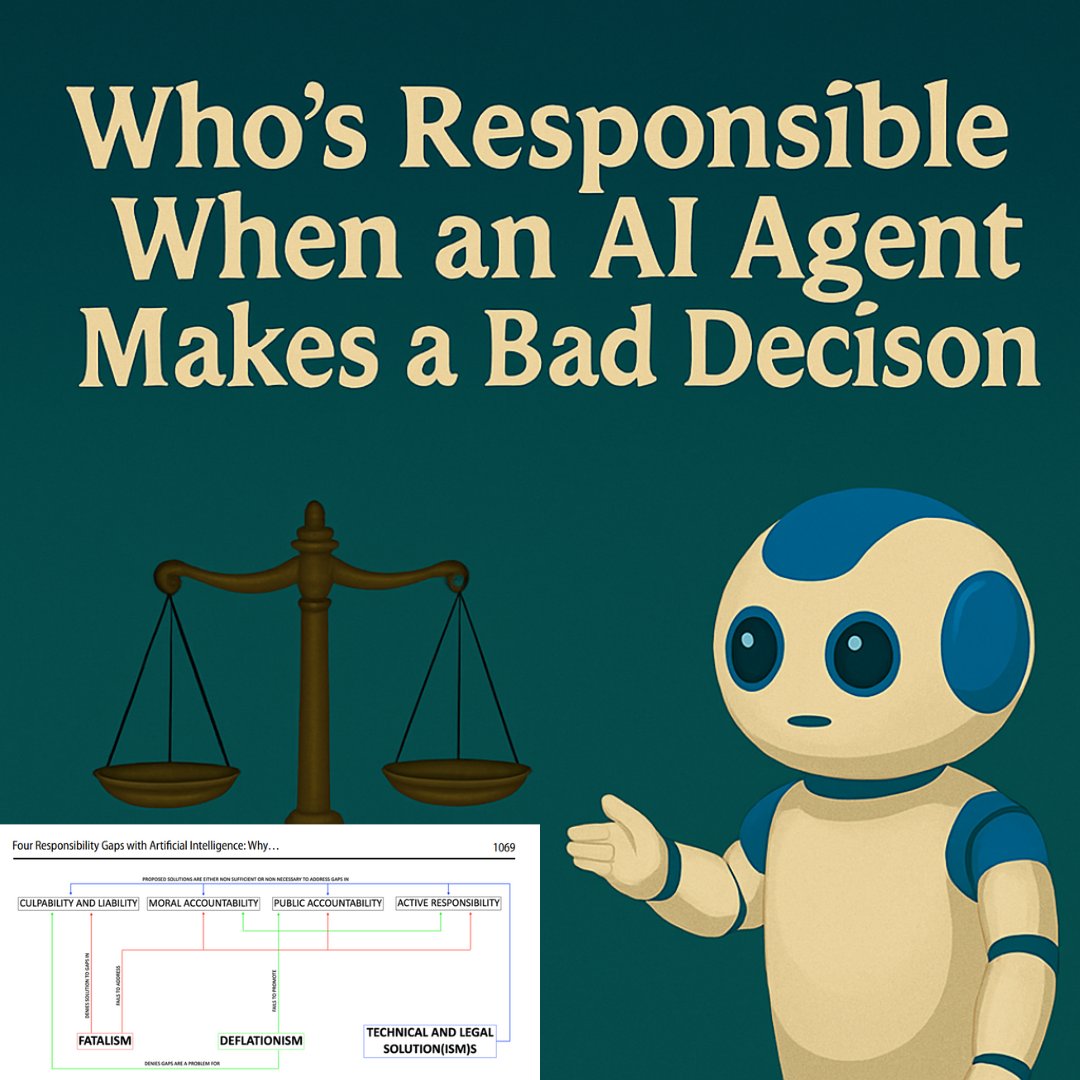
⚖️ Who’s Responsible When an AI Agent Makes a Bad Decision?
A cancer diagnosis delayed.
A pedestrian killed by a self-driving car.
A loan denied due to biased data.
The consequences are real.
But the accountability? Still dangerously unclear.
And in my opinion, the uncomfortable truth is that we’ve built autonomous systems… but forgot to build autonomous accountability.
Over the past few months, I’ve been thinking deeply about this — especially as AI agents become more embedded in critical decisions across industries.
📚 One paper that really struck me recently is by Filippo Santoni de Sio and his colleagues.
According to them, we’re facing a “Responsibility Gap” — not just one, but four intertwined gaps:
➤ Culpability
➤ Moral accountability
➤ Public accountability
➤ Active responsibility
And these aren’t just tech issues — they’re legal, organizational, and societal.
So what should we do?
According to me, we’re falling into 3 common traps ❌
Fatalism: “This can’t be fixed.”
Deflationism: “It’s not that serious.”
Solutionism: “Tech and laws will solve it.”
👨⚖️ For business leaders, here’s why this matters:
If AI is involved in your operations:
✅ You might be legally responsible — even if AI is “just assisting”
✅ Customers will hold you accountable
✅ Regulators are catching up —
The EU AI Act shifts the burden of proof toward developers and deployers.
🛠️ In my opinion, we urgently need to explore emerging ideas to bridge the gap by adopting a few principles:
🔸 Computational Reflective Equilibrium – Accountability based on actual control
🔸 Presumption of Causality – Easier paths for victims to seek justice
🔸 Hybrid Governance – Audits, explainability, and regulation in one framework
Here’s the big question for you:
When AI causes harm… who should be held accountable? The CEO? The engineer? The algorithm?
Or is it time to redefine liability in the age of autonomy? I’d love to hear what you think.
#AI #Leadership #ResponsibleAI #Governance #IrreplaceableAI #AIRegulation #MeaningfulHumanControl #FutureOfWork
5
2
7
762