
Feb 24
☄️🔥 STILL ALIVE: The Forgotten Interstellar Visitor 3I/ATLAS Is Approaching Jupiter — And Almost No One Is Watching
3I/ATLAS Images: spacetracker.space/timeline
In a quiet corner of the sky, far from headlines and trending feeds, something extraordinary is still moving.
3I/ATLAS — the strange interstellar object that once sparked global curiosity — has not disappeared.
It is still there.
Still traveling.
Still alive.
And only a few observers are following it.
🌌 February 23, 2026 — A Faint Ghost in the Stars
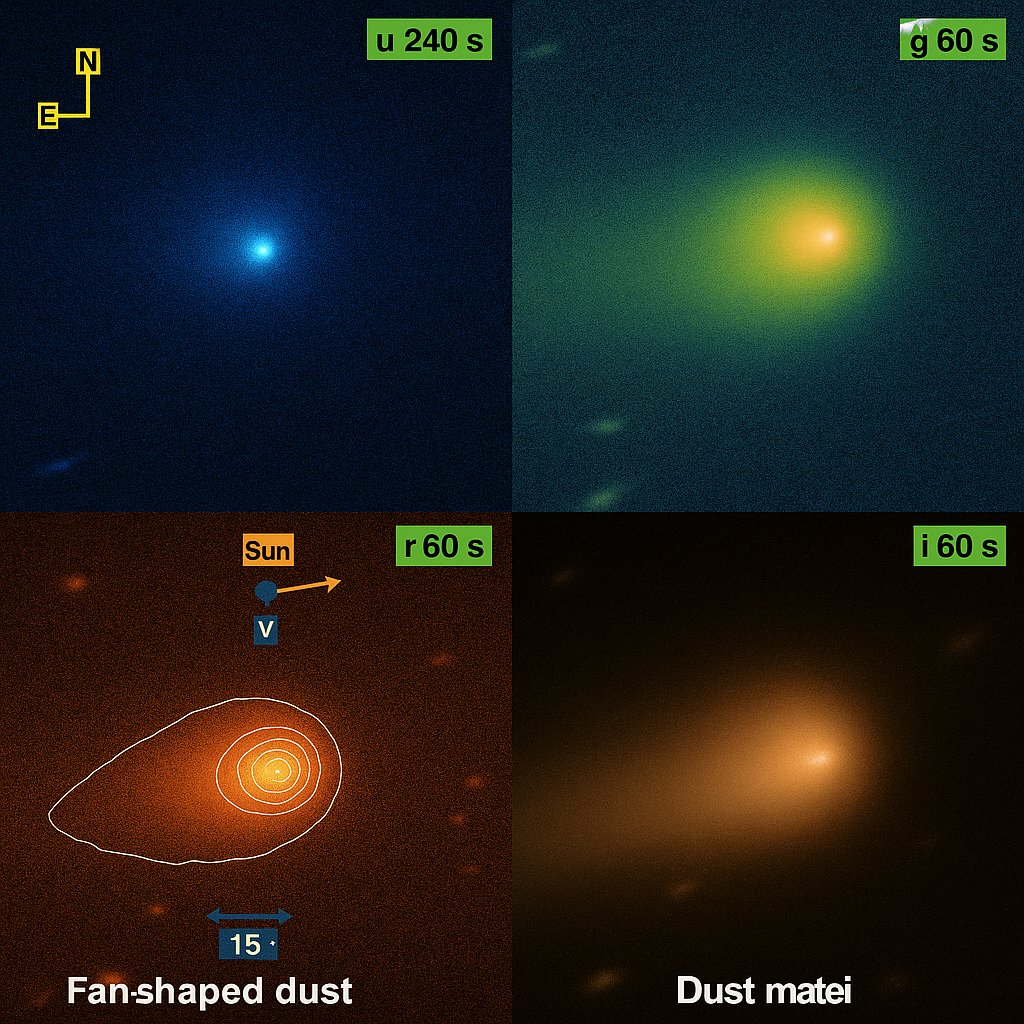
On February 23, 2026, Ray’s Astrophotography captured new footage of 3I/ATLAS.
The object appeared extremely faint, barely distinguishable from background stars. A red arrow was used to indicate its subtle motion across the stellar field — without it, most would miss it entirely.
At that moment:
🌍 Distance from Earth: ~551.6 million km
♃ Distance to Jupiter: ~130 million km
👁 Visual magnitude: Faint — near detection limits for many amateur setups
It is no longer bright.
It no longer trends.
But it is still moving toward something historic.
🪐 The Target: Jupiter
On March 16, 2026, 3I/ATLAS is expected to make its closest approach to Jupiter.
That approach could become a defining moment.
Jupiter’s immense gravity has altered the trajectories of countless comets in our solar system. Now the question is:
What will it do to an interstellar traveler?
Will Jupiter bend its path?
Accelerate it?
Capture new data about its composition through gravitational interaction?
Or will 3I/ATLAS simply slingshot past and vanish back into deep space?
🔭 Why Has Attention Faded?
When 3I/ATLAS was first confirmed as an interstellar object, telescopes around the world turned toward it.
Now, only a handful remain.
There are no dramatic tails filling the sky.
No naked-eye spectacle.
Just a dim traveler against cold stars.
But scientifically, the story is far from over.
Even faint objects carry information:
🧪 Surface composition clues
🌀 Activity levels and outgassing behavior
📐 Orbital refinement data
🧭 Gravitational perturbation measurements
This close pass by Jupiter offers a rare natural experiment.
🌠 The Silent Phase of a Cosmic Journey
Interstellar objects are not common visitors.
Each one carries material formed around another star — another planetary system — possibly billions of years ago.
When 3I/ATLAS fades from public attention, it does not lose its importance.
It simply enters a quieter chapter.
And sometimes, the quiet chapters matter most.
📅 What Happens Next?
March 16, 2026
Closest approach to Jupiter.
Observers are waiting.
Tracking.
Measuring.
If gravitational interaction alters its velocity or trajectory significantly, we may learn more about its mass and structure than ever before.
For now, it remains a faint point moving slowly across the sky — but scientifically, the countdown has begun.
🚀 Why This Matters
We are witnessing:
A confirmed interstellar object
Passing within ~130 million km of Jupiter
Observed at ~551.6 million km from Earth
Approaching a gravitational giant
These events are rare on human timescales.
And history has shown that some of the most important discoveries happen when only a few are still paying attention.
✍️ Final Thought
Not every cosmic event arrives with fireworks.
Some arrive as whispers.
3I/ATLAS is still there.
Still traveling.
Still telling a story written long before our solar system formed.
And a few telescopes are still listening.
☄️ #3IATLAS #InterstellarObject #JupiterApproach #Astronomy #Astrophotography #SpaceNews #Jupiter #DeepSpace #CosmicVisitor #Spacetracker #SkyWatch #March16 #ScienceJourney
4
15
53
4,753
3 Nov 2025
🚨 MUST FOLLOW: 3I/ATLAS Now on Course Toward Jupiter📅 Timestamp: Nov 03 2025 03:00 UTC 🪐 Destination: Jupiter Orbit — Outer Solar
| ---------------------- ---------------------- -------Object | Distance (km) | Distance (AU) | ---------------------- ------------------
☀️ Sun | 203.4 million km | 1.36 AU | |
☿️ Mercury | 254.4 million km | 1.70 AU | |
♀️ Venus | 96.71 million km | 0.65 AU | |
🌍 Earth | 337.1 million km | 2.25 AU | |
🌕 Moon | 337.5 million km | 2.26 AU | |
♂️ Mars | 228.2 million km | 1.52 AU | |
♃ Jupiter | 767.9 million km | 5.13 AU | |
♄ Saturn | 1.63 billion km | 10.90 AU | |
♅ Uranus | 3.06 billion km | 20.45 AU | |
♆ Neptune | 4.68 billion km | 31.29 AU |
🪐 Charon | 5.39 billion km | 36.02 AU |
Approach
🌌 Status: Interstellar Comet in Transit
The interstellar voyager Comet 3I/ATLAS is now racing across the outer Solar System, its ion tail flaring brilliantly as it moves on a direct trajectory toward Jupiter’s orbital zone. Having recently passed within 1.36 AU of the Sun, it continues its journey outward, accelerating through deep space at breathtaking velocity.
⚡ Velocity Tracker
[■■■■■■■■■■■■■■■■■■■■■■■■■■■■■■■■■■■■■■■■■■■■] 54.6 km/s
(≈ 196,560 km/h — about 150 times faster than a commercial jet!)
Each second, 3I/ATLAS travels roughly half of Earth’s diameter, making it one of the fastest natural travellers ever detected near our system.
🛰️ What Happens Next
At this rate, the comet is projected to cross near Jupiter’s orbital path in early 2026, offering astronomers a prime opportunity to observe gravitational and plasma-tail interactions between the interstellar dust and the giant planet’s magnetic field.
🎥 SpaceTracker Live Visuals
Real-time 8 K satellite dashboards now stream 3I/ATLAS telemetry — including distance metrics from the Sun, Earth, and Jupiter — displayed on luminous orbital screens.
Follow the motion live → 🌐 SpaceTracker.space
#3IATLAS #SpaceTracker #JupiterApproach #InterstellarComet #Astrophysics #SpaceNews

1
4
371

11 Jun 2015
Felicidades a @NSSektor y @jupiterapproach por ganar las entradas para ver a @CYBERPUNKERS este Sábado en #Pasaguero.
2