Filter
Exclude
Time range
-
Near
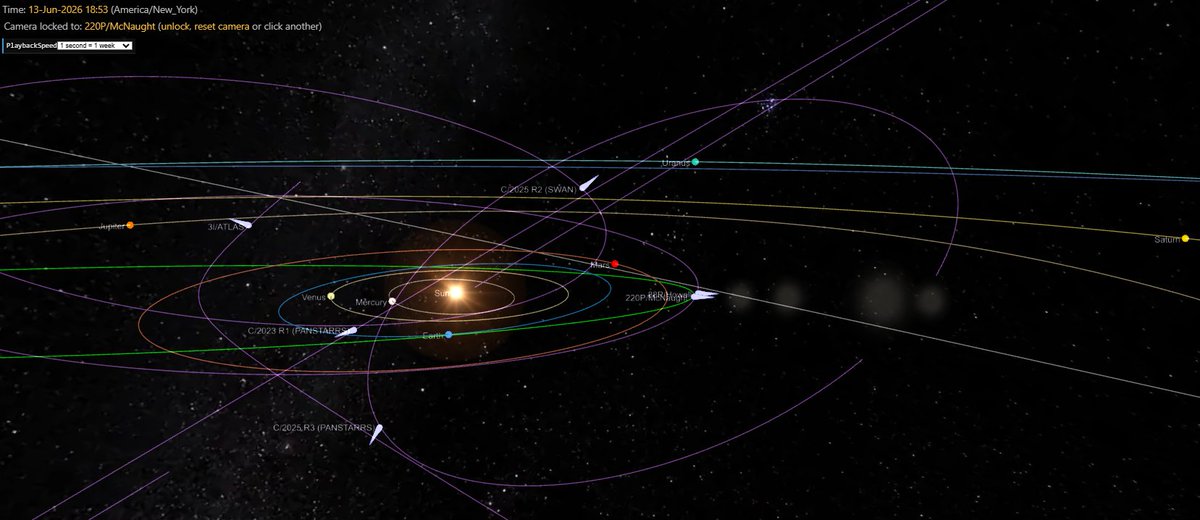
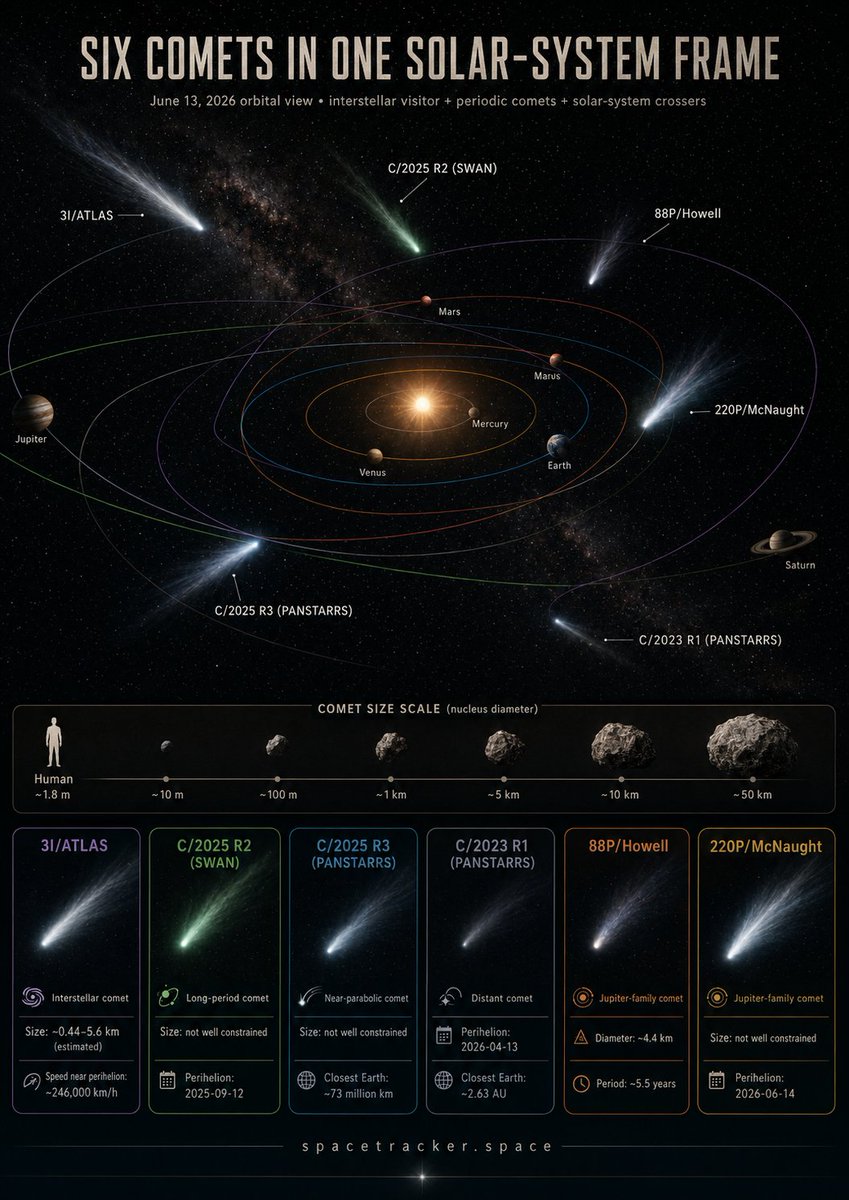
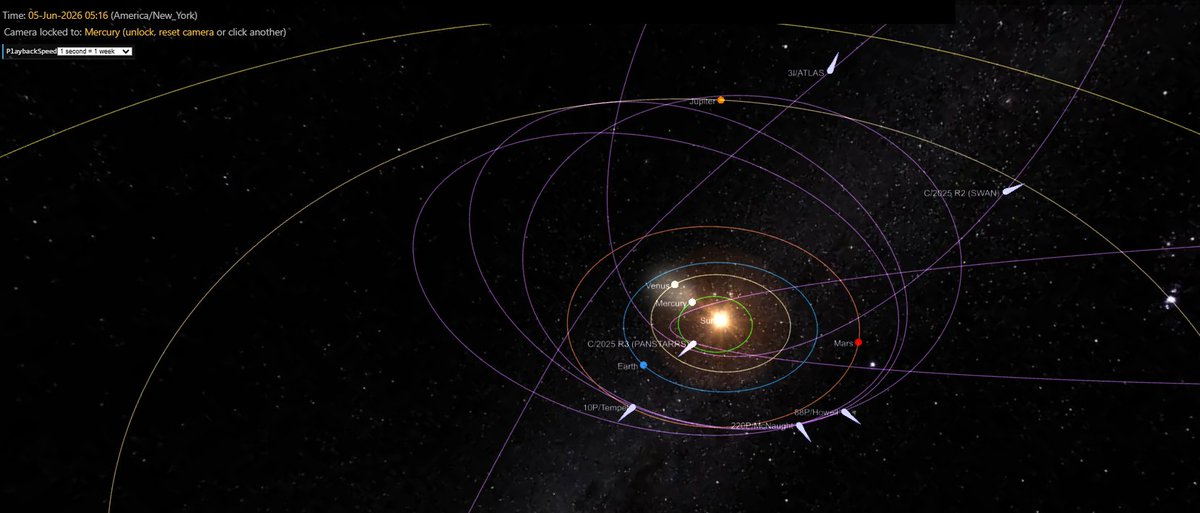
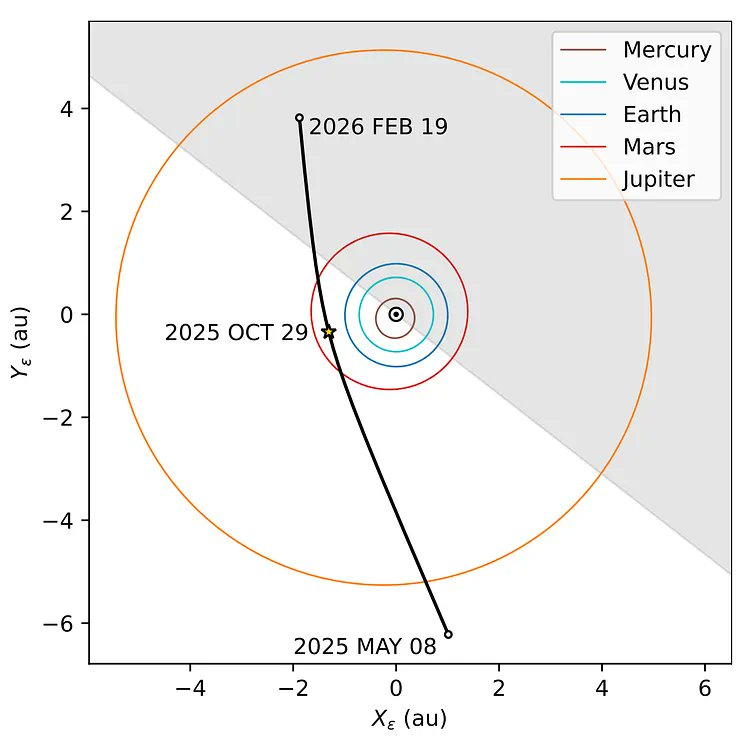
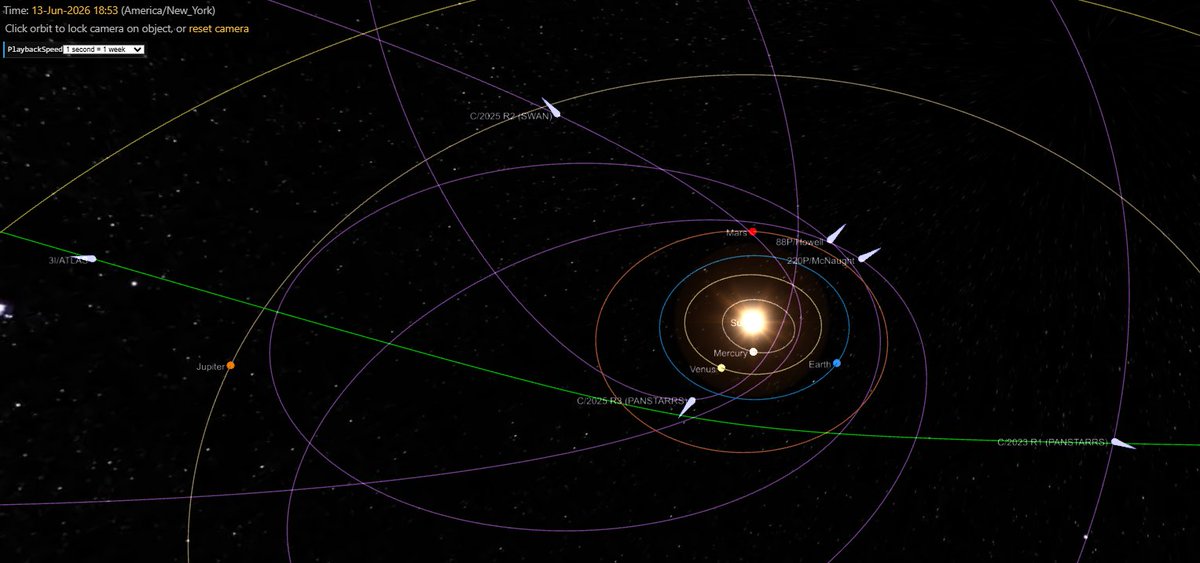
🚨 BREAKING: Six Comets Captured in One Solar-System Frame 3I/ATLAS β€’ C/2025 R2 SWAN β€’ C/2025 R3 PANSTARRS β€’ C/2023 R1 PANSTARRS β€’ 88P/Howell β€’ 220P/McNaught June 13, 2026 orbital view β€’ Interstellar visitor β€’ Long-period comets β€’ Jupiter-family comets Credit: spacetracker.space A new orbital-map view from June 13, 2026 shows a remarkable comet traffic scene across the inner solar system. The image is not a telescope photo. It is an orbit simulation showing comet paths, planetary positions, and the geometry of several active cometary bodies moving through the same solar-system region. The objects visible include 3I/ATLAS, C/2025 R2 (SWAN), C/2025 R3 (PANSTARRS), C/2023 R1 (PANSTARRS), 88P/Howell, and 220P/McNaught. This is not an impact warning. It is a scientific snapshot of comet motion, solar heating, dust activity, gas release, and orbital diversity. SOLAR-SYSTEM COMET TRAFFIC - JUNE 2026 C/2025 R2 SWAN C/2025 R3 PANSTARRS \ / \ / 3I/ATLAS --------\---------------------/------ interstellar escape path \ / \ / Jupiter Mars / Earth / Sun 88P Howell 220P McNaught 🌌 PILLAR 1 -3I/ATLAS: The Interstellar Visitor What it is: 3I/ATLAS is an interstellar comet. That means it did not originate as a normal bound object orbiting the Sun. It entered the solar system on a hyperbolic path and is leaving again. Discovery: It was discovered on July 1, 2025 by the ATLAS survey. Perihelion: Its closest approach to the Sun occurred around October 29–30, 2025, at about 1.4 astronomical units, just inside the orbit of Mars. Closest approach to Earth: It stayed far from Earth, with closest Earth distance around 1.8 AU. It was never an impact threat. Speed: NASA reported it moving at extremely high interstellar speed: about 221,000 km/h at discovery and roughly 246,000 km/h near perihelion. Mass: A confirmed mass is not available from the orbital image. Mass should not be claimed from this screenshot. Size estimates and nucleus constraints exist, but mass depends on density and shape, which are not directly measured from the simulation. Material and chemistry: JWST observations showed an unusually carbon-dioxide-rich coma, with water, carbon monoxide, water ice, dust, and carbonyl sulfide also reported. This makes 3I/ATLAS one of the most scientifically important comet objects in the scene. Tail / anti-tail status: A cometary coma and dust/gas activity are confirmed. A specific anti-tail claim should not be made from this orbit screenshot alone. Scientific importance: 3I/ATLAS is the strongest science object in the frame because it carries material from outside the solar system. It gives astronomers a rare chance to compare chemistry from another star system with comets formed around our Sun. Status: β˜„οΈ Interstellar 🌍 No Earth danger πŸ”¬ High scientific value πŸ§ͺ Unusual COβ‚‚-rich chemistry 🟒 PILLAR 2 - C/2025 R2 (SWAN): The Solar-Wind Discovery Comet What it is: C/2025 R2 (SWAN) is a long-period comet found in solar-observing data. Discovery: The Minor Planet Center recorded reports of cometary activity after the object was detected in SWAN imagery. The comet became widely followed because it appeared close to the Sun and then brightened enough to attract attention from skywatchers. Perihelion: It passed closest to the Sun in September 2025, at roughly half the Earth-Sun distance. Closest approach to Earth: Its closest Earth approach occurred in October 2025 at a safe astronomical distance. Speed: A precise speed should not be claimed from the screenshot. Comet velocity changes continuously along its orbit, and an exact number requires an ephemeris calculation for a specific time. Mass: No reliable mass is confirmed from the orbit map. A comet’s brightness does not directly reveal mass. Material and appearance: SWAN became known as a visually interesting comet, with a bright coma and tail activity as solar heating drove gas and dust release. Tail / anti-tail status: Tail activity is part of its comet behavior, but an anti-tail should not be claimed from the orbital map alone. Scientific importance: C/2025 R2 shows how near-Sun discovery tools can reveal comets that ordinary night-sky surveys may miss until they emerge from solar glare. Status: 🟒 Long-period comet β˜€οΈ Solar-heated activity 🌍 No Earth danger πŸ“‘ Detected through solar-observing data ⚑ PILLAR 3 - C/2025 R3 (PANSTARRS): The Tail-Physics Comet What it is: C/2025 R3 (PANSTARRS) is a bright 2026 comet that became important because of its tail behavior near the Sun. Discovery: It was discovered by the Pan-STARRS survey in 2025. Perihelion: It reached perihelion in April 2026, passing close enough to the Sun for intense heating and strong tail development. Closest approach to Earth: It made its closest approach to Earth in late April 2026 at a safe distance of tens of millions of kilometers. Speed: No exact speed should be taken from the screenshot. A firm velocity needs a date-specific ephemeris. Mass: A confirmed mass is not publicly established from the orbit-map data. Material and tail behavior: This is one of the best tail-science objects in the group. Observations from solar spacecraft showed the comet’s ion tail activity as it moved near the Sun. A dust tail and ion tail are different: dust tails are made of heavier particles pushed by sunlight, while ion tails are made of charged gas shaped by the solar wind. Anti-tail status: No confirmed anti-tail should be stated from the screenshot alone. Anti-tail appearances are usually viewing-geometry effects caused by dust along the orbital plane. Scientific importance: C/2025 R3 is valuable because it shows the interaction between comet gas, dust, sunlight, and the solar wind. Status: ⚑ Tail-physics object β˜€οΈ Strong solar interaction 🌍 No Earth danger πŸ“Έ Important for comet-imaging observers ❄️ PILLAR 4 - C/2023 R1 (PANSTARRS): The Distant Cold Comet What it is: C/2023 R1 (PANSTARRS) is a distant comet with a much larger perihelion distance than the bright inner-solar comets in the scene. Discovery: It was identified by the Pan-STARRS survey. Perihelion: It reached perihelion on April 13, 2026 at about 3.57 AU from the Sun. Closest approach to Earth: Its nearest Earth approach occurred around June 12, 2026 at about 2.63 AU. Speed: No exact speed is stated from the screenshot. Because it remains far from the Sun compared with the inner comets, it is not being presented here as a high-speed near-Sun object. Mass: A confirmed mass is not available from the map. Material and activity: At more than 3 AU from the Sun, this comet is colder and fainter than the inner solar-system comets. Any activity at that distance is scientifically useful because it can involve more volatile ices than ordinary water-ice sublimation close to the Sun. Tail / anti-tail status: The orbit image does not confirm a visible tail or anti-tail. Scientific importance: C/2023 R1 matters because it represents the colder, more distant class of comet behavior. Not every important comet is bright. Some are valuable because they show how comet activity behaves far from the Sun. Status: ❄️ Distant comet 🌌 Cold-region activity 🌍 No Earth danger πŸ”­ Faint but scientifically useful πŸ” PILLAR 5 -88P/Howell: The Returning Jupiter-Family Comet What it is: 88P/Howell is a periodic Jupiter-family comet. Its orbit is strongly shaped by Jupiter’s gravity, and it returns to the inner solar system on a roughly 5.5-year cycle. Discovery: It was discovered by Ellen Howell in 1981. Perihelion: It reached perihelion on March 18, 2026, at about 1.36 AU from the Sun. Closest approach to Earth: Its 2026 nearest approach to Earth is listed for October 10, 2026 at about 1.50 AU. Speed: No exact velocity should be quoted from the screenshot. A precise value requires date-specific orbital calculation. Mass: A confirmed mass is not available from the orbit map. Some diameter estimates exist, but mass requires density and shape information. Material and tail behavior: 88P/Howell is a normal active periodic comet. Its importance is not based on shock value, but on repeat observation. Returning comets help astronomers track how nuclei evolve after repeated solar heating. Anti-tail status: No anti-tail is confirmed from this image. Scientific importance: 88P/Howell is valuable because repeated returns let observers compare brightness, activity, and dust output from one orbit to another. Status: πŸ” Periodic comet πŸͺ Jupiter-family orbit 🌍 No Earth danger πŸ“† Repeat-observation science πŸ’₯ PILLAR 6 - 220P/McNaught: The Outburst Comet in the Frame What it is: 220P/McNaught is a Jupiter-family periodic comet with an orbit of about 5.5 years. Discovery: It was discovered by Robert H. McNaught in 2004. Perihelion: It reaches perihelion on June 14, 2026 at about 1.56 AU from the Sun. Closest approach to Earth: Its nearest Earth approach is listed for October 12, 2026 at about 1.02 AU. Speed: No exact velocity is taken from the screenshot. A precise number requires a time-specific ephemeris. Mass: No confirmed mass is available from the orbit map. Outburst activity: This is the most dramatic comet in the image. Reports in June 2026 described a major brightening event, with 220P/McNaught becoming much brighter than expected. Such outbursts can occur when trapped gas, dust, or fractured surface material is suddenly released. Tail / anti-tail status: Dust-tail development has been reported. An anti-tail should not be claimed from the orbit image alone. Scientific importance: 220P/McNaught is important because sudden comet outbursts reveal unstable surface layers and volatile pockets inside a nucleus. These events help researchers understand how comet crusts fracture, release material, and change after repeated solar passages. Status: πŸ’₯ Outburst comet πŸ” Jupiter-family periodic comet 🌍 No Earth danger πŸ“ˆ Major brightness change reported FINAL SCIENTIFIC SUMMARY This image shows a rare comet-traffic moment, not a collision scenario. The frame includes one interstellar comet, multiple long-period or near-parabolic comet paths, and two Jupiter-family periodic comets. Each object tells a different story: 🌌 3I/ATLAS tells the story of material from another star system. 🟒 C/2025 R2 SWAN tells the story of solar-observing instruments catching comets near the Sun. ⚑ C/2025 R3 PANSTARRS tells the story of dust, ion tails, and solar-wind interaction. ❄️ C/2023 R1 PANSTARRS tells the story of cold, distant comet activity. πŸ” 88P/Howell tells the story of repeat periodic comet evolution. πŸ’₯ 220P/McNaught tells the story of sudden outburst behavior near perihelion. The strongest scientific headline is clear: Six comet paths. One solar-system frame. No confirmed Earth danger. High scientific value. Processed by spacetracker.space #Comet #Comets #3IATLAS #InterstellarComet #220PMcNaught #88PHowell #CometSWAN #PANSTARRS #Astronomy #SpaceScience #SolarSystem #NASA #JWST #SOHO #Skywatching #CometOutburst #IonTail #DustTail #OortCloud #JupiterFamilyComet #InterstellarObject #SpaceNews #Astrophotography #ScienceNotHype #SpaceTracker
1
2
4
938
🌌 SCIENTISTS JUST FOUND METHANE ON A VISITOR FROM ANOTHER STAR SYSTEM. taylortailored.co.uk/science… 3I/ATLAS is only the third confirmed interstellar object ever detected. πŸ’« Now the James Webb Space Telescope has found methane hidden beneath its surface β€” the first time methane has been directly detected on an interstellar visitor. πŸ”­ The bigger story? This object formed around another star. Its chemistry looks different from almost anything in our Solar System, giving scientists a rare glimpse into how alien planetary systems may be built. 🧬 @neiltyson @drbeckyenenche @DJSnM #TaylorTailored #Space #Astronomy #JamesWebb #Science #InterstellarObject
39
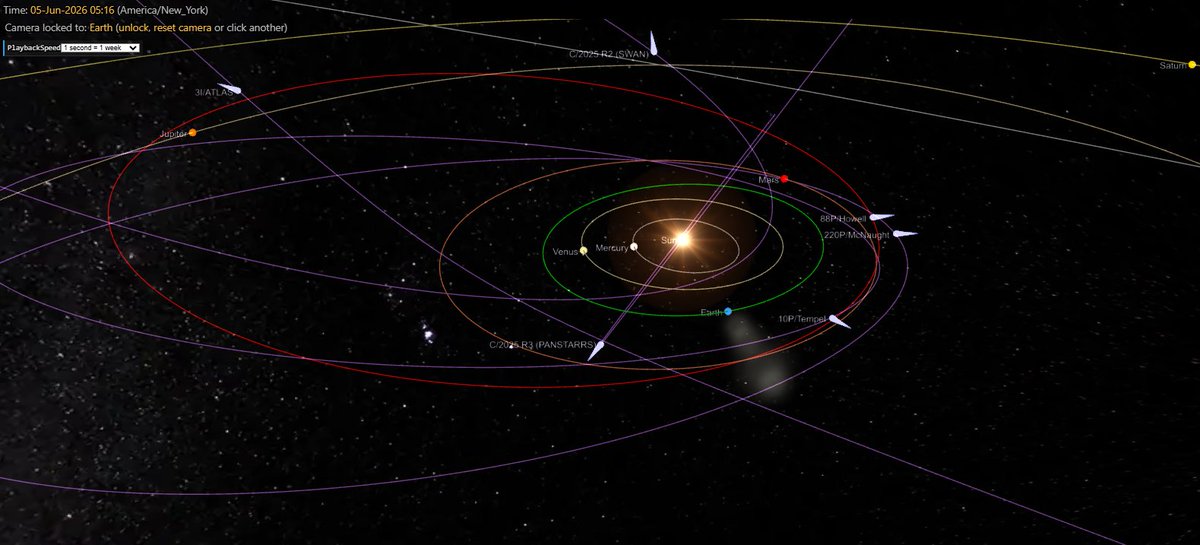
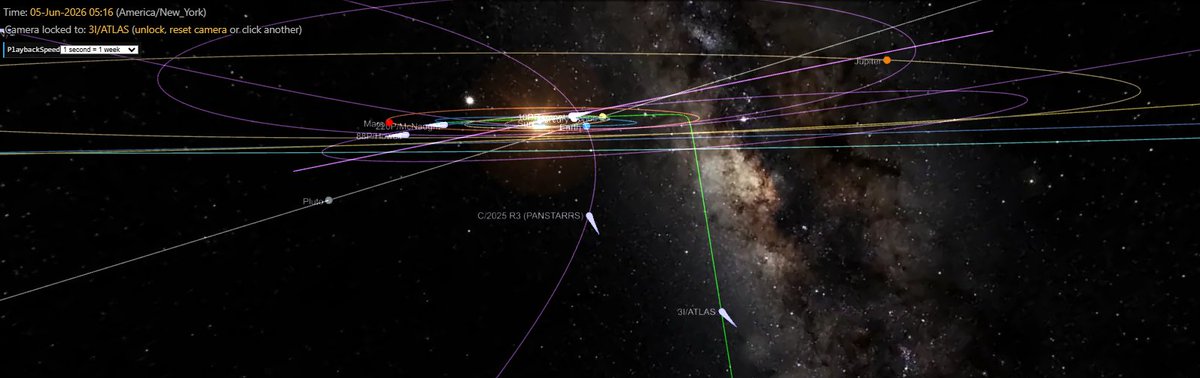
πŸš¨β˜„οΈ BREAKING COMET TRAFFIC MAP: Six Comets Cross the Inner Solar System in One View Processed by spacetracker.space A rare orbital snapshot from June 5, 2026 shows a crowded comet scene around the inner solar system: 3I/ATLAS, C/2025 R2 SWAN, C/2025 R3 PANSTARRS, 10P/Tempel 2, 88P/Howell, and 220P/McNaught. This is not an impact warning. It is something more scientifically interesting: six icy bodies from different origins moving through the same solar arena. Pillar 1 -The Interstellar Visitor 3I/ATLAS is the rarest object in the frame. NASA identifies it as only the third known interstellar object observed passing through our solar system. It was discovered on July 1, 2025, by ATLAS in Chile, reached perihelion around Oct. 30, 2025, and moved at about 68 km/s near perihelion. It came no closer than about 1.8 AU from Earth, so it was never a threat. Pillar 2 -The Bright Long-Period Comets C/2025 R2 SWAN came from a long-period orbit and was discovered in SOHO/SWAN data. It passed perihelion near 0.5 AU from the Sun and made a close-but-safe Earth approach around 0.261 AU / 39 million km in October 2025. NASA’s APOD described its greenish coma and tail, making it one of the visually dramatic recent comets. Pillar 3 -PANSTARRS, the 2026 Showpiece C/2025 R3 PANSTARRS became one of the major comet stories of 2026. It reached perihelion around April 19–20, 2026, about 0.499 AU from the Sun, then passed closest to Earth around April 26–27, roughly 70–72 million km away. Reports described a green coma, dust tail, and ion tail, especially during the solar-wind interaction after perihelion. Pillar 4 -The Heavyweight: 10P/Tempel 2 10P/Tempel 2 is the mass champion of this group. It is a Jupiter-family comet discovered in 1873, returning every 5.36 years. Its 2026 perihelion is on Aug. 2, with closest Earth approach on Aug. 3 at about 0.414 AU. Published modeling gives it a mass of about 3.5 Β± 1.5 Γ— 10¹⁴ kg, making it far better constrained than most comets in this screenshot. Pillar 5 -Howell: The Mission Candidate 88P/Howell is another Jupiter-family comet, discovered in 1981 by Ellen Howell. It reached perihelion on March 18, 2026, at about 1.358 AU from the Sun. Its diameter is listed around 4.4 km, and it has been considered interesting enough for sample-return mission concepts. Pillar 6 -The Surprise Outburst: 220P/McNaught The current headline object is 220P/McNaught. It is a Jupiter-family comet approaching perihelion on June 14, 2026, at about 1.56 AU from the Sun. Just before perihelion, observers reported a major outburst: the comet brightened by hundreds to thousands of times, with reports from roughly magnitude 18 to 11 and possibly as bright as 8.2. The real story: this map shows three comet families in one frame - interstellar, Oort/long-period, and Jupiter-family periodic comets. Some are ancient returners. One is an interstellar escapee. One suddenly erupted. Together they show how active, layered, and alive the solar system really is. Scientific note: comet masses are difficult to measure. Except for well-studied objects like 10P/Tempel 2, most comet masses remain uncertain because we often see the glowing coma and tail more easily than the hidden nucleus. NASA explains that comets develop comae and tails as solar heating releases gas and dust from icy nuclei. Extended hashtags #Comet #Comets #Astronomy #Space #SpaceScience #SolarSystem #3IATLAS #ATLAS #InterstellarObject #SWAN #PANSTARRS #Tempel2 #Howell #McNaught #220PMcNaught #CometOutburst #Astrophotography #Skywatching #PlanetaryScience #NASA #SOHO #JPL #OortCloud #JupiterFamilyComet #SpaceNews #ScienceNews #CosmicDiscovery #SpaceTracker #spacetrackerspace
4
1,305
🚨 BREAKING: First-Ever Real-Time 3D Map of Interstellar Objects 🧡 I spent weeks obsessing over something that's never been visualized properly. Full article and App: spacetracker.space/post/a-re… Three alien objects passed through our solar system. I built the tool that shows all of them - in real 3D - for the first time. Here's what I found, and why it matters πŸ‘‡ 1/In 2017, something impossible showed up. An object came screaming through our solar system at 87 km/s - from outside. No tail. No orbit. Just a dark, flat rock from another star system hurtling past our Sun. We called it Κ»Oumuamua. And we almost missed it entirely. 2/Then in 2019, it happened again. 2I/Borisov - a full interstellar comet - came barreling in from the direction of Cassiopeia. Ice. Coma. Jets. It looked just like our comets. But it came from another star. We're no longer alone in the debris field. 3/Then in July 2025 - ATLAS caught a third one. 3I/ATLAS. Eccentricity of 6.14. Nearly retrograde orbit. Moving at 58 km/s. It passed closer to Mars than Mars is to Earth. Three interstellar visitors. Three separate stars. Three chances to understand what's out there. 4/Here's the problem nobody talks about: Every visualization of these objects is flat. Top-down. A boring 2D map. But these objects don't travel in the flat plane where planets orbit. Κ»Oumuamua came in from ABOVE the ecliptic. Dipped south. Swung back north. Left at 20Β° above the plane. You can't see that in 2D. Ever. 5/So I built it. A full 3D solar system. All 8 planets at their exact positions - calculated from NASA JPL Keplerian elements. All 3 interstellar objects with accurate trajectories validated against published research. Running in real time. In your browser. No app needed. 6/What went into it: βœ… JPL J2000 orbital elements for every planet βœ… Kepler's equation solved numerically for exact positions βœ… Hyperbolic orbit mechanics for all 3 ISO objects βœ… Validated against JPL Horizons Cartesian state vectors βœ… Sources: Nature (2025), Nature Astronomy (2024), JPL, ESO/ALMA Every trajectory cross-checked. Every ecliptic crossing confirmed. 7/The side view changes everything. You see Κ»Oumuamua diving DOWN through the ecliptic plane. You see Borisov crossing at 44Β°, slicing through like a knife. You see 3I/ATLAS nearly flat but retrograde, going the WRONG WAY around the Sun. Three totally different flight paths. Three totally different stars. 8/Speed controls from 0.1Γ— to 10Γ—. Watch Κ»Oumuamua's entire 2017 flyby in slow motion. Watch 13 years of the solar system in 30 seconds. Drag to rotate. Scroll to zoom. Switch between top view, side view, oblique β€” live. This is what space visualization should feel like. 9/The hardest part wasn't the code. It was realizing the z-axis was flipped. Every object appeared to come from the wrong direction. Spent days cross-checking with Wikipedia, JPL Horizons, published papers, Cartesian state vectors. The fix? One line. -z. That's science. 10/We've now confirmed that interstellar objects pass through our solar system regularly. We've detected 3 in 8 years. Statistical models suggest there are thousands crossing the solar system at any given moment, we just can't see them. What else is out there? 11/Full interactive 3D solar system. All 3 interstellar visitors. Accurate to JPL data. Free. No signup. Runs in your browser. πŸ”— spacetracker.space Built by Ammar A. because this needed to exist. If this blew your mind, repost it. Someone in your feed needs to see this. 🌌 #Space #Astronomy #Oumuamua #Borisov #3IATLAS #InterstellarObject #SolarSystem #SpaceVisualization #Science #BuildInPublic #trends #space #astronomy #ufo #uap #alien #trending
1
15
40
9,258
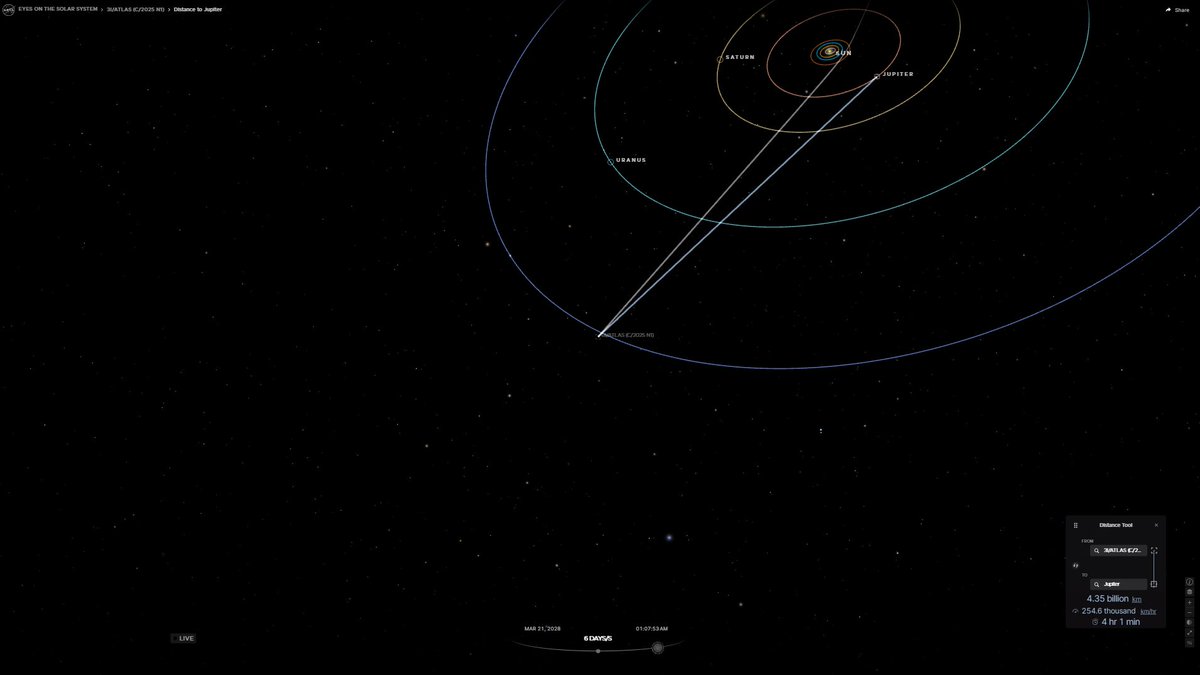
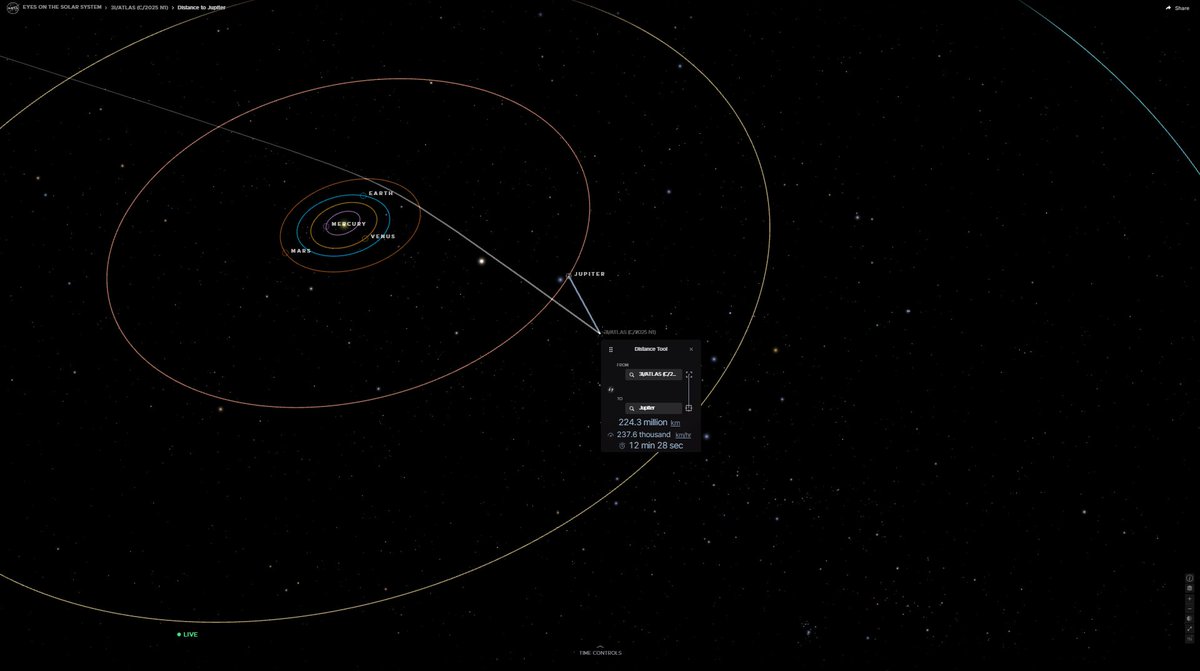
🚨 BREAKING: 3I/ATLAS keeps leaving everything behind By SPACETRACKER.SPACE By mid-April 2026, your tracking angle shows 3I/ATLAS already beyond the Moon’s viewing line and moving away from Jupiter. By April 23, 2026, the distance reading in the screen capture shows the interstellar object about 224.3 million km from Jupiter, still pulling away fast. That is the haunting part of this object. It does not stay. It does not circle back. It turns the Solar System into a trail of markers behind it. First the inner system. Then the Moon’s perspective. Then Jupiter’s realm. And if the long-range simulator path holds, another remarkable checkpoint may come on March 21, 2028 β€” around the equinox season β€” when 3I/ATLAS appears set to cross Neptune’s orbital line. That is a beautiful cosmic coincidence. Not because Neptune and 3I/ATLAS will meet. But because an object from interstellar space would be reaching one of the outer Solar System’s great boundary lines right as Earth passes through one of its own seasonal balance points. It is a reminder that two clocks are always running at once: Earth’s human clock of seasons, equinoxes, and calendars 3I/ATLAS’s galactic clock of escape, distance, and deep time So the story of 3I/ATLAS is no longer just discovery. It is now a sequence of departures. A visitor that passed our planetary zone... left the Moon behind... left Jupiter behind... and may next mark its outward crossing near Neptune’s orbital boundary in March 2028. An interstellar traveler does not need to collide with a planet to become unforgettable. Sometimes the most powerful image is simply this: it came in, crossed our system, and kept going. #3IATLAS #InterstellarObject #Comet #Jupiter #Neptune #Moon #SolarSystem #Astronomy #Space #DeepSpace #Astrophotography #SpaceNews #BreakingNews #CosmicJourney #OrbitalMechanics #PlanetaryScience #SkyWatch #NASA #ESA #Science #SpaceTracker #SpaceTrackerSpace #Equinox #NeptuneOrbit #JupiterDistance #InterstellarVisitor
3
23
1,815
🚨 BREAKING HOT TOPIC: Did 3I/ATLAS Generate Its Own Vacuum Gravity Field Around the Comet? By SPACETRACKER.SPACE 🚨 3I/ATLAS may be strange, but astronomers do not need a new β€œvacuum gravity halo” to explain it 3I/ATLAS is classified as interstellar because its path around the Sun is hyperbolic and unbound, meaning it is not trapped in a closed solar orbit. NASA’s current overview says that when astronomers trace its orbit backward, it clearly comes from outside our solar system. Early characterization papers reported an orbital eccentricity around 6.1 and an incoming hyperbolic excess speed near 58 km/s, which is far beyond what we expect for a normal long-period comet loosely bound to the Sun. That matters because the Oort Cloud is not a wall or shield that an interstellar object must somehow β€œbreak.” NASA describes the Oort Cloud as a vast spherical shell of icy bodies around the solar system. An interstellar comet can simply pass through the outer solar system on a trajectory that crosses that region. The key distinction is not β€œcoming through vacuum,” but orbital energy: most native Oort Cloud comets remain gravitationally bound to the Sun, while 3I/ATLAS is on a trajectory that does not return. So why are most comets β€œours”? Because ordinary solar-system comets have negative orbital energy relative to the Sun: they are still members of the Sun’s gravitational system, even if they spend most of their time extremely far away. 3I/ATLAS is different because its speed and trajectory show it arrived already on an escape-type orbit, meaning the Sun bends its path but does not capture it. The β€œfront tail” is the real hook The most eye-catching part of 3I/ATLAS is the reported sunward feature β€” often called an anti-tail or sun-facing jet. That sounds backwards, because classic comet tails usually point away from the Sun under radiation pressure and solar-wind effects. But current studies do not point to a self-generated vacuum gravity field around the comet. Instead, the working explanations stay within known comet physics: outgassing, rotating jets, grain dynamics, dust/ice survival, and viewing geometry. One recent paper specifically modeling the anti-tail of 3I/ATLAS says the feature can be explained with simple physical comet models, where gas drag lifts grains from the surface and the coma evolves depending on grain size, volatile composition, and sublimation behavior. The authors argue the mass flux near the surface must be dominated by COβ‚‚ while the visible coma can involve scattering from grains and ice released by normal cometary activity. Other recent observations found the jet structure appears to wobble periodically, which fits a rotating nucleus rather than a gravitational halo in surrounding vacuum. A March 2026 Mars-based observing paper also noted a possible sunward jet morphology consistent with the reported spin behavior, and ESA’s JUICE images described visible rays, jets, streams and filaments in the coma. The latest public reports add even more normal-comet physics to the story. ESA said JUICE data returned in February 2026 after a November 2025 observing opportunity, and recent reporting on those results says the comet was expelling roughly two tons of water per second while showing active gas and dust structures. NASA also says more than a dozen missions observed 3I/ATLAS and that the data are being archived for further study. Where the β€œvacuum halo” idea runs into trouble The user idea is poetic: that an interstellar object might drag a kind of gravity halo through vacuum and that this could help explain a forward tail or front-facing jets. But there is no accepted evidence in the current literature or official mission summaries that 3I/ATLAS creates its own gravitational field beyond what its mass already gives it. In standard physics, vacuum does not become a directional gravity halo around a small comet-like body in the way described here. The observed morphology is already being modeled through outgassing, rotating active regions, sublimating grains, and dust dynamics. That does not make the object boring. In fact, 3I/ATLAS is scientifically explosive precisely because it is a foreign comet whose chemistry and activity evolved as it passed perihelion. A new April 2026 report on Subaru observations says the ratio of COβ‚‚ to Hβ‚‚O in the coma changed significantly near the Sun, implying that the comet’s interior and outer layers may not be compositionally identical. That is a direct clue to how small bodies form in other planetary systems. SpaceTracker-style conclusion The deeper story is not that 3I/ATLAS defeats gravity. It is that a body born around another star entered our system on a provably unbound orbit, lit up under solar heating, developed rare sunward structures, showed rotating jets and chemical evolution, and then kept going. That is already enough to shake planetary science #3IATLAS #InterstellarObject #InterstellarComet #Comet #Astronomy #Space #SpaceNews #BreakingNews #NASA #ESA #Astrophysics #CosmicMystery #SolarSystem #OortCloud #Jets #Coma #Antitail #DeepSpace #ScienceNews #SpaceTracker
2
9
1,160
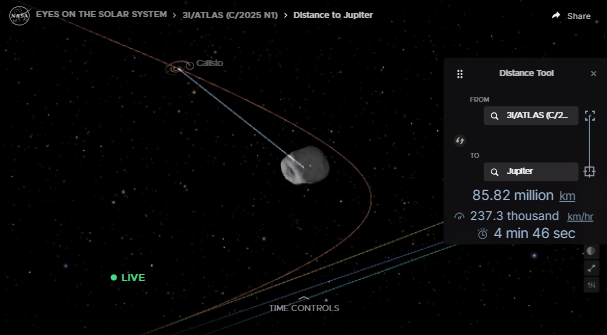
πŸš¨β˜„οΈ BREAKING: 3I/ATLAS JUST PASSED JUPITER β€” AND WE MAY HAVE ONE LAST SHOT TO SEE IT 3I/ATLAS IMAGES: spacetracker.space/timeline A rare window is opening… and it might be the LAST chance. The latest tracking shows 3I/ATLAS ~85.8 million km from Jupiter, moving at an incredible ~237,000 km/h β€” already on its way out of the Solar System. But here’s the part most people are missing πŸ‘‡ 🌌 THE OPPORTUNITY NO ONE IS TALKING ABOUT After passing Jupiter, 3I/ATLAS is moving beyond a crowded region of bright stars lunar interference. ➑️ This changes EVERYTHING for observers: πŸŒ• Moon glare decreasing β†’ darker skies early night ✨ Leaving dense star fields β†’ easier to isolate the comet πŸ”­ Cleaner background β†’ better stacking results πŸ‘‰ That means large telescopes advanced astrophotography setups may still capture it. πŸ”­ WHY THIS MATTERS 3I/ATLAS is not just another comet. 🌠 Interstellar origin (older than our Solar System) ⚑ Speed ~60–70 km/s through space πŸ§ͺ Possible exotic chemistry (methanol, HCN traces suspected) πŸš€ Already past Jupiter β€” no turning back Once it fades further… it’s gone forever. πŸ“‘ CALL TO ASTROPHOTOGRAPHERS This is your moment: πŸ‘‰ Turn your telescopes again πŸ‘‰ Use deep stacking long exposure πŸ‘‰ Target early night windows (lower lunar interference) Even if visually impossible, πŸ“Έ stacked imaging may still reveal it Some of the best detections so far came from heavily processed amateur data ⏳ FINAL PHASE We are now witnessing: The exit trajectory of an interstellar visitor that traveled billions of years… just to pass us once. Miss it now β€” and humanity may never see it again. #3IATLAS #InterstellarObject #BreakingNews #Astronomy #Astrophotography #Space #Jupiter #LastChance #DeepSky #NASA #ESA #SpaceNews #CosmicVisitor #Stargazing #TrendingNow #SpaceAlert πŸš€β˜„οΈ
4
6
36
4,886
🚨3I/ATLAS Is Carrying Fusion Fuel at Impossible Levels and the Mainstream Explanation Doesn't Hold Dr. Avi Loeb is laying out something about 3I/ATLAS that is buried inside a technical discussion, one that you and I may not get to hear about in mainstream science. However the point that Loeb is making is really difficult to ignore when you listen to the facts. We are all aware by now that we are dealing with an interstellar object, something that didn't originate in our solar system, that passed through and was observed closely enough for its chemical composition to be analyzed. That was an amazing opportunity, but what came out of that analysis is where things start to get spicy. The reason I say that this is interesting is because of deuterium. Yes it is a known isotope of hydrogen with an extra neutron and yes it exists everywhere, but only in very small quantities. Across the universe, the ratio is remarkably consistent. Roughly one atom of deuterium for every 50k atoms of hydrogen. That number doesn't change much whether you're looking at stars, gas clouds, or planetary systems. Even in places where it's slightly elevated, like Earth's oceans, it's still nowhere near significant enough to stand out in a major way. It's measurable, but it doesn't dominate anything. That's the baseline that we have to make comparisons from. Now take that baseline and compare it to what was measured in 3I/ATLAS. Instead of one in 50k, you're looking at something closer to one in a hundred in water, and one in thirty in methane. That is a huge jump and once you take that into consideration you're no longer talking about natural variation in any conventional sense at least. The first explanation is the one you would expect. Extremely cold environments, possibly tied to very early star formation, where deuterium can be preserved more efficiently than in regions like our own solar system. All that explanation does is give you a place to put the anomaly without breaking anything, aka mainstream scientific models. But it doesn't actually resolve the full picture. Here's why... The same object showing this deuterium enrichment also contains heavier elements like carbon and oxygen in ways that don't align with those early environments. The universe at that stage didn't have enough of those elements available in the right quantities to produce what we're seeing now. So what you end up with is a contradiction. The conditions that could explain the deuterium don't support the rest of the chemistry, and the conditions that support the chemistry don't explain the deuterium. That's where the conversation conversation obviously becomes difficult for the 'tenure' crowd, because when formation models stop lining up as predicted by archaic models, you're left with a narrower set of possibilities. Either there's a process we don't yet fully understand that can produce this combination, or something has happened to the material after it formed. Considerations by non mainstream science would be that this is not random alteration, but something more deliberate. Processing, concentration, separation steps that could possibly mean function rather than accident. This is where deuterium stops being just an interesting anomaly and starts mean something very different. Deuterium is one of the primary fuels used in nuclear fusion. Every serious attempt to build a functional fusion reactor on Earth relies on it, typically in combination with tritium. It's efficient, predictable, and it's exactly the kind of material you would isolate and concentrate if you intended to use it as an energy source. So when you see an object carrying deuterium at levels this far beyond any natural baseline we observe locally, we have to wonder what conditions would allow that concentration to exist, and whether those conditions are passive or active. That doesn't automatically push you into extreme conclusions, but it does move you out of the safe 'mainstream' zone where everything can be explained with known processes. That's the part that tends to get softened in how this is presented publicly of course. There's a difference between saying something is unusual and admitting that it doesn't currently fit within the models we rely on. One side invites curiosity whilst the other invites scrutiny. What you're seeing here is that tension in real time because the data is absolutely clear enough to acknowledge the anomaly, but the interpretation is being held just short of where it would need to go to fully confront it. So what you're left with is a set of open questions that aren't being pushed by mainstream science, and I am sorry if it sounds like I have a drum to bang, but here we are. Could this be evidence of a type of cosmic environment we haven't observed directly yet, one capable of producing extreme isotopic enrichment alongside complex chemistry? Is there something in the way that we're measuring or interpreting the data that's creating a misleading picture of the ratios? Or are we looking at material that hasn't remained in a purely natural state since its formation? That last question is the one that tends to sit just beneath the surface, acknowledged but not explored too directly and that's not because it's impossible, but because of what it might imply if it turned out to be true, and that's where this becomes worth paying attention to. If this isn't an isolated curiosity then it is yet another one of the already stacked list of anomalies tied to interstellar objects, unusual motion, unexpected structural behavior, and now chemical signatures. Each one on its own can be managed, explained, or set aside, but taken together, they start to form a pattern that really does warrant further consideration. 3I/ATLAS may still end up having a natural explanation and I have always maintained that is always on the table. But if that explanation exists, it's not something we've defined yet, and it's not something that fits inside of current models, and until it does, the signal remains what it is. An object from outside our system, carrying a level of fusion capable material that doesn t match anything we see in our own environment, tied to formation theories that don't fully hold up under scrutiny. #UAP #InterstellarObject #3IATLAS #SpaceAnomalies #FusionFuel #JWST #Astrophysics #UFOtwitter #Disclosure
26
48
317
28,496
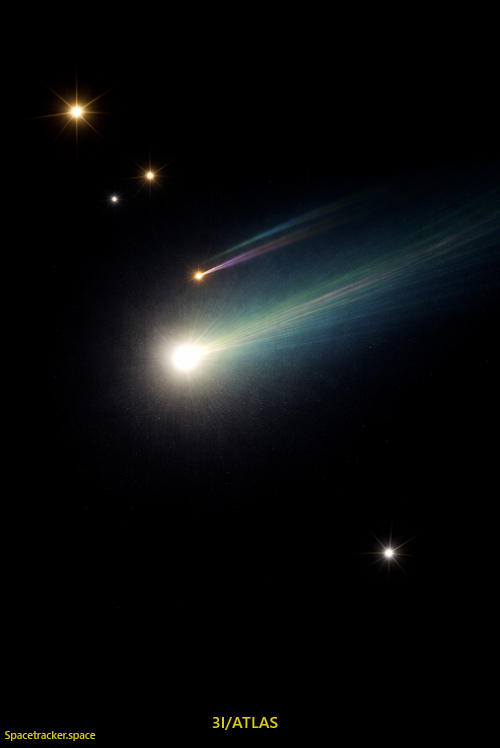
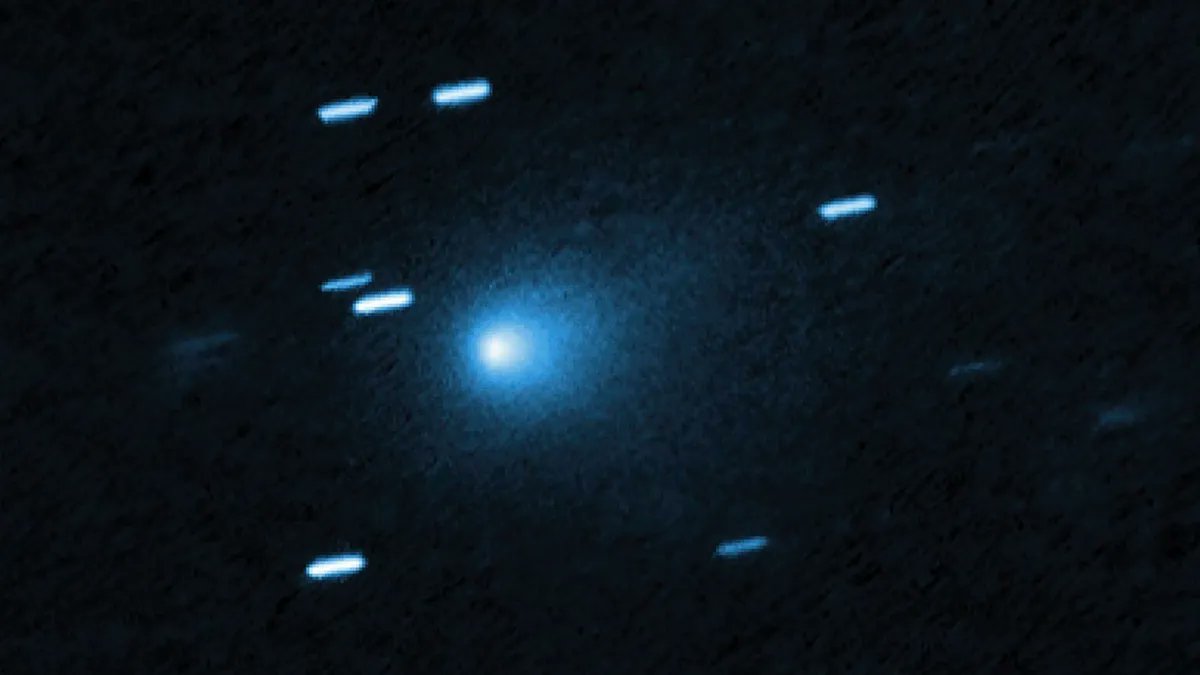
🚨 BREAKING:✨ 3I/ATLAS - THE INTERSTELLAR VISITOR WE WILL NEVER FORGET 🌌 From Deep Space to Human Eyes… and Now in 8K Reality More Images: spacetracker.space/timeline πŸ”­ The Verified Moment (NASA / ESA) In July 2025, the Hubble Space Telescope captured something extraordinary. A multi-frame animation showed interstellar comet 3I/ATLAS moving across a dense star field β€” tracked so precisely that: ✨ The comet appears stable and glowing 🌠 The stars stretch into light streaks πŸ›°οΈ The motion reveals its true trajectory through our solar system πŸ“Έ Credit: David Jewitt / NASA / ESA / STScI This wasn’t just an image. It was evidence of something not born here. 🌠 What Makes 3I/ATLAS Different 3I/ATLAS is not like ordinary comets. 🌌 Origin: Outside our solar system ⚑ Velocity: Hyperbolic escape path 🧭 Trajectory: Slight inclination, yet stable πŸͺ Interaction: Passed through planetary region with minimal deviation πŸ‘‰ A traveler older than our solar system itself. πŸ›°οΈ Observed Across Space Multiple missions tracked it: πŸ”­ James Webb Space Telescope 🌍 SPHEREx πŸ”¬ Hubble Space Telescope Each added layers: Infrared composition Surface reflection Motion tracking Together, they built the first deep profile of an interstellar visitor in motion πŸ§ͺ SpaceTracker Breakthrough πŸ”₯ At spacetracker.space, something different happened. πŸ’‘ Instead of raw data… we reconstructed reality: 🎨 Color-reflected spectrum correction πŸ”¬ Signal refinement from stacked frames πŸ” Deep zoom aggregation 🧠 Noise reduction structure reconstruction πŸš€ Result: πŸ‘‰ The first ultra-refined 8K visualization of 3I/ATLAS Not just an image A scientific-artistic reconstruction of what the human eye could never see directly πŸͺ The Jupiter Passage - A Silent Encounter πŸ“ March 2026 3I/ATLAS made a critical pass: πŸͺ Distance from Jupiter: ~53.7 million km ⚑ No gravitational capture πŸ“ˆ Trajectory remained consistent πŸ‘‰ It slipped past Jupiter like a ghost from another star system. No slowdown. No orbit change. Just… passing through. 🧠 What Did We Just Witness? This wasn’t just a comet. It was: 🧬 A fragment of another planetary system ⏳ A time capsule billions of years old 🌌 Proof that interstellar objects are not rare events And more importantly… πŸ‘‰ Humanity tracked it. πŸ‘‰ Understood it. πŸ‘‰ Reconstructed it. β“πŸ’­ What Do You Think? Is 3I/ATLAS just: A natural interstellar fragment? πŸŒ‘ A rare cosmic coincidence? 🎯 Or something that challenges what we expect from deep space? πŸ‘οΈ 🚨 Final Signal 3I/ATLAS is now leaving our solar system …but its data, motion, and mystery remain. πŸ“‘ Stay tuned. More objects will come. πŸ“‘ 4I may already be on its way. 🏷️ by Ammar A. spacetracker.space #3IATLAS #InterstellarObject #NASA #ESA #Hubble #JWST #SpaceDiscovery #Astronomy #Comet #DeepSpace #SpaceNews #Astrophotography #Science #Universe #SolarSystem #Jupiter #SpaceTracker #SpacetrackerSpace #CosmicVisitor #BreakingSpace #AlienOrigins #ExploreSpace πŸš€πŸŒŒ
6
25
2,012
β˜„οΈ A rare interstellar comet, 3I/ATLAS, has been found to contain unusually high levels of methanol. These rare visitors formed in other star systems, giving astronomers clues about how planets form beyond our Solar System. #Comet #InterstellarObject #Astronomy
2
2
3
327
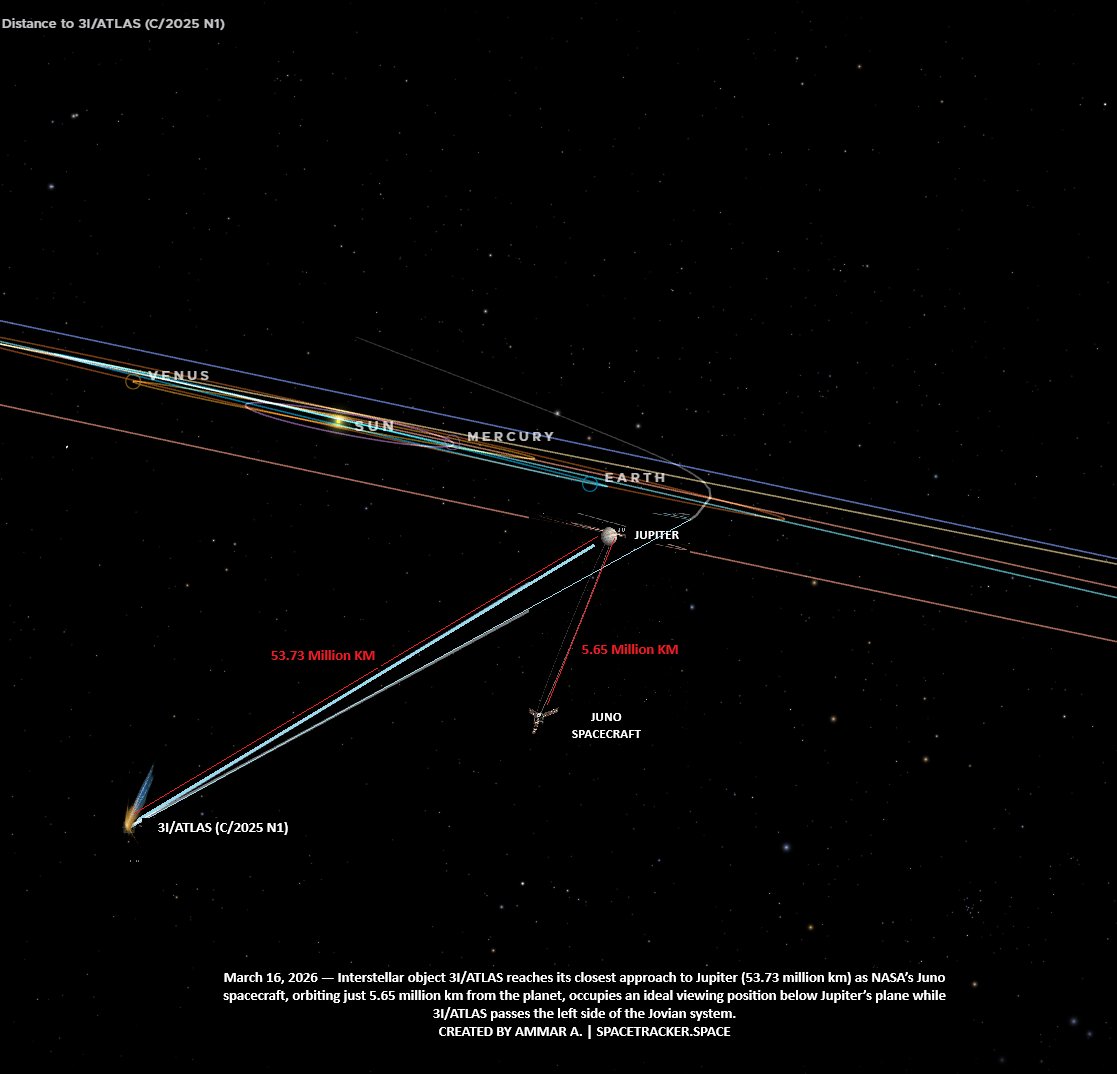
🚨 BREAKING SPACE NEWS🚨 On March 15–16, 2026 3I/ATLAS Approaches Jupiter Analysis & Overview by Ammar A. SpaceTracker.space A rare celestial traveler is now reaching one of the most important checkpoints of its journey through our Solar System. The mysterious object 3I/ATLAS is approaching its closest point to Jupiter, passing roughly 53–54 million kilometers below the giant planet β€” a distant but scientifically important flyby. For months astronomers and sky-watchers have followed this object closely. What began as a faint detection has now become one of the most discussed objects in astronomy β€” not because it threatens any planet, but because of the unusual characteristics of its motion. πŸ›° Timeline β€” Key Moments of the Encounter β˜„οΈ 3I/ATLAS JOURNEY THROUGH THE SOLAR SYSTEM July 1, 2025 β”‚ β”œβ”€ First major observational tracking begins β”‚ Object detected moving at unusually high velocity β”‚ Aug–Sept 2025 β”‚ β”œβ”€ Orbital solutions stabilize β”‚ Astronomers confirm a highly elongated orbit β”‚ Late 2025 β”‚ β”œβ”€ Perihelion passage near the Sun β”‚ Surprisingly little orbital deviation observed β”‚ Early 2026 β”‚ β”œβ”€ Object exits inner Solar System β”‚ Trajectory remains extremely consistent β”‚ March 15–16, 2026 β”‚ └─ Closest approach to Jupiter Distance β‰ˆ 53.7 million km Passing below Jupiter’s orbital plane 🌌 The Jupiter Flyby The encounter with Jupiter represents the largest gravitational interaction remaining inside the Solar System. Even though the pass occurs tens of millions of kilometers away, Jupiter’s enormous mass often alters the paths of comets dramatically. In many cases, the giant planet can: redirect a comet’s orbit capture it into a shorter-period orbit eject it entirely from the Solar System However, in the case of 3I/ATLAS, early calculations suggest something remarkable. The trajectory appears stable and consistent. Observations from July onward have shown only very small deviations, meaning the comet’s path through the Solar System has remained nearly unchanged despite the gravitational influences of multiple planets. This stability is one of the reasons the object has attracted so much attention. πŸͺ A Path Close to the Solar System Plane Another unusual aspect of the object is its trajectory alignment. Most long-period comets approach the Sun from high inclinations, often diving through the Solar System at steep angles. But 3I/ATLAS travels along a path that lies close to the plane of the Solar System, with only a small inclination relative to the orbits of the planets. This geometry is rare because objects arriving from deep space typically have random orientations. Instead, this object moves almost along the same flat disk that the planets occupy. Such an alignment increases the number of potential planetary encounters along its path. πŸš€ Speed and the Mystery of Its Motion From the beginning, astronomers noticed that speed was the defining feature of the object. Compared with many traditional comets, 3I/ATLAS appears to move through the Solar System with a relatively high velocity, suggesting it may not remain gravitationally bound to the Sun for long. Yet despite this speed, the object’s trajectory has remained unusually smooth. Even during perihelion β€” when the comet passed closest to the Sun and experienced the strongest solar heating β€” the orbit showed no dramatic outgassing-driven changes. Many comets experience measurable acceleration caused by jets of gas and dust escaping the nucleus. In this case, however, any such effects appear minimal or surprisingly controlled. πŸ›° Public Speculation and Viral Discussions The unusual combination of: high speed low orbital inclination stable trajectory has sparked numerous discussions across scientific communities and the public sphere. Some viral conversations have speculated about exotic possibilities: a possible interstellar origin an unusual comet nucleus composition or even imaginative ideas such as a β€œmothership” or artificial object Astronomers emphasize that these discussions are speculative and part of the public fascination that often surrounds rare astronomical discoveries. At present, the most likely explanation remains that 3I/ATLAS is a natural cometary body, though one with several properties that make it particularly interesting to study. πŸ›° A Rare Observational Opportunity The timing of the Jupiter pass also places NASA’s Juno spacecraft in a potentially useful viewing geometry. Orbiting Jupiter at a distance of several million kilometers, Juno occupies a vantage point below the planet’s orbital plane. From that position, it may be possible to observe the comet’s passage relative to Jupiter β€” although such observations depend on instrument pointing and mission priorities. Even if Juno does not observe the object directly, Earth-based telescopes will continue monitoring the event closely. 🌠 What Happens Next? After its encounter with Jupiter, the comet will continue moving outward through the Solar System. Several possible long-term outcomes remain: 1 . Oort Cloud visitor The object could eventually slow enough to remain loosely bound within the outer regions of the Solar System. 2 . Solar System escape If its velocity remains high, it may leave the Sun’s gravitational influence entirely. 3 . Interstellar traveler If unbound, the comet will continue its journey through the galaxy, potentially traveling for millions of years before encountering another star system. πŸ”­ A Messenger Passing Through Objects like 3I/ATLAS remind astronomers that the Solar System is not isolated. Occasionally, distant travelers move through our planetary neighborhood, briefly visible before disappearing again into deep space. The upcoming Jupiter flyby marks the final major gravitational milestone in the object’s observed journey through our system. After that moment, the comet will simply continue onward . Leaving behind a trail of observations, data, and unanswered questions. ✦ Overview for SpaceTracker.space Readers From my analysis of the trajectory and observations: β€” The object has shown remarkable orbital consistency since its discovery. β€” Jupiter’s gravity does not appear likely to dramatically redirect its path. β€” Its motion close to the Solar System plane remains one of the most interesting aspects of the object. For now, 3I/ATLAS appears to be quietly escaping the Solar System, continuing a journey that may carry it back into interstellar space. And somewhere far in the future β€” perhaps around another distant star β€” this same object may again pass through another planetary system, just as it has ours. β˜„οΈ SpaceTracker Report Analysis & Overview by Ammar A. SpaceTracker.space #Trending #Viral #SpaceTrending #JWST #JamesWebb #Hubble #AstroPhotography #Science #SpaceX #ElonMusk #Tesla #Starship #Mars #BreakingNews #BreakingSpace #Astronomy #Astrophysics #Cosmos #Universe #SolarSystem #Jupiter #JupiterFlyby #Comet #Comets #3IATLAS #InterstellarObject
2
16
51
3,630
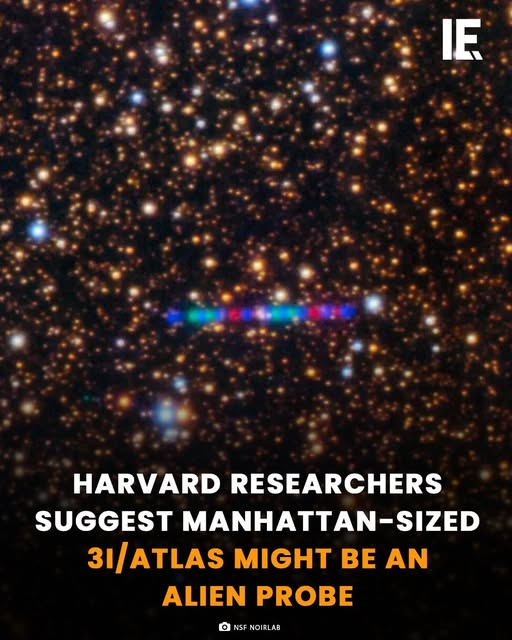
A newly detected interstellar object labeled 3I/ATLAS is racing through the solar system at more than 130,000 miles per hour. Astronomers currently classify it as a natural comet from beyond our solar system. However, Harvard astrophysicist Avi Loeb and colleagues have speculated in a non-peer-reviewed paper that unusual properties could leave open the possibility of an artificial origin. Most researchers strongly favor natural explanations, but the debate reflects how mysterious interstellar visitors can be. #3IAtlas #InterstellarObject #SpaceMystery #Astrophysics #Alie
2
5
16
3,438
🚨 BREAKING SPACE WATCH: Interstellar Comet 3I/ATLAS Racing Toward Jupiter Encounter β˜„οΈ spacetracker.space/timeline A rare visitor from deep space is now approaching a critical moment inside our Solar System. Interstellar comet 3I/ATLAS is currently speeding through the planetary region at nearly 240 km/h, with its trajectory bringing it steadily closer to Jupiter’s powerful gravitational domain. Current tracking measurements show the comet about 69.7 million km from Jupiter, while still 696.4 million km from Mercury, 733.3 million km from Venus, 648.3 million km from Earth, and roughly 906 million km from Mars. Within about one week, astronomers expect the comet to reach its closest approach to Jupiter, a moment that could subtly alter its trajectory through gravitational interaction with the giant planet. This upcoming encounter is drawing attention because Jupiter acts like a cosmic gatekeeper for the Solar System. Its immense gravity often bends, captures, or ejects comets that pass nearby. Scientists and sky-watchers are closely monitoring whether 3I/ATLAS will accelerate, shift orbit, or escape Jupiter’s gravitational corridor entirely. Each new observation helps researchers understand the behavior of objects arriving from interstellar space, making this event one of the most fascinating comet encounters currently unfolding in 2026. Distance Snapshot (Current Tracking) Jupiter | β–ˆβ–ˆβ–ˆβ–ˆβ–ˆβ–ˆβ–ˆβ–ˆβ–ˆβ–ˆβ–ˆβ–ˆβ–ˆβ–ˆβ–ˆβ–ˆβ–ˆβ–ˆβ–ˆβ–ˆβ–ˆβ–ˆβ–ˆβ–ˆβ–ˆβ–ˆβ–ˆβ–ˆβ–ˆβ–ˆβ–ˆβ–ˆβ–ˆβ–ˆ 69.7 M km Earth | β–ˆβ–ˆβ–ˆβ–ˆβ–ˆβ–ˆβ–ˆβ–ˆβ–ˆβ–ˆβ–ˆβ–ˆβ–ˆβ–ˆβ–ˆβ–ˆβ–ˆβ–ˆβ–ˆβ–ˆβ–ˆβ–ˆβ–ˆβ–ˆβ–ˆβ–ˆβ–ˆβ–ˆβ–ˆβ–ˆβ–ˆβ–ˆβ–ˆβ–ˆβ–ˆβ–ˆβ–ˆβ–ˆβ–ˆβ–ˆβ–ˆβ–ˆβ–ˆβ–ˆβ–ˆβ–ˆβ–ˆβ–ˆβ–ˆβ–ˆβ–ˆ 648.3 M km Mercury | β–ˆβ–ˆβ–ˆβ–ˆβ–ˆβ–ˆβ–ˆβ–ˆβ–ˆβ–ˆβ–ˆβ–ˆβ–ˆβ–ˆβ–ˆβ–ˆβ–ˆβ–ˆβ–ˆβ–ˆβ–ˆβ–ˆβ–ˆβ–ˆβ–ˆβ–ˆβ–ˆβ–ˆβ–ˆβ–ˆβ–ˆβ–ˆβ–ˆβ–ˆβ–ˆβ–ˆβ–ˆβ–ˆβ–ˆβ–ˆβ–ˆβ–ˆβ–ˆβ–ˆβ–ˆβ–ˆβ–ˆβ–ˆβ–ˆβ–ˆβ–ˆβ–ˆβ–ˆβ–ˆβ–ˆβ–ˆ 696.4 M km Venus | β–ˆβ–ˆβ–ˆβ–ˆβ–ˆβ–ˆβ–ˆβ–ˆβ–ˆβ–ˆβ–ˆβ–ˆβ–ˆβ–ˆβ–ˆβ–ˆβ–ˆβ–ˆβ–ˆβ–ˆβ–ˆβ–ˆβ–ˆβ–ˆβ–ˆβ–ˆβ–ˆβ–ˆβ–ˆβ–ˆβ–ˆβ–ˆβ–ˆβ–ˆβ–ˆβ–ˆβ–ˆβ–ˆβ–ˆβ–ˆβ–ˆβ–ˆβ–ˆβ–ˆβ–ˆβ–ˆβ–ˆβ–ˆβ–ˆβ–ˆβ–ˆβ–ˆβ–ˆβ–ˆβ–ˆβ–ˆβ–ˆβ–ˆβ–ˆ 733.3 M km Mars | β–ˆβ–ˆβ–ˆβ–ˆβ–ˆβ–ˆβ–ˆβ–ˆβ–ˆβ–ˆβ–ˆβ–ˆβ–ˆβ–ˆβ–ˆβ–ˆβ–ˆβ–ˆβ–ˆβ–ˆβ–ˆβ–ˆβ–ˆβ–ˆβ–ˆβ–ˆβ–ˆβ–ˆβ–ˆβ–ˆβ–ˆβ–ˆβ–ˆβ–ˆβ–ˆβ–ˆβ–ˆβ–ˆβ–ˆβ–ˆβ–ˆβ–ˆβ–ˆβ–ˆβ–ˆβ–ˆβ–ˆβ–ˆβ–ˆβ–ˆβ–ˆβ–ˆβ–ˆβ–ˆβ–ˆβ–ˆβ–ˆβ–ˆβ–ˆβ–ˆβ–ˆβ–ˆβ–ˆβ–ˆβ–ˆβ–ˆβ–ˆβ–ˆβ–ˆβ–ˆ 906 M km Saturn | β–ˆβ–ˆβ–ˆβ–ˆβ–ˆβ–ˆβ–ˆβ–ˆβ–ˆβ–ˆβ–ˆβ–ˆβ–ˆβ–ˆβ–ˆβ–ˆβ–ˆβ–ˆβ–ˆβ–ˆβ–ˆβ–ˆβ–ˆβ–ˆβ–ˆβ–ˆβ–ˆβ–ˆβ–ˆβ–ˆβ–ˆβ–ˆβ–ˆβ–ˆβ–ˆβ–ˆβ–ˆβ–ˆβ–ˆβ–ˆβ–ˆβ–ˆβ–ˆβ–ˆβ–ˆβ–ˆβ–ˆβ–ˆβ–ˆβ–ˆβ–ˆβ–ˆβ–ˆβ–ˆβ–ˆβ–ˆβ–ˆβ–ˆβ–ˆβ–ˆβ–ˆβ–ˆβ–ˆβ–ˆβ–ˆβ–ˆβ–ˆβ–ˆβ–ˆβ–ˆβ–ˆβ–ˆβ–ˆβ–ˆβ–ˆβ–ˆβ–ˆβ–ˆβ–ˆβ–ˆβ–ˆβ–ˆβ–ˆβ–ˆβ–ˆ 1.8 B km πŸ”­ Why this matters: β€’ Jupiter’s gravity may deflect or accelerate the comet β€’ Possible changes in coma activity and tail structure β€’ Rare opportunity to study an interstellar object interacting with a giant planet Tracking & analysis: Processed by Ammar A β€” spacetracker.space #3IATLAS #Comet #InterstellarObject #Jupiter #Astronomy #SpaceNews #BreakingSpace #SpaceTracker #Astrophotography #SolarSystem #Trending πŸš€β˜„οΈ
4
21
76
5,716
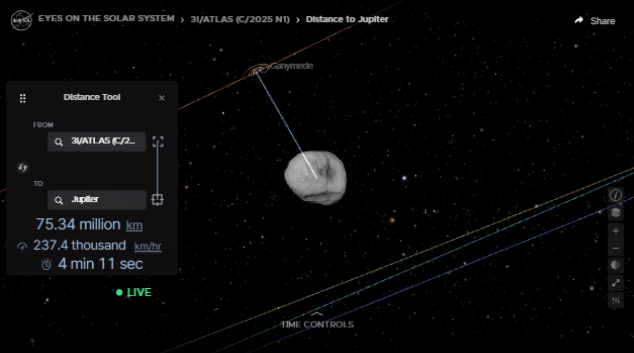
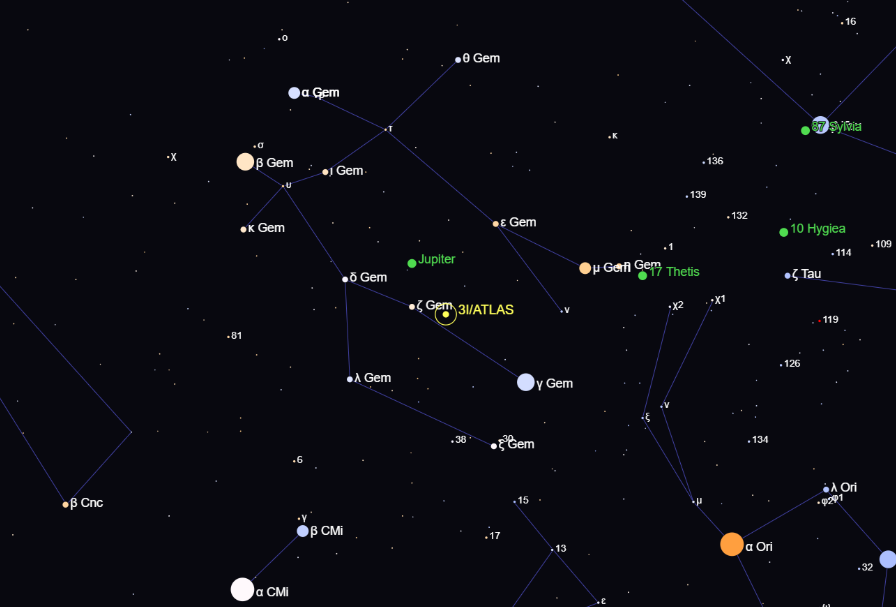
🚨 BREAKING SPACE UPDATE: Interstellar Comet 3I/ATLAS Crossing Jupiter’s Region β€” But Slowly Moving Away β˜„οΈπŸͺ 3I/ATLAS Images: spacetracker.space/timeline Astronomical tracking maps show interstellar comet 3I/ATLAS currently passing through the Gemini constellation, close to the sky position of Jupiter. On March.07.2026 Orbital measurements indicate the comet traveling at an extraordinary ~237,000 km/h, with a current separation of roughly 75 million km from Jupiter. While this places the object within the broader gravitational region dominated by the giant planet, daily tracking maps now suggest that 3I/ATLAS may already be moving gradually away from Jupiter’s gravitational influence. Comparing consecutive sky-tracking charts reveals a subtle but consistent shift in the comet’s position relative to Jupiter and the surrounding Gemini stars. This movement indicates that the comet’s trajectory is not being strongly captured or redirected by Jupiter, but rather continuing along its hyperbolic interstellar path through the Solar System. However, astronomers are still closely monitoring the object because the closest projected approach to Jupiter is expected around March 16, 2026, when gravitational interactions will be analyzed in greater detail. πŸ“Š Orbital Tracking Snapshot Object: 3I/ATLAS Speed: ~237,400 km/h Distance to Jupiter: ~75.3 million km Sky location: Gemini constellation Tracking status: Possibly moving away from Jupiter’s gravitational zone Next key date: Closest approach to Jupiter β€” March 16, 2026 πŸ“ Observed Sky Geometry (Gemini region) Ξ± Gem on Mar.07.2026 * Ξ² Gem ΞΊ Gem * * Jupiter ● ΞΆ Gem * \ \ β˜„ 3I/ATLAS \ Ξ» Gem * Ξ³ Gem * πŸ”­ What scientists are watching now β€’ Whether Jupiter’s gravity slightly bends the comet’s trajectory β€’ If the comet accelerates or changes direction during the March 16 encounter β€’ The behavior of its coma, jets, and twin tails during this gravitational pass β€’ Whether Jupiter’s gravity alters its interstellar escape path Because 3I/ATLAS is an interstellar visitor, even a small gravitational interaction could provide valuable data about how objects from other star systems behave when passing near massive planets. For now, observations suggest the comet may already be drifting outward from Jupiter’s sphere of influence, but the final outcome will become clearer as astronomers continue tracking it toward the March 16 close approach window. πŸ“‘ Orbital Analysis & Image Tracking: Ammar A. β€” SpaceTracker.space #Space #BreakingNews #3IATLAS #Comet #Jupiter #Astronomy #InterstellarObject #Gemini #Astrophotography #SolarSystem #SpaceScience #Trending #SpaceTracker
6
41
2,723
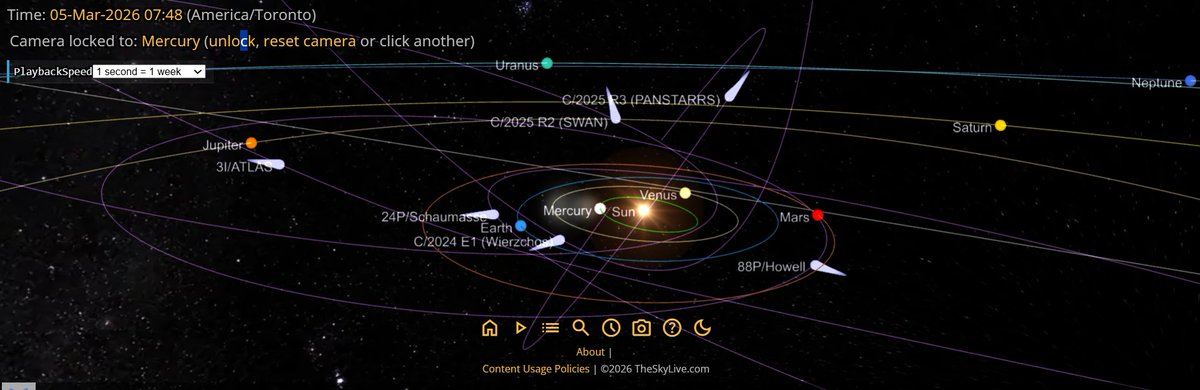
🚨 Cosmic Traffic: Multiple Comets Crossing the Solar System in 2026 A rare configuration is currently unfolding inside our solar system. Orbital simulations reveal that several active comets are moving through the planetary region at the same time, some crossing the orbital paths of major planets and passing near Earth’s orbit. From the massive traveler 3I/ATLAS near Jupiter to newly discovered visitors like C/2025 P3 (PANSTARRS) and C/2025 R2 (SWAN), astronomers are watching an unusual clustering of comet trajectories. The orbital map shows something striking: several comet paths intersect the planetary plane within a short time window, creating what could be described as a temporary cosmic traffic zone of icy visitors. Processed & analyzed by Ammar A. β€” SpaceTracker.space β˜„οΈ Comet Timeline – Closest Planet Approaches 2025 Oct 2025 C/2024 E1 (Wierzchos) Closest pass near Earth's orbital region Dec 2025 24P/Schaumasse Passes near Earth's orbit ----------------------------------------- 2026 Jan 2026 C/2025 R2 (SWAN) Crosses the inner solar system plane Feb 2026 3I/ATLAS Distance from Earth: ~551 million km Distance from Jupiter: ~130 million km Mar 16, 2026 3I/ATLAS Closest approach to Jupiter Mar 2026 C/2025 P3 (PANSTARRS) Travelling between Saturn and Uranus region Apr 2026 88P/Howell Moving near Mars orbital zone Mid-2026 Multiple comet orbital crossings continue πŸ“Š Orbital Structure (Solar System View) Neptune ───────────────────────── C/2025 P3 (PANSTARRS) Uranus ───────────── Saturn ───────────── Jupiter ─────── 3I/ATLAS β˜„ Mars ─────── 88P/Howell Earth ── 24P/Schaumasse C/2024 E1 (Wierzchos) Venus Mercury Sun β˜‰ Why This Moment Is Interesting Astronomers rarely observe so many cometary orbits crossing the planetary region simultaneously. Several factors may explain this clustering: β€’ improved sky survey detection β€’ long-period comets returning together β€’ gravitational perturbations from giant planets β€’ possible interstellar visitors entering the system The presence of 3I/ATLAS, suspected to be an interstellar object, makes this period particularly important for comet research. #Space #Astronomy #SolarSystem #Comets #3IATLAS #CometTracking #InterstellarObject #PANSTARRS #SWAN #Astrophotography #SpaceNews #AstronomyNews #Cosmos #Universe #Science #SpaceScience #PlanetaryScience #AstroTwitter #SpaceCommunity #NightSky #Stargazing #DeepSpace #BreakingNews #Trending #SpaceDiscovery #CosmicEvent #SkyWatch #ScienceNews #SpaceObservation #SpaceTracker
2
11
393
🚨 THIS INTERSTELLAR OBJECT ISN’T ACTING NATURAL β˜„οΈπŸ›Έ 😳A stunning new analysis shared by Harvard astrophysicist Avi Loeb suggests that the interstellar object 3I/ATLAS is behaving in a way that challenges official space science conclusions. According to reports from NASA and its Jet Propulsion Laboratory, the object should be pushed mainly away from the Sun due to normal comet outgassing. But the newest data tells a very different story.😱 Instead of moving only outward, 3I/ATLAS is also being pushed strongly sideways. This kind of non-gravitational acceleration is rare and difficult to explain with standard comet physics. What makes it even stranger are observations from the Hubble Space Telescope, which reveal narrow, highly focused jets rather than a smooth cloud of gas. Scientists have identified three perfectly symmetric mini-jets, spaced exactly 120 degrees apart, rotating with a precise 7.1-hour period, along with a powerful sunward jet.β˜„οΈ This geometry naturally produces sideways motion β€” but the order, symmetry, and stability of the jets raise serious questions. The force involved is extremely small, yet accurate enough to measurably alter the object’s trajectory over time. Such precision is uncommon in natural space debris and forces scientists to reconsider simple explanations.πŸ”­ Avi Loeb emphasizes that science advances by questioning assumptions, even official ones. NASA can be wrong β€” and that’s part of learning. Whether 3I/ATLAS is an exotic natural object or something far more unusual remains unknown. But one thing is clear: this interstellar visitor is not behaving like a normal comet.🌌 #3IATLAS #InterstellarObject #AviLoeb #SpaceMystery #NASA #Hubble #AlienQuestion #CosmicAnomaly πŸŒŒπŸš€πŸ‘€
1
8
33
2,511
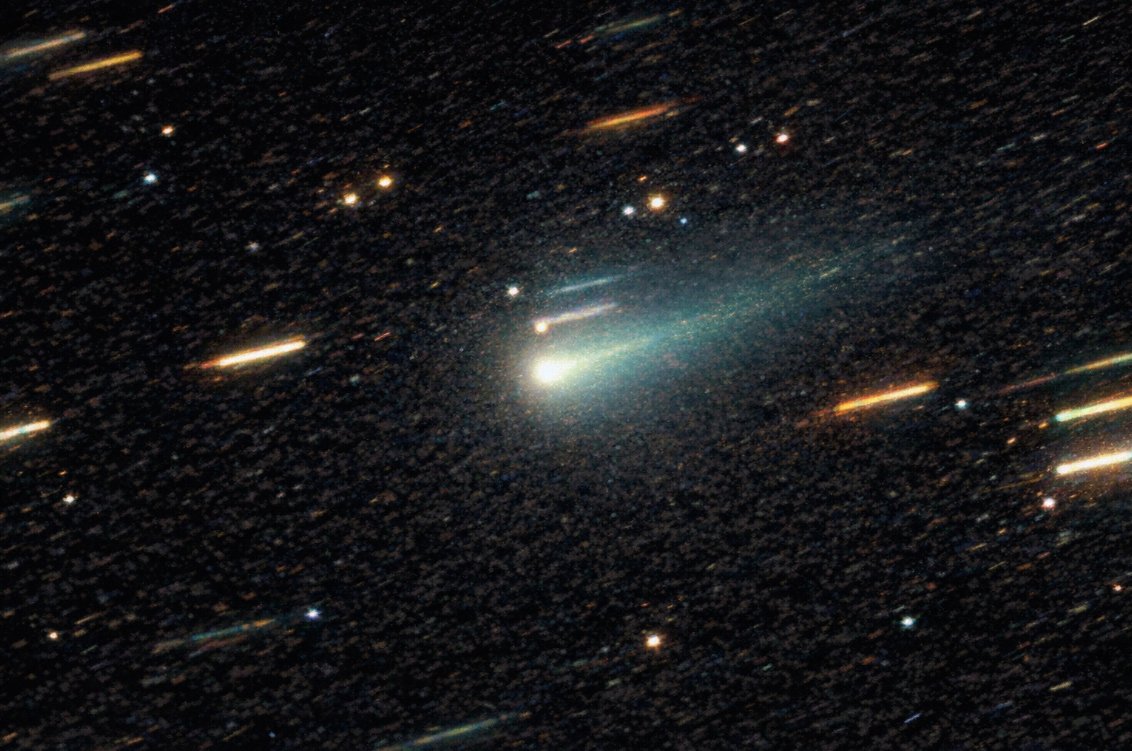
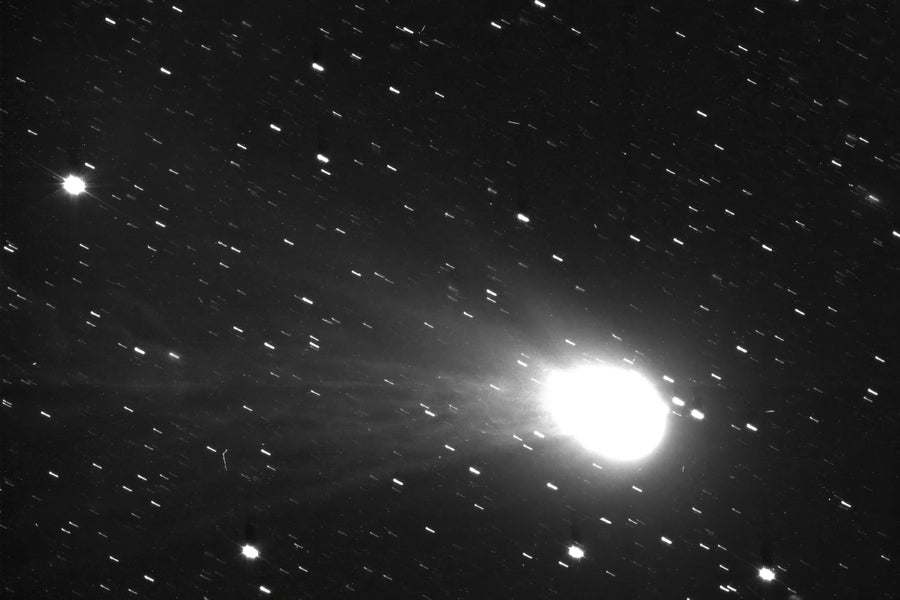
β˜„οΈπŸš¨ BREAKING: 3I/ATLAS BEST IMAGE. The Interstellar Traveler We’re Still Watching 3I/ATLAS Images: spacetracker.space/timeline For months now, a small group of sky watchers have refused to look away. While most telescopes shifted back to routine surveys, 3I/ATLAS kept moving β€” faint, fast, and strangely alive in motion. And now, as new frame stacks and contrast enhancements circulate through the astronomy community, one thing is clear: This object does not behave like an ordinary comet. 🌌 What Makes 3I/ATLAS Different? Unlike short-period comets born in our Solar System, 3I/ATLAS carries the β€œI” designation β€” Interstellar. That means: It is not gravitationally bound to our Sun. Its trajectory suggests an origin beyond our planetary system. Its velocity profile does not match typical Oort Cloud objects. In processed imagery, two distinct structural features repeatedly appear: 1️⃣ The Extended Tails Phase Ion tail stretches sharply outward. Dust tail fans broadly with layered density. Coma appears expanded, glowing, turbulent. 2️⃣ The Compressed Tails Phase Tail shortens dramatically. Structure tightens. Brightness shifts inward toward the nucleus. Observers tracking rotational motion noticed something fascinating: As the nucleus rotates, tail geometry changes rhythmically β€” almost like a breathing system responding to solar radiation pressure. πŸ”¬ The Physics Behind the Motion Comets do not β€œpush” themselves like rockets. Their acceleration is governed by: Solar gravity Outgassing jets (sublimation of ice into vapor) Solar wind interaction with ionized particles When 3I/ATLAS rotates, active vents may face the Sun intermittently. That can: Intensify outgassing Increase ionization Alter tail length and brightness But here’s the viral question echoing through forums: Is the rotational outgassing creating measurable non-gravitational acceleration? Small forces, over long times, matter. 🌠 Frame Stacking & False-Color Enhancement Advanced stacking techniques reveal density gradients not visible in single exposures: Blue-green channels highlight ionized gases. Red/orange layers emphasize dust density. False-color processing exposes structural layering in the coma. These layers create a 3D depth effect β€” almost like geological strata in motion. When enhanced properly, 3I/ATLAS doesn’t look like a blur. It looks engineered by physics at the molecular scale. πŸ“Š Why This Matters Interstellar objects are rare. Before this era, humanity had only confirmed: 1I/Κ»Oumuamua 2I/Borisov Now 3I/ATLAS joins that exclusive class β€” and every photon captured from it is data from another star system. That means: Chemical clues from another stellar nursery. Ice composition that formed under different cosmic conditions. A snapshot of galactic material older than Earth itself. πŸ›°οΈ The Quiet Watchers Not every discovery makes headlines after the first wave. But some of us are still tracking it. Still stacking frames. Still measuring brightness curves. Still comparing tail compression cycles. Because sometimes the most important science happens when the spotlight fades. And 3I/ATLAS is still moving. #️⃣ #3IATLAS #InterstellarObject #CometWatch #Astronomy #SpaceNews #DeepSpace #Astrophysics #SpaceTracker
4
30
1,675
β˜„οΈπŸ”₯ STILL ALIVE: The Forgotten Interstellar Visitor 3I/ATLAS Is Approaching Jupiter β€” And Almost No One Is Watching 3I/ATLAS Images: spacetracker.space/timeline In a quiet corner of the sky, far from headlines and trending feeds, something extraordinary is still moving. 3I/ATLAS β€” the strange interstellar object that once sparked global curiosity β€” has not disappeared. It is still there. Still traveling. Still alive. And only a few observers are following it. 🌌 February 23, 2026 β€” A Faint Ghost in the Stars On February 23, 2026, Ray’s Astrophotography captured new footage of 3I/ATLAS. The object appeared extremely faint, barely distinguishable from background stars. A red arrow was used to indicate its subtle motion across the stellar field β€” without it, most would miss it entirely. At that moment: 🌍 Distance from Earth: ~551.6 million km ♃ Distance to Jupiter: ~130 million km πŸ‘ Visual magnitude: Faint β€” near detection limits for many amateur setups It is no longer bright. It no longer trends. But it is still moving toward something historic. πŸͺ The Target: Jupiter On March 16, 2026, 3I/ATLAS is expected to make its closest approach to Jupiter. That approach could become a defining moment. Jupiter’s immense gravity has altered the trajectories of countless comets in our solar system. Now the question is: What will it do to an interstellar traveler? Will Jupiter bend its path? Accelerate it? Capture new data about its composition through gravitational interaction? Or will 3I/ATLAS simply slingshot past and vanish back into deep space? πŸ”­ Why Has Attention Faded? When 3I/ATLAS was first confirmed as an interstellar object, telescopes around the world turned toward it. Now, only a handful remain. There are no dramatic tails filling the sky. No naked-eye spectacle. Just a dim traveler against cold stars. But scientifically, the story is far from over. Even faint objects carry information: πŸ§ͺ Surface composition clues πŸŒ€ Activity levels and outgassing behavior πŸ“ Orbital refinement data 🧭 Gravitational perturbation measurements This close pass by Jupiter offers a rare natural experiment. 🌠 The Silent Phase of a Cosmic Journey Interstellar objects are not common visitors. Each one carries material formed around another star β€” another planetary system β€” possibly billions of years ago. When 3I/ATLAS fades from public attention, it does not lose its importance. It simply enters a quieter chapter. And sometimes, the quiet chapters matter most. πŸ“… What Happens Next? March 16, 2026 Closest approach to Jupiter. Observers are waiting. Tracking. Measuring. If gravitational interaction alters its velocity or trajectory significantly, we may learn more about its mass and structure than ever before. For now, it remains a faint point moving slowly across the sky β€” but scientifically, the countdown has begun. πŸš€ Why This Matters We are witnessing: A confirmed interstellar object Passing within ~130 million km of Jupiter Observed at ~551.6 million km from Earth Approaching a gravitational giant These events are rare on human timescales. And history has shown that some of the most important discoveries happen when only a few are still paying attention. ✍️ Final Thought Not every cosmic event arrives with fireworks. Some arrive as whispers. 3I/ATLAS is still there. Still traveling. Still telling a story written long before our solar system formed. And a few telescopes are still listening. β˜„οΈ #3IATLAS #InterstellarObject #JupiterApproach #Astronomy #Astrophotography #SpaceNews #Jupiter #DeepSpace #CosmicVisitor #Spacetracker #SkyWatch #March16 #ScienceJourney
4
15
53
4,753
πŸš¨β˜„οΈ BREAKING ALERT 3I/ATLAS A Scientific Look at the Reversed-Color Image. Cuts a Precise Path Through Our Solar System β€” Coincidence or Cosmic Design? 3I/ATLAS Images: spacetracker.space/timeline πŸ›°οΈ 3I/ATLAS β€” CLOSE ENCOUNTER TIMELINE (2025–2026) ══════════════════════════════════════════════════════ πŸ”΄ MARS β”‚ πŸ“… 2025-Oct-03 β”‚ πŸ“ 0.193664 AU β”‚ πŸ“ 28.97 M km β”‚ ☿ MERCURY β”‚ πŸ“… 2025-Oct-08 β”‚ πŸ“ 1.161748 AU β”‚ πŸ“ 173.79 M km β”‚ β˜€οΈ SUN β”‚ πŸ“… 2025-Oct-29 β”‚ πŸ“ 1.356448 AU β”‚ πŸ“ 202.92 M km β”‚ ♀ VENUS β”‚ πŸ“… 2025-Nov-03 β”‚ πŸ“ 0.649450 AU β”‚ πŸ“ 97.15 M km β”‚ 🌍 EARTH β”‚ πŸ“… 2025-Dec-19 β”‚ πŸ“ 1.797553 AU β”‚ πŸ“ 268.91 M km β”‚ ♃ JUPITER β”‚ πŸ“… 2026-Mar-16 β”‚ πŸ“ 0.358330 AU β”‚ πŸ“ 53.60 M km β”‚ πŸ›° EUPHEME β”‚ πŸ“… 2026-Mar-17 β”‚ πŸ“ 0.203592 AU β”‚ πŸ“ 30.45 M km β”‚ ══════════════════════════════════════════════════════ β˜„οΈ Interstellar path: Inner planets β†’ Outer giant β†’ Exit When we invert the colors of an astronomical image, we’re not just creating an artistic effect β€” we’re revealing structural physics hidden in brightness gradients. Your reversed-color rendering of 3I/ATLAS transforms the luminous coma into a dark gravitational well surrounded by glowing outer layers. What looks artistic is actually diagnostic. πŸ”¬ What Happens When We Reverse the Colors? In a standard astrophotograph: Bright regions = intense light reflection or emission Faint regions = low-density dust and gas Dark sky = absence of signal When colors are inverted: The bright nucleus becomes a dark core The faint coma becomes illuminated halos Subtle density waves become visible This enhances contrast between layers of the coma. 🌌 Structural Layers Visible in the Reversed Image 1️⃣ Central Nucleus Region In the reversed image, the bright white core becomes deep indigo/black. This highlights: The true intensity concentration The compact nucleus region Possible jet asymmetry in one direction The darkened core visually mimics a gravitational well β€” which matches the physical reality: the nucleus is the mass anchor of the coma. 2️⃣ Inner Coma Gradient The transition from dark center to bluish halo becomes smoother and more layered. Reversing colors reveals: Radial density gradients Subtle asymmetry in gas distribution Slight elongation indicating motion direction This suggests the comet’s coma is not spherical β€” it is slightly compressed on one side, possibly due to: Solar radiation pressure Solar wind interaction 3️⃣ Outer Dust Envelope In the normal image, this region looks faint and washed out. In reversed mode: Dust appears as structured texture Filament-like streaks emerge Light scattering patterns become visible This helps astronomers identify: Particle size variation Dust jet angles Expansion direction 🧭 Motion & Solar Interaction Clues The coma shows a subtle brightness bias in one direction. In reversed format, this bias becomes more obvious β€” the envelope appears slightly extended along a diagonal axis. That likely marks: β˜€οΈ The anti-solar direction πŸ’¨ Dust being pushed outward 🌑️ Active sublimation zones πŸ“Š Why Astronomers Use Negative Images Professional observatories often inspect negative images because: Faint structures become easier to isolate Noise patterns become obvious Gradient errors become detectable Background galaxies stand out Your reversed rendering unintentionally mirrors real data processing methods used in comet photometry. 🌠 Background Objects Become Clearer In the reversed version: Distant galaxies pop as red or orange specks Foreground stars show clearer halos Subtle background light gradients become measurable This is useful for: Photometric calibration Astrometric referencing Dust contamination estimation 🧠 Scientific Insight from Artistic Flip What we learn from this reversed-color 3I/ATLAS image: βœ” The coma is layered, not uniform βœ” There is directional bias in dust spread βœ” The nucleus dominates luminosity strongly βœ” The object appears dynamically active βœ” The surrounding field contains faint background galaxies πŸš€ What This Means for 3I/ATLAS The structural smoothness suggests: A relatively stable outgassing rate No extreme fragmentation Moderate dust production If fragmentation were occurring, we would expect irregular brightness spikes. Instead, we see controlled radial expansion. πŸ”­ Final Observation The reversed image does not distort reality β€” it highlights it differently. By flipping light and dark, we visually amplify: Density gradients Energy concentration Motion asymmetry Background structure Sometimes the universe reveals more when seen in reverse. by Ammar A. Spacetracker.space #3IATLAS #InterstellarObject #SpaceNews #Astronomy #HyperbolicOrbit #PlanetaryFlyby #SolarSystem #CosmicVisitor #Jupiter #Mars #Venus #Earth #ATLAS #DeepSpace #Spacetracker #Nasa #trends
3
20
1,663
🚨NEW ANOMALY DETECT IN 3I/ATALS 🚨 😱HUBBLE DETECTS ANOMALOUS TRIPLE-JET β€œWOBBLE” ON INTERSTELLAR OBJECT 3I/ATLAS β˜„οΈπŸ›Έ πŸ”­ Observations from the Hubble Space Telescope have revealed something deeply unusual about 3I/ATLAS, the mysterious visitor from another star system now passing through our solar neighborhood. What Hubble captured is not chaotic comet behavior β€” it is structured, rhythmic, and symmetric. πŸ§ͺ What scientists see in the data: β€’ Three narrow jets, evenly spaced ~120Β° apart β€’ Jets emerging close to the nucleus β€” not random surface vents β€’ A clear periodic wobble in jet orientation β€’ Brightness oscillations of ~30% β€’ All synchronized to a ~7.1–7.2 hour rotation cycle Using the Larson–Sekanina rotational gradient filter, astronomers removed the diffuse glow around the nucleus. What remained was stark and undeniable: a symmetric triple-jet system behaving like a rotating mechanism. πŸ‘¨β€πŸ”¬ Harvard astrophysicist Avi Loeb and observer Toni Scarmato report: β€’ Main jet oscillation period: ~7.2 hours β€’ Two secondary jet periods: 2.9 hours and 4.3 hours β€’ Together, they mathematically reinforce the main rotation cycle This is classic non-principal axis rotation β€” a wobble caused by misalignment between the object’s spin axis and internal mass distribution. 🧠 Why scientists are paying attention 3I/ATLAS is ~2.6 km wide, yet only ~1% of its brightness comes from reflected sunlight. The rest comes from active material being expelled. In plain terms: ➑️ This object is not passive ➑️ It is dynamically evolving ➑️ It is expending energy in a structured way πŸš€ Here’s the controversy β€’ Natural comets DO produce jets β€” but usually irregularly, driven by uneven heating β€’ Spacecraft thrusters are placed symmetrically to stabilize rotation β€’ Triple-jet symmetry timing = engineering familiarity Loeb is careful: he says natural sublimation remains plausible β€” but he also refuses to rule out technological origins. That alone is extraordinary. πŸͺ What happens next could decide everything πŸ“… March 16, 2026 β€” 3I/ATLAS makes its closest flyby of Jupiter Jupiter’s gravity may: β€’ Alter the spin rate β€’ Shift jet alignment β€’ Expose internal fractures β€’ Change the wobble period Any deviation will strongly favor either a natural comet model or something far stranger. πŸ›οΈ Where NASA stands The NASA has not classified 3I/ATLAS as artificial. But the data showing symmetry and synchronized wobbling is public, measurable, and repeatable. πŸ›Έ Now add politics Former President Donald Trump has ordered U.S. agencies to begin releasing files related to: β€’ UFOs β€’ UAPs β€’ Extraterrestrial life So the question some analysts are now asking: πŸ‘‰ If an interstellar object showed behavior consistent with controlled propulsion… πŸ‘‰ Which agency would evaluate it? πŸ‘‰ And would the public be told immediately? ⚠️ There is no declaration of alien technology. ⚠️ There is no claim of threat. But there is a growing gap between: πŸ” What telescopes are showing 🀐 And what institutions are willing to say πŸ‘οΈ The investigation is ongoing πŸ“‘ The next data window is approaching 🧩 And the universe just handed us a puzzle we’ve never had to solve before Natural. Engineered. Or something we don’t yet understand. Stay watching the jets. #3IATLAS #Hubble #InterstellarObject #AviLoeb #SpaceMystery #JupiterFlyby #NASA #UFODisclosure #CosmicAnomaly πŸš€πŸ›Έ
4
16
34
4,164