Melani Naty García retweeted

Jun 12
I am STILL LSAD that i cant watch u this year T____T im so sorry that i cant watch you I AM SADDDDS 😭😭😭😭😭😭😭😭😭😭😭😭😭😭

インドネシアのシンガーソングライターArash Buanaくんと再会。
色々と作業してきました。
Kira-kira bakal ada apa ya??
お疲れ様でした〜、楽しかった。
お楽しみに。

1
3
93

Y que capitales privados tiene Chaca?es un desastre como lSAD de Brasil o Uruguay, pensar en las SAD es un grave error, más en una sociedad como la nuestra. En todo caso deberán los clubes sincerar los gerenciamientos de las actividades profesionales.
15

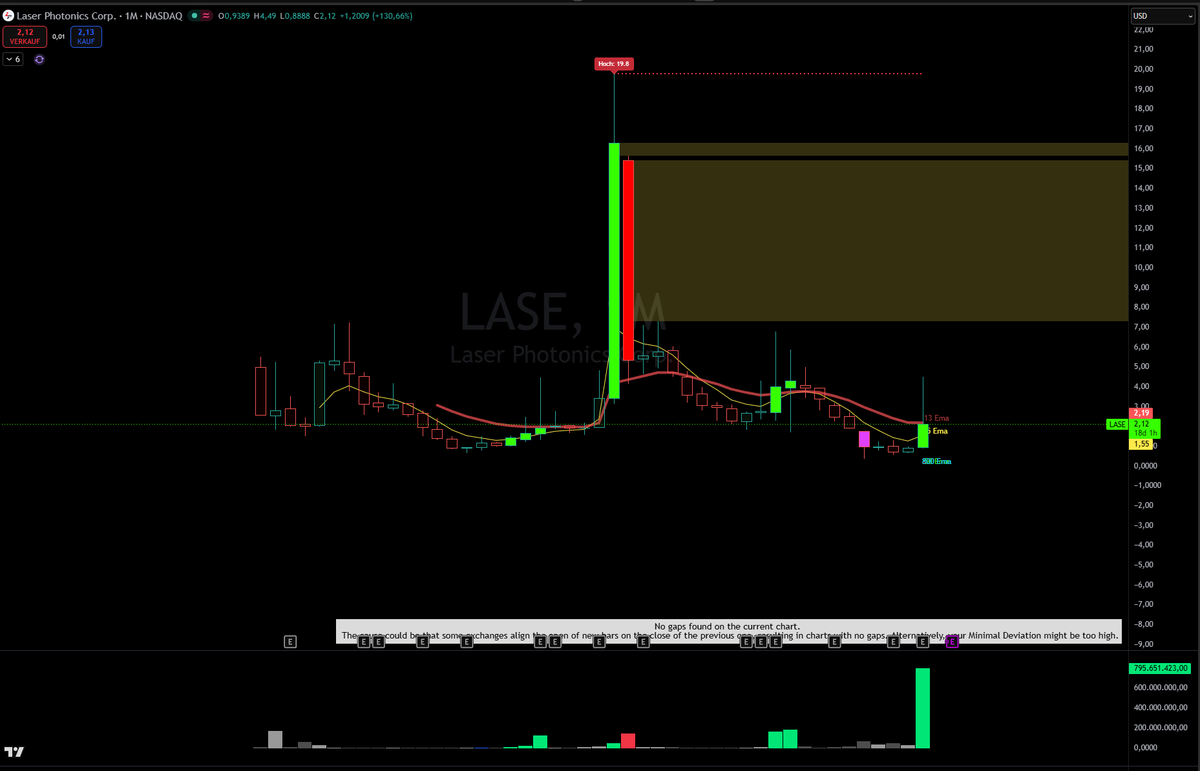

Laser Photonics Completes Laser Shield Anti-Drone Prototype, Advancing LSAD Demonstration Phase $LASE
finance.yahoo.com/sectors/te…
168

Jun 12
For those of you who missed that Laser Photonics $LASE released their earnings yesterday, here is a summary that caught my interest:
"Defense breakthrough with the U.S. Department of War. The Company's Laser Shield Anti-Drone System (LSAD), developed with affiliate Fonon Technologies, advanced from prototype to formal government recognition, selected by the U.S. Department of War under the MEIA "Vulcan" Call for Solutions as a top submission in the Counter-C5ISR-T category and invited to a technical exchange with government engineers. LSAD was also showcased at Special Operations Forces (SOF) Week 2026 and the Capitol Hill Defense Outlook Summit, generating strong engagement across multiple Program Executive Offices.
Launched a new DefenseTech product line. Together with Fonon Technologies, the Company introduced a family of DefenseTech laser systems for military maintenance, repair and overhaul (MRO) and logistics - including the Missile Laser Rust Inhibitor (MLRI), portable Marlin laser cleaners, the Blaster Cabinet 4020, and a compact marking laser - and demonstrated successful validation of its DefenseTech laser cleaning systems in a defense MRO environment.
Expanded commercial momentum and entered medical device manufacturing. New orders spanned pharmaceutical, medical device, energy, and industrial markets, including a $0.25 million custom laser-drilling system order from Johnson & Johnson marking the Company's entry into medical device manufacturing, a $0.5 million order from a U.S. power utility, a $0.5 million CMS laser system for a medical device manufacturer, an OEM-customized marking system for a European industrial project, and a repeat CleanTech® deployment with Cummins.
Strengthened the balance sheet and regained Nasdaq compliance. The Company generated approximately $6.1 million in net proceeds during the quarter from its February 2026 public offering and subsequent warrant exercises and inducements - plus approximately $3.6 million more subsequent to quarter close in April 2026 - and used the proceeds to repay all past-due notes payable.
Completed manufacturing consolidation. Consolidated all manufacturing operations into the Company's state-of-the-art Lake Mary, Florida facility, a move expected to generate nearly $1 million in annualized cost savings and simplify the Company's cost structure heading into 2026."
Source: finviz.com/news/361346/laser…
Jun 12

Laser Photonics, or $LASE, is coiling up inside a rather tight pattern again. Are we going to see yesterday repeat itself?
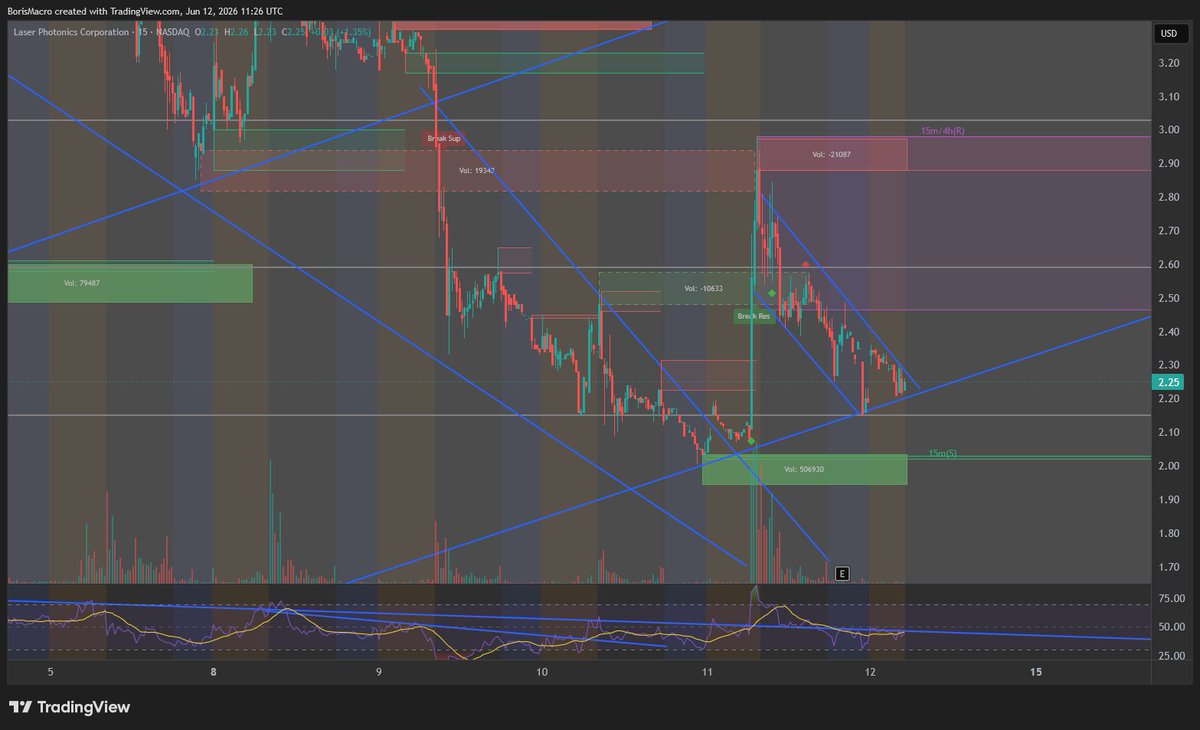
ALT Laser Photonics $LASE 15M
2
8
2,509

Laser Photonics Completes Laser Shield Anti-Drone (LSAD) Prototype and Begins Demonstration Phase with U.S. and International Defense Stakeholders $LASE, #LaserPhotonics, #AntiDrone, #Drones crweworld.com/article/news-p…
73

Jun 11
#threatreport #HighCompleteness
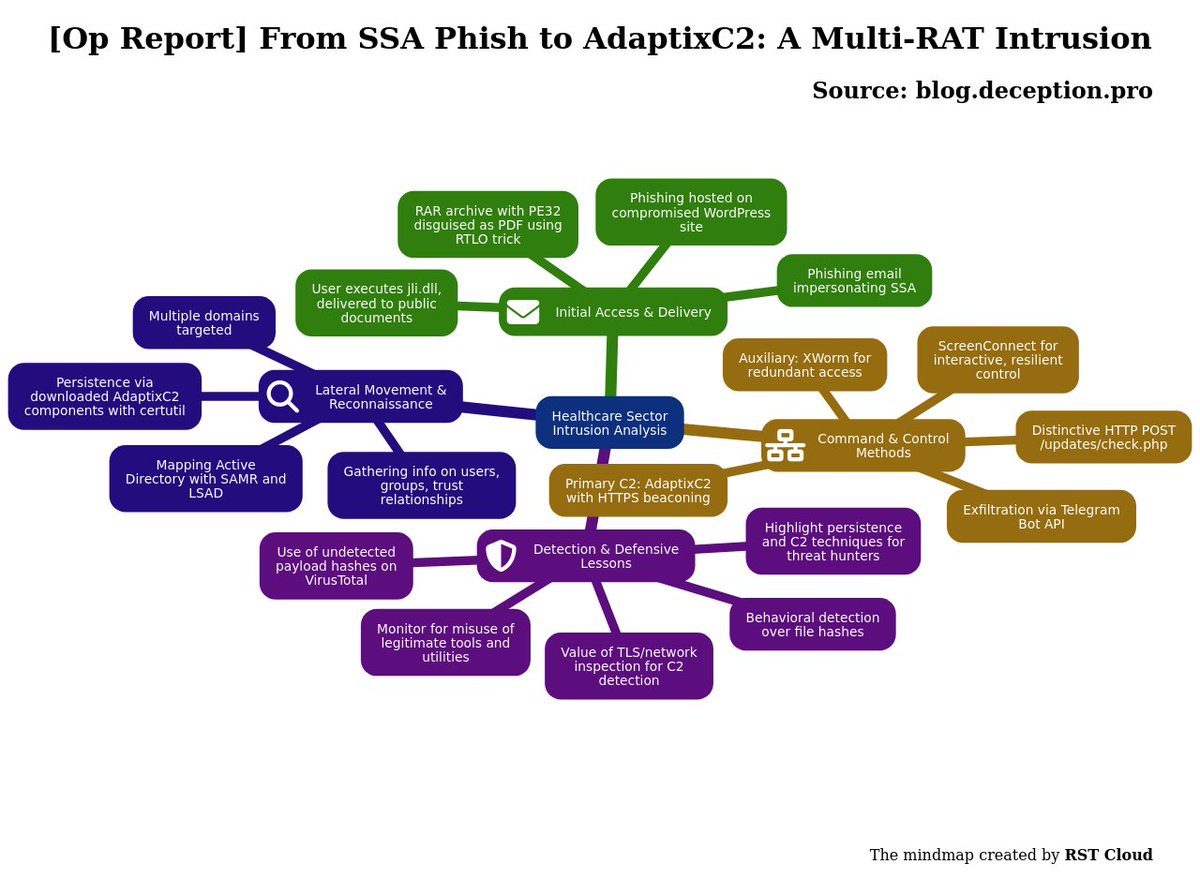
[Op Report] From SSA Phish to AdaptixC2: A Multi-RAT Intrusion | 11-06-2026
Source: blog.deception.pro/blog/xwor…
Key details below ↓
💀Threats:
Adaptixc2_tool, Xworm_rat, Screenconnect_tool, Right-to-left_override_technique, Typosquatting_technique, Phantom_stealer, Pingcastle_tool, Mimikatz_tool, Tinba, Spear-phishing_technique, Credential_dumping_technique,
🎯Victims: Healthcare
🏭Industry: Healthcare
🌐Geo: United states, Polish
📚TTPs:
⚔️Tactics: 3
🛠️Technics: 9
🧨IOCs:
- Domain: 9
- File: 15
- IP: 3
- Url: 10
- Hash: 5
- Path: 3
- Registry: 2
- Command: 2
💽Software: WordPress, Active Directory, Telegram, Windows Powershell
🔢Algorithms: sha256, zip
🔠Functions: RPC
📜Programming Languages: php, powershell
💻Platforms: x86
#threatreport:
In mid-May 2026, a sophisticated commodity intrusion was executed using a multi-layered approach involving malware and remote access tools within a Microsoft Active Directory environment in the healthcare sector. The attack process began with a well-crafted phishing email impersonating the Social Security Administration (SSA), which included a link to a RAR archive hosted on a compromised WordPress site. This archive contained a PE32 executable disguised as a PDF using a right-to-left override (RTLO) filename trick, allowing it to evade detection.
The attacker used AdaptixC2 as the primary command-and-control (C2) infrastructure, employing additional tools such as XWorm for redundant access and Telegram for exfiltration, alongside two independent instances of ScreenConnect for interactive control. Initial compromise involved the phishing email leading to the delivery of a malicious DLL (jli.dll), which was dropped in the user’s public documents. The operator subsequently used the Windows certutil command to download AdaptixC2 components from a specified URL, facilitating the establishment of persistence and further payloads. Over the engagement, multiple Staging variants of AdaptixC2 were launched, exhibiting beaconing behavior to specific IP addresses through HTTPS.
Utilizing TLS inspection provided insights into the C2 traffic, revealing the actual URLs and beacons in plaintext, contributing to effective attribution of the activity. The reconnaissance phase involved mapping out the domain using SAMR and LSAD, allowing the attacker to gather detailed information about domain users, groups, and trust relationships, crucial for lateral movement.
The primary C2 framework, AdaptixC2, exhibited a distinctive beaconing pattern characterized by specific HTTP POST requests to endpoints such as /updates/check.php. XWorm, deployed as a DLL, provided additional access capabilities and utilized Telegram’s Bot API for exfiltration, indicating a well-defined operational methodology. Meanwhile, ScreenConnect offered interactive access with resilience through deployment across multiple domains, complicating attempts to sever attacker access.
Given the complexity of the attack, it reflects an adaptive intrusion strategy where initial access relies on social engineering rather than advanced technical exploits. The use of RTLO to disguise executables remains a reliable tactic to bypass user vigilance, while the presence of non-detectable hashes for the payload in VirusTotal emphasizes the need for behavioral detection and network monitoring rather than reliance on conventional file hash fingerprints. This case underscores the importance of vigilant monitoring for legitimate tools being exploited as part of malicious campaigns, particularly focusing on certificate utilities, persistence mechanisms, and C2 behavior linked to known malware families.
64
Ray Malloy retweeted

$LASE completes Laser Shield Anti-Drone Prototype. This new LSAD system has used a 4 kW near-infrared continuous-wave fiber laser aimed at UAVs for testing.
The market is likely repricing it as a tiny counter-drone directed-energy play. That is why the prototype matters. The upside narrative becomes much bigger than $8.3M in 2025 sales. I think were gonna see some people buying

$LASE Laser Photonics Completes Laser Shield Anti-Drone (LSAD) Prototype and Begins Demonstration Phase with U.S. ... accessnewswire.com/newsroom/…
1
5
1,282
Ray Malloy retweeted

Jun 11
$LASE
Laser Photonics Completes Laser Shield Anti-Drone (LSAD) Prototype and Begins Demonstration Phase with U.S. and International Defense Stakeholders
- Laser Photonics completed final assembly of its Laser Shield Anti-Drone (LSAD) prototype and moved from development to demonstration with U.S. and international defense stakeholders.
- The LSAD counter-UAS system now enters live validation, with multiple scalable configurations and both TAA-compliant and non-TAA models targeting global defense markets.
stocktitan.net/news/LASE/las…
1
5
449
$LASE is one of those tiny names where the story may be changing faster than the market understands.
Laser Photonics was basically an industrial laser company providing laser cleaning, rust removal, surface prep, marking, engraving, maintenance, and industrial systems.
Useful business, but not exactly the type of thing that gets the market excited, right?
That was the old $LASE. The narrative is changing.
You remember the value of UAV companies a year ago? Some companies joined the sector in counter-UAV tech. Most of these UAV companies also make C-UAV tech. This one has Lasers and has diversified into the energy-weapons sector, pushing deeper into defense applications through its DefenseTech products and, more importantly, its Laser Shield Anti-Drone System: LSAD.
$LASE is trying to become a directed-energy / counter-drone defense platform, and since drones have completely changed modern warfare, defense has to change too.
Cheap drones are now a real threat to bases, ships, vehicles, borders, energy infrastructure, and public events. The world needs cheaper, faster, scalable ways to stop small drones.
That is where #LSAD becomes interesting.
The system is being positioned as a transportable laser-based counter-UAS solution designed for small drones. The company says it has moved into prototype / extended-range trial phases, and LSAD was also selected under the MEIA Vulcan Call for Solutions in the Counter C5ISR-T category.
***That does not mean a major contract is guaranteed. it just makes it more interesting to watch.
But it does mean $LASE has moved from this boring industrial tools story into a much bigger defense-tech narrative.
The 2025 base is still tiny: about $8.3M in revenue, up 144% year over year.
It is still a microcap.
it early.
its speculative and it still needs real contracts, funded testing, and proof that revenue can scale.
But this is why I’m paying attention:
Sometimes the market does not move on what a company was. It moves when investors realize what the company is trying to become.
The $LASE story just got a lot more interesting.

$LASE..what's going on here..🧐
Defense Milestone, Insider Buying, and Multi-Vertical Growth.
Laser Photonics achieved a key defense milestone: its Laser Shield Anti-Drone (LSAD) system was selected by the Department of War as a top submission in the Counter C5ISR-T category under the MEIA Vulcan Call for Solutions.
CEO Wayne Tupuola stated: "This selection by the Department of War validates the mission relevance and readiness of our LSAD directed-energy technology..."
This advances LASE into an exclusive technical exchange with government engineers, positioning the company for potential prototyping and future contracts.
Insider Buying:
Director Qing Lu purchased 32,000 shares in open-market transactions between April 25–29, 2026, at $0.61–$0.65 per share, confirmed by SEC Form 4 filings.
Medical Diversification
On May 28, 2026, LASE's subsidiary CMS Laser secured a $250,000 order from Johnson & Johnson for a custom laser drilling system with integrated vision, validating entry into precision medical device manufacturing.
Market Opportunity
The global anti-drone market is valued at ~$2.9–3.3B in 2025, with CAGR estimates of 13–27%.
The counter-UAS segment is accelerating due to rising drone threats in defense and critical infrastructure.
Valuation & Risks
LASE trades at ~$80M market cap. Upside exists if defense contracts materialize, but risks include liquidity volatility, potential dilution, and execution uncertainty.
Bottom Line
Defense selection insider buying J&J order are credible catalysts.
No DoD contract is confirmed yet, the J&J order is modest ($250K), and micro-cap risks remain.
Monitor the MEIA Vulcan technical exchange outcome for procurement milestones.
DYOR. NFA.

2
1
9
2,731

Jun 11
Laser Photonics Completes Laser Shield Anti-Drone Prototype, Advancing LSAD Demonstration Phase (LASE) investorshub.advfn.com/marke…
59

$LASE
"Laser Photonics Completes Laser Shield Anti-Drone (LSAD) Prototype and Begins Demonstration Phase with U.S. and International Defense Stakeholders"
accessnewswire.com/newsroom/…
$LASE..what's going on here..🧐
Defense Milestone, Insider Buying, and Multi-Vertical Growth.
Laser Photonics achieved a key defense milestone: its Laser Shield Anti-Drone (LSAD) system was selected by the Department of War as a top submission in the Counter C5ISR-T category under the MEIA Vulcan Call for Solutions.
CEO Wayne Tupuola stated: "This selection by the Department of War validates the mission relevance and readiness of our LSAD directed-energy technology..."
This advances LASE into an exclusive technical exchange with government engineers, positioning the company for potential prototyping and future contracts.
Insider Buying:
Director Qing Lu purchased 32,000 shares in open-market transactions between April 25–29, 2026, at $0.61–$0.65 per share, confirmed by SEC Form 4 filings.
Medical Diversification
On May 28, 2026, LASE's subsidiary CMS Laser secured a $250,000 order from Johnson & Johnson for a custom laser drilling system with integrated vision, validating entry into precision medical device manufacturing.
Market Opportunity
The global anti-drone market is valued at ~$2.9–3.3B in 2025, with CAGR estimates of 13–27%.
The counter-UAS segment is accelerating due to rising drone threats in defense and critical infrastructure.
Valuation & Risks
LASE trades at ~$80M market cap. Upside exists if defense contracts materialize, but risks include liquidity volatility, potential dilution, and execution uncertainty.
Bottom Line
Defense selection insider buying J&J order are credible catalysts.
No DoD contract is confirmed yet, the J&J order is modest ($250K), and micro-cap risks remain.
Monitor the MEIA Vulcan technical exchange outcome for procurement milestones.
DYOR. NFA.
2
3
15
2,149

Jun 11
$LASE 2.6 dip SL under 2.45
2.80 with volume needed
PT 3/3.25/3.55/3.8/4
Room to go nutty with momentum again
Laser Photonics announces completion of final assembly of LSAD prototype
2
764

Jun 11
$LASE LASE Laser Photonics Completes Laser Shield Anti-Drone (LSAD) Prototype and Begins Demonstration Phase with U.S. and International Defense Stakeholders
138

$LASE
Laser Photonics, insansız hava aracı tehditlerine karşı geliştirdiği Lazer Kalkanı Drone Karşıtı (LSAD) sisteminin prototip montajını tamamladı.
Mühendislik geliştirme aşamasından performans gösterim evresine geçen şirket, ABD hükümet temsilcileri ve uluslararası savunma paydaşları için saha demolara başlayacağını duyurdu.
Geliştirilen bu yönlendirilmiş enerji sistemi, özellikle kritik altyapıların korunmasında ve askeri bölgelerde küçük insansız hava araçlarının bertaraf edilmesinde aktif rol oynayacak. Sabit konuşlandırma, mobil operasyonlar ve saha kullanımı için farklı modüler konfigürasyonlara sahip olan platform, küresel savunma pazarında ticari olarak yer edinmeyi hedefliyor.

$LASE
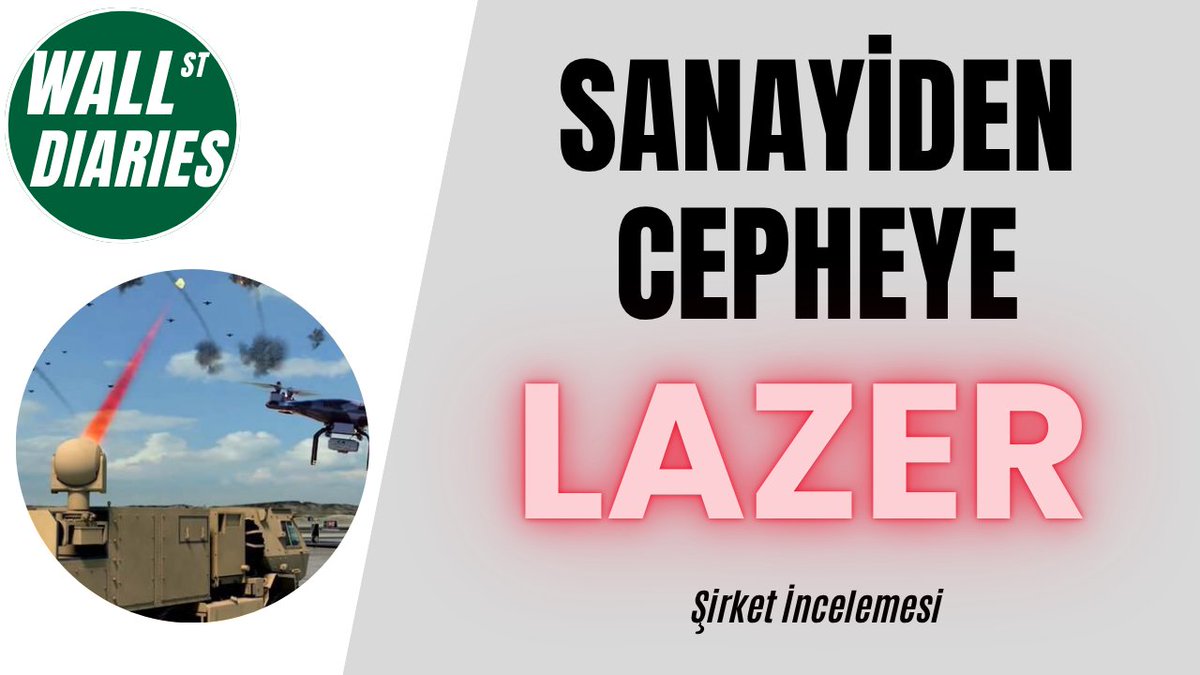
Sanayiden Cepheye Lazer!
Laser Photonics’in iş modelinde yaşadığı dönüşüm gözümüzden kaçmadı.
Sanayi kullanımındaki lazer teknolojileriyle bilinen şirket, artık savunma alanında da iddialı. Lazer Kalkanı Anti-Drone Sistemi (LSAD) ve Yönlendirilmiş Enerji Silahları (DEW) projeleriyle yeni bir kulvara adım attı.
Biz de bu dönüşümü sizler için mercek altına aldık…
YouTube
youtu.be/9FPA7BUdm2Y
Spotify
open.spotify.com/episode/0sI…
2
38
4,132

Jun 11
$LASE Defense Tech Momentum 🚀 Up 37% Premarket!
🔹 Laser Photonics is ripping after completing its Laser Shield Anti-Drone prototype and moving into the demonstration phase 🛡️
🔹 LSAD is now being shown to U.S. and international defense stakeholders 👀
🔹 Company targets laser systems for defense, aerospace, maritime, energy, industrial cleaning & precision manufacturing ⚡
🔹 Counter-drone tech remains a hot sector as global demand for anti-UAS defense keeps growing 📈
🔹 Small-cap defense tech big premarket volume = high-volatility watch at the open 🔥
Not financial advice. For informational purposes only.
2
609