🇧🇷🧲♻️ I posted this last year. Then I posted again. — because Brazil just became a near-construction rare earths project, and the thread runs straight through Belfast.
Reposting the full journey. This is what compounding milestones look like. 🧵
📌 Original thread posts:
→ x.com/roblun1/status/1974681…
→ x.com/roblun1/status/2048959…
→ x.com/roblun1/status/1997106…
⏪ WHERE IT STARTED — May 2025
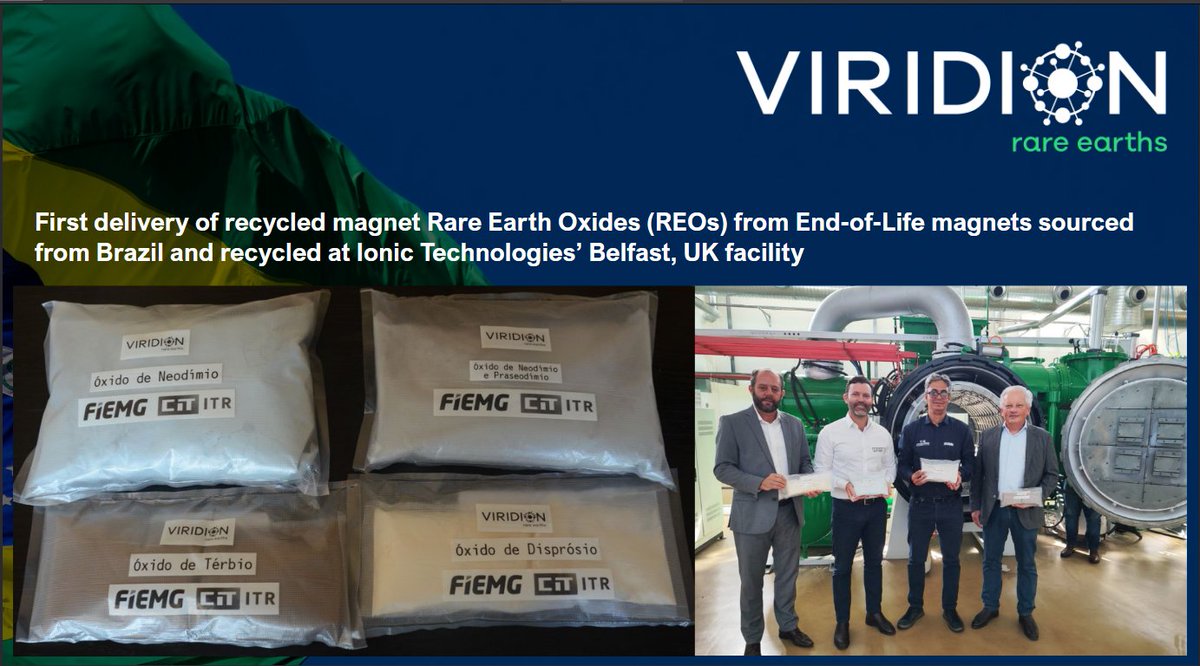
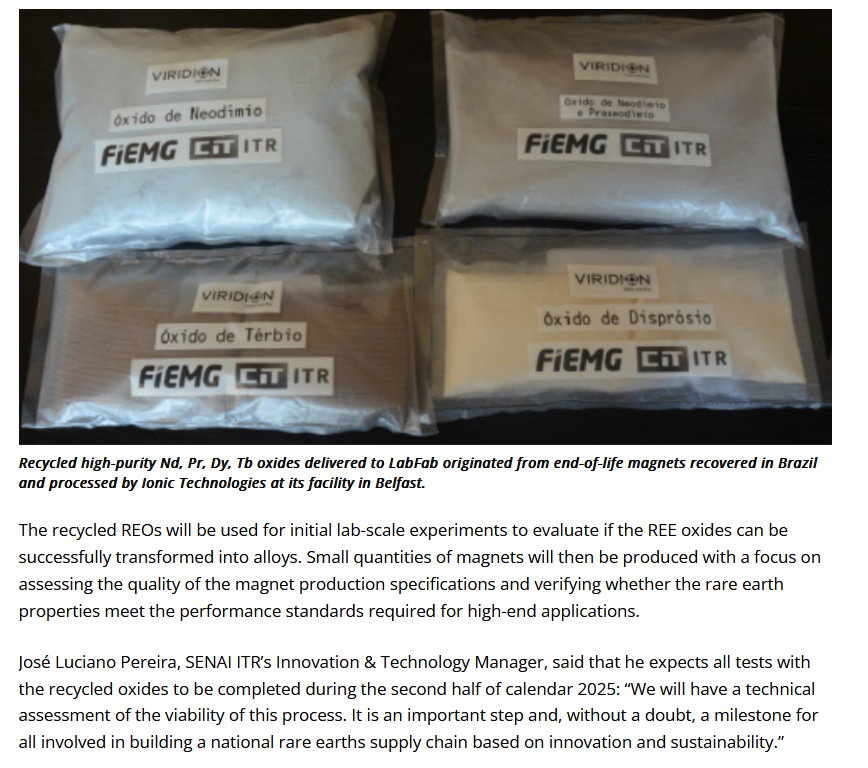
End-of-life magnets recovered from decommissioned MRI machines and wind turbines across Brazil. Shipped to Ionic Technologies in Belfast. Processed through the MAIL platform into high-purity individual Nd, Pr, Dy, Tb oxides. Flown back to Brazil. Delivered to CIT SENAI ITR Lab Fab in Lagoa Santa — Latin America's only rare earth magnet manufacturer.
At SENAI, those Viridion-supplied REOs were melted and spun into magnet alloy flakes — the first step in sintered NdFeB magnet production.
First closed-loop rare earth magnet recycling ever completed in the Southern Hemisphere. Recycled magnets → Belfast → Separated REOs → Brazil → New magnet alloy flakes.
minerabrasil.com.br/fiemg-de…
⏩ WHAT HAPPENED NEXT — Mid 2025
June 2025: Brazil's BNDES and FINEP — through their R$5 billion (~US$900 million) strategic minerals program — selected Viridion to advance to the Joint Support Plan stage, evaluating funding through grants, debt, and equity. One of only a handful of projects selected from the entire Brazilian critical minerals sector.
July 2025: Viridion secured land in Poços de Caldas, Minas Gerais — approved unanimously by the City Council — for the CRITR: Centre for Rare Earths Innovation, Technology and Recycling. A 2,071m² parcel in an established industrial zone.
The CRITR will be a direct replication of Ionic Technologies' Belfast demonstration facility — producing separated REOs at ≥99.5% purity from both primary MREC (from the nearby Colossus deposit) and recycled magnets from Brazil's industrial and e-waste streams. Capacity: 30 tpa magnet recycling plant from wind turbines, medical devices, hard drives and production waste. Scheduled operations: H2 2026.
October 2025: Viridis acquired the CPTR site (rare earth research and processing centre) in Poços de Caldas, wrapping up engineering, construction, and equipment contracts — targeting commissioning of the demonstration plant by end of Q1 2026.
📌 EARLY 2026 — THE YEAR IT BECAME CONSTRUCTION
December 19, 2025 / announced early 2026: COPAM — Brazil's state environmental authority — granted the Preliminary License for Colossus. The hardest regulatory hurdle for any rare earth project in Brazil. Passed. Done.
This is the license that validates environmental and technical viability. The one without which nothing gets built. Viridis simultaneously expanded its Northern Concessions by 46%.
May 2026: Viridis lodged the Installation Licence application — the second of three required approvals in Brazil's environmental permitting process — resetting Colossus as a near-construction rare earths project, with permitting, financing, EPCM selection, and downstream planning now running in parallel.
"The submission of the Installation Licence marks another significant milestone for Viridis as we continue to advance the Colossus Project towards a targeted Final Investment Decision in H2 2026."
— Rafael Moreno, Managing Director, Viridis Mining
🌍 THE BIGGER PICTURE BRAZIL IS NOW PART OF
Brazil holds the world's second or third-largest rare earth reserves — approximately 22 million tonnes primarily in Minas Gerais, Bahia, Goiás and São Paulo.
Serra Verde — Brazil's first integrated ionic clay rare earth mine — commenced operations in 2026, targeting ~5,000 tonnes of REO annually, expected to double by 2030. In April 2026, USA Rare Earth (USAR) agreed to acquire Serra Verde for ~USD$2.8 billion — creating what it describes as the first fully integrated mine-to-magnet platform outside Asia.
Brazil is not a rare earths story anymore. It is a rare earths race. And Viridion — the IXR/VMM joint venture — was doing the proof-of-concept in a lab in Lagoa Santa while that $2.8 billion deal was being conceived.
The FIEMG President said it directly when those first REO deliveries arrived:
"The project led by Viridis/Viridion has the potential to meet up to 7% of magnetic rare earth oxides' global demand — a strategic breakthrough that can significantly reduce dependence on China."
🔑 The IXR technology thread through all of it:
Every step of the Viridion supply chain runs on IXR IP:
🔬 MAIL platform — Belfast hydrometallurgical separation of recycled magnets into individual Nd/Pr/Dy/Tb oxides
⚗️ SST (Selective Separation Technology) — exclusive global rights (ex-Asia, Uganda) held by Viridion for primary MREC feed
♻️ RRT (Rare Earth Recycling Technology) — exclusive Brazil rights for recycled magnet processing
🏭 CRITR facility design — direct replication of Ionic Technologies' Belfast demonstration plant
Any new IP developed during commercialisation in Brazil belongs to Viridion.
The loop is closing. 🔄 Very Exciting times ahead 2026/2027
$IXR $VMM 🇦🇺🇧🇷🇬🇧🧲
#Viridion #IXR #IonicRareEarths #IonicTechnologies #VMM #ViridisMMining #ColossusProject #BrazilRareEarths #MineToMagnet #NdFeB #NdPr #Dysprosium #Terbium #SENAI #LabFab #CRITR #PoçosDeCaldas #MinasGerais #MagnetRecycling #IonicClay 🇧🇷🇦🇺🇬🇧🧲♻️🌍⚗️
6 Dec 2025

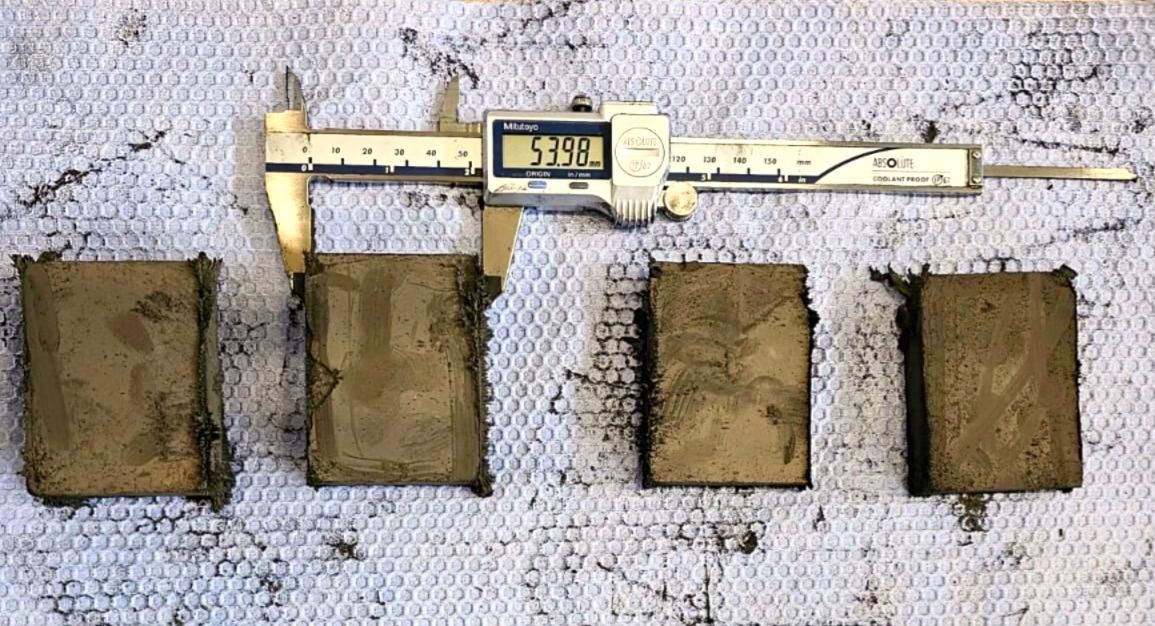
This photo is a much bigger deal than it looks at first glance.
What you’re seeing are the first NdFeB “green” blocks ever uniaxially pressed on an industrial scale in Brazil, done by the MagBras – CIT SENAI ITR team on a 50‑ton press. They’ve gone from alloy flakes → anisotropic powder → pressed parts, with sintering, coating and magnetisation now coming next.
MagBras’ whole purpose is to build a fully national, ore‑to‑magnet supply chain for rare earth permanent magnets – mining, separation, alloy making, magnet pressing and even recycling – so this is a genuine sovereignty milestone for Brazil.
And remember who’s sitting inside that consortium: Viridis and Viridion (IXR VMM) alongside CIT SENAI. Ionic Technologies is the only partner in that group with proven Western separation IP for Nd, Pr, Dy, Tb, so this is exactly the pathway we’ve been talking about:
Colossus clay → MREC → Viridion / Ionic Tech separated REOs → LabFab alloy flakes → MagBras pressed NdFeB parts.
This is the visible hardware step that ties all of that strategy together.
The MagBras Project is building a fully national rare earth permanent magnet value chain – from Brazilian ore, through separation, alloy production, magnet manufacturing and ultimately recycling – to cut import dependence and lock in tech sovereignty for EVs, wind, electronics and defence. 🇧🇷
Critically, MagBras brings together 38 partners, including Viridis, Viridion (IXR VMM) and CIT SENAI, linking Colossus clay and Ionic Technologies’ separation IP to downstream alloy and magnet making. This is the practical bridge from Brazilian rare earths in the ground to Brazilian magnets in motors and generators.
This is a key step in MagBras’ goal: build a fully national, ore‑to‑magnet 🇧🇷 supply chain for rare earth permanent magnets:
🔹 Mining & concentration
🔹 REE separation & oxide production
🔹 Alloy powder production
🔹 Pressing, sintering, coating & magnetisation
🔹 End‑of‑life recycling & circular economy
This is what real strategic sovereignty in magnets looks like, not just talk. 🚀
@IONIC_RE @IONICTECH_UK @timhorizonmet
@Viridis_VMM @IXR2THAMOON @LCM_UK
@EMRmetal #VIRIDION @EU_Commission
@ENERGY @VulcanElements @RE_Exchanges
@DiscoveryAlert @SolvayGroup @ChrisMcDonaldMP
@ussmetals #NdPr #DyTb @MPMaterials
@CyclicMaterials @USRareEarths @LynasRareEarths
@ReElementTech @ucore @USARareEarth
#MagBras #Viridion #IonicTechnologies #Viridis #VMM #RareEarths #NdFeB #Magnets #Brazil #CriticalMinerals #EVs #WindPower #SupplyChain #TechSovereignty #CircularEconomy
1
11
972
🇧🇷🧲⚗️ Reposting this from last year — because what was a milestone in May 2025 is now becoming a mine-to-magnet supply chain under construction.
Look at what Viridion and Ionic Technologies quietly did — and look at where Brazil is heading now. 🧵
This is what actually happened — step by step:
End-of-life rare earth magnets — recovered from decommissioned MRI machines and wind turbine generators across Brazil — were collected and pre-processed in-country.
Those spent magnets were then shipped to Ionic Technologies' facility in Belfast, UK, where they underwent IXR's proprietary advanced hydrometallurgical separation — the MAIL platform — to produce high-purity individual Nd, Pr, Dy and Tb oxides.
Those separated REOs were then transported back to Brazil and delivered to the CIT SENAI ITR Lab Fab facility in Lagoa Santa, Minas Gerais — Latin America's only rare earth magnet manufacturer.
At CIT SENAI ITR, those Viridion-supplied REOs are now being melted and spun to create magnet alloy flakes — the first step in the sintered NdFeB magnet production process — with the goal of producing new permanent magnets and verifying that the recycled oxide properties meet performance standards required for high-end applications.
🔄 That is a closed loop. Recycled magnets → Belfast → Separated REOs → Brazil → New magnet alloy flakes.
The first time this has ever been done in the Southern Hemisphere.
🇧🇷 Now read what's being built on top of that foundation:
"CIT SENAI's Lab Fab facility aims to increase NdFeB magnet production to 100 tonnes per annum by the end of 2026."
Discussions are active with Minas Gerais authorities on siting pilot facilities for both REO refining and magnet recycling operations — strategically located near the Colossus Project in the state.
The Colossus Scoping Study confirms it as the lowest cost rare earth producer globally — with exceptional project economics even at today's cyclical low prices.
And the Brazilian government is now backing this with serious capital:
🏦 BNDES FINEP Public Call No. 001/2025 — R$5 billion (~US$880 million) allocated to support strategic mineral transformation in Brazil
🔬 Second Public Call — R$3 billion (~US$530 million) specifically for R&D and Innovation centres — exactly the kind of pilot facility Viridion is planning
🚗 MagBras Project — approved under Brazil's MOVER program — R$73.3 million (~US$13 million) to develop a domestic low-carbon magnet industry, with Viridion as a key member
💬 The voices that matter:
"Delivery of high purity Nd, Pr, Dy, Tb oxide to SENAI/FIEMG, in support of Latin America's first magnet manufacture, is another important example of Viridion's capability to help develop a Brazilian and Latin American rare earth magnet industry and ensure security of supply for downstream users looking to decouple its dependence on the Chinese supply chain."
— Rafael Moreno, CEO, Viridis Mining
"The project led by Viridis/Viridion has the potential to meet up to 7% of magnetic rare earth oxides' global demand — a strategic breakthrough that can significantly reduce dependence on international markets, especially China."
— Flávio Roscoe, President, FIEMG
"This is a historic process highlighting the importance of recycling — these materials are not new but have been efficiently reused."
— Flávio Roscoe, President, FIEMG
🔗 The IP architecture underpinning all of this:
Viridion holds exclusive global rights (ex-Asia and Uganda) to IXR's Selective Separation Technology (SST) and exclusive rights in Brazil to IXR's Rare Earth Recycling Technology (RRT).
Any new IP developed from commercialisation belongs to Viridion.
The JV is positioned to become the first major producer of the full suite of refined Light AND Heavy REOs — Nd, Pr, Dy, Tb — in Latin America from a single separation plant.
That is not a pilot. That is a sovereign supply chain being built, one milestone at a time, in plain sight.
📍 Where this sits in the global picture — May 2026:
We've spent the past few days on this thread covering the same missing link that Dr. Erik Eschen flagged at the Copenhagen Democracy Summit: REO → Metal → Magnet. The metallisation gap. The step that's 91–95% Chinese.
Brazil is now building its own answer. Not from scratch — from the IXR technology platform, from Viridion, from SENAI's Lab Fab, from BNDES capital, and from the Colossus ionic clay deposit that requires no blasting, no flotation, no corrosive acid cracking — just a 0.3M ammonia sulphate wash at room temperature over 30 minutes to produce high-purity MREC.
This is the supply chain that was missing. It's being built. And the REOs that started this whole journey — those alloy flakes at SENAI Lab Fab right now — came through Belfast, from Spent Magnets originally from Brazil. 🇬🇧🇧🇷
wcsecure.weblink.com.au/pdf/…
$IXR $VMM 🇦🇺🇧🇷🧲
#Viridion #ViridisMMining #VMM #IonicRareEarths #IonicTechnologies #IXR #BrazilRareEarths #MineToMagnet #NdFeB #Neodymium #Dysprosium #Terbium #RareEarthRecycling #MagnetRecycling #SENAI #LabFab #CITSENAIITRi #MagBras #ColossusProject #IonicClay #MREC #BNDES #FINEP #MOVER #BrazilSupplyChain #LatinAmericaRareEarths #SouthernHemisphere #CircularEconomy #ClosedLoopRecycling 🇧🇷🇦🇺🇬🇧🧲♻️🌍
5 Oct 2025
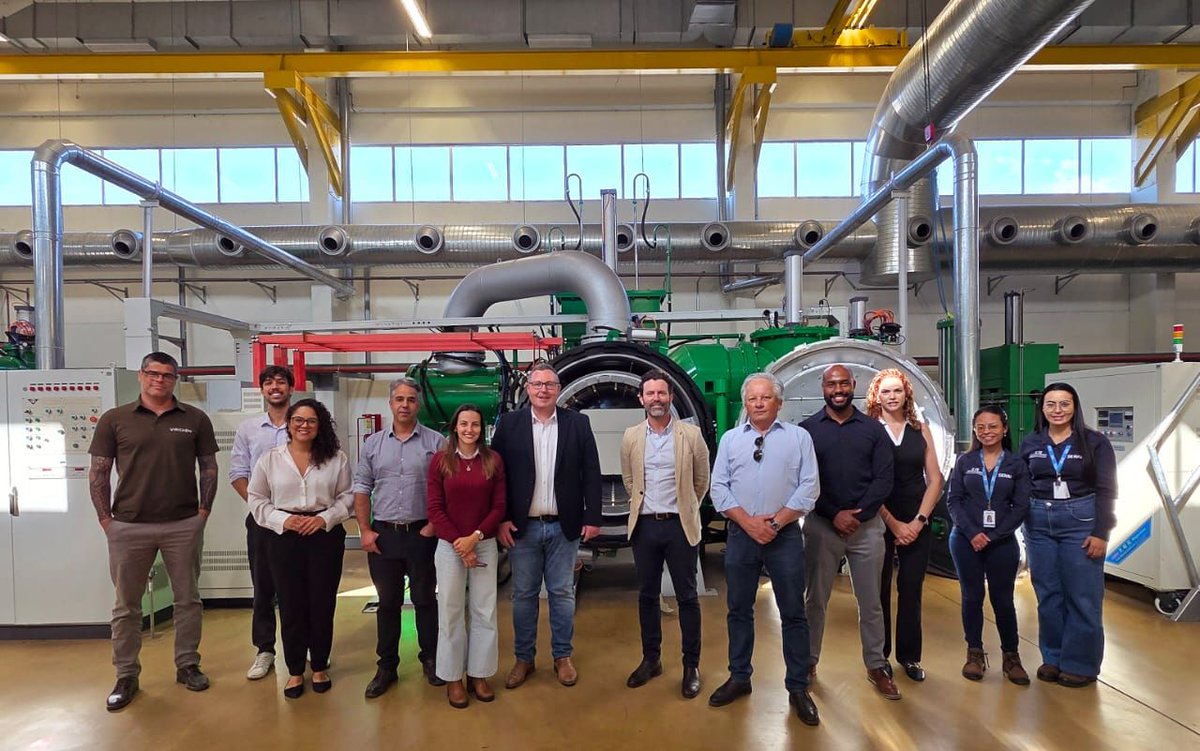
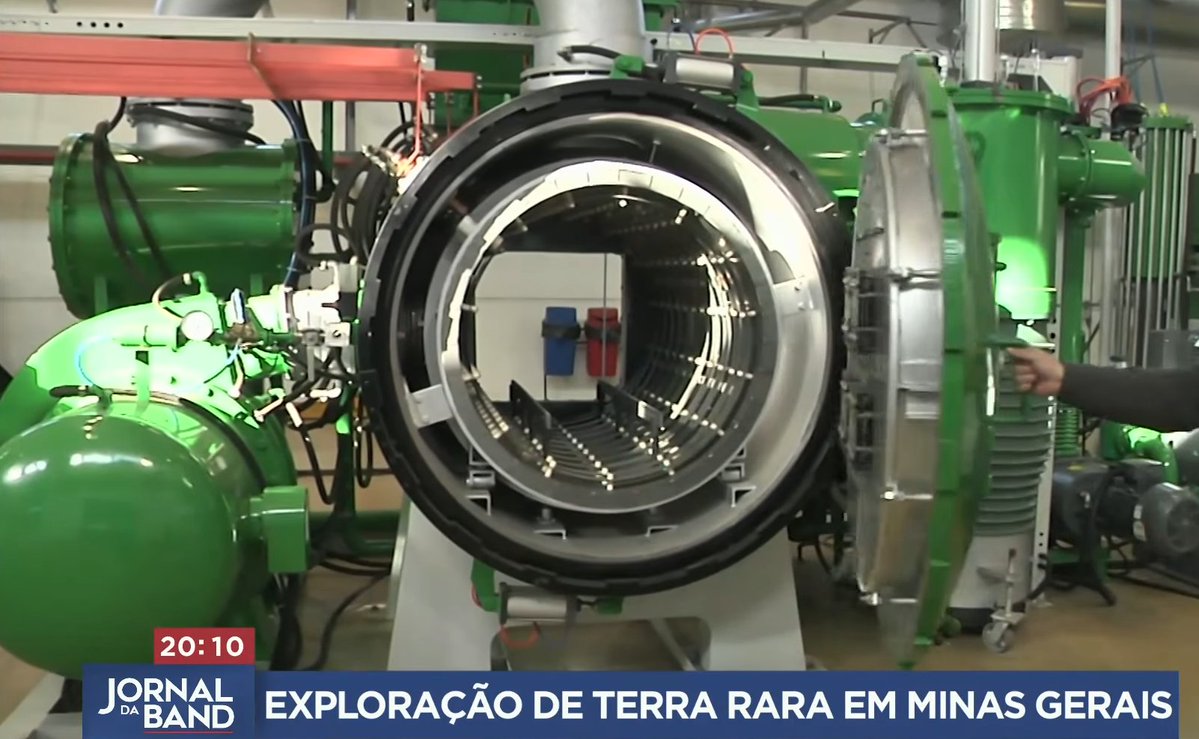
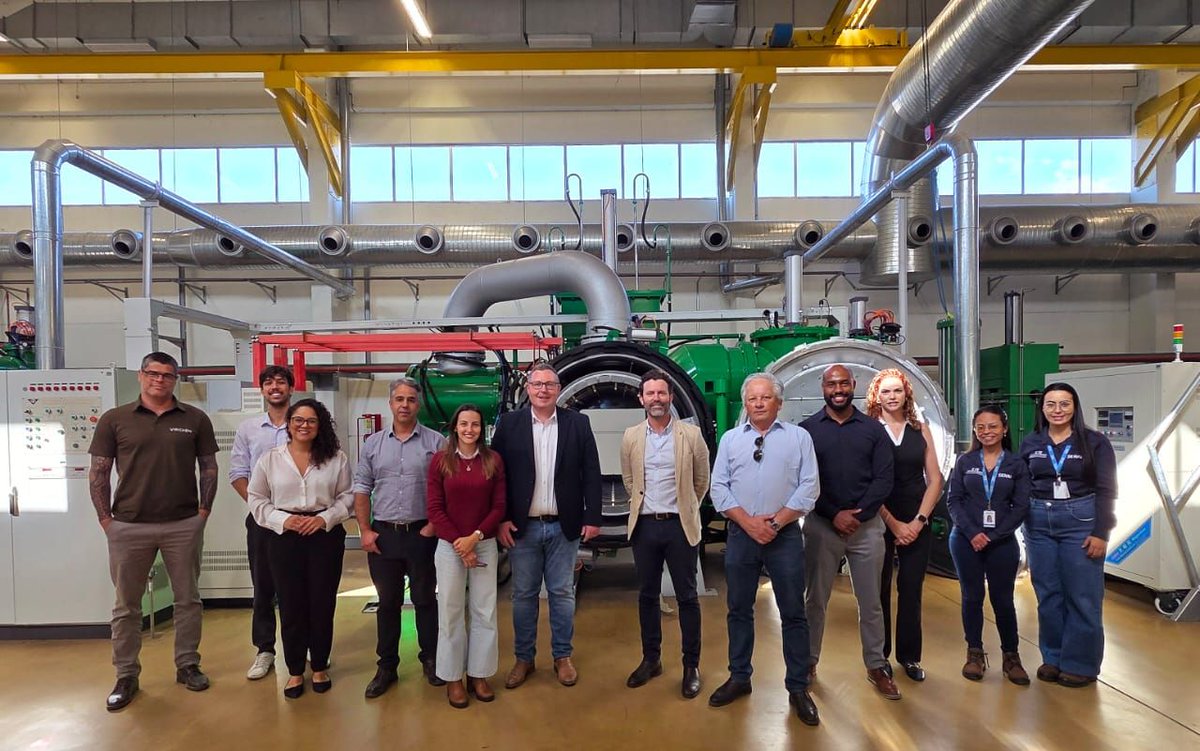
The Video from the CIT SENAI ITR facility (LabFab) in Lagoa Santa, Minas Gerais, Brazil. This is South America's first rare earth magnet laboratory and production facility, operating through a joint venture between IXR's Ionic Rare Earths and Viridis Mining and Minerals called Viridion. Laboratory Equipment shows high-temperature processing equipment with glowing elements, consistent with the melt spinning process used to create magnet alloy flakes from rare earth materials.
Lab Fab (CIT SENAI ITR) facility separated REOs from IXR's joint venture Viridion are being converted through melting and spinning to create magnet alloy flakes.
José Luciano de Assis Pereira, the technology and innovation manager at CIT SENAI ITR, confirmed that the facility initially produces neodymium iron boron magnets but expects to produce magnets from other rare earths as well. The facility is targeting production of 100 tonnes per year of permanent magnets by the end of 2026.
The facility has received significant backing from the Brazilian government, with BNDES and FINEP selecting Viridion for substantial funding to accelerate rare earth refining and recycling facilities, very nice
#viridion #IXR #VMM #Magnet #NdPr #Dy #Tb @IONICTECH_UK @IONIC_RE @Viridis_VMM @LCM_Metals #LabFab @IXR2THAMOON #MinasGerais #CITSENAI #MAGBRAS #TERRASRARAS #LabFaBITR #TecnologiaDePonta
2
11
656
@IONIC_RE Affiliate to Lead Project Recyling REOs for High-Performance Magnets- Investor Webinar
🧲♻️🌍 IXR Deep Dive | May 2026 Investor Webinar Deck Analysis.
Ionic Technologies: The Western World's Only Operating Recycler of Separated Magnet REOs
📺 Webinar video in comments | Disclosure: Held
🔬 THE TECHNOLOGY FIRST – because everything else flows from it
At the core is Ionic Technologies' patented multi-amide ionic liquid ligand separation platform – a hydrometallurgical circuit running near room temperature that delivers >99.5–99.9% purity separated Nd, Pr, Dy and Tb oxides.
It is genuinely feedstock-agnostic: spent magnets, pre-consumer swarf, MREC from primary ores, EOL motors – all go in, individually separated high-purity REOs come out. The process uses 15-stage solvent extraction with optimised lixiviant chemistry and materially lower reagent consumption than conventional routes. Critically, it sits behind a serious patent wall – and in a world where Western REE separation is about to become an IP game as much as a capex race, that matters enormously.
This isn't lab chemistry. The Belfast demonstration plant has been running 24/7 since January 2024 at 10 tpa separated REO capacity. And as of this morning's ASX announcement, Ionic Technologies has now passed Ford's own durability test – recycled-magnet rotors built at Halewood, tested at Dunton R&D, equivalent to primary-material production magnets on the first attempt.
📊 THE NUMBERS FROM THE MAY DECK
Belfast Commercial Plant (Feasibility Study, November 2024):
🏭 400 tpa separated REOs out / 1,200 tpa magnet scrap in
💰 Post-tax NPV: US$502m | IRR: 43.6% | Payback: 2.4 years
🔧 Capex: £85m | Opex: ~US$27.68/kg REO (ex-feedstock)
📈 Lifetime EBITDA: US$1.8bn | Net Revenue: US$2.1bn over 20 years
🏗️ Target construction complete: 2028
And the pricing context that makes those numbers sing (April 2026 Western vs China pricing):
NdPr: broadly aligned as in pricing
Dysprosium: US$1,450,000/t West vs US$201,684/t China (~6.2x)
Terbium: US$4,750,000/t West vs US$894,495/t China (~4.3x)
Yttrium: US$1,525,000/t West vs US$10,400/t China (~145.6x) 🤯
The disconnect is structural, not cyclical. It will not correct until ex-China separation capacity for heavy rare earths is built, qualified and operating at scale.
🏛️ GOVERNMENT BACKING IS REAL
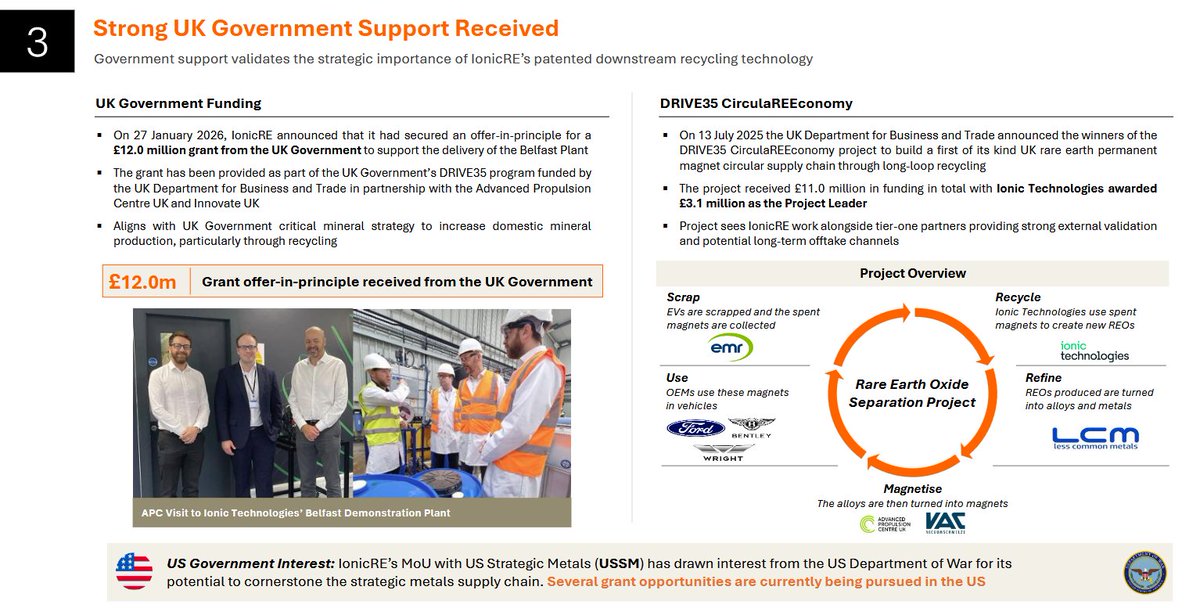
✅ £12m grant offer-in-principle (UK Govt, DRIVE35, January 2026)
✅ £3.1m as project leader in the £11m CREEM/CirculaREEconomy consortium
✅ Belfast Plant designated "strategically significant" by FORGE
✅ US DoD/War Dept interest in the USSM Missouri MoU
✅ Viridion JV shortlisted for Brazil's A$1.4bn BNDES/FINEP funding program
The UK Government's Vision 2035 Critical Minerals Strategy targets 10% domestic 20% recycled mineral supply by 2035 – currently sitting at just 6% domestic. Ionic Technologies is the flagship demonstration that recycling can close that gap fast.
🌐 THE MULTI-JURISDICTIONAL PLATFORM
What I think the market is missing in the current share price is that IXR isn't just a Belfast story anymore. There are now four interlocking nodes:
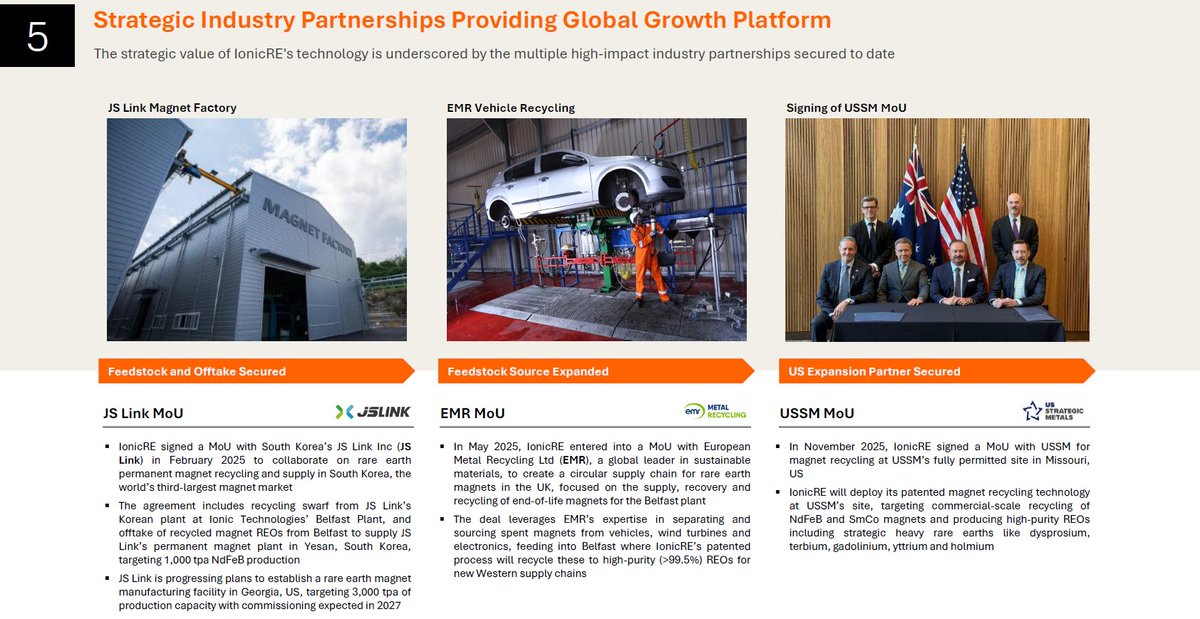
1. 🇬🇧 Belfast (UK) – 400 tpa commercial plant, FID pathway, Ford/GKN/LCM validated, EMR feedstock MoU
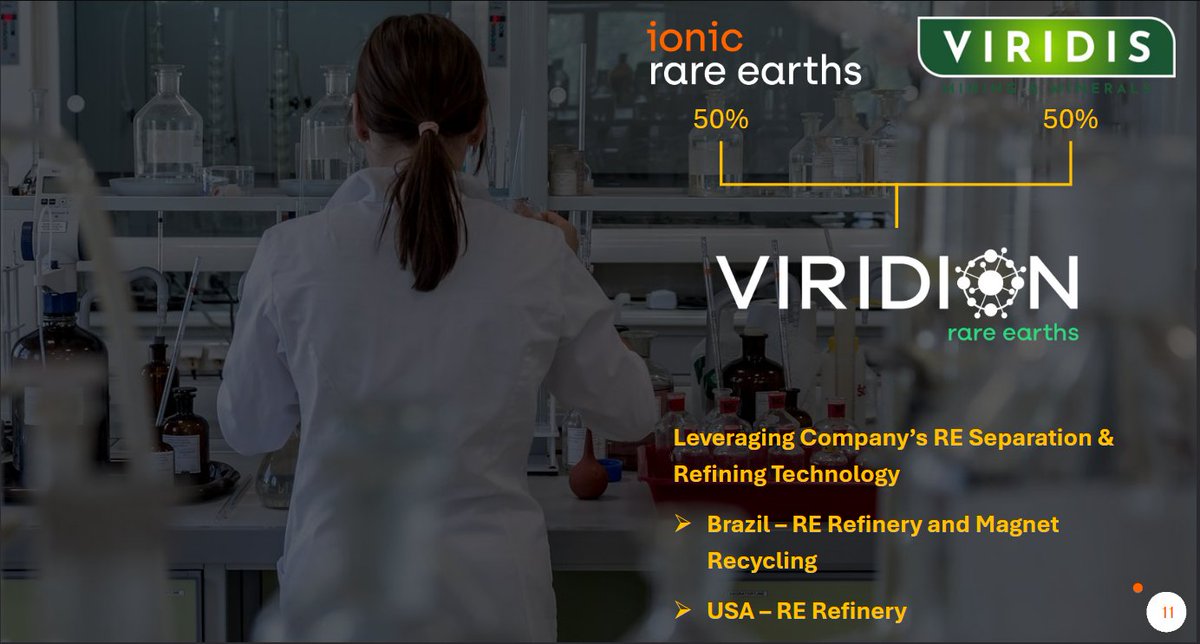
2. 🇧🇷 Viridion JV (Brazil) – 50:50 with Viridis, govt land grant secured, BNDES financing advanced, first REOs delivered to Brazil, SENAI LabFab connection
3. 🇺🇸 USSM MoU (Missouri, US) – deploying IXR chemistry into an existing permitted chemicals complex, ~US$100m per co-location site, targeting NdFeB SmCo swarf from the ~20kt of US manufacturing swarf being created by the announced ~45 ktpa of new US magnet capacity
4. 🇺🇬 Makuutu (Uganda) – 60% owned, 35-year life, 45% HREO basket, fully permitted and shovel-ready, Pre-tax NPV US$406m, IRR 32.7%
The US opportunity in particular is underappreciated. At 25–40% yield loss across the metals-to-magnet chain, that 45 ktpa of announced US NdFeB capacity implies ~15–37 ktpa of swarf – a captive, recurring, domestic feedstock stream that cannot economically be exported and cannot be short-looped at heterogeneous scale. Long-loop chemistry is the only viable solution, and IXR holds the IP.
♻️ THE EMR FEEDSTOCK STORY
The EMR partnership is further along than most appreciate. EMR isn't starting from zero on magnet liberation – they've already built embedded capability through REAP (audio products), SCREAM (automotive), and Re-Rewind (wind turbines), all aimed at building a truly circular rare earth magnet economy. They recycle 10 million tonnes of material per year across UK, USA, Germany and Netherlands, targeting net-zero by 2040.
I keep posting this because the entire sector is learning the same hard lesson: collection, liberation and sorting are the real bottleneck, not the separation chemistry. EMR is one of the very few players with both the industrial infrastructure and the programme track record to actually solve it at scale. Their embedding in CREEM and the wind turbine liberation work alongside ReactUK, HyProMag and BGS is exactly the upstream foundation long-loop refiners need.
♻️ THE EMR FEEDSTOCK STORY – AND THE UK'S TWO-PILLAR APPROACH
The EMR partnership is further along than most appreciate. EMR isn't starting from zero on magnet liberation – they've already built embedded capability through REAP (audio products), SCREAM (automotive), and Re-Rewind (wind turbines), all aimed at building a truly circular rare earth magnet economy. They recycle 10 million tonnes of material per year across UK, USA, Germany and Netherlands, targeting net-zero by 2040.
What I think is genuinely underappreciated is that the UK Government hasn't bet on a single technology or a single loop length – they've deliberately funded two complementary and parallel pillars under the DRIVE35 critical minerals programme:
🔵 Pillar 1 – Short Loop | HyProMag ReactUK
Hydrogen Processing of Magnet Scrap (HPMS) –
demagnetising and reprocessing magnets directly back into sintered NdFeB, keeping the material in the magnet-to-magnet loop. Fast cycle, lower processing steps, but requires relatively clean, graded feedstock. ReactUK is the magnet liberation and HPMS hub operating at Kingston.
🟢 Pillar 2 – Long Loop | Ionic Technologies CirculaREEconomy (CREEM)
Hydrometallurgical dissolution → individual REO separation → metal → alloy → magnet. Handles any feedstock regardless of grade, coating or oxidation state – the dirty, mixed, heterogeneous material that short-loop cannot process. Ionic Technologies leads CREEM with Ford, Bentley, Wrightbus, LCM and EMR as partners.
EMR sits across both pillars – supplying liberated magnets upstream into both routes – which is precisely why their investment in REAP, SCREAM, Re-Rewind and the BGS turbine fleet mapping work is so strategically valuable. They are the collection and liberation infrastructure that feeds the entire UK circular RE economy.
The UK Government's logic is sound: short-loop for clean manufacturing swarf and graded EOL magnets; long-loop for everything else – the mixed, oxidised, coated material coming out of EVs, wind turbines and WEEE at scale. Both need to work, and both are being funded. IXR owns the long-loop IP. That's the irreplaceable part of the stack.
♻️ FEEDSTOCK STORY – AND WHERE THE SWARF ACTUALLY COMES FROM.
🏭 VAC (Vacuumschmelze) – Alloy and Strip Casting
Strip-cast alloy production generates heel material, off-spec ingots and casting losses from every pour. At 25–40% yield loss across the metals-to-magnet chain, a facility producing thousands of tonnes of NdFeB alloy is generating a significant, recurring and chemically well-characterised swarf stream – exactly the kind of material Ionic Technologies' long-loop process handles best.
🔧 LCM (Less Common Metals) – Metal and Alloy Production
LCM's own metallisation and strip-casting operations produce off-cuts, turnings, skull material and remelting losses from Nd, Dy, Tb and NdPr ingot production. As Aaron Riley confirmed in today's CLIMATES announcement – "producing magnet-specification alloy from 100% recycled rare earth oxides" – LCM is now a direct participant in the closed loop, meaning their own process waste becomes a natural feedstock return path back to Ionic Technologies.
✂️ Block Magnet Cutting and Shaping – The Hidden Swarf Mountain
This is the one most people miss. Sintered NdFeB magnets are pressed and sintered as blocks or cylinders, then precision-cut, sliced, ground and shaped to OEM specification using diamond wire saws and grinding wheels. The yield loss at this stage alone runs to 20–35% of the input magnet mass – generating a continuous stream of fine, oxidation-prone, coating-contaminated swarf that:
1. Cannot be economically exported
2. Cannot be reliably short-looped via HPMS at heterogeneous scale
3. Can only be economically recovered via long-loop hydrometallurgical processing – i.e. Ionic Technologies' exact process
This is precisely why the US magnet expansion creates such a captive recycling opportunity for IXR. The ~45 ktpa of announced US NdFeB magnet capacity implies a base case of ~20 ktpa of swarf being generated domestically – stranded, uneconomic to export and strategically wasteful to discard.
The feedstock isn't a future problem waiting to be solved – it's being generated today at VAC, LCM, GKN and every other alloy and magnet producer in the Western supply chain. IXR's partners are simultaneously its best feedstock suppliers. That's what a truly closed loop looks like.
🧲This to me is a huge Plus and have been following this very closely for a few years now 📸
🇬🇧🚗 FORD VALIDATION – TODAY'S ASX ANNOUNCEMENT
This morning's CLIMATES result isn't just a technology milestone – it is a bankable de-risking event for the Belfast funding stack. Every box project financiers and grant bodies need to tick:
✅ REO purity to magnet spec: proven
✅ LCM metallisation from 100% recycled inputs: proven
✅ GKN magnet manufacture from recycled alloy: proven
✅ Ford durability test at Dunton R&D: passed first attempt
✅ All parties extending into CirculaREEconomy/CREEM: confirmed
More validation = lower technical risk = better funding terms = faster path to FID.
⚠️ WHERE I'M SPENDING MORE TIME – THE HONEST CAVEATS
The technology hasn't broken. What has slipped is the political and bureaucratic plumbing around converting grants, permits and debt into a funded construction contract on a 2026–2027 timeline. Belfast FID has moved right, and in a tougher macro with higher rates, layering £85m of capex through UK grant processes debt equity is simply harder and slower than the PowerPoint curve suggests.
My focus areas going forward:
How the Belfast and Brazil funding stacks actually close (timing and conditions)
How fast EMR-sourced and JS Link/VAC swarf MOU's can scale to nameplate vs the feasibility assumptions
Risk-adjusted production profiles once you haircut the headline curves
IXR and Ford deep dive – this week's post will go much further on the commercial implications of today's CLIMATES result 🔍
Market Cap: A$63.3m | Enterprise Value: A$54.7m | Cash: A$8.5m
At current prices, the market is pricing in very little of a post-tax NPV of US$502m for Belfast alone – let alone Viridion, USSM and Makuutu optionality. Whether the funding stack lands in time is the question. The technology just passed Ford's test. 🧲🇬🇧
@IONIC_RE @IONICTECH_UK @LCM_Metals @EMRGroupLimited @forduk @CMA_Minerals #VAC
#IXR #IonicRareEarths #IonicTechnologies #RareEarths #NdFeB #NdPr #Dysprosium #Terbium #CriticalMinerals #MagnetRecycling #CirculaREEconomy #Climates #ReEVALUATE #CircularEconomy #Belfast #CLIMATES #CREEM #DRIVE35 #Ford #EMR #Viridion #USSM #Makuutu #EVs #WindEnergy #Defense #UKManufacturing #SupplyChainResilience 🧲♻️🌍🇬🇧🇺🇸🇧🇷🇺🇬
2
4
10
424
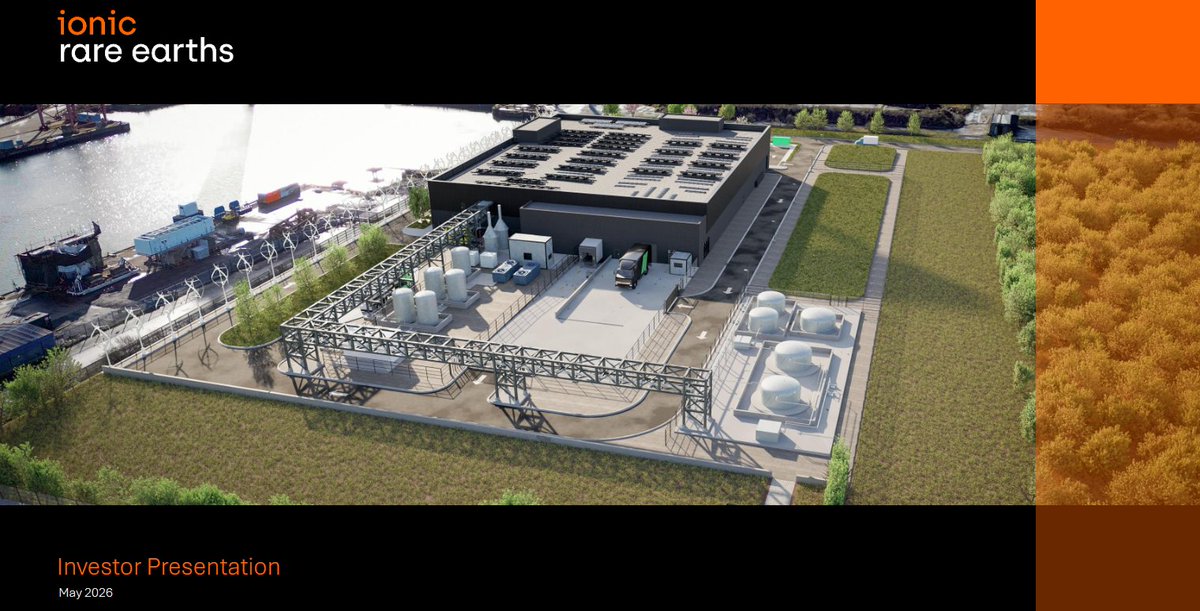
Premium deep dive on IXR’s May 2026 deck Tim Harrison’s Emerging Growth Conference presentation (video linked in comments) – plus my own feedstock and funding takeaways.
At the core is Ionic Technologies’ multifunctional‑amide Ionic Liquid, ligand separation platform – a proprietary hydrometallurgical circuit that runs near room temperature, delivers >99.5–99.9% purity oxides, and materially lowers carbon and safety risk versus conventional solvent extraction. It is genuinely feedstock‑flexible (primary ores, MREC, magnet scrap, EOL motors) and sits on a serious patent wall, which matters if Western REE separation turns into an IP game rather than just a capex race.
The Belfast long‑loop recycling plant is still the financial anchor: 1,200 tpa of magnet scrap in, 400 tpa of separated REOs out, with a feasibility‑study IRR of 43.6%, 2.4‑year payback and opex of ~US$27.68/kg REO ex‑feedstock. Government backing is real – £12m DRIVE35 grant in principle, CREEM leadership, FORGE “strategically significant” status – and the EMR partnership goes a long way toward de‑risking magnet feedstock in a world that is only now waking up to the fact that collection, liberation and sorting are the real bottlenecks.
What has changed since earlier decks is timing and dependence on the funding stack. Belfast FID and build are slipping further into 2026 as IXR works through UK grant processes and layers in debt equity in a much tougher macro, and that delay – plus broader UK policy drift – is a big part of why the share price has been hammered. The underlying technology hasn’t broken; the political and bureaucratic plumbing around getting public money and permits released has simply moved to the right.
In parallel, IXR is quietly stitching together a multi‑jurisdictional platform:
1. Makuutu IAC in Uganda (shovel‑ready, 35‑year life, heavy‑rich basket with no radionuclides and ~43% magnet REO content) gives optionality on primary supply;
2. Viridion JV in Brazil brings a state‑bank‑backed refinery recycling hub feeding Brazilian NdFeB production via SENAI’s LabFab; and the
3. USSM MoU in Missouri is about dropping IXR’s chemistry into an existing chemicals complex aimed squarely at the US DoD/EV magnet gap as the 2027 China‑magnet ban bites.
The big caveat – and where I’m spending more time – is feedstock logistics and timing versus nameplate ambitions.
EMR gives IXR a far better starting point than most, but the entire sector is discovering that getting enough liberated, graded magnet material to a refinery gate at the right cost is at least as hard as building the separation plant.
EMR isn’t starting from zero here either. They’ve already established themselves as a leading player in magnet liberation through projects like REAP (Rare‑Earth Extraction from Audio Products), SCREAM (Secure Critical Rare Earth Magnets for the UK Automotives) and Re‑Rewind (recovering rare earth magnets from wind turbines), with HyProMag all aimed at building a truly circular rare earth magnet economy. Drawing on years of work across EVs, wind and WEEE, EMR is now focused on liberating magnets in the safest, most cost‑effective way – exactly the kind of upstream capability long‑loop refiners like Ionic Technologies need.
As posted many times before, For context, EMR is a global leader in sustainable materials with operations across the UK, USA, Germany and the Netherlands, recycling over 10 million tonnes of material a year and avoiding more than 19.1 million tonnes of CO₂ emissions, with a target to be fully net‑zero by 2040 as they invest into low‑carbon, circular technologies.
Crucially, I’m seeing exactly the same structural issue in other countries and across other magnet recyclers. The technology works – long‑loop, short‑loop, hybrids – but the logistics of magnet liberation, sorting and routing (from EVs, wind turbines, WEEE, swarf) take time to build out properly, as I’ve posted many times.
What I'm seeing now is that EMR has very high potential here and is already embedded in two flagship UK programmes: the £11m CirculaREEconomy/CREEM consortium and Ionic Technologies’ wind‑turbine magnet liberation work, alongside ReactUK, HyProMag’s EV‑motor liberation and BGS mapping of on‑ and offshore turbine fleets – all covered earlier in this magnet thread and absolutely worth reading back through if you want the full context.
So for me, IXR remains one of the very few names that actually looks like a potential Western REE systems integrator – primary IAC, proprietary separation, and magnet‑grade recycling across the UK, US, Brazil and Uganda – but the market is now forcing them to prove they can turn geopolitical validation and grants into funded, fed, operating plants on a realistic 2026–2028 timetable.
I’ll be digging further into: how the Belfast and Brazil funding stacks actually land, how fast EMR‑sourced and other magnet feedstocks can scale, and what risk‑adjusted production profiles look like once you haircut the PowerPoint curves.
@IONIC_RE @IONICTECH_UK @EMRGroupLimited @LCM_Metals @CMA_Minerals @ussmetals #Drive35 @Viridis_VMM #Viridion #MAIL #CircularEconomy
#IXR #IonicTechnologies #RareEarths #NdPr #DyTb #MagnetRecycling #CriticalMinerals #Makuutu #Belfast #Brazil #USSM #FORGE #EMR @theapcuk #Geopolitics 🧲♻️
14
375
📚 Part of a Bigger Series x.com/roblun1/status/2033432…
This is Ionic Technologies Magnet Recycling breakdown which is part of my ongoing series on the new magnet‑recycling and separation ecosystem — covering how different technologies and business models stack up across Ionic Technologies, Cyclic Materials, REEcycle, ReElement, Ucore, and HyProMag, and will be adding Caremag/Carester comparing product purity, processing routes, scalability, and where each fits in the emerging circular magnet supply chain.
The Last Part of the Magnet Recyclers in my series
💎 Ionic Technologies & Multifunctional Amide Ionic Liquids
🧪 INTRO — MAIL: The Belfast chemistry quietly solving the West’s magnet problem
85% of rare earth processing and magnet manufacturing still sits in China. Export controls on Dy/Tb in 2025 showed how fragile that is.
In Belfast, Ionic Technologies (ASX: $IXR) has spent a decade building something radically different:
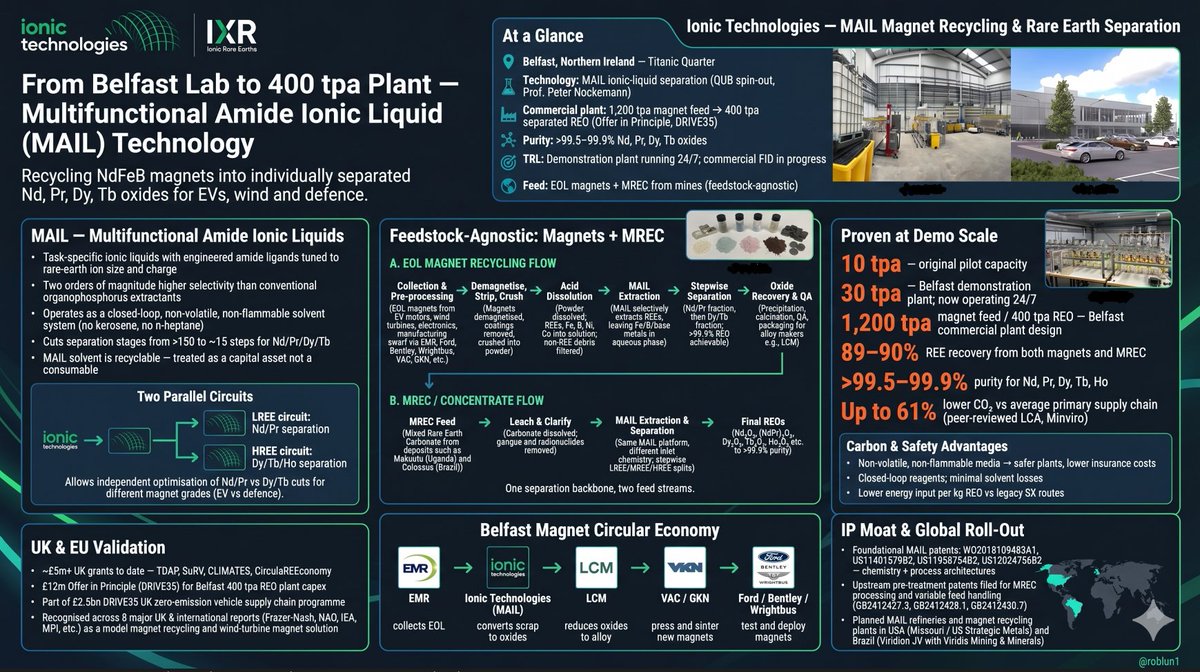
Multifunctional Amide Ionic Liquid (MAIL) technology that can separate Nd/Pr in one circuit and Dy/Tb in another — from both end‑of‑life magnets and mixed rare earth carbonate (MREC).
Here’s how it works and why it matters. 🧵
🧬 1️⃣ The Chemistry — Engineered Ligands, Not Kerosene
Traditional rare earth separation uses organophosphorus extractants dissolved in kerosene or n‑heptane, running through hundreds of mixer‑settlers to tease apart Nd, Pr, Dy, Tb. Dirty, sprawling, and dangerous — and China spent 30 years perfecting it.
MAIL flips that on its head.
Uses task‑specific ionic liquids — salts that are liquid near room temperature.
Attaches multifunctional amide ligands precisely engineered to grab specific lanthanide ions.
Achieves selectivity ~100x higher than legacy extractants, so the whole separation happens in ~15 steps instead of >150.
The solvent is non‑volatile and non‑flammable — no kerosene, no explosion risk.
The ionic liquid doesn’t get consumed; it’s recycled loop‑after‑loop as a capital asset, not a throw‑away reagent. ⚙️
🧪 A decade in the lab, 30 months in continuous operation
MAIL isn’t a concept on a whiteboard — it’s the result of 10 years of ionic‑liquid research at Queen’s University Belfast, spun out as Seren Technologies in 2016 and acquired by Ionic Rare Earths in 2022.
Since early 2024 the Belfast demonstration plant has been running 24/7, taking in batches of end‑of‑life NdFeB magnets and production swarf and consistently outputting >99.5% purity Nd, Pr, Dy and Tb oxides for partners like LCM, Ford and VAC.
That continuous 30‑month operating history under industrial control systems is what turns MAIL from an interesting chemistry paper into a bankable midstream separation platform.
♻️ 2️⃣ Two Circuits — Nd/Pr and Dy/Tb from Any Feedstock
MAIL is built around two parallel separation circuits:
A light‑rare‑earth (LREE) circuit tuned for Nd/Pr
A heavy‑rare‑earth (HREE) circuit tuned for Dy/Tb/Ho
Feedstock can be:
End‑of‑life NdFeB magnets from EVs, wind turbines, electronics, production swarf
MREC (Mixed Rare Earth Carbonate) from primary mines like Makuutu (Uganda) or Colossus (Brazil)
The front‑end changes, the separation backbone doesn’t:
Magnets → demagnetised, stripped, crushed, dissolved
MREC → leached and clarified
Both become a mixed REE solution that goes through MAIL → Nd, Pr, Dy, Tb split into separate oxide streams at >99.5–99.9% purity.
One platform, two feeds, four critical oxides. 🧲
🏭 3️⃣ Belfast Demo → 400 tpa Plant
Ionic’s tech isn’t just lab‑scale — Belfast’s demonstration plant is running 24/7:
10 tpa early pilot → now 30 tpa demonstration plant in Titanic Quarter
Producing >99.5% pure Nd₂O₃, (NdPr)₂O₃, Dy₂O₃, Tb₄O₇ from real magnet scrap
Independent LCA (Minviro) shows up to 61% lower CO₂ vs typical primary routes, especially for Dy oxide.
Next step: 1,200 tpa magnet feed / 400 tpa REO commercial plant in Belfast, with a £12m Offer in Principle under the UK’s £2.5bn DRIVE35 programme. Capex: £85m; IXR is now lining up strategic equity alongside UK grants.
First production target: within ~2 years of final investment decision. ⏳
🧱 4️⃣ Feedstock Locked In — EMR, OEMs & BGS Data
A recycling plant lives or dies on scrap — and on knowing where future scrap will come from. Belfast has both:
♻️ EMR — leading UK/EU recycler (150 yards), bringing EOL EVs, wind turbines and industrial scrap; projects like REAP, SCREAM, Re‑Rewind and the £11m CirculaREEconomy (CREEM) programme are explicitly configured to feed Ionic’s Belfast hub.
🧲 VAC & GKN — European magnet makers whose production swarf, offcuts and rejected parts are ideal high‑grade feedstock for MAIL.
🚗 Ford Halewood — up to 420,000 e‑drive units/year, each using roughly 1–2 kg of NdFeB magnets; manufacturing offcuts and warranty returns are designed to loop back into Belfast.
🚍 Bentley & Wrightbus — smaller volumes but very high‑value scrap and EOL flow from premium EV and hydrogen bus platforms engaged in the same circular programme.
🌬️ BGS & UK Technology Metals Observatory — new interactive maps and material‑flow models quantify Nd, Pr, Dy, Tb stocks in UK wind farms and EV motors, including when each wind farm is likely to hit end‑of‑life and become magnet feedstock.
sciencedirect.com/science/ar…
bgs.ac.uk/news/new-interacti…
techmetalsobservatory.org/ci…
On the back of this work, I’ll be running a dedicated series on UK feedstock availability — using the same approach I used for profiling magnet recyclers — to track how quickly those in‑use stocks (EVs, wind, HDDs, industrial motors) can realistically support Belfast and the wider UK circular REE industry.
Combined consortium supply today is already ~1,000–1,850 tpa of NdFeB magnet material, more than enough to saturate Ionic’s 1,200 tpa magnet‑feed Belfast design capacity, with BGS/TechMetals data highlighting a much larger wave of wind‑turbine and EV magnets arriving through the 2030s.
🔍 And just like every other magnet recycler, feedstock is the whole ballgame.
The chemistry is proven and the grants are real, but long‑term success for Ionic, HyProMag, Cyclic, ReElement, REEcycle, Caremag and the rest will come down to one thing: who can lock in sustained, high‑grade magnet and MREC supply at scale as EVs, wind turbines and data centres hit end‑of‑life through the 2030s. My upcoming UK feedstock series will dig into exactly that.
🌍 5️⃣ Partners & Grants — UK’s Chosen Midstream Platform
The UK and EU have quietly picked their midstream horse:
~£5m in direct UK grants to Ionic (TDAP, SuRV, CLIMATES, REEVALUATE) plus leadership role in the £11m CirculaREEconomy (CREEM) consortium.”
£12m DRIVE35 Offer in Principle for Belfast commercial plant capex
Backed across 8 major reports (Frazer‑Nash, NAO, IEA, MPI, etc.) as the leading example of magnet and wind‑turbine recycling in the UK’s critical minerals strategy.
CirculaREEconomy consortium: EMR, LCM, VAC, GKN, Ford, Bentley, Wrightbus, BGS.
This isn’t a science project any more — it’s the UK’s reference midstream separation platform for EVs, wind and defence. 🇬🇧
🌐 6️⃣ IP Moat & Global Roll‑Out
Ionic’s MAIL platform is heavily patented:
Chemistry & separation families: WO2018109483A1, US11401579B2, US11958754B2, US12024756B2
Upstream pre‑treatment for MREC and variable feeds: GB2412427.3, GB2412428.1, GB2412430.7
Expansion nodes:
🇺🇸 Missouri (US Strategic Metals) — MAIL recycling & separation co‑located on a permitted multi‑metal platform under the US–Australia critical minerals framework.
🇧🇷 Brazil (Viridion JV with Viridis Mining & Minerals) — MAIL refinery recycling hub tied to the Colossus ionic clay project, aiming to support 100 tpa NdFeB at SENAI’s LabFab line by 2026.
viridionre.com/
Belfast is the template — Missouri and Minas Gerais are the next bricks in a global MAIL network. 🌎
🎯 7️⃣ Why MAIL Matters for Investors
✅ Feed‑agnostic: handles both EOL magnets and MREC from multiple deposits.
✅ Purity & yield: 89–90% recovery, >99.5–99.9% purity Nd/Pr/Dy/Tb/Ho.
✅ Carbon & safety: up to 61% lower CO₂; non‑volatile, non‑flammable solvents.
✅ Capital efficiency: ~15 stages vs >150, closed‑loop solvent turns OPEX into CAPEX.
✅ Strategic fit: explicitly name‑checked across UK & IEA policy reports as the model for magnet and wind‑turbine recycling.
For anyone tracking ex‑China magnet supply chains, MAIL in Belfast is no longer optional homework — it’s required reading. 🧠🧲
@IONICTECH_UK @IONIC_RE @timhorizonmet @EMRGroupLimited @LCM_Metals #VAC @Wright_bus @BentleyMotors @QUBelfast @CMA_Minerals @ChrisMcDonaldMP @IEA $IXR #IonicTechnologies #MAIL #RareEarths #NdFeB #MagnetRecycling #CriticalMinerals #EVSupplyChain #WindEnergy #DefenceSupplyChain #Belfast #DRIVE35 #CirculaREEconomy #IonicLiquids #GreenChemistry #SupplyChainSovereignty @roblun1 @IXR2THAMOON
🧲♻️ Magnet Recycling Spotlight
🚀 Over the next few weeks this series will cover different magnet‑recycling technologies and business models across players like, Ionic Technologies, Cyclic Materials, REEcycle, ReElement, Ucore and HyProMag, comparing product purity, processing routes, scalability and where each fits in the emerging circular magnet ecosystem.
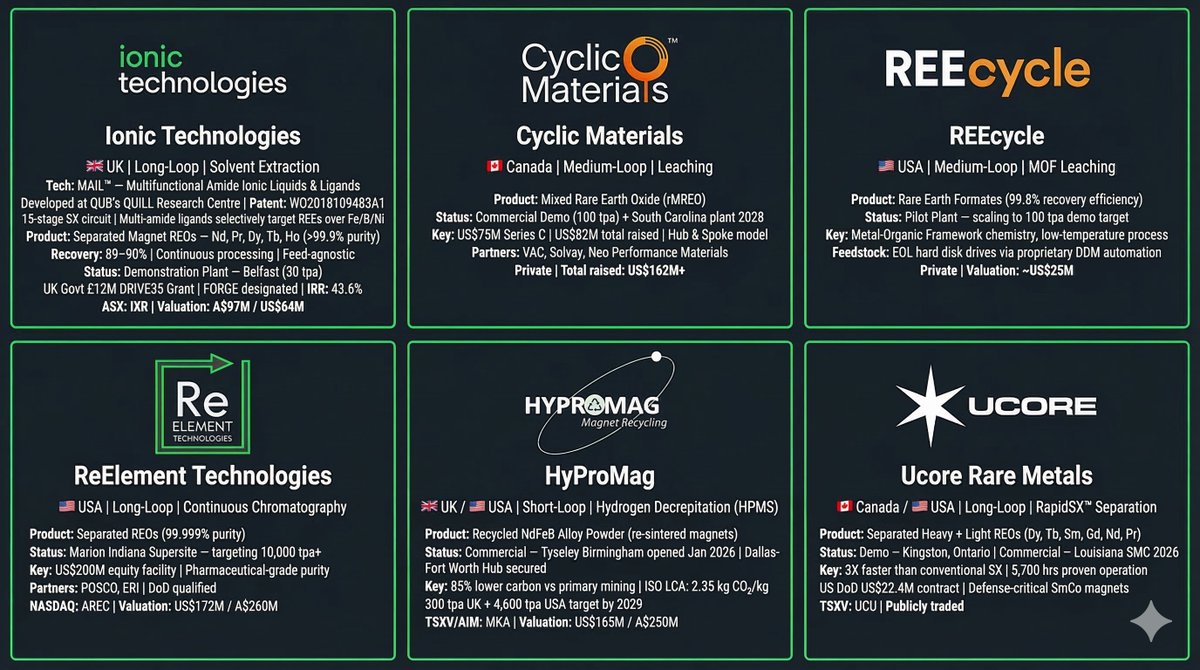
🧲 Not all magnet recycling is created equal. These 6 companies represent 6 distinct technology business model combinations — and together they map the entire Western supply chain response to China's rare earth dominance, the 6 pure-play recyclers🧵👇
Tier 1 — Pure-Play Magnet Recyclers (the 6)
Ionic, Cyclic, HyProMag, ReElement, REEcycle, Ucore
→ Magnet recycling IS their entire business model.
Solvay lies in between, accepts recycled feedstock as one input stream among several.
REEtec of Norway sits alongside Solvay, it is building a large-scale separation facility at Herøya funded by LKAB specifically to accept recycled and mined mixed REO feeds and convert them into separated oxides for European magnet makers.
Tier 2 — Integrated Players with Recycling Arms
MP Materials, USA Rare Earth/LCM, Energy Fuels, Carester, Momentum, Geomega, S
→ Recycling is a strategic component within a larger mine-to-magnet or multi-metal business
Tier 3 — Established Asian Incumbents
Shin-Etsu, Proterial, Santoku
→ Commercial at scale for 15 years but within closed Japanese supply chains — the benchmark the West is trying to match
1️⃣ Ionic Technologies 🇬🇧
Long-loop Solvent Extraction using MAIL™ (Multifunctional Amide Ionic Liquids & Ligands)
→ Separated REOs (>99.9% purity) | Continuous processing | Lowest variability | Feed-agnostic
✅ Published LCA
✅ Feasibility Study
✅ UK Govt £12M Grant
✅ FORGE designated
The precision specialist — highest purity, proven IP, ready to license globally
2️⃣ Cyclic Materials 🇨🇦
Medium-loop Leaching (MagCycle REEPure)
→ Mixed Rare Earth Oxide (rMREO) | Hub & spoke model | Real plant operating NOW
✅ US$162M raised
✅ South Carolina plant confirmed (2028)
✅ VAC Solvay offtakes signed
The volume play — feedstock-agnostic, massively funded, scaling fast
3️⃣ REEcycle 🇺🇸
Medium-loop Leaching using Metal-Organic Frameworks (MOFs)
→ Rare Earth Formates | 99.8% recovery efficiency | Low-temperature chemistry
⚠️ Pilot stage | No LCA or feasibility study published | Dependent on downstream separators
The chemistry innovator — compelling science, still proving economics at scale
4️⃣ ReElement Technologies 🇺🇸
Long-loop Continuous Chromatography (pharmaceutical-grade)
→ Separated REOs (99.999% purity) | Marion Indiana Supersite targeting 10,000 tpa
✅ US$200M equity facility
✅ DoD qualified
✅ POSCO ERI feedstock partnerships
The purity champion — highest specification product, aggressive US scaling
NASDAQ: AREC
5️⃣ HyProMag 🇬🇧🇺🇸
Short-loop Hydrogen Decrepitation (HPMS)
→ Recycled NdFeB Alloy Powder | Re-sintered directly into new magnets
✅ Commercial Birmingham plant OPEN Jan 2026 ✅ Dallas-Fort Worth Hub secured
✅ ISO LCA: 85% lower carbon vs primary mining | 4,600 tpa USA target by 2029
The speed champion — shortest loop, lowest carbon, first to commercial in UK
TSXV/AIM: MKA
6️⃣ Ucore Rare Metals 🇨🇦🇺🇸
Long-loop RapidSX™ (Advanced Column Solvent Extraction)
→ Separated Heavy Light REOs (Dy, Tb, Sm, Gd, Nd, Pr) | 3X faster than conventional SX
✅ US$22.4M DoD contract
✅ 5,700 hrs proven operation
✅ Louisiana SMC commercial 2026
The heavy REE specialist — defence-critical SmCo magnets, filling the most acute Western gap
TSXV: UCU
The Western magnet recycling ecosystem is deliberately segmented. End-users — magnet makers, OEMs, and defence primes — will choose based on four dimensions:
🔬 Product spec — Separated oxide (Ionic, ReElement, Ucore) vs mixed oxide (Cyclic, REEcycle) vs alloy powder (HyProMag)
🌍 Geography — Feedstock proximity energy costs geopolitical mandate (US IRA, UK DRIVE35, EU CRM Act)
🌱 Sustainability — LCA proof required by OEMs (Ionic ✅ HyProMag ✅ others pending)
⚡ Scale timing — Who can deliver volume WHEN the EV and wind ramp demands it (2026–2030 critical window)
The US government is deliberately not picking one winner — it is funding across all three loops:
🔬 Long-loop separated REO → Ucore (DoD, US$22.4M), USA Rare Earth (Commerce, US$1.6B LOI)
🧪 Medium-loop recycling → REEcycle (DoD DPA Title III, US$5.1M)
🏭 Full supply chain → DOE US$134M open program US$1B broader critical minerals
The Demand Explosion
Adamas forecasts the global magnet rare earth oxide market will increase more than 7-fold by 2040, from US$9.7 billion today.
Critically, they project approximately US$7.3 billion worth of magnet REO demand will go completely unsatisfied by 2040 if supply doesn't grow beyond their base case — driven specifically by Dy, Tb, and NdPr undersupply.
adamasintel.com/global-marke…
@IONIC_RE @IONICTECH_UK @ussmetals @anduriltech @CMA_Minerals @IXR2THAMOON @timhorizonmet @ThalesDefence @northropgrumman @LockheedMartin @BoeingDefense @DeptofWar @DoWCTO @Viridis_VMM @ucore @LCM_Metals @CyclicMaterials
@MPMaterials @ReecycleInc @SolvayGroup @ReElementTech @EMRmetal #VIRIDION @EU_Commission @ENERGY @VulcanElements @RE_Exchanges @DiscoveryAlert @USRareEarths
@DeptofWar #MagnetRecycling #RareEarths #CriticalMinerals #CircularEconomy #SupplyChain #Sustainability #EVs #WindEnergy #NdFeB #IonicTechnologies #CyclicMaterials #HyProMag #ReElement #Ucore #REEcycle #MAIL #GreenTech
1
8
791

Apr 11
Those 2 racist degenerate tnucs always get triggered when Black people (us) turn up & laugh with Helen, Ms Dayglo, Labfab & Cats Rock. You can start a stopwatch to time how long the racism will come out of both of them
1
3
21
Apr 10
She parrots it to get a reaction from Labfab, who still ignores her. It's wasted on them. Got a dm, they're literally trolling over goldfish. I mean that's their fkn level of maturity. Everyone's talking about Melanie Trump, Iran, Green's win, etc.
3
35
Mar 29
Really Kitty. So how are we here supporting Labfab & Ms Dayglo, Helen, Cat & all the yt people you & your racist mates troll & abuse,
if we can't separate, are they not all yt? I've told you before...you're low iq on this, those women I've mentioned, listen, interact with other

1
1
2
97
Mar 14
'Dark tnuc, Labfab, T'...you're all jealous of me & are all LOSERS!'. 💀

2
3
51
Mar 7
You follow my friend Labfab. That unhinged racist has abused her & Black people for nearly 2 yrs. Careful who you align yourself with.


8
9
191

6 Dec 2025
This photo is a much bigger deal than it looks at first glance.
What you’re seeing are the first NdFeB “green” blocks ever uniaxially pressed on an industrial scale in Brazil, done by the MagBras – CIT SENAI ITR team on a 50‑ton press. They’ve gone from alloy flakes → anisotropic powder → pressed parts, with sintering, coating and magnetisation now coming next.
MagBras’ whole purpose is to build a fully national, ore‑to‑magnet supply chain for rare earth permanent magnets – mining, separation, alloy making, magnet pressing and even recycling – so this is a genuine sovereignty milestone for Brazil.
And remember who’s sitting inside that consortium: Viridis and Viridion (IXR VMM) alongside CIT SENAI. Ionic Technologies is the only partner in that group with proven Western separation IP for Nd, Pr, Dy, Tb, so this is exactly the pathway we’ve been talking about:
Colossus clay → MREC → Viridion / Ionic Tech separated REOs → LabFab alloy flakes → MagBras pressed NdFeB parts.
This is the visible hardware step that ties all of that strategy together.
The MagBras Project is building a fully national rare earth permanent magnet value chain – from Brazilian ore, through separation, alloy production, magnet manufacturing and ultimately recycling – to cut import dependence and lock in tech sovereignty for EVs, wind, electronics and defence. 🇧🇷
Critically, MagBras brings together 38 partners, including Viridis, Viridion (IXR VMM) and CIT SENAI, linking Colossus clay and Ionic Technologies’ separation IP to downstream alloy and magnet making. This is the practical bridge from Brazilian rare earths in the ground to Brazilian magnets in motors and generators.
This is a key step in MagBras’ goal: build a fully national, ore‑to‑magnet 🇧🇷 supply chain for rare earth permanent magnets:
🔹 Mining & concentration
🔹 REE separation & oxide production
🔹 Alloy powder production
🔹 Pressing, sintering, coating & magnetisation
🔹 End‑of‑life recycling & circular economy
This is what real strategic sovereignty in magnets looks like, not just talk. 🚀
@IONIC_RE @IONICTECH_UK @timhorizonmet
@Viridis_VMM @IXR2THAMOON @LCM_UK
@EMRmetal #VIRIDION @EU_Commission
@ENERGY @VulcanElements @RE_Exchanges
@DiscoveryAlert @SolvayGroup @ChrisMcDonaldMP
@ussmetals #NdPr #DyTb @MPMaterials
@CyclicMaterials @USRareEarths @LynasRareEarths
@ReElementTech @ucore @USARareEarth
#MagBras #Viridion #IonicTechnologies #Viridis #VMM #RareEarths #NdFeB #Magnets #Brazil #CriticalMinerals #EVs #WindPower #SupplyChain #TechSovereignty #CircularEconomy
2
1
11
1,384
29 Oct 2025
Its ok, I know you can't show jack 💩.
Please post racist tweets from both Helen & Labfab & I will tag them in & call out their asses in 4K dear. 👍🏿

2
1
9
409
29 Oct 2025
Its done. We can only hope she has the guts to unblock T, Helen, Labfab & all the other women she maligns on here daily to tell them all to their faces.
2
1
3
99
5 Oct 2025
The Video from the CIT SENAI ITR facility (LabFab) in Lagoa Santa, Minas Gerais, Brazil. This is South America's first rare earth magnet laboratory and production facility, operating through a joint venture between IXR's Ionic Rare Earths and Viridis Mining and Minerals called Viridion. Laboratory Equipment shows high-temperature processing equipment with glowing elements, consistent with the melt spinning process used to create magnet alloy flakes from rare earth materials.
Lab Fab (CIT SENAI ITR) facility separated REOs from IXR's joint venture Viridion are being converted through melting and spinning to create magnet alloy flakes.
José Luciano de Assis Pereira, the technology and innovation manager at CIT SENAI ITR, confirmed that the facility initially produces neodymium iron boron magnets but expects to produce magnets from other rare earths as well. The facility is targeting production of 100 tonnes per year of permanent magnets by the end of 2026.
The facility has received significant backing from the Brazilian government, with BNDES and FINEP selecting Viridion for substantial funding to accelerate rare earth refining and recycling facilities, very nice
#viridion #IXR #VMM #Magnet #NdPr #Dy #Tb @IONICTECH_UK @IONIC_RE @Viridis_VMM @LCM_Metals #LabFab @IXR2THAMOON #MinasGerais #CITSENAI #MAGBRAS #TERRASRARAS #LabFaBITR #TecnologiaDePonta
1
3
1,356
30 Apr 2025
Scanning the TLs...since this fkn am! 🤣🤣🤣💀.
This am Ms Dayglo, now Labfab & Cauli, waving the same fkn SS like its kryptonite.
Fkn 💀. 🤣🤣🤣🤣
1
4
46

Brasil vai fabricar ímãs de terras raras, lembrando que temos a terceira maior reserva em termos globais
Os ímãs serão produzidos no Laboratório de Produção de Ímãs de Terras Raras (Labfab ITR) da Companhia de Desenvolvimento de Minas Gerais (Codemge)
oglobo.globo.com/economia/ne…
4
12
447

21 Jan 2025
El Campus de Alcoy de la UPV cuenta un nuevo LABFAB
cadenaser.com/comunitat-vale…
1
3
140

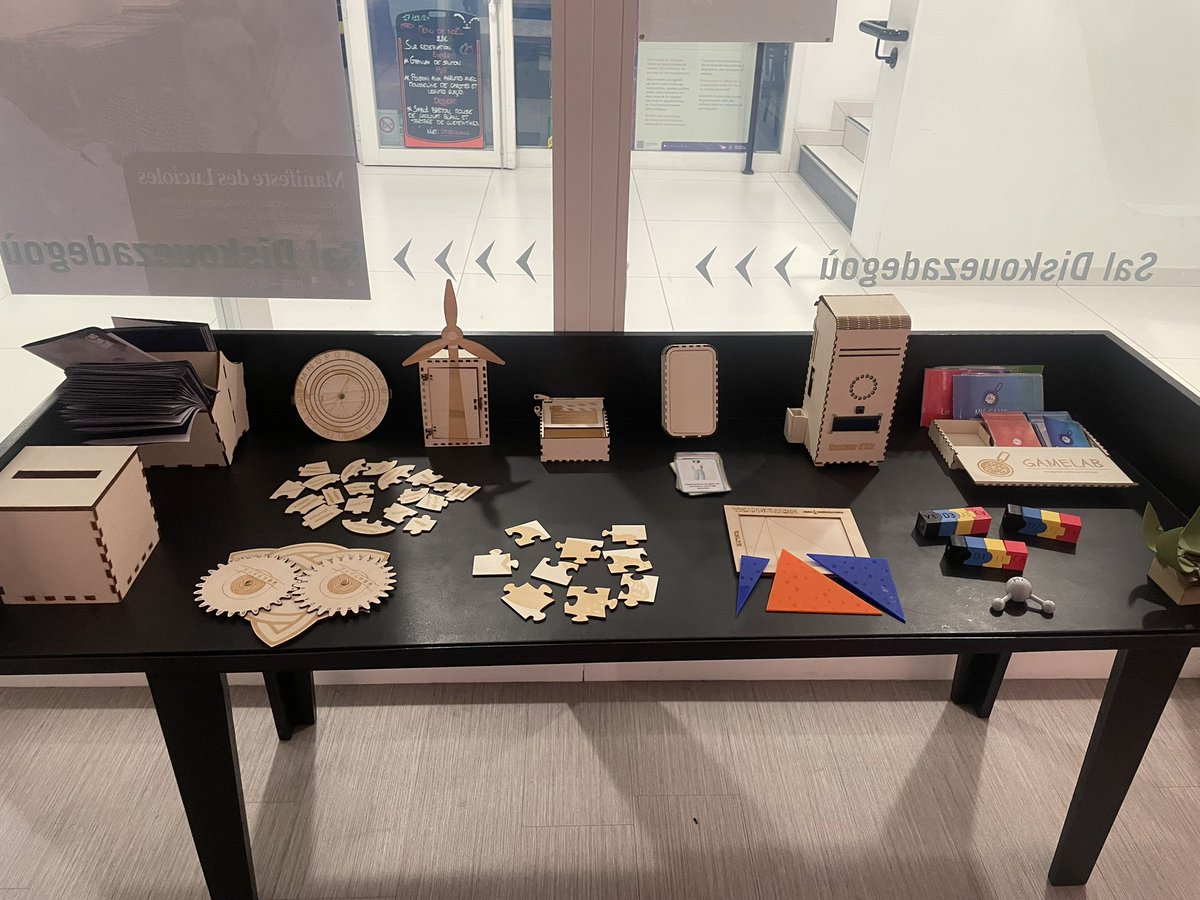
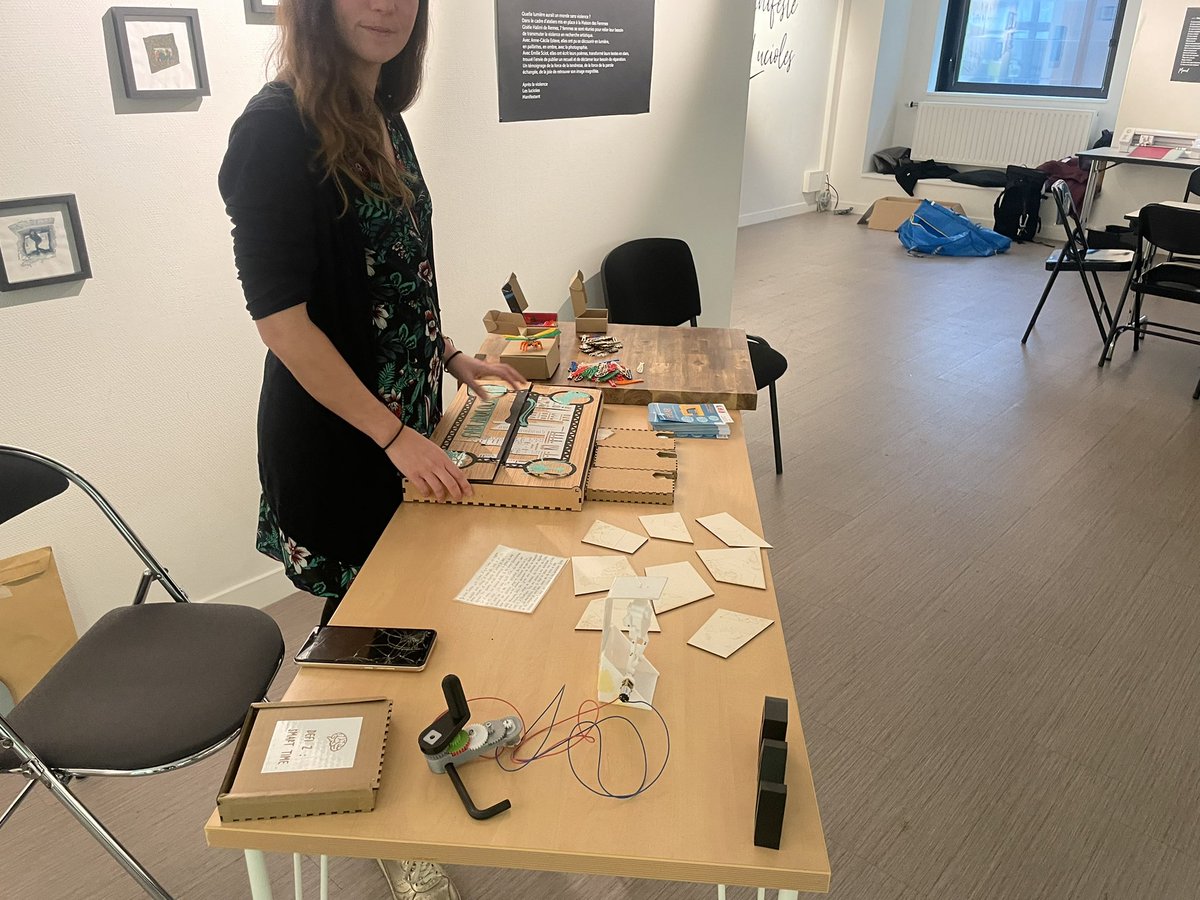
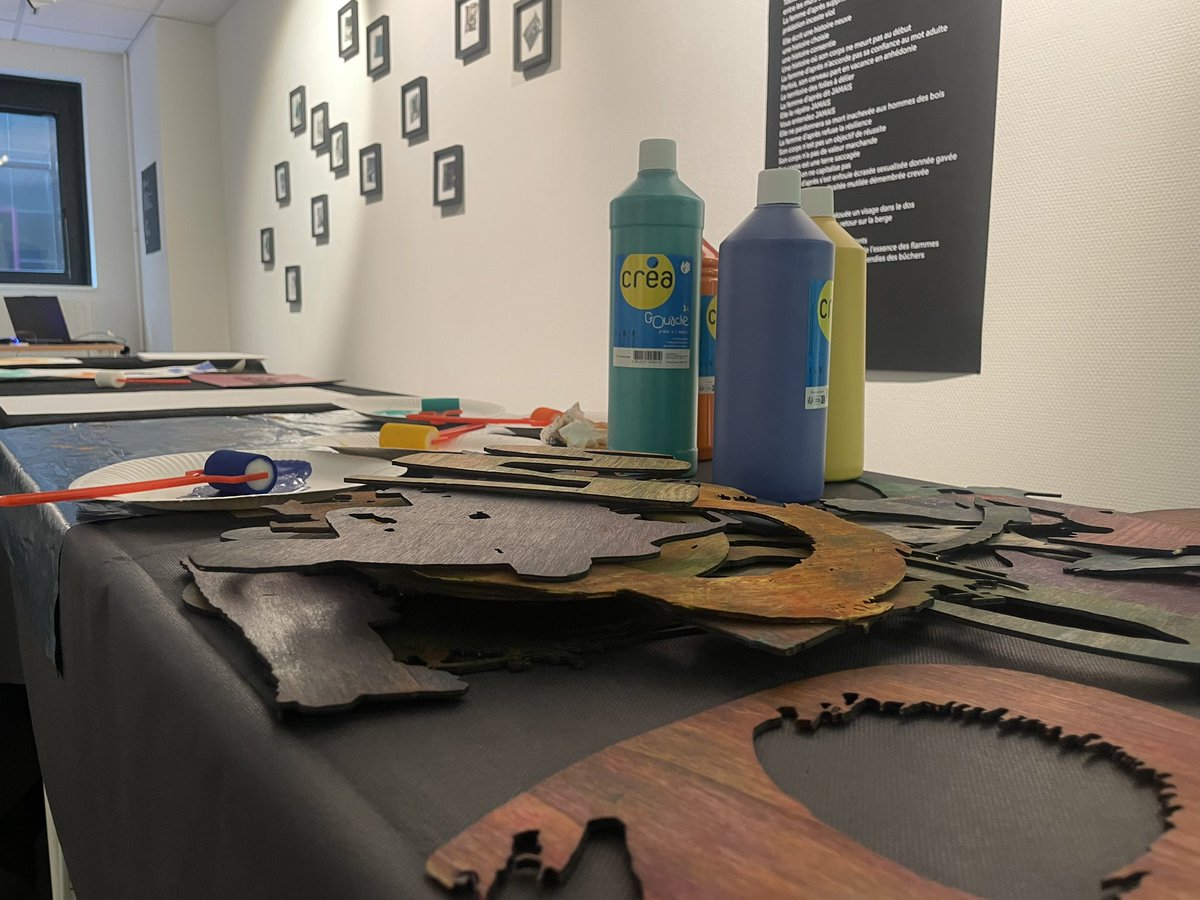
Ateliers créatifs dans la salle d’exposition @MDARennes avec @BerengereAmiot, Camille du Teaching Lab de @RennesUniv et Célia du LabFab des Beaux Arts jusqu’à 19H. Faites-le vous mêmes!!!

3
3
387

12 Dec 2024
ARAXÁ, MG 🇧🇷
A empresa australiana St George Mining Ltd anunciou a assinatura de dois Memorandos de Entendimento com o SENAI, instituição brasileira de pesquisa, visando colaboração em oportunidades de desenvolvimento downstream relacionadas ao projeto Araxá, no estado de Minas Gerais.
A empresa está próxima de concluir a aquisição do projeto, com o fechamento do acordo previsto para o primeiro trimestre de 2025. O projeto Araxá apresenta mineração em larga escala de nióbio e terras raras, com teores de até 8% de Nb2O5 e 33% de TREO. Um anúncio sobre a abertura de negociações foi feita pelo Secretário de Desenvolvimento Econômico do governo Romeu Zema no final de outubro.
O primeiro memorando estabelece uma parceria para a produção de ímãs de terras raras na futura instalação do SENAI no Laboratório de Produção de Ímãs de Terras Raras (LabFab ITR) de Lagoa Santa, também em Minas Gerais.
Essa será a primeira fábrica de ímãs permanentes do Brasil e da América Latina, com início de produção previsto para o final de 2024. A planta começará com uma capacidade anual de 100 toneladas de ímãs de alto desempenho, que deve dobrar nos três primeiros anos de operação.
Já o segundo acordo tem como objetivo desenvolver métodos sustentáveis para o processamento de nióbio e terras raras.
John Prineas, presidente executivo da St George, destacou que os acordos representam uma base sólida para o futuro do projeto Araxá. "Estamos construindo uma plataforma robusta para impulsionar o desenvolvimento do projeto e estabelecer uma operação de mineração bem-sucedida", afirmou.
Segundo ele, a parceria com o SENAI reforça a integração da operação de Araxá às cadeias de suprimento de metais críticos no Brasil. "O SENAI é a principal instituição de pesquisa científica do país e tem um histórico notável de colaboração com o setor privado por meio de tecnologia inovadora", concluiu.
(via Business News e Estado de Minas)
7
16
2,348

À Montréal dans les labfab on fabrique des machines pou tricoter des « bas »
2
179