

18 Jul 2025
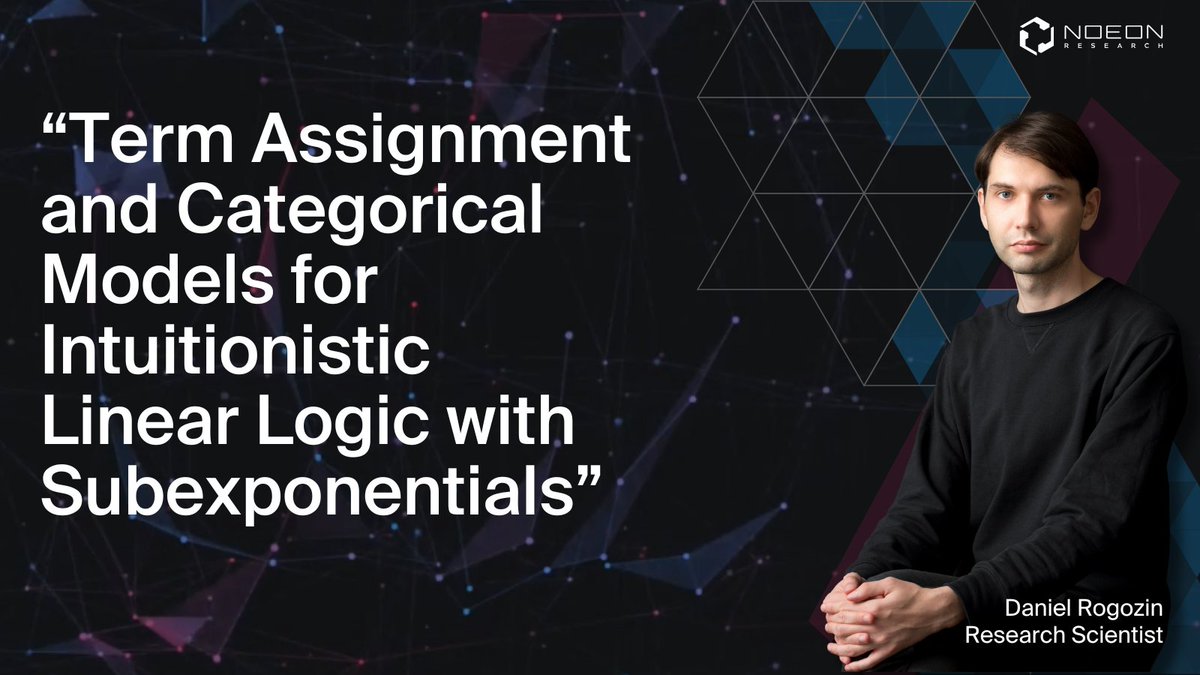
Our Research Scientist, Daniel Rogozin, has published a new paper: "Term Assignment and Categorical Models for Intuitionistic Linear Logic with Subexponentials".
This work represents a significant step toward developing next-generation knowledge representation languages that could transform how intelligent systems process information.
Read it on ArXiv: arxiv.org/abs/2507.12360
#TypeTheory #CategoryTheory #KnowledgeRepresentation #TheoreticalComputerScience #ProofTheory #LinearTypes
4
272

30 Apr 2025
Have you heard of @yolc_dev?
I am presenting it at @EthPrague & @EthCC , and @LambdaDays (not a crypto conference) this year.
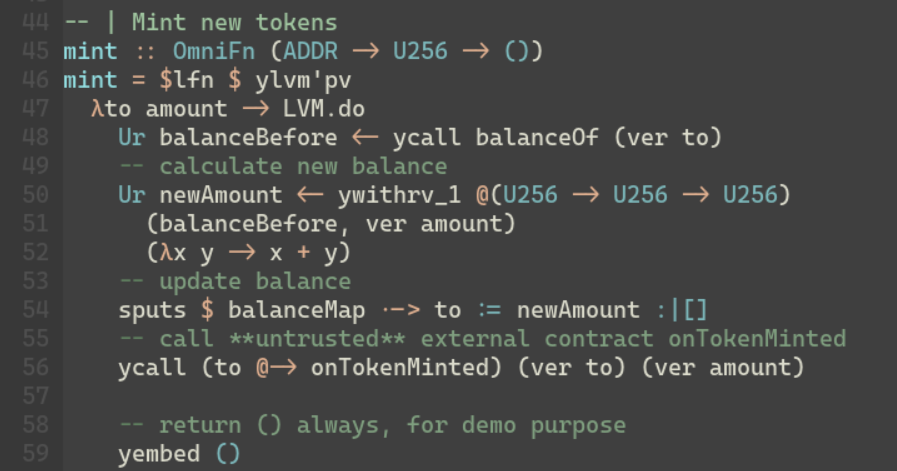
It deep embeds a language in Haskell, so all the advanced type system is available to the language:
- It has algebraic data types, hence "pattern matching" for free.
- It has parametric polymorphism, hence "generics" for free.
- It uses LinearTypes to provide "data freshness" check in compile time, no more reentrancy issues or similar linear-time temporal logic errors.
- It will have all the functional programming goodies versy soon: Functor, Applicative, Traversable, lenses, etc.
- Honestly, I can show off many more stuff in this language, but it's all because I use other well-engineered technologies.
Most importantly, it works end-to-end and is integrated with Foundry. It is in technical preview, I am bridging the gaps of features every day, and I am busy packaging and preparing it for the upcoming conferences.
4
7
473
27 Apr 2025
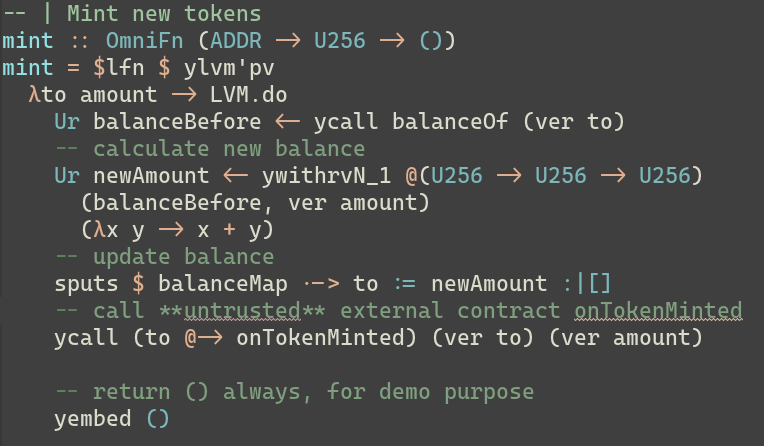
This is probably the only genuine innovation I have for Yolc: encoding "Linear-time Temporal Logic" using LinearTypes.
I am building everything else on top of existing technology and toolings: True power of composition.
27 Apr 2025

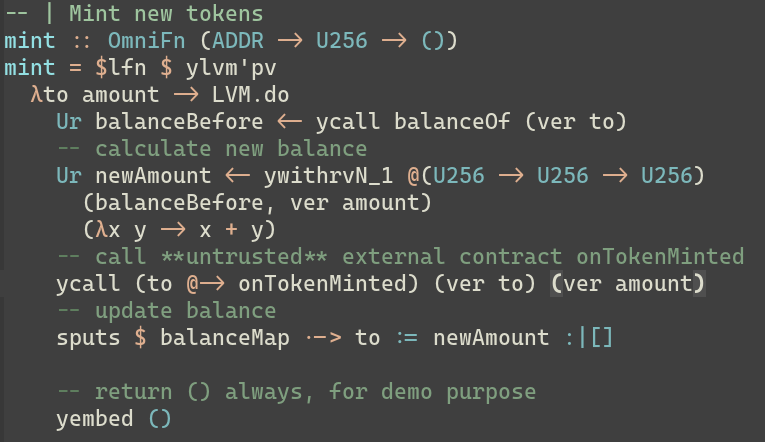
It is a TYPE ERROR to use the newAmount calculated from balanceBefore, after calling the untrusted external contract.
This is the power of LinearTypes used for Linear Temporal Logic (LTL) in action.
This is just beginning!

3
92

4 Jan 2025
Except 90% of these LANGUAGE pragmas have been around since before the dawn of time, and at the risk of being contrarian, maintaining a sliding window of compiler support is actually not a lot of work if you pay for it as you go, but is nightmarish if you try (and half the time fail) to do one big migration every 2-3 years.
That said, within an organization I'm generally on board with blessing a compiler version, and putting the upgrade effort squarely on the shoulders of the part of the team that wants to drag the organization foward to a new one, as long as the current blessed compiler isn't sliding out of support!
Often the "shiny new extensions" you seem to be railing at here are the dividing line that makes something doable or not doable at all as a library.
You should be able to have the discussion about if that shiny new thing serves as a business purpose, but I don't think saying that _no risk is acceptable_ is a terribly forward thinking policy.
Risk seems like the kind of thing that grown up developers should be able to have a discussion about, rather than saying such and such extension be it LinearTypes or whatever, is forbidden because daddy knows best, and because 4 years ago when you locked down your compiler it wasn't ready. Risk is something that can be tracked and budgeted for like anything else. There's potentially disproportionate benefit to getting out ahead of the curve, but it has to be weighed.
I just don't think all that weight lies on one side of the scale, and research and production have different tolerances here as well.
If what you're saying is more of a "disagree and commit" you revisit periodically as the situation changes, I think you'd find a lot less pushback, but a zero appeals process is basically a great way to get folks to become disgruntled and leave.
You don't stave off all those tensions, you're just bottling them up and ensuring they'll blow off in directions you don't expect at times outside of your control, taking out developers and institutional knowledge when they do inevitably go off.
2
1
17
637

4 Nov 2024
I was mostly trying to grasp the concepts. The syntax is mechanical and learned through practice.
I had 8 years of experience with Haskell, which made many things easier to understand. Besides, Haskell has LinearTypes which are similar to borrow checker, so this helped too.
And I used to code in C a lot back at uni, so things like pointers were no strangers.
1
4
854


11 May 2024
The GHC developers are very pleased to announce the release of GHC 9.10.1! 🎉
discourse.haskell.org/t/ghc-…
#Haskell #FunctionalProgramming #LinearTypes #DependentTypes
1
22
65
5,401

9 May 2024
ViewPatterns
LambdaCase
ApplicativeDo
DataKinds
ImplicitParams
ScopedTypeVariables
LinearTypes
AllowAmbiguousTypes
ViewPatterns
9 May 2024

Challenge: name a language for each letter of your name:
K
ALGOL
T
E
3
28
1,733

5 Apr 2024
Exciting updates coming in GHC 9.10: The GHC2024 language edition support; Visible forall in types of terms, and types in terms available; Extension of LinearTypes (linear lets); JavaScript FFI support in WebAssembly backend; and much, much more! discourse.haskell.org/t/ghc-…
9
40
3,252
Haskell は Rust になれるのか?──2023年の Linear Haskell 体験記zenn.dev/konn/articles/2023-… #zenn
GHCのLinearTypes拡張でLinear Haskellをがっつり使ってみた経験を基にLinear Haskellはこんな感じだよ、Rustになれるかな?という記事を1日半かけて書いたら5万字になりました。ご笑覧ください。
2
77
201
27,928

In our latest video, we explore linear types and how they are implemented in Haskell. We give some theoretical background on linear types, look at the LinearTypes extension, and list some of the perks that linear types can bring to the table.
Watch now: youtube.com/watch?v=FqDHSIpW…

4
37
4,949

25 Feb 2023
What started as a day optimizing Eclair, ended in upgrading to text 2.0 and LinearTypes with text-builder-linear package🥴
1
8
580

13 Jan 2023
マイナーですし割と最近の修正なのでどれほど普及したかも不確かですが、GHCのRecordDotSyntax zenn.dev/mod_poppo/articles/… とかLinearTypes ghc.gitlab.haskell.org/ghc/d… は界隈では結構大きな変更ですねぇ。
1
3
4
2,056

初歩的な、Haskellの線形型の使い方と有用性。
わかりやすい!
まずはこれを見てみて。 "HaskellのLinearTypes言語拡張について少し調べた" via @techfeedapp #techfeed techfeed.io/e?id=602795e6d1e…
1
3
501


4 Aug 2022
Linear/affine type aren't exclusive to procedural languages, even Haskell has a LinearTypes extension for quite a while. There wouldn't be much benefit without converting a large part of base to linear typing though.
ghc.gitlab.haskell.org/ghc/d…
1
3

29 Jun 2022
From top of my head:
🔰DerivingVia
🔰LinearTypes
🔰Backpack
🔰Cabal Nix-style builds
🔰DerivingStrategies
🔰New GC algorithm
🔰GHC2021
🔰OverloadedRecordDot
🔰Simplified subsumption
🔰QuantifiedConstraints
🔰QualifiedDo
🔰BlockArguments
🔰UnboxedSums
🔰UnliftedDataTypes
2
8