
loadbalancer on my github was my capstone project and i have only used codex with it. i wanted to try to bring more visibility to whats happening
9

Kubernetes v1.36 removes Service ExternalIPs entirely.
If you're still routing external traffic this way:
→ Audit your Services now
→ Migrate to LoadBalancer or NodePort
Quiet removals like this cause more incidents than major API changes.
2
79

Jun 12
90% of Kubernetes interviews in 2026 come down to these 7 points. Can you explain them without buzzwords?
1. Pod vs Deployment vs StatefulSet: when you need stable identity, volumes, rollouts, and why
2. Services DNS: ClusterIP vs Headless vs LoadBalancer, and how traffic actually reaches a pod
3. Requests/limits: scheduling vs throttling vs OOMKilled, and how you size for spiky workloads
4. Probes: startup vs readiness vs liveness, and what breaks during deploys if you misuse them
5. Config secrets: env vs volumes, reload patterns, and what not to put in etcd
6. Ingress gateways: TLS termination, path routing, timeouts, and where mTLS usually lives
7. Debugging: kubectl logs/exec/describe/events, ephemeral containers, and reading why a pod is Pending or CrashLoopBackOff
1
6
43
2,128


Jun 12
Atleast I was being honest.
I worked in Azure TrafficManager service in Microsoft which is a L7 loadbalancer.
Upto you if you think it's valuable or not. Thanks.
1
97

Jun 12
21-Why Kubernetes Needs ClusterIP, NodePort & LoadBalancers (Office Buil... youtu.be/KsGEQtz9L8A?is=PwIe… via @YouTube
New video explains Kubernetes ClusterIP, NodePort, and LoadBalancer with a completely new perspective.
Don’t memorize definitions and YAML files.
1
65

Jun 12
nossa, nunca parei pra pensar nisso e vc tem razão...
precisei usar um NLB do EKS com service e LoadBalancer pra expor um nginx com mTLS... e ele pediu porta pra fazer o forwarding, que é da L4...
deveria ser Transport Load Balancer pela lógicakkkk
1
13

Jun 11
Thank you for helping me discover what a real loadbalancer should be able to do! 🙌
494

Jun 11
Most people start learning Kubernetes the wrong way.
They see Kubernetes as a list of concepts. Pods. Deployments. Services. Ingress. They memorize them without understanding why they exist.
>> You start with a Pod.
- A pod runs your container. Simple. Clean. Done.
- Until it crashes.
- Nobody restarts it. It is just gone.
In production, that is not acceptable.
>> So you use a Deployment.
- A Deployment watches your pods.
- One dies, and it creates another.
- You want 3 running, it keeps 3 running.
- You want to scale to 10; one command does it.
Pods were too fragile for production.
Deployments fixed that.
>> But now you have a new problem.
- Every pod gets a new IP when it restarts.
- You have 3 pods running your app.
- Another service needs to talk to them.
- Which IP do you use? They keep changing.
- You cannot hardcode them.
- You cannot track them at scale.
>> So you use a Service.
- A Service gives your app one stable IP address.
- It finds your pods using labels, not IPs.
- Pods die and come back with new IPs.
- The Service does not care.
- It always finds them.
- It also load balances.
- Traffic coming in gets distributed across all healthy pods automatically.
Pods had unstable IPs. Services fixed that.
>> But your app still needs to be accessible from the internet.
- So you use a LoadBalancer Service.
- This creates a real cloud load balancer.
- AWS ALB. Azure LB. GCP LB.
- Your app gets a public endpoint.
- Works perfectly. Until you have 10 services.
- Now you have 10 load balancers.
- Each one costs money every single month.
- Your cloud bill does not care that 6 of them handle almost no traffic.
LoadBalancer Services solved external access. But one per service does not scale.
>> So you use Ingress.
- One load balancer. All your services behind it.
- Ingress routes traffic based on rules.
- Request comes in for /api, goes to the API service.
- Request comes in for /dashboard, goes to the frontend service.
-One entry point. Smart routing. One cloud load balancer on your bill.
But Ingress is just a set of rules. Something has to execute those rules.
>> So you use an Ingress Controller.
- Nginx. Traefik. AWS Load Balancer Controller.
- These are the actual engines that read your Ingress rules and make the routing happen.
- Ingress without a controller is just a config file nobody reads.
To summarize it:
> Pod ran your app but had no resilience.
> Deployment gave it resilience.
> Service gave it a stable address and load balancing.
> LoadBalancer Service gave it external access.
> Ingress replaced 10 load balancers with one.
> Ingress Controller made the rules actually work.
Each concept exists because the previous one was not enough.
7
10
63
3,545

Jun 11
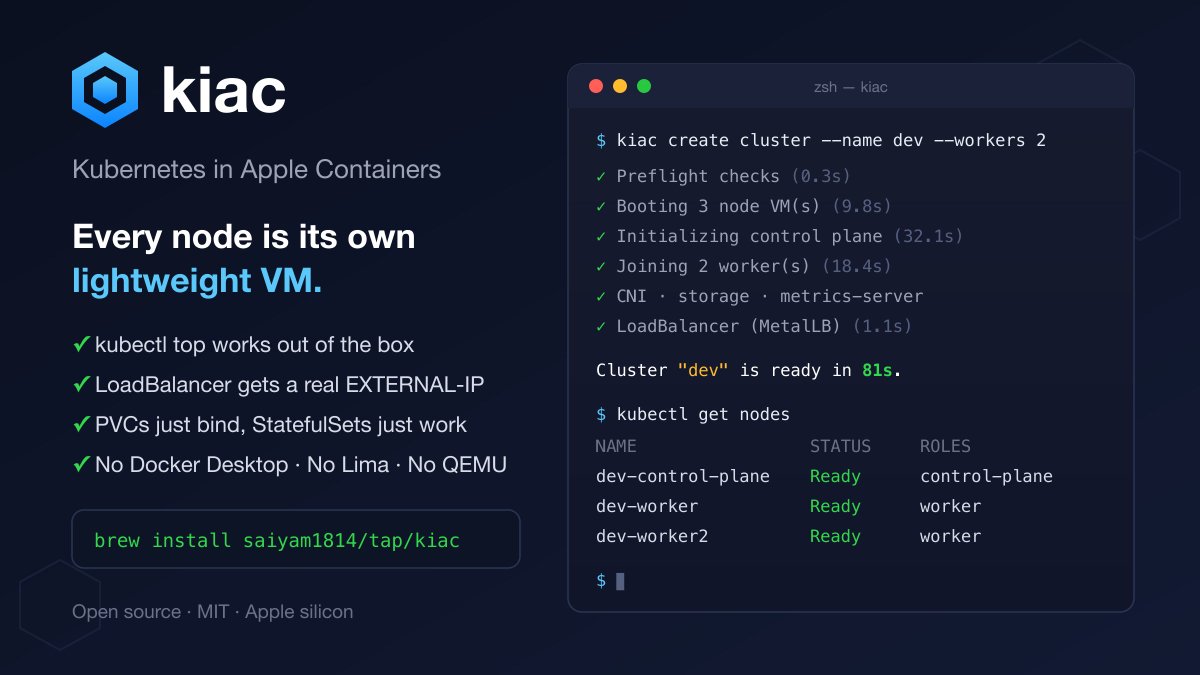
🚨 Introducing kiac(Kubernetes in apple containers)
I just moved to apple containers for my kubernetes clusters.
With apple containers 1.0, each container boots as its own lightweight VM. So I built kiac on top of it, why not?
- every node = a real VM with its own kernel
- kubectl top works out of the box
- type: LoadBalancer gets a real EXTERNAL-IP
- PVCs just bind
- no Docker, no Lima, no QEMU
Command: brew install saiyam1814/tap/kiac
Do try, give a star and show some love by sharing :) issues/contributions are welcome.
14
12
95
8,723

Mallik retweeted

Jun 10
In AWS EKS, a Kubernetes Service of type LoadBalancer will create NLB or ALB ?
6
2
28
10,133

Jun 10
But he mentioned specifically 'Service of type LoadBalancer' which only creates NLB
1
10

Jun 10
EKS Service of type LoadBalancer → NLB
EKS Ingress (via AWS Load Balancer Controller) → ALB.
1
7
533

Jun 10
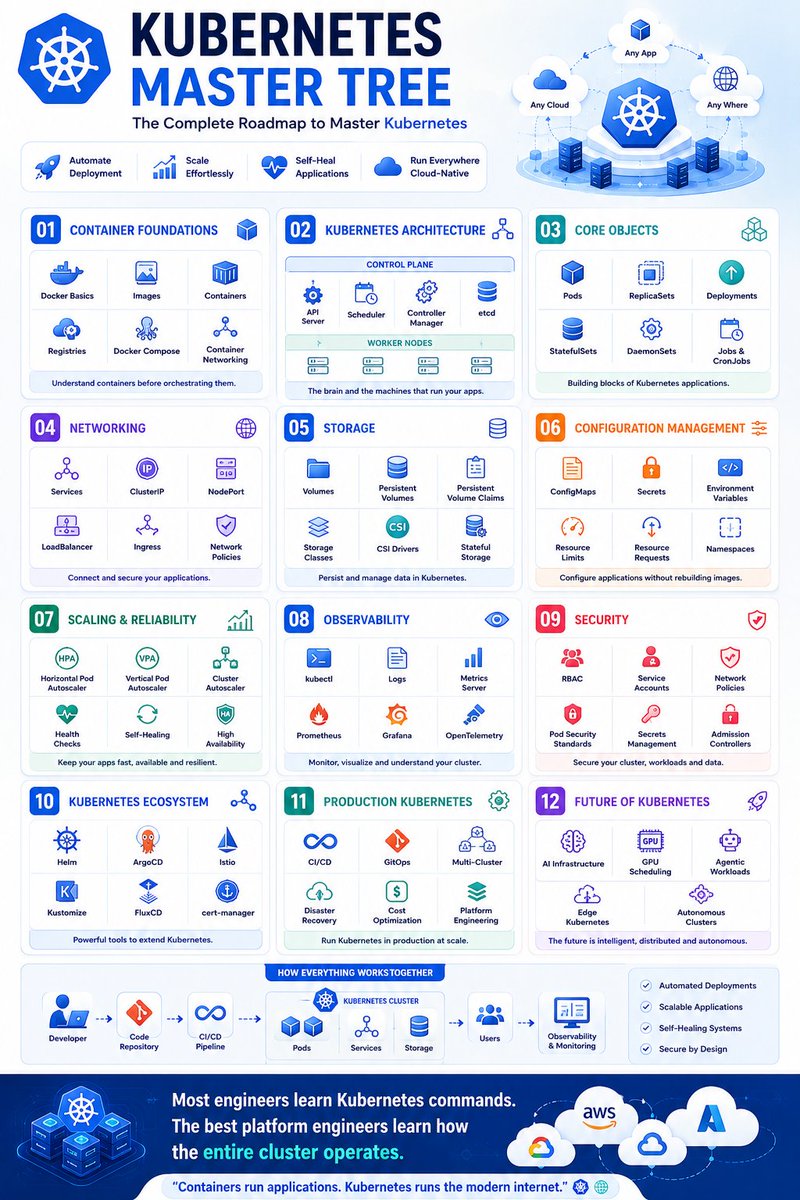
KUBERNETES — MASTER TREE ☸️
Kubernetes
│
├── 01. Container Foundations
│ ├── Docker Basics
│ ├── Images
│ ├── Containers
│ ├── Registries
│ ├── Docker Compose
│ └── Container Networking
│
├── 02. Kubernetes Architecture
│ ├── Control Plane
│ ├── API Server
│ ├── Scheduler
│ ├── Controller Manager
│ ├── etcd
│ └── Worker Nodes
│
├── 03. Core Objects
│ ├── Pods
│ ├── ReplicaSets
│ ├── Deployments
│ ├── StatefulSets
│ ├── DaemonSets
│ └── Jobs & CronJobs
│
├── 04. Networking
│ ├── Services
│ ├── ClusterIP
│ ├── NodePort
│ ├── LoadBalancer
│ ├── Ingress
│ └── Network Policies
│
├── 05. Storage
│ ├── Volumes
│ ├── Persistent Volumes
│ ├── Persistent Volume Claims
│ ├── Storage Classes
│ ├── CSI Drivers
│ └── Stateful Storage
│
├── 06. Configuration Management
│ ├── ConfigMaps
│ ├── Secrets
│ ├── Environment Variables
│ ├── Resource Limits
│ ├── Resource Requests
│ └── Namespaces
│
├── 07. Scaling & Reliability
│ ├── Horizontal Pod Autoscaler
│ ├── Vertical Pod Autoscaler
│ ├── Cluster Autoscaler
│ ├── Health Checks
│ ├── Self-Healing
│ └── High Availability
│
├── 08. Observability
│ ├── kubectl
│ ├── Logs
│ ├── Metrics Server
│ ├── Prometheus
│ ├── Grafana
│ └── OpenTelemetry
│
├── 09. Security
│ ├── RBAC
│ ├── Service Accounts
│ ├── Network Policies
│ ├── Pod Security Standards
│ ├── Secrets Management
│ └── Admission Controllers
│
├── 10. Kubernetes Ecosystem
│ ├── Helm
│ ├── ArgoCD
│ ├── Istio
│ ├── Kustomize
│ ├── FluxCD
│ └── cert-manager
│
├── 11. Production Kubernetes
│ ├── CI/CD
│ ├── GitOps
│ ├── Multi-Cluster
│ ├── Disaster Recovery
│ ├── Cost Optimization
│ └── Platform Engineering
│
└── 12. Future of Kubernetes
├── AI Infrastructure
├── GPU Scheduling
├── Agentic Workloads
├── Edge Kubernetes
└── Autonomous Clusters
Most engineers learn Kubernetes commands.
The best platform engineers learn how the entire cluster operates. ☸️🚀
2
2
127

Jun 10
KUBERNETES — MASTER TREE ☸️
Kubernetes
│
├── 01. Container Foundations
│ ├── Docker Basics
│ ├── Images
│ ├── Containers
│ ├── Registries
│ ├── Docker Compose
│ └── Container Networking
│
├── 02. Kubernetes Architecture
│ ├── Control Plane
│ ├── API Server
│ ├── Scheduler
│ ├── Controller Manager
│ ├── etcd
│ └── Worker Nodes
│
├── 03. Core Objects
│ ├── Pods
│ ├── ReplicaSets
│ ├── Deployments
│ ├── StatefulSets
│ ├── DaemonSets
│ └── Jobs & CronJobs
│
├── 04. Networking
│ ├── Services
│ ├── ClusterIP
│ ├── NodePort
│ ├── LoadBalancer
│ ├── Ingress
│ └── Network Policies
│
├── 05. Storage
│ ├── Volumes
│ ├── Persistent Volumes
│ ├── Persistent Volume Claims
│ ├── Storage Classes
│ ├── CSI Drivers
│ └── Stateful Storage
│
├── 06. Configuration Management
│ ├── ConfigMaps
│ ├── Secrets
│ ├── Environment Variables
│ ├── Resource Limits
│ ├── Resource Requests
│ └── Namespaces
│
├── 07. Scaling & Reliability
│ ├── Horizontal Pod Autoscaler
│ ├── Vertical Pod Autoscaler
│ ├── Cluster Autoscaler
│ ├── Health Checks
│ ├── Self-Healing
│ └── High Availability
│
├── 08. Observability
│ ├── kubectl
│ ├── Logs
│ ├── Metrics Server
│ ├── Prometheus
│ ├── Grafana
│ └── OpenTelemetry
│
├── 09. Security
│ ├── RBAC
│ ├── Service Accounts
│ ├── Network Policies
│ ├── Pod Security Standards
│ ├── Secrets Management
│ └── Admission Controllers
│
├── 10. Kubernetes Ecosystem
│ ├── Helm
│ ├── ArgoCD
│ ├── Istio
│ ├── Kustomize
│ ├── FluxCD
│ └── cert-manager
│
├── 11. Production Kubernetes
│ ├── CI/CD
│ ├── GitOps
│ ├── Multi-Cluster
│ ├── Disaster Recovery
│ ├── Cost Optimization
│ └── Platform Engineering
│
└── 12. Future of Kubernetes
├── AI Infrastructure
├── GPU Scheduling
├── Agentic Workloads
├── Edge Kubernetes
└── Autonomous Clusters
Most engineers learn Kubernetes commands.
The best platform engineers learn how the entire cluster operates. ☸️🚀
2
42
178
5,620

of een loadbalancer kwestie. Geen idee. Geen tijd om uit te zoeken :-P
54
Maryam | Cloud Engineer retweeted

K8s network vocabulary:
ClusterIP → internal service IP
NodePort → expose on node's IP
LoadBalancer → external load balancer
Ingress → manage external HTTP access
DNS → service discovery by name
CNI → container network interface plugin
1
1
71