
⎐كُـود⎐كوبِون⎐خـِصم⎐
⎐نون⎐
⊵CBB54⊴
⎐درعه⎐
⊵Bf78⊴
⎐سنبل⎐
D46⊴
⎐تُيموُ⎐
⊵tea37⊴
⎐نمشي⎐
⊵BLK13⊴
⎐باث▬اند▬بودي⎐
Af8p⊴
⎐مفارش▬الحبيب⎐
⊵sm29⊴
⎐بلومنغديلز▬بلومينغديلز⎐
⊵d15⊴
___
can
MYmD
1


Esse desgraçado já matou uma menina, mas como é rico e envolvido com a máfia da mymd 8, a polícia corrupta do Br " concluiu" que a culpa foi da vítima
5
220

Mar 6
QCLS presents a case study in the micro-cap "narrative arbitrage" business model: a perpetually pre-revenue entity that sustains itself by iterating through investment themes, raising capital against each narrative cycle, and diluting shareholders who fail to exit before the narrative expires.
The company's trajectory follows a clear pattern. Akers Biosciences (diagnostics) failed to commercialize, merged with MyMD Pharmaceuticals (pharma), renamed to TNF Pharmaceuticals (narrower pharma focus), and most recently became Q/C Technologies (quantum computing). Each pivot was accompanied by a capital raise, a ticker change, fresh press releases, and a new set of retail investors drawn by the latest narrative. The fundamental reality -- zero revenue, 2 employees, chronic cash burn -- remained unchanged through every iteration.
The September 2025 quantum computing pivot introduced a genuinely interesting technology partner (LightSolver, with legitimate WEF and EU credentials) but layered it through a related-party acquisition where the CEO was among the sellers. The resulting $14.1M Technology License asset -- now the largest item on the balance sheet after goodwill -- was created through insider transactions, not arms-length technology development.
The December 2025 appointment of Martin Shkreli as Strategic Advisor and his wife Chelsea Voss (OpenAI) to the board created a potent retail narrative catalyst. Shkreli's $100 price target, published on X and his Substack, generated an 1,100% intraday move (from ~$4 to $44) before the stock collapsed back. This spike served its purpose: it demonstrated that retail demand could temporarily absorb equity issuance at elevated prices, extending the company's dilutive financing model.
The strategic incoherence (no real business, serial pivots, insider self-dealing) creates the conditions for the dilution spiral (no revenue to fund operations, requiring perpetual equity issuance). The anti-dilution ratchets on preferred stock and the $100M shelf offering make the spiral self-accelerating.
The pharma pipeline (Isomyosamine), ironically, may be the most real asset the company has ever held. Phase 2a data showing statistically significant biomarker reductions in a first-in-class oral TNF-alpha inhibitor had genuine scientific merit. But the Phase 2b trial was suspended, the company is seeking divestiture, and the asset is being abandoned to fund the quantum computing narrative. The GLP-1-induced sarcopenia angle -- potentially connecting QCLS's drug to the hottest therapeutic market in the world -- will likely be captured by a future acquirer at a fraction of its potential value, if it is captured at all.
For existing shareholders, the expected outcome is continued dilution until the share count renders existing positions negligible, followed by another reverse split, followed by more dilution -- the pattern that has already destroyed 99.99% of pre-split shareholder value.
3
190

6 Dec 2025
So I have this theory about @MartinShkreli: After getting absolutely torched on his $CAPR short—where he called it a total bust but the stock rocketed on positive Phase 3 data, forcing him to eat crow and apologize—he pivots straight to pumping this obscure nano-cap called $QCLS (Q/C Technologies).
We're talking a company that was straight-up pharma (formerly TNF Pharmaceuticals, and before that MyMD Pharmaceuticals) until it rebranded to "quantum/photonic tech" in September 2025. Barely any operations: just 2 employees listed in filings, no real website, and if you punch their old Baltimore address (855 N. Wolfe Street) into Google Earth, it looks like some nondescript spot that could pass for the front of a train station or a mailbox drop. Now they're supposedly pioneering "quantum class" optical computing to outpace GPUs and quantum hype?
Shkreli buys in, slaps a $100 near-term target on it (lol, from like $3-4), and even says he'd CEO if Trump lets him. Classic pump setup after a big L, using wild claims to dump on retail. This kinda market manipulation should be illegal, but hey, Pharma Bro's no stranger to shady antics or SEC run-ins. Thoughts? 🚀📉 #StockScams #Shkreli $CAPR $QCLS
1
7
782

24 Sep 2025
I’ve followed this company for some time. They rebranded from MYMD to TNFA a few years ago and currently have two promising pharmaceutical products in development. The challenge is that the management team lacks direct experience in the quantum sector, which likely means they are leaning on PharmaCyte Biotech for strategic guidance. On the financial side, they are well-capitalized, with more than $20 million in assets. Technically, the key resistance level sits at $10.00, the same area where the company previously issued 150 million preferred shares under a ratchet-down clause prior to the reverse split.
1
2
221

24 Sep 2025
WKKKKKK masa udh dibenci kmd mau dibenci mymd juga, di sk aja wkt itu pada pura2 jadi org malay, kl di malay nya mau pura2 jd org mana😭😭 they our sisters bet they can recognize bentukan kt

1
4
426



27 Aug 2025
$TNFA Soars pre-market! 🚀 FDA fast-tracks MYMD-1 for sarcopenia. Renova AI deal sparks rally! #TNFA #Pharma #AI
Get the published purchase price and detailed analysis for free.
👉 tinyurl.com/qttxd33

1
2
108

27 Aug 2025
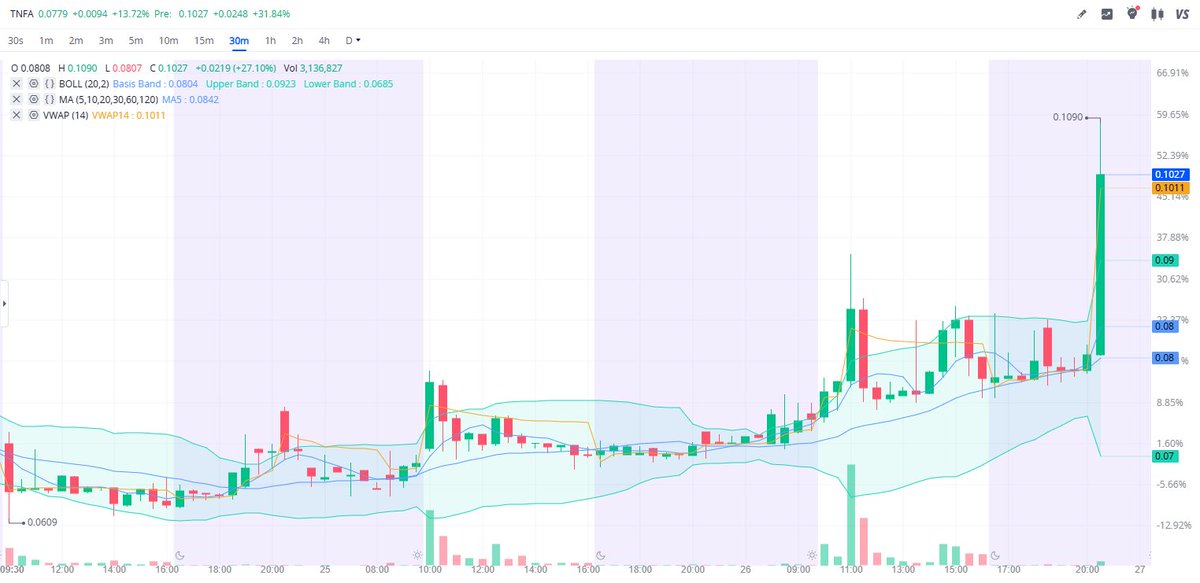
$TNFA Soars pre-market! 🚀 FDA fast-tracks MYMD-1 for sarcopenia. Renova AI deal sparks rally! #TNFA #Pharma #AI
Get the published purchase price and detailed analysis for free.
👉 tinyurl.com/qttxd33
1
2
100

21 Aug 2025
If I clean one more bathroom, I’m moving out, but myMD has more bathrooms . Haha it has one advantage, no one comes to visit us there.
2
215

18 Aug 2025
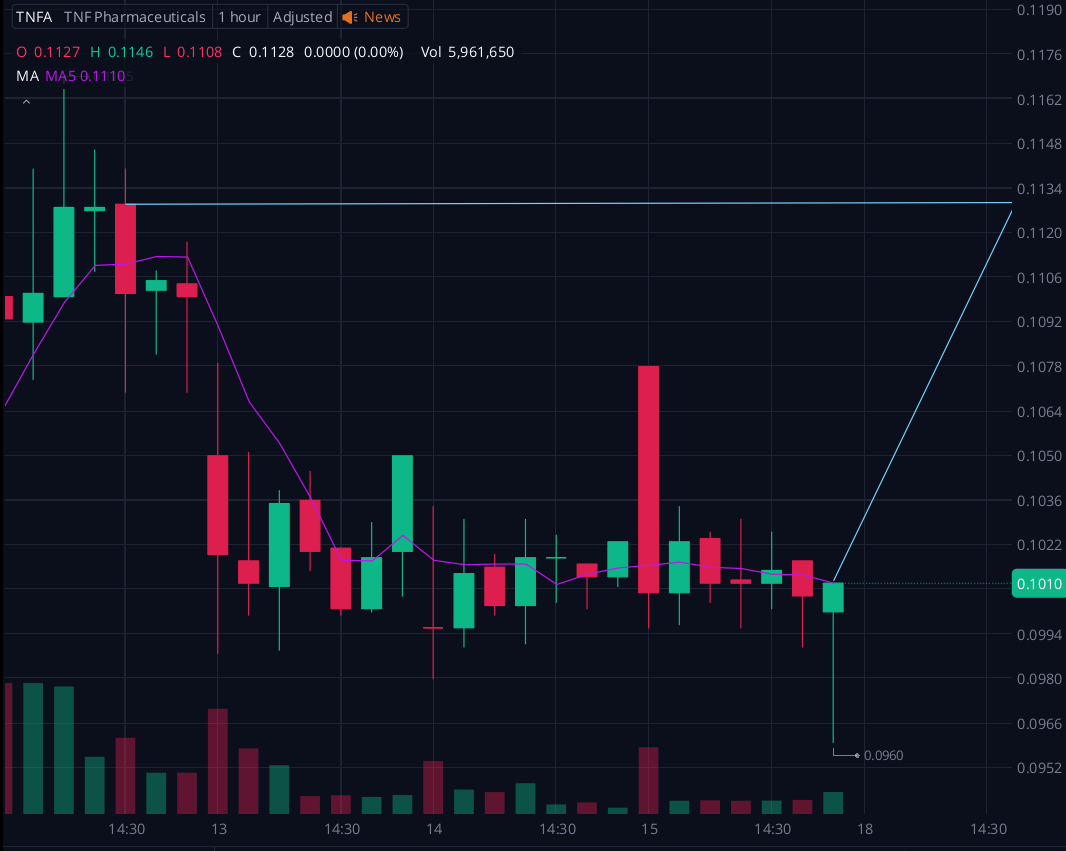
$TNFA focuses on oral TNF-α inhibitors like MYMD-1, advancing in sarcopenia/frailty trials with a scalable platform and high-growth market potential.
2
208

16 Aug 2025
$TNFA This is what keeps TNFA on the alert radar. 👀 “If approved, MYMD-1® has the potential to be the first drug approved by FDA for the sarcopenia..." And with trial updates coming soon this could be one of the best plays available, especially with a tiny float and high si.😍❤️
1
2
15
1,095

16 Aug 2025
$tnfa
From their website
"The company is now planning to initiate Phase 3 trials. If approved, MYMD-1® has the potential to be the first drug approved by FDA for the sarcopenia..."
6
6
29
4,557
5 Aug 2025
From the TNFA website it says the study for MYMD-1 has demonstrated the potential to slow the aging process & extend healthy lifespan. The product is being evaluated in Phase 2 studies. A PR stating progress for an anti-aging drug could give TNFA a breakthrough we're looking for.
2
145

5 Aug 2025
🚨 $TNFA - more manipulation by mm's on this one today. Waiting for a consistent move north!
🎯 2 drugs in Clinical Trails - (one in Phase II B Clinical Trials)
🎯 14.17 million float
🎯 Stock has traded around to 2 BILLION shares in the last month of trading, but the float is only 14 million???
🎯 Warrant package at $.364 that expires soon gives access to 118 million warrants - Warrants Act Like a Magnet - Financiers holding warrants don’t want to exercise at $0.364 and immediately sell for less. But if the stock runs to $0.50 , $0.75, or $1.00, exercising and selling becomes highly profitable — even with a large position.
Incentive = Create or support market conditions that allow for liquidity above $0.364.
🎯 Public float is ~14.17 million shares, very small relative to warrant coverage.
With that kind of structure, it takes relatively modest capital and volume to start a move. Retail attention small float existing high volume (27M avg daily) makes TNFA an ideal short-term setup for financiers to “run the tape.”
Could we see $TNFA go from $.10 - $1.00 ?
Answer: If positive Phase 2b data for MYMD‑1 drops in Q3/Q4 2025:
🌟Stock gets a legitimate biotech re-rate narrative
🌟Financiers can let retail buying or algorithmic momentum push the stock up above warrant strike
🌟 Exercise sell warrants = major return, especially for those who acquired them at low market levels, via preferred-share structures or early conversions.
5
4
19
3,622
5 Aug 2025
$TNFA Probability They Run It Above $0.364?
High — If any of the following occur:
✅ Strong clinical trial update (especially MYMD-1 Phase 2B data)
✅ New institutional partnership or FDA Fast Track style news
✅ Large options activity or insider buys ahead of September
✅ Signs of algo volume thinning, breakout candles on volume
Medium — if no trial update drops, but the float gets locked and social sentiment builds (e.g., via Reddit or FinTwit)
Low — if no catalyst, and market-makers prefer to let the warrants expire worthless to tighten future supply
This is not investment advice, do your own due diligence!
1
5
14
1,663
4 Aug 2025
$TNFA operates in the Healthcare sector, under the Medical – Drugs (Pharma/Biotech) industry.
As of July 11, 2025: float ~14.17 million shares (virtually entire shares outstanding) TNF Pharmaceuticals, Inc. 8Yahoo Finance 8TradingView 8.
Today (August 2025): still ~14.17 M (no major dilution since)
🚨 Since July 11th - TNFA has traded over 1.5 BILLION shares with a 14m share float - ⁉️HOW⁉️ - Again, over the last three weeks this stock has traded 1 and a half BILLION shares, but it has a 14 million share float. Hmmmmmm🧐... Now as a former long time stockbroker and trader, I'm really curious how this is possible lol?!?
MYMD‑1 (isomyosamine): in Phase 2b (randomized, placebo-controlled) for sarcopenia/frailty, enrolling early 2025 at University of Florida; also trials in GLP‑1–induced muscle loss pain/niche nichetnfpharma.com 5 biospace.com 5trial.medpath.com 5.
Supera‑CBD: pre-clinical / IND-enabling for epilepsy, chronic pain, addiction/anxiety, aiming toward Phase I submission - MYMD‑1 success in sarcopenia and GLP‑1 muscle-loss indications (multibillion-dollar markets) could position $TNFA to cross $1.00/share, representing near 10 × from $.10 current.
With positive Supera-Combined, a plausible 5 - 10× move depends on data quality, market reaction, and dilution (for example from warrant exercise overhang).
$TNFA stands out with a real regulatory-backed Phase 2b program, transparent float, and a warrant overhang that - if exercised - could both fuel price action and a potential short squeeze!!
Risky trade, but for those who can stomach the risk this one is setup nicely! Do your own DD, this is not trading advice.
4
778
28 Jul 2025
No one’s talking about the warrant level potentially acting as a magnet. The split wasn’t delayed without a reason and likely signals an intention to raise capital. With MYMD-1 news, there’s a strong chance of overshooting that level.
4
6
462
22 Jul 2025
They need to exercise the warrants at $0.3640 to help fund the future development of MYMD-1. I believe there's sufficient data to support a speculative run that could push the stock beyond that level ahead of the reverse split. NFA
2
23