
16 Feb 2025
Harnessing large language models for data-scarce learning of polymer properties @NatComputSci
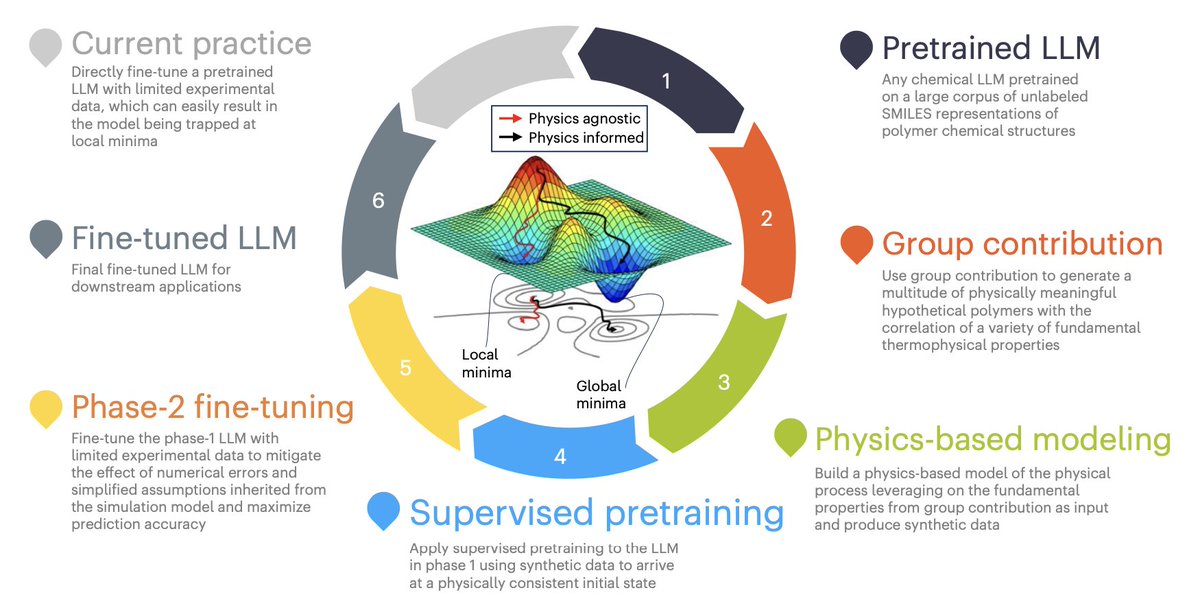
1/ This paper presents a new framework that combines physics-based modeling and large language models (LLMs) to predict polymer properties in data-scarce situations. The approach leverages synthetic data generated through physics models to effectively pretrain LLMs before fine-tuning them with limited experimental data.
2/ The two-phase training strategy starts with supervised pretraining using synthetic data that captures the physical behavior of polymers, such as flammability. This phase helps LLMs learn the underlying physical principles before transitioning to phase 2, where the model is fine-tuned with real-world experimental data.
3/ By incorporating physics-informed group contribution methods, the framework generates physically meaningful polymer data, even in the absence of large experimental datasets. This allows for the creation of synthetic polymers with associated thermophysical and pyrolysis properties, crucial for fire performance prediction.
4/ Results demonstrate that this hybrid model significantly enhances predictive accuracy, outperforming baseline LLMs by up to 50% in the prediction of key polymer properties like time to ignition and peak heat release rate, even when experimental data is limited.
5/ The framework also quantifies uncertainty in synthetic data generation, providing confidence intervals for predictions, which is vital for practical applications in material design and safety assessments, such as fire performance in polymeric materials.
6/ This approach shows promise for expanding the potential of LLMs in materials science, especially in situations where obtaining large-scale experimental data is not feasible. It opens new avenues for efficient polymer property prediction and optimization.
💻Code: github.com/ningliu-iga/Trini…
📜Paper: nature.com/articles/s43588-0…
#MaterialsScience #MachineLearning #PolymerProperties #AIinScience #PhysicsGuidedML #DataScarcity #PolymerDesign #MachineLearningForMaterials #FireSafety #MaterialPrediction
2
26
1,875
16 Feb 2025
Harnessing large language models for data-scarce learning of polymer properties @NatComputSci
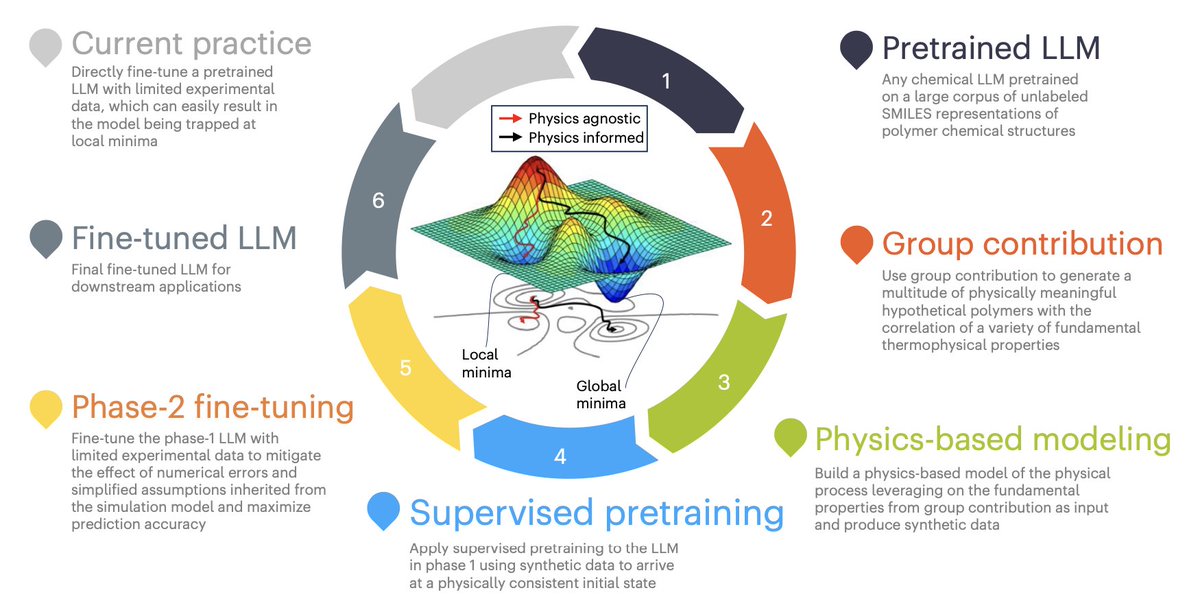
1/ This paper presents a new framework that combines physics-based modeling and large language models (LLMs) to predict polymer properties in data-scarce situations. The approach leverages synthetic data generated through physics models to effectively pretrain LLMs before fine-tuning them with limited experimental data.
2/ The two-phase training strategy starts with supervised pretraining using synthetic data that captures the physical behavior of polymers, such as flammability. This phase helps LLMs learn the underlying physical principles before transitioning to phase 2, where the model is fine-tuned with real-world experimental data.
3/ By incorporating physics-informed group contribution methods, the framework generates physically meaningful polymer data, even in the absence of large experimental datasets. This allows for the creation of synthetic polymers with associated thermophysical and pyrolysis properties, crucial for fire performance prediction.
4/ Results demonstrate that this hybrid model significantly enhances predictive accuracy, outperforming baseline LLMs by up to 50% in the prediction of key polymer properties like time to ignition and peak heat release rate, even when experimental data is limited.
5/ The framework also quantifies uncertainty in synthetic data generation, providing confidence intervals for predictions, which is vital for practical applications in material design and safety assessments, such as fire performance in polymeric materials.
6/ This approach shows promise for expanding the potential of LLMs in materials science, especially in situations where obtaining large-scale experimental data is not feasible. It opens new avenues for efficient polymer property prediction and optimization.
💻Code: github.com/ningliu-iga/Trini…
📜Paper: nature.com/articles/s43588-0…
#MaterialsScience #MachineLearning #PolymerProperties #AIinScience #PhysicsGuidedML #DataScarcity #PolymerDesign #MachineLearningForMaterials #FireSafety #MaterialPrediction
1
912

2 Dec 2019
Excited to present a talk on JARVIS-DFT topological materials database (#MaterialsforQuantumComputing MQ02.04.05) and to serve as a session-chair in the #MachineLearningforMaterials sessions (MT02.04) #F19MRS @Materials_MRS #jarvisnist

1