
Non-Hermitian Casimir effect of magnons: npj Spintronics has APC waivers available that can be allocated upon acceptance on an ad-hoc basis. For additional information, contact the Journal Publisher, Daniel Payne. lifeboat.com/blog/2026/06/no…
25
Craig anthony baker retweeted

@sepultura let the Cro-Magnons out 🤯🔥🔥🔥🔥🔥🔥🔥🔥🔥🔥🔥🔥🔥🔥🔥🔥🔥
#cromags #cromagslive #cromags2026
🔥🔥🔥🔥🔥🔥🔥🔥🔥🔥🔥🔥
@realharleyflanagan @blkiiblk #sepultura video @ladandmisfit 💥
1
5
78

"this explicitly creative expression of interest and enthusiasm is unimaginative." What the fuck are these cro-magnons on about.
1
2
22

Africans are not descendants of cro magnons. Cro magnons were the first modern humans.
21


🚨 THE FUTURE OF COMPUTING MIGHT NOT JUST USE ELECTRICITY OR LIGHT.
IT COULD USE SOUND.
Scientists have found a way to generate spin currents using acoustic waves in 2D magnetic materials.
Researchers at INST Mohali have developed a theoretical framework showing that surface acoustic waves (sound waves travelling along a surface) can create effective pseudogauge fields in a graphene-like 2D antiferromagnetic material. These fields drive magnons collective magnetic excitations and generate spin currents.
The setup involves placing the magnetic material on a piezoelectric substrate. When sound waves propagate, they distort the lattice, which in turn influences magnon motion and produces a controllable spin current. This happens without needing conventional charge currents or strong spin-orbit coupling.
Why this matters:
• It offers a new, potentially very low-power method to generate and control spin currents
• Magnons can carry information with far less energy loss than electrons
• The approach combines acoustic waves with quantum geometric effects in 2D magnets
• It could enable strain-engineered or acoustically controlled spintronic devices
The deeper implication:
Most spintronics research focuses on using electric currents or light to manipulate spins. This work shows that mechanical vibrations (sound waves) can also do the job efficiently by coupling to the material’s magnetic excitations through lattice distortions.
Because the effect relies on pseudogauge fields and magnon dynamics rather than dissipative charge flow, it could open routes to extremely energy-efficient information processing. In the long term, this kind of acoustic-spin coupling might help build hybrid devices where sound, spin, and charge work together in low-power computing or quantum technologies.
We’re learning that even something as everyday as sound can be turned into a precise tool for controlling quantum magnetic states.
How do you think using sound waves to generate spin currents could impact the development of future low-power spintronic or magnonic devices?
Follow for more frontier spintronics, 2D materials, and quantum condensed matter research.
9
41
201
12,508

It is absolutely the same, you are a submental midwit, games have always been bullshit for cro magnons, all the best.
1
24

Europeans are taking the world back to the stone ages when Neanderthals and Cro-Magnons ruled.

UK court upholds terror label for Palestine Action
——
Britain's Court of Appeal has reversed a major human rights victory, ruling that the government’s classification of the activist group Palestine Action as a "terrorist" organization is entirely lawful. The decision, delivered today, successfully overturns a High Court ruling from February which had declared the state's sweeping ban under the Terrorism Act 2000 to be both unlawful and a disproportionate violation of free speech.
With this judicial reversal, the UK state has solidified its legal assault on the Palestine solidarity movement. The decision ensures that supporting Palestine Action—a direct-action group that explicitly targets British factories manufacturing weapons for Israel's genocide in Gaza—remains a severe criminal offense punishable by up to 14 years in prison.
The ruling follows a massive wave of state repression, during which British police have arrested more than 3,000 citizens for defying the ban and protesting the criminalization of dissent. The state’s campaign to shield the arms trade went a step further on Friday, when a London court ruled that four activists convicted of property damage at an Israeli-owned military facility would be sentenced on the basis of having a "terrorist connection."
The aggressive legal maneuver, which elevates non-violent direct action to the level of armed militancy, effectively lumps peaceful anti-war activists into the same legal category as global terror syndicates.

2

Those words are relative and change depending on context.
Europeans are native to europe because they emerged from the land.
Cro magnons emerged as a result of sapien and neanderthal hybridization in the continent of europe.
Same for Asia and the rest of the races. Except for africa.
But not asiatic Indians here in the americas.
No they crossed a land bridge and populated the coastlines mainly.
Thats not indigenous. Thats settling a land.
5

Jun 14
Without Cro Magnons' high-IQ achievements, Homo Africanus wouldn't able step onto airplane/ship fly & sail out of Africa rape, rob, beat, kill Homo sapiens.
Neanderthals (N) no have African DNA; Asians/Whites have (N) DNA. We didn't evolved from Africa: Jew Lies bastardize us.
1
10
Jun 14
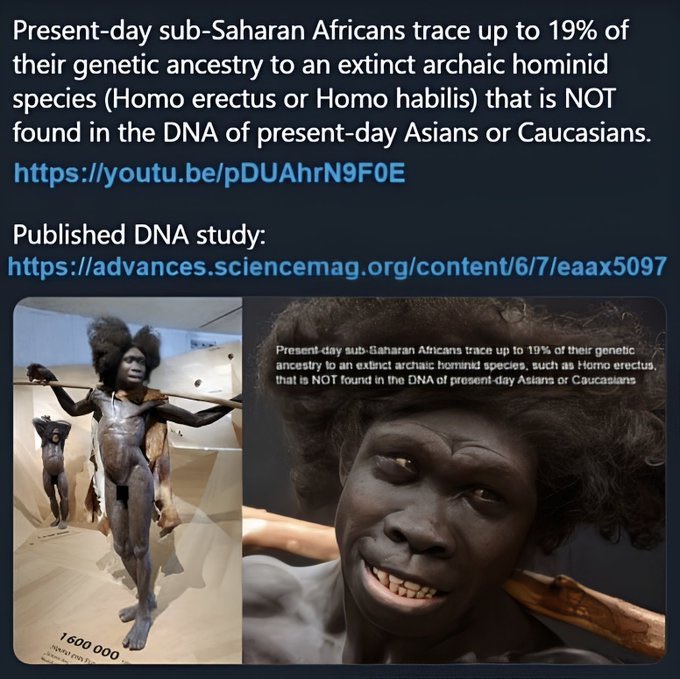
Niggars are another species of Hominids that are NOT Homo sapiens (Humans) or specifically White European Modern Day Humans known as Cro Magnons
1
7
178

Jun 14
Very low IQ, very low impulse control. When the cro magnons went down to Africa (yes humans went to Africa. We did not come from Africa), they got involved with these arcane hominids and created low iq Black people.
22

Jun 14
i can 100% argue against this
you Cro-Magnons make analogies so fucking stupid that even in the cartoonishly simple child-logic world you live in. You somehow manage to still be wrong
money is finite, taxed, and needs to be earned
speed is none of these things, dipshit.
3
4
250

Jun 14
WE WUZ CRO MAGNONS, nobody cares about your fake alternative history entirely created by a schizo named Robert Sephr with no actual scientific basis lol.
1
1
25

Jun 14
Sans oublier cro magnons avant la découverte du 🔥 vivaient tous nus ds des grottes à des - 10 et mangeaient la viande crue sans avoir de 🦠🤣 ils se reproduisaient ds la crasse aussi sans 🦠
Sors de ta bulle et réfléchis un peu et arrête de mentir sur archachon et tes visions
7
Kevin John Parrish retweeted

Mechanical Concepts in Hybrid Quantum Computing with Magnons
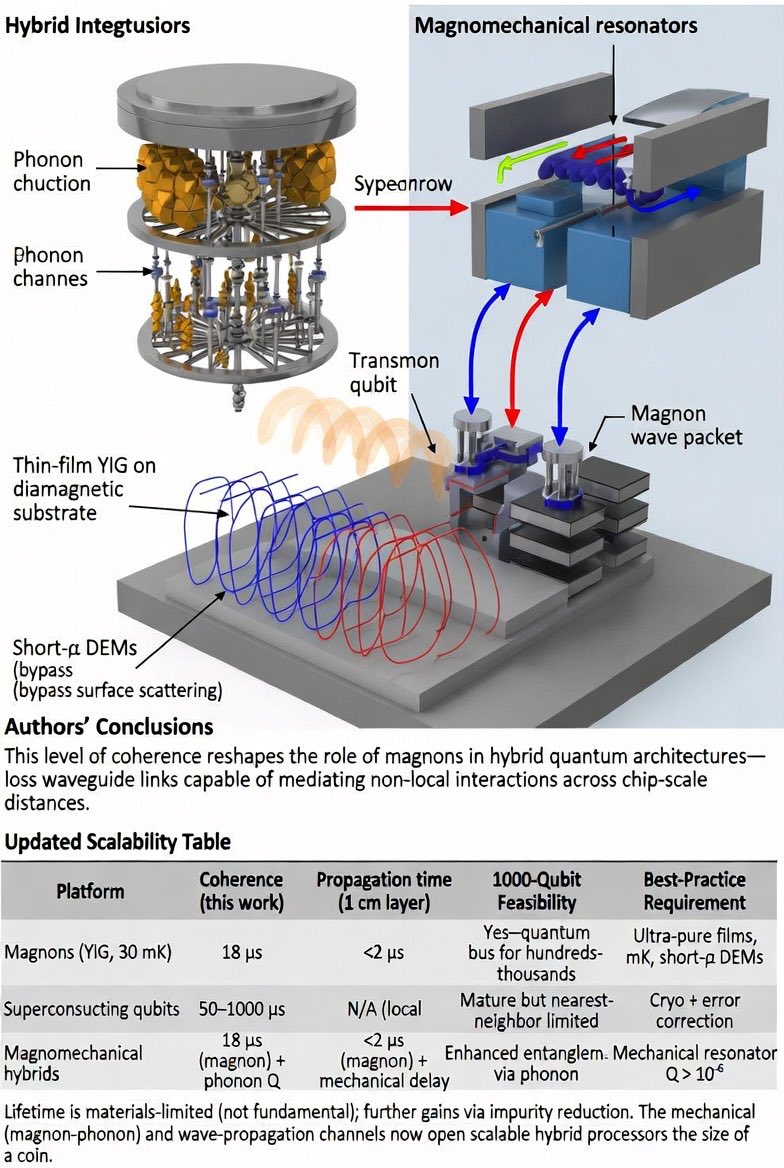
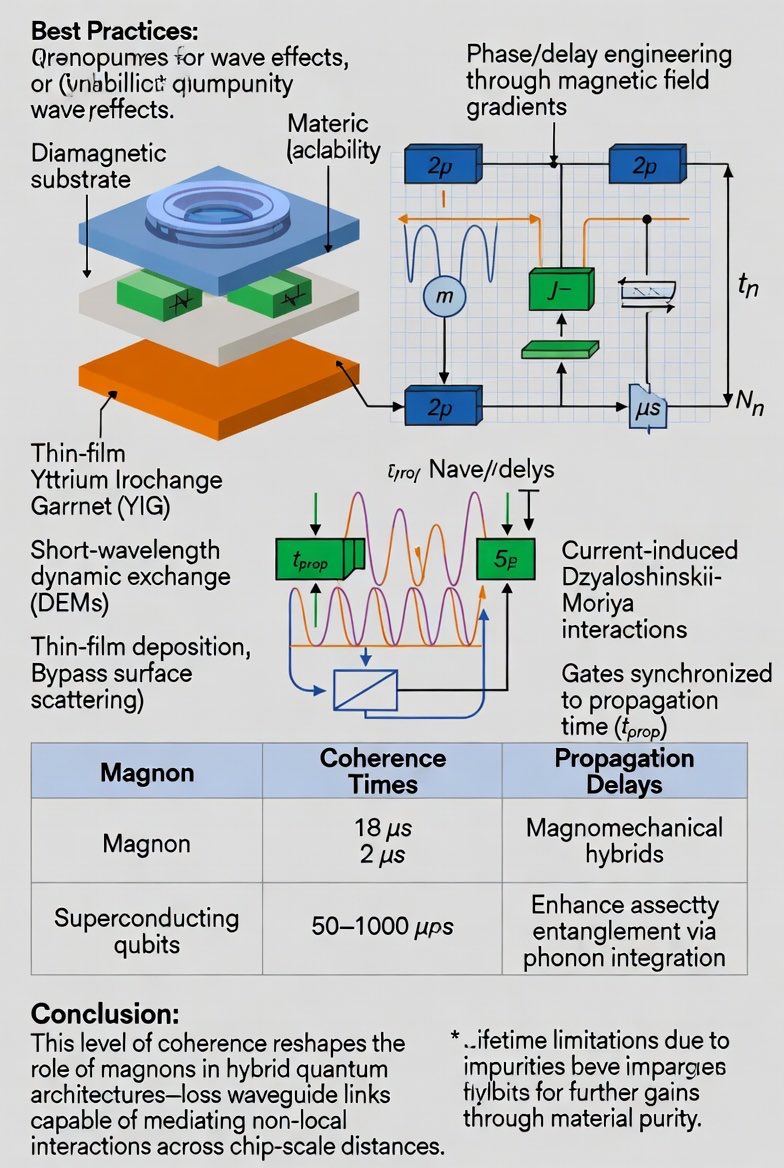
The breakthrough ultra-long-living magnons (up to 18 μs at 30 mK in YIG) directly enable cavity magnomechanics (CMM)—a hybrid quantum platform where magnons (spin waves in YIG), microwave photons (cavity modes), and phonons (mechanical vibrations in a resonator or YIG itself) are coherently coupled. This mechanical concept adds a third degree of freedom beyond pure magnon-qubit or magnon-photon hybrids.
In CMM:
• Magnons couple dispersively or parametrically to a mechanical oscillator (e.g., YIG sphere/bridge vibrating at MHz–GHz or high-overtone bulk acoustic resonators in YIG/GGG thin films).
• This forms a tripartite system (magnon–photon–phonon) for enhanced entanglement, quantum state preparation (squeezing, nonclassical states), and back-action evasion.
• The paper references magneto-mechanical architectures for photon-magnon entanglement and nonclassical state engineering. Magnon-phonon scattering (Kasuya-LeCraw mechanism or Cherenkov processes) is the dominant residual damping channel at mK but is strongly suppressed as the thermal phonon bath population drops (T → 0 limit).
Recent complementary work (2024–2026) shows thin-film YIG magnomechanics operating in the low-GHz regime, with strong magnon–phonon coupling suitable for quantum thermodynamics, precision measurement, and hybrid quantum networks. The 100× lifetime gain makes magnons competitive with transmon coherence while adding mechanical tunability (e.g., strain or vibration control for frequency shifts).
Timing of the State of Matter (Quantum Limit vs. Classical Regimes)
The “state of matter” here refers to the transition into the quantum limit at millikelvin temperatures (<100 mK), where YIG behaves as a near-perfect quantum magnonic medium:
• Classical regime (>4 K): Multi-magnon and magnon-phonon scattering dominate; lifetimes ~1 μs (room T) or hundreds of ns.
• Quantum limit (<100 mK, kT ≈ magnon frequency ~2 GHz): Thermal quasiparticle populations freeze out. Intrinsic damping (magnon–magnon, magnon–phonon) is inhibited. Lifetime saturates at 4.5–18 μs (purity-dependent) because only rare-earth impurity fluctuations remain.
• Key timing data (from three-magnon parametric decay threshold): Lifetime τ_DEM saturates below ~100 mK. Growth starts below 4 K; full quantum suppression of thermal channels occurs at 30 mK.
• Equation for lifetime extraction (parametric threshold): τ = [36 √(V Γ ω₀) / (A ω μ₀ γ (2ω - 9ω_M) sin(2θ))] ⋅ 1/√P_thr (where Γ is linewidth, V volume, etc.; paper uses measured ~30 dB drop in P_thr from 300 K to 30 mK).
• Authors conclude: “In the quantum limit (T→0), damping from magnon-phonon … and magnon-magnon [is] suppressed.” This coherence window (18 μs) enables magnons as robust carriers—far beyond prior sub-μs limits.
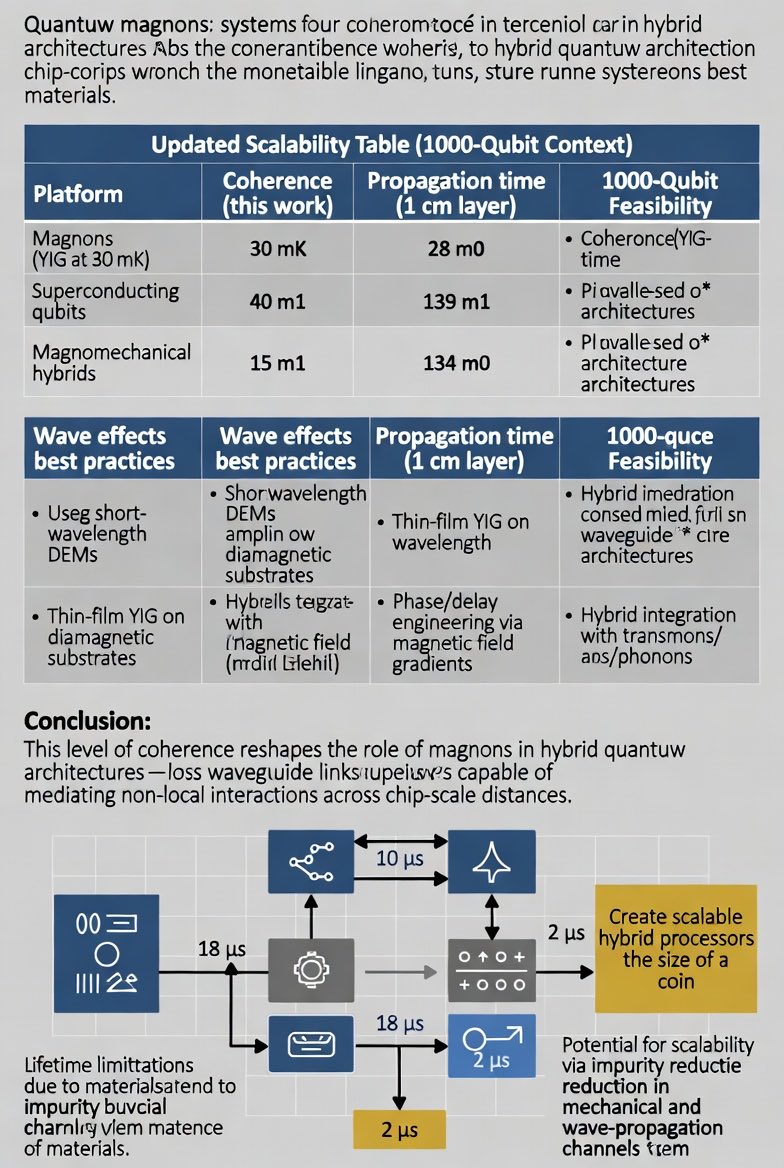
Best Practices for 1000-Qubit-Scale Hybrid Systems: Wave-Effect Duration Across a Quantum Layer
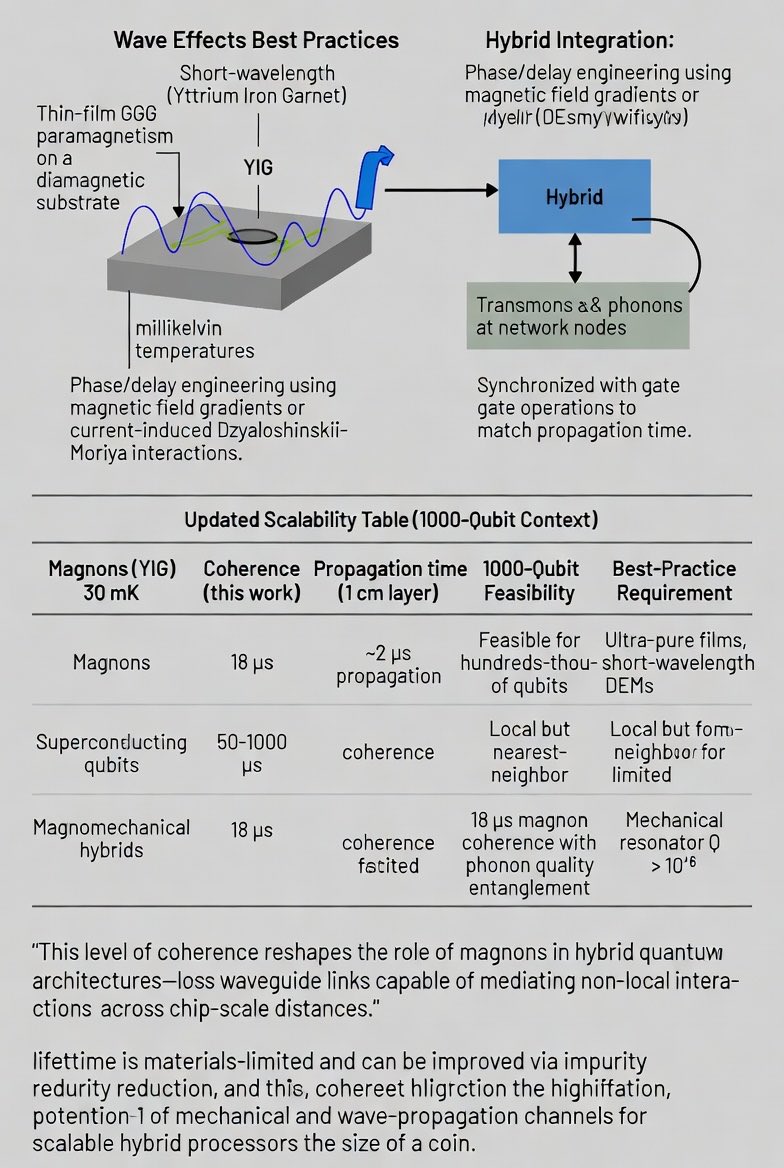
With 18 μs lifetimes, magnons act as a programmable on-chip quantum bus mediating non-local entanglement among hundreds of qubits (scalable to 1000 via waveguide arrays). The wave nature (short-wavelength dipolar-exchange magnons, k ≈ 3 rad/μm) allows propagation as coherent spin-wave packets with phase control, interference, and nonreciprocity—ideal for fan-out across a quantum layer (chip-scale waveguide or thin-film magnonic circuit).
Propagation timing (wave-effect duration)
• Typical YIG dipolar-exchange magnon group velocity: ~3–6 km/s.
• For a realistic 1000-qubit quantum layer (waveguide length L ≈ 1 cm): Propagation time t_prop ≈ L / v_g ≈ 2 μs.
• With τ = 18 μs, the wave retains > e^(–t_prop/τ) ≈ 89% amplitude after crossing the layer.
• Distance traveled before 1/e decay: v_g × τ ≈ 90 mm—multiple chip traversals possible.
Page 1 of 2
1
9
14
528

Jun 13
Par pitié cette mode de pas mettre le pronom relatif "que" dans vos phrases, on est chez les cro-magnons ?
1
31