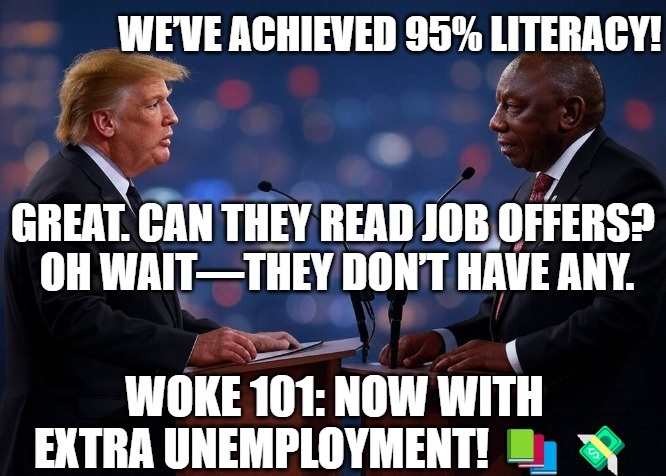
🎓 Degrees to Nowhere: South Africa’s Academic Plot Twist 📉 📚 Literacy ≠ Livelihood: The Great South African Education Heist 💸 🔥 Woke But Broke: UCT, Harvard, and the Education Apocalypse 🌍💣
South Africa stands at a crossroads, its education system a paradox of pride and pain. With a literacy rate of 95%—second in Africa, #110 globally—the nation has scaled heights few dared dream in 1994. Yet, beneath this triumph lurks a shadow: a 34.9% unemployment rate (2023) that swallows graduates whole, their degrees useless against an economy crying for skills they don’t possess. From Cape Town to Cambridge, universities like the University of Cape Town (UCT) and Harvard flirt with financial ruin, risking millions in funding for ideological crusades—labeled "suicidal empathy" by psychologist Gad Saad—while neglecting the economic and democratic foundations they’re meant to uphold. This is no mere local scandal; it’s a global crisis of classrooms chasing applause over purpose, and South Africa, the beloved country, bears the scars.
#EducationForLikes
The Literacy Mirage: South Africa’s Hollow Victory
South Africa’s literacy rate has climbed from 80-85% in 1995 to 95% in 2025, a testament to post-apartheid grit. It outshines Nigeria’s 63.2% (2021) and Kenya’s 82-83%, trailing only Seychelles in Africa and holding its own against India’s 77.7%. On paper, it’s a win—classrooms filled, books opened, minds ignited. But step into the real world, and the story sours. Graduates stride out of universities like Wits and Stellenbosch, clutching degrees steeped in decolonial theory, ready to dismantle the past—but not to build the future. The tech sector begs for coders, manufacturing pleads for engineers, yet these bright minds offer essays on “systemic oppression” instead of skills to fix systems that hum and grind.
Picture Thandiwe, a fictional everywoman graduate from Soweto. She aced her thesis—“The Semiotics of Apartheid in TikTok Trends”—but when she applied at a Joburg factory, the foreman asked, “Can you operate a lathe?” Thandiwe paused, then offered a lecture on “machinery as colonial metaphor.” He waved her off: “Next!” Her story isn’t rare; it’s the norm in a nation where literacy dazzles but employability dims. The ladder of learning, built with such hope, leans against a wall of joblessness, a hollow victory for a country that fought for education as freedom.
#LiteracyButNoJobs
Questions Begging:
Why does a 95% literacy rate leave so many graduates stranded?
What skills are missing from South Africa’s classrooms, and who let them slip away?
Emerging Questions:
How did curricula drift so far from the economy’s pulse?
Can South Africa’s pride in literacy survive if it doesn’t pay the bills?
Why: These questions dig at the roots of a system that promises much but delivers little, urging us to ask whether education is a trophy or a tool—and who’s wielding it wrong.
Suicidal Empathy: UCT and Harvard’s Ideological Gamble
In June 2024, UCT’s council passed resolutions on Gaza—likely divestment calls or condemnations tied to the BDS movement—waving a flag of solidarity. By March 2025, the bill came due: whispers of losing NIH grants, the university’s lifeline for research funding from the US. A new, pro-Israel US administration hinted at cuts, and UCT’s leadership scrambled. A motion to retract the resolutions tied in a vote, leaving the grants—and the future—in limbo. Across the ocean, Donald Trump fired a shot on X in 2025: Harvard’s tax-exempt status was on the chopping block, accused of peddling “ideological sickness” through DEI and progressive stances. Both institutions, drunk on moral clout, now stagger toward financial cliffs.
Imagine UCT’s dean, bleary-eyed from a “Gaza Solidarity Webinar,” refreshing her inbox as NIH replies vanish into the ether. Meanwhile, Harvard’s president tweets “
#EquityFirst” as IRS auditors sharpen their pencils. It’s a dance of "suicidal empathy"—empathy for causes afar, ruin for those at home. UCT’s NIH funds prop up labs and livelihoods; Harvard’s tax status shields billions. Yet both bet it all on politics, not pupils, proving that even ivory towers can crumble when they forget their foundations.
#SuicidalEmpathy101
Questions Begging:
What pushed UCT and Harvard to gamble their futures on ideological stands?
How much funding hangs in the balance, and what’s the real cost to students and research?
Emerging Questions:
Are universities worldwide falling into the same trap of politics over purpose?
Can South Africa’s institutions afford to play global hero when local needs scream louder?
Why: These questions probe whether universities are still about learning—or just loudspeakers for leaders with more heart than head, risking all for a hashtag.
Billions for Buzzwords, Zero for Civics: The Misallocation of Education Funds
South Africa spends big—6.15% of its GDP, R119 billion yearly—on education, trouncing Nigeria’s measly 0.35% and topping India’s 4.12%. It’s a flex of commitment, a promise to the rainbow nation’s kids. But follow the money, and the promise fades. It pools in “dialogue circles” and “equity workshops,” not workshops with welders or labs with lathes. Meet Dr. Harmony Hugwell, our fictional dean of vibes at a fictional varsity. She greenlights “Decolonial Dance Therapy” while engineering budgets shrink. Globally, it’s the same: Harvard’s DEI machine hums louder than its trade schools, and UCT’s “inclusivity summits” dwarf its civics courses.
The fallout? Graduates like Thandiwe, jobless and civically lost. Afrobarometer (2021) found 60% of South African youth don’t grasp the Constitution—ignorant of rights to work, dignity, or freedom. Picture Dr. Hugwell’s “Constitutional Vibes” seminar: students sip rooibos, share feelings, and leave clueless about Section 22 (freedom of trade). The beloved country pours billions into buzzwords, leaving its youth neither employable nor empowered, a double betrayal of Mandela’s dream.
#ConstitutionWho
Questions Begging:
What programs soak up South Africa’s education billions with so little return?
Why do leaders like Dr. Hugwell face no reckoning for this waste?
Emerging Questions:
How does civic ignorance fuel joblessness and despair?
Can South Africa’s R119 billion build citizens, not just seminar attendees?
Why: These questions demand we trace the cash—and the cowardice—behind an education system that funds feelings over futures, leaving a generation adrift.
The Human Cost: Talent Crushed by Dogma
Thandiwe’s degree hangs above her barista station, a bitter joke. South Africa’s 34.9% unemployment rate (2023) isn’t a statistic—it’s her life, and thousands like her. At UCT, the human toll cuts deeper. Professor Bongani Mayosi, a cardiologist of rare genius, faced
#FeesMustFall fury in 2016. Activists dubbed him a “sell-out” for urging calm; leadership froze, too timid to back him. In 2018, he took his life, a loss that still echoes. Across the Atlantic, 40% of US academics self-censor (NAS, 2021), terrified of crossing progressive lines. Harvard profs murmur dissent in shadows; UCT faculty dodge “decolonial” tripwires.
Picture Thandiwe steaming oat milk, muttering about “latte oppression” to unimpressed customers—her degree’s only gig. Or a Harvard don, slipping a contrarian essay into a drawer, fearing the mob. This isn’t progress; it’s a global shredding of talent, where dogma silences brilliance and spineless leaders watch. South Africa’s youth and scholars deserve better than this gutting of their potential.
#JoblessByDesign
Questions Begging:
How did leadership’s silence doom figures like Mayosi—and thousands like Thandiwe?
What keeps universities from shielding talent against ideological storms?
Emerging Questions:
Is self-censorship the new norm, choking academia worldwide?
Can South Africa’s youth rise if their mentors are muzzled and their skills ignored?
Why: These questions scream for justice—for lives lost, futures stalled, and a system that picks ideology over its own people.
A Global Reckoning: Reclaiming Education’s Purpose
But despair isn’t destiny. South Africa, born of struggle, can spark a global reckoning. Imagine Dean Thabo Steel, a fictional reformer at UCT, unveiling a “Jobs-and-Civics Curriculum.” “We teach welding and rights,” he booms, “not hashtags and vibes.” Graduates emerge with trade skills and constitutional fire—knowing Section 23 (fair labour) as well as they know a wrench. The beloved country could lead: ditch "woke" dogma, weave civic literacy into every course, align classrooms with the economy’s pulse. Globally, universities must follow—Harvard taxing ideology, not talent; UCT balancing freedom with pragmatism.
Picture it: Thandiwe swaps her apron for a factory gig, quoting the Constitution to demand fair pay. Harvard profs debate openly, unafraid. Education could again be Mandela’s “most powerful weapon”—not for likes, but for life. South Africa, with its 95% literacy and R119 billion war chest, has the bones to build this future. Will it?
#DegreesThatPay
Questions Begging:
What reforms could stitch South Africa’s education to its job market?
How can constitutional literacy arm graduates to fight for their place?
Emerging Questions:
Could South Africa’s reset ripple to a world of floundering universities?
Will global donors—like the NIH—back this shift, or punish it?
Why: These questions are the beloved country’s compass—pointing from hollow victories to a future where education means power, not just paper.
Conclusion: The Fight for Tomorrow
South Africa’s 95% literacy shines like a medal on a fraying ribbon, outshone by a 34.9% unemployment crisis and universities betting their souls on ideology. UCT’s Gaza gamble and Harvard’s tax tightrope mirror a global rot: education adrift, serving neither democracy nor economy. Yet, the beloved country, forged in fire, can rewrite this story. By grounding learning in civic truth and practical grit, South Africa can turn degrees into paychecks, not protests. This fight spans continents, stakes the future, and starts now—because a nation that reads but doesn’t rise has only half its freedom.
#KnowYourRights
Key Citations
South Africa Literacy Rate 1980-2025 - Macrotrends
South Africa Public Spending on Education - Trading Economics
South Africa Unemployment Rate - Trading Economics
UCT Council Debates Risk of Defunding - UCT News, March 17, 2025
Trump’s X Post on Harvard - X, 2025
Afrobarometer 2021: Civic Education in South Africa - Afrobarometer
#DegreesToNowhere 🎓🗺
#EducationParadox 📘❌
#WokeButBroke 😩💸
#CloutOverClassrooms 📲🏫
#TikTokTaughtMe 📱📚
#NoJobsOnlyJargon 📉🔤
#UnemployedWithHonours 🧑🏽🎓🚫💼
#ThandiweNeedsATrade 🔧😭
#UCTvsUnemployment ⚖📉
#VarsityOfVibes 🌈👩🏽🎓✨
#BaristasWithBAs 🎓
#LearnToWeld 🔧🧰
#NotAnotherWebinar 😤📺
#STEMOrScream 🧪🔬😱
#WorkshopNotWokeshop 🪚👷
#WrenchesOverWokeness 🔩💪
#BuildNotBlame 🧱🛠
#WhereAreThePlumbers 🚽🔍
#MachineryAsMetaphor 💭🛠
#HireSkillsNotHashtags 💼📛
#EngineerMyFuture 🚀📐
#SuicidalEmpathy101 💔🌍
#DecolonialDanceTherapy 💃🏽📉
#DEIvsROI 📊🧑🏾🎓
#HarvardVsTheIRS 🧾🎯
#GazaFirstGrantsGone 🎓🕊🚫
#EquityOverExcellence ⚖👀
#ProfWontSpeak 🧑🏽🏫🤐
#AcademicAsylumNow 🏥📚
#TenureTears 😢📜
#TheVibeIsUnemployed 🌈🚫
#95PercentAndNowWhat 🇿🇦🤷🏽♀
#MandelaDidNotFightForThis 🫱🏾🫲🏽📉
#ConstitutionWho 🤨📖
#CivicLitOrBust 🧠🚦
#RainbowNationDropout 🌈🏚
#MatricToMiserable 📜😩
#UnemploymentU 🧑🏽🎓📉