
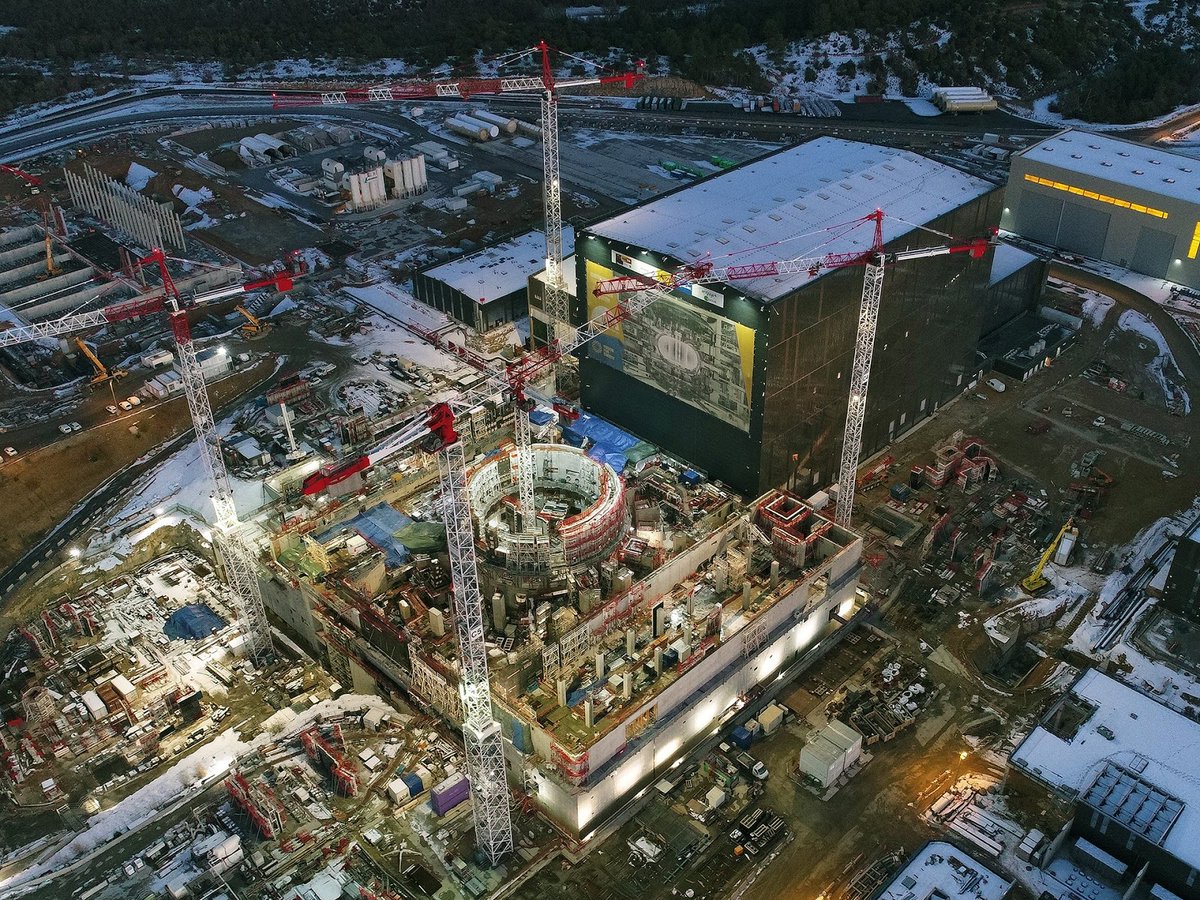
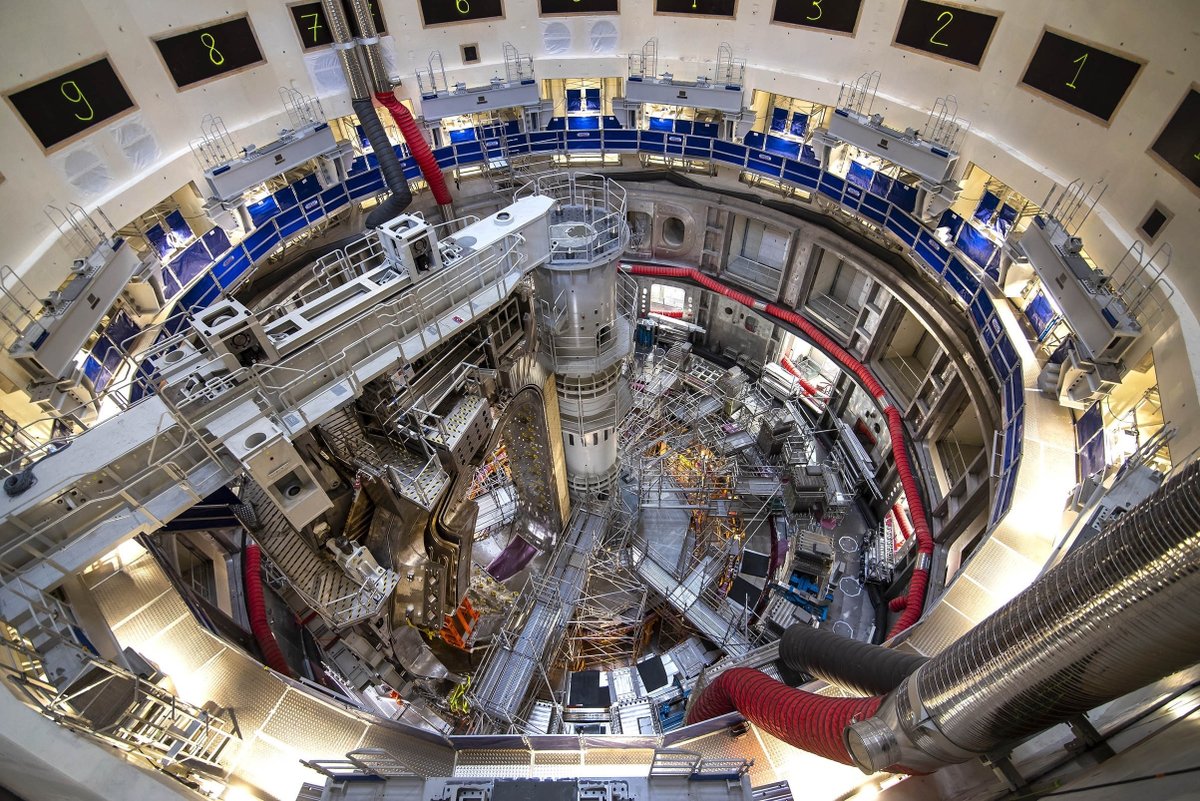
ITER at Cadarache, southern France, is a multinational fusion energy megaproject centered on a tokamak reactor, assembling ultra-precise, heavy components from 35 countries into one of the most complex scientific constructions ever built. #Science #FusionEnergy #ITER
3

I worked on Megaprojects
What the Communists pretend to not understand is that the Megaproject creates literally around 4 jobs for other people for each of its own employees.
Shopping Malls, housing, literally towns develop around the Megaproject.
2

कोसी पर बनेगा 6-लेन महासेतु!
#KosiBridge #SixLaneBridge #BiharNews #Infrastructure #MegaProject #BreakingNews #BiharDevelopment

4

سندھ حکومت نے عظیم پورا فلائی اوور صرف 93 دن میں مکمل کرکے پاکستان کی تاریخ میں ایک نیا ریکارڈ قائم کر دیا۔
عیدالاضحیٰ کی چھٹیوں کے باوجود تعمیراتی کام 24 گھنٹے جاری رہا۔ 14 مختلف ٹیموں، انجینئرز اور محنت کشوں نے دن رات محنت کرکے اس منصوبے کو مقررہ وقت سے بھی تیزی سے مکمل کیا۔
📍 مقام: کراچی شاہ فیصل
🏗️ منصوبہ: عظیم پورا فلائی اوور
⏱️ تکمیل کا وقت: 93 دن
آپ اس تاریخی کامیابی کے بارے میں کیا رائے رکھتے ہیں؟ کمنٹس میں ضرور بتائیں
#AzeempuraFlyover #SindhGovernment #mayorkarachi #MegaProject
3
15
26
401

मुंबईला मोठा दिलासा! नरीमन पॉइंट ते भाईंदर सिग्नल-फ्री रोड - देवेंद्र फडणवीस
@CMOMaharashtra @MumbaiPolice @MTPHereToHelp @MahaDGIPR
#MumbaiNews #NarimanPoint #Bhayandar #SignalFreeRoad #DevendraFadnavis #InfrastructureDevelopment #MumbaiTraffic #MegaProject #BreakingNewsMaharashtra #citynews_amravati
1
30

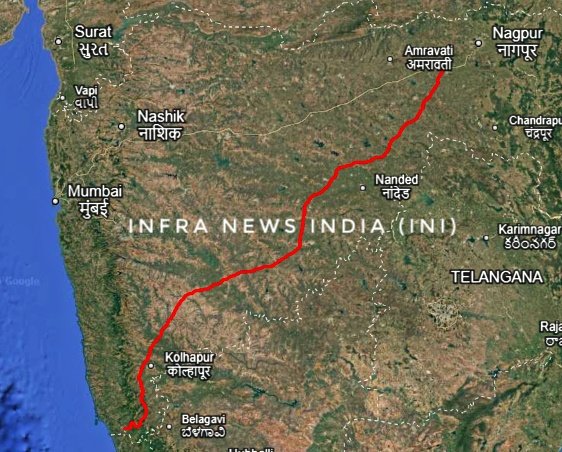
𝐍𝐚𝐠𝐩𝐮𝐫-𝐆𝐨𝐚 𝐒𝐡𝐚𝐤𝐭𝐢𝐩𝐞𝐞𝐭𝐡 𝐄𝐱𝐩𝐫𝐞𝐬𝐬𝐰𝐚𝐲 𝐟𝐫𝐨𝐦 𝐌𝐚𝐡𝐚𝐫𝐚𝐬𝐡𝐭𝐫𝐚.
The Government of Maharashtra has issued the section 15 (2) Government Resolution (Rajpatra) for the upcoming Shaktipeeth Expressway.
This notification means the government has completed the preliminary administrative processes and they are now moving ahead with compensation rate finalisation and physical acquisition.
The compensation rates are expected to be announced in the next 6-8 weeks.
The Shaktipeeth Expressway is truly a megaproject and to understand its grand scale, here are some numbers:
• Districts: 13
• Talukas: 40
• Villages: 409
Here are the district-wise lengths of Shaktipeeth Expressway as per the revised alignment:
• Wardha: 35 km
• Yavatmal: 137 km
• Nanded: 20 km
• Hingoli: 70 km
• Parbhani: 60 km
• Beed: 39 km
• Latur: 43 km
• Dharashiv: 40 km
• Solapur: 130 km
• Satara: 49 km
• Sangli: 72 km
• Kolhapur: 125 km
• Sindhudurg: 36 km
👉 Total: 856 km
An expressway of this scale being built completely by the state government is really noteworthy.
Initially, there was opposition for the upcoming Purandar International Airport as well. However, once the attractive compensation package was declared, 95% land owners gave their consent for land acquisition.
It would be interesting to see how quickly the land acquisition for Shaktipeeth Expressway progresses once the compensation package is announced.
Need the revised alignment KML file for Shaktipeeth Expressway? Get in touch with us today on WhatsApp/Arattai/Telegram: 7588806161.
#DevendraFadnavis @mieknathshinde @SunetraA_Pawar #Nagpur #Goa #Shaktipeeth #Expressway #Maharashtra #India #Infra #InfraNewsIndia #INI @maharevenue
1
5
57
2,116

Rolls-Royce SMR getting nuclear justification, then lining up Wylfa and Temelín, is the useful version of the small-reactor story. The reactor is almost the boring part, a 470 MWe pressurized-water machine wrapped in factory discipline. The hard object is the sequence around it, justification, GDA, site work, supplier qualification, financing, repeat orders.
The anti-nuclear mind keeps looking for a bespoke megaproject to litigate into ritual exhaustion. The SMR bet is that nuclear can be forced into a product cadence before the bureaucracy metabolizes it. If Rolls-Royce and ČEZ turn paperwork into a second build rather than another commemorative document, Europe gets a template with teeth.
11

Now we are hearing claims of 12,000 Alaska jobs. Alaska does not have a labor pool of 12,000 skilled workers for a megaproject. We did not have that during TAPS either. The jobs will be real, but most will be filled by workers from Outside. That is not a criticism. It is simple math.
During TAPS, the boom towns were full of workers flown in from the Lower 48. The same thing will happen here. The jobs will exist, but they will not be Alaska jobs in the way politicians are claiming.
We are also hearing that the unions and Glenfarne made a deal. What that really means is a closed shop. Every worker, including those flown in, pays dues. The unions will make millions. That is not the same thing as Mat‑Su residents getting the jobs.
1
1
29

11h
For sure, I'm quite surprised the Americans have sat back for so long, knowing full well the risks and what could happen, and they seem to have learnt since R1 (which I loved)
Europe certainly has this ability, at a nationstate and continental level, some are better at it than others, the intelligence services and governments are far less open and very rarely make things public knowledge about their AI efforts, the UK have been at it for a very long time, the big problem is really rallying society together for some sort of "European AI megaproject" because people are still stuck psychologically in the old ways, we try to forget how much things have changed, it will take real societal shocks to kind of unite people behind something greater, with building our own ASI, maybe in ways that are more efficient, faster and effective, Europe is full of great minds with so much untapped potential because essentially we are too "domesticated" for now, until we need to eat
But largely I agree, we are on the backfoot and we cannot afford that, which thankfully is becoming more and more clear to all of us
1
1
28

Total let traders evaluate battery risk. Everyone else pushed them through megaproject committees. Short-cycle arbitrage analyzed like 20-year LNG offtakes. Wrong people, wrong framework.
14
What HB 381 Really Means
Mat‑Su residents are being told HB 381 is “maximum benefit” for Alaska.
Before we accept that, we should look at what the bill actually does and what it means for our borough.
HB 381 removes all Alaska LNG project property from normal municipal taxation.
This is in Section 3 of the bill, which adds a new exemption to AS 29.45.030(a)(11).
That means Mat‑Su loses the ability to tax the largest industrial asset ever proposed in Alaska.
The bill also removes that value from the school funding formula.
Section 2 amends AS 14.17.510(d) so the “full and true value” used for required local contributions cannot include LNG project property.
This is a permanent loss of local fiscal capacity.
In exchange, Mat‑Su gets a slice of the Alternative Volumetric Tax.
The AVT is allocated by formula and controlled by the Department of Revenue.
See Amendment 72.
If throughput drops, revenue drops.
There is no minimum and no backstop for boroughs.
Now we are hearing claims of 12,000 Alaska jobs.
Alaska does not have a labor pool of 12,000 skilled workers for a megaproject.
We did not have that during TAPS either.
The jobs will exist, but most will be filled by workers from Outside.
That is not a criticism. It is simple math.
During TAPS, the boom towns were full of workers flown in from the Lower 48.
The same thing will happen here.
The jobs will be real, but they will not be Alaska jobs in the way politicians are claiming.
We are also hearing that the unions and Glenfarne made a deal.
What that really means is a closed shop.
Every worker, including those flown in, pays dues.
The unions will make millions.
That is not the same thing as Mat‑Su residents getting the jobs.
The RCA price cap is being sold as consumer protection.
The cap is sixteen dollars per thousand cubic feet, indexed to inflation.
See Amendment 14.
Interior communities had been aiming for five dollars.
Sixteen dollars is not a win for affordability.
There is no protection for underflow risk.
The only throughput protection in the bill applies to utility customers, not borough revenues.
See the conceptual amendment to Amendment 15.
If volumes fall, borough revenue collapses.
Mat‑Su is left holding the bag.
HB 381 also shields future energy transition revenue from local taxation.
Amendment 11 defines “natural gas pipeline projects” to include carbon capture facilities, underground storage, liquefaction, and “any other facility associated with a natural gas pipeline project.”
All of that falls under the exemption in Section 3.
That means Mat‑Su cannot tax 45Q carbon capture infrastructure, 45V hydrogen production, ammonia production, or CO2 storage if they are placed inside the LNG project envelope.
These are the revenue streams expected to dominate the next generation of energy markets.
So here is the question Mat‑Su residents should be asking their representatives:
How does giving Glenfarne everything it asked for help Alaska and her people?
How does removing our tax base, removing our school funding value, removing future carbon and hydrogen revenue, and replacing it with a throughput tax we do not control meet the standard of maximum benefit?
This is not anti project.
It is a simple recognition that the fiscal terms are underpriced and the long term cost to Mat‑Su is very high.
Alaska can support the LNG project without hollowing out borough tax bases.
HB 381 is not the victory some are claiming.
Mat‑Su deserves an honest accounting of what was traded away.

37
What HB 381 Really Means
Mat‑Su residents are being told HB 381 is “maximum benefit” for Alaska. Before we accept that, we should look at what the bill actually does and what it means for our borough.
HB 381 removes all Alaska LNG project property from normal municipal taxation. This is in Section 3 of the bill, which adds a new exemption to AS 29.45.030(a)(11). That means Mat‑Su loses the ability to tax the largest industrial asset ever proposed in Alaska.
The bill also removes that value from the school funding formula. Section 2 amends AS 14.17.510(d) so the “full and true value” used for required local contributions cannot include LNG project property. This is a permanent loss of local fiscal capacity.
In exchange, Mat‑Su gets a slice of the Alternative Volumetric Tax. The AVT is allocated by formula and controlled by the Department of Revenue. See Amendment 72. If throughput drops, revenue drops. There is no minimum and no backstop for boroughs.
Now we are hearing claims of 12,000 Alaska jobs. Alaska does not have a labor pool of 12,000 skilled workers for a megaproject. We did not have that during TAPS either. The jobs will exist, but most will be filled by workers from Outside. That is not a criticism. It is simple math.
During TAPS, the boom towns were full of workers flown in from the Lower 48. The same thing will happen here. The jobs will be real, but they will not be Alaska jobs in the way politicians are claiming.
We are also hearing that the unions and Glenfarne made a deal. What that really means is a closed shop. Every worker, including those flown in, pays dues. The unions will make millions. That is not the same thing as Mat‑Su residents getting the jobs.
The RCA price cap is being sold as consumer protection. The cap is sixteen dollars per thousand cubic feet, indexed to inflation. See Amendment 14. Interior communities had been aiming for five dollars. Sixteen dollars is not a win for affordability.
There is no protection for underflow risk. The only throughput protection in the bill applies to utility customers, not borough revenues. See the conceptual amendment to Amendment 15. If volumes fall, borough revenue collapses. Mat‑Su is left holding the bag.
HB 381 also shields future energy transition revenue from local taxation. Amendment 11 defines “natural gas pipeline projects” to include carbon capture facilities, underground storage, liquefaction, and “any other facility associated with a natural gas pipeline project.” All of that falls under the exemption in Section 3.
That means Mat‑Su cannot tax 45Q carbon capture infrastructure, 45V hydrogen production, ammonia production, or CO2 storage if they are placed inside the LNG project envelope. These are the revenue streams expected to dominate the next generation of energy markets.
So here is the question Mat‑Su residents should be asking their representatives:
How does giving Glenfarne everything it asked for help Alaska and her people? How does removing our tax base, removing our school funding value, removing future carbon and hydrogen revenue, and replacing it with a throughput tax we do not control meet the standard of maximum benefit?
This is not anti project. It is a simple recognition that the fiscal terms are underpriced and the long term cost to Mat‑Su is very high.
Alaska can support the LNG project without hollowing out borough tax bases. HB 381 is not the victory some are claiming. Mat‑Su deserves an honest accounting of what was traded away.
1
2
53
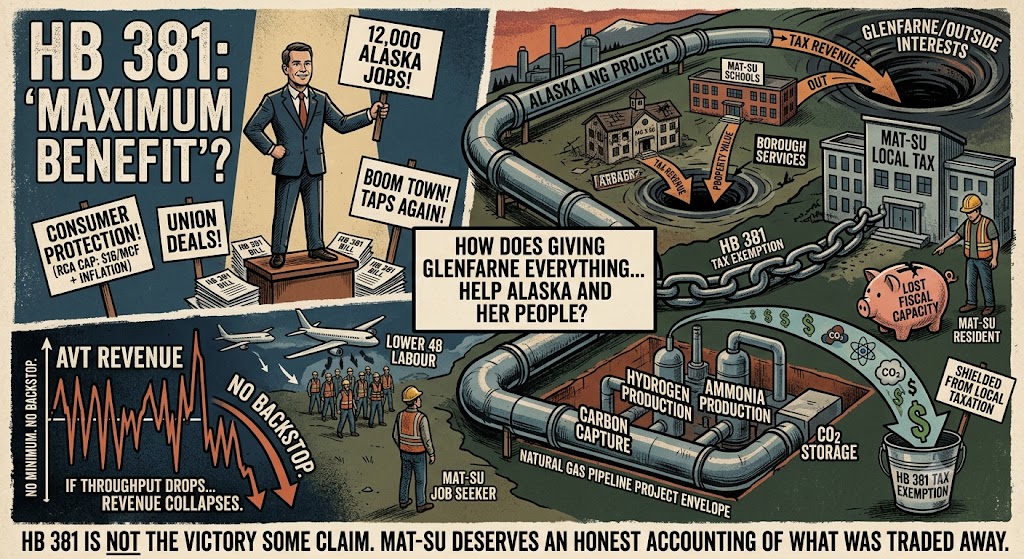
Politicians are celebrating HB 381 as “maximum benefit” for Alaska. The bill text tells a very different story. Here is what the bill actually does.
HB 381 removes all Alaska LNG project property from normal municipal taxation. This is in Section 3 of the bill, which adds a new exemption to AS 29.45.030(a)(11). Boroughs like Mat Su lose hundreds of millions in taxable value.
The bill also removes that value from the school funding formula. Section 2 amends AS 14.17.510(d) so the “full and true value” used for required local contributions cannot include LNG project property. This is a permanent loss of local fiscal capacity.
In exchange, boroughs get a slice of the Alternative Volumetric Tax. The AVT is allocated by formula and controlled by the Department of Revenue. See Amendment 72. If throughput drops, revenue drops. There is no minimum and no backstop.
Politicians are claiming 12,000 Alaska jobs. Alaska does not have a labor pool of 12,000 skilled workers for a megaproject. We did not have that during TAPS either. The jobs will exist, but most will be filled by workers from Outside. That is simple math.
The union agreement with Glenfarne is being sold as proof of “benefit.” What it really guarantees is a closed shop. Every worker, including those flown in, pays dues. The unions will make millions. That is not the same thing as Alaskans getting the jobs.
The RCA price cap is being advertised as consumer protection. The cap is sixteen dollars per thousand cubic feet, indexed to inflation. See Amendment 14. Interior communities had been aiming for five dollars. Sixteen dollars is not a win for affordability.
There is no protection for underflow risk. The only throughput protection in the bill applies to utility customers, not borough revenues. See the conceptual amendment to Amendment 15. If volumes fall, borough revenue collapses. The bill leaves that risk entirely on local governments.
HB 381 also shields future energy transition revenue from local taxation. Amendment 11 defines “natural gas pipeline projects” to include carbon capture facilities, underground storage, liquefaction, and “any other facility associated with a natural gas pipeline project.” All of that falls under the exemption in Section 3.
That means boroughs cannot tax 45Q carbon capture infrastructure, 45V hydrogen production, ammonia production, or CO2 storage if they are placed inside the LNG project envelope. These are the revenue streams expected to dominate the next generation of energy markets.
Politicians are calling this “maximum benefit.” For who? The developer gets a custom tax regime. The unions get guaranteed dues. The state gets centralized control. The boroughs get a fraction of what they would have received under normal taxation.
Mat Su and other boroughs are being asked to surrender a large and flexible tax base in exchange for a smaller and unstable revenue stream that depends entirely on throughput. This is not anti project. It is a simple recognition that the fiscal terms are underpriced.
If Alaska wants to support the LNG project, it can do so without hollowing out local tax bases and without giving away future carbon and hydrogen revenue. HB 381 does not meet the standard of maximum benefit for Alaska communities.
The project may still be worth pursuing. But the bill is not the victory some are claiming. It is a major concession package, and the people of Alaska deserve an honest accounting of what was traded away.

1
4
113

Sure.
high-speed rail construction, large-scale infrastructure delivery, industrial manufacturing capacity, supply chain integration, EV production scaling, solar panel production, battery manufacturing, rare earth processing, port infrastructure development, metro system expansion, urban planning execution speed, export logistics efficiency, electronics assembly scale, drone manufacturing, telecommunications hardware deployment, AI hardware supply chain depth, civil engineering workforce mobilization, megaproject completion timelines, energy grid expansion, renewable energy rollout speed, steel production capacity, cement production capacity, industrial automation scaling, e-commerce logistics networks, domestic market scaling, fast industrial policy execution, public infrastructure financing coordination
Want more?
2
229

A Century-Defining Project: The Bridge of Trust - Vision or Illusion? The "Putin-Trump Tunnel" Project Beneath the Bering Strait
ST. PETERSBURG / WASHINGTON DC:
It reads like a geopolitical thriller or a sci-fi epic: a direct land connection between Eurasia and North America. At the St. Petersburg International Economic Forum (SPIEF) in June 2026, Kirill Dmitriev, the Kremlin’s special envoy for investments, announced that Russia and the United States are on the verge of signing a landmark agreement to advance planning for an undersea tunnel between Chukotka and Alaska. Behind the scenes, this highly ambitious megaproject is already moving forward under a striking moniker: the "Putin-Trump Tunnel."
A Historic Dream in a New Geopolitical Guise
The idea of bridging or tunneling the roughly 80-kilometer-wide Bering Strait is by no means new. Tsar Nicholas II gave a preliminary green light to similar plans by American railroad magnates at the beginning of the 20th century, and during the Cold War, Nikita Khrushchev and John F. Kennedy discussed the concept as a potential "Bridge of Peace."
The proposed tunnel beneath the Bering Strait is envisioned by its proponents as the ultimate peace project of the 21st century. It represents a physical and symbolic connection between the Western and Eastern hemispheres, designed to usher in a new era of cooperation and deep mutual trust between global powers.
What was once an insurmountable frontier of the Cold War would be transformed by this monumental infrastructure into a vital artery for global exchange.
The Vision and Opportunities of a Historic Partnership
- A Monument to a New Era: Championed by leadership at the Russian Direct Investment Fund (RDIF), the project is presented as a historic milestone for U.S.-Russian relations. It serves as a powerful statement that shared economic and scientific goals can transcend long-standing geopolitical divides.
Technological Breakthroughs: By leveraging cutting-edge tunneling technologies—such as those pioneered by Elon Musk’s Boring Company—this mammoth undertaking aims to be realized more efficiently, cost-effectively, and faster than ever previously imagined. A projected timeline of under eight years signals the sheer drive behind this new alliance.
- A Shared Future in the Arctic: The tunnel is seen as the key to unlocking the pristine resources and economic potential of the Arctic—not through rivalry, but through collaborative partnership.
Bridge-Builders in Dialogue
- The project has already captured the attention of the highest political echelons. Donald Trump’s receptive response, calling the idea "an interesting one" and noting that "we'll have to think about that," is viewed by supporters as a crucial first step toward diplomatic rapprochement.
While currently in its early, conceptual design phases—anchored by initial planning contracts in Russia—the idea embodies the courage to think big and challenge the status quo.
Milestones on the Path to Realization
To transform this grand vision into a lasting connection of trust, planners are looking at how to turn remaining challenges into shared successes:
The Goal :
- The Collaborative Approach
Infrastructural Boom:
- Building the missing rail and road networks through the permafrost (3,000 km in Russia, over 1,000 km in Alaska) is viewed as a once-in-a-generation economic stimulus that will revitalize remote regions and create thousands of jobs.
Joint Investment:
- Mobilizing the necessary capital is framed as a long-term, high-yield investment in global trade, co-financed and shared by both nations.
Economic Benefits:
- Proponents of the tunnel point to massive economic synergies. The corridor would revolutionize intercontinental freight traffic and facilitate joint resource development projects in the Arctic.
Read the full story here: whatsapp.com/channel/0029VbC…

54
Speedy#57 retweeted

ANALYSIS: Wab Kinew’s new interest in Conawapa megaproject based on ‘Rothschild Way Of Knowing’: energy watchdogs say
cbc.ca/news/canada/manitoba/…
8
2
12
305

Maybe should have done i in 2014
"$18-billion version of the Conawapa project. The project was placed on hold in 2014 when the estimated cost reached $10 billion.."
Conawapa megaproject 'doesn't make a lot of sense,' energy watchdogs say ino.to/WQrQ5wx
11

Saudi Arabia has unveiled one of the most ambitious stadium concepts in football history for the 2034 World Cup.
The centerpiece is the NEOM Sky Stadium (also called the Sky Stadium), which will be built 1,150 feet (350 meters) above ground level, making it by far the highest football venue ever designed. The pitch will sit high inside a towering structure within The Line, the groundbreaking linear smart city that is part of Saudi Arabia’s futuristic NEOM megaproject.
The stadium is designed to host up to 46,000 spectators and will feature sleek, panoramic architecture with immersive fan experiences. It forms part of Saudi Arabia’s massive World Cup bid, which includes 73 proposed venues across 15 host cities.
The concept has generated huge global excitement, especially after dramatic AI-generated videos of the floating-style stadium went viral without actually being real (as shown here).
While many praise the bold futuristic vision, others have raised questions about the technical and logistical challenges of completing such an ambitious project in time for 2034.
Saudi officials remain confident the Sky Stadium will be ready, promising it will redefine what a football venue can be if successfully built.

32
43
278
35,788