
19 Oct 2025
You might have heard of microaggressions; those subtle digs or throwaway comments that seem harmless on the surface but carry sharp, hidden messages:
“You’re so inspiring for coming to work.”, “You don’t look disabled.” “We’d hire more people with disabilities, but…”, “I didn’t mean it like that.”, “You’re being too sensitive.”
These aren’t “little” things. Not when you hear them every day. Not when they chip away at your confidence, credibility, or right to belong.
If you’ve ever been:
- Spoken about instead of to
- Interrupted or ignored in a meeting
- Asked to share your story only when it suits someone else’s agenda
- Praised as “inspiring” when you’re trying to be taken seriously as a professional
You know the sting. You know the silence that follows. You know what it costs.
Microaggressions don’t just hurt feelings. They shape culture.
They become normal. They go unchallenged. They quietly tell disabled persons:
"You’re lucky to be here, Don’t make it uncomfortable, Don’t expect too much."
So what can we do?
✨️ Replace it - Use microvalidations to build safety & respect in culture.
✨️ Interrupt It - Call it out. Educate. Awareness. Hold certain persons #Accountable.
✨️ Name It - Make space for people to say, "that didn't land well."
✨️ Validate It - When someone tells you the comment or behavior was harmful, believe them. When someone says that they are "upset" or "mad" or "feeling erased," believe them. Provide validation.
And... CHECK IN.
#MentalHealth #disabilitytwitter
#Disability #Neurodiversity #DisabilityVoices #DisabilityAdvocate #AutismAdvocate
6
149

18 Sep 2025
Social media has to be the main driving force. More and more crazy positions were needed for attention and stronger dopamine hits from "like" microvalidations
7
752

30 Jul 2024
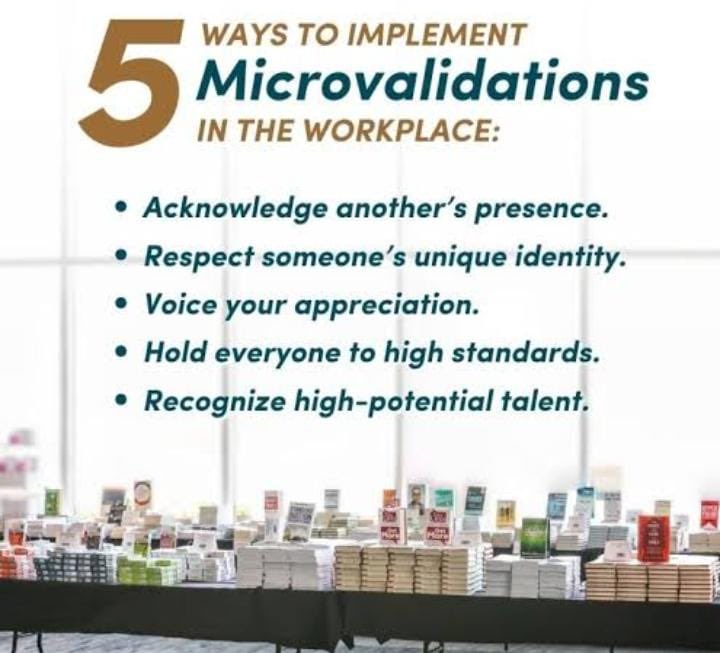
Microvalidations can act as an antidote to microaggressions. Integrating microvalidation techniques can have a positive impact on the employee productivity. It acts as a superpower for women workforce.
Fight #Microaggressions with #Microvalidations
#Workingwomen
2
23

16 Feb 2024
Now DEI enforcers are saying you need to start performing "microvalidations".
These are defined as "small gestures that can help to counteract the unwelcoming and disrespectful signals that microaggressions send."
They invented a disease and now they've invented a cure for it.
22
46
174
4,822

5 Feb 2024
The @POhWERadvocacy team has been putting together really useful info and links as part of #RaceEqualityWeek24. Today I've been learning about microvalidations - small positive acts that can make a big difference.
5 Feb 2024

This #RaceEqualityWeek24, @RaceEquality_UK have created a 5 day challenge to help organisations reflect on their collective and individual journeys towards race equality. Day 1 focuses on Microaggressions. Watch this short video called ‘All The Little Things’ to take a look at how microaggressions feel like a thousand little cuts: youtube.com/watch?v=WvI3Akdb…
#ItsNotMicro #5DayChallenge
6
499


7 Jun 2023
To remedy the harm of #microaggressions we need to avoid committing them AND counteract them. How can we do this? With #Microvalidations such as what WAPPP Co-Director Iris Bohnet refers to as “micro-sponsorship.”
Read @HarvardBiz's article to learn more: ow.ly/erYX50OIjUE
1
1
2
228

1 Jun 2023
Being empathetic, being courteous, being considerate might sound old-school but these are little ways to practice microvalidations towards people -- supporting and affirming them. #CauseAChatter
2
12
1 Jun 2023
Microvalidations are small, positive actions that encourage or affirm. I was reading about them being an antidote to microagggressions that we unknowingly commit in our workplaces or in social settings. #CauseAChatter
@blogchatter
1
4
83

28 May 2023
Bye-bye, microaggressions. Hello, microvalidations.
According to @HarvardBiz, microvalidations are small, positive actions that seek to encourage or affirm, like using a leader's formal title when appropriate and referring to people in the same way they think of themselves.
1
6
44
22,792

22 May 2023
Good piece.
Here’s a quick summary of 5 Microvalidations anyone can use to shield against microaggressions.
-Acknowledge Presence
-Validate Identity
-Voice Your Appreciation for Everyone’s Contributions
-Hold People to High Standards
-Affirm Leadership Potential and Status
15 May 2023

Small, positive affirmations can make a big difference. hbr.org/2023/05/an-antidote-…
1
1
337

19 May 2023
Today's 5 Ally Actions newsletter, w/ tips from @ImTiffanyYu @alignmentquest @sheaadelson and others
1️⃣Embrace microvalidations
2️⃣Practice empathetic mirroring
3️⃣Respect the language others use to describe themselves
4️⃣Nurture learning
5️⃣Measure your GPP
mailchi.mp/25aa33bc295a/5-al…
5
4
949

18 May 2023
An Antidote to Microaggressions? Microvalidations. hbr.org/2023/05/an-antidote-…
1
1
452

17 May 2023
Microvalidations (acknowledging, validating, appreciating, affirming) are key to ensure minority group members understand their value and fulfill their potential. Nice paper to teach diversity in the workplace, esp. to managers.hbr.org/2023/05/an-antidote-…
1
10
974
16 May 2023
4/ The authors' suggestion? Embrace microvalidations.
For example,
- Voice appreciation for everyone’s contributions, especially for people who are members of underrepresented groups
2
3
373

16 May 2023
The concept of using microvalidations as a positive reframe and tool to counteract the harm caused by microaggressions is a powerful call to action.
It is important to remember that even small, seemingly insignificant actions like sincere compliments and…lnkd.in/eAJZT7Eg
2
3
324

16 May 2023
The secret weapon to defeat microaggressions....... Microvalidations. These are small, positive actions that encourage or affirm. hbr.org/2023/05/an-antidote-…
1
3
204

16 May 2023
Important to avoid #microaggressions & also take ACTION to fight them - Love idea of microVALIDATIONS:
1. Acknowledgement
2. Validation of Identity
3. Appreciation
4. High standards
5. Affirm #leadership potential
#GenderEquity #DEI #CareerDevelopment
hbr.org/2023/05/an-antidote-…
6
26
3,986

16 May 2023
An Antidote to Microaggressions?
Microvalidations.
Small, positive affirmations can make a big difference.
hbr.org/2023/05/an-antidote-…
1
3
865

15 May 2023
Microaggressions and microvalidations exist on the opposite ends of a spectrum of small behaviors that can make people feel like either outsiders or insiders of a particular group - their power lies in their subtlety. hbr.org/2023/05/an-antidote-… @alignmentquest
1
96