
Konnex: How Autonomous Systems Could Create a New Labor Market for Robots The technology landscape is increasingly shifting from simple digital tools toward systems that can operate independently, make decisions, and carry out tasks without constant human supervision. Konnex sits squarely in that direction. It is building infrastructure for autonomous systems, robots, and physical work on-chain. This is not just another Web3 narrative or a speculative trend; it is an attempt to create a new market where robots, AI models, and execution systems can interact in a structured, scalable, and economically meaningful way. Konnex belongs to one of the most interesting frontiers in modern technology: the convergence of robotics, artificial intelligence, decentralized coordination, and the tokenization of real-world activity. In practical terms, that means building a marketplace where autonomous units can discover tasks, negotiate conditions, complete work, and get paid in a verifiable way. That vision is far more ambitious than a standard points campaign or a simple loyalty program. Konnex is trying to lay the foundation for an economy where machine labor becomes a native part of the internet of value. What Konnex Is Konnex is a project centered on the idea of an “autonomous systems economy.” Its core concept is to create an intermediary layer between robots, tasks, and payments. In the traditional model, robotics operates in isolation: a machine is programmed for a specific process, and its use is limited by ownership, location, and a closed operating environment. Konnex aims to break that model and introduce a system in which robots can function as market participants. Under this model, a robot is no longer just a device executing commands. It becomes an economic unit that can take part in the flow of work, services, and value. That opens the door to entirely new applications: logistics micro-tasks, infrastructure inspection, industrial operations, maintenance, and distributed physical services across geographies. Konnex wants to be the place where those activities meet and where they can be settled in a trusted and efficient way. Why It Matters Konnex matters not because “another robot project” sounds futuristic. It matters because it addresses a real scaling problem. As AI and robotics progress, the number of systems capable of doing work faster, cheaper, and more precisely than humans keeps growing, but there is still no universal coordination layer. Every environment, company, and manufacturer tends to build its own silo. That makes shared resources, service exchange, and a true market structure difficult to achieve. Konnex is responding directly to that gap. The project proposes a model where robots and other autonomous systems can communicate within a common economic layer. Instead of closed silos, there is an open infrastructure for exchanging services. Instead of one-off deployments inside a single company, there is a network that can grow as more participants join. This is similar to what the internet did for information: it moved from local, isolated databases to a global sharing layer. Robots as Market Participants One of the most fascinating aspects of Konnex is its treatment of robots as market participants. That means machines can become more than tools controlled by an operator. They can operate in an environment where tasks are assigned dynamically and compensation depends on actual work being completed. Such a model requires several key components: device identification, task verification, settlement mechanisms, and a reputation system. Without those, trust between parties is impossible. If a robot is supposed to perform work on someone else’s behalf, there must be confidence that the task was completed according to the agreed terms. Konnex is aiming directly at this problem by building a mechanism that supports trusted coordination of physical work performed by machines. This is important because the future is no longer just about whether a robot can do something. It is about whether it can join a broader economy and function within it much like applications, service providers, or freelancers do in the digital economy. If this model takes hold, robotics will stop being purely a capital expense and start becoming an income-generating asset layer. On-Chain as the Trust Layer The use of on-chain mechanisms in Konnex is central to its design. Blockchain here is not just a fashionable addition. It is a core tool for building trust, settlement, and an auditable record of events. In traditional systems, many actors must trust a central operator. In an on-chain model, some of that trust shifts to protocol rules and publicly available data. This makes it possible to track who completed a task, when it was completed, what the conditions were, and how settlement was handled. In a robotics environment, that is particularly valuable because every error, delay, or dishonest action can create cost. Transparency is not just ideology here; it is an operational necessity. If a system is expected to handle real services and real devices, it must be auditable. On-chain architecture also improves interoperability. Instead of building a separate system for every manufacturer, one can imagine a shared layer that allows different machines and environments to participate in the same market. That neutral infrastructure is one of Konnex’s most important strengths. The Economy of Physical Work Konnex is not limited to an abstract “AI blockchain” narrative. Its story focuses on the economy of physical work, the domain where real-world actions are performed by machines. That can include production, transport, monitoring, inspection, technical service, and auxiliary tasks in industrial and commercial environments. This matters because physical work has very different characteristics from digital work. It is not easily replicated, often requires proof of execution, and comes with higher operational risk. That means the settlement system for such tasks has to be much more sophisticated than a basic online services marketplace. Konnex is trying to build exactly that: a specialized market, not for files, data, or clicks, but for actual actions carried out by robots. If this infrastructure reaches critical mass, it could change how people think about automation. Instead of buying one robot for one process, companies could access a distributed network of performers that dynamically allocate physical and computational capacity wherever it is needed. That would move robotics closer to a service-based model and make it financially more flexible. Community and Points The points system around Konnex is also very important. Programs like this serve several purposes at once. First, they encourage users to stay in regular contact with the project. Second, they help build a base of early participants and test engagement mechanics. Third, they often serve as a way to distribute future ecosystem value to an active community. In practice, points become a measure of activity rather than just a cosmetic reward. Users complete specific tasks, publish content, interact with the project, and in return earn a position in the system. This model works best when it is designed well and does not devolve into spam. In projects like Konnex, quality of engagement matters more than raw quantity. That is why daily X posts, tagging the official account, and performing a weekly check-in can matter. It is not just about ticking a box. It is about showing consistent presence in the ecosystem and building a credible participation history. In projects like this, regularity is often more valuable than a single burst of activity. Why the Narrative Works From a communications standpoint, Konnex hits several powerful trends at the same time. First, robotics remains one of the hottest technology narratives of recent years. Second, AI continues to draw enormous attention, and any project combining intelligent systems with the physical world gets an immediate advantage. Third, Web3 and DePIN are still looking for useful applications beyond pure speculation. Konnex brings all of those together in one story. That matters because in the current environment, the most effective projects are not just products; they are compelling narratives. Konnex is not simply selling a token. It is selling a vision of the future in which autonomous machines become part of the economy. That is a very strong theme because it combines technology, economics, and futuristic imagination. At the same time, the project does not need to solve every problem on day one to attract attention. It only needs to present a credible direction and steadily deliver the next layers of the ecosystem. That is why communities engage so readily with projects like this: they are not only participating in a campaign, they are helping construct a story about the future. Market Potential Konnex’s market potential should be viewed across several dimensions. The first is the robotics market itself. The second is the infrastructure market for autonomous agents. The third is the settlement and coordination market for physical tasks. Each of those segments is interesting on its own, but together they create a very large opportunity space. If robotics develops along current trends, demand for interoperable coordination systems will continue to rise. Companies will not want to remain locked into a single vendor or a single environment. They will look for ways to flexibly add devices and services into their infrastructure. A system like Konnex could become the middleware between hardware and the broader economy. In that sense, Konnex could become more than just another well-branded project. If it builds real utility and secures the right partners, it could become an important player in a new technology category. That, of course, requires time, iteration, and product maturity, but the direction is clearly interesting. Risks and Challenges Every project of this kind faces significant challenges. The biggest one is technical complexity. Coordinating autonomous systems in the physical world is harder than building a typical web application. Safety, reliability, latency, environmental conditions, and regulatory compatibility all have to be considered. The second challenge is adoption. Even the best infrastructure will fail without real users and partners. Robotics requires capital investment, hardware access, and practical use cases. This is not a market where scaling through marketing alone is easy. Demonstrations, deployments, and business partnerships will matter far more. The third issue is community trust. Web3 projects are often judged through the lens of speculation and points campaigns, so Konnex has to consistently prove that there is real technology beneath the narrative. The more the project demonstrates value beyond the token or points system, the stronger its long-term foundation will be. How to Talk About Konnex Professionally If you want to write about Konnex in a professional way, it helps to focus on three layers: technology, market, and economics. Technology asks how the project coordinates autonomous systems. Market asks who can use it and why. Economics asks how value is created and how it is settled. A good Konnex article should show that this is not merely a trendy robotics story. It is an attempt to build infrastructure that can change how work is organized in the physical world. That is what distinguishes a serious article from a casual shill post. It also helps to emphasize that the project combines several industries at once, which raises its strategic significance. In community communication, a language of consistency and observation usually works better than overblown promises. Rather than saying “this will change everything,” it is better to say that the project is “building the layer for an autonomous robot economy” or that it “could become an important part of physical AI infrastructure.” That sounds more mature and is often better received by technical audiences. Why It Is Worth Watching Konnex is worth watching for several reasons. First, it operates at the intersection of several very strong narratives: robotics, AI, DePIN, and on-chain coordination. Second, its concept is broad enough to apply in many areas of the economy. Third, if the team continues to build product and partnerships consistently, it could become recognizable beyond the usual crypto audience. Another advantage is that Konnex does not feel disconnected from the real world. Its story is about work, task execution, settlement, and value created by physical systems. That makes the narrative more concrete than many other Web3 projects that rely mostly on abstract financial mechanisms. From the perspective of someone active in community campaigns, Konnex is also interesting because it combines social participation with the possibility of entering the ecosystem early. That creates a chance not only to earn points, but also to become part of a network that may develop rapidly. Final Thoughts Konnex is trying to answer one of the most important questions of the next decade: how do we organize the economy of autonomous systems in the physical world? Its ambition goes beyond classic Web3 thinking and touches the very way robots, AI, and on-chain infrastructure could work together in practice. That makes it an interesting, ambitious, and worth-following project. Konnex’s greatest strength is that it combines vision with a concrete problem space. It does not just talk about the future; it addresses a real challenge: coordinating machine labor, verifying task completion, and creating a market for autonomous services. If it can turn that vision into a working product, it may play an important role in the next wave of physical AI and robotic infrastructure. At the same time, it is important to remember that projects like this take time. The best results usually belong not to the noisiest teams, but to the ones that consistently build technology, community, and utility. That is why Konnex is a project worth not only observing, but also understanding in a broader technological and market context. is one of those projects that immediately stands out because it is not trying to fit into a narrow crypto category. Instead, it is aiming much higher: to create the economic layer where autonomous systems, robotics, AI agents, and verified physical work can interact in a coordinated, market-driven way. That ambition makes Konnex interesting not only as a Web3 project, but as a broader infrastructure thesis for the future of machine labor. At its core, Konnex is building a permissionless marketplace for autonomous systems. The idea is simple to say but difficult to execute: robots and intelligent machines should not just exist as isolated tools, but should be able to discover work, negotiate participation, complete tasks, and settle value in a transparent, verifiable manner. This transforms robotics from a hardware-only story into a full economic system. In that sense, Konnex is not merely a project about machines. It is a project about how machines become productive participants in a digital economy. The Core Vision The vision behind Konnex is grounded in a very important shift happening across technology. For decades, automation meant replacing a human task with a closed machine process. The machine performed a job, but it remained locked inside a single environment, owned by a single operator, and monetized through a fixed business model. Konnex proposes something different: a network where autonomous systems can act more like economic actors than passive tools. This matters because the next wave of value creation will not come only from software. It will come from the combination of software, AI, robotics, and real-world execution. The ability to coordinate those layers is what turns isolated automation into a scalable economy. Konnex is trying to be the coordination layer for that economy. It wants to make it possible for robots to participate in task-based work the way digital freelancers or service providers do today. That concept is powerful because it creates a bridge between physical labor and blockchain infrastructure. Once that bridge exists, entirely new markets become possible. Tasks can be distributed dynamically, work can be verified more easily, and compensation can be automated with greater transparency. That is the type of structure Konnex is betting on. Why This Narrative Matters Now The timing of Konnex is important. The world is entering a phase where AI systems are becoming more capable and robotics is becoming more practical. Hardware is improving, perception systems are getting better, and machine decision-making is advancing rapidly. But even as the technical side improves, there is still no widely accepted market mechanism for coordinating all these systems at scale. That is the gap Konnex wants to fill. It is not enough for a robot to be intelligent. It also has to be economically useful. It needs a way to find work, prove completion, and receive payment in a system that is trusted by all participants. Traditional infrastructure was never designed for that. It was built around centralized companies, fixed fleets, and manual oversight. Konnex is trying to replace those assumptions with a more open, market-based layer. This is why the project aligns so well with current narratives around DePIN, AI, and robotics. DePIN is about decentralized infrastructure with real-world utility. AI is about intelligence and automation. Robotics is about physical execution. Konnex sits at the intersection of all three. That intersection is one of the most valuable places to build today, because it connects digital coordination to material outcomes. Autonomous Systems as Economic Agents One of the most compelling parts of Konnex is the idea of treating autonomous systems as economic agents. This is a major conceptual shift. In the old model, a machine is owned, scheduled, and supervised by a person or company. In the Konnex model, the machine can be part of a wider marketplace where tasks are allocated based on availability, reputation, and capability. That means a robot can become more than a piece of equipment. It can be a participant in a network of production. It can search for work, accept jobs under certain conditions, and contribute to a shared pool of value. The implications are enormous. If a machine can autonomously participate in transactions, then labor itself begins to take on a new form. Of course, this requires robust infrastructure. There has to be reliable identification, task verification, secure execution, and a settlement mechanism that works across participants. But this is exactly where Konnex is positioning itself. It is not trying to solve everything at once. It is trying to establish the framework that makes this future possible. Onchain Coordination and Trust The use of onchain systems is not just decorative in a project like Konnex. It is foundational. When physical work is involved, trust becomes the central problem. Who performed the task? Was it completed correctly? Did the system follow the agreed rules? How is payment distributed? In a centralized environment, all of these questions are answered by one operator. In a decentralized environment, they must be answered by protocol design. This is where blockchain provides value. An onchain layer makes task records more transparent, settlement more auditable, and participation more verifiable. It reduces reliance on black-box coordination and replaces it with visible logic. For machine labor, that is incredibly important. The more complex and distributed the work becomes, the more valuable transparent coordination becomes. Konnex’s model suggests that blockchain can serve as the trust fabric for machine economies. That does not mean every action must be written directly onchain in the same way. It means the critical records of participation, execution, and settlement can be anchored in a way that gives the system credibility. In a market where autonomous robots are expected to carry out work independently, this trust fabric is essential. Physical Work as a New Market Category A key strength of Konnex is that it is not limited to abstract digital tasks. It is focused on physical work. That distinction matters a lot. Physical work is harder to automate than digital work, but it is also more valuable in many real-world industries. Logistics, inspection, maintenance, manufacturing support, monitoring, and service operations all contain large volumes of repetitive or semi-structured work that could eventually be performed by autonomous systems. If Konnex can help create a market where this work is standardized, verified, and economically tradable, then it is addressing one of the biggest opportunities in the next industrial wave. The platform would essentially help define how machine labor is accessed and monetized. That is a major infrastructure opportunity, not just a niche app use case. The significance of this becomes even clearer when you imagine a world with thousands or millions of autonomous units operating across different environments. They will need a common mechanism to receive tasks and settle outcomes. Without that, scaling becomes fragmented and inefficient. Konnex’s value proposition is to offer that common mechanism. The Role of Community and Points Like many early-stage projects, Konnex also uses community engagement as part of its growth strategy. Points programs are now a familiar mechanism in Web3, but they are not all the same. In a well-designed system, points help build early participation, reward consistency, and identify users who are genuinely interested in the project’s direction. For Konnex, this matters because the project is not just trying to attract attention. It is trying to create an informed early community around a complex technical idea. A project about autonomous systems and physical work needs more than hype. It needs people who understand the significance of the category and are willing to stay engaged over time. That is where points become valuable. When users post about Konnex, tag
@konnex_world
, and complete regular check-ins, they are doing more than promotional work. They are reinforcing the social layer around the project. That social layer matters because a network becomes stronger when its participants are visible, active, and consistent. In that sense, community participation supports the broader thesis of the project itself: distributed work needs distributed engagement. Why the Project Feels Different Konnex feels different from many crypto projects because it is not centered primarily on financial abstraction. It is centered on a real economic problem. How do you create a market for machine labor? How do you coordinate autonomous systems across a physical environment? How do you settle value when the work is not virtual but real? These are not trivial questions, and that is exactly why the project is interesting. It is trying to address a deeper layer of infrastructure than many short-term campaigns or speculative token launches. That gives it a more serious tone and a broader possible relevance. The project also benefits from a strong narrative fit. AI and robotics are already among the most compelling technology trends of the decade. When those trends are combined with decentralized infrastructure and onchain coordination, the result is a story that is both futuristic and economically grounded. That combination is powerful because it attracts both technical audiences and crypto-native communities. Market Potential and Strategic Angle The market potential for Konnex depends on whether it can become a meaningful coordination layer for autonomous systems. If it succeeds, its total addressable opportunity is not limited to one sector. It could touch robotics infrastructure, machine identity, decentralized task markets, physical AI, and even industrial automation platforms. That breadth is important because it makes the project adaptable. It does not need to rely on one exact niche to remain relevant. As autonomous systems become more capable, the need for common coordination, trust, and settlement layers will only grow.
12

The range is so wide as results depend on a tokenizer and JSON type and there are a lot of possible combinations.
I've also used a benchmark that consists of only 35 examples of multiple kinds of JSON data. Right now I'm building the better benchmark and I'll publish it tonight.
As for the json structured outputs, we're just changing the encoding and RAIF round-trips losslessly back to json
There's only a problem that existing integrations and harnesses don't speak RAIF. I'm working on making sort of vLLM plugin or something similar to use it as a middleware that converts RAIF to JSON at the serving layer so harnesses won't need tuning.
Our LoRA completely changes json output to RAIF, so the benchmark shows relevant metrics excluding prose json markings and other stuff that happen.
1

Institutions prefer ultra efficient base layers over extractive rent seeking middleware
5


subchains for ai-defi is the right direction, less weird middleware, more real execution.
16
Sa retweeted

48m
here's your updated $UMBRA dd
CORE THESIS
umbra sits in onchain privacy infra/middleware. first privacy wallet approved by apple on solana. first of 14 projects in arcium ecosystem. mobile app live, web app incoming. lane isn't saturated but the north korean laundering story (220m through umbra in april) is a regulatory timebomb waiting to go off
TEAM & EXECUTION
no public info on founders or team structure in the data. execution looks solid though - shipped mobile app on apple/play stores, web app announced, integrated as zerion's privacy backend, partnered with streamflow, teasing private payroll system. double audits planned post-launch
but that laundering incident is a execution risk even if it proves the tech works
TOKENOMICS & MARKET STRUCTURE
raised 3m on metadao ico against 155m in commitments. current price $0.44, down 82% from ath of $2.48 in oct 2025. market cap sitting at 6m vs 20m reported earlier and 12.8m fdv from 18 days ago. 30m volume hit new amms after launch but current 24h volume only 89k
no vesting schedule or allocation breakdown available. price action suggests heavy sell pressure post-launch despite 7.9% bounce in 24h and 11% up over 30d
VC & KOL SIGNALS
metadao launched it. arcium powers it. zerion and streamflow integrated. riskonpod hosting a live discussion friday (june 13). no major vc names in the data. signals look more ecosystem-driven than kol-pumped
PRODUCT & TRACTION
mobile wallet live and approved by apple (first solana privacy wallet to get that). web app build announced for soon. sdk ready - already backend for zerion agents doing private swaps. private payroll system teased for q2
the 220m laundering through umbra proves transaction volume but attracts the wrong kind of attention
REVENUE
no explicit fee model disclosed. 30m volume through new amms suggests transaction activity that could generate fees but actual revenue to protocol isn't stated. private payroll launch hints at b2b revenue potential. ico raised 3m but no other treasury data
bottom line - product execution is there, privacy tech works (maybe too well), but tokenomics look rough and that north korean money flow is a sword hanging over regulatory legitimacy
1
2
596

The conversation around AI agents is heavily focused on digital workflows, but the most disruptive shift happens when those agents control physical hardware
That's the infrastructure @konnex_world is bringing to life. They are building a decentralized coordination layer that bridges DePIN, advanced robotics, and agentic AI. Instead of keeping hardware locked inside fragmented corporate silos, Konnex provides the economic rails for machines to act as independent economic agents
Through their marketplace, automated hardware can securely download specialized machine-learning models, execute real-world tasks, and settle contracts natively on-chain without centralized middleware
It completely flips the script on how we manage, deploy, and monetize automated physical assets
1
9


30m
This is a strong articulation of a real structural issue in DeFi: the cost isn’t just fees, it’s stacked margins across middleware layers.
2

AI agents automating DeFi isn't just cutting costs—it's rewriting the rules. The real play? Watch who controls the middleware.
5


47m
On Neo-Cypherpunk in Ethereum (Part I).
First let me tap the sign: Ethereum is not a company. It’s a polycentric system of multivariate stakeholders, ignited by a rich array of cultural imaginaries, which are ultimately bound together by the ineliminable core of neo-Cypherpunk values. These values are defended by the ideologically-driven part of the community. This is what the Social Layer means, properly understood. The element that, if it ceased to exist, Ethereum would no longer be recognisably Ethereum.
The value of NCP for Ethereum is in distinguishing ourselves from traditional Cypherpunk. Which is our lineage but deep enough into the past that it can occlude the granular discussion of our blockchain variant. We never quite get to analysing our own concepts because there is too much historicising to do.
I see our modern story as beginning with the Cypherpunk Renaissance that @VitalikButerin
inaugurates in Make Ethereum Cypherpunk Again.
Which is essentially a response to Tornado Cash, whose sanctions exposed elements of the middleware services around PoS as censorious. MECA is the origin of the walkaway test, where decentralisation was re-conceptualised away from its earlier senses in blockchain communities, as meaning power is distributed as widely as possible. In its new garb, decentralisation becomes a TC-inflected concept, that a protocol continue to function even if the developers disappear. Interesting, the Mandate says that the ultimate goal of Ethereum is to pass the walkaway test.
The trojan work of the contemporary Ethereum NCP story is found in the work of @pcaversaccio , whose Ethereum Cypherpunk Manifesto essentially lists what we would later come to know as CROPS. This document was clearly quite influential on EF leadership, even if it is not widely known among the everyday Etherean. It's where the OPS merge with what I consider the first among equals value in contemporary Ethereum, Censorship Resistance. This document is also the origin of the decentralisation as means / ends distinction. A means to the end of, well, CR. This has had memetic attraction, as I often have X users say it to me!
Not long afterwards pcav also wrote Ethereum Privacy: The Road to Self-Sovereignity, a document that exposes the sheer volume of tasks, both small and large, that would be required to ensure Ethereum was unconditionally private. Every serious Etherean should know this document, if only to understand how little they know. I would also emphasise the governance part of this Roadmap, which rightly notes that if Privacy was Ethereum’s true focus, the entire (official) Roadmap would have to be overhauled with it in mind. Vitalik’s follow-up, the Maximally Simple L1 Privacy Roadmap, is a pragmatic response, outlining near-term manageable Privacy gains, that we now see the fruits of via Kohaku.
The story becomes more complicated by the memory-holed Populist Revolt of 2025, where a faction of the community demanded more focus on ETH the asset and institutional outreach. Which was met by installing Tomasz as Co-EDm to represent these views and Hsiao-Wei as representing the more traditional Cypherpunk perspective. It appeared at that time that we might get something like a hybrid EF, part Pragmatist, part Cypherpunk. One of the more interesting documents of this time is H-W’s EF Treasury Management document, which set out strict criteria for what projects the EF would be willing to fund. For those with eyes to see, this is essentially a proto-CROPS message about EF scope. I believe this is also the first time that FOSS is specifically mentioned, that transparent code is insufficient, forkability is also a requirement.
A lesser known but interesting document is the Trustless Manifesto, which I appreciate for its realism. It takes a realpolitik perspective on just how embedded closed-source code is in our industry and how from a certain vantage point Ethereum is one giant web of convoluted dependencies. This is where the strategy of minimisation of dependencies is first seeded, that will turn up in the Mandate. It is also arguably the most Security of the documents. In MECA, Vitalik says that dealing with cybercrims should occur further up the stack. Which can be interpreted a few ways. One could say in the near term we should put the full Tayo / Zach / Circle / Arbitrum Security Council to work. To freeze out Lazarus and company. But there is another way to read it, that I think the TM nails. Which is that we should cypherpunk-ify the higher layers of the stack, because a cypherpunk mindset would not have a 1-1 DVN config. This is where i get my little insight that cypherpunk can be good business. Next up is the infamous EF Mandate. Which I'll discuss in Part 2.
4
2
7
165

Z.AI has made GLM-5.2 available to all GLM Coding Plan subscribers, including Lite, Pro, and Max users. The model is positioned for complex coding and long-horizon agentic engineering, with support for 1M-token context configurations in supported tools. Open-source weights and general API access are expected next week.
That wording is stronger because the official docs specifically say GLM Coding Plan now supports GLM-5.2 for Max, Pro, and Lite users, and the docs also show how to configure 1M context via glm-5.2[1m] plus a 1,000,000 compact window in Claude Code. OpenClaw’s provider docs also list zai/glm-5.2 as the Coding Plan default with 1M context.
Better version of the announcement
Clean press-style version:
Z.AI has released GLM-5.2, its newest flagship coding model, to all GLM Coding Plan subscribers.GLM-5.2 is built for long, multi-step engineering workflows: large-repository understanding, complex debugging, agentic refactoring, tool-heavy coding sessions, and tasks that require sustained reasoning over extended context.The model supports usable 1M-token context configurations in supported coding tools, making it better suited for full-codebase analysis, multi-file migrations, and long-running development sessions. GLM-5.2 is now available across Lite, Pro, and Max GLM Coding Plans, with open-source weights and broader API access planned for next week.
Developer-first version:
GLM-5.2 is now available for GLM Coding Plan users.Use it when a coding agent needs to understand a large repo, reason across many files, run multi-step tool workflows, or stay coherent through long debugging and refactoring sessions.Supported plan users can select glm-5.2; supported 1M-context configurations use the glm-5.2[1m] model suffix and a 1,000,000-token compact window setting where applicable. Open-source weights and API availability are scheduled to follow next week.
Sharper social post:
Z.AI just rolled out GLM-5.2 to all GLM Coding Plan users.The headline is not just “better coding.” It is long-horizon agentic engineering:full-repo context, multi-step debugging, large migrations, longer tool loops, and 1M-token coding workflows.API access and open weights are planned for next week.
Major missing elements
The current text says the right things, but it does not answer the questions developers immediately care about.
1. Exact model identifiers
Add the actual names users should type:
glm-5.2
glm-5.2[1m] for 1M-context use in compatible setups
zai/glm-5.2 in OpenClaw-style provider notation
This matters because the docs distinguish normal model configuration from the 1M-context suffix, and OpenClaw uses provider/model refs like zai/glm-5.2.
2. Tool compatibility
The announcement should not imply universal availability everywhere. It should say something like:
GLM-5.2 is available through supported GLM Coding Plan tools, including Claude Code-style setups, Cline/OpenAI-compatible tools, OpenClaw, and other officially supported coding environments.
Z.AI’s tool integration docs say the Coding Plan is limited to officially supported tools, with OpenAI-compatible and Anthropic-compatible endpoints depending on the tool.
3. Endpoint details
Add a tiny “how to use” block:
OpenAI-compatible endpoint:
api.z.ai/api/coding/paas/v4
Anthropic-compatible endpoint:
api.z.ai/api/anthropic
Model:
glm-5.2
The docs explicitly list those two Coding Plan endpoints and warn that using the wrong endpoint can prevent subscription quota from applying.
4. Context-window caveat
“Support for usable one-million-token context windows” is promising, but it needs precision. Add:
1M context requires compatible tool configuration. In Claude Code-style setups, users should use the glm-5.2[1m] suffix and set the compact window to 1000000. In OpenAI-compatible tools like Cline, set the context window size to 1000000.
That is much more credible than simply saying “1M context.”
5. Quota and cost implications
This is a big missing piece. GLM-5.2 appears to consume Coding Plan quota faster than lighter models. Z.AI’s FAQ says GLM-5.2 and GLM-5-Turbo are deducted at higher rates during peak and off-peak hours, while also noting a limited-time off-peak 1× benefit through the end of September.
Add this to avoid user frustration:
Because GLM-5.2 is a higher-capability model, it is best reserved for complex engineering tasks. For routine development, Z.AI recommends using GLM-4.7 to conserve quota.
That recommendation is directly aligned with Z.AI’s own FAQ guidance.
6. Exact “next week” timing
“Next week” is too vague. Replace it with:
Open-source weights and API access are planned for the week of [exact date], subject to final release checks.
Also include whether API access means:
General Z.AI API access
Coding Plan API access
OpenAI-compatible endpoint access
Model availability on console
Pay-as-you-go pricing
Enterprise/private deployment access
Z.AI’s current public pricing page I found lists GLM-5.1, GLM-5, GLM-5-Turbo, GLM-4.7, and other models, but not GLM-5.2, so API pricing is a missing launch artifact.
7. Open-weights details
“Open-source weights” is not enough. Developers will ask:
What license? Apache-2.0, MIT, custom, research-only, commercial-use allowed?
What parameter count? Dense or MoE? Active parameters?
What precision? BF16, FP8, INT4?
Where? Hugging Face, ModelScope, GitHub?
What inference stack? vLLM, SGLang, llama.cpp, KTransformers?
Minimum hardware? H100/H200/A100? Multi-GPU only?
Will there be quantized weights?
Will there be a model card?
Will there be eval scripts?
Will there be checksums?
Z.AI’s GLM-5 GitHub repo is a useful precedent: it provides model download links, precision information, and local serving instructions for vLLM/SGLang. GLM-5.2 should launch with the same level of deployment clarity.
“Genius-level” positioning upgrades
1. Stop selling “coding model.” Sell “engineering duration.”
Most coding-model launches say: better benchmarks, better coding, better reasoning. The defensible differentiator here is duration under complexity.
Use this frame:
GLM-5.2 is designed for the point where coding assistants usually break: after the repo gets large, the task becomes ambiguous, the first fix fails, tests reveal new problems, and the model has to keep going.
That is much more compelling than “stronger coding performance.”
2. Replace “long context” with “context survivability”
A 1M-token context window is only valuable if the model can retrieve, prioritize, and act on the right information. The launch should introduce a term like:
Context survivability: the model’s ability to preserve task intent, constraints, repo structure, and prior decisions across long tool loops.
Then show proof:
Full-repo migration
Multi-hour debugging session
100 tool-call trace
Before/after diff
Tests passing
No context reset
No hidden manual intervention
3. Publish a “1M Context Reality Sheet”
A brutal, honest table would earn trust:
QuestionAnswer to publishMax input context1,000,000 tokens in supported configurationsMax outputInclude actual max output tokensRecommended compact window1,000,000 where supportedLatency expectationGive ranges by context sizeTool-call reliabilityInclude eval or internal test resultContext degradationState known limitsBest use caseLarge repo, migration, debugging, planningBad use caseTiny tasks, quota-sensitive workflowsRecommended fallbackGLM-4.7 for routine work
The docs already expose some of this, including OpenClaw’s contextWindow: 1000000 and maxTokens: 131072, so the release can build from there.
4. Ship a “model routing recipe”
This would be extremely useful:
Routine code generation: GLM-4.7
Fast edits / small tasks: GLM-4.5-Air or GLM-4.7
Complex debugging: GLM-5.2
Large refactors: GLM-5.2
Repo-wide migration: GLM-5.2[1m]
Long tool-agent sessions: GLM-5.2, max effort
Quota-sensitive work: avoid GLM-5.2 during peak
Z.AI’s docs already recommend GLM-5.2 for complex tasks and GLM-4.7 for general tasks to conserve quota.
5. Add “effort mode” guidance
The Claude Code configuration docs mention switching effort with /effort and recommend max effort for deeper reasoning and more stable complex task performance. That should be part of the announcement because it directly affects perceived quality.
Suggested line:
For complex coding tasks, Z.AI recommends using max effort mode to improve stability on deeper, multi-step work.
Obscure but high-leverage additions
1. Publish failure-mode examples
Counterintuitive but powerful: show what GLM-5.2 still struggles with.
Example:
Known limits: extremely noisy monorepos, ambiguous requirements without tests, generated-code verification without executable environments, and tasks requiring unsupported external tools.
This makes the launch feel serious, not hype-only.
2. Add a “long-horizon trace”
Do not just show benchmark numbers. Show a compressed trace:
Task: migrate auth middleware from legacy session cookies to JWT
Repo size: 820k tokens
Files touched: 41
Tool calls: 186
Tests run: 23
Failed attempts: 4
Recovered from: 3
Final result: all tests passing
Human edits after model: 2 small naming changes
This kind of proof is far more persuasive than “improved reliability.”
3. Measure “recovery after wrong turn”
Most agentic models look good when the first plan is right. Real engineering needs recovery.
Create a benchmark category:
Wrong-Turn Recovery Rate
The model is intentionally given an incomplete or misleading first hypothesis. Score whether it:
detects contradiction
abandons bad path
reads more evidence
patches correctly
updates its plan
does not spiral
4. Add “context needle with code causality”
A normal needle-in-haystack test is too shallow. Use a coding-specific version:
Place an important invariant in one file, a failing test in another, an implicit API contract in a third, and a misleading comment in a fourth. Score whether the model finds the real causal chain.
This would make the 1M-context claim much more meaningful.
5. Launch with a repo-memory starter kit
Z.AI’s best-practice docs emphasize project context, task context, environment context, project-level guidance files, and reusable workflows. Package that into a “GLM-5.2 Ready Repo” template:
.agent/
project.md
architecture.md
testing.md
security.md
style.md
release.md
debugging-playbook.md
Then give users a command:
glm init-agent-memory
Even if the command is just a docs flow, the launch becomes actionable.
6. Publish memory architecture examples
Z.AI’s memory docs distinguish session, project, semantic, episodic, and procedural memory, and recommend keeping instruction memory separate from learning memory. That could become a killer GLM-5.2 story:
1M context is not a replacement for memory architecture. Use 1M context for active working state, project memory for stable repo rules, semantic memory for docs, episodic memory for past bugs, and procedural memory for repeatable workflows.
That is a much more advanced position than “bigger window.”
7. Include “agent hygiene” rules
This is obscure but valuable:
Use GLM-5.2 for planning-heavy tasks, not every autocomplete.
Start a fresh session per major task.
Compress after major milestones.
Use max effort only when the task justifies it.
Keep stable project rules in files, not prompts.
Run tests after each meaningful change.
Use subagents for exploration, testing, and review.
Do not dump the entire repo unless the task benefits from it.
Z.AI’s own best-practice docs emphasize deliberate session management, planning before execution, environment configuration, and full development-loop participation.
Benchmark and proof checklist
The launch would be much stronger if it included:
SWE-bench Verified
SWE-bench Pro
Terminal-Bench 2.0
LiveCodeBench
Aider polyglot benchmark
Repo-level bug fixing
Long-context repo QA
Multi-file refactor benchmark
Tool-call reliability benchmark
Pass@1 and pass@k
Latency by context size
Cost/quota usage by task type
Long-session degradation curve
Human-eval examples
Ablation against GLM-5.1, GLM-5-Turbo, GLM-4.7
Comparison against Claude Sonnet/Opus, Gemini, GPT, Qwen, DeepSeek, Kimi, etc., where legally and methodologically appropriate
Z.AI’s GLM-5 and GLM-5.1 materials already frame the family around agentic engineering, SWE-Bench Pro, NL2Repo, Terminal-Bench 2.0, and long-horizon tasks, so GLM-5.2 should continue that proof style rather than just making a broad “stronger coding” claim.
Trust gaps to fix immediately
One notable issue: the release-notes page I found showed GLM-5.1 as the latest visible model entry, while separate GLM Coding Plan docs and FAQ pages already reference GLM-5.2. That mismatch creates avoidable confusion.
Fix with:
A dedicated GLM-5.2 release note
A GLM-5.2 model card
A GLM-5.2 migration page
A pricing/quota explainer
A “supported tools” matrix
A status page for API/open-weights rollout
A single canonical announcement URL
Suggested final announcement package
Use this structure:
Headline:
GLM-5.2 is now available to all GLM Coding Plan users
Subhead:
A flagship coding model for long-horizon agentic engineering, large-codebase reasoning, and 1M-context workflows.
What’s new:
Stronger coding performance
More reliable multi-step execution
1M-context support in compatible configurations
Better long-session stability
Available across Lite, Pro, and Max Coding Plans
How to use:
Model: glm-5.2
1M context: glm-5.2[1m] where supported
OpenAI-compatible endpoint: api.z.ai/api/coding/paas/v4
Anthropic-compatible endpoint: api.z.ai/api/anthropic
When to use GLM-5.2:
Large repo understanding
Complex debugging
Multi-file refactoring
Architecture changes
Long-running coding agents
Tasks where GLM-4.7 gets stuck
When not to use it:
Simple edits
Routine autocomplete
Quota-sensitive work
Tiny single-file tasks
Coming next week:
Open-source weights
General API access
Model card
Pricing details
Deployment recipes
Proof:
Benchmarks
Long-horizon task traces
Repo-level case studies
Context reliability tests
Tool-call reliability metrics
Strongest single improved paragraph
Z.AI has released GLM-5.2 to all GLM Coding Plan subscribers, including Lite, Pro, and Max users. The new flagship coding model is designed for long-horizon agentic engineering: large-codebase understanding, multi-file refactoring, complex debugging, and extended tool-driven coding sessions. In supported configurations, GLM-5.2 can use a 1M-token context window, including glm-5.2[1m] setups for compatible Claude Code workflows. Open-source weights and broader API access are planned for next week.
That version is precise, credible, developer-useful, and avoids overclaiming.

Z AI released GLM-5.2, its new flagship coding model, for all users subscribed to GLM Coding Plans.
The model includes stronger coding performance, support for usable one-million-token context windows, and improved reliability on long, multi-step tasks.
Open-source weights and API access are planned for next week.
1
119


indexers bots middleware stitched with prayers, builders deserve better
1
1
5


The agent economy won't be built by one foundation model. It'll be built by execution layers — the middleware that makes agents trustworthy enough to handle real money.
#AutonomousAgents #Web3

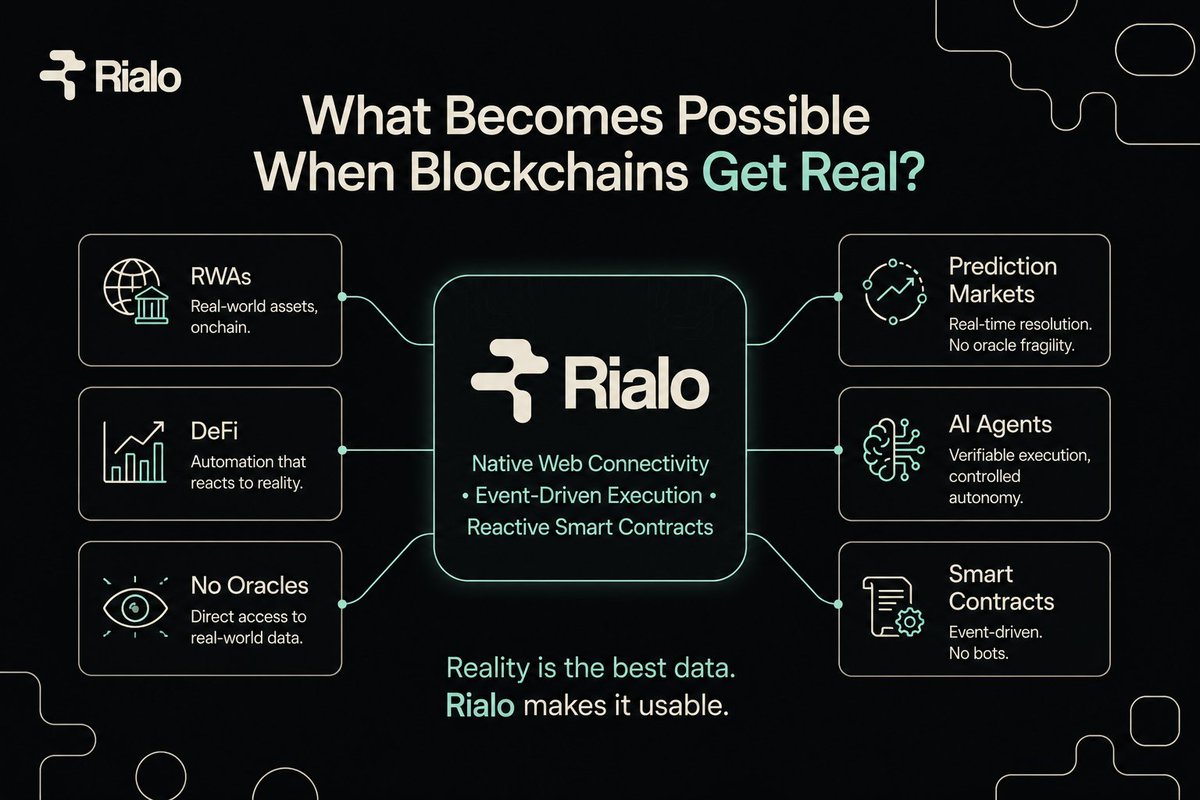
Most blockchain applications aren't limited by computation.
They're limited by access:
•Access to data.
•Access to events.
•Access to the real world.
That's why developers rely on:
• Oracles
• Bots
• Middleware
• External infrastructure
The result?
• More complexity
• More trust assumptions
• More points of failure
What if real world interaction was native to the protocol?
• RWAs
• Prediction Markets
• AI Agents
• Automated DeFi
That's the direction Rialo is exploring.
@Subzero_Labs @RialoHQ
22h

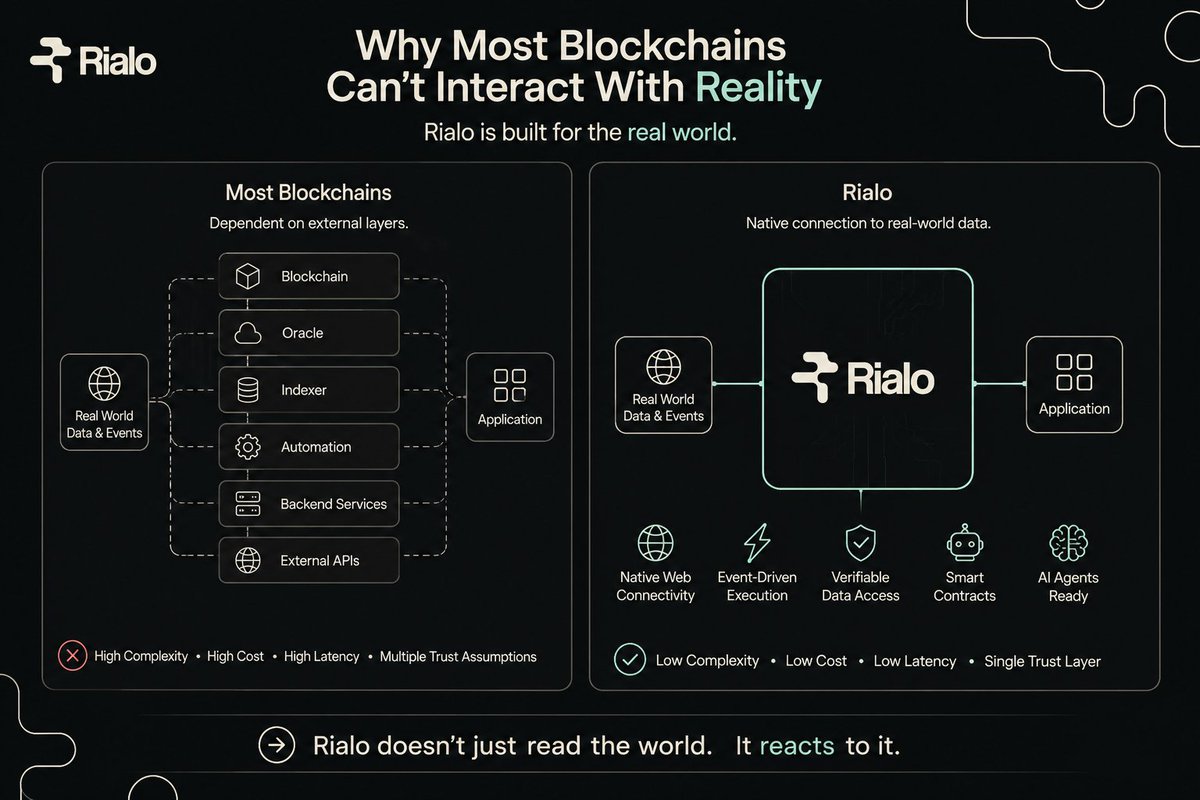
Most blockchains weren't designed for the real world.
They're great at processing onchain transactions.
But the moment an application needs to interact with real world data, the stack gets complicated.
Want to build:
• Prediction Markets
• RWAs
• AI Agents
• Automated DeFi
• Real time Applications
You'll quickly discover a problem, blockchains can't natively access external information.
Today's solution is usually a patchwork of:
→ Oracles
→ Bots
→ Indexers
→ Automation services
→ Custom backend infrastructure
Every new component introduces:
• Cost
• Latency
• Complexity
• Trust assumptions
This raises an interesting question:
Why are critical application functions still being outsourced?
Shouldn't a blockchain be able to interact with the world directly?
That's where Rialo takes a different approach.
Instead of relying on layers of external infrastructure, Rialo introduces:
✓ Native Web Connectivity
✓ Event Driven Smart Contracts
✓ Verifiable External Data Access
✓ Reactive Execution
What does that unlock?
Prediction Markets.
Instead of waiting for oracle updates and external resolution systems...
Markets can react directly to real world outcomes.
RWAs:
Most tokenized assets today are static.
Realworld assets are dynamic.
Rialo enables applications that can respond to real world state changes as they happen.
AI Agents :
Autonomous agents need access to information.
They need permissions.
They need verifiable execution.
Rialo provides the infrastructure layer for that interaction.
The future of blockchain isn't just more throughput.
It's better interaction with reality. , Get real Get Rialo.
@subzero_labs @rialohq @ericargent31113
11
1
20
407

1h
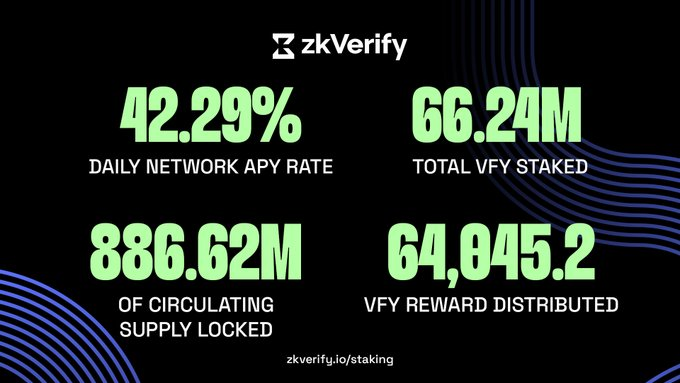
zkVerify is designed to offload the resource-intensive work of verifying zero-knowledge proofs. It supports a wide range of proof systems — SNARKs, STARKs, PlonK, Groth16, etc
It works as a middleware layer between rollups and base chains. Institutions want to use AI in trading and regulators want proof it stayed within parameters.
The problem is that showing compliance usually means revealing strategy. ZK proofs solve that and proves that the rule was followed but reveals nothing else.
@ZKVProtocol makes this possible and $VFY is the token that powers it. Proof verification needs more than speed and low cost. It needs a network secured by the people who believe in the role verification!
1
8