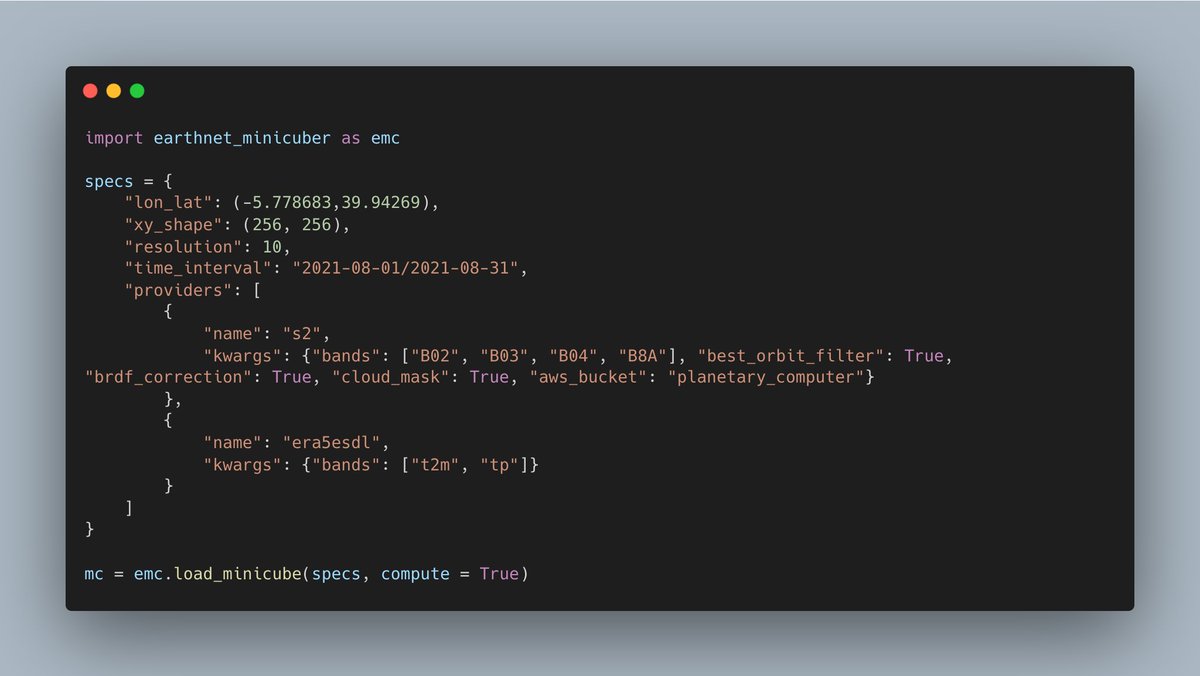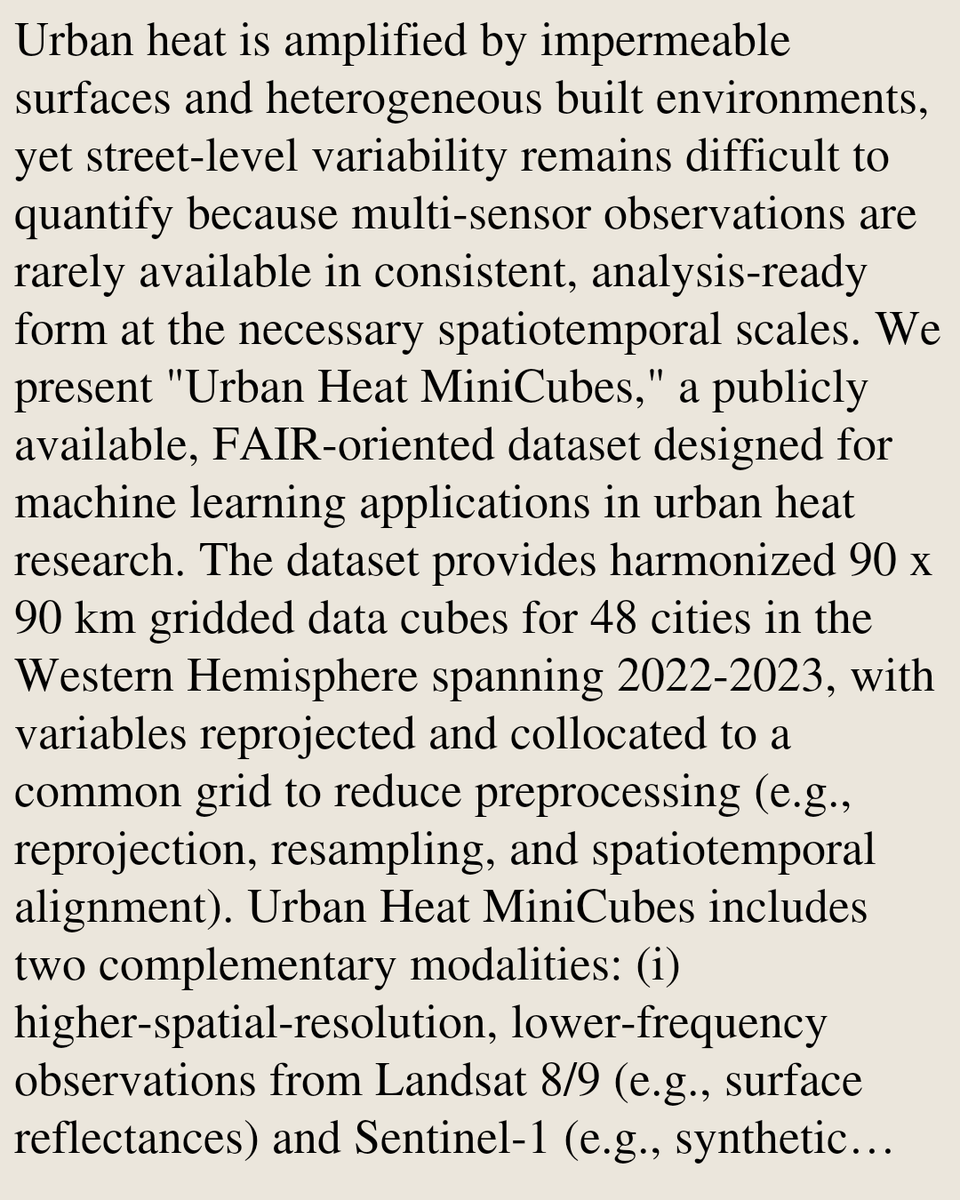
ALT Urban heat is amplified by impermeable surfaces and heterogeneous built environments, yet street-level variability remains difficult to quantify because multi-sensor observations are rarely available in consistent, analysis-ready form at the necessary spatiotemporal scales. We present "Urban Heat MiniCubes," a publicly available, FAIR-oriented dataset designed for machine learning applications in urban heat research. The dataset provides harmonized 90 x 90 km gridded data cubes for 48 cities in the Western Hemisphere spanning 2022-2023, with variables reprojected and collocated to a common grid to reduce preprocessing (e.g., reprojection, resampling, and spatiotemporal alignment). Urban Heat MiniCubes includes two complementary modalities: (i) higher-spatial-resolution, lower-frequency observations from Landsat 8/9 (e.g., surface reflectances) and Sentinel-1 (e.g., synthetic aperture radar backscatter), and (ii) higher-temporal-frequency, coarser observations from GOES-R (e.g., longwav