
May 19
If any of these are weak, the project struggles to attract serious capital. It's the gap between projects that get built and projects that quietly disappear and it's the reason we spend so much time thinking about what "investment-ready" actually means.
See how #mining projects qualify for investment and development 📲
minestarters.com/blog/how-ju…
#MiningCapital #MiningAssets #MiningTokenization #RWA #Web3
3
49
May 6
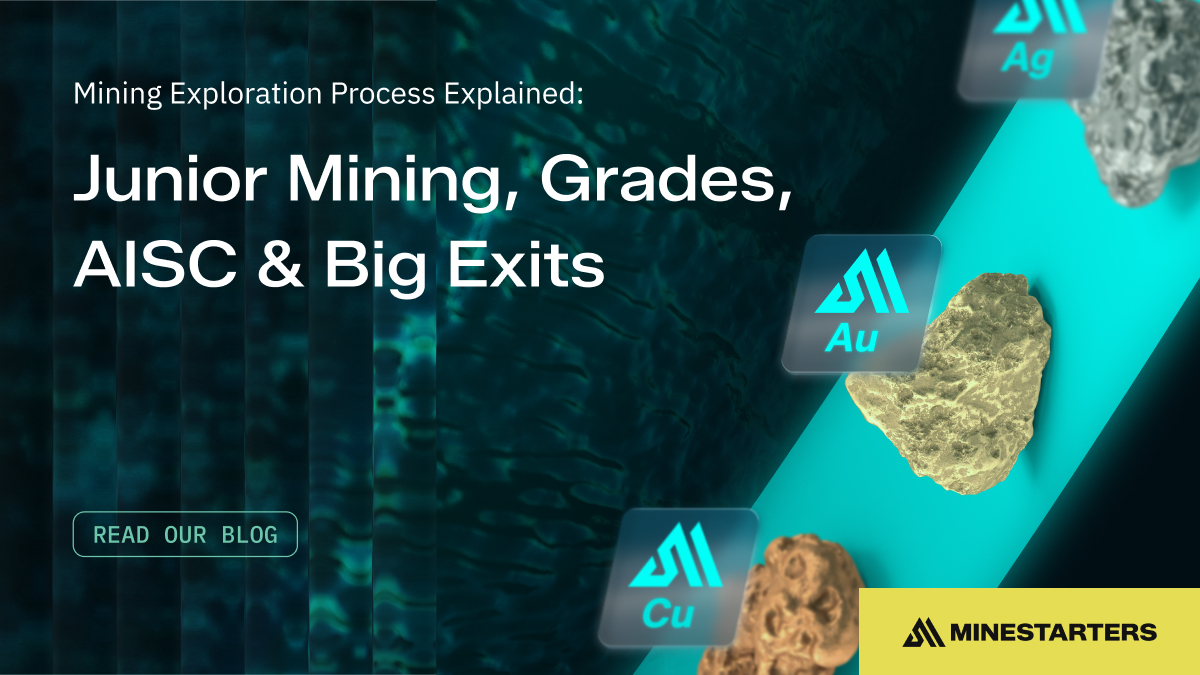
Junior miners don't actually pull metal out of the ground. They discover, de-risk, and exit.
If you are looking at #mining finance or #RWA tokenization, you have to understand the mechanics of exploration. We just published a complete guide on how early-stage projects go from surface sampling to acquisitions by major operators.
Learn how grades, tonnage, and AISC actually dictate a project's survival.
Read the full breakdown here 📲 minestarters.com/blog/mining…
#JuniorMining #MiningExploration #MiningCapital #MiningTokenization
3
5
143
Apr 16
The deficit is the part that actually matters. If supply keeps coming from inventories instead of new production, it’s not a short-term squeeze, it’s a pipeline issue.
From a #mining perspective, that usually comes back to capital. Projects don’t move fast enough to close that gap, even when the signal is clear. That’s where the real constraint sits.
minestarters.com
#MiningTokenization #MiningAssets #MiningCapital #RWA #Web3
2
9
Apr 16
Squeezes get framed as positioning events, but they usually start with supply. #Silver’s been running a structural deficit for a while now, and new supply isn’t something you can switch on quickly. Even when prices move, the mining side takes time to respond. That’s where things tend to get tight.
minestarters.com
#MiningTokenization #MiningAssets #MiningCapital #RWA #Web3
1
2
165
Apr 16
High-grade intercepts definitely get attention, especially in a district like Red Lake. But turning that into a mine is still a different step. Geology is the starting point, capital, execution, and timing are what actually determine outcomes. That’s usually where things get harder.
minestarters.com
#MiningTokenization #MiningAssets #MiningCapital #RWA #Web3
2
22
Apr 14
Fair point on price behaviour. In the short term, gold can trade like any other risk asset depending on flows and positioning.
But the underlying supply side doesn’t change. Bringing new gold to market still takes years of development and months from extraction to recovery.
That disconnect between how gold trades and how it’s actually produced is where a lot gets overlooked.
Worth understanding how capital moves into the #mining layer behind it: minestarters.com
#MiningTokenization #MiningAssets #MiningCapital #RWA #Web3
2
22
Apr 14
Interesting framing. A lot of this comes back to trust and where capital chooses to sit.
But behind all of it is the physical layer. Gold doesn’t exist without the #mining process that brings it out of the ground, and that process is slow, capital intensive, and often underfunded.
That gap between demand for hard assets and the reality of producing them is where things get interesting.
Worth understanding how capital actually flows into mining: minestarters.com
#MiningTokenization #MiningAssets #MiningCapital #RWA #Web3
2
31
Apr 14
Makes sense. Geopolitics and rates set the backdrop, but supply response in mining isn’t immediate.
Even with stronger pricing, it still takes months to move from extraction to recovery and years to bring new projects online.
That lag between price signals and actual supply is where capital becomes the constraint.
Worth understanding how that capital flows into #mining assets: minestarters.com
#MiningTokenization #MiningAssets #MiningCapital #RWA #Web3
2
16
Apr 14
$4,800 gold changes the math across the board.
Projects that didn’t work at $1,800 suddenly look very different. Margins expand, but timelines and capital cycles don’t.
#Mining still takes years to develop and months to generate output. That lag is where most opportunities get stuck.
Worth understanding how capital actually flows into these assets: minestarters.com
#MiningTokenization #MiningAssets #MiningCapital #RWA #Web3
2
12
Apr 13
Most #JuniorMining projects don’t fail on geology. They fail on capital.
Early-stage assets are illiquid, hard to price, and usually funded through dilution. When markets tighten, funding disappears fast even for solid projects.
That’s the gap ☝️
The #Minestarters Incubator helps teams get funding-ready with proper structuring, technical validation, and compliance built in from day one.
Less noise. More signal.
If you are developing a project, or know someone who is, learn more here 🚀minestarters.com/incubation
#MiningCapital #MiningAssets #MiningTokenization
1
2
11
240
Apr 13
That “control over physical resources” line is the real takeaway!
If this plays out over years, the focus won’t stay on #commodities alone. It moves upstream into the assets that actually supply them.
That’s where the constraint sits.
minestarters.com
#MiningTokenization #MiningAssets #MiningCapital #RWA #Web3
5
30
Apr 8
If the cost floor is moving higher, that’s a #mining story as much as a price story.
Energy, input costs, and project timelines all feed into supply. When that shifts, it changes how and where capital gets deployed upstream.
Most people focus on price. The structure behind supply is where things get interesting.
That’s something we’re working on at Minestarters ⚡️
minestarters.com
#MiningTokenization #MiningAssets #MiningCapital #RWA #Web3
2
35
Apr 8
This is the other side of the story people miss.
Gold gets framed as a reserve asset, but in moments like this it becomes liquidity. Something that can be mobilised fast when pressure builds.
That shift feeds straight into the supply side. When reserves move, markets react, and mining ends up carrying part of that adjustment.
Access to that layer is still limited for most.
That’s something we’re working on at Minestarters ⚡️ minestarters.com
#MiningTokenization #MiningAssets #MiningCapital #RWA #Web3
1
24
Apr 8
When reserve strategy shifts like this, it doesn’t stay at the central bank level.
It feeds straight into the supply side. More demand for gold means more pressure on #mining, exploration, and capital deployment upstream.
What’s still missing is access to that part of the value chain.
That’s something we’ve been working on at Minestarters ⚡ minestarters.com
#MiningTokenization #MiningAssets #MiningCapital #RWA #Web3
1
1
31
Apr 8
6 straight months of buying tells you this isn’t short-term positioning. It’s structural.
When central banks accumulate, it puts pressure upstream. Supply has to come from somewhere, and that brings #mining back into focus.
The interesting part is access. Most investors still can’t participate directly in that layer.
That’s something we’re working on at Minestarters 🚀
minestarters.com
#MiningTokenization #MiningAssets #MiningCapital #RWA #Web3
1
19
Apr 6
Interesting part isn’t just the gain.
It’s how gold is treated at that level. Standardisation, custody, location.
All downstream from the same upstream reality. #Mining, refining, supply.
The asset moves. The system behind it stays slower.
Worth understanding how exposure to that layer is structured: minestarters.com
#MiningTokenization #MiningAssets #MiningCapital #RWA
1
29
Apr 6
Gold gets repositioned at the macro level. But supply still comes from the same place. Mines, timelines, capital constraints.
The system can shift. The production layer moves slower. That gap is where things tend to play out.
Worth understanding how exposure to that layer is structured: minestarters.com
#MiningTokenization #MiningAssets #MiningCapital #RWA
2
38
Mar 31
Most #JuniorMining projects don’t fail because of geology.
They fail because they can’t access the right capital at the right stage.
We broke down how projects actually qualify... from due diligence to onboarding.
Worth a read if you’re looking at #mining from the capital side 👇
minestarters.com/blog/how-ju…
#MiningTokenization #MiningAssets #MiningCapital #RWA
1
6
133
Mar 31
Programmability is where things start to get real.
Settlement speed becoming standard makes sense. That was always the easy part.
What’s more interesting is how this applies to asset classes like #mining, where capital isn’t deployed in one step but across stages.
Exploration, development, production... each phase has different risk and capital needs.
Programmability starts to unlock how that gets structured.
We’re exploring this from a mining-first perspective at Minestarters 🪙 minestarters.com
#MiningTokenization #MiningAssets #MiningCapital #RWA
2
24
Mar 20
Everyone’s watching tokenized stocks.
Fewer are paying attention to what comes next.
Real assets. Commodities. Supply chains.
That’s where we’re focused 😉
minestarters.com
#Minestarters #Mining #MiningTokenization

🚨 Tokenized equities just exploded from under $100M to over $4B since the start of 2025.
That’s not growth… that’s a shift.
Stocks are going onchain. 🚀

4
76