
まじかー
AMD製FPGAで作ったNINTENDO64互換機「ModRetro M64」が2026年7月に海外で発売。その実機を見てきた
4gamer.net/s/G999902.2606100…
24


So I decided to see what's going on with this #pokemon Champions game. I grabbed my Veno from #ORAS and loaded him in, then went to battle. This is my 1st battle after all the intro stuff and getting to play against a real player. This Veno has been through thick and thin and has battled many of the forum gyms back in the day, and also been in every game I can have it in since 1st capturing it. This capture card I got for cheap I think works really well lets hope its compatible with the @modretro #M64 when I get it as ill be smashing out vids again then. Sorry for my lack of activity lately, just getting snowed under by life, but water will find its balance. Enjoy the footage and have a great day.
1
202


Love the console packaging !
Not sure about the cartridge and notice package (inside the game box).
5


Thanks to you I have learned a new word in english : sourpuss or maybe you are French.
1
Should I wait for retailers in France ?
Or buy it in july but do not want to pay 20% extra tax :(
3

“You’re excited about a “killer long-sleeve shirt”… made by robots?!”
100%.
1000% if it’s the same company, that’s literally “reindustrializing America and manufacturing fabrics for defense and space.”
Exactly the same way, I’m excited about a color Game Boy/N64 made using metal 3D printing via robotics [100%], in general, and especially if it’s a side project from the same people making drones for US defense [modretro, anduril].
Using that as a tangible example of a couple of more abstract concepts I’ll be diving into.
1st up, anyone doing anything substantive gets lots of ‘confusion’ and internet friction. It’s not a bug, but a feature, demonstrating they’re doing something worthwhile [cf. example above].
Full disclosure, I say that as a repeat exited founder [AI & B2B SaaS data/analytics], EY Entrepreneur of the Year, occasional lecturer for Harvard, Hopkins, MIT etc. on Entrepreneurship and Innovation [resistance & adoption], History of Economic Development and Capitalism, and Workforce Development [usually named talks focusing on interdisciplinary history, business, engineering, material science - background includes PhD/Fulbright/Sorbonne’s Interdisciplinary center for science & humanities], and served as technology & entrepreneurship adviser to the White House & Presidential commissions under multiple administrations - also, someone personally who started out working work 2nd shift on the line, one of multiple jobs while at a community college. An investor too, proudly in @anatar, and other robotics, AI, blockchain, and technology/science across farming, manufacturing, finance, etc. - personally betting on generative tech and new biz models to benefit US and humanity - and doubling down via family foundation to teach kids/young adults how to use AI/Robotics to build IRL businesses in rural Kentucky.
So full disclosure, the answer represents my take, informed by a very specific perspective above, doesn’t represent any of the companies above, and may not be for you, may not be for you now. As a startup founder i don’t want universal adoption, but rather ‘common knowledge’ friction - that shows me i’m doing something large, worthwhile, non-obvious and needed - it’s not just price to play but my moat.
But for those interested in the broader questions of how generative tech, on its own, especially when domestically based in regionally resilient supply chain, benefits US citizens overall, and specifically workforce development against a demographic inversion curve, and, why is doing a consumer t shirt not just a cherry on top but a power move that should be HBS case study in being rock awesome, read on.
Many ways to take conversation - and since we’re asking big questions, we’re going to have to be precise in our thinking and avoid non sequiturs [i think X, i’ve seen Y, i have concerns about Z, etc - some tbad things can happen A, what about B, how are you / have you C, etc.] - could go into onshoring as core to regional resilience, which forms an anti-brittle national supply chain topology required for global autonomy - aka specific unwinding not just of offshoring but 40 years post Bretton Woods and recreation of endemic farming, manufacturing [scalable output as metric, creating jobs as result], and forward facing deployment, globally and beyond.
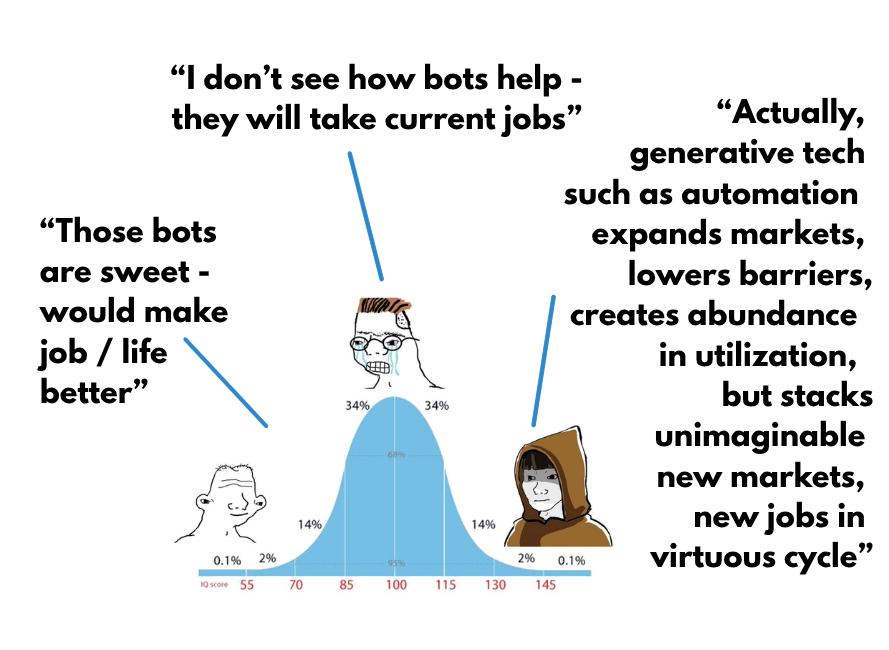
But I think this conversation really revolves around core assumptions - aka generative technology. Even outside of global positioning, multi-planetary aspirations, benefiting US citizens, humanity, the starting point is: Does generative tech create markets - aka does it cannibalize current jobs, merely increase the size of the current market, or de novo create new markets? How you answer that question basically dictates the entire conversation, not just what answer, but how you answer it. Do you look to history as an example, even if it rubs one’s assumptions, much less current/loud/vocal sentiment, the wrong way [on that note, X algorithm has been having one of its midcurve overweighting runs lately].
Generative tech, by definition, creates markets. That’s not better/faster/cheaper, but net new, de novo. That’s not big slice of zero um pie, ot bigger pie, but a whole new pie, a whole new stack in different flavors, not just pumpkin meets lemon meringue or trad apple, put pizza pies and some deconstructed quiche thing.
Really? Give me an example. Print. Print was an awful idea; no one read, but there was a cottage industry that seemed to get outsourced, and the printing press only looked to make things worse. Many people had ‘concerns’ about its automation [looked like a manual automaton], putting manuscript writers out of work. Many had seen the dark downside of a print shop. Many couldn’t see how the printing press would ‘improve’ anything; others didn’t get it. It seemed to take a bad situation, outsource, and make it worse, automated. [notably exogenous power funded such thinking, against the populace’s own interests, in very specific ways, for very specific reasons, but that’s a history lesson for another time].
But…… the generative tech created the market. It didn’t serve it, didn’t commoditize it, but created a new market, and new markets on top of markets, benefitting participants in ways they couldn’t see at the time, much less predict. That’s the nature of generative tech. Print created literacy itself. Full stop. Didn’t meet the rising demand of literacy for print, the artifacts created by generative tech generated demand itself. Full stop.
The market didn’t shrink; it exploded. The automated tech that ‘took away’ jobs from manuscript copyists created many more jobs than could ever be imagined. Literacy went from ~5% to whatever you think it is today [give X comments lately, could still be 5%]. Copyists became printers and mechanical engineers.
The artifact had utility. Books went from an annual salary plus to the price of a dinner. Rather than diminishing demand, it created new demand. This seems very counterintuitive to mid curve. How does automated production benefit the person making the artifact? It actually creates more demand for more artifacts in more ways. Starting with utility. Being able to access an automated tech artifact didn’t satisfy extended demand; it created new demand. You didn’t have a book, you now had one, and then wanted more, a library if you will, and each of those things had benefits [how to plant/farm/start a biz/philosophy/entertainment/etc]. Yes, the automated copyist robot ‘took jobs away from copyists’ but it created not only new jobs for print, but more demand, more jobs, higher wages, new kinds of jobs, in new kinds of economic models.
Now the cascading effects. First automation, especially localized creation of tech, creates more demand, benefiting all - aka literacy, that fact that you’re reading at all now. Then, meta, it actually creates a new market, print, media, aka the thing you're reading on now [McLuhan Guttenberg Galaxy - and much more broadly, software as ‘media’ and andy hardware stack requiring ‘software’, but again, another story]. Then, the super meta, the markets of markets, not just the market for the artifact [because now scale abundance creates new markets but utility unlocks others previously inaccessible due to production constraints -x- imagination]. Books at scale allow me to do other business besides selling books - aka teaches me how to do ledger/credit, compute/automate other things besides copying letters, creates other markets -x- philosophy/theology to do those things [no need to be beholden to a foreign lord holding supply chain power, actually fictional story/path of how to break out DIY it.] Said differently, generative tech changes not only the business, but actually how business is done - not just a new market or market of markets but market mechanics - aka new capital formation.
‘But how does that benefit the worker?’ Uh, yes, fewer hand copiers, but more printing jobs, and jobs printing unlocks, aka new types of construction, ‘rediscovered ad fontes / that ’whole renaissance thing’, and also distributed banking, aka credit/investment to found new companies themselves. This is what we call a virtuous cycle.
I still don’t get it. How does that benefit the worker/me? Um, you could unlock assets via automated production to create not only new markets but new value capture de novo? Huh/what? Capitalism, literally, The Birth of Capitalism - The Birth of the Middle Class. If you’re not a noble lord and aren’t living as an indentured peasant, thank the automated robotic machines for the printing press. If you can read, for work/value creation, or to explore/pleasure, get down on your knees and kiss the automated tech robots call the ‘printing press’.
But Dr. Rosenthal, that’s old-timey stuff, it’s not applicable today. Core idea: utility via automated benefits via new creation. Encyclopedias were a good biz, not super useful; maybe you checked out once a week/day. Internet/Google search was awful, it put so many’ encyclopedia writers, printers, warehousemen, salesmen' out of business. What about the jobs it’s taking? I don’t get how this helps! But you search quite a bit, likely more than once a day, it created new jobs, not just the same thing but bigger/better/cheaper [software/hardware/media etc] but new things unlocked by that - that medieval manuscript copier or 1950s encyclopedia editor you could never have imagined.
But robots, what about the bots, sure that not ‘tech’ it doesn’t work in the same way as print, code, etc. Um, machine bots via the presses. Hardware for the software for the media. Secretaries replaced via Word/Google Docs, accountants via XL/Google Docs, art ‘departments via PPT/Canva. But that’s all abstract, i don’t like abstract [insert what’s this have to do / 2001 space monkeys/ monolith]. Think about it this way, if you don’t buy into on shore defense resilience, beyond global exploration, or if you don’t by into history, aka that generative tech creates - transformas the current into something new, traumatic for the current imagination that can’t imagine the recreation [FWIW this is why we call it a renaissance], then straightline tink in terms of demographic and what is replacing what and what that unlocks.
Example. We have an investment in an agriculture robotics company - Tiny Land Drones. But doesn’t that take away US farming jobs? Um, no. Those jobs were already replaced by chemicals. The US ag system went from manual labor [usually child] for weeding, to chemical, spraying chemicals to prevent weeds. This was not an accident; the demographics collapsed [fewer kids, youth left the farms], but chemicals replaced. The robots don’t replace those jobs, but they are a chemical replacement for those jobs. How does that help? Well, the chemicals run into land and soil, and the seed companies bioengineer seeds to resist, but that’s again, another history lesson. The point is that farming is not viable for anything less than mega aggregation without bots. The bots unlock the regional resilience, say to grow crops for textiles, or other niceties such as food. Which ‘keeps’ jobs, but also creates new jobs, the bots are made here, hardware and software, and service layer of deployment, and with right to repair, and, and, and. But that’s investor talk. No, this farmer-founded, invested, client-based, and led.
All my 2 cents, but, to review:
‘I’ve seen, i think, the downside of X/Y/Z’ - may not be for you / non sequitor - not any one artifact, shirt, company, but more broadly flows from market creation, history, entrepreneurship, innovation [resistance/adoption], dynamic workforce re/creation, etc.
How does US/Regional/Based production help US citizens, and humanity beyond the globe in space efforts - hopefully pretty clear, bordering on definitional.
How does generative tech help US workers? Should be definitional, generative tech, generates new markets, not only expands current, but utility creates demand, and cascading markets, not just businesses, but net-new markets otherwise unimaginable. Think printing press ‘bot’, internet hardware ‘bot’, etc. Super salient in demographic inversion [cf farm bots], but the real bet is in utility through automation, benefiting at scale. Full cards on the table, I personally think this goes exponential, new utility via automation compounded via new capital formation mechanisms and new generative tech for on-demand abundance - aka not hardware textile vs LLM, or IRL vs AI but bother and, and wrapped in new capital formation [increasingly participatory, think ledger/credit, aka mortgage on house for ownership, fractional equity stock/NASDAW/401k, pre IPO stocks/prediciton markets], but those are lessons for other times nd not necessary for this -- but do introduce what might be at play, and, if the historical example rhymes, that means generative tech led to rise fo middle class, your home ownership etc, in addition to your reading machines/robots and your ability to read itself.
So if all that’s in play, and you’re rocking it in regional resilience for defense, space, both crucial and epic, literally using gen tech not to cannibalize to participate in tried and true historical lessons that created capitalism and the rise of the middle class, aka that utility creates abundance, and doing that in broader context of other parts of the complete rework stack with agentic creation and next gen capitalism, and then you offer white label production for other players, then, while recreating the world, you put it on the back of a shirt. Yeah, 100% excited.
We’re at a show for the ages, epic, historical - front row seats, good sound, artists interacting with the crowd - 1000% gonna get the shirt.
4
757
Exactly the same way, I’m excited about a color Game Boy / N64 made using metal 3D printing via robotics [100%], in general, and especially if it’s a side project from the same people making drones for US defense in the US [modretro, anduril].
1
2
3
149

Sure it is buddy. Just like this coming 'Recession' I've been hearing about every day for seven years.
13

まち retweeted

Jun 6
ModRetroからニンテンドー64互換機「ModRetro M64」が7月28日に登場!当時のカセットが直接動く229ドルの究極ハード
daily-gadget.net/game_gaming…
#デイリーガジェット #ModRetro



1
250
805
130,463

Jun 13
ModRetroからニンテンドー64互換機「ModRetro M64」が7月28日に登場!当時のカセットが直接動く229ドルの究極ハード
daily-gadget.net/game_gaming…
229ドル=約36,712円ということです。
53

Jun 13
AMD製FPGAで作ったNINTENDO64互換機「ModRetro M64」が2026年7月に海外で発売。その実機を見てきた
4gamer.net/s/G999902.2606100…
33

Jun 13
Come on @modretro time to bury Analogue. Once you're done with the M64 let's go for an FPGA GBA.
1
99

