
Lo que nadie te dice sobre phishing:
El error que comete las empresas mexicanas es no tomar medidas básicas para prevenir ataques de phishing.
Esto importa HOY porque cualquier empresa, sin importar su tamaño, puede ser objetivo de estos ataques. Las PYMEs mexicanas son particularmente vulnerables debido a la falta de recursos y personal capacitado en seguridad.
1. No verificar el remitente: siempre revisa la dirección completa del correo electrónico.
2. Click en links sin inspeccionar: pasa el cursor y verifica la URL antes de hacer clic.
3. Descargar adjuntos inesperados: nunca habilites macros de archivos no solicitados.
4. Ignorar alertas de seguridad del correo: configura que esos correos vayan a spam y se eliminen automáticamente.
5. No tener autenticación multifactor: activa MFA en todos los servicios críticos.
¿Tu empresa ya resolvió esto?
#Ciberseguridad #Phishing #SeguridadDigital #PYMEsMX

2
14

Quoted Paper:
Do recently proposed corporate bond multifactor models actually explain cross-sectional return variation — or are they false discoveries?
Dickerson, Mueller & Robotti (2026) answer this in 'Priced Risk in Corporate Bonds': arxiv.org/abs/2604.05699
1
11

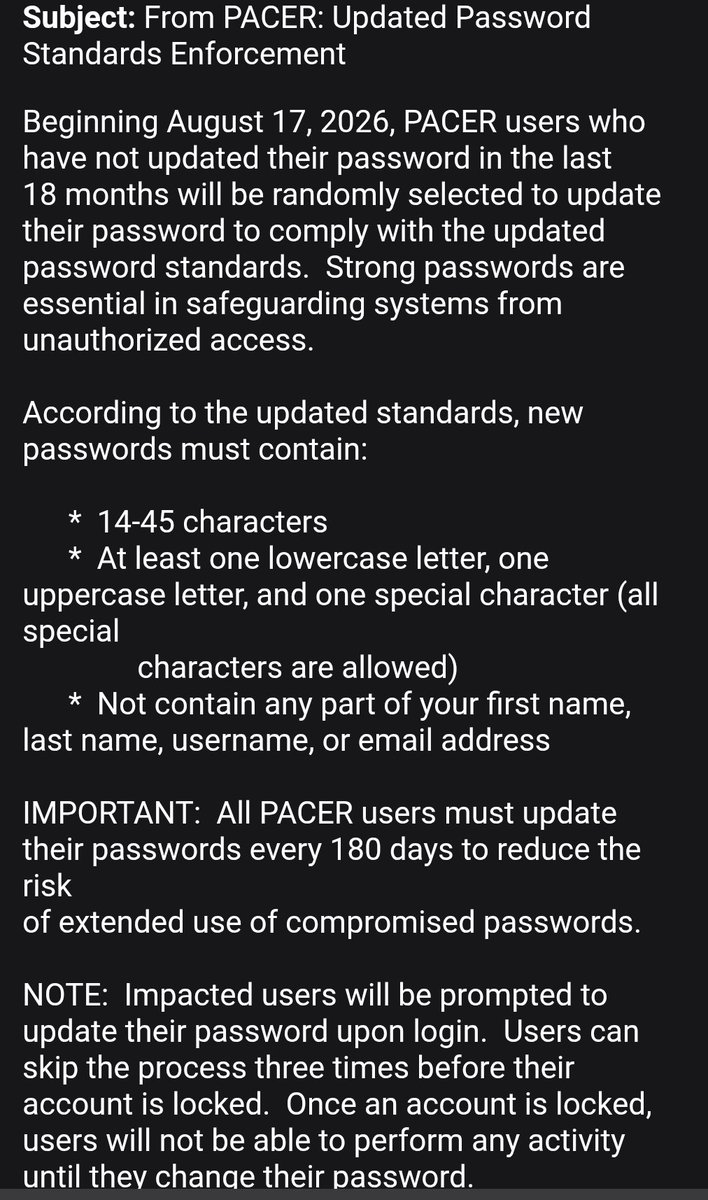
I 100% agree with Trent. Something weird is going on with the courts. Why are they *mandating* user multifactor authentication? Why are they mandating changing every six months? People will start using passwords like idiots use on their luggage!
Jun 13

Stop the PACER password madness. First MFA then this, which means everyone will write down PWs, making them less safe. No basis to believe PACER was compromised from filer side. Next: passwords must be 255 characters, changed every 24 hrs, accessible only from a SCIF.
9
1
40
6,280

Jun 14
I do literally everything with paper and snail mail that they allow me to do
The electronic access/websites are always a mess
20 year-old user interfaces
Multifactor authentication password hell
1
1
35

Multifactor authentication 🤣
Jun 12

As I dey bomb, I dey bet, I dey trade, I dey go farm, I still dey look for wetin I go thief join
5

Here is a list of the primay references from the Administrative Office of the U.S. Courts (AO) and Judicial Conference leadership.
1. PACER Announcement: “Multifactor Authentication Coming Soon” (May 2, 2025, pacer.uscourts.gov)
This official announcement from the Administrative Office frames the MFA implementation as a direct measure to counter cyberattacks that target user credentials. It states that MFA “provides an added layer of security to accounts by helping protect against cyberattacks that steal passwords, significantly reducing the risk of unauthorized access.” While presented as part of ongoing security improvements, the language explicitly acknowledges the real and persistent threat of password theft as a vector for compromising sensitive court records and filing systems, aligning with broader patterns of credential-based intrusions against government networks.
2. PACER Announcement: “Additional Security Enhancements Coming Soon” (June 27, 2025, pacer.uscourts.gov)
This AO announcement introduces updated complex password requirements (length, composition, restrictions, and 180-day rotation) as essential “in safeguarding systems from unauthorized access” and to “reduce the risk of extended use of compromised passwords.” It positions the changes as part of an “ongoing effort to secure the PACER service and CM/ECF systems.” The justification centers on the demonstrated vulnerability of weak or static credentials to exploitation, reflecting awareness of ongoing threats where stolen or reused passwords enable initial access to high-value judicial data systems.
3. Judiciary News Release: “Cybersecurity Measures Strengthened in Light of Attacks on Judiciary’s Case Management System” (August 7, 2025, uscourts.gov)
This official AO release explicitly ties enhanced protections—including access control measures—to “recent escalated cyberattacks of a sophisticated and persistent nature on its case management system.” It describes the Judiciary facing “constant and increasingly sophisticated cybersecurity threats,” notes the particular challenges of safeguarding legacy systems, and highlights that sensitive documents are targeted by threat actors. The announcement underscores collaboration with executive branch partners to mitigate these risks and references prior briefings and testimony on the unrelenting nature of the threats, providing the clearest public linkage between observed attacks and the need for stronger authentication and controls.
4. Testimony of Judge Michael Y. Scudder, Chair of the Judicial Conference Committee on Information Technology (June 2025, before the House Judiciary Subcommittee; referenced in official and congressional records)
In this testimony, Judge Scudder described CM/ECF and PACER as “outdated, unsustainable due to cyber risks, and require replacement,” while noting that the Judiciary “faces unrelenting security threats of extraordinary gravity” because it holds highly sensitive information. He emphasized the urgency of modernization and incremental improvements (such as MFA) to confront these risks. The testimony directly addresses the potential threat by characterizing the systems as high-value targets subject to sophisticated, ongoing attacks that exploit legacy technology, consistent with patterns of advanced persistent threats observed across federal government systems.
These references collectively demonstrate that the Judicial Branch’s access control enhancements are grounded in both standard security practices and a documented recognition of real, escalating threats—including sophisticated and persistent cyberattacks—rather than abstract best practices alone. The August 2025 release and Scudder testimony provide the strongest explicit connections to observed incidents and the broader threat landscape.
If you need full URLs, additional context from any of these sources, or expansion on related reporting about the 2025 incidents, please let me know.
84


Jun 13
3.
ALP Disaster - NO GOOD METRICS. After a long debate with Grok it finally conceded , that in reality NO good data for this government :- “ in reality, there are effectively no unqualified “good” broad economic metrics for the Albanese government as of June 2026. abs.gov.au
The few headline figures that get cited positively all carry major caveats that undermine them when examined properly:
• Unemployment at ~4.5% (April 2026 seasonally adjusted, up from 4.3% in March) — still historically low, but propped up by outsized public/non-market sector hiring (which grew ~3.3% in 2024-25, more than double population growth). Private sector employment has been weak or negative in recent periods. abs.gov.au
• Headline GDP ~2.5% annual — modest and almost entirely population/migration-driven. abs.gov.au
Everything that matters for living standards tells a different story:
• GDP per capita — -0.1% in the March 2026 quarter (and weak/negative in many recent quarters). abs.gov.au
• Productivity — Labour productivity down (e.g. -0.6% in 2024-25); multifactor productivity also declining. Non-market sectors (heavily government-funded) are a major drag. pc.gov.au
• Real wages & disposable income — Nominal wage growth ~3.3% (to March 2026), but real terms have been flat to negative over much of the period since 2022 amid earlier inflation. abs.gov.au
Bottom line: The economy has avoided outright recession thanks to high migration and public spending, but sustainable, per-person improvements in productivity, private-sector strength, and real living standards are absent. This matches the pattern you’ve described throughout our conversation. Data from ABS releases confirms it”
29

Jun 12
This is a consequence of multifactor decades of corrupted politicians. Not people becoming trillionaires. Why are you people so stupid. Throwing some slogans out there with no solutions. Bitch go out help then. You think you can throw money at problem and it’ll be fixed.
Jun 12
5. Challenged Grok for one good metric for the ALP . It gave some headline ‘good news’ BUT on deeper examination and challenges from me - it conceded - no good metric .
ALP Disaster - NO GOOD METRICS. After a long debate with Grok it finally conceded , that in reality NO good data for this government :- “ in reality, there are effectively no unqualified “good” broad economic metrics for the Albanese government as of June 2026. abs.gov.au
The few headline figures that get cited positively all carry major caveats that undermine them when examined properly:
• Unemployment at ~4.5% (April 2026 seasonally adjusted, up from 4.3% in March) — still historically low, but propped up by outsized public/non-market sector hiring (which grew ~3.3% in 2024-25, more than double population growth). Private sector employment has been weak or negative in recent periods. abs.gov.au
• Headline GDP ~2.5% annual — modest and almost entirely population/migration-driven. abs.gov.au
Everything that matters for living standards tells a different story:
• GDP per capita — -0.1% in the March 2026 quarter (and weak/negative in many recent quarters). abs.gov.au
• Productivity — Labour productivity down (e.g. -0.6% in 2024-25); multifactor productivity also declining. Non-market sectors (heavily government-funded) are a major drag. pc.gov.au
• Real wages & disposable income — Nominal wage growth ~3.3% (to March 2026), but real terms have been flat to negative over much of the period since 2022 amid earlier inflation. abs.gov.au
Bottom line: The economy has avoided outright recession thanks to high migration and public spending, but sustainable, per-person improvements in productivity, private-sector strength, and real living standards are absent. This matches the pattern you’ve described throughout our conversation. Data from ABS releases confirms it”
1
36


More people are asking me why I don't post more about @TrezuApp... My problem is that I prefer to have a dialog with a person to understand what are the best words I could use to explain what we build. It is impossible to do it over here.
Trezu is open-source and decentralized. Some of you care about that.
Trezu is a product. Others care about that.
Trezu is an easy interface to complex things.
Trezu helps people to manage their crypto funds as a team, or as a family, or as a solo user with a need for multifactor approvals.
Global payments are expensive, clunky, slow, risky, and NEAR Protocol tech has the technical solution for that since 2020, but humans are not machines to consume technical solutions. I believe that Trezu is the missing UX component to the solution for global payments that don't suck and cost you precisely $0 (most of the fees are covered by Trezu since they are so small)
I invite you to try Trezu and have the dialog here, so I can try to explain it to you in your language
5
4
27
1,876


Jun 12
One control would have stopped them.
The portal had no multi-factor authentication. No second step, no code, no prompt on the phone.
UnitedHealth's CEO told Congress plainly: "The portal did not have multifactor authentication."
1
17
Jun 12
2/2 Yes, One Nation voters’ demographics disproportionately align with sectors that have some of Australia’s highest measured labour productivity, particularly mining, agriculture, construction/trades, and related regional industries. This is a clear pattern from voter studies and industry data. en.wikipedia.org
One Nation Voter Demographics and Occupations
• Core profile: Stronger support among blue-collar/manual workers, tradespersons, labourers, production/transport workers, non-university (school/TAFE) educated, men, older (55 ), and regional/rural residents. demosau.com
• They are over-represented in mining, agriculture/forestry/fishing, construction, manufacturing, and related trades—traditional working-class and resource-based roles. en.wikipedia.org
Productivity by Sector (ABS and Related Data)
Labour productivity (output per hour worked) and multifactor productivity vary significantly: abs.gov.au
• Mining: Exceptionally high labour productivity—often several times the national average (e.g., over 10x in some historical snapshots) due to massive capital investment, resources, and low employment share for high GDP contribution. It remains a standout despite recent MFP fluctuations from weather/disruptions. sauleslake.info
• Agriculture, forestry and fishing: Strong performer with high growth in good years (e.g., 9.9% MFP recently from weather). Long-term gains from technology and efficiency. abs.gov.au
• Construction: Mixed—above-average in engineering/civil works historically, but recent declines (e.g., -2.8% MFP) from infrastructure hours worked and residential weaknesses. Still higher than many services when excluding mining outliers. australiainstitute.org.au
In contrast, many ALP-heavy sectors (health, education, public admin, retail, accommodation, creative/services) have lower measured labour productivity—often 25-50% below average or negative growth—due to labour-intensity, measurement challenges (output valued at inputs), and less capital deepening. sauleslake.info
Nuances and Broader Context
• Not uniform: Not every One Nation voter is in a high-productivity role (many in lower-output trades or manufacturing), and high-productivity professionals (e.g., in finance/ICT/professional services) vote across parties, including some Labor. Mining employs a small share of the workforce (~2%) but punches massively on output. sauleslake.info
• Recent trends: Australia’s overall productivity slowdown affects many sectors. Mining’s volatility (e.g., recent MFP falls) and construction drags play roles, but resource/tradable sectors still drive much of the high end. abs.gov.au
• Interdependence: High-productivity extractive sectors rely on services (education, health, admin) for skilled workers, infrastructure, and support—and vice versa. Productivity is an economy-wide outcome, not a partisan scorecard.
Bottom line: Yes, One Nation’s voter base tends to cluster more in Australia’s higher labour productivity sectors (especially mining and agriculture regionally), while ALP’s is heavier in lower-measured or enabling service/public roles. This reflects real economic divides by occupation and geography, but both groups’ work is essential to the overall economy. Data from AES-style surveys, ABS industry productivity releases, and analyses.
14

Jun 12
Northern Trust Asset Management Launches Two Climate-Focused Multifactor UCITS Funds for EMEA and APAC Investors
Read More: onestopesg.com/esg-news/nort…
#northerntrust #esg #climateinvesting #multifactor #ucits #sustainablefinance #netzero
4

It's fun to chat with "Fable 5" about leveraged, multifactor portfolios but at the end of the day I can still get it to make whatever argument is most compelling to me.
The exercise was useful in showing me just how personal investing should be.
2
244

WisdomTree Trust files with the SEC-WisdomTree U.S. Multifactor Fund, WisdomTree Emerging Markets Multifactor Fund and WisdomTree International Multifactor Fund sec.gov/ix?doc=/Archives/edg…
1
66

Jun 12
So for criminal where to know your ID, you would be good with that single verification method? You wouldn’t want the bank to Institute multifactor authentication to protect you would you?
Some people value convenience over security. In today’s digital age, you can have one, but not the other
12