
Feeling so lonely I might eventually start playing co-op with random ppl. Which is crazy cus I hate playing on multilayer

Dreamcast didn't pioneer anything.
It wasn't the first console to have a built in modem.
It wasn't the first console to offer online multilayer.
2

Multilayer cellulose hybrid films with tunable UV selectivity and mech... sciencedirect.com/science/ar…
1

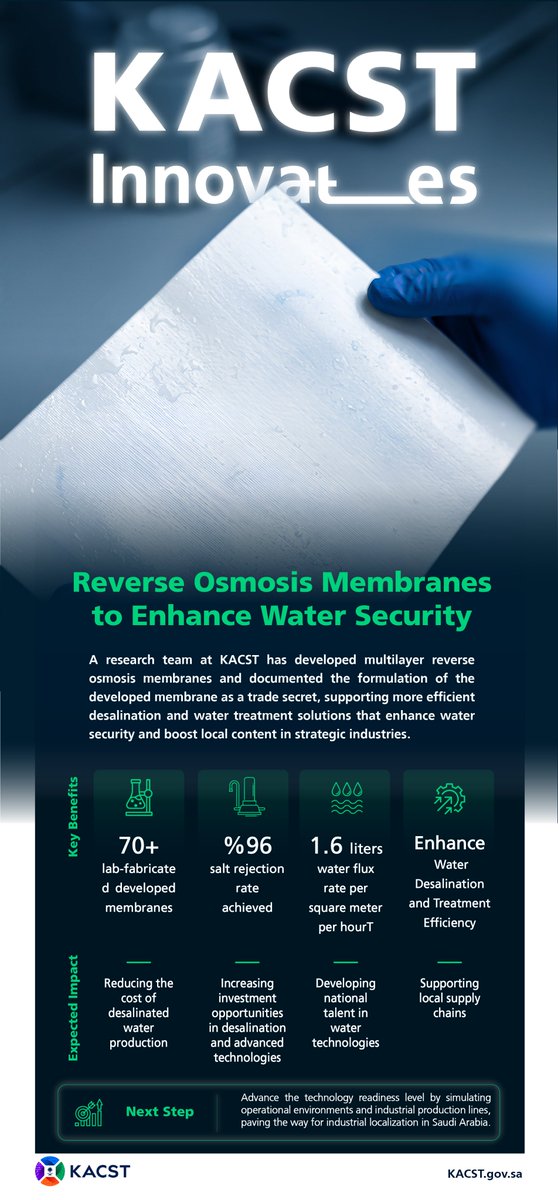
A research team at #KACST has successfully developed locally produced multilayer reverse osmosis membranes, achieving a high salt rejection rate of 96%. This milestone supports the localization of desalination and water treatment technologies, strengthens water security, and boosts local content in advanced industries.
#KACSTInnovates
1,092

Solid-state battery cell hits 465 Wh/kg, passes extreme safety tests | Aman Tripathi, Interesting Engineering
The company is prioritizing the aerospace, maritime, transport, and defense sectors for its initial battery cell rollouts.
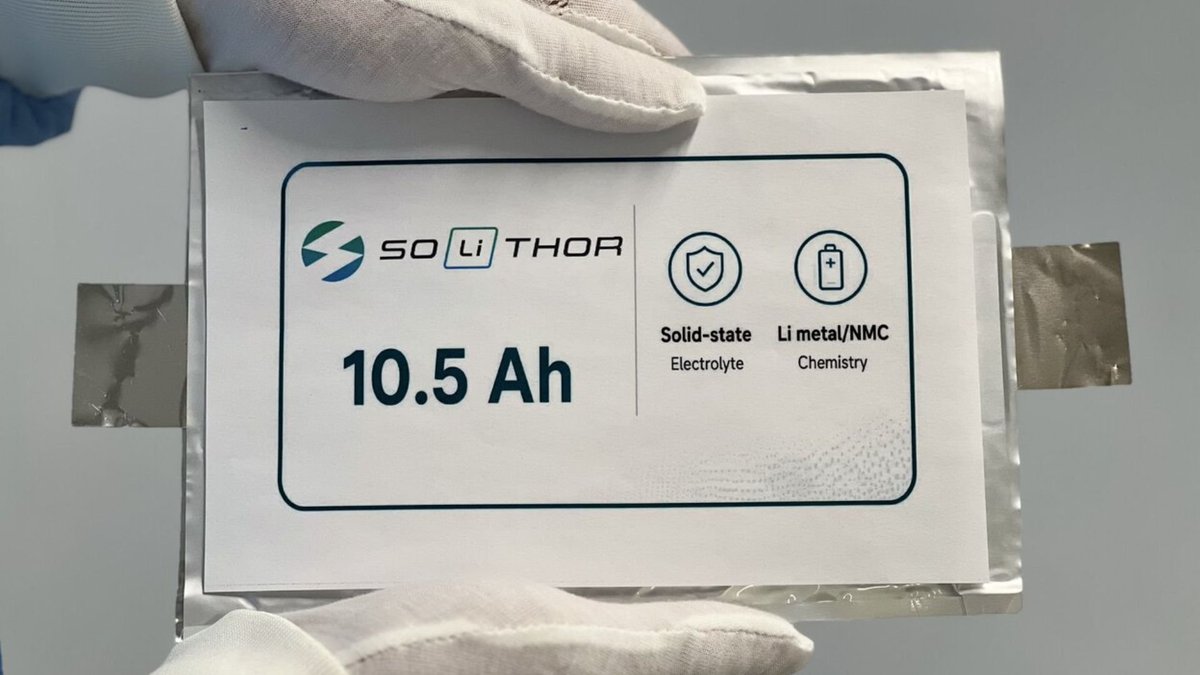
European battery startup SOLiTHOR has produced its first 10 Ah demonstration cell, marking an increase in the physical scale of its solid-state lithium battery technology. The company intends for this larger format to show that its laboratory chemistry can transition into commercial production for industries requiring specialized power sources.
Alongside the production of the larger cell, the company reported stack-level energy densities of 465 Wh/kg and 1400 Wh/L within a pouch design. Engineers reached these figures by introducing a high-loading cathode with an areal capacity of 8mAh/cm2 into the company’s proprietary Solid Composite Electrolyte.
Unlike traditional lithium-ion systems or certain semi-solid designs, this chemistry uses a sol-gel process that functions without requiring any liquid electrolyte injections during assembly.
Laboratory evaluations indicate specific performance characteristics under varied operational environments. When testing multilayer pouch cells at a temperature of 25°C, the cells sustained continuous discharge rates reaching 5C without experiencing major drops in capacity.
Performance limits and safety metrics
The same units tolerated short 30-second power pulses up to 10C when held at a 50% state of charge. This specific energy discharge behavior is relevant for machinery that requires brief, intense energy outputs, such as unmanned aerial vehicles during departure and descent sequences.
“SOLiTHOR has developed a chemistry that allows the industry to rethink the manufacturing of solid-state battery cells,” said Dr. Fanny Bardé, Co-Founder and Chief Technology Officer at SOLiTHOR.
Long-term stability tests were conducted on smaller 1 Ah multilayer pouch cells. These units completed more than 500 full discharge cycles while maintaining over 80% of their original storage capacity, which provides an initial benchmark for the operational lifespan of the chemistry.
During standardized safety protocols, the fully charged multilayer cells were subjected to intentional overcharging and direct nail penetration.
Production economics and industry targets
“In safety assessments, SOLiTHOR’s technology successfully passed the overcharge and nail penetration tests on a 100% charge multilayer pouch cell with no smoke, leakage, thermal runaway, or fire,” highlighted the company in a press release.
“These technical achievements not only prove that the chemistry works, but that it delivers the combination of energy density, power performance, and cycle life required for practical applications,” added Bardé.
The manufacturing framework for the new chemistry relies on roll-to-roll processing systems already common in the battery sector. By removing the liquid filling stage entirely and accelerating the subsequent chemical formation and aging protocols, the production timeline for these steps is shortened by two-thirds.
Because these specific phases normally represent one-quarter of total cell manufacturing expenditures, their reduction alters the overall processing economics.
Facility adaptation for market deployment
“Existing Li-ion facilities can be upgraded for solid-state production with no new equipment, limited switching costs, and reduced operational costs,” noted the press release.
The company is targeting initial applications for its battery cells within the aerospace, maritime, transport, and defense sectors.
“With this major technical update, we are demonstrating that our technology can be realistically produced, satisfying the demands of high-performance and high-value applications within aerospace, dual-use, and mobility,” concluded Rodrigo P. Navarro, CEO at SOLiTHOR.
interestingengineering.com/e…
9
1,170

Am making a Snugstone multilayer acrylic block so it imitates how it looks like in the anime :^) it’ll also be packed ina brown sachet hehe
1
85

Many outdoor malls have had multilayer surveillance systems for years. Multiple layers of built-in digital security videos, microphones built into objects, even some can detect other sensory data. Unveiled in security magazines and literature years ago, I posted about it years ago after I went to one such mall in Virginia and found the system there. I would say many theme parks use the same systems. You wouldn’t know without seeing the documentation first.
1
2
62


@CMMadhyaPradesh आज मैं मैहर स्थित शारदा देवी मंदिर में दर्शन करने आया हूं। मैं आप को यहां 500 गाड़ियों हेतु multilayer पार्किंग का सुझाव देना चाहता हूं जिससे सुदूर से चल कर आने वाले दर्शनार्थियों को सुविधा हो सके।
@DrMohanYadav51
@Collector_Satna @BJP4MP @narendramodi
1
2

Samsung Electro-Mechanics Expands Beyond MLCCs into Silicon Capacitor Business
Samsung Electro-Mechanics is in discussions with multiple global Big Tech companies to supply silicon capacitors (Si-Cap) for AI servers. The company is rapidly emerging as a major supplier alongside Japan's Murata and Taiwan's TSMC.
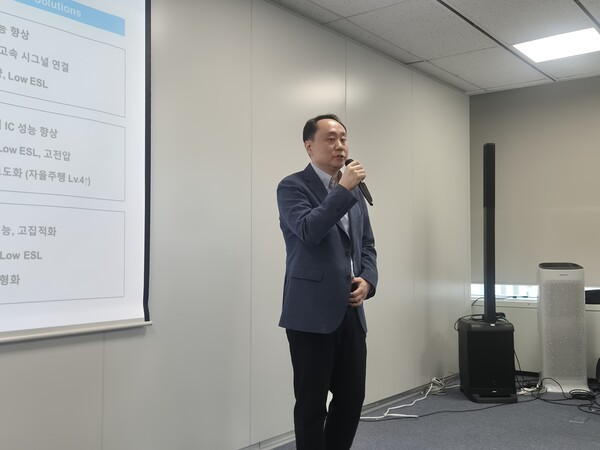
On the 11th, Samsung Electro-Mechanics held a technology seminar at the Taepyeongno Building in Jung-gu, Seoul, where it shared its silicon capacitor technology and commercialization roadmap. Kim Won-gi, head of Samsung Electro-Mechanics' Si-Cap Development Group, said, "Global Big Tech companies whose names you would immediately recognize are reviewing the adoption of silicon capacitors," adding, "Because the market is formed around a small number of players, Samsung Electro-Mechanics is also aggressively pursuing sales activities."
The silicon capacitor market is led by Japan's Murata and Taiwan's TSMC. Barriers to entry are high because the business requires both semiconductor wafer process and passive component capabilities, and the number of suppliers is limited. Samsung Electro-Mechanics President Chang Duck-hyun is cultivating silicon capacitors as a core growth business in the company's push into the AI market.
The company made its full-scale entry into the market last year as it began supplying customers. It supplied products for the AI accelerators of Marvell—a leader in custom networking chips (ASICs)—and for the package of Samsung Electronics' mobile application processor (AP), the Exynos 2600, among others. More recently, it secured a supply contract worth 1.5 trillion won from a global Big Tech company—the largest single contract in Samsung Electro-Mechanics' history. The related revenue is scheduled to be reflected in earnings starting in 2027.
Samsung Electro-Mechanics presented a "total solution" strategy—bundling its silicon capacitor, multilayer ceramic capacitor (MLCC), and package substrate businesses—as a differentiating factor. Silicon capacitors are mounted inside or adjacent to the package substrate. By supplying both products together, Samsung Electro-Mechanics can design and optimize the package and components simultaneously. Samsung Electro-Mechanics is the only company that operates both passive component and package substrate businesses.
Rather than building large-scale production facilities, the company has chosen a design-centric strategy. It employs a fabless model, outsourcing wafer production to foundries and componentization to specialized semiconductor back-end (OSAT) firms, while Samsung Electro-Mechanics handles product design, testing, and quality verification. The company has a silicon capacitor design and development organization at its Central Research Institute in Suwon.
Samsung Electro-Mechanics' silicon capacitors are manufactured on a 300-millimeter (mm) wafer basis.
A silicon capacitor is a passive component made from a silicon wafer. It temporarily stores electricity and supplies it when needed, keeping the voltage inside the semiconductor package stable. Whereas conventional MLCCs secure capacitance by stacking multiple layers of ceramic, silicon capacitors bore microscopic holes into a wafer and place electrodes inside them. This allows the thickness to be reduced to 100 micrometers (㎛) or less.
Samsung Electro-Mechanics drew its business idea from DRAM technology. DRAM uses a capacitor inside each cell to store data. Samsung Electro-Mechanics developed the silicon capacitor by taking just the capacitor portion of this structure and advancing it into a separate component. The fine-process technology it accumulated while shrinking DRAM circuit linewidths was transferred directly into silicon capacitor development. The more microscopic holes formed in the wafer, the greater the capacitance a silicon capacitor can achieve.
There are differences in silicon capacitor technology between competitors. Samsung Electro-Mechanics utilizes a DRAM-based structure, while TSMC is known to use a logic-process-based trench structure. Samsung Electro-Mechanics mass-produces its products on a 300mm wafer basis, the type primarily used for memory semiconductors.
Samsung Electro-Mechanics projected that the silicon capacitor market will grow at an average annual rate of more than 18%. Its scope of application is expanding from a mobile focus into AI servers, automotive electronics, aerospace, and optical communications. AI servers in particular are emerging as the largest source of demand, as power density increases and package integration intensify simultaneously.
Kim said, "The higher semiconductor performance becomes, the more important power stabilization becomes," adding, "Silicon capacitors will see their range of application continuously expand in the AI server and next-generation high-performance semiconductor markets."
7
33
259
47,665

SOME not all, skins should transfer from MW2-3 to MW4, actual mil-sim skins that suit the characters, should transfer.
Ghost is a great example, he has mil-sim and dogshit wacky stuff.
Transfer the mil-sim skins, remove the ass anime shit.
Put their skins in multilayer to.
2
292
Sweet Florida retweeted

Buoys buoys everywhere! More border security going in Eagle Pass, Texas. All part of the multilayer approach that the Trump administration is using to give us the most secure border in American history. Still more work to be done, but thank God we don’t have traitors running our country anymore!
With Del Rio Sector Border Patrol Chief, Scott Good @USBPChiefDRT
Law & Border @RealAmVoice
@BorderPatrolHQ @DHSgov
10
535
2,734
22,389
Ryan retweeted

Jun 13
We know our business pretty well, It makes little sense to believe that such a hardened, multilayer underground facility was built only for storing regular ammunition. Installations with this level of depth, fortification, and layered security are usually meant for strategic assets, command-and-control nodes, or critical wartime stockpiles. Assuming otherwise ignores basic military doctrine, or suggests the PAF invested major resources into protecting something of low strategic value. Anyone familiar with defence planning understands the purpose of such infrastructure.
Jun 13

Lolzzz, soo even an ammo dump = Nuclear C2
Peak comedy 😂
3
1
48
2,256

Ok I have one question are you moving your map focus to multilayer horror stuff instead of multilayer story horror? Because I absolutely adore your story horror maps but these last two new maps sealed and run aren't that high quality they feel very rushed that's my opinion
1
18

Jun 13
the multilayer joke that is The Black Silence

ALT okay for context. We've got Yi Sang who is using Rien (2nd) as a skin. That's what an ID is in limbus. Then we've got Rien. He is being directed by Prescripts to imitate Roland (3rd). Roland is The Black Silence. He was not originally The Black Silence, his wife (4th) was. The guy on the far right isn't even what she looks like. No one who knew her title knew what she looked like so even she has lost her original self.


3
73


Jun 13
Hahahahaha people who oftenly cheat will call the project guy as lurus bendul and naive.
It is because they did not understand your multilayer deceitful way of work. DBKL and all these projects should be in SPRM watchlist.
Bukan DBKL jer 🫣
5
142
9,608